Showing posts with label Tin Woodman. Show all posts

30 October 2025

At Last an Our Gang/Wizard of Oz Crossover

In 1962, as described yesterday, Starlight Musical Theatre of San Diego held tryouts for a production of The Wizard of Oz, using music from the MGM movie.

To play the Tin Woodman the company chose a local television personality: Johnny Downs!

Downs brought decades of experience as performer, starting with acting in Our Gang comedies in the mid-1920s. In fact, he had sung and danced alongside MGM’s Tin Man, Jack Haley, in such movies as Coronado and Pigskin Parade, which also featured fourteen-year-old Judy Garland.

Downs appears in this photograph scanned from the 3 June San Diego Union with Cammy Wesson as Dorothy, Ray Wilde as the Cowardly Lion, and John Bryce as the Scarecrow.

The director was Charlie Cannon, a co-founder of Starlight Musical Theatre (San Diego Civic Light Opera Company) years before. In 1978 the San Diego Evening Tribune reported:
Cannon is most proud of his “Wizard of Oz” production in 1962 featuring Johnny Downs, a TV personality, as the tin man. “We put close to 5,000 in the bowl for that one,” he said. “We even had people sitting in the aisles, and Downs would stay after the show for an hour signing autographs.”
That number may be an exaggeration since on 10 Aug 1964 the San Diego Union reported that 3,800 people was “a record crowd” at the Starlight Bowl. However, that record was set by the 1964 production of The Wizard of Oz—the show was so popular that the company brought it back after only two years.

In the revival Johnny Downs once again played the Tin Woodman, and was often listed first in newspaper notices. Cammy Wesson, now a college student, returned as Dorothy. Ole Kittleon played the Scarecrow and Forest Gantz the Cowardly Lion.

A new director reblocked the action for that run. In an interview with a high-school classmate for the 12 Aug 1964 Coronado Eagle and Journal, Wesson described having trouble at first knowing which way to turn. She added: “Johnny Downs, who plays the Tin Woodsman [sic], has adapted very well, but he’s a professional.”

Cammy Wesson went on to careers as an elementary school teacher, realtor, and financial advisor. As a sexagenarian back in Coronado, she took up marathon running.

29 October 2025

The Wizard of Balboa Park

The San Diego Civic Light Opera Association was founded in 1945. Its first show was Gilbert and Sullivan’s The Mikado in the Wegeforth Bowl at the San Diego Zoo.

Because of San Diego’s ideal weather, the organization staged its shows outside. It soon took on the name of the Starlight Opera.

On July 29, 1946, the San Diego Union and Daily Bee said: “If the new Starlight Opera company becomes any more popular it will have to move to Ford Bowl.” That was the amphitheater in Balboa Park built for a 1935 expo.

Indeed, the Starlight Opera Company was soon using that larger space. Around 1950 the amphitheater became known as the Starlight Bowl. (An amphitheater in Burbank was using the same name at that time, confusing matters.)

The Light Opera Association also widened its repertoire to include new, popular shows and operated under the same of Starlight Musical Theatre.

Because the amphitheater was right under the main flight path to Lindbergh Field, performers learned to freeze when a loud plane passed overhead. Starlight Musical Theatre’s old website called this “One of the most artistic innovations of productions at the Starlight Bowl.”

In 1962 the Starlight company planned a summer season of The Music Man, Can-Can, The Wizard of Oz, and Bye Bye Birdie.

About the third show the 7 Apr 1962 San Diego Evening Tribune explained:
“The Wizard of Oz,” was adapted originally for the stage by L. Frank Baum from his classic children’s story. It was first presented in 1903, starring the team of Fred Stone and David Montgomery. Their leading lady was Anna Laughlin, the mother of singer Lucy Monroe.

The version of “Wizard” which Starlight is using has been updated by Frank Gabrielson, and features the songs of Harold Arlen and E. Y. Harburg, composed for the highly successful 1939 movie.
That adaptation had originally been commissioned by the St. Louis Municipal Opera in 1942 and is therefore known as “the MUNY Version.” As the licensor says, it “features characters and events not seen in the MGM film”—and it also leaves out several characters and events.

The 1962 San Diego Evening Tribune article was headlined “Little Munchkins Needed for Starlight ‘Wizard of Oz’,” and its main news was:
Casting for Starlight’s production of “The Wizard of Oz” will be held for three days, instead of the usual two, due to the large number of children needed in the cast. . . .

The youngsters will be used for the Wizard of Oz’s “army,” composed of one private and 24 generals. They will also be used as munchkins—the little people enslaved by the Wicked Witch of the East and freed by Dorothy. . . .

Roles open for adults include that of the Scarecrow—which also requires dancing ability; the Tin Woodman and the Cowardly Lion. The leading role of Dorothy, calls for a teenage soprano with acting experience, age 18 at the maximum.
In 2010, after more than sixty straight years of productions, the San Diego Civic Light Opera Association went out of business. There’s now a Save Starlight campaign to fix up the abandoned amphitheater and stage new concerts and shows there.

TOMORROW: Crossing the streams.

25 February 2020

Art for “The Axman’s Arm”

At Skookworks, David Lee Ingersoll has just shared his illustrations from the 2006 issue of Oziana magazine, which I edited and produced for the International Wizard of Oz Club.

David created the art for a story I wrote called “The Axman’s Arm,” a horror tale exploring what happened to the Tin Woodman’s left arm after it was chopped off in The Wonderful Wizard of Oz. That arm wasn’t around for the assembly of the character of Chopfyt, introduced in The Tin Woodman of Oz—so where did it go?

I rarely tell horror stories, but the Oz books’ premise that people and animals can survive being sliced up leads inevitably to that mode.

For that issue of Oziana, David also illustrated Adrian Korpel’s poem “Rivals” with pictures of the Scarecrow, Tin Woodman, and Cowardly Lion looking bitter and angry—and yet completely recognizable. I’d seen some of the pictures David drew for the Oz Squad project, so I knew he could do a great job with that challenge. I don’t view those poems as “canonical,” but they offered an interesting alternative view of favorite characters.

18 September 2018

More on Woodman and Woodsman

My examination of the shifting prevalence of “woodman” and “woodsman” and what that implies for how people speak of L. Frank Baum’s character the Tin Woodman brought this comment:

You don't seem to address the difference in the two professions, Woodman vs. Woodsman, though I'm not sure how well you could specify that in the search. But the word usage rates are clearly dependent on such, IMHO.

A woodman chopped and/or delivered firewood (like the Iceman or Milkman or Postman. A "Woodsman" is a forest ranger, naturalist, etc., that specializes in knowing about "the woods" and the failure to realize this difference in professions is what galls some of us - not the slight change to the spelling. Nick Chopper is a lumberjack not a forest ranger.
When did such a distinction arise, and how established is it?

Dr. Samuel Johnson’s 1755 dictionary didn’t include the word “woodsman” at all. And his definition for “woodman,” with citations from his beloved Shakespeare, said nothing about chopping or delivering wood.
Instead, for Johnson a “woodman” was someone who hunted for sport in the woods.

Let’s jump ahead to Noah Webster’s dictionary in 1828. Once again, there was no entry for “woodsman.” And according to Webster, a “woodman” was:
1. A forest officer, appointed to take care of the kings wood.
2. A sportsman; a hunter.
It would be good to check an American dictionary from the 1860s when Baum was a boy, because that would be the best reflection of usage when he was learning the language. But I couldn’t find one on the web.

So let’s jump again to the 1903 edition of Chambers’s Twentieth Century Dictionary of the English Language, published close to the time of The Wonderful Wizard of Oz, albeit in Britain. It included a subentry for the word “woodsman”—but defined that word simply as a synonym for “woodman.” As for “woodman,” for the first time we see the word defined as Baum used it—but alongside the older definitions: “a man who cuts down trees : a forest officer : a huntsman.”

Finally, the 1913 edition of Webster’s had separate but overlapping entries for the two words. A “woodsman” was “A woodman; especially, one who lives in the forest.” A “woodman” had a more detailed definition, including all of the earlier meanings plus a new one:
1. A forest officer appointed to take care of the king's woods; a forester. [Eng.]
2. A sportsman; a hunter.
3. One who cuts down trees; a woodcutter.
4. One who dwells in the woods or forest; a bushman.
Today’s Merriam-Webster website shows how the popularity of the two terms has flipped: the entry for “woodman” points to “woodsman.” As for the definition of the latter term, the site says: “a person who frequents or works in the woods / especially one skilled in woodcraft.”

The Oxford Dictionaries site likewise has overlapping definitions. Woodman: “A person working in woodland, especially a forester or woodcutter.” Woodsman: “A person living or working in woodland, especially a forester, hunter, or woodcutter.”

The Collins Dictionary site offers the added complication of different entries for American and British usage, but the definitions still overlap. Woodman:
1. a person who looks after and fells trees used for timber
2. another word for woodsman
3. obsolete: a hunter who is knowledgeable about woods and the animals living in them
Woodsman:
1. a person who lives or works in the woods, as a hunter, woodcutter, etc.
2. a person at home in the woods or skilled in woodcraft
Thus, there never appears to have been a widespread understanding that the two words have distinct and different meanings, with “woodman” meaning a woodchopper and “woodsman” meaning a forester. What’s more, the way Baum used the word—to mean someone who made his living chopping down trees—came late to the standard dictionaries of English.

28 August 2018

The Shift from Woodman to Woodsman

One of the attractions at OzCon earlier this month was a showing of James Ortiz’s The Woodsman, produced in New York in 2015. It was a striking piece of theater stylishly adapted from L. Frank Baum’s story of the Tin Woodman.

Another attraction was a preview of R. F. Wohl’s performance as Baum. He was workshopping a new one-person show with an audience of knowledgable Oz fans. Afterwards I heard an attendee note that Baum consistently referred to his tin creation as a “Woodman,” not a “Woodsman”—though many people (not just James Ortiz’s play) now use the longer word.

That prompted some musing that perhaps one form had become more popular than the other, so I turned to the Google Books Ngram Viewer. I asked it to graph out the popularity of “woodman,” “woodsman,” and “woodchopper” from 1800 to 2000. I restricted the query to lowercase only, eliminating “Woodman” as a proper name (and almost all mentions of the Tin Woodman as well).

Here’s the result:

As you can see, “woodman” was the more popular word when Baum grew up and when he published The Wonderful Wizard of Oz in 1900. “Woodsman” rose suddenly in popularity starting in 1880 and around 1910 surpassed the shorter form. Both forms have been declining in print use since 1940 as we’ve moved away from a wood-based economy.

In addition to affecting how people speak of the Tin Woodman, that shift in everyday language has also affected how we quote the George Pope Morris poem that begins, “Woodman, spare that tree!”

18 July 2017

The Tin Woodman of Forkland

Starting in 1993, Jim Bird has been building statuary out of old farm equipment and hay bales on his fields in Forkland, Alabama.

Among those figures is this “32-foot sculpture of the tin man from Oz, assembled from old bathtubs, 55-gallon drums and a discarded fuel tank—and topped with an old fertilizer spreader.”

As of 2015, this was the most expensive of Bird’s statues since he spent $40 on paint; otherwise, he has a rule not to spend more than $5. The heart has text which reads, “Jim loves Lib.” That’s a message for Bird’s wife Lib; he started building his figures when she was on a trip and he missed her.

(Photo courtesy of the Library of Congress.)

08 December 2015

Fierstein Adding “a Little More Sense” to Oz

Last week NBC broadcast a restaging of The Wiz that’s also slated for Broadway next year. It has a new book by Harvey Fierstein, who boasted about his improvements in an interview with BroadwayWorld:
I've loved Wizard of Oz my whole life but have had questions. I was always a questioning kind of kid. I got to answer all the questions that I had. Where did Dorothy's parents go? There's this girl living with her aunt and uncle... well I killed off the uncle; he doesn't do anything anyway. Do we care about him just sitting on the porch rocking away? You have a girl living with her aunt, and it's never mentioned what happened to her parents. Dorothy's such a victim. She didn't create that storm; she gets taken away. She doesn't kill the witch; the house falls on her. She doesn't kill the other witch; she throws water to save her friend. She's just a victim. I said, "Why should she be just a victim? It's her dream! It's her fantasy!"

So I gave her a story, and we open with her running away from home trying to get home to Omaha where she was actually born. Her parents are dead. She hates her school; she hates Kansas. "I hate this place; I hate being out in the cornfield. I want to go home." Her answer is this is your home but your too old for me to tell you what to do. I could keep you here and force you, but at some point in your life you have to figure out where you really belong. She's sent off on this very different journey of going home to Omaha. She ends up in this place that's not Omaha and becomes much more of an active participant in it. In the end, when the Wiz turns out to be from Omaha when they get in the balloon. Instead of missing the balloon, I have her walk away from the balloon an say you're going to your home, I'm headed somewhere else. She finally figures out home is not where your feet are; it's where your heart is.
Clearly Fierstein’s playing off the 1939 MGM adaptation rather than L. Frank Baum’s novel. In the original, Dorothy doesn’t throw water on the Wicked Witch of the West to save the Scarecrow; she does so because she’s ticked off (a situation Fierstein rediscovered). Uncle Henry does more than sit on a rocker.

Fierstein’s characterization of Dorothy makes sense only if she’s a teenager, like nineteen-year-old Shanice Williams. Judy Garland was a teen, of course, but she played a younger girl. The Dorothy of the books is younger still.

In Baum’s books, the Wicked Witch of the East enchants the Tin Woodman because she (or another old woman) doesn’t want to lose the services of his beloved. Fierstein instead put those three characters into a love triangle:
I gave each of those characters a backstory that makes a little more sense. The Tin Man got turned into the Tin Man by the Wicked Witch because she had a thing for him. She caught him with this girl, and she blasted his ass and stole his heart. She said, "If I can't have your heart, no one can."
That “makes a little more sense” for an older audience, perhaps. But children haven’t had trouble understanding Baum’s original motivation for the witch.

Evidently the choice to cast Queen Latifah as the Wiz prompted Fierstein’s thinking about that character:
Queen Latifah's backstory [as the Wiz] is that she was a magician's assistant at a carnival so they gave balloon rides and all of that but you ever meet the person that is not bad enough they're unhappy, they have to make everyone unhappy and that was this guy. She jumps in the balloon to piss him off and this balloon landed me in Oz. Everyone came running so I put on the magic hat and did the magic act. They put me in here and I've been hiding ever since so nobody finds out that I'm not anything. I was the assistant. She is a woman escaping the world of men, which I thought would give a different color to Dorothy as well. It all has to come out of a little girl's imagination. If you don't believe it came out of her imagination it doesn't work.
Because then Oz would just be real, and who wants that?

21 January 2015

Woodsman, Spare This Retelling

Today’s New York Times offers Laura Collins-Hughes’s review of The Woodsman, an hourlong play inspired by The Tin Woodman of Oz:
A movement piece with puppets, James Ortiz’s “The Woodsman” is an elemental reimagining of L. Frank Baum’s world of Oz. The spectacle is handmade, infused with breath and light.

This is the Tin Man’s back story: how a regular human named Nick Chopper (Mr. Ortiz) came to be a rusting pile of metal in need of a heart. The story, laid out in a spare spoken prologue in this largely wordless piece, involves the witch who rules this part of Oz. Her only apparent vulnerability is an aversion to sunlight.

When Nick falls in love with her barefoot slave Nimmee (an appealing Eliza Simpson), the witch schemes to prevent their union. She enchants an ax to cut off chunks of Nick, one by one. With prosthetics to replace them, soon he is wholly made of tin. Without a heart, he can no longer love. . . .

Mr. Ortiz’s puppets are fanciful and gorgeous: the witch, with her pinched face and dowager’s gown; the crows, whose wings in motion are all taffeta susurration; a fabulous golden-eyed monster, a cross between a tiger and a bear. (Oh, my.)
That would be a Kalidah, shown above.

Alas, Collins-Hughes concludes, “With so many pieces well in place, it seems churlish to complain, but one significant flaw holds ‘The Woodsman’ back: The storytelling isn’t clear enough. The visual language can be muddled, and important bits are sometimes rushed.” She obviously hopes a future staging will improve.

05 March 2014

“Shining in a ray of sunshine that fell between the trees”

The Bits & Pieces catalogue is offering this “Tin Woodsman” garden statue. It’s 30" high and “made of soldered iron.” (Ironic in multiple ways.)

The catalogue says, “Some minor assembly required.” Since Bits & Pieces’ main business is jigsaw puzzles, one might wonder what “minor assembly” means in that office. But I’ve ordered from that catalogue and was largely satisfied.

04 March 2014

Disability Studies and the Wizard of Oz

The Sentinel of Shippensburg, Pennsylvania, reports that Joshua R. Eyler, director of the Center for Teaching Excellence at Rice University, will deliver a presentation on “If I Only Had a Brain: Disability and Difference in the Oz Narratives,” on Thursday, 6 March, at Shippensburg University.

The paper explains:
Eyler’s talk will examine Baum’s fiction about the land of Oz and the literary and cinematic legacies of this Oz mythology, using the lens of disability studies. Although disability is not the first thing that comes to mind when reading the Oz narratives, disability unquestionably and powerfully appears as a thematic current running throughout the tradition. The talk will explore how each text within the tradition picks up the theme anew to construct its own particular meaning.
Eyler has been working on this topic since at least 2007, when he and colleague Gretchen Nevins presented a talk at Columbus State University titled “Figuring Disability in L. Frank Baum’s The Wonderful Wizard of Oz.” Last fall the Children’s Literature Association Quarterly published Eyler’s article “Disability and Prosthesis in L. Frank Baum’s The Wonderful Wizard of Oz.” He’s stated that reading about characters searching for a brain, a heart, and courage can “help the story’s young readers learn difficult lessons about empathy” and that “the book works very well as a way to introduce many ideas about disability and society to young readers.“

Eyler’s talk will begin at 7:00 in the Old Main Chapel at Shippensburg University. It’s free and open to the public.

03 December 2013

Parade Balloons Over 75 Years

Macy’s 1939 parade included a Tin Man balloon to promote MGM’s new movie, The Wizard of Oz.

For the movie’s seventy-fifth anniversary (which is actually next year), the movie’s current owner, Time Warner, paid for another balloon. According to Yahoo TV, “Macy's repurposed an older balloon. . . . The designers took a balloon shaped like a — see if you can follow — hot-air balloon and decorated it with images of the beloved L. Frank Baum characters.” The portraits were hand-painted.

29 January 2013

A Darker Dorothy in London

Opening next month at the Immersion Theatre in London, Dorothy in Oz, a “skewed adaptation” of L. Frank Baum’s The Wonderful Wizard of Oz. The troupe promises “a piece unlike anything that has ever been seen on the London fringe circuit.”

What does that mean? When playwright James Michael Shoberg directed his own company’s premiere of the drama in 2009, the Pittsburgh City Paper said:
Shoberg, Pittsburgh’s self-styled striver after “darker tastes in art,” usually combines a fixation with sex, drugs, rock ’n’ roll and dazzling costumes with cumbersome scene changes and sloppy projections. Forcing the often-rambling style of Shoberg and/or his players onto a smaller stage, much closer to the audience, focuses the production. . . .

His Dorothy in Oz includes winking references from various versions of the story—The Wiz as well as generous dollops of the iconic 1939 movie—as he twists the familiar characters and their journey. The new setting is a psychiatric hospital for the unfortunate Dorothy, here named Dottie. . . .

The most fun comes from Carrie L. Shoberg’s glitzy and ditzy portrayal of Glinda, and from the stunning ensemble—costume, props and performance—of Brittany Spinelli as the doctor’s secretary. The three companions are a mixed bag: Chucky Hendershot almost boneless as he wrestles with gravity and a heroin addiction as a Goth “Skarekrow”; Sean Michael Gallaher appropriately loud as the anger-challenged multi-pierced punk “Rusty Tinneman”; and Joseph A. Roots totally smooth as the repulsive “Harry Lyons.” In the title role, Adrienne Fischer is credible and credibly brave, but the character just doesn’t have the fun the others do.
Dorothy in Oz is scheduled to run in London 26 Feb-17 Mar 2013.

26 June 2012

Open Heart Surgery on the Yellow Brick Road?

This portrayal of the companions from The Wonderful Wizard of Oz is by Sabrina Alberghetti, an artist in Vancouver, via deviantArt. She also shared her sketches for this piece and some other sketches of a hip-hop Scarecrow.

I’m not at all sure what’s going on in this scene, but the characters have a lot of character.

22 May 2012

Darkside Is Coming, Now Nothing Is Real

The Morton Report recently featured Bill Baker’s online conversation with artist Tommy Castillo about a book called The Art of The Darkside of Oz. The second capitalized T in that title is the tip-off that this book is a teaser for Castillo’s comics series called The Darkside of Oz.

Most of the drawings shown with the interview have appeared on Castillo’s earlier collections and website, so I’m not completely sure how they represent the ultimate product. Baker writes of Castillo’s plans:
…if the images and ideas he’s slowly begun to reveal are any indication, we’re about to see Dorothy, the Scarecrow, the cowardly Lion and the Tin Man in a whole new twilight.
And Castillo says, among other things:
How do you tell an epic tale of woe and love, desire and greed, wars and betrayals? How do you tell of revenge and have all of it wrapped up in the idea of redemption? And how can you do this all with the highest amount of respect for the creator of Oz, Frank Baum?
To be frank, I’m not impressed with the respect for Baum displayed so far. It’s details like:
  • Misspelling Glinda’s name as “Glenda.”
  • Using the MGM movie (still protected by copyright and trademark) as the basis of plot comments instead of Baum’s books (in the public domain).
  • Promising not to render Dorothy as “some scantily clad teen with giant boobs,” but dressing her in a very short skirt.
Furthermore, the notion that “everything we knew about our beloved Oz was a lie” isn’t that new, especially in comics form. After The Oz Squad, Dark Oz, Woe Is Oz, and so on, it’s no surprise to see Dorothy and her companions panelized in grim and gritty ways. It looks like Castillo will show us another Tin Woodman as a robot with a giant axe, another Scarecrow with a sinister slant to his eyes, another Lion as an anthropomorphic warrior, and so on.

Of course, Castillo could still create a compelling, eye-opening story out of those elements. Gregory Maguire certainly did with Wicked. But it would require knowing Baum’s work deeply, and intervening reinventions as well. Deciding to take a myth in the exact opposite direction may seem revolutionary, but it doesn’t really take as much imagination as digging deeper, or going off at an angle.

22 November 2011

The Tin Woodman’s Head on My Mind

In The Wonderful Wizard of Oz, W. W. Denslow gave the Tin Woodman a skull-shaped head.

Of course, the long nose and ears riveted on that dome, as well as the lively eyes, make it possible to overlook the resemblance most of the time. But the rounded cranium and hinged jaw are quite reminiscent of fleshless human anatomy.

John R. Neill followed Denslow’s model in his illustrations for Ozma of Oz and Dorothy and the Wizard in Oz. As in the series’s first book, the tin man’s head bulges out at the back.

However, in The Marvelous Land of Oz, published before those two titles, and in all the Oz books that followed them, Neill used a different character design, with a cylindrical head. The neck varied at first, but eventually settled on the vague sort of attachment Denslow has used.

In most of those books, when the Tin Woodman takes off his funnel cap, we see that the top of his head is a rounded dome. Neill used the same design for Captain Fyter, the tin emperor’s doppelgänger in The Tin Woodman of Oz (1918).

Toward the end of his career, starting with Ozoplaning with the Wizard of Oz (1939), Neill made yet another variation: he drew the tin man’s head as flat on top, like a tin can. I suspect Neill was out of practice drawing his Tin Woodman; Ruth Plumly Thompson made little use of Baum’s more mature male characters.

I review this history to acknowledge that even within the Oz books there’s a significant variation in the Tin Woodman’s character design. On top of that, we have the costumes created for David Montgomery and Jack Haley, which have to allow a man to fit inside. Thus, people can imagine many things when they think of Nick Chopper.

Lots of comics artists like to depict the Tin Woodman as a robot. That’s doesn’t really fit his origin, in which he’s a living man whose body is gradually replaced with tin parts, and it leaves less room in the saga for Tik-Tok, an actual robot. But some artists just love drawing robots.

One example of that trend is David Hutchison in his Oz: The Manga series, as shown at right. His Tin Woodman’s head is a smokestack, and the robotic characterization extends to gear-shaped speech balloons.

Skottie Young avoided that temptation in helping to adapt the series for Marvel Comics. Indeed, his character design plays up the characters’ old-fashioned, rural beginning. (The man harvested wood, after all.) The tin mustache is reminiscent of L. Frank Baum himself.
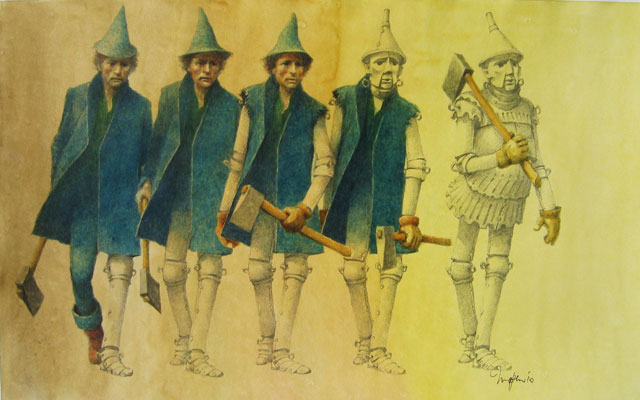
And I have a hard time warming to the result. I think the problem for me is that as colored in a pale, tinny way, the mustache looks white. The character’s smooth round head and old-fashioned style reinforce that impression. As a result, this Tin Woodman always looks to me like an old man.

Based on Neill and Denslow’s art, and Baum’s writing, I think of Nick Chopper as a man in his twenties, preserved agelessly by being made into tin (and by living in Oz). Though the Tin Woodman has excellent and kind instincts, and matures somewhat over the series, he’s not old enough to have become wise. He makes mistakes and still regards his appearance with more than a little vanity.

I have trouble imagining the Tin Woodman as a Richard Farnsworth type, much as I admire that actor and some of the characters he’s played. Of course, it’s better than a robot.

13 September 2011

A View of Oz from Oz

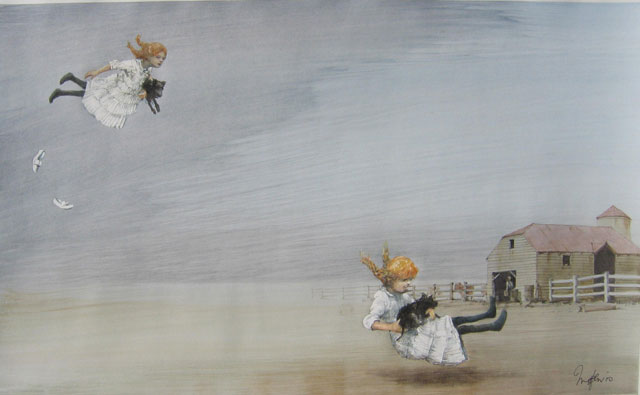
The honored Australian illustrator Robert R. Ingpen created this watercolor for an edition of L. Frank Baum’s Wonderful Wizard of Oz commissioned by Palazzo Editions and published this spring by Templar Editions in the UK and Sterling in the US.

Melaleuca Galleries of Australia offers a page of Ingpen’s artwork for this book, including:
The image above comes via Melaleuca.

07 September 2011

Okay, Break It Up

Artist Jesse Lonergan is offering silk-screened prints of this battle royale at SPX this weekend.

Among the combatants, visible toward the middle of the right edge, is the Tin Woodman.

For a closer view that allows one to pick out Astro Boy, Spaceman Spiff, Deadman, Beetlejuice, Graham Chapman as King Arthur, and a California Raisin, among many others, visit Lonergan’s blog.

19 July 2011

“Follow the Yellow Brick Road” as an Earworm

Conversations at the recent Winkie Convention made me resolve to post something Ozzy on every Tuesday, at least, in order to justify this blog’s name.

So this is a detail from a Malaysian advertisement for Penguin audiobooks, featured at Ads of the World and elsewhere.

The artist got the characters of Dorothy’s companions quite right, though they’re marching toward the Gale farmhouse rather than away. Dorothy looks more like Alice than usual.

As for what this version’s road of yellow brick is made of, I don’t want to think about it. (Simren Deogun saw another part of the human anatomy in this campaign.)

20 December 2010

Exploring Oz through Google Books Ngram Viewer

As I discussed yesterday, I played a little with the Google Books Ngram Viewer last week. This program graphs the relative frequencies of words and phrases in Google’s growing database of English literature. At this point it seems most useful as a dipstick for measuring the verbal context of a literary work, or its verbal impact.

For example, we may associate the phrase “rags to riches” with Horatio Alger’s novels of a century ago, but that phrase actually flourished after 1925. In Alger’s time “get rich quick” or “strike it rich” were more prevalent.

And what have English speakers called readers in their teens? We can watch the term “teenage” swamp the older phrase “young adult,” with “teenaged” a late arrival.

So what can the Ngram Viewer tell us about L. Frank Baum’s Oz books? I started at the beginning, with the storm that carries Dorothy away from Kansas. Technically it’s a tornado, as Baum acknowledged in a letter after publication. But “Kansas cyclone” was a very familiar phrase back in 1900, perhaps even cliché.

And what do we call Dorothy’s friend Nick Chopper? In Baum’s books, he’s the “Tin Woodman.” The 1939 MGM movie called him the “Tin Man,” and that phrase became much more prevalent in the late 1900s as the movie aired over and over on television. Meanwhile, ”Tin Woodsman,” which has no textual support but sibilants, is also on the rise.

Glinda of Oz introduces three Adepts of Magic. That noun was unfamiliar to me when I first read the book, and I was interested to read later that Baum borrowed it from theosophical usage. The Ngram Viewer shows how the popularity of the capitalized “Adepts” spiked around 1880 and hit a second high around 1920, the year that book was published (after Baum’s death).

I was surprised to see a recent sudden spike in the use of the word “Ozma.” Because of the musical performers who use the name? Because of Project Ozma? Knowing more about Google’s sample might explain that.

Finally, I used the Ngram Viewer to graph the frequency of three phrases:

  • “no place like home,” which Baum borrowed from John Howard Payne, as I discussed back here. It was near the peak of its popularity around 1900, when Baum wrote.
  • “Munchkin,” Baum’s own coinage, which has entered our language for something small. It had a burst of usage a century ago, and has been growing more common since 1970.
  • And, as a comparison, “Muggle,” which has been around for decades but achieved new heights after J. K. Rowling used it in her Harry Potter books.

24 November 2010

News That Would Break His Heart

This week the Associated Press issued a story about tests it commissioned on drinking glasses bought at the Warner Brothers Studio store. Those tumblers turned out to have high levels of lead and cadmium.

AP’s testing, conducted by ToyTestingLab of Rhode Island, found that the enamel used to color the Tin Man had the highest lead levels, at 1,006 times the federal limit for children’s products.

Every Oz and superhero glass tested exceeded the government limit: The Lion by 827 times and Dorothy by 770 times; Wonder Woman by 533 times, Superman by 617 times, Batman by 750 times and the Green Lantern by 677 times.
Also involved are glasses made with a Return of the Jedi license, and those for particular soft-drink and fast-food brands.

It appears that these glasses were made in China, where standards are loose, and compliance and enforcement lax—which is one reason why American manufacturers can find such cheap prices there. Now American companies are scrambling to take these products off their shelves.

There are political dimensions to this problem. One is whether the glasses are children’s products, as opposed to products for adult collectors. For biological reasons, safety standards for lead are much more strict when it comes to things children are likely to put in their mouths. The glasses would therefore be illegal as children’s products, but legal as adult products.

Another question is whether the government should regulate cadmium on “design surfaces,” meaning the outside of glasses like these. Tests show that the lead- and cadmium-based paint flake off under normal use, but it’s unclear whether it would be ingested.

And of course there’s the broad political question: whether the Republican approach to safety regulation, giving businesses a freer hand in the name of…business, serves the public well when it comes to balancing costs with safety. We may soon find out.