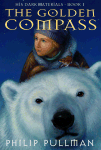
Showing posts with label SERIES His Dark Materials. Show all posts

07 December 2017

Guest Reviewer on The Book of Dust: La Belle Sauvage

Godson has some things to say about The Book of Dust: La Belle Sauvage:
…the book ostensibly isn’t on the scale of the trilogy. I was somewhat worried, until I realised that whilst the book limits itself to the Thames, almost entirely to Oxfordshire, and for swathes two buildings, the adventure is still epic beyond belief.

To think critically for a moment, this book can almost be called magic realism, not fantasy. Or at least it is fantasy of the Terry Pratchett school - it can tell very ordinary stories on a heroic scale. The echoes of Pullman’s predecessors and contemporaries are obvious. Add Pratchett’s humour to Gaiman’s dark twist (Pullman jokingly called La Belle Sauvage ‘His Darker Materials’) to C. S. Lewis’ storytelling and worlds to Lewis Carroll’s allegory (and, as one critic pointed out, the fact that Pullman’s heroine is called Alice is slightly on-the-nose) and you begin to approach Pullman’s brilliance.

Approach, mind you - La Belle Sauvage is a clinic in how to structure a novel, allaying each fear I had almost as soon as I had it, the pattern mimetic of the action itself. It brought to my mind the episodic nature of the Icelandic Sagas at one point, a Christie-esque murder mystery at another, thrillers, love stories and epics at others. It transcends genre, and does so to the tune of Pullman’s beautifully simple prose, that captures in the same way as the originals a Romantic quality that is inherently readable for everyone.
The full essay is on his school’s book blog.

04 November 2015

A Golden Time for a New Golden Compass?

The news that there’s a deal for a television adaptation of Philip Pullman’s His Dark Materials series is very intriguing for us fans. It also shows how the economics of special-effects adventure dramas have changed in recent years.

In 2007, New Line’s adaptation of The Golden Compass cost an estimated $180 million to make. But that movie just didn’t capture the books’ magic, earning only $70 million in the US. That was so little that New Line’s parent corporation restructured the division the next year, bringing it under the control of Warner Bros. (The film made more overseas, but most of that money went to distributors, not the studio.)

Now television shows like Supergirl can afford digital visual effects on the same level, despite having a lower budget. And miniseries have become quite lucrative. So it’s possible to conceive of a His Dark Materials adaptation that’s not only visually stunning but tells the complete story of the three books.

Philip Pullman is part of this new deal. So is New Line, perhaps because it still holds the dramatic rights, and Scholastic. The production company, Bad Wolf, is new, without any completed projects, but its founders have brought on the BBC, their former employer. They also have ties to HBO, which would be a prime customer for the series in the US. All that makes me feel a little more hope than usual that this announced deal will lead to an actual show.

22 September 2014

Philip Pullman in Three or Fewer Dimensions

Princeton’s Cotsen Children’s Library has a podcast called “Bibliofiles,” and this comes from its new conversation with author Philip Pullman:
I’ve written four fairy tales. I call them fairy tales—I Was a Rat!, Clockwork, The Firework-Maker’s Daughter and The Scarecrow and His Servant. They’re different from my novels because the characters are flat rather than round. That’s the way I think of it.

When I’m doing a novel such as the Sally books or “His Dark Materials,” the purpose, what you’re trying to do, is make the characters as real as you can make them, which involves a certain amount of three-dimensionalism. Now you know they’ve got depths, depths sometimes which they’re not aware of themselves. So you want to make those characters as real as possible.

But in a fairy tale, such as the four books I’ve mentioned and of course, “Puss in Boots,” I've done that, and the Grimm tales, the Tales from the Brothers Grimm, character isn’t such an important thing. All the characters in a fairy tale are pretty flat, really. They don’t have much depth. And the interest of the story is not in the psychological complexity of the character so much is in the incident and what happens and what succeeds and will follow it. So they’re different kinds of writing.
Pullman is of course pulling from E. M. Forster’s Aspects of the Novel, as well as the Victorian distinction between “novels of incident” and “novels of character.”

14 December 2010

Harry Potter and the Flawed Interpretation

Last month The Awl published Maria Bustillo’s attack on the Harry Potter series in the guise of a review of the movie adapted from the sixth-and-a-half book. The essay struck me as far more ad hominem and nasty than it needed to be, and simply erroneous in some aspects.

Bustillo is correct, however, that J. K. Rowling’s books undercut her progressive surface themes through the structure of the magical world where they take place. Most particularly, as the article notes, there’s the congenital divide between wizards and muggles, and the never-resolved issue of the house elves.

But Bustillo misses how the books give so many of their good characters solid Anglo-Saxon names (Harry Potter, Granger, Weasley, Dumbledore, Black) while the worst villains have Latinate and French names (Lucius Malfoy, Voldemort, Lestrange). And foreigners are always funny—even as the books depict a modern multiethnic British society. In other words, Rowling’s fantasy world is both founded on some deep British prejudices and inclusive in how it defines being British.

Bustillo errs in identifying the Weasleys—middle-class civil servants—as aristocrats in Rowling’s world simply because they’re wizards. In fact, the Weasley clan is dedicated to good governance, deference to democratic authority, and protection of “muggles.” Symbolically, I think their ancient homestead actually reflects another deep prejudice: that the countryside is nicer than the city, regardless of class.

Bustillo closes with praise for Philip Pullman’s His Dark Materials, which I can’t fault but I also can’t see as a ground-breaking recommendation. I wonder if she’s ever applied her critical eyes to that series and how it, too, reflects British notions of class. (All servants’ daemons being dogs, for example.) And perhaps we can discuss whether fantasy literature’s potentially Manichean presentation of good and evil needs to be reflected in critical thinking about it.

17 December 2008

Golden


Three books, eight to thirteen years old, previously read but not harshly, to be auctioned at Sotheby’s in London for an estimated £1,500-2,000. These are the ordinary first-edition British hardcovers, not a special issue, not signed by the author--and not stickered with the Carnegie Medal.

That’s about a quarter the estimated cost of a Hugh Lofting drawing for The Story of Doctor Doolittle, and less than a twentieth the estimated cost of a Beatrix Potter sketch of Peter Rabbit, pre-publication. But imagine what these books could be worth in another hundred years.

20 March 2008

Revisiting Baum and Pullman

Back in my first month of blogging, I posted an entry called "Pullman and Baum tackle the same scene". It noted some parallels between Philip Pullman's The Scarecrow and His Servant and L. Frank Baum's The Marvelous Land of Oz, particularly a scene in which a clever child pretends to translate between two characters who are actually speaking the same language.

This morning I heard from Laurie Frost, author of The Elements of His Dark Materials, that another guide to Pullman's trilogy, The Rough Guide to His Dark Materials by Paul Simpson, cited that posting to support this statement:

The story of Oz--in celluloid and literary form--has had a significant impact on Pullman's imagination. As the fantasy writer J. L. Bell has shown, Pullman's The Scarecrow And The [sic] Servant is directly influenced by Oz, paying homage to specific scenes and character names.
Actually, I didn't show that at all. I simply pointed out some similarities, but I didn't feel they were close enough to prove influence, nor did I have any evidence about Pullman's reading. The Wizard of Oz is not such a presence in British culture as it is in America, and Baum's sequels are even less known over there.

Both Baum and Pullman wrote about live scarecrows and characters named Jack. Other authors have explored the idea of a live scarecrow as well, and Jack is not simply a common name--it's generic.

As for the translation scenes, I found it interesting to consider how the two fine authors handled the same notion. My only implication about influence was that if Pullman had been inspired by Baum, he made more of the idea: his character's "strategem actually plays a role in the plot" while "Baum's scene is characteristic vaudeville [with] no consequences." But a fake-translation joke is basic enough that it could well have occurred to each of these authors (and others) independently.

Simpson's book appears to be a very "rough guide" indeed. I'm flattered at being cited in it as an expert, but surely there are better ways of gathering information about Pullman's influences than trawling for remarks on the internet and reading too much into them.

Frost tells me she had actually asked Pullman about the possibility of inspiration from Oz in connection to the interaction between Dorothy and Toto, which reminded her of the tighter bond between Lyra and her daemon, Pan. (The Rough Guide makes the same point with a picture from the MGM movie.) Frost writes:
I was flabbergasted when he wrote back that he has never seen the movie, or read the book. He knows a few of the songs, and he has seen Wicked! which he found very confusing, but that's the extent of his Oz knowledge.
Frost's Elements seems to be self-published; it's the only title from The Fell Press. It doesn't have the benefit of the Rough Guides' branding or market reach. But it has an endorsement from Pullman himself, and it's clearly a more reliable guide to what actually inspired him.

02 January 2008

The Real Star of The Golden Compass?

All along, my main question about the Golden Compass movie was whether it would get Iorek Byrnison right. Would the studio be able to find just the right polar bear to play the part?

Fortunately, New Line studio also saw the polar bears as crucial to the movie. It found an ursine actor named Ian McKellen for the part--I hadn't even known there were polar bears in the British Isles. He turned in a fine performance, making Iorek The Golden Compass's equivalent of Aslan in Narnia, as the Shortpacked webcomic knows.

Iorek's scenes could have been even more effective, though. I recognized dialogue and action from the book in the scene that introduced him, but it still seemed surprisingly inert for one that involves a half-drunk polar bear smashing apart a building.

I went back to reread that part of The Golden Compass, and realized how heavily condensed it had been. Two long scenes were compressed into one, many details were removed (e.g., Iorek has to retrieve his armor from the local priest, for the first time we feel Lyra and her daemon Pan separating), and we never see Lyra restraining Iorek's killing instincts. Philip Pullman's narrative voice disappears, too, of course.

Such compression is necessary for a movie, of course, but in this case the result felt slower, not faster. Which leads me to quote Eoin O'Faolain at Screenhead criticism about The Golden Compass's drab pacing and repetitive plot twists:

Weitz’s utter lack of...ability to generate excitement through a sense of adventure is disappointingly evident throughout the entire movie. The film uses the old “hero is about to be killed but at the last second is saved by an ally” device four times in a row, making the action scenes rather bland. Characters appear and disappear in the movie having little valid reason to be there (while the witches are important in the books, they acted as a mere deus ex machina in the film).
(I believe that should be "deae ex machina.")

O'Faolain also criticizes Weitz for not being able to muster any "visual panache," but there I disagree: as a series of still pictures, The Golden Compass looked mighty good. But in its dialogue and in how those pictures move from one to another, in how new elements enter scenes, it felt a little too draggy and familiar. For example, I could have done with about half the number of golden-hued special-effects shots of what Lyra sees in her alethiometer.

The first time the movie sprang to life for me was Iorek's duel with another armored polar bear. That might have been because at long last there was no leaden dialogue explaining everything. Alas, we never got to see the bears' catapult attack on an airship, which appears in the book's final chapters; I've been waiting to see that scene for years now.

Instead, The Golden Compass's action climax is a long battle on an icescape--a scene with a fine cinematic antecedents, from Alexander Nevsky to The Empire Strikes Back. But here the movie's visual acuity failed. It's important to light such a battle so the audience can see what's happening. Otherwise, it's just a bunch of dim men in fur coats swinging at each other.

01 January 2008

A Dull Adaptation, and There Wasn't Enough of It

There's an old joke about people complaining that the food at a resort is almost inedible, and what's more, the servings are too small. The Golden Compass movie fits that model. It was disappointingly shallow and pedestrian, but probably could have been exciting and rich if there had only been more of it.

The cast was well chosen and the scenes' visuals, with one exception (which I'll discuss tomorrow), are handsome, and I could have spent much more time in those settings. The dialogue, however, leaps so desperately from one expository moment to another that there's little room for character development.

New York magazine's comparison of two early scripts for The Golden Compass with each other and the final film traces what could have been:

Like many fans, we'd always assumed that [Tom] Stoppard's draft must have been a work of genius, and that his replacement by [Chris] Weitz surely doomed the project. Much to our surprise, upon reading the screenplays, we're wrong. Had Stoppard's screenplay been filmed, the movie would have been ponderous, a bit dull, and far too long. Weitz's original script was actually great and makes us sad about the movie that could have been. . . .

Weitz's early draft, though still long — 156 pages and likely three hours of running time — is sharper, funnier, and more streamlined than Stoppard's. It's also more exciting, more coherent, and significantly better than the final product. . . . Why was this all cut? Presumably, to keep the film to two hours. . . . In the end it was that decision more than any other that doomed The Golden Compass to mediocrity.

Most notably, of course, both early screenplays contain the end of the book, the crucial sequence cut from the movie entirely so that its ending would remain uplifting.
Chris Kohler at Wired agreed that, "Many of the problems with Golden Compass can be blamed squarely on the film's run time."

Rope of Silicon has posted a link to some footage cut from the end of the movie but included in the videogame. Stills from the same scene show up in picture-book adaptations of the movie, so the cut must have come relatively late. Obviously Weitz filmed something like the book's ending, but in concurrence with New Line studio cut those final scenes to make the movie shorter and less downbeat.

IMDB.com confirms something I’d suspected: those final scenes might show up at the start of a Subtle Knife movie, should one be made from the second book in Philip Pullman's trilogy. There the footage would serve as a bridge from Lyra's adventure to the new story (which starts with a different protagonist), and establish the stakes in the new plot. But will that movie now be made, given The Golden Compass's lackluster domestic earnings? The all-important worldwide box office figures will say.

26 December 2007

Searching for Boys with The Golden Compass

Although the Golden Compass movie has gotten generally positive reviews, its American box office performance has been tepid: a weekly average of $16 million over its first three weeks. In contrast, so far the film has made $130 million overseas, and was the world's top draw for two weeks.

The Golden Compass cost a lot to make: $180 million, or about two-thirds of what the Bush-Cheney administration expends on the Iraq occupation in one day. That high cost means it could be hard for the studio to produce sequels on the same scale, even with an international audience. The series might go the way of The Neverending Story, which had two follow-ups squeezed out over the next ten years with decreasing budgets and new young actors in the lead roles.

New Line studio has apparently decided that one weakness with the movie is that it has a young female lead. The Marketing Department has Photoshopped a boy into the newspaper ads. Perhaps armored polar bears alone weren't enough to get boys into cinemas.
At least there's a prominent boy hero in the second book, The Subtle Knife.

04 December 2007

Looking Out for Iorek Byrnison

As soon as I received the last issue of The Atlantic, I turned to Hanna Rosin’s article “How Hollywood Saved God,” which was said to be about how the people making the Golden Compass movie had altered Philip Pullman’s Dark Materials saga to make its Gnosticism less troubling to non-Gnostics (not that those themes appear much in the first book).

I was disappointed to realize soon enough that that the reporter obviously hadn’t seen either the shooting script or the finished movie, and thus had no evidence on which to base any conclusions.

I did, however, note one passage about how the New Line studio came to option the book:

In 2003, when describing what sold him on the movie, Toby Emmerich, New Line’s president of production, explained, “It was two words: Iorek Byrnison.” Iorek is an “insanely awesome character,” he added.
That much-deserved praise for Pullman's armored polar bear came back to me this weekend when I read Charles McGrath’s story in the New York Times, “Unholy Production With a Fairy-Tale Ending.” Writer-director Chris Weitz initially declined to direct the movie because he felt it would be too big for him to handle.
The studio then turned to an even more unlikely director, Anand Tucker, known mainly for “Shopgirl,” based on the Steve Martin novel, who impressed the executives with storyboards suggesting how the movie might look. But Mr. Tucker and New Line soon ran into the kind of impasse that in Hollywood is called “creative differences.”

“You know, sometimes that’s really what they are: creative differences,” Mr. Emmerich said. From Mr. Emmerich’s own account and that of others, it appears that the problem with Mr. Tucker’s “Golden Compass” was that it was paradoxically both more expensive than the movie New Line was hoping for and smaller in scale. The deal breaker may have been when Mr. Tucker, as a cost-cutting move, decided to eliminate the bear fight, the movie’s great set piece.
Yes, that seems like a very quick way to lose a job: eliminate the most important scene for the studio head’s favorite character!

(Though, plotter that I am, I can’t help but wonder whether Tucker was simply proposing to eliminate that scene in order to force Emmerich to raise the production budget enough to get it back in. When federal agencies do that with their budget requests to Congress, it’s called the “Washington Monument ploy.” It doesn’t always work.)

The movie opens this weekend.


15 November 2007

Comics, Criticism, and the Compass

For folks bored with all these musings about comics, I once again offer a supplemental daily entry with a couple of outside links.

And the first one is about...comics! It's Publishers Weekly's brief report on a panel discussion about the future of comics retailing, through comics shops or bookstores, especially with more of the industry going online. One excerpt:

As graphic novels continue to claim more and more shelf space at traditional bookstores, the issue of how to categorize graphic novels in bookstores--by format or content--remains complicated.

[Graphic novels publisher Rich] Johnson reported that Barnes & Noble recently decided to shelf the Yen Press title With the Light, a manga tale about raising autistic child, in the child developmental section, rather than the manga section.

But [Pantheon Editorial Director Dan] Frank, who recalled “the tremendous amount of difficulty” he experienced in 2000 getting traditional bookstores to stock the critically-acclaimed Chris Ware graphic novel, Jimmy Corrigan, the Smartest Kid on Earth, remarked that “even to this day [we] can have trouble with the more traditional chains. They don’t know quite where to put some of our things.”
On the heels of the National Book Award for Denis Johnson's Tree of Smoke, I can't help linking to B. R. Myers's thoroughly exasperated review of same in The Atlantic:
When a novel’s first words are “Last night at 3:00 a.m. President Kennedy had been killed,” and the rest of it evinces no more feel for the English language and often a good deal less, and America’s most revered living writer touts “prose of amazing power and stylishness” on the back cover, and reviewers agree that whatever may be wrong with the book, there’s no faulting its finely crafted sentences--when I see all this, I begin to smell a rat.

Nothing sinister, mind you. It’s just that once we Americans have ushered a writer into the contemporary pantheon, we will lie to ourselves to keep him there.
The same issue of the magazine includes Hanna Rosin's article about how the upcoming Golden Compass movie will deal with the His Dark Materials trilogy's portrayal of religious organizations and sexual awakening. That investigation is hampered by the facts that:
  • Rosin has apparently seen neither the movie nor the script.
  • All the bits that are really controversial appear in the latter two books, especially the third, and therefore were never slated for this movie anyway.
So, like the Catholic League's bombast, this is all based on unproven assumptions.

11 October 2007

Bombast Launched against The Golden Compass

William A. Donohue, president and sole voice of the politically conservative Catholic League, has proclaimed a crusade against the upcoming Golden Compass movie, claiming that Philip Pullman wrote the His Dark Materials series in part to "denigrate Christianity, especially Roman Catholicism."

Donohue's crusade takes the form of issuing press releases and speaking bombastically on television, which is his normal business (as detailed by Media Matters and Talk to Action). He's also selling a "booklet" (size unknown) of his opinions on Pullman's books for $5 apiece, or ten for $30. As of 2005, Donohue's salary was over $300,000, and that money has to come from somewhere.

The Golden Compass takes place in a fantasy world, with people's spirits manifest as companion animals, talking polar bears, and tree branch-riding witches. That world also contains an oppressive church, called the "Magisterium," which the book does indeed portray in a poor light. (Something about killing kids to obtain their spirits--you know how books can blow these things out of proportion.)

In a 2004 interview on the BBC show Belief, Pullman acknowledged taking some of the Magisterium's terminology from the Christianity of medieval western Europe, but said:

we're talking about another world, remember, and we're talking about a world in which the Catholic church develops in a very different way, because [John] Calvin became the Pope in the history of Lyra's world.
He also spoke of the emotions that motivated this story:
it's a deep anger...and yes, horror at the excesses of cruelty and infamy that've been carried out in the name of a supernatural power. And it's not only the Catholic church that is guilty of this, of course. The Protestants were just as guilty of burning the Catholics and their town, and of hanging the witches. And both sides are guilty of persecuting the Jews. And then you get Moslems killing Hindus, and Hindus killing Moslems, and Sikhs killing Moslems and Hindus. . . . .

I think it was a physicist [Nobel laureate Steven Weinberg], who said the truest thing about this. He said, good people have done good things, and bad people have done bad things without the help of religion, but for good people to do evil things, that takes religion.
That's the kind of fair, rational thinking that gets Donohue angry enough to go on television and sell booklets at $5 apiece, ten for $30.

It seems more than presumptuous for Donohue to think that the Magisterium in Pullman's make-believe world is the same Roman Catholic Church that he's appointed himself to defend in the US. Wouldn't he be better off insisting that there's no connection or similarity between his own church and an oppressive institution based on imaginary power? But apparently he sees an insult there, or an opportunity.

For myself, I'm really looking forward to seeing Iorek Byrnison in action. There's a character who truly fights for people's rights.

25 March 2007

Pullman Panel Promotion

Following breadcrumbs laid through the woods at Educating Alice, I found Saestina's report on a panel in Oxford where Philip Pullman participated in promoting the upcoming film adaptation of his novel Northern Lights/The Golden Compass.

The most interesting tidbits, I thought, had to do with Pullman's creative process while writing the books, lo those few years ago. He's mentioned the inspiration for the trilogy title before:

His initial inspiration for the book was the landscape of hell that Milton describes in the first two books of Paradise Lost, which is also where the title His Dark Materials comes from. The original working title for the trilogy was The Golden Compasses, also from a quotation from Paradise Lost.
That would be from Book VII:
Then staid the fervid wheels, and in his hand
He took the golden compasses, prepared
In God's eternal store, to circumscribe
This universe, and all created things:
One foot he centered, and the other turned
Round through the vast profundity obscure;
And said, Thus far extend, thus far thy bounds,
This be thy just circumference, O World!
Saestina's description of Pullman's remarks continues:
When Northern Lights went to the US editor, he thought the [original series] title was a reference to the alethiometer, changed it to a singular compass and made it the title of the first book instead of the trilogy as a whole. This is, apparently, the same editor who changed the name of the first Harry Potter book from Philosopher's Stone to Sorceror's Stone, which Pullman said, "obviously makes no sense."
Not to quibble, but the US publishers of the Harry Potter series and Pullman's retitled (and soon to be renumbered) trilogy are different companies. In fact, to confuse matters beyond easy meaning, the UK publisher of Northern Lights is the same multinational firm as the US publisher of Harry Potter.

It may also be worth acknowledging that a stone which conveys magical immortality makes much more sense--in modern usage--as a "sorcerer's stone" than as a "philosopher's stone." Yes, I support educating fourth-graders in the history of Renaissance scientific nomenclature as much as the next guy, but let's face it--until that happens, there's a case for "sorcerer's stone."

And it definitely seems noteworthy that while J. K. Rowling's Philosopher's Stone title survives in the UK and around the world, for both book and movie, Pullman accepted the US title for his first volume even though that meant he had to find a new series title. Such is the power of US sales.

An item of more interest to story creators:
Pullman really struggled with the first chapter of Northern Lights. On his sixteenth draft (according to him, I think this may have been hyperbole) he was hit with the idea of daemons and it all came together.
What, at least from this hind perspective, seems like a fundamental element of the His Dark Materials universe, and even of some of the books' plotting, wasn't part of Pullman's original planning.

Fuse #8 provides a link to another Golden Compass movie promotion, an advance trailer spotlighting the half-finished special effects.

14 December 2006

Visiting the Far North

The producers of the first Golden Compass movie, due in late 2007, have unveiled the necessary website.

To heighten the sense of being in an strange parallel word, explore the site in an unfamiliar language, such as suomi. (That is, assuming you don't already know suomi.)

Unfortunately, the site does not respond to the Bork Bork Bork! add-on for Mozilla for added boreality.

Maybe I'm not taking this movie pretentiously enough.

20 July 2006

Seeking direction on The Golden Compass

On Sunday, Variety magazine analyzed the challenges, technical and financial, in filming Philip Pullman's The Golden Compass (a/k/a Northern Lights) this fall.

Among the obstacles ahead are "over 800 CGI shots," no worldwide brand of the magnitude that New Line could count on for its Tolkien trilogy, and finding just the right polar bear to play Iorek Byrnison. (All right, that last one isn't in the article.)

Variety also lists this as a challenge: "There is a decidedly anti-authority tone to the stories. (Because of Pullman's atheist beliefs, some have interpreted this as anti-organized religion, but for him, it's a metaphor for any controlling organization.)" In other words, there are no more problems with organized religion than with any other organization that tries to make people think and behave in a certain way to benefit its leaders. Evangelical moviegoers are so open-minded that few will have a problem with that, right?

Ironic that we audiences can cheer for the rebellion in Star Wars, for defying government authorities in E.T., for breaking down class lines and etiquette in Titanic, for maritime criminals in Pirates of the Caribbean--but an "anti-authority tone" might be a problem when it comes to a fictional church.

The detail from the Variety article that seems most ominous to me is:

New Line, which hardly ever goes over $40 million on a budget, hasn't yet committed to filming the other books in the trilogy, The Subtle Knife and The Amber Spyglass.
As we recall, the first book ends with Lyra flying up Some of you haven't read it? Please, run, run, like a bunny to the library and get yourself a copy.

In the meantime, The Golden Compass is clearly the first part of a trilogy. It ends with important threads unresolved and the heroine heading off to a new, strange world. Hollywood won't be able to give viewers a satisfying ending without changing the book's story, but New Line's not yet ready to commit to the full trilogy.

Perhaps we'll end up with two endings for The Golden Compass: one for the standalone version, in case it doesn't make enough money to warrant a sequel, and one to lead into The Subtle Knife. After all, the unscreened ending could always go on the DVD.