Showing posts with label AUTHOR Maurice Sendak. Show all posts

30 July 2019

Sea Fairies and Sea Sirens

Sea Sirens is a new middle-grade graphic novel by Amy Chu and Janet K. Lee. It’s subtitled A Trot & Cap’n Bill Adventure, and the back cover says it was “inspired by L. Frank Baum’s classic adventure The Sea Fairies, the ‘underwater Wizard of Oz.’” The story’s last page promises more Trot & Cap’n Bill Adventures.

However, this is not a story about Trot and Cap’n Bill from The Sea Fairies and Sky Island, whom Baum settled in the Emerald City in The Scarecrow of Oz. It’s a remix of elements from The Sea Fairies including the names of major characters, the setting in and off the coast of southern California, and the general idea of being able to breathe underwater to visit mermaids.

Baum’s Sea Fairies is one of his weaker fantasies, though it introduces some of his most winning characters and one of his scariest villains. As in Jules Verne’s Twenty Thousand Leagues Under the Sea, a lot of pages are taken up by underwater tourism with little plot (but, in Baum’s case, plenty of puns). Though Trot is a winning personality already distinct from Dorothy Gale, she functions mostly as an observer; she becomes more of a plot driver in Sky Island.

Lee, who created the striking Return of the Dapper Men, had the idea to pull from The Sea Fairies to create a modern adventure. Like Trot, the Trot* in Sea Sirens lives along the southern California coast with her mother and a disabled older man—not a one-legged sailor but her grandfather, who suffers from intermittent dementia. The new Cap’n Bill* is one-eyed cat.

Trot* is a Vietnamese-American surfer. About twenty years ago I wrote an Oz novel featuring a Vietnamese-American surfer as the child who travels to the Emerald City. I’m therefore particularly intrigued by Trot*. Both stories hinge on the powerful allure of surfing, particularly as a respite from domestic tensions.

In The Sea Fairies, Trot and Cap’n Bill are boating off the coast when the mermaids of the title appear and invite them to visit. They want to disabuse Cap’n Bill of his superstitious ideas about mermaids luring sailors to their deaths. Once underwater, Trot and Cap’n Bill meet many creatures, culminating in a gigantic, ancient sea serpent named King Anko, who presides over the Pacific. Then they get captured by the villainous Zog.

Sea Sirens strives for more conflict from the start. (Perforce this paragraph and the following contain SPOILERS.) Trot* is at odds with her mother over whether it’s safe to leave her wandering grandfather to go surfing. Trot* and Cap’n Bill* almost drown before a mermaid princess with her own mother issues rescues them and empowers them to breathe underwater. The mermaid queen Aquareine* is imperious instead of just friendly. The mermaids are close to war with a nation of underwater serpents, and Trot*’s grandfather wanders into their possession.

However, in the end that conflict washes away in a few pages. The King Anko* in Sea Sirens is a former cabin boy with more than a little resemblance to Maurice Sendak’s Max, Mikey, Jack, and Guy, who in turn harken back to Winsor McCay’s Nemo. Anko* is delighted to find other humans underwater at last. Trot* asks him and Aquareine* to pull back their armies, and they do. Problem solved.

Even Trot*’s fear of her mother worrying that she and her grandfather have drowned evaporates quickly. It turns out the entire underwater adventure takes only an hour in surface time. (In The Sea Fairies, Baum had the mermaids cast a spell on Trot’s mother so that she slept peacefully through her daughter’s absence.) There’s a final fear that Cap’n Bill* has drowned, but he hasn’t.

In sum, Sea Sirens ends up being even slighter than The Sea Fairies. The pictures are lovely, and the graphic storytelling successful on a page-by-page, moment-by-moment basis. The character-based jokes land, especially when Trot* learns there’s more to Cap’n Bill* than she thought. Jimmy Gownley, creator of the Amelia Rules! series, provides fine lettering. Now that the characters are established, we can hope the next graphic Trot & Cap’n Bill Adventure is more of an adventure.

16 October 2013

I Could Just Eat This Up

I look askance at our current culture’s habit of declaring that something is the best Thing EVER, so that may slightly dampen my expression of enthusiasm for Betsy Bird’s “Re-Sendakify Sendak Project”: inviting a recently celebrated children’s-book illustrator to create art for one of Maurice Sendak’s books in the style of another celebrated children’s-book illustrator.

The example above shows the opening panels from Sendak’s Where the Wild Things Are in the style of Jules Feiffer’s Village Voice cartoons as drawn by Nick Bruel.

Other works of elevated collective genius in Bird’s posting include Pierre in the style of Chris Van Allsburg by Nathan Hale and Bumble-Ardy in the style of Richard Scarry by K-Fai Steele. And then the next generation gets into the act.

It’s the best thing ever.

15 November 2012

Sendak “born to Holocaust survivors”?

Gail Gauthier clued me in to this interview with Maurice Sendak at The Believer. It was no surprise that the conversation touched on the Nazi Holocaust. Sendak stated:
Nearly all my relatives died in the concentration camps, except my parents.
“Nearly all”! Well, a few seconds later he said:
The only one who talked about it was my grandmother, who was a very fierce woman. The only grandparent I had.
Okay, nearly all his relatives except his parents and one grandparent.
She was the only one who came over. Who was brought over by her idiot daughters, my aunts. And idiot uncles, her sons.
Okay, except his parents, one grandparent, and an unknown but plural number of aunts and uncles.

And at least one of the uncles or aunts had at least one child:
We [Sendak and his older brother and sister] had a cousin. We were not supposed to like her, because she was a communist. She was very plain. I adored her, and me and my sister would steal off and go to her house. She sat and talked to me and told me that I knew how to draw and that I could be an artist, or anything, and I thought if she was in the world, then good was in the world.
And about that grandmother:
Her husband died when he was forty, which drove my mother crazy. She blamed his death on my grandmother, which is why my grandmother sent her to America—shut up, get outta here. So she came to America. A sixteen-year-old girl, alone.
Sendak’s mother, Sadie Schindler, was born in 1895, and if she came to America at sixteen that was even before World War I. Which means her father had died decades before the Nazi concentration camps. So Nana Schindler was indeed “The only grandparent” Sendak knew, but the Holocaust wasn’t the reason Sendak didn’t know his maternal grandfather.

Sendak did tell a story about his father learning that all his family had been killed in Europe, the news arriving on on the day of his bar mitzvah. That was in 1941, and Philip Sendak’s home town of Zambrow, Poland, was wiped out by the Nazis starting in July 1941, according to different sources.

So Sendak did lose relatives he never had the chance to meet in the Holocaust—but not “Nearly all” his family except his parents. The Holocaust was undoubtedly part of his psyche and his artistic inspiration, but its actual effect on his relatives became exaggerated.

In its obituary for Sendak, The Jewish Press described him as “born to Holocaust survivors” even as it reported his age. He was born in 1928 in Brooklyn to a couple who hadn’t survived the Holocaust because it hadn’t happened yet and they were thousands of miles away when it did. But that’s apparently not how Sendak saw himself.

23 August 2012

Redoing Mickey’s Monkey?

The legend of Maurice Sendak’s In the Night Kitchen is that “librarians across the country” painted a diaper or underwear over the hero Mickey’s genitals. This month at School Library Journal Kathleen T. Horning pointed out that the great majority of librarians supported full access to the book as Sendak had created it, as they supported him for most of his career.

Horning found three sets of evidence for authorities painting in the book:

  • a letter to School Library Journal from one Louisiana librarian in 1971, which prompted a semi-public response from Sendak’s editor, Ursula Nordstrom.
  • a school system in Missouri doctoring forty books before using Night Kitchen in a classroom.
  • Sendak’s own statement in 1991 that “I have a number of [altered] copies smuggled out to me by embarrassed librarians.”
However, in that same 1991 speech Sendak declared:
It’s been brought to my attention by a number of people that Mickey, in the lithograph I prepared for this American Booksellers Assn. convention, is still the 1970 little boy he always was—but that, oddly, his privates have grown way out of proportion. Now, this is true—I was unaware of that detail—and I’d like to think I inadvertently touched on some significant unconscious point—and not merely that I’m guilty of bad drawing. Either explanation might be correct, but of course I prefer the former.

What could be more reasonable under the circumstances? It makes a kind of comical sense; like Pinocchio’s nose displaced downwards (in Freud, it usually goes the other way), Mickey’s penis grows in response to the lie that is censorship, the lie that says children must be protected from such a sight.
Actually, all those explanations and symbolic interpretations are based on a faulty premise. The image of Mickey on the ABA 1991 poster was basically traced from a panel in Night Kitchen. And he shows little significant growth or shrinkage at all. Well, except in his feet.

22 August 2012

Baked-in Resentment from Sendak

I was struck by this quotation from Jonathan Cott’s interview with Maurice Sendak in Pipers at the Gates of Dawn (1983), about the inspiration for In the Night Kitchen:

When I was a child, there was an advertisement which I remember very clearly. It was for the Sunshine bakers, and it read: “We Bake While You Sleep!” It seemed to me the most sadistic thing in the world because all I wanted to do was stay up and watch . . . It seemed so absurdly cruel and arbitrary of them to do it while I slept. And also for them to think I would think that was terrific stuff on their part, and would eat their product on top of that. It bothered me a good deal, and I remember I used to save the coupons showing the three fat little Sunshine bakers going off to this magic place at night, wherever it was, to have their fun, while I had to go to bed. This book was a sort of vendetta book to get back at them and to say that I am now old enough to stay up at night and know what’s happening in the Night Kitchen!
A similar Chicago Tribune article says Sendak saw that slogan when his sister left him in the Uneeda Biscuit exhibit at the 1939 World’s Fair.

Sunshine Biscuits and Uneeda (from Nabisco) were rival products, and it looks like the real story might be a blend of those memories. As shown above, Sunshine Biscuits ran ads as early as 1936 depicting miniature bakers at work on its products. At the 1939 World’s Fair the company evoked those scenes with little people dressed as bakers, as shown in the postcard at right. Sendak, who turned eleven that year, might well have seen the little bakers at work.

However, I haven’t found any Sunshine Biscuits ads proclaiming something like “We Bake While You Sleep!” The company could have used that line, of course. Bakers have long been known for getting up early to produce fresh bread for the day. Merita Breads, a brand centered in the South, used “Baked while you sleep” as one of its slogans. The Carmel Bakery, in business in Monterey County since 1906, proclaims, “We bake while you sleep.”

What’s most striking to me about Sendak’s story of inspiration is its emotional dimension. Many children might be intrigued by the thought of bakers (especially little bakers) working all night for them. But Sendak declared that arrangement was “sadistic,” “absurdly cruel and arbitrary” to himself, and used it to fuel “a sort of vendetta book.” But he talked like that a lot in middle age.

TOMORROW: The legends of Mickey’s diaper and penis.

28 May 2012

Jules Feiffer Tries Yet Another New Thing

Christopher Borrelli’s interview with Jules Feiffer in the Chicago Tribune brings out several interesting remarks about his multifaceted career:
Q: You've done so many different things — where do your biggest royalty checks come from?

A: (Laughs.) A diversity of places. Mostly children's books, I suppose. A lot of it comes from "The Phantom Tollbooth," the book I did with Norton Juster. That book has become a great annuity for me, a sizable one. It just celebrated its 50th anniversary, and it's amazing how well it still sells. It's also amazed me how much the book and my art has been remembered. At the time, in the early '60s, it was work that I didn't really appreciate that much. I had difficulty doing it and didn't feel like I was a natural at that kind of thing.

Q: Was it hard because so much of "Phantom Tollbooth" feels abstract?

A: No. Maurice [Sendak], in the new edition, wrote that I was one of the few cartoonists who can illustrate ideas. I've always felt that illustrating the abstract — drawing ideas — is one of the primary jobs of the cartoonist. . . .

Q: How did the death of Maurice Sendak affect you?

A: When you said his name my heart sank. I loved him. We rarely saw each other because he was in Connecticut. But we had deep affection for each other. When he had his first heart attack, he was in London and I happened to be in London, so I spent time with him. But we were very different in temperament. He was much more of a Russian Jew than I was, much more given to doubts of depression and grimness, and I never entirely lost some of the giddy boy-cartoonist traits I've always had. We would sit for hours and talk.

Q: And like Maurice, you seem too acidic to write children's books.

A: True. (Children's books) were a means to an end, a way to make me a living. Children's books were not a passion. That's how I felt in the '50s — once I met Maurice, I didn't think I would dare compete with him. But years later, after one of my plays, "Grown Ups," got beat up badly, I thought I needed another obsession. My idea was about this kid cartoonist, and that became "The Man in the Ceiling." I wrote it, then I called Maurice, and he gave me the name of his editor, Michael di Capua, and I've been with Michael ever since.
Feiffer’s current project is Kill My Mother, a graphic novel drawn in a film noir style he expects his fans not to recognize.
Yes, thought I could write a graphic novel, someone else could illustrate it. But as it developed, it ended up being long, starting in 1933, then switching to 1943, going from the Depression to World War II. And I couldn't find anyone to draw it right. For this kind of Chandler-Hammett noir thing, you need shadows, rain. So I had to learn how to do it. Fortunately, I have Turner Classic Movies. I record all this film noir, "The Maltese Falcon," "The Big Sleep," and hit pause on my remote. That's been my research medium. It will not be drawn (in a) traditional Feiffer style. I stole from [Will] Eisner. I hope it will be finished by the end of next year.
Last month Feiffer told Publishers Weekly about this project:
Feiffer went on to explain that, “when I started out in the comic book business, I didn’t plan on producing social and political commentary,” and said he really wanted to produce action/adventure comics strips like his cartoonist heroes, Will Eisner (The Spirit) and Roy Crane (Wash Tubbs). “But I couldn’t draw like them. Since I had no qualifications and couldn’t imitate them, I tried to do my own thing,” Feiffer said.
The Tribune interview also contains remarks about Hugh Hefner as an editor, Philip Roth as a joker, Jack Nicholson starstruck by Warren Beatty, and more.

17 May 2012

Sendak as a Born Curmudegon

Among all the encomia for Maurice Sendak that have appeared in recent days, I particularly appreciated Michael Patrick Hearn’s clear-eyed remembrance posted at Educating Alice. Rather than focus exclusively on Sendak’s storytelling talent and contrarian statements about childhood, Hearn wrote about the personality that produced that work:
Almost every conversation began with the kvetching. Oh the kvetching! It was not a word I really knew until I met Maurice Sendak. He was constantly upset with this and that, with that person and this person. His anger fueled him. Look in the dictionary under the noun kvetch and you will find:
  1. A chronic, whining complainer.
  2. A nagging complaint.
  3. Maurice Sendak, American picture book artist-author.
But once he got that off his chest, he was the funniest person you could ever meet.
Hearn also writes about how Sendak “loved being the provocateur,” and “was emotionally needy.”

Such comments reminded me of Leonard Marcus’s recollection of meeting Sendak in Publishers Weekly:
I arranged to be introduced to Maurice at the giant children’s breakfast at ABA, and at first he didn’t really look me in the eye. “Another interview?” he must have been thinking, as he commented on the banquet hall’s sprinkler system, which he said reminded him of a Nazi gas chamber.
That remark would make sense for someone who’d actually been threatened by, you know, a Nazi gas chamber. But Sendak was born in Brooklyn in 1928. He lost Polish relatives in the Holocaust (the same sort of foreign relatives he cited as the scary inspiration for the Wild Things), and later described that news as introducing him early to thoughts of death. But Sendak was already eleven when Hitler invaded Poland, and I’m pretty sure every American child growing up during World War 2 had to think about death.

As with the Lindbergh kidnapping (another memory Sendak invoked, this one really from his early childhood), the Holocaust seems more likely to have provided a focus for his anxiety and fears rather than their cause or inspiration. He explored themes of endangered children in his later books, when he could tell any story he wanted, because that situation struck deep chords with him.

Not that Sendak wasn’t also a charming person and a terrific picture-book creator, as both Hearn and Marcus describe. His critical writing was often very insightful, but I think it was at its best when he wrote about other people’s work rather than when he made pronouncements about childhood and literature based on his own idiosyncratic world-view.

Back to Hearn:
No matter how many other directions he went into and how far he grew as an artist, everyone wanted another Wild Things. Once a book was published, he was through with it. He did not go back. He never wanted to repeat himself. He was constantly evolving. He called Wild Things the first in a trilogy that also embraced In the Night Kitchen and Outside Over There. But their artistic connection is dubious. What they did have in common was that Maurice was working out his therapy through them. The traumas of his childhood came out as metaphors. The books are fraught with Freudian symbols.
Hearn calls attention to Sendak’s 2005 edition of Ruth Krauss’s Bears, a “sequel of sorts” to Wild Things since it included a wolf-suited Max. It was “one of the most delightful of Sendak’s books in many years,” Hearn says, but “almost universally ignored by the reviewers and the public.”

08 May 2012

Maurice Sendak on Oz

Here’s the late, great Maurice Sendak on the power of the MGM Wizard of Oz, from the pages of the New York Times:

“Children make crucial decisions at that point,” he said, “and it happens in the wink of an eye. It’s those crucial seconds when the mother and father can’t watch. This was so absolutely, beautifully, rendered for me when I was very young and I saw ‘The Wizard of Oz.’ There’s a scene that I think was a little bit St. Paul-on-the-road-to-Damascus for me. It was near the end of the movie, when Dorothy is imprisoned in the room with the Wicked Witch, and the witch takes the hourglass and turns it over and says: You see that? That’s how much longer you’ve got to be alive.

“And Dorothy says, I’m frightened, I’m frightened, and then the crystal ball shows Auntie Em, and Auntie Em is saying, Dorothy, Dorothy, where are you? and Dorothy hovers over it and says: I’m here in Oz, Auntie Em. I’m locked up in the witch’s castle. Don’t go away, I’m frightened. And I remember that when my sister took me I burst into tears. I knew just what it meant, which was that a mother and child can be in the same room and want to help each other, and they cannot. Even though they were face to face, the crystal ball separated them. Something separates people now and then. And I think it’s that moment that interests me, and compels me.”
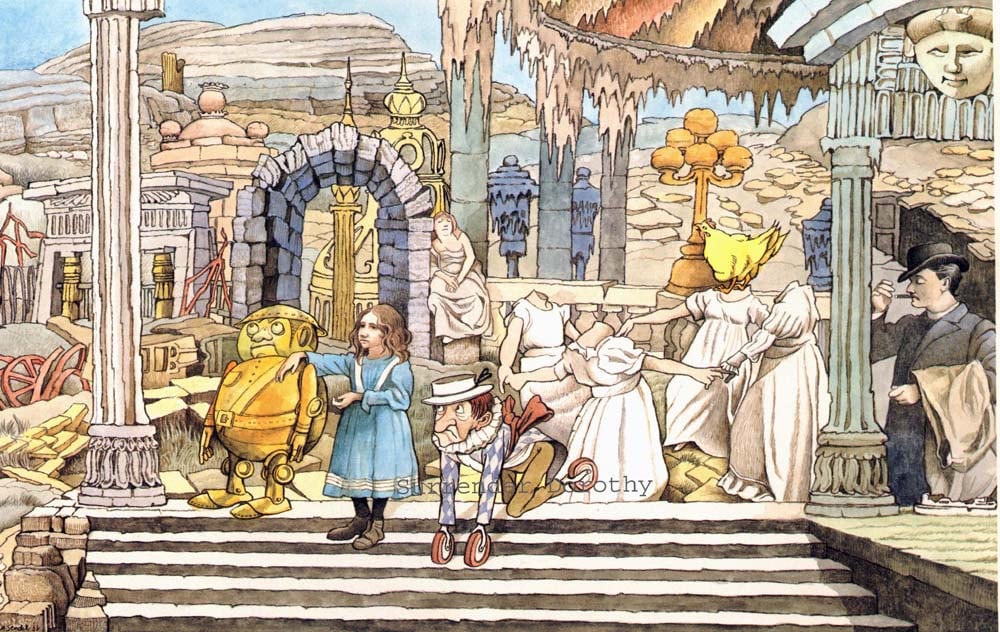
When Disney was planning a quasi-sequel to that movie, the studio hired Sendak to help design it. Ultimately he had little to do with Return to Oz, but he did produce this poster for the publicity campaign. This image is from Surrender Dorothy’s Etsy site.
I’m not sure who the somewhat sinister gent on the right is supposed to be.

Sendak also drew the more cheery cover art for Books of Wonder’s Oz: The Hundredth Anniversary Celebration. But why would the Scarecrow and Tin Woodman have eating utensils?

04 August 2009

The Mark of the Wild Thing

Last week Entertainment Weekly ran this photo by Michael Muller of Max Records, star of the cinematic adaptation of Where the Wild Things Are. (The magazine's website features a different image.) It immediately made me ask:

What did he have written on his left palm?

(Me, I've always preferred this new technology we call "paper.")


Many attendees at the San Diego Comic-Con reported online that the words were something author-illustrator Maurice Sendak had told Records during a birthday phone call. He'd written them down to read to the audience:
“You know I really love this movie and I hope people like it, because if not they can all go straight to hell.”

01 November 2008

Strangest Comic of the Month

Blotchmen, by Kevin Cannon, is a parodic mash-up of Alan Moore and Dave Gibbons's Watchmen, William Carlos Williams's "This Is Just to Say," Crockett Johnson's Harold and the Purple Crayon, and Maurice Sendak's Where the Wild Things Are.

Seriously.


As a bonus, this page throws in unnecessary action labels from Japanese comics.

Thanks to Matthew Holm for the pointer. I think.

11 September 2008

Sendak as a Lion in Winter

Yesterday's New York Times profile of Maurice Sendak at 80 might be summed up as, "He's gay, but he's not happy." Which is a short way of saying that Sendak appeared just as comfortable telling interviewer Patricia Cohen "that I'm gay" as he was enjoying any other aspect of life, which is to say not comfortable at all.

This wasn't really a public coming-out. Other authors have written about Sendak's long partnership with psychiatrist and art historian Eugene Glynn: Tony Kushner in The Art of Maurice Sendak in 2003 (excerpted here) and Cynthia Zarin in a New Yorker profile from 2006. But this may be the first time Sendak brought up the question with an interviewer, and people are responding to it as news.

I'd wondered about Sendak's family life, hoping he hadn't been living like One Was Johnny, alone with his books and anxieties. But he had a long partnership with, apparently, a good temperamental match until Glynn died in May 2007.

And temperament appears to play a big role in Sendak's life and work. Most of Cohen's article is taken up with dreads named and nameless, everything from the Lindbergh kidnapping to a poor review from Salman Rushdie. He was charming, she assures us, and I've seen Sendak in front of an audience, a completely entertaining curmudgeon. But every profile I've seen describes the same rough emotional ride, and in this one Sendak comes across particularly like my grandmothers when they're fretting and unable to hear any reassurance.

Indeed, I suspect that Sendak's natural anxiety is more of a factor than the many historical events that he hangs his worries on. He's often written and spoke of the shadow of the Holocaust over his work. According to this 2004 AP dispatch archived at the Jewish News Weekly:

Sendak, his sister Natalie and late brother Jack, are the last of the family on his father’s side since his other relatives didn’t escape Europe. The only family member Sendak really knew on his mother’s side was his grandmother.
But Sendak's also stated that one inspiration for his Wild Things were frightening immigrant relatives who visited his house as he grew up in the 1930s--so there must have been more survivors on his mother's side, just not people he "really knew." The disappearance of the Lindbergh child in 1932 also predates Hitler's ascension.

Kushner wrote of those deeper anxieties, still tying them to Sendak's heritage:
Maurice is a child of the Great Depression and of Jewish Depression, if I may generalise. Jewish Depression is that inherited awareness of the arduousness of knowing God, the arduousness of knowing anything, an acute awareness of the struggle to know, the struggle against not knowing; and it is that enduring sense of displacement, yearning for and not securely possessing a home.
But even by American Jewish standards, Sendak is a world-class fretter. I suspect he would fret no matter what historical period he lived through, and would fret--albeit in a different way--no matter what culture he was raised in.

Of course, being gay in mid-20th-century America, even in New York art circles, would have increased Sendak's sense of unease. Not just keeping his partner private from his mother, but wondering what the people who criticized In the Night Kitchen for showing a naked boy would have said if they'd known.

Pulling all this together, I end up wondering about Sendak's thoughts on passing on the family name, a Jewish tradition even for people who don't perceive their family to be in constant danger. Sendak didn't raise children--not an option for him and Glynn. (And at least that meant fewer things to worry about.) But his decades of artistry have made a huge impact on children, and have made the Sendak name both famous and beloved.

09 November 2007

Same Image, Slightly Different

Having broken the news that there are more pictures on a typical comics page than a typical picture-book page, I'm going out on a limb today to suggest that there are fewer pictures in a traditional picture book than a comics-style book of the same length. Yes, the insights just keep coming.

My real point is that I think the smaller number of images in typical picture books has pushed artists away from a method of using sequential pictures that comics artists use a lot: a series of similar images with small changes from one to the next.

Picture books have a minimum number of images, a fact that writers have to consider when they conceive of their stories. As Peggy Tibbetts wrote, "if you can't come up with at least a dozen concrete visual images for the illustrator to choose from, you might want to re-think your picture book idea." Jan Fields went further in distinguishing a picture-book story from one more appropriate for a magazine: "In a picture book, it is...important that every illustration be different (not all in the same room, not all of two people talking)."

Traditional picture books also have a maximum number of images. They tend to be 32 pages, and if nearly every spread offers a single picture, that means there are only about 17 holes to fill. Where the Wild Things Are has an extra half-signature: 48 pages (including endpapers). But, even counting the cover, Maurice Sendak created only 20 images for that book. The picture-storybook Pink and Say is also 48 pages; Patricia Polacco created only 26 pictures.

Faced with so few opportunities for art, most picture-book artists strive for visual variety. They make each image a full-spread masterpiece, showing a complete scene. When a manuscript calls for them to portray the same scene over time, most choose different angles or move characters around to create dissimilar images. After all, why spend 2 of 17 spreads (more than 10% of a 32-page book) repeating yourself?

In contrast, the comics storytelling style often requires artists to depict the same scene several times on a page: the same two people talking in a room, for example. Artists can show that scene from a variety of angles, with lots of character action. Or they can create a series of similar panels, focusing readers' attention on the passage of time or the small variation between one panel and the next. I've come to think of that technique as another hallmark of comics art that's uncharacteristic of recent picture books.

The page from Sendak's In the Night Kitchen that I showed back here offers a view of that technique, clearly inspired by comics. A single page contains two images of Max falling through the same room. By comparing one to the next, we can see how he's moving down past the chandelier and the clock. We can also see Max lose all his clothes, which is bound to keep a young reader's attention.

I suspect that technique works best if the two similar illustrations aren't separated by a page turn. When the two images are side by side, we can see their similarity even as we concentrate on the details; we don't have to hold one in memory. However, some picture-book artists have used this technique well from spread to spread. Ellen Raskin was a master at it: Spectacles, And It Rained, Nothing Ever Happens on My Block. (I wonder if it was more popular when artists were responsible for supplying their own separations, and so were copying their drawings already.)

As an example of how this type of sequential art works so well in comics, I've taken two facing pages from Art Spiegelman's Maus. (I've fuzzed the unnecessary words so as not to show more than fair use.) On these pages the narrator's father describes his family gatherings before World War II.

This page contains eight images. Two show the narrator's father speaking from his exercise bicycle; in a picture book, that would be redundant. The other six images show the father's family, and they're even more repetitive. They're all from the same angle. They all show nearly the same instant in time. Yet they're still visually interesting because of their differences.

By comparing one similar image to the next, we understand that Spiegalman is bringing us into the scene through the window (like the opening of Citizen Kane!), and introducing us to each part of the family in turn. On this page, he's used panels to organize a single scene mostly by space.

On the facing page, Spiegelman continues to show us the same family from the same angle, but this time he emphasizes time by keeping the same part of the table in every picture, the same characters in the same seats. We're forced to focus on what changes from one panel to the next.
That puts more weight on the grown-up characters' words. We also see time pass by following a couple of little wordless stories involving the younger relatives. The teenager Lolek has his book taken away, and pouts. Baby Richieu turns over his plate, gets scolded, wails, and gets a hug. In a picture book with one image per spread, those four moments would need nearly a quarter of the book. Here it's just a lovely detail on a single page.

07 November 2007

Page Spreads versus Pages

Yesterday I promised my thoughts on how picture books and comics work differently, even though they're both made up of words and sequential pictures. Here's the first major difference I see.

By and large, in modern picture books the main subsidiary unit is a two-page spread containing a single large image. When artists plan a picture book from a manuscript, their first step is to divide the text into page spreads.

In contrast, comics by and large have two or more--usually many more--images assembled in front of the reader at the same time. Together they make up one large image, of course, but each represents a different scene in time and space. Furthermore, historically the main subsidiary unit of comics has been the single page, broken into panels; of all the ways to write comics scripts, the pages/panels organization seems like the only constant.

This is, of course, not a hard and fast rule. Plenty of picture books have two or more separate pictures on a page spread, especially to break up a series of large images and change the mood or pace. Last year I talked about how nicely Chris Wormell's George and the Dragon does this.

Conversely, plenty of comics have two-page spreads. Indeed, a dramatic single-image spread containing title and credits has overtaken the introductory splash page as a comic-book convention. I also see more artists designing comics so that a page spread, even though it contains many images, has a unified visual scheme.

That's a recent development in comics, however--at least in the format that dominated the field in the US for so many years, the comic book. Those books depend on advertising pages that pop up in the middle of the story, making it harder for artists to plan full-page spreads. We can see the consequence in volumes collecting comics that are twenty or more years old. Each page of a story/issue is usually numbered by hand in a lower corner; sometimes even-numbered pages appear on the left in the book, sometimes on the right. In other words, the two pages we see on a spread were probably not designed to be viewed side by side.

The most popular periodical comics still have ads, but their publishers have discovered the additional revenue stream of reprints without ads in "graphic novel" format. That, plus digital tweaking of art, has let comics artists think in terms of page spreads. But there can still be a few bugs in the system. In the book version of DC's histrionic Infinite Crisis, editor Anton Kawasaki says of one segment:

We're also adding two new pages to this issue to "fix" the awkward way the Green Lantern spread originally fell. Damn you periodicals people for not paying attention and making us poor Collected Editions guys work harder!
A two-page spread in the original comic book would have been broken by a page turn in the graphic novel if Kawasaki hadn't commissioned an extra page before and after it. That sort of problem never comes up in picture books because they're designed around spreads from the start (and have no ads).

How does this play out in classic picture books? Munro Leaf and Robert Lawson's The Story of Ferdinand usually has one large illustration on each spread, showing one moment of time. So do Maurice Sendak's Where the Wild Things Are, Robert McCloskey's Make Way for Ducklings, and Ellen Raskin's Spectacles. [I choose my classics; you choose yours.]

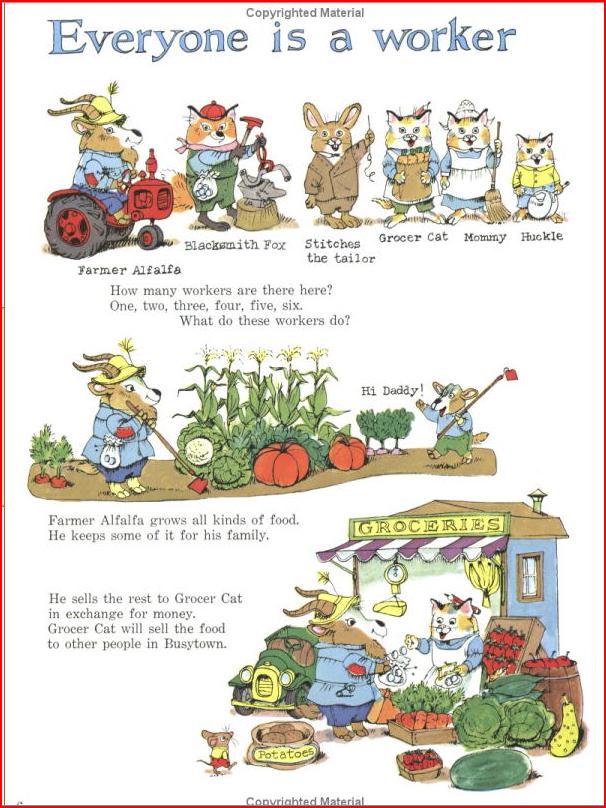
But Sendak's In the Night Kitchen does not. As shown yesterday, Sendak took a leaf from his model, comics master Winsor McCay, and pictured more than one instant on a single page. Two other author-illustrators who often used that technique are Jules Feiffer and Edward Gorey--the other children's-book creators that Scott McCloud proudly names in Understanding Comics. Yet another example that McCloud doesn't mention, but who I think clearly belongs in the same group, is Richard Scarry in his larger books. They all have multiple sequential images on a typical page, my first hallmark of comics style.

TOMORROW: How we read picture books and comics differently.

06 November 2007

Drawing the Line Between Comics and Picture Books

I am of course not the only fellow musing on where the line, if any, lies between comics and picture books. That's a big part of the argument in Dylan Horrocks's essay, "Inventing Comics," against taking Scott McCloud's influential analyses of comics as the last word on the art form.

This passage in Horrocks's critique focuses on McCloud's attempt in Understanding Comics to distinguish between picture books and comics:

The belief that ‘comics are a visual medium’ sits guard at one of comics’ most fragile frontiers - the one between comics and illustrated texts (children’s picture books and so on). In fact, in Understanding Comics [McCloud] fails to define it at all. And by including a number of children’s picture books (such as Maurice Sendak’s In the Night Kitchen), he even seems to leave it wide open.

But when R. C. Harvey raises the question of this border, it soon becomes clear that this was not Scott’s intention:
Harvey: ‘Do you think that your definition also includes children’s literature - books in which there is a picture on every page and prose beneath each picture?’

McCloud: ‘not if the prose is independent of the pictures. Not if the written story could exist without any pictures and still be a continuous whole. That’s how it’s usually done, whereas the pictures are usually discontinuous...’

Harvey: ‘[That is] the narrative is continuous and independent of the pictures. And the pictures really are illustrating some moment in the prose narrative. There’s no necessary narrative strand in the pictures themselves.’

McCloud: ‘If you turn that on its head, you have comics. If the pictures, independent of the words, are telling the whole story and the words are supplementing that, then that is comics.’
This exchange is a revealing one. If we were to take his definition at face value, we would expect Scott to agree that children’s picture books are indeed comics. So long as there are two pictures somewhere in a book - and so long as those pictures form a narrative, then that book is a comic by Scott’s definition. After all, there are those books by Sendak, [Jules] Feiffer and [Edward] Gorey he includes in Understanding Comics. And if he’s willing to include stained glass windows, photo-booth strips and Hogarth’s etchings, then surely he’s happy to welcome the countless literary classics that the inclusion of picture books would bring into the realm of comics.

But McCloud is not willing to concede the point. Instead he struggles to qualify his definition in such a way that it will exclude ‘mere illustrated texts.’ It is no longer enough that there be spatially juxtaposed pictures, nor that the reader performs closure in reading those images. Now the pictures must tell the whole story, independent of the words - which are only allowed to supplement the pictorial narrative. In effect, McCloud has added an amendment to his definition: comics must not only contain pictorial narrative; they must be dominated by it.
I think Horrocks is correct that McCloud's attempt here to differentiate traditional picture books from traditional comics doesn't hold water. In many picture books the illustrations can tell the whole story, with the words merely filling in details. And there are wordless picture books, such as Flotsam. And finally there are many comics that would be incomprehensible (or even more incomprehensible) without their words.

But I do think there's an artistic difference between the examples of picture books that McCloud accepts as comics and most picture books. And I think it's apparent in this page from In the Night Kitchen.

TOMORROW: Spelling out the difference, part 1.

08 July 2007

Let the Wild Rumpus Begin

Here's the first production still released from Spoke Jonze's filming of Where the Wild Things Are, by Maurice Sendak, courtesy of Movieweb. A well-chosen image, I must say. Evocative, exciting, and yet unrevealing.

Almost enough to overcome my dread based on the track record for feature-length movies made from picture books.