Showing posts with label AUTHOR Len Wein. Show all posts

25 August 2013

Titans vs. X-Men

A Twitter comment from UK artist Randolph Hoyte alerted me to Chris Sims’s Comics Alliance essay on Marv Wolfman and George Pérez’s New Teen Titans. Sims is careful to note that his assessment of that magazine versus its predecessor is a matter of taste and “probably has a lot to do with reading X-Men as a kid and not getting around to The Judas Contract until I was in my 20s.”

As I’ve noted before, Sims was twelve in the 1994, and the comics we read when we’re twelve shape our tastes and memories, for better or worse. I was in my late teens when New Teen Titans was published, and hadn’t read previous versions of the team. The magazine thrilled and pleased me by doing all I’d learned to like in superhero comics and more besides. I can reread those stories and enjoy the nostalgia, but it’s next to impossible to find the same thrill in other superhero stories—and nothing’s more disappointing than picking up a story touted as “classic” and finding that it’s, well, just a superhero comic showing the traits of the time it was written.

It’s fair to compare New Teen Titans to Uncanny X-Men, Marvel’s alternate-superhero team book of the same era, as Sims does. Wolfman, Pérez, and their editor Len Wein probably did pitch their Titans revival as a possible answer to Marvel’s mutant magazine. And the X-Men issues that Chris Claremont, John Byrne, and Dave Cockrum created in the late 1970s and 1980s are top-notch.
But Sims gives more space in this essay recounting favorite moments from X-Men #132 (“Wolverine gets dropped through four floors to the sewer, then comes back at the end ready to literally murder everyone he sees”) than discussing any New Teen Titans story, for better or worse. It’s true that X-Men “feels like a product of the Modern Age,” but that’s because a big part of the “Modern Age” (at its height around, oh, 1994) was Wolverine killing lots of people. A look at The New Teen Titans should highlight its storytelling, perhaps noting some qualities that the “Modern Age” left behind.

Unfortunately, Sims’s aside about when he read “The Judas Contract” is the only time he mentions that best-remembered New Teen Titans storyline. And the only page of Wolfman and Pérez’s work illustrating the essay is one that introduces a supporting character (one whom many readers hate far more than I think is healthy). Those details indicate how glancing this assessment is.

Let’s start instead with the differences between Uncanny X-Men and New Teen Titans to isolate the qualities of each. Wolfman and Pérez worked with a different universe and characters, and they created a different type of superhero saga.

The Uncanny X-Men had the overall theme of being outcast. The Marvel mutants were disliked and hunted by authorities. Their headquarters was a shadowy private school in upstate New York. In contrast, the Titans were celebrities who worked with the government out of a T-shaped skyscraper on an island in the East River.

Even the Titans who felt like outcasts fit in better than almost anyone on the Marvel team. X-Men’s “demonic” character was Nightcrawler, who had a barbed tail, blue skin, and a habit of disappearing in a puff of brimstone. The Titans’ equivalent was Raven, daughter of a horrific giant four-eyed red demon who looked like…a beautiful thin girl with straight dark hair wearing a hooded cape. Cyborg had major body issues, but he was a big, handsome jock. In fact, as Pérez drew them, all the Titans looked like supermodels, and the one who was a supermodel looked like a Playboy fantasy. Being accepted and popular wasn’t their problem. Their challenges grew from their internal lives and their pasts.

The overall theme of the New Teen Titans was inheritance. All four of the established heroes were sidekicks or younger versions of adult heroes, with varied feelings about their mentors and legacies. The three new heroes were all at odds with their parents. (One was sold into slavery by her father, another crippled when his father opened an interdimensional rift, and then there’s that four-eyed giant red demon—the usual issues.) The magazine’s breakout villain, Deathstroke the Terminator, was the epitome of a toxic father. The villainous cult of Brother Blood was a corrupted reflection of the new “family” that the Titans were creating for themselves.

The best and most innovative New Teen Titans stories focus on family: the ground-breaking issue built around Wally West’s letter to his parents, Starfire’s rivalry with her sister, Changeling’s rage at the killers of his adopted mother, Donna Troy’s search for relations, Dick Grayson’s decision to move past being Robin, and even “The Judas Contract.” Those emotional issues reflect the superhero storytelling style of the early 1980s when the big fights were held together with extended melodramas full of thought balloons.

As Sims says, that sort of superhero saga might not be to everyone’s taste. Undoubtedly my own fondness for those stories is rooted in the fact that I was in my late teens when they appeared. But the best of Wolfman and Pérez’s work stands up just as well as Claremont, Byrne, and Cockrum’s, and may hit deeper emotions.

03 February 2013

What Legacies Left Us

DC Universe: Legacies was a comics series published in 2010-11 during an apparent wave of nostalgia at DC Comics. It was scripted by Len Wein, a top editor at the house in the early 1980s, and drawn by a stellar cast of established artists: Joe and Andy Kubert, Dave Gibbons, José Luis García-López, George Pérez, Jerry Ordway, Dan Jurgens, Brian Bolland, and so on.

As the series ended, DC trumpeted several single-issue stories about its top characters created in the style of the 1970s, 1980s, or 1990s, using talent that had worked on the characters in those decades. Those magazines had the umbrella label of DC Retroactive.

Legacies retold the entire history of the DC Universe as it then existed—the universe that had been created by merging several parallel continuities at the end of Crisis on Infinite Earths in 1986 and remade more gently at ten-year intervals in the Zero Hour and Infinite Crisis crossovers. For the purposes of the weekly Robin, the series notes the debut of the first two Robins, the first two versions of the Teen Titans, and Nightwing, but shows little of Tim Drake, Young Justice, or later Titans groupings.

Wein retold that super hero history through the eyes of a kid from Metropolis who grew up to be a police officer and detective. That approach was quite like the way Kurt Busiek and Alex Ross structured Marvels, a 1994 retelling of Marvel Universe highlights through the eye of a news photographer.

Legacies’ main storyline is thus a recap of the company’s mythos—just enough for new fans to figure out how events fit together and a trip down memory lane for folks who’d read the stories originally. Wein didn’t try to reconcile or “retcon” gaps in the continuity, which left such glitches as Depression kids becoming a young couple in the late 1980s. (Hey, it’s comics!) With so much “history” to get through, there’s a high panel-per-page ratio reminiscent of earlier decades, but not much chance for deep drama or characterization unaided by reader nostalgia.

Wein added eight-page back-up stories about some of the odd corners of the DC Universe: the World War 2 soldiers, the sci-fi adventure teams of the 1950s, Jack Kirby’s New Gods, and so on. Shoved to the back of the collected edition, those little tales might be the most fulfilling because they’re complete tales in themselves, not squeezed to rush on to the next event that might change the entire world.

Where does the volume leave readers? For decades the narrator collects accounts of those costumed heroes on pulp paper, filing them in plastic—just like DC Comics’s most devoted fans. And the final pages reveal that he’s an old man in a nursing home, repeating those stories every night for an uninterested and unbelieving audience of attendants. Hardly the portrait readers would want of themselves.

Furthermore, just after this series ended, DC had announced that the continuity it recounts would be set aside in favor of a new variation. Was Legacies therefore a test of whether the nostalgia market was big enough to sustain the operation? Was it a sincere attempt to give new readers a way to “jump in” and catch up to the existing universe, only for the company to decide it had to do something more dramatic? Or was it always designed to be what it and DC Retroactive became, a last hurrah for that continuity before the company swerved onto a new path?

27 September 2009

The Legend of Jericho and the Teen Titans

This is one of the more dramatic and less flattering Robin images of recent years, drawn specially for the cover of DC Universe Illustrated by Neal Adams, vol. 1, the latest in a series of hardcover reprints of Adams’s artwork for DC Comics in the late 1960s and 1970s.

Earlier volumes covered Adams’s ground-breaking work on Green Lantern/Green Arrow, Deadman, and Batman (including the Batman/Teen Titans crossover, “Punish Not My Evil Son!”, a precursor to today’s storyline of Bruce Wayne suddenly acquiring a son of questionable morals).

In this volume DC leaves no barrel unscraped by assembling a miscellany of Adams’s superhero and war stories, including three issues from the Teen Titans in 1969. The story behind those issues is actually more interesting than the story they tell. The backstage drama appears in Adams’s introduction to this book and in the interviews in The Titans Companion, volume 1, by Glen Cadigan.

At the time, Adams was among the younger creators at DC Comics, pushing the company to make its magazines both technically better and more socially relevant. People came to see him as a mentor and advocate of a couple of even younger writers, Marv Wolfman and Len Wein.

In late 1968 they scripted an issue of Teen Titans that team introduced a not unsympathetic Soviet superhero—a daring move at the time. And they had an even more daring idea for their next assignment.

As Marv Wolfman told Cadigan:

We met with [editor] Dick Giordano, and told him our idea of a gang, a black super-hero, and of a fairly straightforward type of story, closer to what we were seeing in Spider-Man, but with the Teen Titans. We came up with a black character because DC didn't have any at the time. . . .

Dick liked the story concept, but knew that there could be some problems because of the time period, and brought us into Irwin Donenfeld’s [office], who I guess was the Vice-President; I forget the exact title. We met with Irwin for maybe fifteen minutes at most. Irwin said he really wanted us to try to do this, try to make it a multi-parter—which, in itself, was incredibly exciting—to really be powerful and very street and very authentic, and try to get down and dirty, get a lot grittier. . . .

A couple of weeks later we came back, and at that point Irwin had left and there was a new person in charge. Whatever the reasons were, because there are so many differences of opinions on this, the story got dropped. Whether it was actually because it was a bad story, or whether it was because of some other reasons, I don’t know.
Actually, the DC editorial team was aghast at what Wolfman and Wein had delivered. They were probably prepared for Jericho to be DC’s first black hero (as Marvel had already introduced Black Panther and Falcon), but the young writers had gone really “down and dirty.” Giordano recalled:
Len and Marv came back with a story that everyone but me, evidently, thought was too preachy in its approach to the race problem. Carmine [Infantino] brought the lettered pencils that he may have had on his desk to design a cover and threw it on my desk, rejecting it! It was already a tad late and there was no way of my replacing it on time. But for Neal Adams!
And Adams picks up the tale:
Not only was it a black character, but it was a black character who was very aggressively mouthing anti-white [dialogue]. Very, very aggressive black-oriented dialogue, right off the bat. . . .

I started to hear some really hostile reports relative to the script from Carmine. Everybody was just lit up, and I was worried about [them]. Here Len and Marv were trying to make it into the business, and they had just fried their own chicken. So I was concerned about them. I checked into it, and I asked if I could read the script. I thought, maybe just a little doctoring of the script could fix it.
Of course, since people perceived Adams as Wolfman and Wein’s sponsor, a bit of his own reputation was on the line. Here’s how he describes that moment in the DC Universe Illustrated volume:
Len and Marv appealed to me to step in. . . . I went in and made a case. The suits read the dialogue to me...aloud.

I said...just have Len and Marv modify the language.

They didn’t trust them to do it. I volunteered to do it.

They asked did I read the whole script?

I hadn’t. So I did.

Oh. Golly.

Yep, they had done it. It pushed so hard that DC wouldn’t abide it. No amount of dialogue doctoring would turn it around. Len and Marv were ahead of their time. DC wasn’t.
And the deadline for that multi-issue arc was getting tighter. Adams suggested that he could write a similar story without the racial angle, one which probably had to fit the announced title “Titans Fit the Battle of Jericho.” Infantino insisted that Adams needed to pencil the story himself in order to keep the magazine on schedule. The result is a crazy casserole of youth politics, giant robots (as shown at top), masked men, guest stars, crime bosses manipulated by interdimensional monsters, and more.

Adams wasn’t too pleased with his hurried work for Teen Titans, #20-22, in terms of writing or art, but felt that he’d helped preserve Wolfman and Wein’s careers. Giordano saw the whole thing as “my blunder,” and regretted that he and his fellow editors were ordered not to use those young writers. Wolfman recalled, “Len and I didn’t get work for almost two years from DC.”

At least that’s the legend of Jericho. Except that Wein told Cadigan that DC blackballed him and Wolfman over something else, which he didn’t specify:
It was nothing to do with that story. It had to do with an entirely different situation. . . . Something had happened that we were accused of which we were not responsible for. We were sort of blackballed there, and when it was eventually proven that someone else at the company, who had been there for many years, was responsible, they shame-facedly said, “We’re sorry. Never mind,” and we came back to work for them.
That discrepancy is a mystery for comics historians to solve.

In early 1970, longtime DC editor Robert Kanigher (1915-2002) introduced DC’s first black superhero, Mal Duncan, in the pages of Teen Titans. [ADDENDUM: More of that story, and editor Dick Giordano’s use of coloring to minimize complaints about an embrace between Mal and a white girl, at Comic Book Legends Revealed, #229.]

28 February 2009

Titans Killed in Implosion?

Yesterday I wrote about my memories of New England’s infamous “Blizzard of ’78.” I wasn’t yet reading comic books then, but I’ve since learned that that meteorological event had a major effect on DC Comics.

In the mid-1970s DC was losing ground in the marketplace. Marvel’s comic books were hipper, attracting more college kids and fewer elementary-school kids. Even with constant turnover in the editor-in-chief's office, Marvel kept growing. So Warner Bros., which had become DC's parent company, fired editorial director Carmine Infantino and hired young Jenette Kahn, founder of Kids and Dynamite! magazines.

Kahn responded to economic pressures by raising prices—to fifty cents!—while also expanding the magazines. Issues grew from 17 pages to 25, meaning there were longer stories or backup stories. The company also put out “giant-sized” magazines for a whole dollar. Kahn sought to build more links between DC's magazines and kids' TV shows and movies.

DC and Marvel were then in a “newsstand war,” vying for space at news racks, drugstores, and other traditional retail outlets. Kahn’s strategy was a plethora of new titles to increase visibility, promoted to readers as the “DC Explosion.” Kirk Kimball’s Dial B for Blog website ran over the stats:

DC launched 16 new titles in 1975, 21 in 1976, 12 in 1977, and 8 in 1978—a total of 57 new titles in four years. New superhero books included Firestorm, Black Lightning, Shade the Changing Man, and Steel. There were also relaunches of older books such as Jack Kirby's New Gods and Mister Miracle.
And among the relaunched books was The Teen Titans.

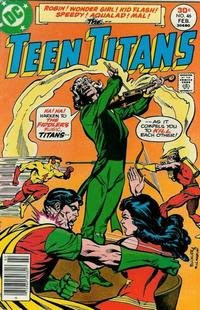
fiddlerThat title, featuring a team of superhero sidekicks led by Robin, had started in 1966, with scripts by Bob Haney. (His attempts at teen-aged slang are unintentionally their most entertaining feature.) That series ended with a whimper in 1973. But it began again with issue #44 in late 1976 under new scripter Bob Rozakis, who'd started as a prominent comics fan and broken into the business by supplying puzzles on superhero themes.

Then came a force stronger than Wonder Girl. Here's more from Dial B:
In late 1977, America was frozen stiff as horrendous winter weather swept much of the nation, with one blizzard raging on for as long as 25 hours, and wind chills reaching 60 below zero. Seven western New York counties were declared national disaster areas, and in Buffalo, 29 people died of exposure. Then, in February 1978, the "Blizzard of 1978” battered the entire East Coast, claiming 54 lives and causing an estimated billion dollars in damage.
DC's distribution system was crippled. And each of its magazines had a date right on the cover, meaning that they looked like old goods even before they got out of the warehouses.

The sales numbers looked awful, and Warner Bros. insisted that DC cut its line back. That required canceling sixty-five titles, a move that insiders sardonically called "the DC Implosion." Basically, the corporation threw in the towel and chose to focus on milking its core legacy properties, like Superman and Batman, rather than creating new characters. Marvel had won.

In an interview published in Glen Cadigan's The Titans Companion and here at titanstower.com, Rozakis recalled that the "DC Implosion" killed his Teen Titans run. He had enough warning to write a farewell issue, which told the origin of the team (Haney had never bothered to explain) and then showed the sidekicks disbanding.

But here’s the thing. The last issue of Rozakis’s run was #53, with a cover date of February 1978. That means it was supposed to reach newsstands a month or two earlier, and he’d scripted it a month or two before that. DC must have called off the Teen Titans even before the winter of 1977-78 began. As Dial B’s stats show, the company was still introducing new titles in 1978, and didn’t cut back until late that year.

So why did DC kill the title? According to Cadigan’s Titans Companion interview with comics editor Len Wein, Kahn told him, “it was making a profit when we cancelled it, one of the few occasions in history that we cancelled a successful book because we were so embarrassed by the creative content.” Ooh.

I suspect that Rozakis, looking back after twenty years, amalgamated his memory of the Teen Titans cancellation with the “DC Implosion” that followed several months later. It's also possible that DC insiders' understanding of the “Implosion,” the basis of the description above, might be too simplistic; the real problem might have been lots of mediocre comics that were shut down gradually, but people preferred to blame it all on the weather.

Ironically, the Teen Titans cancellation and DC Implosion set up the company for three major developments of the next decade. First, the summer of 1978 brought the first Superman movie starring Christopher Reeve, a huge hit for Warner Bros. That made the corporation very happy about its DC Comics line, and bolstered Kahn’s strategy of tying comics to other media.

Second, Wein, Marv Wolfman, and George Pérez had a clear playing-field when they came up with The New Teen Titans in 1980. That series’ combination of gorgeous art and relatively mature, emotional stories made the sidekicks team into DC’s best and best-selling comic book of the new decade.

And third, the market for comics moved away from those newsstands and drugstores into specialized comics shops, where the staff and clientele sought out quality. The New Teen Titans were one of the first new hits in that marketplace. With an eye on the new playing field, in the early 1980s Kahn and her editors took the bold step of going to Britain to recruit talented writers and artists. They brought back contracts with Alan Moore, Neil Gaiman, Grant Morrison, and many others, part of a true explosion in American comics.