Showing posts with label BOOK Artemis Fowl. Show all posts

23 December 2011

Bartimaeus Flattened on the Page

Andrew Donkin shares credit for the script of the Amulet of Samarkand graphic novel with Jonathan Stroud, just as he shared credit for the Artemis Fowle adaptation with Eoin Colfer.

I thought the Artemis Fowle comic was very good, equal or perhaps even better than the novel. However, I thought the comics adaptation of the first Bartimaeus novel was merely a flattened version of the original.

The Samarkand art, by draftsman Lee Sullivan and colorist Nicolas Chapuis, is just fine. Their pictures of a magical London are terrific; I especially like the way their London Eye has the five-pointed pentagram inside it. I found it somewhat difficult to follow how old Nathaniel was in different scenes as the narrative flashed back and forth, but that really points to the larger problem in this adaptation.

Colfer’s Artemis Fowle was practically made for the comics form. The narrative voice is an omniscient, detail-oriented third person. The conflict is built on opposing teams with clear goals. The narrative is built up from plot twists in the physical world rather than realizations in the mental one. The characters cover a broad range of physical types, with corresponding personalities.

In contrast, Stroud’s Bartimaeus books are a triumph of narration. There’s Bartimaeus’s own voice, with its boasts and footnotes, which brief comics captions can barely replicate. That voice helps us follow the djinn through his shapeshifting and world-jumping while in the graphic format we have to see Bartimaeus from the outside.

The novel’s other, third-person narrative voice shows us Nathaniel growing up and working his schemes. It provides the sense of distance useful for an anti-hero while letting us into his head as he thinks and rethinks.

The narration also keeps the timing of different scenes distinct. In the comics version, there’s a short sepia-toned flashback to when Nathaniel was very little, but all the other scenes unfold before us looking like the present, differentiated only by captions saying NOW and BEFORE.

Indeed, I wonder if this form would have worked better if it started at Chapter 11, “The Day Everything Changed”; using Nathaniel’s confrontation with Simon Lovelace to fill us in on the boy’s background and world; and then proceeding chronologically. That approach would have kept Bartimaeus off the stage for longer. However, if we can’t hear his voice in all its glory, it’s unfortunately not such a loss.

25 February 2008

Models of Magical Law Enforcement

My recent return to the world of Artemis Fowl left me thinking about magical law-enforcement. It's widely recommended that fantasy authors figure out how magic works in the worlds they create, communicate those processes and limits to readers, and then stick to them. So rules of magic are part of nearly all fantasies.

But rules against magic that characters could do but shouldn't are another matter. These, too, have a long history, back to the sorcerer's apprentice and beyond.

Sometimes such laws are given the force of government, as when Princess Ozma of Oz forbids her subjects from practicing magic, excepting only Glinda and the Wizard--and herself--and Dorothy, when she needs to--and her other friends, come to think of it. Hmmm.

Diana Wynne Jones's Chrestomanci is also a magical law enforcer and fixer, though his source of authority is not exactly clear. This is an aristocratic model of government: a carefully educated strong man chosen for his power, passing down his title and property (though not within his family).

In recent years, magical regulation has become more bureaucratic. We met the feckless Ministry of Magic in J. K. Rowling’s Harry Potter series, a branch of the British civil service headed by a politically minded wizard. Harry and his friends get a close-up look at its workings in HP7, when they penetrate its headquarters in disguise, and that book's epilogue tells us that as adults they basically seize its levers of power.

We also encountered an entire magical government of Great Britain in Jonathan Stroud's Bartimaeus trilogy. In these books, wizards don't serve a non-magical Prime Minister but hold the ministries themselves, oppressing the commoners who can't work magic and the genies who actually perform all the spells.

All these models of magical law enforcement involve human magicians regulating other humans. Magical creatures, even sentient ones, basically remain above (or below) any law but nature's. A genie or giant might have to be suppressed here and there, but no one expects magical creatures to significantly adapt their behavior to society. After all, such creatures are basically embodiments of mysterious natural forces.

Which brings me back to Artemis Fowl. In that novel Eoin Colfer shows us all the bureaucratic rivalries and back-biting of the Bartimaeus books, the abject concern for public relations and petty rules of the Ministry of Magic. But in Colfer's world, the law enforcers are fairies themselves. They have natural laws they must follow, but they also have rules they've decided on for their protection and enforce ruthlessly. Far from being beyond human-style politics, they're in the thick of it. No wonder the series leaves some readers dyspeptic.

20 February 2008

How Artemis Fowl Goes Graphic

When Eoin Colfer's Artemis Fowl was first published in 2001, Miramax/Hyperion marketed it as a counterpoint to Harry Potter. Of course, back then every book from presidential memoirs on down was being compared to Harry Potter. At least Colfer had actually written in the same genre as J. K. Rowling.

Artemis is an anti-hero, angling to be a master criminal rather than a magical law enforcer. He has vast resources and loyal support. Though eventually we learn he's as hungry for a happy family as Harry is, long before then the reader might feel that what Artemis deserves most is a punch in the face.

Perhaps as a result, Colfer and Rowling used different storytelling strategies. The Harry Potter novels stick closely to Harry's point of view. When they narrate events through into someone else's eyes, as in the start of HP4, there must be a very important reason: in that case, to show Voldemort killing so we understand the stakes.

In contrast, Artemis Fowl was never all about Artemis Fowl. Yes, the story starts by tracking his scheme to steal fairy secrets and gold, but Colfer shifts to narrating over the shoulder of a young fairy law enforcer named Holly Short--a more upright and sympathetic character. For the rest of the novel, the point of view bounces among different characters, including Holly's gruff but dedicated boss, one of Artemis's household servants, and a dwarf expert in breaking and entering.

Comic books have shifted like that for years. The visual dimension makes it easier for readers to follow the change: we turn the page, see a new character in a new locale, and we get it. We don't even need "Meanwhile,..." captions anymore.

In the last couple of decades, the omniscient narrator who used to fill the captions of comic books with bombastic explanations has disappeared. Instead, most captions are in the first-person, present-tense voice of the main character. That technique has developed its own symbolic grammar: those captions often have different colors, symbols, and fonts for different characters. That lets comics delineate two or more points of view in the same scene, even the same panel.

Indeed, I think a great potential strength of the comics form is its ability to show two parties working against each other without making readers take sides (if the creators wish to remain neutral, of course).

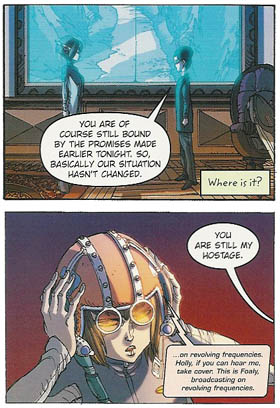
Artemis Fowl: The Graphic Novel uses that comics technique to replicate the prose novel's shifting points of view. Contrast the caption in the first of the four stacked panels above, its font and coloring, with the caption in panel three. The first is the fairy Holly's thought as she searches for her helmet. The second is Artemis's reflection as he sees Holly about to punch him in the face. The comics form offers both characters' thoughts in the same scene.

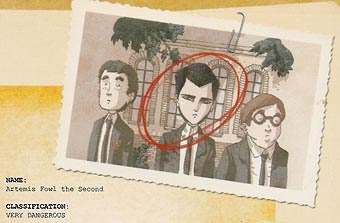
Another comic-book technique that pops up in Artemis Fowl: The Graphic Novel is the character profile; the top illustration is a bit of Artemis's. Each full-page profile offers a combination of words and image to introduce a magical creature or locale. Novels can't lay out such information without breaking the narrative flow, but such profiles are a comic-book tradition. DC publishes a whole series offering such dossiers on its heroes and villains: Secret Files. Another inspiration is probably card games like Magic: The Gathering. (It's no surprise that similar pages appear in The Spiderwick Chronicles; coauthor and artist Tony DiTerlizzi worked on Magic cards.)

There are other big points of overlap between Colfer's Artemis Fowl and comic-book adventures:

The second of those qualities is a flaw in any kind of novel, but the last one is a plus for the graphic form. The action allows visual storytelling in the hyped-up style that comic-book creators have developed to a high effect over the years. It's another way that, I found, Artemis Fowl: The Graphic Novel works as an over-the-top adventure comic.

Bottom line: A novel that reads a lot like a comic book makes a good comic book.

22 September 2006

Crying Artemis Fowl

Early in chapter 1 of his first Artemis Fowl book, Eoin Colfer offers this description of the title character: "A pale adolescent speaking with the authority and vocabulary of a powerful adult."

How could wish-fulfillment like that not find a worldwide audience? Plus, Colfer gives that pale adolescent boatloads of money, high-tech weapons and surveillance toys, and a loyal manservant to handle all the dangerous physical work. What more could videogame players want? Sure, Artemis's father is missing and his mother insane, but pale adolescents half-wish, half-believe they're in that situation already. As Gregory Maguire's review for the New York Times said, the novel may have only faint charm to go along with its thrills, but it does what it sets out to do.

I don't know how Penguin published Artemis Fowl in the UK, but Miramax Books did a fine job of positioning it in 2001 as the anti-Harry Potter, darker and older. Plus, just as news of the US book deal boosted Potter at its publication, Miramax crowed about the movie rights it had also bought. Since then, of course, the Harry Potter books have gotten dark as well, but Colfer gained his necessary toehold in North America.

As I read Artemis Fowl and things exploded and burst and farted around me, I found myself thinking about the book as a nationalist statement. Colfer is an Irish author who, until this book, hadn't been published outside Ireland. He portrays his home island as particularly beloved of the ancient fairies, but also extremely high-tech. Colfer's 2003 interview with C.M. McDonald hints at his feelings:

McDonald: His books also give us a sense in America what has happened because of the technology industry in Ireland. Have you found your corner of Ireland changing quite a bit?

Colfer: Very much so. People still have this Quiet Man vision of Ireland, and that does exist to a small extent, but Ireland has the largest growing economy in Europe and we have more computer plants per capita that I think anywhere else in Europe, as well. There’s a lot of American big business in Ireland--Mac and Dell and all these companies are there. A very high percentage of people are working in computers and are computer graduates. There are a lot of Porsches and BMWs driving around now that you never would have seen twenty years ago.
Indeed, in 1987 the per-capita income of Ireland was only 63% of that in the UK, but in 2004 the Irish measure passed Great Britain's. To some extent the picture of Eire as a high-tech hub is exaggerated. EU statistics show Britain still ahead of Ireland in internet access and use, and the level of poverty in Ireland remains higher. But Artemis Fowl emphasizes futuristic, not nostalgic, Ireland.

Compare Colfer's use of technology to what we see in the Harry Potter books. Rowling's wizards are determinedly old-fashioned, using quills and candles. Only the muggles have modern technology, which fascinates Mr. Weasley, but Harry's poverty and preference for the wizards' world leaves him without a PC, Gameboy, or cellular phone. His idea of high tech is a new flying broom. Artemis has much better toys, and his world's magical beings have also upgraded.

Perhaps later Artemis Fowl books, such as The Arctic Incident, don't have quite such an undercurrent of Ireland and what it means today. But I doubt Colfer has left that theme behind. He is, after all, author of The Legend of Spud Murphy, about a potato-blasting librarian.