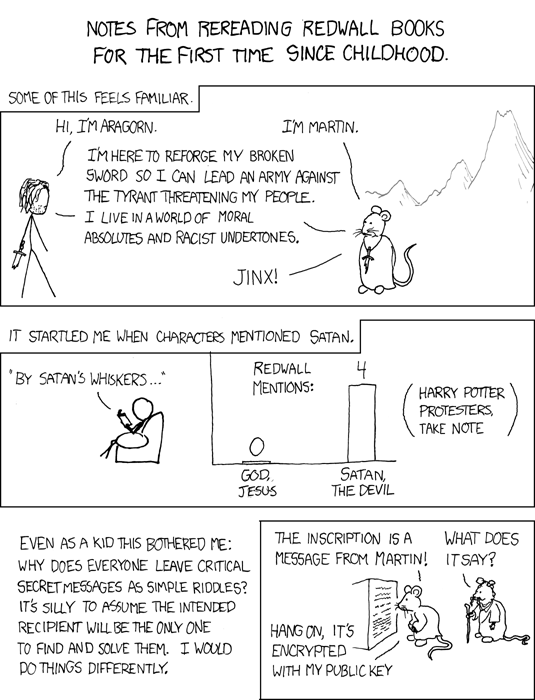
Our latest generation of readers has had a range of sword-wielding mice to choose from. First came Brian Jacques's Redwall series, starting in 1986. Then Kate DiCamillo's Tale of Despereaux, both the 2003 Newbery Medal winner and the major motion picture. And in comics there's David Petersen's Mouse Guard.
In the preface to the series' first collection, Mouse Guard: Fall 1152, Petersen described how he came up with the world:
On a scrap of paper I had quickly scratched "Mice have a culture all their own. Too small to integrate with other animals." This scribble led to more thought about how mice would survive as characters in such a hostile world populated with predators. "Hide the cities. Make them self sufficient and spread apart from one another." From a storytelling perspective the mice were prisoners in their own homes.
Sketches followed of three mice, Saxon, Kenzie, and Rand, destined to play the roles of pathfinders for their kind. As Mouse Guard rattled around in my head, the world became populated with more characters, towns and villages, and a history of its own, until 2005 when it began spilling onto paper.

During a panel discussion at the recent Chicago Comic-Con, as
reported by Comic Book Resources, Petersen offered more detail on how he found this story:
I started developing mouse society and planning on then moving onto all the other animals and treating the different species as different "races." As soon as I got to the point of protecting the mice and having a Mouse Guard and having them live in this little world, I thought, "This is the heart of the story. This is the story of the underdog." That's where it came from.
I find it interesting that Petersen's idea of a sword-and-sorcery culture for mice preceded his ideas for characters and plots. And the route from the first aspect to the full story was a theme of the little underdogs.
Some author-illustrators might have started with sketches; indeed, the most appealing and impressive aspect of Petersen's comic is the gorgeous, large-panel, color art. Some writers would have started with the characters, or with particular moments, such as the little caped mice in battle with snakes and crabs.
Instead, the roots of this saga seem to lie in its maps (soon to be outmoded) and pictures of little mice at work. Those remind me of similar pictures in
David Macaulay's
Cathedral,
Eric Sloane's books on agricultural tools, and
Edward Tunis's volumes on colonial America.