Showing posts with label COMIC Batman. Show all posts

24 November 2019

Tom Lyle and the Robin Miniseries

In 1986 Tom Lyle, an aspiring comic-book artist in his thirties, went to a comics convention in Philadelphia. There he met Chuck Dixon, a young writer who was scripting Air Boy for Eclipse. Based on Lyle’s samples, Dixon got him the job of penciler on a related title, Sky Wolf. In a chat with Comics Interview magazine, Lyle credited that as “the event that triggered my career” in comics.

Lyle was recruited by DC Comics to draw Starman in 1988. After a couple of years, as he was wrapping up that assignment, Lyle asked Batman group editor Dennis O’Neil if he had any openings. O’Neil was planning a miniseries focusing the newly created Robin, Tim Drake.

“I’ve never been real thrilled with the Robins,” Lyle told his interviewer. “Dick Grayson, the original Robin, I couldn’t have given a flip about when I was a kid; it was like, ‘Get out of the way, kid, I want to see Batman.” But a job was a job.

O’Neil’s team wanted to make Robin into a martial-arts expert, so they needed a writer who understood the martial arts. Lyle suggested Dixon. He got the assignment and went on to be DC’s most productive writer of the decade. (On the occasion of his 40,000th comics page in 2017, Bleeding Cool noted Dixon wrote 106 issues of Robin, 89 issues of Detective Comics, 77 issues of Nightwing, 46 issues of Birds Of Prey, and 22 issues of Catwoman, to name a few.)

Dixon and Lyle’s first issue of the first Robin series carried a cover date of January 1991. The character of Tim Drake had been created by Marv Wolfman in issues drawn by George Pérez, Jim Aparo, and Norm Breyfogle, and his costume was designed by Neal Adams. But Dixon and Lyle’s portrayal fleshed him out by showing him on his own. Lyle was especially good at portraying Tim as a thirteen-year-old, lithe but not a powerhouse, the littlest guy in the fight who needed to think harder than anyone else to stay alive.

In the gritty, pouched, and overpumped 1990s, Robin was the equivalent of counterprogramming on broadcast television—standing out by doing something different. And it worked. According to Lyle, DC expected to sell about 200,000 copies of the first issue of the Robin miniseries. Instead, it sold three times that number.

DC asked the Dixon-Lyle team for a second miniseries about Tim Drake going up against the Joker, issued at the end of 1991. Then came a third, featuring the character the Huntress for an interesting contrast. That was the height of the speculative boom, and those magazines are festooned with holograms and other gimmicks.

Dixon and Lyle also collaborated on issues of Batman and Detective Comics showing Batman and Robin together. One of those magazines introduced Stephanie Brown as the Spoiler, who went on to become Tim Drake’s love interest, a fan favorite, and eventually Robin and Batgirl herself for limited periods. Lyle was also the artist for the first Robin Annual and the 1992 public service ad in which Tim decides to learn the facts about AIDS.

During that time, Lyle also plotted and penciled the early issues of The Comet for DC’s Impact imprint. In 1993 he started working for Marvel Comics on Spider-Man stories. That same year, DC launched the Robin monthly series with Dixon as regular scripter.

After another ten years or so, Lyle left monthly comics to become an art teacher at the Savannah College of Art and Design. Earlier this year he suffered an aneurysm, and last week he died, aged 66. Friends and fans have set up a Go Fund Me page for his family.

06 December 2015

Sam Hamm’s Plan for Robin, part 4

When we last left Sam Hamm’s penultimate screenplay for the 1989 Batman film, Batman was badly injured in the crash of his bat-shaped airplane, and Dick Grayson, dressed in his “ominous” red-and-green gymnast’s suit, was chasing the Joker with a .38.
EXT. GOTHAM CATHEDRAL - NIGHT

A BELLTOWER's jagged spire, jutting up into the night sky, piercing the moon. At street level, the JOKER scrambles up the marble steps the entrance of the old abandoned cathedral. He pulls a WALKIE-TALKIE off his belt.

JOKER
Gotham Cathedral. Come and get me.

HEAVY PANELED DOORS groan on tired hinges as THE JOKER forces his way inside. A beat. Then DICK GRAYSON appears, hot on his trail, sprinting up the steps two at a time.

INT. CATHEDRAL - A MOMENT LATER - NIGHT

Ancient and creepy. A huge pipe organ, shattered stained glass windows, row after row of mahogany pews… all forgotten, covered with dust and cobwebs. The JOKER wanders about, staring at the statuary, the rusted icons.

DICK enters silently behind him. He kneels behind a rear pew, brings up the GUN, and squeezes off THREE QUICK SHOTS at the JOKER. The JOKER dives, takes cover, and RETURNS DICK'S FIRE. Then: silence.

In a crouch, groping his way along the wall, THE JOKER finds what he wants: a small door opening on a wooden stairway, leading to belltower. He ducks inside and starts up.

DICK'S GUN drops with a thud. His hand slips from the back of the pew. In the second before he slumps to the floor, unconscious, he sees a curious sight: a TINY BLACK NINJA WHEEL, embedded in the flesh of his leg.

Behind him -- framed in the arched doorway -- A RAGGED BLACK GHOST begins his final unholy march down the center aisle of the old cathedral.
That would be the Batman. And apparently he’s stuck Dick Grayson with a ninja wheel. Perhaps the Joker has also shot Dick, perhaps not. Perhaps the ninja wheel is drugged. That’ll teach the kid the danger of using guns!

The Batman follows the Joker up the tower. They have a fight that involves fainting, the helicopter, a time bomb, a collapsing staircase, and a flock of bats. The Joker dies. Because killing someone with a bomb or by causing him to fall from a helicopter is clearly better than shooting him.

For a moment it appears Bruce Wayne is also dead, having sacrificed himself to kill the Joker (and his helicopter pilot, and co-pilot, and possibly Dick Grayson from lack of blood).

But instead the dead man is just the character eventually played by Robert Wuhl, so no great loss. The denouement scenes include Vicki Vale and Bruce in a pool together, and then:
EXT. BATCAVE - THAT MOMENT - DAY

DICK GRAYSON stands at the brink of the bottomless pit and looks up at the GYMNAST'S RINGS suspended overhead. He sets his jaw and then -- with only a moment's hesitation -- LEAPS INTO THE VOID.

His hands find the rings. He launches himself HIGH INTO THE AIR and does a spectacular TRIPLE SOMERSAULT, catching the rings on his way down.

Exhilarated, he makes a perfect landing on the edge of the pit. A SMILE OF PLEASURE comes to his lips.

CUT TO:

EXT. ROOFTOP - GOTHAM CITY - NIGHT

A dark, moonless night. LIGHTS OF THE CITY sparkle in the distance. CAMERA DRIFTS across the rooftop, settling finally on the broad back of a BLACK-CAPED FIGURE poised at the edge of the roof, gazing down on the streets below.

A SECOND FIGURE enters frame. We get a brief glimpse of his RED-AND-GREEN SUIT in the seconds before our EYES TURN SKYWARD... to the SEARING YELLOW SPOTLIGHT sweeping through the clouds. In its center: the VAST BLACK SILHOUETTE of a BAT, wings extended, DOMINATING the sky.

We HOLD on the GLARING BAT-SIGNAL as BATMAN and ROBIN vanish over the edge of the roof, plunging down toward new adventures as we...

FADE OUT.
But none of those scenes made it into the 1989 movie. As Hamm explained to Comics Alliance, after many requests to include Robin in the screenplay, the producers decided his scenes were too expensive and took them all out.

Batman was a huge hit nonetheless. And the immediate plans for a sequel gave Hamm another chance to introduce Robin, the Boy Wonder.

22 November 2015

Sam Hamm’s Plan for Robin, part 3

Way back here, I was sharing excerpts of Sam Hamm’s early screenplay for the 1989 Batman movie, a version that featured Robin. Here’s more.

At this point, Dick Grayson’s parents have been killed during their trapeze act—not by Boss Zucco ’s enforcers but by the Joker. Dick wants to go after that villain. Bruce wants him to stay safe in stately Wayne Manor. They fight. In losing the fight, Dick figures out that Bruce is Batman.
INT. BATCAVE - EVENING

TIGHT ON a tiny electronic device: two cylindrical steel casings bracketed together, topped by a DIGITAL TIMER.

BRUCE watches the TIMER tick off seconds: 30. 29. 28. At 25 seconds, BRUCE kills the countdown and CLAPS THE DEVICE into an empty packet on his utility belt.

He stands up wearily. Behind him, hanging back discreetly in the shadows, is his loyal butler ALFRED.

BRUCE
Where's the boy?

ALFRED
Upstairs. He's quite docile.

BRUCE
I know the feeling. It won't last.
(sighing)
He's a long way ahead of where I was at his age.

ALFRED
Respectfully, sir... there'll never be another one like you.

BRUCE smiles sadly. He takes a moment to survey the Batcave as ALFRED looks on tremulously.

BRUCE
How long's it been, Alfred? A quarter of a century?
(beat)
It seems like yesterday. I guess we ended up doing more harm than good.

ALFRED
Don't ever say that, sir. Don't ever believe it.

BRUCE
If not for you I never would've made it. You know that. My own parents couldn't have...
(taking Alfred's shoulders)
... The boy, Alfred. You'll both be provided for. Don't let all this go to waste.

Their eyes lock for a long moment. ALFRED is unable to speak. Finally BRUCE turns and starts slowly up the long circular stairway which leads from the Batcave to Wayne Manor.
After some foofaraw, Batman goes out to confront the Joker, armed with nothing but an advanced fighter plane equipped with missiles.
EXT. STREET - ON JOKER

He LAUGHS INSANELY as the BATWING bears down. At the last instant he hoists a SUBMACHINE GUN. BULLETS pepper the dome of the cockpit.

BATMAN'S MISSILE goes wide right, EXPLODING on the sidewalk. The JOKER drops to the street, unharmed, as the BATWING swoops past. The rear stabilizer wing is trailing THICK BLACK SMOKE.

INT. BATWING - MOVING - THAT MOMENT

BATMAN knows he's in trouble. He buckles a parachute around his chest, finds a button on the control panel. THE COCKPIT DOME flies free of the BATWING, leaving BATMAN exposed to the buffeting wind.

EXT. STREET - ON JOKER

He's scored a hit. He HOWLS IN TRIUMPH. But his maniacal glee is short-lived.

Standing not twenty feet away, in the clearing smoke from the rocket explosion, is an ominous figure in a RED-AND-GREEN GYMNAST'S SUIT.
This is obviously some new usage of the word “ominous.”
DICK GRAYSON -- eager for the kill -- sets out in pursuit of the JOKER.

INT. BATWING - MOVING - THAT MOMENT

BATMAN is losing altitude. HIS CAPE billows wildly around him as he reaches for a SECOND BUTTON -- this one labelled 'EJECT.'

He punches the button. His SEAT disengages. But Batman finds himself suddenly JERKED BACK INTO THE COCKPIT.

HIS CAPE HAS SNAGGED ON THE EJECTION MECHANISM!!! He clutches frantically at this throat as the plane plummets to earth!

EXT. STREET - THAT MOMENT - NIGHT

THE JOKER, on the lam, darts around a parade float. DICK vaults onto the float, LAUNCHES HIMSELF into the air, and DROPS the JOKER with a flying tackle.

But before he can strike... A RESOUNDING CRASH shakes the street.

ANGLE ON BATWING

The plane lies in pieces on the pavement. FLAMES ERUPT. BATMAN's been thrown free, but he's PINNED BY THE WRECKAGE. It's a matter of seconds until the gasoline tank goes up.

EXT. STREET - ON DICK AND JOKER

DICK watches in shock. On one side, the killer of his parents. On the other, BATMAN -- who will surely die unless someone pulls him free.

There's only one choice, and they both know it. DICK glares at the JOKER for the merest of seconds, then TURNS HIM LOOSE. MAD LAUGHTER echoes in the streets as the JOKER escapes -- and DICK races off to BATMAN's aid.

EXT. STREET - A MOMENT LATER - NIGHT

BATMAN grimaces in agony as DICK struggles to free him. His right leg -- shattered -- is like rubber beneath him. His ribs are crushed. He's barely alive.

BATMAN
How did you...

DICK
I hitched. MOVE IT!

DICK drags BATMAN to safety as the remnants of the Batwing BLOWS UP.

BATMAN
The Joker. Is he -- ?

DICK spots an abandoned .38 on the pavement -- left there by one of the JOKER'S GOONS.

DICK
Forget it. Relax.
(reaching for the gun)
... He's mine now.

BATMAN
DICK!

THE BATMAN tries to pull himself erect. The pain is unendurable. His body has finally failed him.

He collapses on the pavement, powerless to intervene, as DICK races off with murder in his eyes.
Okay, now it’s a teenager in a red-and-green gymnast’s suit with a gun. Because that’s what the Batman mythos is all about.

But it’s interesting that Hamm was decades ahead of The Incredibles in warning about the danger of capes and aircraft.

15 November 2015

“A depth that other superhero comics didn’t have”

A few months back, as McFarland sent out the first copies of Dick Grayson, Boy Wonder, editor Kristen L. Geaman asked all of us contributors to describe what our essays were about.

Here’s how I summed up my essay “Success in Stasis: Dick Grayson’s Thirty Years as a Boy Wonder” for the project’s Tumblr page:

The first chapter of the book looks at the first thirty years of stories about Dick Grayson, from his debut in 1940 until he leaves Wayne Manor in 1969. That was a period of stasis for the character, with no growth and no rifts with Batman that weren’t solved by the end of a story. Yet it was also the period that established Robin the Boy Wonder as a household name.

This chapter argues that the partnership of Batman and Robin was crucial to how those characters survived in the late 1940s when almost all other costumed superheroes stopped being published. The emotional bond between Dick Grayson and Bruce Wayne, explored most often in stories written by Bill Finger, gave their adventures a depth that other superhero comics didn’t have.

Robin thus became DC Comics’s preeminent symbol of youth, and the 1960s produced a roiling youth culture that forced the company to make changes in Dick Grayson’s life. After thirty years in his early to mid-teens, he had to grow up.
That highlights the hypothesis I arrived at while preparing that essay: that the emotional bond between Bruce Wayne/Batman and Dick Grayson/Robin was the crucial ingredient that made their series survive when most superheroes faded away. And Bill Finger, co-creator of the characters, was the storyteller who did the most to establish and explore that bond.

08 November 2015

“Some outstanding work” in Dick Grayson, Boy Wonder

Here are nice quotes from reviews of Dick Grayson, Boy Wonder, edited by Kristen L. Geaman and published this year by McFarland.

John DeNardo, Kirkus Reviews:

“Dick Grayson, aka. Robin, Batman’s young sidekick, [has] been around nearly as long as the caped crusader but rarely sees any media attention. That is, until now, with this collection of scholarly essays. Dick Grayson, Boy Wonder: Scholars and Creators on 75 Years of Robin, Nightwing and Batman is an interesting collection that features critical analyses and essays about the most overshadowed sidekick in comics. Also included are interviews with the Boy Wonder’s past and current creators Chuck Dixon, Devin Grayson and Marv Wolfman. Collectively, these essays examine Robin’s place in comics and his evolution across the decades—all within various contexts like trauma, friendship, feminism and masculinity.”
Nick Smith, ICv2 (4 Stars out of 5):
“Some outstanding work . . . for anyone who wants insights into the detailed history of Dick Grayson, as Robin and as Nightwing, and into the creative processes that have guided the character over such a long time, this is a valuable work, well worth reading. It should also be of interest to anyone interested in writing any company-owned character, because the history and interviews may prevent career-threatening pitfalls. Its price may keep it out of the hands of some fans, but it belongs in most libraries, at the least.”
As I wrote last week, the preview function on Barnes and Noble and Amazon websites offers an overview of the book and a good chunk of the first essay, by me.

09 November 2014

“No other comic-book character has lasted as long”

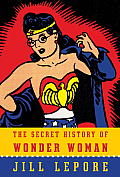
In articles derived from her new book, The Secret History of Wonder Woman, Jill Lepore has been talking up that comic-book heroine’s place in superhero history.

In Smithsonian:
Wonder Woman is the most popular female comic-book superhero of all time. Aside from Superman and Batman, no other comic-book character has lasted as long.
In The New Yorker:
Superman débuted in 1938, Batman in 1939, Wonder Woman in 1941.
Who’s missing from this discussion? “The Sensational Character Find of 1940,” of course.

Dick Grayson has appeared in stories for nearly three-quarters of a century, about a year and a half longer than Wonder Woman. He’s been a major character in two movie serials, a television series, and two feature films. Plus, half a dozen television cartoons have featured some version of Robin.

I suspect Robin is a pop-culture reference as recognizable as Wonder Woman. In fact, the name “Dick Grayson” might be better known than Wonder Woman’s occasional alias, “Diana Prince.”

Of course, Robin has always been a sidekick to Batman, and thus a supporting character or one in an ensemble instead of a lead. Though he appeared on more comic-book covers in the 1940s than Batman, not until the 1990s was there a comic book with the Robin name in its official title. In contrast, there’s been a Wonder Woman magazine since 1942 (with a yearlong break in 1986-87), and she’s usually worked on her own as well as with the Justice Society and Justice League.

So I’m not arguing that Wonder Woman is less prominent than Robin, just that he qualifies as a famous, long-lasting comic-book crime-fighter on the same level.

(And I won’t even mention that Archie Andrews made his debut in comic books in the same month as Wonder Woman, so those two comic-book characters have lasted the same time.)

26 October 2014

What Is Dick Grayson’s Core?

Kyle Higgins appears to be wrapping up his current work on the Dick Grayson character. The latest stories in Batman Beyond 2.0, including an upcoming chapter titled “The Final Fate of Dick Grayson,” have Alec Siegel’s name as co-writer, and Siegel’s the one signing the footnoted cross-references. (Wasn’t that once the editor’s prerogative?)

Therefore, even though Higgins is back on the Batman beat as one of the writers scripting the final stretch of Batman Eternal, and though he says he’ll likely return to Dick Grayson someday, his recent interview with Crave Online reads like a farewell retrospective:
Your work on Nightwing really expanded the character. Was everything in place from day one, or did it come as you wrote the story?

I had an idea from the start, but I learned so much along the way. I remember having a conversation with one of my best friends, who is an incredibly talented writer who works in TV and did some Gates Of Gotham with me [Ryan Parrot]. We said, when you boil Dick Grayson down, how do you describe him in a few sentences. What is his core? We did it as an exercise with Superman, Spider-Man, Batman, and boiled all them down to their central drive.

With Dick Grayson I couldn’t do it, I had a really hard time with it. I realized that was a problem. I know who the character is, but I can’t fully articulate why I love the character. It wasn’t until I settled on this idea that he grew up in a circus, so he’s all about catching people when they fall. That’s actually the final line of my final issue. I sat on that for over a year.

Dick seems more involved with the people he’s helping.

It’s about the empathy for who he saves. Every superhero, in one way or another, does it for the good of so-and-so, and they want to help people, but Dick Grayson more than all is about the people. He’ll save you from a mugger, tie your shoe and buy you a beer.

Dick and Bruce are very similar, but very different. Why?

Well, in a weird way one is more focused on his parents’ deaths, and the other is more focused on his parents’ lives. To me Dick and his Nightwing persona is more about spectacle than Batman. He’s sailing between buildings, it’s a performance and people can see him. He’ll operate in the daylight. It’s much more about the circus life and how he was brought up and the show. Nobody wants a brooding mopey Dick Grayson.
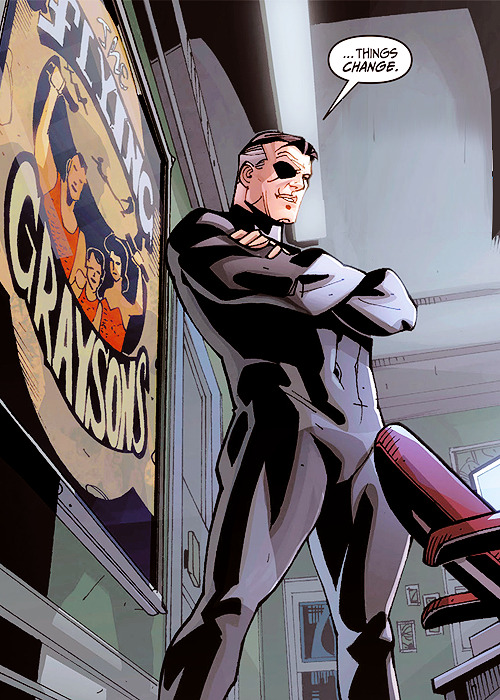
Another reason why the grim, one-eyed Dick Grayson in Batman Beyond 2.0 is a signal of a dystopic future.

Higgins continues to work on C.O.W.L., his story of a superhero labor politics in post-WW2 Chicago, for Image. We have yet to see the equivalent of Dick Grayson in those comics, but one did appear in Higggins’s student film, apparently set in the same world. And, to be frank, that character’s kind of mopey.

19 October 2014

Loeb’s Untraveled Road

This month John Siuntres’s Word Balloon podcast reran excerpts from some past years’ interviews with Batman story creators. Starting about 54 minutes into the recording, scripter Jeph Loeb described a story of the Dynamic Duo that never got off the ground:
My pitch on the original All-Star Batman and Robin, which is a book that I was writing when I left for Marvel and then got replaced by Frank Miller—and if you've got to get replaced by somebody, that's not a bad choice—…was going to be Jim [Lee’s] and my return to the character. . . .

At the beginning we really didn’t understand what All-Star was. The first time it was pitched, it was, “Take these characters as though it’s 1968, that’s the continuity you’re using.” And I was like, “So, basically, what you’re saying is that Barbara Gordon hasn’t been shot. I mean, is there anything different?” Because I really thought it all should have been Year One, and you should take it from there, and that way you could do whatever you wanted. And then I didn’t know how much you could change stuff around. I never had any idea they were going to change things as much as they were, like, you know, the Black Canary playing such an important role in Batman’s world. . . .

The story that I wanted to tell was that Jason was the first Robin, and that he’d been killed, and that Batman…hid the fact that Jason had died, and then met Dick in the same way that he always met Dick. And decided that there was a way that all the mistakes that he had made with Jason he could rectify with Dick. Which is a little bit more like what he did with Tim Drake, having failed with Jason.

But what I liked about this story was that the only two people who knew what he had done were Gordon and Superman, both of whom came to Bruce and said, “What the hell are you doing? Like you’ve already gotten one child killed, why would you do this again?” And then you really saw Batman’s arrogance about it, that he thought that he could make up for the death of this child by making it right with another child.

But that was not a story that ever got told.
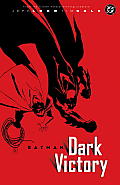
That apparently would have been Loeb’s second take on how Dick Grayson came to be Robin, following Dark Victory. Then again, considering that All-Star Batman and Robin the Boy Wonder fans are still waiting for Lee to finish the issues Miller mapped out years ago, it might be more accurate to say it would have Loeb’s take one-and-a-half.

05 October 2014

Sam Hamm’s Plans for Robin, part 2

Back at the end of August, I started quoting from a late draft of Sam Hamm’s screenplay for the 1989 Batman film. Originally the movie was to include Robin, but that plot thread was cut.

As the previous extract showed, the screenplay introduces the Flying Graysons, then quickly has the Joker killl off the parents in spectacular fashion. Dick Grayson goes after the villain in acrobatic fashion, but Batman saves him from being killed as well. The story picks up the next morning:
INT. WAYNE MANOR - GUEST BEDROOM - DAY

DICK GRAYSON is sprawled on a huge four-poster bed, unconscious, softly moaning. He COMES TO with a jolt.

Breaking into a sweat almost instantly, he looks at his unfamiliar surroundings. A shadowy figure stands nearby.

DICK
... Where am I?

BRUCE
My name is Bruce Wayne. You're welcome to stay here as long as you want.

BRUCE steps out just as ALFRED enters with a breakfast tray. DICK makes a puzzled face. What the hell is going on here?

INT. HALL OF JUSTICE - DAY

Beneath the statue of blind Justice, BRUCE and HARVEY DENT march through the portico, engaged in a heated argument.

DENT
We'll send a team into Ace the moment the warrant comes through.

BRUCE
He'll be ready when you do. Remember what happened at the apartment.

DENT
All right, Bruce, what do you suggest?

BRUCE
I suggest a nice big bomb.

DENT
Good. A bomb. On a blind tip from Bruce Wayne. -- We do have laws.

BRUCE
Then for God's sake, Harvey, cancel the anniversary celebration.

DENT
We've told him we'll deal. What could he possibly have to gain by --

BRUCE
Do you still think the Joker cares about money??

DENT
I don't know. I'm just a D.A. I don't have access to all your expert sources.

Mexican standoff. BRUCE stalks off fuming. DENT hangs back a moment, then turns down the hall.

EXT. WAYNE MANOR - ESTABLISHING - DAY

The ornate, wrought-iron GATE which opens on the long driveway snaking up toward Wayne Manor. It's bolted shut.

INT. WAYNE MANOR - DAY

A glass-enclosed room which houses an enormous HEATED INDOOR SWIMMING POOL. DICK GRAYSON does a couple of laps, then climbs out and towels himself off.

He looks out at the estate: tennis courts, a riding stable in the distance. He's not happy. All this opulence could drive a guy stark staring nuts in short order.

INT. GUEST BEDROOM - DAY

An OPEN SUITCASE on the bed. DICK fingers a gold ashtray bearing the figure of Winged Victory -- then shrugs and tosses it into the suitcase on top of his gymnast's costume. When he looks up he sees BRUCE in the doorway behind him.

DICK
... Your butler wouldn't gimme a ride so I figured I'd hoof it.

BRUCE
Sorry. I can't let you leave.

DICK
You can't keep me here, man. That's kidnapping.

BRUCE
If I let you leave, you'll do the same thing again. You'll go after the Joker... and you'll wind up dead.
(turning to go)

DICK
Hey, man. Look at you. You're rich. You got everything you want. How do you know what's in my mind?

BRUCE turns to face him. The little hellion's eyes are filled with raw, burning hatred. BRUCE knows the feeling.

BRUCE
I don't care what's in your mind. You're staying.

BRUCE reaches for a key in his pocket. Without warning, the kid RUSHES him, throwing a rock-solid punch. With blinding speed, BRUCE sidesteps him, parries the blow, and winds up spinning DICK around -- INTO A WALL.

DICK is stunned, but he has to laugh. This rich boy has a move or two. BRUCE stands there, silently challenging him.

A second later, the kid is airborne -- upping the ante with a scissor-kick aimed squarely at BRUCE's gut. In a blur of motion BRUCE checks the kick, swings an arm into DICK's chest, and sends the boy sprawling flat on his back.

INT. WAYNE MANOR - KITCHEN - THAT MOMENT

ALFRED, in his apron, fixing a tray of snacks. He looks up curiously at the ceiling. From the sound of it, a battle royal is shaping up in the guest bedroom.

INT. GUEST BEDROOM - THAT MOMENT

DICK'S BODY -- head down, feet up -- flies through the air. He SMASHES INTO a closet door and slumps to the carpet. Shaken now, and sweating profusely, he looks up at BRUCE... who stands calmly over him, adjusting his necktie.

A long, tense moment passes between them. Then:

DICK
... You're him.

No reply from BRUCE. Their gazes lock. And suddenly...

ALFRED (V.O.)
FREEZE!

DICK and BRUCE look around. The puny, mustachioed butler stands in the doorway, feet spread in a Dirty Harry stance, a .44 MAGNUM trained on DICK.

BRUCE
It's all right, Alfred. Everything's under control.

ALFRED
... Very good, sir.

ALFRED relaxes, musters his dignity, and turns to go.
Yes, there’s more.

28 September 2014

Beyond Batman Beyond

It’s interesting to watch what DC Comics has done with its Batman Beyond storyline this year, reflecting changes in its target audience.

Batman Beyond was a spin-off of the very successful 1990s Batman TV cartoons of the 1990s. Les Daniels’s Batman history states, “a new show was requested that might skew toward younger viewers.” The resulting cartoon was set in the future when the world has more advanced technology and Bruce Wayne is a goddamn octagenarian. The new Batman was a hot-tempered teenager named Terry McGinnnis.

This show was an extension of the DC Animated Universe, thus not tied to the publisher’s main comic-book continuity. There was an accompanying comic book in 1999-2001, but readers were supposed to keep it separate in their minds from the main Batman titles of the time.

In this version of the future, Barbara Gordon has long ago retired as Batgirl and now holds her father’s old job as police commissioner. She was romantically involved with Dick Grayson when they were college-age, then later with Bruce Wayne for some unspecified period, and is now married to someone else. Dick himself, having established himself in the DCAU as Nightwing, has left Bruce’s team and is nowhere to be seen.

Batman Beyond lasted for 52 episodes plus a TV movie—a respectable but not sterling run. Nevertheless, it made a strong impression on a lot of viewers, including Kyle Higgins. He told Comics Alliance:
I was such a huge fan of the show. The DC Animated continuity was my introduction to DC Comics growing up. So I know that stuff inside and out, and I actually know it better than the books.
Higgins’s fondness for the cartoon is also evident in how he spoke about it on Kevin Smith’s podcast and in other interviews.

In 2010, DC launched a series of new Batman Beyond runs scripted by Adam Beechen. One of his mandates was to tie the world of the TV cartoon more closely to the DC comics (though those were about to go through some sudden changes themselves). Beechen brought back Dick Grayson, revealing that he’d stepped away from crime-fighting and from Bruce Wayne after losing one of his eyes in a fight.

That was the history Higgins inherited when he took over DC’s digital-first Batman Beyond series in 2013. His series was subtitled “2.0” because it showed Terry McGinnis breaking away from Bruce as mentor and working instead with Dick. Higgins was thus writing two different versions of Dick Grayson as he finished his Nightwing run and started this series.

In a story titled “Mark of the Phantasm” (digital issues #25-31), Higgins and co-writer Alec Siegel dug deeper into the relationships among Barbara, Bruce, and Dick. Craig Rousseau provided the art for the scenes set in the future, adhering to the standard Batman Beyond style. Phil Hester penciled scenes set in the past, following the style of the earlier Batman: The Animated Series cartoon and its spin-off comics.

Issue #28 shows Barbara and Dick telling Terry how they broke with Bruce. In their early twenties they had started to rekindle their relationship and Dick was ready to propose, only for Barbara to discover she’d become pregnant by Bruce—only for Barbara to miscarry after intervening in a mugging.

Remember, this story appeared in a continuity created to “skew toward younger viewers.” But that was back in 1999. Those same viewers have aged fifteen years and are ready for plot twists based on sexual relationships and spontaneous abortion. They got that more adult story even within the nostalgic visual style that Hester provided.

In another sign of the DCAU’s hold on today’s comics readers, the main DC Comics continuity is being disrupted by a crossover story called “Future’s End,” and Terry McGinnis as a next-generation Batman is in the middle of it all. While he still represents only one possible future for the company’s main continuity, he’s also what the company thinks its present-day readers want to see.

10 September 2014

Where Do You Get Your Ideas?

From Marc Tyler Nobleman’s interview with comics scripter Arnold Drake:

when Bill [Finger] was looking for an idea for Batman, one of the tricks that he used was to open up the Yellow Pages in the phone book and just kind of ripple through it. Where his fingers stopped he’d say, “Piano tuner…I wonder if there’s a story in a piano tuner?”
And then, of course, Finger would imagine the piano to be giant-sized.

07 September 2014

Grayson’s Future End

Modern comic-book writers often dread big crossover events, at least when they’re not in charge. Whatever storylines they might have mapped out over several issues have to be put on hold for one or two episodes tied into a larger conflict determined by the publisher’s top staff or star writers. But crossovers tend to sell more copies of all the titles involved, and often continue to sell in paperback form, so the industry keeps ordering them up.

Currently the big crossover event from DC is “Futures End,” not to be confused with the last crossover, “Forever Evil.” (The company seems to have a thing for those initials. I will refrain from making a scatological joke about what they really mean.) “Futures End” is set five years into one possible dismal future for the DC Universe.

As I explored back here, in the DC pantheon Dick Grayson has long represented hope for a better future, so to showcase how awful a future is the company often shows how badly Dick Grayson’s life has turned out. Grayson: Futures End, published last week, is squarely in that tradition.

That situation freed up Grayson writers Tom King and Tim Seeley (they plotted the issue together, King wrote the dialogue). Working within a timeline that’s supposed to be averted, they don’t have to leave the door open to further stories or other crossovers. They can start at Dick’s sad end and work backward—which they do.

Each page in the magazine takes place “Earlier” than the preceding page, hopping backwards in time from five years in the future (as in “Futures End”) to Dick’s childhood. Characters allude to events, promises, and in-jokes that we don’t see for another few page flips. As one commenter noted, the issue is like a sestina, with certain details—ropes, codes, last days—popping up rhythmically. It demands, and rewards, immediate rereading.

I hesitate to call this a self-contained story because it depends completely on readers’ knowledge of the legend established in Detective Comics, #38: when extortionists put acid on the ropes of the Flying Graysons’ trapeze apparatus, causing Dick’s parents to fall to their deaths. But it surely brings its own story to an end (as in “Futures End”).

As promised, King takes the opportunity to offer his “New 52 Universe” explanation for why Robin dresses in stoplight colors. That’s not because Dick as a circus performer and/or little kid likes bright colors, the explanations in some previous versions of the mythos. (The “New 52” Flying Graysons wear blue, and the “New 52” Dick becomes Robin in his mid-teens.) Rather, the colors are Bruce Wayne’s way of making night patrols harder for Dick so he has to be more careful. I’m not sure that will go over well with fans of either character.

Grayson: Futures End also shows Barbara Gordon as Batgirl suggesting that Dick’s ideal romantic partner is someone who treats him like Bruce. Fifteen years ago the company was adamantly against Barbara likening Bruce and Dick’s relationship to a romance. Now DC is embracing the metaphor. But perhaps only in this not-necessarily-so future.

Which brings me to the remaining mystery of this magazine—when its timeline is supposed to deviate from the “New 52” present that DC’s line will presumably return to at the end of the crossover. Does that deviation produce the events we see: Dick and his agency handler Helena Bertinelli becoming lovers, Dick becoming willing to kill? In other words, when exactly does Dick’s life start to turn out badly?

31 August 2014

Sam Hamm’s Plans for Robin in 1989

In Comics Alliance’s interview with Sam Hamm, first screenwriter of the 1989 Batman, he said:
The studio insisted on having Robin in the picture, and Tim and I couldn’t figure out how or where to squeeze him in. We spent a whole weekend pacing around in a sweat, but we couldn’t get anywhere, and we finally decided that we would have to call the WB brass and tell them there would be no Robin.

Then, moments away from picking up the phone, we started spitballing again, and miraculously, we came up with a really cool Robin sequence. So a couple of years later, when production is underway, and the picture is running over budget, what does the studio decide to cut? You guessed it – Robin! And in the end, nobody missed him.
Well, I did.

Here’s one version of the scene Hamm came up with, from an early version of the screenplay. This comes toward the end of the movie, after Batman and the Joker have already been tussling. The Flying Graysons are performing their trapeze act…suspended from helicopters. And Batman, for some reason, is on horseback.
ANGLE ON FLYING GRAYSONS

GRAYSON has just completed a double somersault in midair, landing in the capable hands of his wife. Now they're swinging again, building momentum as he prepares to make the return leap back to his own trapeze.

INT. HELICOPTER - THAT MOMENT

In the bay of the helicopter stands a kid, fifteen, compact, tough, and wiry: DICK GRAYSON. Like his parents, he's wearing a red-and-green suit. From the copter, he's got a perfect bird's-eye view of the BATMAN-JOKER chase.

PILOT
Ready to go, Dick?

DICK
What's all the ruckus down there?

EXT. PARK - GROUND LEVEL - THAT MOMENT

The VAN bounces over rocks and bushes, narrowly avoiding trees, with BATMAN in hot pursuit.

INT. VAN - THAT MOMENT

At the foot of a hill, the JOKER spies a truck. On its side, in bright red letters, a WARNING: "DANGER - FIREWORKS. FLAMMABLE LOAD."

The JOKER reaches into the back for a HIGHWAY FLARE.

JOKER
Head for the truck!

INT. HELICOPTER - THAT MOMENT

Hovering over the chase scene, DICK catches sight of the JOKER. He GASPS IN SHOCK as a LIT FLARE flies from the back of the VAN... directly into the FIREWORKS TRUCK.

EXT. PARK - GROUND LEVEL - A MOMENT LATER

THE BATMAN is thrown off his horse by the shock of a massive EXPLOSION. All at once, THE SKY IS FULL of BURSTING, INCANDESCENT COLORS!!

THE JOKER hangs out of the rear of the van, looking up, an expression of PURE DELIGHT on his face.

JOKER
I love fireworks!

ANGLE ON HELICOPTERS

LURCHING AND SPINNING IN THE SKY as FIREWORKS rocket past. One of them takes a dead hit on the rotor. JOHN GRAYSON falls to his death instantly; a moment later, the COPTER plummets into the trees with a resounding, fiery CRASH.

MARY GRAYSON hangs from the second copter as it bobs and weaves out of control. ONLOOKERS SCREAM IN TERROR.

EXT. STREET - THAT MOMENT

THE JOKER'S VAN bursts out of the park and speeds up a wide, cordoned-off avenue. Overhead, THE SECOND COPTER veers wildly, out of the park now, swinging dangerously close to the tall buildings along the avenue.

INT. HELICOPTER - THAT MOMENT

DICK GRAYSON at the mouth of the bay, hanging on by a canvas strap. He watches helplessly as his MOTHER swings into a POWER LINE and drops three stories to the pavement.

DICK
NO! NOOOOOOOO!!!!

His face is contorted with rage and pain. The PILOT struggles desperately to right the copter, barely avoiding a collision with the nearest building. And then -- before THE PILOT can make a move to stop him -- DICK HAS JUMPED OUT OF THE COPTER.

ANGLE ON DICK

With astonishing physical grace, he DIVES. GRABS A FLAGPOLE. Executes a perfect somersault. FLIPS onto a nearby fire escape. VAULTS to the next fire escape down. And LEAPS OUT OVER THE STREET --

-- MAKING A PERFECT TWO-POINT LANDING on his intended target... THE ROOF OF THE JOKER'S VAN!!

INT. VAN - THAT MOMENT

THE JOKER hears a THUNK overhead. He casually lifts his gun and BLOWS A HOLE THROUGH THE ROOF OF THE VAN.

EXT. ROOF OF VAN - MOVING - THAT MOMENT

The blast just misses DICK. He sprawls flat, YANKS at the chrome luggage rack on the roof of the van, and BREAKS OFF A FOUR-FOOT SHAFT OF METAL.

ANOTHER SHOT through the roof. DICK rolls forward, hoists his chrome spear over the windshield.

INT. VAN - THAT MOMENT

SPLINTERED GLASS flies everywhere as DICK RAMS THE SHAFT THROUGH THE WINDSHIELD. THE DRIVER dodges left and LOSES CONTROL OF THE WHEEL.

EXT. ROOF OF VAN - MOVING - THAT MOMENT

The VAN careens wildly toward an OVERPASS. DICK rises up into a crouch just in time to see a sign which reads "DANGER -- LOW CLEARANCE." He's about to get his head taken off!

ONE SECOND BEFORE IMPACT a BLACK-CAPED SHADOW swings across the street and SCOOPS DICK OFF THE ROOF OF THE VAN.

EXT. STREET - NIGHT

BATMAN AND DICK tumble to the pavement. THE VAN knocks over a fire hydrant and STOPS. DICK is already on his feet, ready to CHARGE THE VAN, when BATMAN throws a powerful arm around his waist.

DICK
LET ME GO! LET ME --

THE JOKER steps casually out of the van. TWO GOONS with MACHINE GUNS emerge behind him. PEDESTRIANS SCREAM as the GOONS level their guns at the CROWD.

DICK (cont.)
YOU PIECE OF -- YOU MOTHERF--

DICK is kicking, screaming, clawing, biting. BATMAN has his hands full restraining the kid.

JOKER
Like your boyfriend. He's kinda hot.
(glowering at BATMAN)
Hands off the belt.

BATMAN
Take me. Let the boy go.

JOKER
Gosh, I could kill you, but then you'd miss my party. And I'd be real, real sad if you couldn't make it.

BATMAN
What are you talking about?

JOKER
Batman! Don't you even recognize your old pal Jack? After all...
(cackling insanely)
You made me what I am today.

BATMAN cocks his head in puzzlement as DISTANT SIRENS BLARE. The JOKER and his HOODS -- guns still aimed at the crowd -- back away and race off on foot, vanishing into the night.

DICK BREAKS FREE and BOLTS AFTER THEM. BATMAN throws him to the street with a flying tackle. The boy is hysterical.

DICK
HE KILLED MY PARENTS! HE KILLED MY --

BATMAN flinches at the sound of the words. He reaches into his belt and -- mercifully -- breaks a KNOCKOUT CAPSULE under DICK's nose.
Yes, it goes on.

23 August 2014

Putting Distance between Green Arrow and Batman

As I described on Thursday, DC Comics’s syncretism meant the company sometimes ended up owning two quite similar characters/trademarks. That pushed its staffers to come up with creative ways to distinguish them, expanding the bounds of its superhero stories.

Thus, in 1986 the company put Superman and his most successful equivalent from another publisher, Captain Marvel, in the same universe. And the editors and writers started emphasizing what made them different.

The fact that Captain Marvel is really a kid named Billy Batson—i.e., even more of a naïf than Kansas farmboy Clark Kent—became the defining aspect of his character. Storytellers also found more significance in how Captain Marvel’s powers arose from some form of magic (rather than, like Superman’s, through science).

Wonder Woman didn’t present such problems because no other company had such a powerful female hero. Instead, DC had to struggle with America’s changing picture of the ideal woman—and that’s another story.

As for Batman’s equivalents, it’s important to note what defined that character for most of his 75-year history. It wasn’t being dark and brooding and driven by vengeance. In fact, from the early 1940s through the mid-1980s, Batman was a cheery special independent agent of the Gotham police who just happened to dress as a bat. What defined him was:
  • He had no special powers beyond being a very smart, very athletic man.
  • He wore a mask to preserve his real identity.
  • He was an immensely rich socialite.
  • He had a lot of cool bat-themed gadgets and vehicles to deploy in a fight.
  • He worked with a teen-aged assistant.
That formula proved so popular that in 1941 DC’s sibling company, All-American Publications, created its own version: Green Arrow. He, too, wore a mask to disguise his life as Oliver Queen, an immensely rich bachelor. He used trick arrows, an Arrow Car, an Arrow Plane, an Arrow Signal, and even an Arrow Cave. And of course Green Arrow had his own kid sidekick, Speedy.

For a long time, DC kept Batman and Green Arrow apart. While Batman was an occasional member of the Justice Society of America, Green Arrow was relegated to a lesser hero team, the Seven Soldiers of Victory. Stories about him and Speedy appeared in World’s Finest after Batman and Robin’s, but the heroes never met. Green Arrow survived in backup stories through the early-1950s crash of superhero comics, probably because DC editor Mort Weisinger had co-created him, but he never had his own magazine.

When DC launched the Justice League of America, first in The Brave and the Bold and then in its own title, Batman made brief appearances. But Green Arrow didn’t show up at all, prompting fans to ask why he was left out. The problem, I suspect, was that he seemed too similar to Batman—why would the team need them both?

After popular demand, Green Arrow finally joined that group in Justice League of America, #4. Batman then stopped appearing so often, and it wasn’t until issue #10 that both characters showed up on the same cover.

Eventually the proximity of two similar characters prompted a new generation of creative minds to come up with ways to distinguish them—and to take superhero comics in a new direction. In 1969 artist Neal Adams gave Green Arrow a new look with a Van Dyke beard (at a time when facial hair had a politic meaning). Writer Dennis O’Neil made radical changes in the character of Oliver Queen. He lost all his money—no longer a millionaire with an unending supply of gadgets. He started a romance with an independent crime-fighting colleague, Black Canary.

While Bruce Wayne was then showing a new sort of social conscience with the Wayne Foundation, O’Neil had Oliver Queen start speaking loudly for political justice and change. Now the character stood out in Justice League meetings—in fact, he came to alienate some members of the group. It wasn’t just his politics but his temper and attitude. Green Arrow thus became one of DC’s first examples of a superhero who wasn’t a paragon in every way.
As a result, Green Arrow became an interesting character, perhaps for the first time. O’Neil and Adams partnered him with Green Lantern in a series of stories exploring social issues in America. Those highly regarded tales didn’t sell well enough to keep the Green Lantern magazine from cancellation in 1972, but they did cement the new character of Oliver Queen for readers. As a result, it became possible for him to be a foil for Bruce Wayne/Batman in subsequent decades rather than a pale green copy.

A similar process occurred in the late 1980s after DC introduced the Charlton character of Ted Kord, the Blue Beetle, into its main line. He, too, was a masked man without powers but with a lot of gadgets and smarts. He ended up on the Justice League with Batman. But that was the start of the grim, antisocial Batman we know today, and the magazine’s creators moved that Blue Beetle in the opposite direction, toward comedy.

With the “New 52,” DC brought Wildstorm Comics’s Batman equivalent, Midnighter, into its standard universe. Already Midnighter had been established as gay and happily partnered with the Wildstorm equivalent of Superman, providing more distance from the Caped Crusader. Now Midnighter is showing up in Grayson, actually offering storytelling value in how the character is a version of Batman.

21 August 2014

How Syncretism Made DC Stretch

In 1960 the DC Comics editor Julius Schwartz wanted to add a new superhero to his line of comics, a supporting character in the Flash magazine. Schwartz was four years into his project of reviving DC’s old trademarks, starting with the Flash himself and then moving on to Green Lantern, Hawkman, the Atom, and so on.

The company’s new character had to be distinct from those other heroes, to have some roots in science fiction, and to fit into crime-fighting stories but provide some comic relief.

Working with writer John Broome and artist Carmine Infantino, Schwartz came up with Ralph Dibny, the Elongated Man. His power was that he could stretch his body in superhuman ways, making himself tall, thin, bouncy, table-shaped, and so on.

That was also the power of Quality Comics’s leading superhero of the 1940s, Plastic Man, created and usually drawn by Jack Cole. Schwartz hadn’t realized that since 1956 DC had owned Quality’s comics trademarks, including Plastic Man. He later told colleagues that if he’d known that, he would simply have revived the Plastic Man name.

But it was too late: DC now owned two crime-fighting superheroes with stretching powers, both on the funny side. From the start, knowledgeable comics fans saw the similarities. When Schwartz took over the Batman line in 1964, he made the Elongated Man a backup feature in Detective Comics, raising his profile further. And two years later DC launched a new Plastic Man magazine. So what could make the two stretchy guys distinct?

Such overlaps were a drawback to how DC Comics grew through syncretism, as I described yesterday. Different companies created the same types of heroes to star in the same types of stories, but once those heroes were put into the same universe they lost their special qualities.

Fortunately, that need to distinguish characters opened the door for more creative storytelling. In the case of the Elongated Man, he ended up doing things that went against the typical superhero tropes. He married his girlfriend, Sue. He dropped the mask and secret identity. He announced himself as a professional detective for hire. Though he never had his own series, Ralph Dibny became a unique character in the DC Universe with his own following.

As for Plastic Man, DC’s creative teams recognized that Jack Cole had written his crime stories mostly for laughs, so they went further in that direction. Plas became the most wackadoodle hero of the whole line. He could be in the Justice League with Batman, and writers could play off their contrasts for laughs. Creators also made clear that Plastic Man was more topologically powerful and invulnerable than the Elongated Man.

None of that would have happened if Julius Schwartz had simply revived the Plastic Man trademark to create a supporting character for the Flash. Having two similar characters in the same universe forced him and his colleagues to think in new directions.

COMING UP: Syncretism and the Batman.

29 May 2014

From Spring Heel Jack to Batman

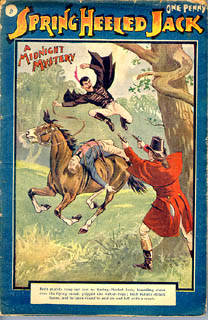
Among the ephemera on display in the “Comics Unmasked: Art and Anarchy in the UK” exhibit at the British Library is a penny-dreadful tale of Spring-Heeled Jack, which the curators suggest was an inspiration for Batman, pointing particularly to his horns.

I thought that was a stretch. Not that Bob Kane and Bill Finger were above borrowing plots, images, and details from other adventure stories of their time, acknowledged and unacknowledged. But how would two guys growing up in post-WW1 America have seen the Spring-Heeled Jack magazine serials from Victorian Britain? And wasn’t Spring-Heeled Jack a monster and/or troublemaker instead of a crimefighter?

At io9, commenter Michael Munro laid out a lineage of pulp fiction leading from London to California to Gotham:
Spring Heeled Jack…transitioned from London urban myth (1830s) to melodrama anti-hero (1870s) to prototype superhero (1880s-early 1900s). As written by "penny dreadful" author Alfred Burrage, SHJ was a wealthy aristocrat who assumed the disguise of a devilish, bat-winged avenger of the night, maintained a secret underground lair and used his athletic and technological skills to battle evil-doers - sounds familiar?
Expounding at more length, Munro wrote:
The several "penny dreadful" iterations of Spring Heeled Jack, many written by Alfred Burrage under the pseudonym "Charlton Lea", portrayed him as a nobleman who had been cheated out of his inheritance and who took up a devilish disguise to punish those responsible. Along the way, Spring Heeled Jack also rescued damsels in distress and generally stood up for the innocent and downtrodden. He wore a distinctive mask and costume and was capable of performing incredible leaps thanks to a special pair of boots, credited in one source to a secret mechanism invented by Indian street magicians.

Anticipating Zorro, Jack was fond of marking both enemies and territory by carving his initial with the point of his rapier. He also maintained a secret underground lair (in a converted crypt) and terrified his adversaries with his ringing laugh and catch-phrase, "The day is yours - leave the night to me!"
As Munro notes, the Batman team acknowledged Zorro, created by Johnston McCully in 1919, as an inspiration. Thus, Spring-Heeled Jack wasn’t a direct influence on Batman, and the horns/ears were a shared trope rather than deliberate borrowing.

25 May 2014

Back in Bellingham

This art is by Carororo. It’s part of a display of fan art at Friendly Neighborhood Comics in Bellingham, Massachusetts.

Though that store’s in my home state, and my home state isn’t that large, it’s still what I consider a long drive from my home. What’s more, I’m in London this weekend, so it’s even less likely that I’ll visit. So I was happy to learn about this event online.

11 May 2014

Not-So-Secret Origin

Before DC published Secret Origins, #1, with the origin stories of Dick Grayson as Robin as well as Superman and Supergirl, scripter Kyle Higgins said in an interview that his final issue of Nightwing actually “says everything I have to say about the character.”

Unfortunately, he was right. The twelve-page story in Secret Origins goes over old ground. The art, penciled by Doug Mahnke, is pretty, just as in the recent Batman and Robin Annual. The story confirms some things already established in DC’s “New 52” continuity, such as Dick already being in his mid-teens when he meets Bruce Wayne. The title “The Long Year” provides another temporal fact for readers who care deeply about such things.

But the problem is that the first Robin’s origin just isn’t secret anymore. In fact, it’s so well known among superhero fans that storytellers can evoke it with just partial images, such as a Flying Graysons poster or the broken trapeze rope swinging into the frame in the TV cartoon episode “Robin’s Reckoning.”

While the stories of how Jason Todd and Tim Drake became Robin have been significantly reworked, Dick Grayson’s has remained basically the same since 1940. The only changes have been at the margins: whether the authorities sent Dick to an orphanage instead of apparently straight to Wayne Manor, whether Tony Zucco or his family are still around.

The radical changes have been Frank Miller’s story of Bruce kidnapping Dick over several long issues of alternative-continuity All-Star Batman and Robin and Scott Snyder’s decision to make the Haly Circus a training ground for athletic assassins—which plays no role in Higgins’s new story.

So Higgins’s origin story has almost no place original to go. We see the robin bracelet he already established in Robin, #0. We see Tony Zucco threatening the circus. We see the death of Dick’s parents as Bruce Wayne watches, and an orphanage. Dick tries hunting his parents’ killer and has to be rescued by Batman, but we’ve seen that before, too.

Higgins said the one idea he had left to explore was the origin of the Robin name, mostly because DC’s new editors had nixed the idea of inspiration from Robin Hood movies. (Apparently Kevin Costner’s and Russell Crowe’s versions don’t have the cultural resonance of Errol Flynn’s.) So we have a page of Dick thinking about what his crime-fighting identity should be and seeing a robin fly by—the same scene we saw with Bruce Wayne and a bat back in 1939.

The last panel on that page drives home the symbolism with Bruce speaking of the robin as a symbol of “growing up,” which is what Robin/Dick Grayson has meant in the DC mythos since the following year. But we already knew that.

20 April 2014

Reworked Robins

This month DC unveiled its plans for the character of Dick Grayson after Forever Evil and Nightwing end. He’ll become a secret spy, out of contact with everyone but Bruce Wayne (and presumably not much in contact with him, either).

Of course, Agent Grayson will wear his initial in an emblem on his chest. These are still superhero comics, after all.

DC made that announcement with art of Dick looking remarkably like Tom Cruise in the first Mission: Impossible movie. Mikel Janin’s image will appear on the first issue of the new Grayson magazine, arriving this fall.

Grumpy Old Fan Tom Bondurant wrote:
DC has already undercut Dick’s grounding by fiddling with its overall superhero timeline [in the “New 52” continuity]. By pruning his Robin career (and the corresponding emotional attachment) dramatically, and possibly throwing out all of his Titans adventures, DC has left Dick with a set of skills and not a lot more. No wonder he’s turning to espionage.
DC had some professional spies in its previous continuities, some even created back in the 1950s when superhero stories had stalled out. But that’s an unclaimed area now, so it makes some sense to fill that narrative space with a character who brings his own following.

Only some sense, though. As fans immediately noted, the sight of Dick Grayson pointing a gun at the viewer on the cover of Grayson, #1, contradicts Batman’s anti-gun lessons; the fatal side of black-ops would make more sense for Jason Todd. And the surveillance-and-secrecy side would be a better fit for Tim Drake. Nevertheless, the plans have been established.

And remade. In January writer James Tynion IV revealed that he was working on Nightwing, #30, the last issue of the current volume of that magazine and (presumably) the transition to what comes next. But now the creative team on that issue will be the same who are working on Grayson: Tim Seeley and Tom King. Before previews and internet discussions, no one outside the publisher would have known anything about this. Now, of course, it’s a mini-scandal.

Bondurant also wrote that DC now “arguably has too many Robins.” As powerful as the story of a dead Robin has been, the company may be bringing all ex-Robins back. Peter J. Tomasi’s miniseries Robin Rises: Omega will grow out of Batman’s search for Damian. Meanwhile, Steve Snyder and his team are introducing a new roster of young assistants for Batman in Batman Eternal, including Blue Bird and Spoiler. Plus, Grant Morrison is working on a story crossing alternative universes. How long can that situation last?

19 April 2014

What Will “On Your Left” Mean?

In the discussion of the political implications of Captain America: The Winter Soldier, Greg Carpenter at Sequart found a key in the movie’s strong opening scene. Steve Rogers and Sam Wilson are jogging around the reflecting pool in Washington, the former (having been injected with the super-soldier serum) much faster than the latter:
Each time Rogers approaches Wilson, he gives the same cautionary warning: “On your left.” They are the first words spoken in the new film, Captain America: The Winter Soldier, and they lay the groundwork for much of the political perspective of the film. While this Captain America may sneak up on you—you’ll find him “on your left.”
Not everyone caught that, as Alyssa Rosenberg shows in the Washington Post:
“Captain America: The Winter Soldier” returns time and time again to the idea that the biggest issue in national security is who controls the apparatus, rather than whether we should use certain technologies or techniques at all.
To be sure, there’s an inherent tension between the superhero narrative, or any hero narrative that focuses on an individual or small group of individuals, and spread-out popular power. As a result, some critics have trouble noting the moments built into superhero films that celebrate the crowd: the scenes in the first two Spider-Man movies in which groups of ordinary New Yorkers stand up to villains when Spider-Man is in trouble, for example.

In Winter Soldier, the conflict ends with the spy agency’s (unspecified) secrets being dumped out onto the internet. The directors, Joe and Anthony Russo, noted that as they were filming Edward Snowden released some secret files from the National Security Agency with the same idea. Of course, Wikileaks and Bradley/Chelsea Manning had done something similar already.

Granted, heroic narratives aren’t good at exploring the actual challenges of broad-based decision-making. Jonathan Stroud’s original Bartimaeus trilogy gets to that at the end of the third volume. George Lucas’s Star Wars films and J. K. Rowling’s Harry Potter series declare the superiority of democracy over dictatorship, but they show actual politicking as pretty feckless. L. Frank Baum’s Oz and other magical kingdoms tend to settle for benevolent dictatorships. But the larger the fictional universe, the more stories bottom-up authority allows.

In an article for Business Insider, Jeff Gomez and one-time Robin/Red Robin scripter Fabian Nicieza analyzed how developments in Winter Soldier open up possibilities for Marvel’s overarching movie narrative:
Feige faced a daunting creative challenge for his thriving film series: while Nick Fury and SHIELD served as the perfect impetus for uniting a disparate band of dysfunctional superheroes [in The Avengers], now the filmmakers were stuck with global icons like Hulk, Thor, and Iron Man effectively bowing to a secret American military organization. That had to end, but the choice of making Captain America cut the umbilical cord? Genius. . . .

The result is the fall of SHIELD, and the vast U.S. military-industrial complex no longer stands as the leash-holder to Captain America and his superhero allies. Steve Rogers becomes apolitical, while still representing the world’s perception of American selflessness, justice, and heroism dating back to World War II.
Already the Agents of SHIELD television show is reflecting the new situation (not that I’ve watched it since the pilot). We’ll see if the next set of Marvel moviemakers can fulfill that promise.