Showing posts with label the genius of the conglomerate. Show all posts

21 January 2020

The First Whiff of Gunsmoke
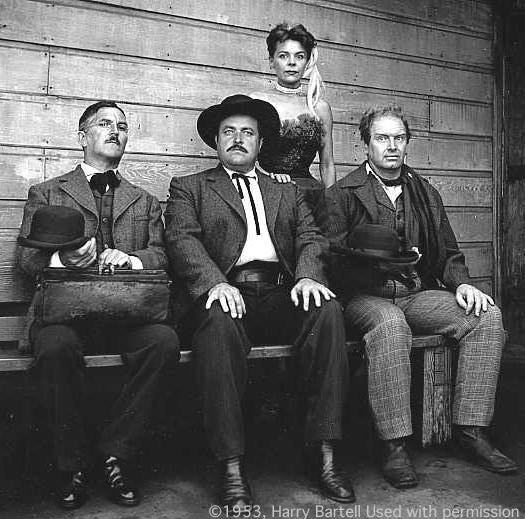
In the late 1940s the head of CBS, William Paley, asked his staff to develop a radio drama based on the concept of “Philip Marlowe in the early West.”

At the time, most western shows on the radio were aimed for kids, in the mold of The Lone Ranger. In contrast, this show was supposed to air in the evening and appeal to adult listeners.

CBS executive Harry Ackerman, who produced the Philip Marlowe radio show, had writers Mort Fine and David Friedkin take one of their scripts from Mike Shayne, another hard-boiled detective show, to create a pilot called “Mark Dillon Goes to Gouge Eye.”

The influence of Raymond Chandler on that script is obvious. Dillon serves as narrator as well as protagonist, his voiceover is full of elaborate metaphors. The plot checks off several requirements of the hard-boiled genre, such as the detective being knocked out for a while.

In the summer of 1949 Ackerman recorded two versions of the pilot with different actors playing Mark Dillon. But then the project stalled over contract issues.

A short time later, Philip Marlowe producer Norman Macdonnell and writer John Meston also started to develop an adult western radio drama. They produced an episode of their series Romance called “Pagosa” featuring a lawman named Jeff Spain. Macdonnell and Meston proposed a “Jeff Spain” show.

Ackerman told Macdonnell and Meston that CBS was ready to air their adult western, but it had to grow out of the network’s existing pilot. And it had to be called Gunsmoke.

With a hole opening in the network’s schedule in early 1952, Macdonnell and Meston had only a couple of weeks before going on the air. They changed the lawman’s name to Matt Dillon, cast busy radio actor William Conrad in that role, and recorded the first episode in time to air in April.

Gunsmoke had little to no narration after the first episodes, but the voice of the protagonist introduces each show in full Chandleresque mode:
I’m that man, Matt Dillon, United States Marshal–the first man they look for and the last they want to meet. It’s a chancy job, and it makes a man watchful…and a little lonely.
The first episode starts with the murder of a man who has just robbed a bank out of desperation and gets darker from there, with Dillon shooting the dead man’s brother when he comes leading a lynch mob. The marshal snaps at friends and locks up an innocent man on little evidence. The town doctor is gleeful over the number of corpses to autopsy.

Yet the most direct signal to listeners that this was not your kid’s western might come in the character of a young runaway whom Marshall Dillon tries to take under his wing. Billy was played by Dick Beals, an actor who had a glandular condition that meant his voice never deepened, so he played a lot of child roles on radio and in cartoons.

As the shows ends, Dillon realizes that young Billy knifed that bank robber to steal his gun. But by then the boy has grabbed a horse and ridden off to a life of crime under the name of, as the episode title says, “Billy the Kid.” So not only was this not a kids’ western, but the cute little kid was the most hard-boiled of them all.

(All episodes mentioned here available through the podcast OTR Westerns.)

16 November 2014

DC to Feed Nostalgia for Six to Twelve Years Ago

DC Comics executive Dan DiDio told USA Today that the company’s “Convergence” crossover event for next spring will return to older versions of its primary characters. “We’re picking up at points of their lives where we left them and finding out what’s gone on with them since then,” he said.

Closer examination at Comic Book Resources confirms that these stories hearken back to the company’s continuity before the “New 52.” But each tale seems designed to return its hero to a happy high point popular with his or her following. Back in June, the gossipy site Bleeding Cool heard from a creator that the upcoming project would be “a love letter to DC Comics fans.”

Thus, Wally West is not only the Flash once more, but he’s married to Linda and both their kids appear to have superpowers. (After 2010, only their daughter had powers.) In another nod to the domesticity of about eight years ago, Superman and Lois Lane are expecting a child.

Stephanie Brown will be back at Batgirl, with Tim Drake in his first Red Robin costume and Cass Cain as the Black Bat. That also reflects their situation in about 2010 (though we didn’t see much of Cass back then). Damian Wayne, who appears to be coming back in some form in the regular continuity, might well show up in one of these miniseries without ever having died.

“Convergence” thus gives DC a chance to “correct,” at least temporarily, recent developments that many fans vocally disliked, such as the murder of the Atom Ryan Choi and Roy Harper’s loss of both his arm and his little daughter.

Indeed, in some way, these series “correct” the entire “New 52” as they show the heroes fending off attacks from “Flashpoint versions” of other heroes; Flashpoint was a 2011 crossover presenting dystopic versions of the world which led to the “New 52.” The characters or versions of characters that disappeared in that transition have, the summaries suggest, been living under a protective “dome.”

I have particular questions about the Nightwing/Oracle title, to be scripted by Gail Simone. The teaser for the first issue says:
Dick Grayson and Barbara Gordon reevaluate their relationship under the dome (wedding!), but Flashpoint Hawkman and Hawkwoman attack, and everything changes.
For many fans, Dick and Barbara are meant to be together. But the last time they were talking marriage in DC’s regular continuity was back in 2006. So are they reevaluating from that perspective, or after all the events that happened between then and Flashpoint? If the latter, that means Dick has become Batman, and no one has successfully penned his decision to go back to being Nightwing. At least not yet.

02 November 2014

“That history will always be in the background”?

In an interview with Comic Book Resources, Grayson co-scripter Tom King spoke of his particular fondness for the character of Dick Grayson:
You’ve said a few places that Dick was always your favorite DC character thanks to his accessibility. With that in mind, what were the big stories that first brought you into his world? Are any of them the kind of thing you’ll look to fold into the background of this book?

I came into DC comics with Tim being Robin and Dick being the ex-Robin, the man who had gone through that uniquely frightening experience and emerged as someone uniquely brave. I remember buying my first trade, A Lonely Place of Dying, and obsessing over the Tim/Dick/Batman interaction. There was this essential question there about how do you leave childhood without losing who you were as a child. I read that thing to pulp. The first time I got to write my own complete script for the series, I titled it “Only a Place for Dying,” as a tribute to that experience.

Some of my other favorite Grayson stories are:

Birds of Prey #8 (the Barbara/Dick date issue), which is where Agent 8 from Grayson #3 gets her name; Batman #156 (“Robin Dies at Dawn”), which will play a role in an upcoming issue; and, probably my favorite Dick Grayson story of all time, Secret Origins Annual #3, which I haven’t yet figured out how to squeeze story out of — but I will! Dick Grayson has a 74-year history, and though Grayson is a book solidly set in the New 52 featuring a very modern take on the hero, that history will always be in the background and will always haunt and elevate our hero.
That’s almost sad. Secret Origins Annual, #3, was a story scripted by George Pérez in 1989 which synthesized the whole history of the Titans up to that point, both pre- and post-Crisis on Infinite Earths. It sought to build coherence and depth from the illogical late-1960s storylines of Bob Haney, revealing a series of villains to be one foe in different guises trying to undermine Dick Grayson.

That story also restored a version of Betty Kane, the first Bat-Girl, who had been abandoned with the “New Look” back in 1964. It reestablished the basics of Titans history as written in the 1960s, 1970s, and early 1980s within DC’s new continuity. And in doing all that, it reflected the importance of Nightwing and his team to the company at that time.

In contrast, the “New 52” reboot of the DC Universe that King and his co-writer Tim Seeley are working within wrote off Dick Grayson’s version of the Titans, and most of the characters and relationships that Pérez’s story stitched together. Grayson has left the character even more alone within the DC Universe. The scripts might contain slight allusions to beloved older stories for long-time fans, but I don’t see how this Dick Grayson can be haunted by a history that he never had.

07 September 2014

Grayson’s Future End

Modern comic-book writers often dread big crossover events, at least when they’re not in charge. Whatever storylines they might have mapped out over several issues have to be put on hold for one or two episodes tied into a larger conflict determined by the publisher’s top staff or star writers. But crossovers tend to sell more copies of all the titles involved, and often continue to sell in paperback form, so the industry keeps ordering them up.

Currently the big crossover event from DC is “Futures End,” not to be confused with the last crossover, “Forever Evil.” (The company seems to have a thing for those initials. I will refrain from making a scatological joke about what they really mean.) “Futures End” is set five years into one possible dismal future for the DC Universe.

As I explored back here, in the DC pantheon Dick Grayson has long represented hope for a better future, so to showcase how awful a future is the company often shows how badly Dick Grayson’s life has turned out. Grayson: Futures End, published last week, is squarely in that tradition.

That situation freed up Grayson writers Tom King and Tim Seeley (they plotted the issue together, King wrote the dialogue). Working within a timeline that’s supposed to be averted, they don’t have to leave the door open to further stories or other crossovers. They can start at Dick’s sad end and work backward—which they do.

Each page in the magazine takes place “Earlier” than the preceding page, hopping backwards in time from five years in the future (as in “Futures End”) to Dick’s childhood. Characters allude to events, promises, and in-jokes that we don’t see for another few page flips. As one commenter noted, the issue is like a sestina, with certain details—ropes, codes, last days—popping up rhythmically. It demands, and rewards, immediate rereading.

I hesitate to call this a self-contained story because it depends completely on readers’ knowledge of the legend established in Detective Comics, #38: when extortionists put acid on the ropes of the Flying Graysons’ trapeze apparatus, causing Dick’s parents to fall to their deaths. But it surely brings its own story to an end (as in “Futures End”).

As promised, King takes the opportunity to offer his “New 52 Universe” explanation for why Robin dresses in stoplight colors. That’s not because Dick as a circus performer and/or little kid likes bright colors, the explanations in some previous versions of the mythos. (The “New 52” Flying Graysons wear blue, and the “New 52” Dick becomes Robin in his mid-teens.) Rather, the colors are Bruce Wayne’s way of making night patrols harder for Dick so he has to be more careful. I’m not sure that will go over well with fans of either character.

Grayson: Futures End also shows Barbara Gordon as Batgirl suggesting that Dick’s ideal romantic partner is someone who treats him like Bruce. Fifteen years ago the company was adamantly against Barbara likening Bruce and Dick’s relationship to a romance. Now DC is embracing the metaphor. But perhaps only in this not-necessarily-so future.

Which brings me to the remaining mystery of this magazine—when its timeline is supposed to deviate from the “New 52” present that DC’s line will presumably return to at the end of the crossover. Does that deviation produce the events we see: Dick and his agency handler Helena Bertinelli becoming lovers, Dick becoming willing to kill? In other words, when exactly does Dick’s life start to turn out badly?

23 August 2014

Putting Distance between Green Arrow and Batman

As I described on Thursday, DC Comics’s syncretism meant the company sometimes ended up owning two quite similar characters/trademarks. That pushed its staffers to come up with creative ways to distinguish them, expanding the bounds of its superhero stories.

Thus, in 1986 the company put Superman and his most successful equivalent from another publisher, Captain Marvel, in the same universe. And the editors and writers started emphasizing what made them different.

The fact that Captain Marvel is really a kid named Billy Batson—i.e., even more of a naïf than Kansas farmboy Clark Kent—became the defining aspect of his character. Storytellers also found more significance in how Captain Marvel’s powers arose from some form of magic (rather than, like Superman’s, through science).

Wonder Woman didn’t present such problems because no other company had such a powerful female hero. Instead, DC had to struggle with America’s changing picture of the ideal woman—and that’s another story.

As for Batman’s equivalents, it’s important to note what defined that character for most of his 75-year history. It wasn’t being dark and brooding and driven by vengeance. In fact, from the early 1940s through the mid-1980s, Batman was a cheery special independent agent of the Gotham police who just happened to dress as a bat. What defined him was:
  • He had no special powers beyond being a very smart, very athletic man.
  • He wore a mask to preserve his real identity.
  • He was an immensely rich socialite.
  • He had a lot of cool bat-themed gadgets and vehicles to deploy in a fight.
  • He worked with a teen-aged assistant.
That formula proved so popular that in 1941 DC’s sibling company, All-American Publications, created its own version: Green Arrow. He, too, wore a mask to disguise his life as Oliver Queen, an immensely rich bachelor. He used trick arrows, an Arrow Car, an Arrow Plane, an Arrow Signal, and even an Arrow Cave. And of course Green Arrow had his own kid sidekick, Speedy.

For a long time, DC kept Batman and Green Arrow apart. While Batman was an occasional member of the Justice Society of America, Green Arrow was relegated to a lesser hero team, the Seven Soldiers of Victory. Stories about him and Speedy appeared in World’s Finest after Batman and Robin’s, but the heroes never met. Green Arrow survived in backup stories through the early-1950s crash of superhero comics, probably because DC editor Mort Weisinger had co-created him, but he never had his own magazine.

When DC launched the Justice League of America, first in The Brave and the Bold and then in its own title, Batman made brief appearances. But Green Arrow didn’t show up at all, prompting fans to ask why he was left out. The problem, I suspect, was that he seemed too similar to Batman—why would the team need them both?

After popular demand, Green Arrow finally joined that group in Justice League of America, #4. Batman then stopped appearing so often, and it wasn’t until issue #10 that both characters showed up on the same cover.

Eventually the proximity of two similar characters prompted a new generation of creative minds to come up with ways to distinguish them—and to take superhero comics in a new direction. In 1969 artist Neal Adams gave Green Arrow a new look with a Van Dyke beard (at a time when facial hair had a politic meaning). Writer Dennis O’Neil made radical changes in the character of Oliver Queen. He lost all his money—no longer a millionaire with an unending supply of gadgets. He started a romance with an independent crime-fighting colleague, Black Canary.

While Bruce Wayne was then showing a new sort of social conscience with the Wayne Foundation, O’Neil had Oliver Queen start speaking loudly for political justice and change. Now the character stood out in Justice League meetings—in fact, he came to alienate some members of the group. It wasn’t just his politics but his temper and attitude. Green Arrow thus became one of DC’s first examples of a superhero who wasn’t a paragon in every way.
As a result, Green Arrow became an interesting character, perhaps for the first time. O’Neil and Adams partnered him with Green Lantern in a series of stories exploring social issues in America. Those highly regarded tales didn’t sell well enough to keep the Green Lantern magazine from cancellation in 1972, but they did cement the new character of Oliver Queen for readers. As a result, it became possible for him to be a foil for Bruce Wayne/Batman in subsequent decades rather than a pale green copy.

A similar process occurred in the late 1980s after DC introduced the Charlton character of Ted Kord, the Blue Beetle, into its main line. He, too, was a masked man without powers but with a lot of gadgets and smarts. He ended up on the Justice League with Batman. But that was the start of the grim, antisocial Batman we know today, and the magazine’s creators moved that Blue Beetle in the opposite direction, toward comedy.

With the “New 52,” DC brought Wildstorm Comics’s Batman equivalent, Midnighter, into its standard universe. Already Midnighter had been established as gay and happily partnered with the Wildstorm equivalent of Superman, providing more distance from the Caped Crusader. Now Midnighter is showing up in Grayson, actually offering storytelling value in how the character is a version of Batman.

21 August 2014

How Syncretism Made DC Stretch

In 1960 the DC Comics editor Julius Schwartz wanted to add a new superhero to his line of comics, a supporting character in the Flash magazine. Schwartz was four years into his project of reviving DC’s old trademarks, starting with the Flash himself and then moving on to Green Lantern, Hawkman, the Atom, and so on.

The company’s new character had to be distinct from those other heroes, to have some roots in science fiction, and to fit into crime-fighting stories but provide some comic relief.

Working with writer John Broome and artist Carmine Infantino, Schwartz came up with Ralph Dibny, the Elongated Man. His power was that he could stretch his body in superhuman ways, making himself tall, thin, bouncy, table-shaped, and so on.

That was also the power of Quality Comics’s leading superhero of the 1940s, Plastic Man, created and usually drawn by Jack Cole. Schwartz hadn’t realized that since 1956 DC had owned Quality’s comics trademarks, including Plastic Man. He later told colleagues that if he’d known that, he would simply have revived the Plastic Man name.

But it was too late: DC now owned two crime-fighting superheroes with stretching powers, both on the funny side. From the start, knowledgeable comics fans saw the similarities. When Schwartz took over the Batman line in 1964, he made the Elongated Man a backup feature in Detective Comics, raising his profile further. And two years later DC launched a new Plastic Man magazine. So what could make the two stretchy guys distinct?

Such overlaps were a drawback to how DC Comics grew through syncretism, as I described yesterday. Different companies created the same types of heroes to star in the same types of stories, but once those heroes were put into the same universe they lost their special qualities.

Fortunately, that need to distinguish characters opened the door for more creative storytelling. In the case of the Elongated Man, he ended up doing things that went against the typical superhero tropes. He married his girlfriend, Sue. He dropped the mask and secret identity. He announced himself as a professional detective for hire. Though he never had his own series, Ralph Dibny became a unique character in the DC Universe with his own following.

As for Plastic Man, DC’s creative teams recognized that Jack Cole had written his crime stories mostly for laughs, so they went further in that direction. Plas became the most wackadoodle hero of the whole line. He could be in the Justice League with Batman, and writers could play off their contrasts for laughs. Creators also made clear that Plastic Man was more topologically powerful and invulnerable than the Elongated Man.

None of that would have happened if Julius Schwartz had simply revived the Plastic Man trademark to create a supporting character for the Flash. Having two similar characters in the same universe forced him and his colleagues to think in new directions.

COMING UP: Syncretism and the Batman.

20 August 2014

The Syncretism of DC Comics

In religion, the term syncretism refers to the amalgamation of different religious traditions, or possibly the absorption of one faith’s traditions into another. It’s how, for example, the mythology of Greek gods expanded to incorporate other cultures’ deities, either as aspects of that established pantheon or as new members of it.

Some of the pagan traditions that early Christianity syncretically absorbed in its spread across Europe still define how we celebrate Easter and Christmas. Christian missionaries tended to build churches on ground that previous religions already considered sacred, which is why we have the French locale of Saint-Michel-Mont-Mercure (Saint Michael/Mount Mercury) and an English cathedral right beside the hot springs at Bath.

Of the two major US publishers of superhero comics, Marvel has resisted syncretism but DC has grown through it. In nearly every decade since it was founded, DC has absorbed a publishing competitor, not just taking over its past publications but eventually bringing its characters into the “DC Universe.”

Indeed, this pattern was built into the company’s operations soon after it introduced the first comics superhero, Superman. What we now call “Golden Age DC” consisted of three comics companies with overlapping ownership: National Allied Publications, Detective Comics, and and All-American Publications. The last operated out of separate offices, but in mid-1940 its heroes started appearing alongside some of the other companies’ in All Star Comics. In 1946 National/DC bought out All-American, obtaining complete ownership of the Flash, Wonder Woman, the Spectre, the Sandman, Hawkman, and other trademarks.

Superhero stories went into a decline in the following decade, but DC was able to maintain sales of Superman, Batman and Robin, Wonder Woman, and a few backup characters. Other companies stopped publishing in the genre, or publishing altogether. In some cases, DC stepped in to buy their trademarks.

Eventually, superhero stories became popular again, along with the idea that all of a company’s heroes operated in the same universe and could meet, fight, and then go after common foes. In 1961 editor Julius Schwartz and writer Gardner Fox created parallel universes, which gave DC room for all the heroes it had accumulated over the years.

At first DC editors confined each parent company’s legacy mostly to one version of Earth. Thus, Fawcett Comics’s Captain Marvel and his family and villains were on Earth-S or Earth-5; Quality Comics’s Freedom Fighters were on Earth-X. But then the Crisis on Infinite Earths miniseries of 1985-86 ended with all those different realities being amalgamated into one common history and reality—full syncretism at last!

Here’s DC’s acquisition timeline and how it incorporated its new intellectual properties:
  • Quality Comics acquired 1956, Blackhawk kept in publication, Plastic Man syncretized in 1966, Quality’s other superheroes syncretized in 1973.
  • Fawcett Comics’s Captain Marvel and family licensed and syncretized in 1972, acquired outright in 1991.
  • Charlton Comics’s “action heroes” acquired in 1983, syncretized in 1986.
  • Milestone Comics partnered from its start in 1993, Static and others syncretized starting in 2009.
  • Wildstorm Comics acquired in 1999, some characters syncretized in 2011.
In 2006 DC tried splitting up its heroes into separate universes again, with fifty-two realities promised (though not all explored). The “New 52” of 2011 cut back on that scheme, but there are at least a handful of alternate universes in the company’s comics today, and since characters can (with effort) cross over, it’s all one reality.

TOMORROW: The problems with superhero syncretism.

14 July 2014

Weekly Robin Extra: Grayson Intelligence

On Saturday I attended a signing by Grayson co-writer Tom King at Friendly Neighborhood Comics, and enjoyed chatting with him about his new assignment. Here are some things I hadn’t read elsewhere.

As King understood the situation behind Nightwing, #30, DC decided not to print the original story it had commissioned from James Tynion IV and Meghan Hetrick because executives thought the firm was publishing a lot of elegies lately. They asked Seeley and King to produce a replacement that was less funereal than a story set at, well, a funeral.

Because that issue was already slated to be an extra-long 30 pages, Seeley and King divided their story into three distinct sections that were sent out to three different pencilers: Javier Garrón, Jorge Lucas, and Mikel Janin. That’s how tight deadlines are met in a collaborative art form.

Looking ahead, DC’s big crossovers continue to do mischief to storytellers’ schedules. King wrote one alternate-future issue that was to be tied into the “Future’s End” event but numbered like a regular Grayson issue. Then the company changed its collective mind, and that will be Grayson: Future’s End, #1. As headaches go, that’s a minor one, and there’s probably serious marketing thought behind DC’s decision. But it’s interesting how such tactics are still being worked out on the fly.

Finally, there’s been a lot of discussion among fans about the fact that Dick Grayson is carrying a gun in his job as a spy. King told me that Grayson, #3 (following that “Future’s End” issue) will have “the gun go off.” As in Anton Chekhov’s playwriting axiom that if we see a gun on stage in Act I, it has to go off by the end of the show. How will Dick’s gun go off? What will be the consequences? That, of course, is part of the story.

In addition, King promised his explanation of why this Dick Grayson chose as Teen Wonder to dress in stoplight colors.

13 July 2014

Won Over by Grayson, #1

I was dubious about the premise of the Grayson comic book until I saw the preview pages.

When DC first announced that Dick Grayson would give up life as a costumed crime-fighter to become an undercover spy, an announcement accompanied by multiple images of Dick pointing a pistol at the viewer, I wasn’t convinced that move took his established character into account.

Rather, I thought DC’s editorial echelon had looked at what type of stories are popular with their main target demographic and not already covered by their line: the spy thrillers of Bond, Bourne, Chuck, Mission Impossible, and their heist counterparts. A few years back, I detected some Bourne influence in how Tim Drake was reworked into Red Robin, but espionage adventures represented an empty space in the company’s “New 52” lineup.

Yet that role seemed all wrong for Dick Grayson. A license to kill for a hero raised never to take a life, especially with guns? Anonymity for a character defined from the start in connection with other heroes, and established in the 1980s as the best and most popular team leader in the DC Universe? Undercover work for a natural entertainer raised in the spotlight? Those contradictions raised the specter of the company arbitrarily inserting a popular character into stories that would be all out of character.

The preview pages for Grayson, #1, showed that the magazine’s writing team, Tim Seeley and Tom King, understand those character traits. Their opening pages show Dick choosing not to fire his gun but to knock out an assailant by throwing it. (Of course we could ask why, if Dick had enough freedom of movement and leverage to throw that gun, he didn’t just conk the other guy on the head with it.) And we read Dick’s thoughts in caption lamenting: “The downside of a solo act. No one around to see you do the cool stuff.”

In other words, Seeley and King immediately reestablished the character as he’s been written for the last two decades. They recognize that precisely because being a gun-toting undercover agent isn’t the best fit for Dick Grayson, that role can create drama in his life as he tries to reconcile his old values with his new job. They couldn’t do much about Dick’s friendships with other heroes outside the “bat family” since those have been largely erased from the “New 52” Universe—but the issue’s final page indicates that Dick’s new role is still closely tied to all the remaining masked crime-fighters.

To be fair, DC’s editorial team might have been looking for that tension all along. But I still give Seeley and King credit for carrying it out.

TOMORROW: Grayson news from Tom King.

18 May 2014

Adam Beechen on Taking on Tim Drake

Several weeks back, the Nerdist Writers podcast had a discussion about the challenge in comic-book scripting of taking over an ongoing magazine. One of the regulars, Adam Beechen, spoke about his two experiences with that challenge, which both happen to have involved Tim Drake as Robin.

One was Robin itself at the “One Year Later” break after DC’s Infinite Crisis, issues #148-166. As Beechen says, he wasn’t picking up right after the previous scripter; the company had established an excuse for changing things, dropping threads, reworking the situation.

The second magazine was Teen Titans a short time later, with a transitional period of co-scripting with that volume’s founding writer Geoff Johns, issues #44-49. (Beechen briefly mentions his work launching a Batman Beyond comic and doesn’t mention his Batgirl miniseries.)

Along the way, Beechen, who came from the field of television animation, made a few notable observations:
  • DC’s only editorial mandate for Robin was that the first villain had to be Cassandra Cain, then Batgirl. That remains a very unpopular decision with her fans, for which Beechen is sometimes blamed. (I discussed the possible thinking behind DC’s mandate here.)
  • Beechen studied his predecessor Bill Willingham’s issues of Robin and tried unsuccessfully to contact him, and he read Chuck Dixon’s earliest issues, available in paperback. But he apparently didn’t check the bulk of Dixon’s run (nor the intervening stretch by Pete Wood).
  • Beechen didn’t study Batgirl. His comments implicitly acknowledge one result, the fan criticism of how he handled the question of Cassandra Cain’s difficulties with language.
  • Beechen came away with the idea that no one had explored Tim’s life as a teenager. Actually, that was the focus of most of Dixon’s issues. One result, it seems to me, is that after the initial storyline Beechen’s issues don’t really stand out. The small moments that are memorable, however, involve Tim’s relationship with Bruce Wayne.
As for Teen Titans, Beechen voices the usual complaints of a comics writer without the clout of Johns or Grant Morrison: sudden editorial changes, company-wide crossovers, having to cut a plotline short.

19 April 2014

What Will “On Your Left” Mean?

In the discussion of the political implications of Captain America: The Winter Soldier, Greg Carpenter at Sequart found a key in the movie’s strong opening scene. Steve Rogers and Sam Wilson are jogging around the reflecting pool in Washington, the former (having been injected with the super-soldier serum) much faster than the latter:
Each time Rogers approaches Wilson, he gives the same cautionary warning: “On your left.” They are the first words spoken in the new film, Captain America: The Winter Soldier, and they lay the groundwork for much of the political perspective of the film. While this Captain America may sneak up on you—you’ll find him “on your left.”
Not everyone caught that, as Alyssa Rosenberg shows in the Washington Post:
“Captain America: The Winter Soldier” returns time and time again to the idea that the biggest issue in national security is who controls the apparatus, rather than whether we should use certain technologies or techniques at all.
To be sure, there’s an inherent tension between the superhero narrative, or any hero narrative that focuses on an individual or small group of individuals, and spread-out popular power. As a result, some critics have trouble noting the moments built into superhero films that celebrate the crowd: the scenes in the first two Spider-Man movies in which groups of ordinary New Yorkers stand up to villains when Spider-Man is in trouble, for example.

In Winter Soldier, the conflict ends with the spy agency’s (unspecified) secrets being dumped out onto the internet. The directors, Joe and Anthony Russo, noted that as they were filming Edward Snowden released some secret files from the National Security Agency with the same idea. Of course, Wikileaks and Bradley/Chelsea Manning had done something similar already.

Granted, heroic narratives aren’t good at exploring the actual challenges of broad-based decision-making. Jonathan Stroud’s original Bartimaeus trilogy gets to that at the end of the third volume. George Lucas’s Star Wars films and J. K. Rowling’s Harry Potter series declare the superiority of democracy over dictatorship, but they show actual politicking as pretty feckless. L. Frank Baum’s Oz and other magical kingdoms tend to settle for benevolent dictatorships. But the larger the fictional universe, the more stories bottom-up authority allows.

In an article for Business Insider, Jeff Gomez and one-time Robin/Red Robin scripter Fabian Nicieza analyzed how developments in Winter Soldier open up possibilities for Marvel’s overarching movie narrative:
Feige faced a daunting creative challenge for his thriving film series: while Nick Fury and SHIELD served as the perfect impetus for uniting a disparate band of dysfunctional superheroes [in The Avengers], now the filmmakers were stuck with global icons like Hulk, Thor, and Iron Man effectively bowing to a secret American military organization. That had to end, but the choice of making Captain America cut the umbilical cord? Genius. . . .

The result is the fall of SHIELD, and the vast U.S. military-industrial complex no longer stands as the leash-holder to Captain America and his superhero allies. Steve Rogers becomes apolitical, while still representing the world’s perception of American selflessness, justice, and heroism dating back to World War II.
Already the Agents of SHIELD television show is reflecting the new situation (not that I’ve watched it since the pilot). We’ll see if the next set of Marvel moviemakers can fulfill that promise.

15 April 2014

What Captain America Missed Around the World

At one point in the Avengers movie, Captain America is excited to finally recognize one of the pop-culture references people are throwing around: “Flying Monkeys.”

You see, Captain America was trapped in ice at the end of World War 2 and thawed out only recently. When I was a lad, “only recently” meant the early 1960s, which was no longer that recent, but the basic conceit was established.

The new movie series allowed the corporate storytellers to move the date of Cap’s thawing up to the twenty-first century. Chris Evans plays him as a refugee from the 1940s trying to keep up with modern times. He knows the MGM Wizard of Oz but not much since.

The new Captain America: The Winter Soldier movie carries on that theme by showing how Cap keeps a to-look-up list consists of topics he’s missed and needs to look into. These include I Love Lucy, the Moon landing, the Berlin Wall’s rise and fall, and someone named Steve Jobs.

However, As Comics Alliance reported, a Reddit user collected screenshots from different versions of Captain America: The Winter Soldier from around the world, showing that Marvel/Disney tailored the hero’s to-look-up list for different audiences.

For Russian audiences what’s self-evidently important about the last seventy years are Yuri Gagarin, Vladimir Vysotskiy, the USSR breakup, and Moscow Does Not Believe in Tears.

For South Koreans, it’s Dance Dance Revolution, Ji-Sung Park, Old Boy, and the 2002 World Cup in soccer.

For Mexicans, it’s the Chilean miners, Maradona’s “hand of God,” Shakira, and Neri Vela.

And so on. It would make an interesting social-studies lesson for teams to identify what all those variant items are, and why they’re as important to other culture as I Love Lucy is to ours. Every nation has a different perspective on space, it appears, and almost every nation but the US is mad about soccer.

30 March 2014

The New New Teen Titans

DC Comics has started to promote an alternative version of its Teen Titans brand, to debut this fall. Teen Titans: Earth One, is what for the past quarter-century would have been called an “Elseworlds” story, and prior to that an Earth-Two or imaginary tale. It uses the familiar brand names but is outside of the current main continuity, thus allowing more latitude in storytelling. Paradoxically, DC is creating multiple “Earth Ones” for its main brands.

The main creators of this book will be writer Jeff Lemire and artists Terry and Rachel Dodson, and Lemire gave an interview to Comic Book Resources this week. As usual in such promotional interviews, the conversation is all about describing how wonderful the story will be while avoiding as many specifics as possible.

But here are some mildly interesting details:
  • This story is clearly inspired by the Marv Wolfman–George Pérez New Teen Titans series of the 1980s. Lemire told CBR: “Marv Wolfman and George Pérez were the first creators whose work I followed avidly. ‘The New Teen Titans’ from the ’80s was like my Bible as a kid. I read every issue over and over and over again.”
  • However, one of the major themes of that series—inheritance—will be less in evidence because the new team won’t include such protégés of older heroes as Robin/Nightwing, Kid Flash, and Wonder Girl. In the new story’s world, these heroes are the first generation to have superpowers. (Of course, they might still have problematic parents.) That said, Beast Boy/Changeling, created in 1965 as a sort of mascot of the Doom Patrol, will be in this new story; he’ll have his old green coloring but presumably a new backstory.
  • The team includes new versions of several Wolfman/Pérez creations from the ’80s: Cyborg, Raven, Starfire, Terra, Jericho, and Deathstroke. That helps DC maintain the viability of those trademarks. However, Lemire is promising surprises with several characters’ backstories, so readers can’t make assumptions based on past versions.
  • Lemire has “been done [with] this book for over a year.” As a standalone volume rather than an ongoing magazine series, it needed a longer lead time for the art, so DC has kept the project under wraps until now. If the book proves to be a hit, Lemire is obviously up for a sequel—though that could presumably take another year or two.
No versions of the Teen Titans have survived for long without a Robin or Wonder Girl. Will this departure break that pattern?

02 March 2014

Kyle Higgins’s Last Words on Dick Grayson?

DC Comics is touting an upcoming issue of Secret Origins as writer Kyle Higgins’s last word on Dick Grayson, whom he’s been writing in Nightwing for the past two and half years.

Higgins sounded a bit bemused when he told Kiel Phegley at Comic Book Resources about that story:
The Secret Origins one-shot is a little weird. It’s something they asked me to do while I was wrapping my run on Nightwing, and in some ways, I did a lot on Dick’s early days in our issue #0. So this was about trying to find a different point of view on a lot of the ideas we’d already introduced. . . . Honestly, my final issue of Nightwing kind of says everything I have to say about the character, so it’s a little weird to be doing this origin story too, but it’s fun.
I should note that Higgins’s last issue of Nightwing will be followed by a final issue written by a different team, which completes a story being told in a miniseries titled Forever Evil. That magazine has already shown Dick Grayson being unmasked, which would certainly force major changes in his career as a mysterious vigilante. DC is of course trying to play up fears that that storyline will end with Dick dying.

But back to Higgins and “Dick’s early days”:
The one story point that I really wanted to explore was the Robin name. It’s something I hadn’t done in issue #0, and it was something that I’d had an idea for for a while. We had kind of touched on the bracelet [with a robin motif] that Dick gave his mother in issue #0 as the origin of why he ultimately took the Robin name, but there’s a little bit more to it than that. What a Robin actually means to Dick Grayson hasn’t been defined, and that’s something I wanted to bring into his origin. Originally, the Robin identity came out of Errol Flynn and the Robin Hood movie, but that’s not exactly the direction DC wanted to go with the New 52 version, so this was all about finding a new spin on the Robin moniker. We’ll show where it comes from and what it means to Dick in this Secret Origins story in a pretty cool way.
Actually, Jerry Robinson’s inspiration for Robin came from his memory of N. C. Wyeth paintings of Robin Hood, not the 1938 Errol Flynn movie (though its popularity couldn’t have hurt). Narrative captions in the first comics that featured Robin made that link to British mythology explicit. But it wasn’t till later retellings of Robin’s origin that DC’s writers showed Dick identifying himself as a Robin Hood fan. Subsequently a Robin Hood painting became a staple of his bedroom in Wayne Manor.

And there’s a curious story from Detective Comics, #226, in 1955 called “When Batman Was Robin,” which showed young Bruce Wayne dressing in the oh-so-inconspicuous Robin costume to get tutoring from the famous detective Harvey Harris. Seeing the kid in the red jerkin, Harris says he looks “as brilliant as a robin redbreast” and dubs him Robin.

That story by Edmond Hamilton undercuts the Dynamic Duo mythos in a couple of ways. Since it was set before Bruce’s parents were killed, it meant their murder wasn’t actually what set him to dressing up in a cape and mask and fighting crime. And it meant Bruce gave Dick the name Robin and the same type of costume he’d worn as a teenager without ever explaining their history.

But to get back to Higgins once more, is this really his farewell to Dick Grayson, or just to DC’s main, official, present-day version of that character? In January Higgins told Vaneta Rogers at Newsarama, “I’ve got some huge Dick Grayson/Nightwing stuff coming up in Batman Beyond 2.0…which I can’t urge you enough to pick up. . . . It’s the best stuff I’ve done at DC.” That digital-first magazine is set in one possible future for the DC heroes, spun off the animated cartoons rather than the main comic books, so it’s not quite so official.

In addition, Higgins has an upcoming series from Image called C.O.W.L., set in an original superhero universe. Higgins started to build that world with his student film The League, which featured an equivalent of Dick Grayson named the Sparrow or, later, the Wraith. Interviews don’t indicate if that character shows up in The C.O.W.L., but a version of his mentor does, so there’s a strong possibility.

23 February 2014

Neal Adams on Robinson’s Robin

In the third part of Kevin Smith’s podcast interview with artist Neal Adams, Smith asks whom Adams sees as the creator of Batman. Earlier in the conversation Adams mentioned both Bob Kane and Bill Finger, and he didn’t evince a lot of respect for either man. Rather, he says, he sees Batman as a collective creation, not any one person’s character.

But Adams goes on to say:
I think of Robin as Jerry Robinson’s, for sure. That bouncy…Robin that I put in Batman: Odyssey. Like, I have Man-Bat right at the beginning of the story. . . . Man-Bat comes into the cave and just grabs Robin and starts flipping him up into the rafters. And so they fight up in the rafters, but while they’re fighting Robin is talking to Batman, and Batman is talking to Robin.

And for Robin, that’s great. First of all, he’s hearing from his mentor,…and yet he’s flying around in the top of the cave…with Man-Bat, and they’re spinning on stuff and doing all this shit. That’s Jerry Robinson’s Robin to me. He doesn’t stand there and have a conversation, boy, if he can be up in the rafters and spinning around. That’s Robin. And I love that Robin.
That said, Adams dressed the Dick Grayson in Batman: Odyssey in the costume he’d designed for Tim Drake back in 1989 or so, rather than in Robinson’s costume. There are limits, after all. Or maybe royalties.

Adams and Robinson were both crusaders during the 1970s fight for creators’ rights. In the middle third of Smith’s interview Adams described how they teamed up to win recognition and pensions for Superman creators Jerry Siegel and Joe Shuster, as shown above. (Robinson is on the right, pre-toupée. Adams is the young man.) So I suspect Adams saw Robinson as standing out from the collective a bit.

29 December 2013

Young Justice Time

Last month the Nerdy Show podcast interviewed the creators of the Young Justice TV show, Greg Weisman and Brandon Vietti, on the release of a videogame tied to the show.

That game is set between the TV show’s two seasons, which take place five years apart—one of the striking ways this cartoon used narrative time. In addition, each episode and each sequence have precise stamps of time and place (which Weisman and Vietti said proved to be a real headache), and the companion comic book had to fit into the same timeline.

In the interview Weisman explained how showing the passage of time was integral to the show’s main themes and narrative:
We felt that we were doing a show about growing up, gaining responsibility, gaining powers, gaining experience. . . . The first season takes place over six cohesive months, from July 4 to January 1, and our second season, and this was always the plan, takes places from Jan 1 to July 4, so it’s six months cohesive as well. . . . So in one sense we were always doing “a year in the life,” it’s just that half the year took place five years ago.

In order to tell a story about growing up…and the life of a teenager in particular, you just can't show that in six months or even in one year. And so if you’re going to show how Robin has evolved, or rather what I should say is Dick Grayson has evolved, then we want to see him as Robin in season one and Nightwing in season two. [We want to see him] advance from being an incredibly competent but still relatively immature thirteen-year-old kid to being a leader. You’re not to going to see that over the period of six months. . . . You needed to see him become Nightwing, you needed to see him become a true sort of heir to Batman, whether he wanted to or not, and that meant jumping. So it made the time jump somewhat inevitable. And I don’t just mean Dick Grayson, it was true of Wally West and Artemis and everyone who was a lead in season one—we really wanted to see…how they grew.

And so the time jump, I’m not saying it was planned from moment one, but it was something that we talked about from really early on in the development of the show, and certainly by the time we were in…preproduction of season one we knew we were going to do the time jump for season two—assuming we got a season two.
The show never got a season three, so we don’t know what Weisman and Vietti might have had planned for that season’s timeframe.

Both Weisman and Vietti are working on new projects. For Weisman, one is a new series of novels about a teen-aged girl in the Caribbean, starting with Rain of the Ghosts.

01 December 2013

More Retrospective Than Retroactive

A while back I looked at DC Comics’s Legacies miniseries, a summary of its 1986-2011 superhero universe’s history. Just after Legacies the company announced a line called DC Retroactive, pitched as exercises in nostalgia.

Editor Ben Abernathy told Newsarama that “the opportunity to revisit that era, with the creators who made it great, is a welcome change from everything else going on in the industry these days.” It was almost an explicit admission that DC’s audience had become middle-aged folks chasing memories of their early teens.

That announcement ran in mid-April 2011. At the end of May, Newsarama was running breathless stories about DC’s “New 52,” which replaced the latest continuity with a new one. That news took up all the attention of comics fandom and critics, leaving little for the DC Retroactive magazines when they came out. I don’t know if this fact is at all pertinent, but Abernathy is no longer with DC Comics.

The idea behind DC Retroactive was to publish stories in the style of the ’70s, ’80s, and ’90s from creators who had worked on the properties then. There were triads devoted to Superman, Batman, Wonder Woman, the Flash, Green Lantern, and the Justice League. (There was no Teen Titans equivalent, but Marv Wolfman and George Pérez’s finally-completed Games would push similar buttons.)

The only DC Retroactive book to feature a Robin was the 1980s Batman issue. It was created by Mike W. Barr and Jerry Bingham, collaborators on the Batman: Son of the Demon graphic novel from 1987. But Barr’s story has more connections with Detective Comics stories he created with Alan Davis featuring a young Jason Todd.

Thus, as in Barr’s issues of the digital Legends of the Dark Knight, we see a Batman who calls Robin “chum” and shouts to him not to look at one of the villains kills another. The bat-cave’s criminal files are actually file cabinets.

Robin adds puns to a fight scene and needs to sit on a Gotham phone book to drive the Batmobile. It would have been nice to see Davis‘s small, spindly Robin in these scenes instead of Bingham’s bigger, tougher-looking version.

Barr’s DC Retroactive story is also a sequel to his Year Two series from 1987, set before any Robin. (A previous sequel, Batman: Full Circle from 1991, had brought Dick Grayson into the story.) All these stories featured a murderous vigilante named the Reaper, a role taken on by a series of people.

Year Two has been controversial for many Batman fans because it shows Bruce Wayne thinking about using a gun in his war on crime—and not just any gun but the gun that killed his parents. The fact that the story ends with him deciding against that method doesn’t stop many readers from declaring that action completely out of character.

At the end of its 1994-95 Zero Hour crossover, DC apparently repudiated the Year Two story. Yet here the Reaper is back. The DC Retroactive: Batman—The ’80s comic book even reprints the story that ends with Bruce holding up the old gun. This magazine was thus an exercise in reclamation not just for old readers but for an old writer.

(As I composed this posting, I discovered that weekly Robin essays comprise this website’s discussion of Jason Todd. Needless to say, I agree with most of the insights there, but I disagree on reprinting them without permission, credit, quotation marks, or links.)

27 November 2013

Corporate Cultures and the Marvel Method

This episode of Decompressed, a podcast by British comics scripter and journalist Kieron Gillen, is one of the most interesting discussions of comics scripting that I’ve ever heard.

Gillon tries to focus his podcast on the mechanics of creating comics, not just enthusiastic appreciation. The nominal subject of this discussion is the contrast between Marvel’s three-stage plot–art–dialogue method of creating comics and the full-script (or plot–dialogue–art) method that DC and most of the industry use.

Gillen shares lots of examples from the participants, including script pages and finished line art, on his blog. (At left is a first-stage “Marvel Method” script with short action descriptions and the artist’s thumbnail sketches but no finished dialogue.) The practical insights from fellow writers Mark Waid and Matt Fraction and special guest artist Jamie McKelvie are useful but not particularly surprising.

I was more struck by the participants’ observations about how the cultures of the “Big Two” American comics publishers have been shaped by those different approaches. Fraction notes that Marvel still pays a writer separately for the plot and the dialogue even if he (since it’s usually a “he”) delivers them at the same time. Waid points out that DC, at least as of the 1980s when he was an editor there, paid twice as much for a story’s dialogue as for its plot—which naturally motivated writers to provide full scripts.

The comics creators in the conversation—three of them writers—also make interesting observations about what happened when artists Dick Giordano and Joe Quesada came to be in charge of DC and Marvel, respectively. Suddenly the artists were getting more compensation.

17 November 2013

A Plethora of Alternative Robins

There’s no Robin in the official DC Comics continuity right now, and the company is trying to raise questions about the fate of Dick Grayson as Nightwing in the “Forever Evil” crossover (accompanied by a shift in the Nightwing comic book’s writer).

But the company is offering a plethora of Robins in alternative universes. These include:
None of these alternatives is, of course, adequate for fans of one Robin or another—though none of those specific Robins might satisfy everyone. Together they do demonstrate the continued storytelling viability of Robin as a symbolic figure.

03 November 2013

Dick Grayson and Redheads

A few weeks back I had a Twitter conversation about the idea that Dick Grayson is attracted to red-haired women. Where did this idea come from, and who promulgated it?

Dick’s two longest and deepest relationships in the comic books have been with Koriand’r (Starfire) and Barbara Gordon (Batgirl, Oracle). And both those female superheroes are redheads. But otherwise they’re very different characters.

DC Comics introduced Barbara to prepare the way for Batgirl in the Batman television show. She was already at work in a library while Dick was in high school. Later she served in the House of Representatives when he was in college. In the late 1970s the Batman Family magazine raised the possibility of a relationship between them, only to bat it down.

In 1980 Marv Wolfman and George Pérez created Koriand’r in New Teen Titans to become Robin’s love interest. That was obvious from their first storyline. Together Dick and Kory led DC into exploring relationships that involved sex, as I discussed back here. Their pairing was a mainstay of the Titans comics for more than a decade, until the mid-1990s when they broke up.

The first Nightwing miniseries; Nightwing Annual, #1; and the Nightwing-Huntress miniseries showed Dick Grayson exploring the possibilities of other relationships. But it was apparent—especially in the last—that the company was moving him back toward Barbara Gordon. That partnership finally took hold during the No Man’s Land crossover.

In most ways Kory and Barbara were symbolic opposites. The first was an extraterrestrial princess descended from cats who had spent her adolescence in slavery. The second was the daughter (or niece and/or adopted daughter) of Gotham police commissioner James Gordon who had spent her adolescence earning a library science degree. Kory was emotionally open and naïve about life on Earth; Barbara was all about knowledge. Kory was a towering, buxom, barely-dressed supermodel who represented physical power and pleasure. Barbara at that point was paralyzed from the waist down and represented intellectual power and pleasure.

But of course both had red hair. Was that why Dick Grayson was attracted to them? I don’t like to think so, for two reasons. In the first place, that would make Dick rather shallow, driven by one physical trait rather than his deep emotional connections to people. I interpret his character as drawn to strong and strong-willed women who nonetheless seemed to need rescuing, as both Kory and Barbara did at times.

The second reason is all those other women DC’s creators showed Dick attracted to over the years, at least for a while:
  • Mary Wills in Star-Spangled Comics, #103 (1950), redhead.
  • figure skater Vera Lovely (1957), blonde.
  • tennis star and occasional crime-fighter Betty Kane/Bat-Girl (1960-64), blonde.
  • college student Lori Elton (1975), blonde.
  • damsel in distress Miggie Webster (1995), dark hair.
  • murder suspect Emily Washburn (1997), blonde.
  • landlady Bridget Clancy (1997), black straight hair—she being Eurasian.
  • fellow vigilante Helena Bertinelli/Huntress (1998), black hair.
  • fellow Titan Jesse Chambers/Jesse Quick (2000), blonde.
  • first kiss Wily Wendi (2002), black curly hair—since she’s African-American.
  • fellow vigilante Catalina Flores/Tarantula (2003-04), black hair.
In sum, DC Comics didn’t depict Dick Grayson as having a physical “type” at all.

Nevertheless, the idea that Dick likes red hair took hold. The earliest exemplar of that statement I could find is a fanfiction request dated 20 July 2004 which says: “Dick had a definite thing for redheads - Barbara, Wally, Kory, Roy.” That offered two more data points not from the comic books but from slash fanfiction—which DC was still running away from at the time. The Titans comic books don’t really show Dick in love with Wally West (Kid Flash, Flash) and Roy Harper (Speedy, Arsenal, Red Arrow, Arsenal,…); some fans just like that idea.

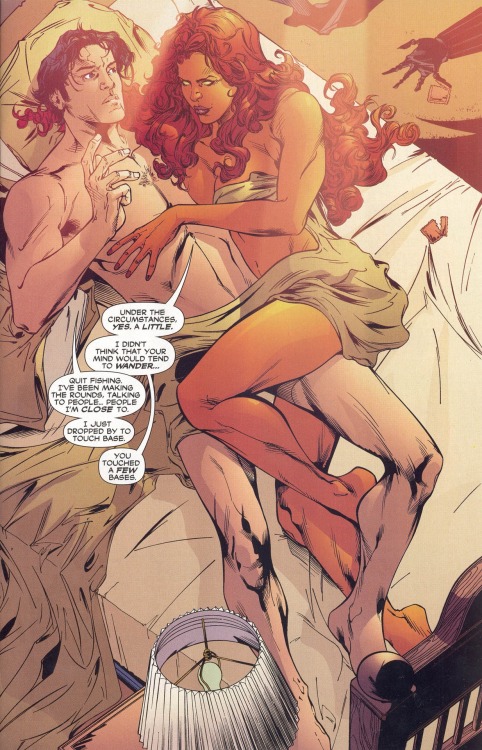
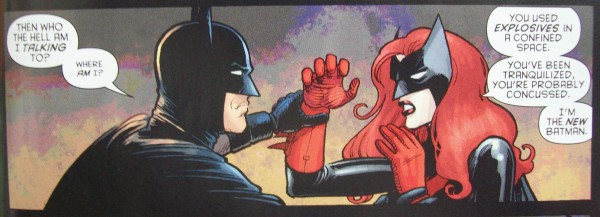
Only after the redhead meme became popular among fans did DC’s writers adopt it, in a way. The collectively written magazine 52, #30 (Nov 2006), showed him saying to Kate Kane/Batwoman, “I’ve got a thing for redheads.” Kate’s type is policewomen, so the creative team knew that wasn’t going to work out—it was just a wink to Nightwing fans.
Since then, however, the comics have shown Dick in a series of other relationships with a variety of women—brunettes, blondes, and, it appears, a somewhat higher fraction of red-haired women. What started as a cheeky fan observation has apparently become part of the mythos.