Showing posts with label OIP Derangement Syndrome. Show all posts

11 December 2015

OIP Derangement Syndrome Trumping Facts

Recently a reporter from the Washington Post sat in on a focus group organized by Frank Luntz, the GOP pollster and message-shaper. Luntz was trying to find out, on behalf of the Republican Party establishment, what could shake Donald Trump’s followers.

It turned out the big problem is OIP Derangement Syndrome, spread by the American right over the past seven years. For example, here’s a man who pictures burning the President alive:
Frank Lanzillo, a 59-year-old retired marine, took that as a cue to explain just how anti-American the president really was.

“When you bend down to the Saudis, take your shoes off, put your hand on a Koran and then the Bible when you’re sworn in?” Lanzillo said. “He took his flag pin off. I’m a Marine and former deputy sheriff. He took that off, he was in the toilet to me. I would not only not piss on him if he was on fire — I’d throw gas on him.”

(The president briefly chose not to wear a flag pin during the 2008 campaign; he was not sworn in on a Koran.)

Asked if the president was a Christian, only three of the 29 participants raised their hands. Asked if he was born in the United States, eight said no. When Luntz returned to policy, mistrust of the president informed the exclamations of trust in Trump.
As a result of OIP Derangement Syndrome, these voters were unable to process factual information from Luntz. No evidence of Trump’s policy extremes, boorish manners, or distance from reality could shake their loyalties. They’re sticking with Trump, and the GOP is stuck with them.

27 November 2015

Turkey in the Straw Poll

This week Public Policy Polling released the results of a Thanksgiving survey (PDF download) which provided new evidence of OIP Derangement Syndrome among self-identified conservatives and Republicans.

The questions were all Thanksgiving-themed, such as respondents’ favorite pies, whether stuffing should be called dressing, and which Presidential candidates people might and might not like as Thanksgiving guests.

And then there was this question:
Do you approve or disapprove of President Obama’s executive action last year to pardon 2 turkeys rather than the customary one turkey at Thanksgiving?
Choices were approval, disapproval, and “not sure,” which we should assume includes “don’t give a darn.”

The results were quite widely split by party affiliation and political leaning. As PPP reported, “Only 11% of Republicans support the President’s executive order last year to 38% who are opposed—that's a pretty clear sign that if you put Obama’s name on something GOP voters are going to oppose it pretty much no matter what. Overall there’s 35/22 support for the pardon of Macaroni and Cheese thanks to 59/11 support from Democrats and 28/21 from independents.”

But what’s really telling (though not told by PPP) is that Presidents started “formally” pardoning turkeys each year back in 1989, and there have always been two turkeys involved. The breeders provide a matched pair in case one doesn’t look like it can handle the ceremony. Here, for example, is the report on President George W. Bush pardoning two turkeys in 2007.
In other words, 38% of Republicans opposed the current President pardoning two turkeys even though they’d seen his predecessor do that same thing eight times, simply because PPP’s question presented them with a chance to express disapproval of “executive action,” doing something other than “customary,” and “President Obama.”

20 November 2015

Weighing the Woes of White Americans

Janell Ross in the Washington Post this week:

In a new poll released by the Public Religion Research Institute (PRRI) on Tuesday [PDF download], a whopping 43 percent of Americans told researchers that discrimination against whites has become as large a problem as discrimination against blacks and other minority groups.
To be precise, half of all white Americans feel that way. Less than 30% of blacks and Hispanics agree. Ross continues:
White Americans feel put-upon and mistreated — and large shares of non-white Americans do not seem to have any knowledge of the challenges that white Americans say they face.

Of course, there are always aspects of other people's lives that we do not or cannot understand. But the sheer size of the racial/ethnic gap concerning perceived discrimination against white Americans is particularly interesting because there is very little in the way of objective evidence of this discrimination and the disadvantage that typically follows. On just about every measure of social or economic well-being, white Americans fare better than any other group.

That's true of housing and neighborhood quality and homeownership. That's true of overall health, health insurance coverage rates, quality of health care received, life expectancy and infant mortality. That's true when it comes to median household earnings, wealth (assets minus debt), retirement savings and even who has a bank account. . . .

White Americans are, as a group, born healthier and live longer and get better health care, jobs, education and housing in the years in between. Yet half of white Americans believe that discrimination against them is as big a problem in their lives as it is for those of people of color. But there's just no evidence to back that up.

What does exist is ample evidence of continued-but-shrinking racial and ethnic inequality in many arenas and utter stagnation and backsliding in others. Basically, what's changed since the 1950s — outside of technological innovations such as this here Internet — is that white Americans no longer have an exclusive or almost-exclusive hold on the best housing, jobs, schools or the ballot box.
The question on the latest PRRI American Values Survey was “Just your impression, in the United States today, is there a lot of discrimination against any of the following groups or not?”

In past polls, the most comparable question has been whether respondents agree with the statement “We have gone too far in pushing equal rights in this country.” Agreement hovered between 38% and 49% from 1987 to 2012. So the perception that, despite empirical evidence, whites suffer from discrimination as much or more than non-whites doesn’t appear to be new, nor growing, in that period.

The new survey also notes that the perception of anti-white discrimination among whites is much higher within the “working class” (60%) than among people with college degrees (36%). A recent analysis of American mortality rates from 1999 to 2013 by Anne Case and Angus Deaton also found that educational difference was a significant dividing line among middle-aged white non-Hispanic Americans. People who had any college education died at a slightly smaller rate over that period. But mortality for people who had no college had gone up so much as to produce a strikingly higher mortality rate for the entire age/race cohort.

Thus, white Americans without college education might well be justified in perceiving a more difficult life than they expected. But they’re more likely to blame that on “discrimination” against whites rather than, say, a changing economy.

21 November 2014

The Benghazi Strain of OIP Derangement Syndrome

One easy diagnostic test for OIP Derangement Syndrome is an abiding belief in conspiracies and secrets surrounding the fatal attack on the US consulate and CIA outpost in Benghazi, Libya, in 2012.

In my personal experience, the people who say they’re most concerned with digging out more facts about that event also have a lot of trouble keeping the existing facts straight, such as how the US had no embassy in Benghazi.

There have been multiple investigations of the attack. In fact, the “Asked and Answered” website not only answers common right-wing questions and claims about Benghazi but also a list of how many times those questions have already been authoritatively answered.

Today, two weeks after the national elections, the House Intelligence Committee finally released its report on the event. And that bipartisan but GOP-controlled body came to the same conclusions as the previous inquiries.

As the Associated Press reported:
A two-year investigation by the Republican-controlled House Intelligence Committee has found that the CIA and the military acted properly in responding to the 2012 attack on a U.S. diplomatic compound in Benghazi, Libya, and asserted no wrongdoing by Obama administration appointees.

Debunking a series of persistent allegations hinting at dark conspiracies, the investigation of the politically charged incident determined that there was no intelligence failure, no delay in sending a CIA rescue team, no missed opportunity for a military rescue, and no evidence the CIA was covertly shipping arms from Libya to Syria.

In the immediate aftermath of the attack, intelligence about who carried it out and why was contradictory, the report found. That led Susan Rice, then U.S. ambassador to the United Nations, to inaccurately assert that the attack had evolved from a protest, when in fact there had been no protest. But it was intelligence analysts, not political appointees, who made the wrong call, the committee found. The report did not conclude that Rice or any other government official acted in bad faith or intentionally misled the American people. . . .

In the aftermath of the attacks, Republicans criticized the Obama administration and its then-secretary of state, Hillary Rodham Clinton, who is expected to run for president in 2016. People in and out of government have alleged that a CIA response team was ordered to “stand down” after the State Department compound came under attack, that a military rescue was nixed, that officials intentionally downplayed the role of al-Qaida figures in the attack, and that Stevens and the CIA were involved in a secret operation to spirit weapons out of Libya and into the hands of Syrian rebels. None of that is true, according to the House Intelligence Committee report. . . .

Rice's comments were based on faulty intelligence from multiple agencies, according to the report. Analysts received 21 reports that a protest occurred in Benghazi, the report said—14 from the Open Source Center, which reviews news reports; one from the CIA; two from the Defense Department; and four from the National Security Agency.
The AP also noted that this report “was released with little fanfare on the Friday before Thanksgiving week,” despite how much importance some Americans have attached to the subject in recent years.

Sadly, Republican leaders in the House of Representatives have already taken steps to feed those people’s delusions further. Earlier this year it commissioned a special House committee to conduct an eighth government investigation. Based on this one’s schedule, we can expect its report days after the 2016 election.

(Shown above is the cover of a book that supposedly exposed some of those lies and conspiracies about the bengahi attacks. It was featured on Sixty Minutes, then pulled by the publisher when the author was found to be lying. Note how the cover twice uses the word “embassy”—that should really have been a clue about its accuracy.)

14 November 2014

Family Fairness, Then and Now

Back in early October, The Hill reported:

Congressional Republicans are outraged that President Obama may take executive action on immigration reform after the mid-term elections—perhaps by deferring deportations and providing work authorization to millions of unauthorized immigrants with strong family ties to the United States. However, past Republican presidents have not been shy to use the White House’s power to retool immigration policy. In fact, Obama could learn a lot from presidents Ronald Reagan’s and George H. W. Bush’s executive actions to preserve the unity of immigrant families, and move past Congressional refusal to enact immigration reform.
After President Reagan signed the 1986 immigration reform law, people noted that it could apply to some members of certain families but not all, thus putting the US government in the position of splitting up families. Advocates like the US Catholic bishops argued that the government should take care to prevent that, but bills went nowhere in Congress. In 1987, therefore, Reagan’s Immigration and Naturalization Service commissioner announced the agency was “exercising the Attorney General’s discretion” to defer deportation for many illegal immigrants.

Immigrant advocates worried that still left many families at risk. Legislation once more stalled in Congress. In February 1990 President Bush used executive action to implement the provisions of a bill that the Senate had passed overwhelmingly and the House hadn’t acted on. Bush’s INS commissioner explained the “family fairness” policy by saying, “we can enforce the law humanely. To split families encourages further violations of the law as they reunite.” The administration estimated that action would affect 40% of the illegal immigrants in the US at the time.

Today the Obama administration faces very similar challenges: keeping families intact, not coming down hard on children, bringing productive members of American society out of the shadows, a Congress too divided to act. The US people granted President Obama executive power in the 2008 and 2012 elections, which clearly includes the Reagan and Bush administration precedents. So far Obama has issued fewer executive actions than his recent predecessors.

And yet top Republicans in Congress are now saying that if President Obama uses the same executive power as Presidents Reagan and Bush to address the same problem, that would justify either shutting down the federal (again) or impeachment (again).

07 November 2014

Aggregation

This is a snapshot from Talking Points Memo, my favorite site for political news. It shows the aggregation of several polls over recent weeks about Americans’ attitudes toward our two main political parties.

As you can see, Americans thought much worse of the Republican Party, and yet favored its congressional candidates by a slight edge. Which is what we saw in the mid-term election this week. And enough slight edges across the country’s competitive districts turn into a strong run of victories for those unfavored Republicans.

But as to how voters can reconcile those attitudes in their minds, that’s a mystery. Part of the answer is turnout. Part is that we the electorate are almost evenly divided, making slight edges more crucial—this is the fourth of the last five election cycles that swung sharply against the previous vote for Congress.

And part might be underlying OIP Derangement Syndrome, in which some voters, sensing a problem in the national government, blame President Barack Obama despite agreeing in the abstract with his policies and methods.

31 October 2014

The Cloture Wars

Earlier this week Farah Stockman wrote in the Boston Globe about presidential nominations in recent years:
To see how contentious nominations have become, count motions for “cloture,” which forces a vote when two sides can’t agree to move forward. From 1949 to 1968, there wasn’t a single nominee that needed a cloture motion. From 1967 to 1992, there were eleven. During Bill Clinton’s presidency, 22 nominees needed one. Under George W. Bush, 38 did. But under President Obama, that number has exploded, to a stunning 178, and counting.
That’s illustrated above in the graphic by Olivia Hall that accompanied Stockman’s essay.

What’s more, the pattern through the last three decades of the 20th century was that the number of cloture votes rose when the opposition party was about to take control of the Congress, as in 1986 and 1994. In those years the minority party, sensing better opportunities ahead, stalled on nominations while the majority party tried to preserve them.

The current century shows two new patterns. First, cloture motions became more common from 2002 to 2006 during the Bush-Cheney presidency, though they slumped in the last two years when Democrats controlled the Senate. Second, the need for cloture votes returned immediately in 2009 after the election of President Obama, and then started to rise exponentially in 2012.

03 October 2014

“Three Times as Many Threats as His Predecessors”

Earlier this week the Washington Post published an exposé of how an intruder got further into the White House than the Secret Service had previously disclosed.

Buried inside that article was a national index of OIP Derangement Syndrome:
President Obama has faced three times as many threats as his predecessors, according to people briefed on the Secret Service’s threat assessment.
That shouldn’t be a surprise. Back in 2010, I noted reports of a big spike in threats against this President, and an attempt by the Secret Service at that time to tamp down that concern, at least publicly.

This week also brought a report from a former Mitt Romney campaign communications director that in 2012 a married but flirtatious Secret Service agent leaked President Obama’s schedule while trying to impress another Romney aide. The campaign actually ignored the confidential information, not trusting it, but then found it was accurate.

Understandably, that sort of behavior has left African-American citizens wondering how committed all Secret Service personnel are to protecting this President. Meanwhile, Obama’s political enemies are doing their best to blame the victim of these failures.

Ironically, some of the recent incidents making headlines now, such as a security guard in Atlanta and a fake Congressman at a speech, appear to involve overeager fans of President Obama. There have been assassination conspiracies, but most seem to involve incompetent people.

Protecting officials who want to remain in contact with the people who elected them is not an easy job, especially in a country with more guns than people and a sizable majority suffering from an irrational resentment toward the President.

26 September 2014

Gingrich’s Leap of Language

On Tuesday morning, President Barack Obama spoke about the expansion of the US war in Afghanistan and Iraq into ISIL-occupied Syria. The White House transcript of that statement is here, pegged to the time of 10:14 AM.

Former Speaker of the House and presidential candidate Newt Gingrich responded with a series of tweets.

On the other hand, Gingrich did not have the courtesy to listen to the speech himself, check the official White House text, or wait less than twenty minutes for C-Span to review its real-time transcription.

As the New York Times patiently explained:
…as any regular C-Span viewer can tell you, the network’s real-time captioning produces some far from accurate phrasing. In fact, later in the day, C-Span had Mr. Obama “partnering with African on Jupiter” on clean energy projects. What the president said was “partnering with African entrepreneurs.”
When faced with what he recognized as a “weird” text, Gingrich couldn’t simply consider that there might be an error and hold off commenting until he found more information. Instead, he fit that into his false image of President Obama’s foreign policy and leapt to criticize it. That’s another sign of Gingrich’s ongoing OIP Derangement Syndrome.

19 September 2014

“He’s got a lot to do with that”

From the New York Times, a textbook example of OIP Derangement Syndrome preventing someone from seeing her best interests:

The Affordable Care Act allowed Robin Evans, an eBay warehouse packer earning $9 an hour, to sign up for Medicaid this year. She is being treated for high blood pressure and Graves’ disease, an autoimmune disorder, after years of going uninsured and rarely seeing doctors.

“I’m tickled to death with it,” Ms. Evans, 49, said of her new coverage as she walked around the Kentucky State Fair recently with her daughter, who also qualified for Medicaid under the law. “It’s helped me out a bunch.”

But Ms. Evans scowled at the mention of President Obama — “Nobody don’t care for nobody no more, and I think he’s got a lot to do with that,” she explained — and said she would vote this fall for Senator Mitch McConnell, the Kentucky Republican and minority leader, who is fond of saying the health care law should be “pulled out root and branch.”
It’s not clear what Evans meant by “Nobody don’t care for nobody no more, and I think he’s got a lot to do with that.” If she meant that there’s a lot of antagonism in the country, that’s true, but President Barack Obama isn’t a source of hostility; he’s the recipient of hostility from people like her. If Evans was saying that people don’t look after each other, then the President’s health-insurance reform tried to counteract that trend—as she has experienced.

Thanks to a Democratic governor, Kentucky is one of the states that voted against President Obama but accepted federal money to expand Medicaid to help people like Evans. It did so, however, under the name Kynect, shielding people from having to acknowledge they were benefiting from this President’s policies. As a result, the number of uninsured Americans has gone down considerably in Kentucky while it remains high in other states, like Texas.

05 September 2014

When OIP Derangement Syndrome Is in Fashion

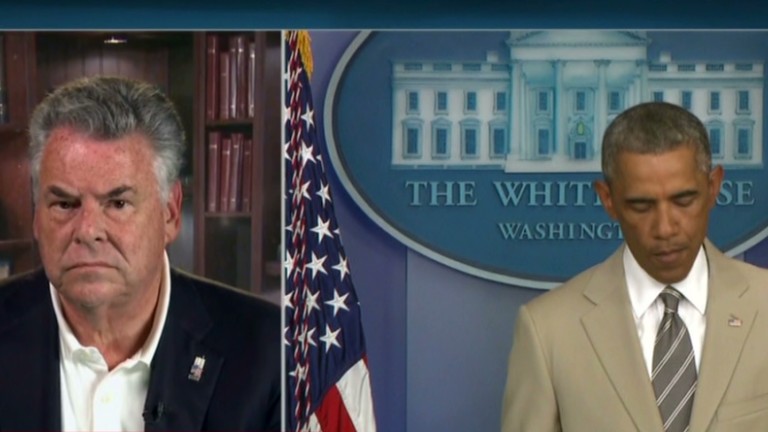
Last week President Barack Obama held a news conference to address the US economy, foreign policy challenges, and other topics. And one day later, as shown above, Rep. Peter King (R-NY) went on a right-wing political site called NewsMaxTV to complain:
There’s no way any of us can excuse what the president did yesterday. When you have the world watching…a week, two weeks of anticipation of what the United States is gonna do. For him to walk out — I’m not trying to be trivial here — in a light suit, light tan suit…
Imagine what detail King would lead with if he were trying to be trivial!

Now not everyone can match up to Rep. King in looking like a recently awoken city boss, perhaps from the old Soviet Union. Nor does everyone else have the finely calibrated fashion sense to know when one can criticize someone else for dressing too casually while not wearing a tie.

But we can note that past Presidents, including Ronald Reagan, George H. W. Bush, and Bill Clinton wore tan business suits during official events without attracting such criticism.

Double standards like King’s are a symptom of OIP Derangement Syndrome. So is hyper-intense focus on trivial details in an attempt to deny the real reason for one’s visceral reactions to seeing Barack Obama at work as President.

29 August 2014

General’s Death Exploited by People with OIP Derangement Syndrome

On 14 August, Maj. Gen. Harold Greene was interred at Arlington National Cemetery, nine days after he had been shot and killed by an Afghan soldier. A military engineer who had never been deployed to a combat zone before, Greene was the highest-ranking US military officer killed by enemy action since the 2001 attack on the Pentagon, the highest-ranking US general killed since the Vietnam War.

Even before that funeral, right-wing critics of President Barack Obama started to complain that he’d show his disrespect for the military by not attending. Morris Davis, a retired US Air Force colonel now teaching at Howard University, saw a need to respond. As he explained to a contributor to the online Washington Examiner:
A couple of days ago I saw several people observe that President Obama was somewhere between disrespectful and treasonous for not attending the funeral of Major General Greene, which triggered the usual flood of anti-Obama hate that is prolific in some right-wing circles.

I knew from my 25 years of military service that it wasn’t common for Presidents to attend military funerals and I figured this fell into the same category as Obama is a communist because he was seen without an American flag pin on his jacket lapel or Obama hates the military because he didn’t go to Arlington Cemetery on Memorial Day; in other words, I knew he was getting bashed again for doing exactly the same thing most of his Republican predecessors had done in similar circumstances.

To note the hypocrisy of the Obama-haters, I used sarcasm and tweeted that he had broken with the tradition Presidents Nixon and Bush 43 set when they attended the funerals of the last General killed in the Vietnam War and the highest ranking officer killed in the 9/11 terrorist attack on the Pentagon, which, of course, neither of them had done.

And in the right-wing’s bash-Obama glee, my tweet has been retweeted a couple of hundred times without anyone taking two minutes to Google to see if it’s true. It’s similar to a Chinese news agency reprinting that Kim Jong-un had been named the sexiest man alive without checking and finding that The Onion is a satirical site. It’s also a sad commentary on how gullible people can be and how willing they are to latch onto “news” that supports the narrative they want.
In sum, Col. Davis laid a trap for people with OIP Derangement Syndrome.

Davis sent that clear explanation to one of the “journalists” who had based a dispatch on his tweet without confirming that they had interpreted it correctly. The contributor issued a retraction, albeit one that blamed the colonel instead of his own lack of fact-checking.

Of course, that correction and the precedents set by previous Presidents haven’t stopped complaints from right-wing media. After all, as Col. Davis noted, OIP Derangement Syndrome is based on double standards.

People with visceral dislike of President Obama are also complaining:
  • That the Secretary of Defense didn’t attend the funeral, either. I got to see that in my Facebook feed. Yet standard, easily found news sources, including the New York Times, National Public Radio, and Stars and Stripes, reported that Chuck Hagel and other Defense Department officials had been at the event. Hagel appears above in a photograph from the army’s homepage.
  • That the White House sent a more respectful delegation to the funeral of Michael Brown, the unarmed eighteen-year-old shot with his hands in the air outside St. Louis. In fact, the federal delegation to that event consisted of an “Assistant to the President and White House Cabinet Secretary,” a “Deputy Director of the White House Office of Public Engagement,” and “an advisor to the public engagement office.” In Washington protocol, none of those officials come close to Hagel, a Cabinet secretary.
  • That President Obama “hasn’t even ordered flags to be flown at half-staff, like he did for the death…of singer Whitney Houston.“ In fact, Gov. Chris Christie ordered flags to half-staff in New Jersey, Houston’s native state; the President took no such action.
Snopes called that last lie “a long-running piece of political misinformation.” In other words, it’s one of the ways people with OIP Derangement Syndrome try to justify their deep-seated prejudices.

22 August 2014

Show Me OIP Derangement Syndrome

Back in 1984 the journalist Michael Kinsley wrote that a Washington “gaffe” occurs when a politician accidentally tells the truth. We had an example of that in Poplar Bluff, Missouri, this week.

KFVS in Missouri reported on a city councilman named Peter Tinsley posting “what some call racist photos” on his Facebook page last year. Those photos, as Talking Points Memo shows, include a doctored image of President Barack Obama as an African witch doctor and another referring to him as “a lyin’ African.” So yeah, they were racist.

Once exposed, Tinsley told a council session: “I apologize from the bottom of my heart. . . . At one time, I was a very active Republican, very opposed to Obama.”

Local Republicans led by an organizer named Eddy Justice quickly reacted to that by insisting that “Tinsley's posts are not representative of the party” even though he is, in fact, an elected representative of the party.

Tinsley then offered another apology for his Facebook habit: “I want people to know that I am very remorseful for it. It was inappropriate. I believe I got caught up in an emotional moment of sharing jokes.” Sharing jokes with whom? Tinsley didn’t say. But we can presume that the Facebook friends of “a very active Republican” include a lot of other local Republicans. Nonetheless, Tinsley insisted: “Anything that I have said, that I referred to the activity because I was a Republican, that is not true. It’s not an excuse.”

And yet it is a reason. Tinsley was caught up in social circles so infected with OIP Derangement Syndrome that he lost sight of the line between reasoned, face-based, respectful political debate and expressions of simple hostility.

As for Eddy Justice, I’m quite willing to accept that he rejects racist jokes. I suspect that in his years as a Tea Party and Republican organizer he’s seen and heard worse such comments, and I hope he’s always been as quick to object to them. I can’t help but note, however, that Justice’s own Facebook page displays:

  • complaints about President Obama taking vacations, even though he’s done so at a rate so far less than President George W. Bush (12 August).
  • insinuations about “Remember when First Ladies were actually ladies?” (25 July).
  • a claim about the cost of health coverage rising 150%—and Justice is himself an insurance agent who sells health policies, so he should know the truth (6 May).
Double standards, snobbish sneers, and lies are all also symptoms of OIP Derangement Syndrome.

15 August 2014

Keith Ablow Lets His OIP Derangement Syndrome Hang Out

This week’s example of OIP Derangement Syndrome comes from Keith Ablow, a FOX television psychiatrist and writer of thrillers featuring a hairless psychiatrist who’s irresistible to women.

Ablow can be relied on to say ridiculous negative things about President Barack Obama, which is of course why he’s under contract to FOX.

He was presumably on the woman-hosted talk show Outnumbered because of his keen insight into feminine psychology, as shown by his claim in 2012 that Newt Gingrich’s pattern of marital infidelity and divorce proves he’s attractive to women.

The Outnumbered regulars brought up Michelle Obama’s campaign for better childhood nutrition, a cause that would ordinarily be so non-controversial that resentment of it is itself a strong sign of OIP Derangement Syndrome. Ablow’s contribution to the conversation was, in the words of Wonkette:
How well could she be eating? She needs to drop a few. [All the women gasp as if they didn’t already know Keith Ablow is terrible] We’re taking nutritional advice from who?
The next day he repeated his argument.

Which he had launched with his paunch hanging over his belt, as shown above.

18 July 2014

OIP Derangement Syndrome in Crises

Did the shooting down of a passenger jet over breakaway eastern Ukraine this week prompt America’s right-wing pundits to rise above OIP Derangement Syndrome? Of course not.

As The New Republic documented, multiple commentators attacked President Barack Obama for not making more of the 23 Americans who died in the airplane. They didn’t bother to confirm that those 23 Americans were, in fact, real.

We might take that as a symptom of the pressure in today’s online news environment to be the first with the story. Except that none of those people were reporting the story—they were opining on it. And they didn’t pause to think that the fact that the White House was not highlighting those people was a strong indication that the reports about them were unreliable. They had to assume that President Obama must be doing something wrong in order to justify their visceral urge to complain about him.

But that’s nothing compared to Rush Limbaugh, who hinted to his aging radio audience that the plane had been shot down in a conspiracy to allow the news media to stop reporting on children from Central America seeking protection in the US:

I don’t want appear to be callous here, folks, but you talk about an opportunity to abandon the Obama news at the border? And, no, I’m not suggesting anything other than how the media operates. Anyway, it’s eerie. It is really eerie. A Malaysian airliner. It was on the way to Kuala Lumpur. Why would it be shot down? Over Ukraine? It was shot down by a missile.

This would lead one to believe that it is not an accident.
With Limbaugh, it’s often difficult to tell whether it’s the pills or the racism talking, but in this case the OIP Derangement Syndrome is clear. And it was strong enough to justify trying to make political points off the sad death of hundreds of people.

16 May 2014

OIP Derangement Syndrome in Wolfeboro

For many years my family vacationed a couple of weeks each summer in Wolfeboro, New Hampshire, so I was especially interested in this example of OIP Derangement Syndrome.

As the Granite State News reported, a new resident of Wolfeboro named Jane O’Toole sent this report to the town government:

My husband and I were enjoying a meal at Nolan’s in Wolfeboro. We were seated very close to the bar, where we witnessed a man eating and drinking alcohol. I found out later he was Police Commission Vice Chairman, Robert Copeland. A man conversing with Mr. Copeland asked if he watched the TV show Chronicle. Mr. Copeland responded loudly, “No, I don’t watch TV because every time I turn it on all I ever see is that F*****g Nigger!” As I left, passing Mr. Copeland I whispered, “Is someone here tossing around the “N” word?” Mr. Copeland swung around and responded with an exuberant, “Yeah!”
Copeland’s reponse was:
While I believe the problems associated with minorities in this country are momentous, I am not phobic. My use of derogatory slang in reference to those among them undeserving of respect is no secret. It is the exercise of my 1st Amendment rights. . . . I believe I did use the “N” word in reference to the current occupant of the Whitehouse [sic]. For this I do not apologize – he meets and exceeds my criteria for such.
Despite that admission, Copeland also claimed that he’d never said specifically what O’Toole had heard—but also that she shouldn’t have been listening to him. All of which suggests that he might have been drinking more “cocktails” than he recalled.

Copeland is eighty-two years old, one of three elected members of the town’s police commission. His term expires in 2017. At a recent board meeting scores of residents came to ask Copeland to step down, but he refused and criticized reporters for covering the event.

Wolfeboro is a small lakeside town now built around tourism. I have some fond memories of it. But I suspect that a lot of people share my feelings and would prefer not to visit a town with a racist helping to oversee the police.

18 April 2014

Captain America and the Threat of OIP Derangement Syndrome

As I noted yesterday, some right-wing media organizations responded to The Lego Movie with complaints that it was anti-business. (Others, to be sure, saw it as simply anti-government, and they were fine with that. Critics on the left saw it as about the danger to people of business and government intertwining, as they often warn. In fact, it’s about commercialism taking over entertainment.)

What about the other big superhero adventure of the spring, Captain America: The Winter Soldier? The directors of that film, Joe and Anthony Russo, said months ago that they were modeling it on the political thrillers of the 1970s, with a few over-the-top action sequences thrown in. They cast Robert Redford as a high official because his filmography includes Three Days of the Condor and All the President’s Men. They even dressed him in a 1970s-style three-piece suit, and he still looks good.

Both Christian Toto at Breitbart on the right and Asawin Suebsaeng at Mother Jones on the left picked up on that anti-authority theme by saying the film wouldn’t be screened at the White House soon. Nor, they could have added on the same speculative grounds, in Congress, the FISA court, the Pentagon, or other pillars of the political center and the security establishment.

But John Nolte at the Breitbart site went off the deep end, calling the movie “a blatant $175 million ‘screw you’ to Barack Obama's surveillance state.” One might be concerned about Nolte watching a PG-13 movie without a parent since he doesn’t appear to remember anything earlier than six years ago. But his response is just a symptom of OIP Derangement Syndrome.

The big danger in Captain America: The Winter Soldier is that a government agency wants to launch worldwide preemptive strikes against what it sees as threats to America or democracy. Preemptive action was the core of the “Bush Doctrine,” which Nolte cheered on his old website, now left to drift into the aether.

The “surveillance state” that Nolte blames on President Obama was in fact built by the Bush-Cheney administration. Nolte really should know that because he’s written, for example, about the Washington Post’s coverage of the NSA’s PRISM program, which clearly stated that program was established in 2007. As soon as the Obama administration came into office in 2009, it started to reveal more about the programs it inherited and to put more limits on them.

The disclosures of Bradley/Chelsea Manning and Edward Snowden show that there’s much more we the people have to know. Nolte offered notable praise for Glenn Greenwald for helping to share the Snowden files. Of course, that happened during the Obama administration.

Based on Nolte’s stated support for some of the most egregious Bush-Cheney policies, such as waterboarding, and his decision to become a right-wing media voice (at first pseudonymous, then openly) because he disliked opposition to the Iraq invasion, I can’t help but think that his position on security leaks would have been quite different under a right-wing President.

Likewise, if Captain America: The Winter Soldier had been released under an administration he supported, Nolte would have complained that it was Hollywood’s usual attack on anything good and conservative. That’s been his professional hobbyhorse for years.

In making the security state its major threat, Winter Soldier echoes a common theme of the American left—a theme the American right takes up only when it’s not in power.

TOMORROW: And does the movie really tackle that threat?

11 April 2014

Getting the Message on OIP Derangement Syndrome

This week’s study in OIP Derangement Syndrome is Rep. Jack Kingston of Georgia, one of three members of Congress running for the Republican nomination for that state’s Senate seat.

As Talking Points Memo reported, Kingston’s campaign released an ad featuring a Barack Obama impersonator supposedly leaving a voicemail for Kingston saying he doesn’t want the man in the Senate.

And here I thought we learned from Clint Eastwood in 2012 that having angry conversations with a wholly imaginary “President Obama” simply makes one look like a crazy person.

But the really crazy part is that in this Senate race Kingston is being attacked from the right.

04 April 2014

Whatever It Is, They’re Against It

This week Quinnipiac University released one of its regular polls of Americans’ views on political issues. As most people would expect, this survey showed a stark partisan divide on most issues.

Among the Republicans surveyed, 74% disapprove of the way President Barack Obama is “handling the situation with Russia and Ukraine.” Of course, since 93% of them disapprove of how he’s generally doing the job of President, Republicans actually think that’s one of the better aspects of the current administration.

Sixty percent of all Republicans think the President is not being “tough enough” on Russia. Yet the same group is almost evenly split on whether it’s more important for the US “to take a firm stand” (47%) or “not get too involved” (42%). And 84% of Republicans, a slightly higher portion than of Americans overall, are “very” or “somewhat concerned” that “the current situation in Ukraine will develop into a larger regional conflict that could lead to the U.S. military getting involved.”

How can the US be tougher, take a firm stand, but not get too involved and definitely not end up in a larger military conflict? That dilemma should puzzle anyone. The survey found 69% of Republicans agreeing on a measure: “imposing economic sanctions on Russia for its actions involving Ukraine.” That’s the approach that President Obama is taking, but of course 74% of those Republicans disapprove of how he’s doing that. The survey didn’t ask about any stronger measures, probably because no one—even in the Republican Party—has come up with any to advocate in a concerted way.

Sixty percent of Republicans agree that “inaction on the part of the administration when chemical weapons were used in Syria conveyed weakness to President Vladimir Putin thus emboldening him in Ukraine.” Of course, Republicans and many of their representatives in Congress did a sudden turnaround back in August 2013 and disapproved when President Obama proposed military action against Syria.

To be fair, President Obama isn’t the only thing that Republicans are at odds with themselves on. A clear majority—58%—disapprove of how the Republicans in Congress are handling their job.

28 March 2014

The Deep Roots of Inflation Fears

Back in 2006, the historian Michael O’Malley wrote an article for Common-place about links between fear of economic inflation (money losing value in the real world) and racial fears. Specifically, he looked at the debate in the late 1800s between maintaining a gold standard for US currency and adding a silver standard:
Arguments for gold aimed at the working class often linked gold to both a high standard of living and the intrinsic superiority of the Anglo-Saxon race. “Take a look at the company before you sit down at the feast,” an anti-silver tract warned workingmen. Who had silverites invited? “Half civilized, half clad peoples, who are weak and ignorant, who have little or no commerce; where bullfights abound and schools do not; where human labor is in sharp competition with the meek and lowly jackass; where the breech-clout is preferred to a full suit.”
In his 2013 book Face Value: The Entwined Histories of Money and Race in America, O’Malley extended that exploration, going back to the early republic and up to the present. This month he discussed some aspects of that history in this episode of Back Story, the radio show/podcast.

O’Malley’s chapter 3 analyzes reactions to paper currency that the US federal government issued during the Civil War at the same time it was enlisting African-American soldiers for the first time in decades. Opposition rhetoric claimed that paper money had less value than specie and those black soldiers had less value than white. Of course, both helped the Union to win the war.

Toward the end of his book, O’Malley notes parallels between such fears and some people’s anxieties today. The election of President Barack Obama in 2008, coinciding with the Bush-Cheney recesssion, prompted sudden new interest in gold. In turn, gold dealers became the leading sponsors of several political commentators on the right.

O’Malley notes a pattern in those advertisers and pundits warning about about “Zimbabwe-style” inflation. Why is that their chosen metaphor, he asks, rather than the better known and more significant inflation in post-WW1 Germany? Perhaps because of the underlying racial component.

More disquieting, because it’s more influential, is how so many economists and politicians have focused on inflation in recent years even though it’s hardly appeared. While international banks warn about deficit spending, most industrial nations that followed austerity programs have recovered more slowly or suffered double-dip recessions compared to those that responded with economic stimulus. Meanwhile, unemployment remains a major problem, one that central banks are supposed to address.