Showing posts with label my first and last post about fashion. Show all posts

19 May 2025

“Seeing all those curls lying on the floor”

Frances Hodgson Burnett finished Little Lord Fauntleroy with young Cedric still wearing the same clothes and hairstyle as when he started.

For boys who disliked that book’s fashions, however, the moment a lad could have his “love-locks” cut became a rite of passage. It was akin to transitioning from skirts to breeches, and later from breeches to long pants. It signaled not only growing older but also moving away from maternal influence.

The slapstick comedian Moe Howard described such a moment in his memoir, Moe Howard and the Three Stooges, published posthumously in 1977. Born in 1897 as Moses Horwitz, he recalled having ringlets as a boy in elementary school:
My school career began in September 1903, when I was six. Whenever I attended school—which in later years wasn’t very often—I was constantly fighting. I fought on my way to school, in school, and on my way home. As I said before, my hair had grown very long, and every school day I would awaken a half hour before everyone else so my mother could wind finger curls through my hair; they reached almost to my shoulders. There were about twenty of them in all, and they resembled a bunch of cigars stuck on my head. Knowing that it was my mother’s greatest delight to spend that half hour arranging my curls, I didn’t complain. But soon it became the battle of my school career.
After recounting lots of fights over how “girly” he looked, Howard recalled meeting a couple of boys who befriended him anyway—but still didn’t like the hairstyle.
I gazed into Donald’s mirror and saw my curls hanging down, a good ten inches long. I glanced over at Donald and Rusty, two normal-looking young boys. I looked in the mirror again, and then something on Don’s dresser caught my eye. A shiny object with black enamel handles. I looked at myself again, trying to create one last impression.

I grabbed the scissors and, with my eyes closed, began to circle my head, clipping curls all the way around. I didn’t dare to look at the floor to see what had fallen. When I finished, I dropped the scissors, afraid to look at myself. Tears quietly flowed down my cheeks.

When I finally opened my eyes, I found Rusty and Don pointing at me and laughing hysterically. I couldn’t resist looking into the mirror. I choked up. There wasn’t a laugh in me. There in the mirror I caught sight of the haircut that was to make me famous in the 1920s. I laughed, then I cried, and I shuddered seeing all those curls lying on the floor and realizing that I had destroyed one of my mother’s few pleasures. . . .

My brother Shemp spotted me first. He let out a war whoop. “Take a look at your son with the fright wig. He thinks it’s Halloween, and what do you know, it’s not a wig; it’s a brand-new haircut.” Then Mother, Irving, and Jack came in. They stared speechless for a moment. Then Mother looked at me. I looked at her and the tears welled up in my eyes, then the tears welled up in hers. She said softly, “Thank God you did it. I didn’t have the courage.”
Thomas Wolfe’s Look Homeward, Angel offers a semi-fictional treatment of the same transition. The autobiographical novel by and about a boy born in 1900 in North Carolina says:
Eliza had allowed his hair to grow long; she wound it around her finger every morning into fat Fauntleroy curls: the agony and humiliation it caused him was horrible, but she was unable or unwilling to understand it, and mouth-pursingly thoughtful and stubborn to all solicitation to cut it.
And a few years and many pages later:
He was now in one of the upper grades of grammar school, he was one of the Big Boys. His hair had been cut when he was nine years old, after a bitter siege against Eliza’s obstinacy. He no longer suffered because of the curls.
TV Tropes lists many female examples of the Important Haircut in recent books, movies, and other entertainment. But in the late nineteenth and early twentieth century, that passage was just as important for many boys.

16 May 2025

“The Fauntleroy period had set in”

The hairstyle and costume popularized by Frances Hodgson Burnett’s Little Lord Fauntleroy, as illustrated by Reginald B. Birch, didn’t remain fashionable for very long.

But it remained vivid in the memory of Americans who lived through the 1880s and ’90s. Indeed, that look for boys became an icon of the Gilded Age.

For instance, Booth Tarkington (1869–1946) published The Magnificent Ambersons in 1918. This passage, looking back on life in Indianapolis three decades before, describes Georgie Minafer as a boy:
…the Fauntleroy period had set in, and Georgie’s mother had so poor an eye for appropriate things, where Georgie was concerned, that she dressed him according to the doctrine of that school in boy decoration. Not only did he wear a silk sash, and silk stockings, and a broad lace collar, with his little black velvet suit: he had long brown curls, and often came home with burrs in them.

Except upon the surface (which was not his own work, but his mother’s) Georgie bore no vivid resemblance to the fabulous little Cedric. The storied boy’s famous “Lean on me, grandfather,” would have been difficult to imagine upon the lips of Georgie. A month after his ninth birthday anniversary, when the Major gave him his pony, he had already become acquainted with the toughest boys in various distant parts of the town, and had convinced them that the toughness of a rich little boy with long curls might be considered in many respects superior to their own. . . .

Thus, on a summer afternoon, a strange boy, sitting bored upon the gate-post of the Reverend Malloch Smith, beheld George Amberson Minafer rapidly approaching on his white pony, and was impelled by bitterness to shout: “Shoot the ole jackass! Look at the girly curls! Say, bub, where’d you steal your mother’s ole sash!”

“Your sister stole it for me!” Georgie instantly replied, checking the pony. “She stole it off our clo’es-line an’ gave it to me.”

“You go get your hair cut!” said the stranger hotly. “Yah! I haven’t got any sister!”

“I know you haven’t at home,” Georgie responded. “I mean the one that’s in jail.”
When Orson Welles adapted Tarkington’s novel into a movie, his script kept that deathless dialogue exactly. It also specified that that scene took place in 1885, thus slightly before Frances Hodgson Burnett’s novel appeared. Bobby Cooper played young Georgie, as shown above.

Tarkington created another portrait of childhood in Penrod and its sequels, but he set those books a generation later, and none of the boys has Fauntleroy curls.

10 May 2025

The Little Lord’s “Love-Locks”

Frances Hodgson Burnett’s Little Lord Fauntleroy started to appear in St. Nicholas Magazine in 1885, then came out in book form in 1886. It was illustrated by Reginald B. Birch.

Cedric, the title character, was defined by a distinctive look:
Mary…was proud of his graceful, strong little body and his pretty manners, and especially proud of the bright curly hair which waved over his forehead and fell in charming love-locks on his shoulders. She was willing to work early and late to help his mamma make his small suits and keep them in order.

“’Ristycratic, is it?” she would say. “Faith, an’ I’d loike to see the choild on Fifth Avey-NOO as looks loike him an’ shteps out as handsome as himself. An’ ivvery man, woman, and choild lookin’ afther him in his bit of a black velvet skirt made out of the misthress’s ould gownd; an’ his little head up, an’ his curly hair flyin’ an' shinin’. It’s loike a young lord he looks.”
Soon the name “Fauntleroy” was applied to the outfit Birch pictured. “Short tailored jacket, knee-length trousers, rather frilly shirt, wide collar with rounded corners, or large loose bow” is how Merriam Webster defines the adjective “Fauntleroy” now.

The long “love-locks on his shoulders” were just as much part of this look for upper-class boys. Indeed, within three years after Burnett’s story appearing, Harper’s Young People published an anecdote about “Little Rex, who is six years old, and has a pretty head of ‘Little Lord Fauntleroy’ curls.”

Soon there was a backlash. By 1893 the University of North Carolina Magazine started a positive review of Burnett’s new story collection with a nod to “the little Chapel Hill boy who wanted to cut off Lord Fauntleroy's curls and roll him in the dirt until he made of him a real boy.”

03 February 2025

“One day I showed up at the studio barefoot”

In his 2001 interview with Richard W. Bann, Bud McDonald shared one memory from working at the Hal Roach Studio at age seven:
We were supposed to work out at the ranch on an Our Gang. Down home, in the summer time, I went barefoot, like everyone else. . . . One day I showed up at the studio barefoot. I didn’t put any shoes on and my mother never noticed. She had to drive all the way back to Bell to get my shoes, and in the meantime they went and bought a new pair of shoes for me at the studio. They had to scuff ’em up real bad.
Movies from the 1920s confirm that it wasn’t unusual for southern California boys to go barefoot. Coy Watson, Jr., didn’t wear shoes while starring in “A Nick-of-Time Hero” (1921) or playing a newsboy in “Galloping Bungalows” (1924). Neither did some players in the earliest Century Kids comedies and later Mickey McGuire movies.

More often, however, it’s ordinary kids called in as extras or hanging around in backgrounds who are shoeless. In the Our Gang movie “Big Business” (filmed September 1923, released 1924; Lucky Corner; YouTube), every anonymous walk-on is barefoot. One special example is the early Laurel and Hardy and James Finlayson short “Sugar Daddies” (1927; YouTube; Dave Lord Heath): a little fellow in overalls is so curious about what the comedians are doing on the Venice Pier that he pads alongside them staring for twenty seconds.

The Lucky Corner website reports that Buddy McDonald’s first three Our Gang movies were filmed on this schedule:
  • “Pups Is Pups” April–May 1930
  • “Teacher’s Pet” May 1930
  • “School’s Out” June 1930
Since McDonald referred to his shoeless arrival as happening “in the summer time,” that was most likely during the June shooting of “School’s Out.” That short was a sequel to “Teacher’s Pet,” with Jackie Cooper still mooning over teacher Miss Crabtree. Buddy was once again in the core group of school kids, though he didn’t have as many lines or close-ups as in the previous movie.

I suspect that the shoes incident affected how people at the Hal Roach Studio perceived Buddy McDonald. To begin with, he appears to have become the studio’s choice to play barefoot country boys.

Sometime later that year, Buddy and occasional Our Gang member Bobby Mallon shot a scene for the Laurel and Hardy’s first feature Pardon Us (Dave Lord Heath). That movie grew from a short subject as the studio kept adding episodes over several months, and I can’t tell when this scene was filmed.
Buddy and Bobby played two kids in overalls and straw hats, fishing and listening to Stan and Ollie discuss their criminal past. Ultimately that scene was cut from the English-language picture, but it survives in the treatment, this one publicity photo, and possibly the German print.

Buddy’s next release for Roach, filmed in February–March 1931, was the Charley Chase comedy “One of the Smiths” (YouTube; IMDB; Dave Lord Heath). He played a hillbilly kid, as shown at top. Though this character doesn’t have lines, his actions are crucial to the plot.

(McDonald also recalled a line he delivered in another Charley Chase movie, with Chase perhaps playing a druggist, but no one’s found that footage. It’s therefore possible Buddy filmed that scene before “One of the Smiths,” but I’m guessing not.)

COMING UP: Another effect of Buddy’s barefoot arrival may not have been so positive.

29 January 2025

“They want boys like Farina”

As I wrote before, the 1930 Our Gang short “Pups Is Pups” (Lucky Corner; IMDB; Dave Lord Heath) was set in a city, with big industrial structures looming over the kids’ yard.

That setting was also reflected in the gang itself, which was more multiethnic than it had been since 1925. That was when George “Sonny Boy” Warde made the last of his nine movies playing a stereotypical Chinese kid. For “Pups Is Pups” the gang included Alan Dong in a similar role, never repeated.

Of course, like all the Our Gang films, “Pups Is Pups” included some African-American kids: Allen “Farina” Hoskins; his sister Jannie, as shown in a still from a deleted scene; and young twins Kenneth and Hugo Hill playing his little brothers. (In the next movie, Matthew Beard arrived as a little brother for Farina. At first called Hercules, he’d soon be nicknamed “Stymie.”)

“Pups Is Pups” was also the first movie for Buddy McDonald, whose 2001 interview with Richard W. Bann I’ve been studying. Having a racially integrated set of playmates was new to Buddy, but he enjoyed working with Farina and Stymie:
I really liked them, both. They were the very first black people I met. I thought nothing of it at the time. I did learn about racial prejudice, but not at Hal Roach Studios. My mother was a bigot. . . .

Farina was the only one I stayed in touch with. We were pretty good friends. I talked to Al Hoskins around the year he died. He was back and forth between Oakland and Los Angeles. He’d been down and out too. He seemed to have nothing left either from his days in the Gang, other than memories. But it didn’t defeat his optimism. What a nice man.
In that interview, McDonald drew Bann’s attention to a part of Farina’s costuming imposed to make him fit the prevailing stereotype of black kids:
watch the films with Farina. He had another pair of shoes on inside those big shoes he wore to make his feet look extra large.
The 1925 promotional film “Our Gang at Home” makes the difference obvious. That movie is included in Ben Model’s Silent Comedy Watch Party, episode 88. Watch from 45:30 to 46:10, when little Farina briefly gets to wear only his own shoes.

“Pups Is Pups” played off American racial attitudes in another way that Bann’s interview didn’t address. Early in the movie, Farina reads an advertisement seeking “colored boys” to be pages at a dog and pet show. Jackie proposes the whole gang seek jobs as pages, but Chubby says, “They want boys like Farina.” There’s no explanation of what that means, but probably no explanation was necessary. Farina heads downtown to earn good money, promising that once he lands the job he’ll get the gang prizes for their pets.

As I mentioned above, one publicity photo shows a scene that never made it into the final cut. Apparently the original script showed all the other neighborhood kids of Farina’s age in blackface, presumably to apply for page jobs. That group includes (from left) Jackie, Chubby, Mary Ann, Buddy McDonald, and Alan Dong.
Bann didn’t ask McDonald about being made up for this scene or how it played out, and McDonald didn’t bring it up. But I have to think it was a unusual, memorable experience for a new actor.

The book Hollywood Speaks quoted Hal Roach this way: “I’d say fifty percent of written comedy won’t play. Things sound funny on paper, but when you get on the set, they may not be funny.” The studio relied on improvisation, and many planned or even performed scenes were never released.

In this case, the original plan for “Pups Is Pups” must not have played. Director Robert McGowan pulled back into familiar territory of kids and animals pushing into a dignified adult setting. (Chaos and hilarity ensued, of course.)

(NEXT: “One Day I showed up at the studio barefoot.”)

28 August 2017

An Upsetting Tap on the Shoulder

In a conversation with novelist John Le Carré arranged and recorded by the New York Times Book Review, the espionage historian Ben Macintyre spoke of being recruited for the British secret service MI6 by a man calling himself “Major Halliday”:
It was the typical sort of tap on the shoulder. It was quite amusing, really. A don that I didn’t know terribly well came barreling up and he said, “What are you doing after university?” I said, “I don’t really know.” And he said, “Well, there are some parts of the Foreign Office that are different from other parts of the Foreign Office. In a sense, they are different from the Foreign Office itself.” He went on for about five minutes. Of course, I knew exactly what he was saying, although he never actually said it.

So I went along to Carlton House Terrace [where MI6 had an office]. And there was very clearly more than one Major Halliday, because other people I know were recruited by a completely different Major Halliday. Mine had on socks and sandals, which was quite upsetting at the time.
Le Carré’s new novel is A Legacy of Spies. Macintyre’s latest is Rogue Heroes.

24 November 2015

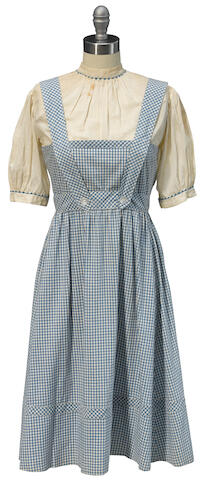
“It was gingham, with checks of white and blue”

Yesterday Bonhams sold a dress for $1,565,000. It was made for a Kansas farmgirl in the early 20th century.

Now that sum’s only about half of the price of the Cowardly Lion costume Bonhams sold last year, but it’s still high enough to place this outfit fourth on this list of most expensive Hollywood costumes.

Two other garments on that list are also dresses made for Dorothy Gale, one used for only a couple of weeks of filming before the director was replaced.

This dress had an excellent provenance, starting with labels inside that identify its wearer as “Judy Garland” rather than a stand-in. As for after it left the studio, “This blouse and pinafore were retained by Kent Warner, the costume collector employed by David Weisz Co. to help organize the 1970 MGM Auction who subsequently cherry-picked many of the best pieces for himself.” It was last sold at a Christie’s New York auction in 1981.

27 September 2014

Praying to Adidas

Of the items I read on the web this week, my favorite might well be this Gawker essay from July about a claim by right-wing “militia” members that they’d found and photographed a “Muslim prayer rug” abandoned on the US-Mexico border.

Adam Weinstein analyzed their photo thusly:
1. Here we see a waist hemline on the Muslim prayer rug.

2. This would be a sleeve opening on the Muslim prayer rug, just above the diamond-hatch red-and-white pattern so popular among lower-tier football clubs and militant Muslim prayer-rug salesmen.

3. Islamic scholars and Arsenal fans will immediately recognize "die marke mit den 3 streifen" [Adidas trademark] here on the Muslim prayer rug.
Of course, that didn’t stop the Lieutenant Governor of Texas from repeating the old rug tale this week.

05 September 2014

When OIP Derangement Syndrome Is in Fashion

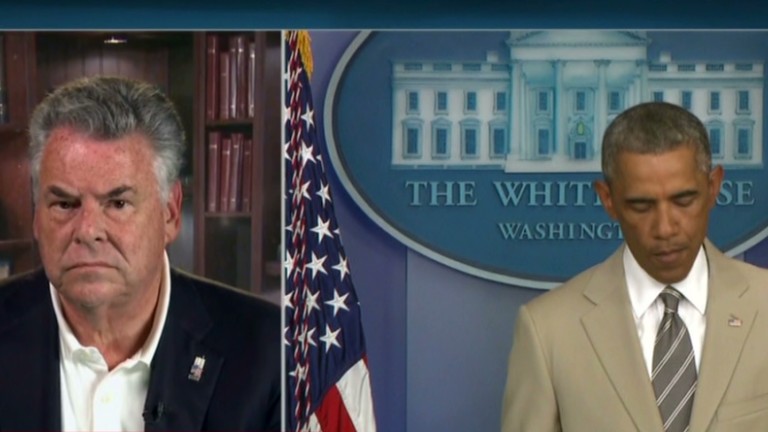
Last week President Barack Obama held a news conference to address the US economy, foreign policy challenges, and other topics. And one day later, as shown above, Rep. Peter King (R-NY) went on a right-wing political site called NewsMaxTV to complain:
There’s no way any of us can excuse what the president did yesterday. When you have the world watching…a week, two weeks of anticipation of what the United States is gonna do. For him to walk out — I’m not trying to be trivial here — in a light suit, light tan suit…
Imagine what detail King would lead with if he were trying to be trivial!

Now not everyone can match up to Rep. King in looking like a recently awoken city boss, perhaps from the old Soviet Union. Nor does everyone else have the finely calibrated fashion sense to know when one can criticize someone else for dressing too casually while not wearing a tie.

But we can note that past Presidents, including Ronald Reagan, George H. W. Bush, and Bill Clinton wore tan business suits during official events without attracting such criticism.

Double standards like King’s are a symptom of OIP Derangement Syndrome. So is hyper-intense focus on trivial details in an attempt to deny the real reason for one’s visceral reactions to seeing Barack Obama at work as President.

20 July 2014

A Touch of Blue

When DC launched its “New 52” continuity, it redesigned almost all its heroes’ costumes. Nightwing’s new outfit replaced the light blue stripe across the chest and upper back with a bright red stripe and, though it didn’t seem possible, made the tight black body suit even more shiny.

But the biggest change, so far as fans were concerned, was the removal of the light blue stripes down the costume’s arms all the way out the two middle fingers. Nightwing’s new gloves—excuse me, gauntlets—had fins to match his mentors’, and I guess keeping the “fingerstripes” as well would have seemed too frilly.

As new artists arrived on the Nightwing magazine, however, red stripes edged down his sleeves again until they reached the fingers. The process was gradual, as if the editorial office didn’t want the bosses or the fans to notice that they’d realized they’d left behind something good.

And then Dick Grayson gave up the Nightwing costume, at least for a while, for work as a secret agent. A very handsome, acrobatic secret agent. This panel from Grayson, #1, shows some touches designed to please the character’s old fans.

I’m not just talking about Mikel Janin’s multiple images of Dick flipping, which were common in Nightwing both before and after the “New 52” break. I’m talking about those dark gray gloves Dick is wearing, with sky blue bands across each palm.

That detail can only be a nod back to Nightwing’s blue fingerstripes. Sure, the stripe runs along an orthogonal axis, but why else color them that shade of blue? It’s like Dick’s designation as Agent 37 (#37 being the last issue of Detective Comics before Dick Grayson became a sensation of 1940) and the clasp on his shoulder belt (looking like a G, more or less where his R symbol used to be). It’s a sign of “continuity fans” creating this book and struggling to backfill meaning into a universe where most of the past has been erased.

01 July 2014

Beyond Their Comprehension

From Tim Grove’s A Grizzly in the Mail and Other Adventures in American History (University of Nebraska Press, 2014):
During my time at the Museum I never tired of observing visitors express delight at seeing a familiar object in person. The iconic ruby slippers from The Wizard of Oz remain one of the most popular items in the collection. Judy Garland used the museum’s pair, one of only four pairs still in existence, for the dance sequences in the film. Their sequins, though showing wear, still glitter and make young girls gasp with delight. Their enduring popularity is a puzzlement to many museum employees, who become quite good at providing directions to the shows through gritted teeth and a fake smile. How visitors can place greater importance on the ruby slippers than the Star-Spangled Banner, say, or the first computer, is beyond their comprehension.
Having worked at the American History Museum, Grove is now chief of learning at another branch of the Smithsonian, the National Air and Space Museum.

26 March 2014

The Ruby Slipper Gang

From the DNAInfo website (via Blair Frodelius’s Daily Ozmapolitan) comes the story behind the recent theft of replica ruby slippers from a hotel on Staten Island.
The three, including a former Washington DC lobbyist, took the $2,500 replica shoes from the lobby of the Hilton Garden Inn on South Avenue earlier this month, police said.

Julie Walker-Merkle, 39, and Joseph Cipoletti, 58, turned themselves in March 21, police said. Ronald Geraghty, 57, was arrested March 24.

Walker-Merkle and Cipoletti lifted the display case the slippers were in while Geraghty kept lookout on March 2, court documents said.

Walker-Merkle, a former lobbyist for American Public Power Association and congressional aide, was caught on surveillance video wearing the slippers in the hotel and later left with them on, hotel owner Richard Nicotra previously told DNAinfo New York.

Nicotra reported the theft on March 6 and, a day later, Walker-Merkle's father dropped them off inside a bag at the hotel's front desk of the hotel, the source said.
The New York Daily News added that the bow was broken off one of the shoes when it was returned. Again, these were replicas the hotel used to promote its services, with no direct connection to the MGM movie.

09 March 2014

Forever Robin?

Listening to Kevin Smith and Marc Bernardin discuss the Batman Forever movie from 1995 on Smith’s Fat Man on Batman podcast got me thinking how poorly cast Chris O’Donnell was as Dick Grayson.

O’Donnell was in his mid-twenties when he made the movie. His appearance certainly called into question the state’s need to assign Dick Grayson a bachelor millionaire as a guardian, but that wasn’t the only problem.

O’Donnell is at his best playing bottled-up characters alongside wild cards (as in Scent of a Woman with Al Pacino). But Dick Grayson is the more emotionally open side of the Dynamic Duo. Furthermore, that movie’s take on the partnership called for Dick to be edgy.

Looking back, I was reminded of a scene in the 1960s Batman television show in which Dick tries to infiltrate a youth gang by cleverly dressing up in a leather jacket and slicking his hair. A girl offers him a cigarette. He coughs at the first inhale, offering the lame excuse that he’s had too many already that day. (Burt Ward himself didn’t smoke growing up, he says.) Adam West as Bruce Wayne later acknowledged that Dick had done his best, but it was…painfully obvious…that…he was not…a smoker.

Even with an earring, O’Donnell looked just as incongruous reading his lines. Just working on a motorcycle doesn’t make a kid a potential juvenile delinquent—especially when he looks old enough to be in law school.

Reportedly director Joel Schumacher had narrowed down his casting choice to O’Donnell and Leonardo DiCaprio, four years younger and already Oscar-nominated for What’s Eating Gilbert Grape?. The moviemaking team asked a focus group of young teen-aged boys—the core audience for action movies since Star Wars—which of those two actors looked like he’d win in a fight. The boys says O’Donnell would. But that was the wrong question. A big part of the appeal of Robin is that he’s the littlest guy in the fight, but comes through anyway.

O’Donnell played the role of Dick Grayson through two movies directed by Schumacher. Then, as he tells the story, he walked away from blockbuster roles to marry and raise a family while taking less time-demanding acting jobs. He’s now a father of five, three of them boys, and they’re naturally proud of their father’s most iconic role. O’Donnell described the pattern in a 2010 interview:

“I used to try to be really low-key on airplanes, with my hat pulled down. Now I pre-announce to the people around us, ‘I want to apologize in advance,’” he jokes.

“When Chip was 3, as soon as we sat down, he said, ‘My dad was Robin in the Batman movie.’”
During a recent visit to Conan O’Brian’s talk show, O’Donnell disclosed that he still owns one of the Robin costumes, in an unopened crate that he’s moved from house to house. I’m sure his kids would be glad to see inside.

14 February 2014

Gowned If She Does, Gowned If She Doesn’t

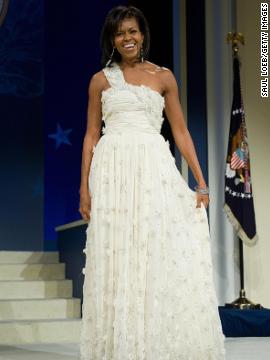
Earlier this week First Lady Michelle Obama wore a ball gown from a well-known designer to the White House’s state dinner for the President of France. This is what First Ladies have done for many decades.

But of course some people don’t like the thought of Barack Obama being President and his wife being First Lady, and to justify those feelings to themselves (or simply make trouble) they come up with reasons to criticize the couple.

As Amanda Marcotte at Slate reported, this produced right-wing claims that Michelle Obama was being too extravagant or high-class—or perhaps just uppity. Marcotte characterized this as “an ugly attack on Michelle Obama for thinking she gets to have nice things.” We saw that during the 2012 campaign when John Sununu unveiled a hitherto unknown interest in women’s fashion by claiming to know the price of Ms. Obama’s convention outfit (and ignoring Ann Romney’s expensive garments).

Of course, if Ms. Obama had not dressed as well as or better than most of the First Ladies who preceded her, those same critics would have justified their resentment by complaining she was setting too low a tone. We know this because that we started hearing that complaint back in August 2009 when Ms. Obama traveled with her daughters to a vacation in Mexico while wearing shorts. (Once again: August in Mexico.)

How strongly did some people seize on that? Three years later, during the 2012 election, a Republican voter named Bobbie Lussier told National Public Radio her feelings about the Obamas: “I just—I don’t like him. Can’t stand to look at him. I don’t like his wife. She’s far from the First Lady. It’s about time we get a First Lady in there that acts like a First Lady and looks like a First Lady.”

Many listeners interpreted that as rank bigotry, given how Lussier hadn’t mentioned any policy disagreements and instead dwelled on looks (“Can’t stand to look at him…looks like a First Lady”). By a startling coincidence, the same NPR reporter was invited to speak to Lussier again at another event, and she insisted:
I don’t care what color she is. It’s just she just doesn’t act and look like a First Lady. I mean she’s more about showing her arms off. . . . I think that’s very inappropriate for a lot of functions that she goes to. . . .

You see her walking around in shorts, and you know, just real casual wear. And to me…I mean when I go to functions I kind of dress up other than today, but you just gotta look the part.
Lussier still didn’t have any policies to complain about. She once again said Michelle Obama doesn’t “look like a First Lady,” but she insisted that wasn’t a response to the color of Ms. Obama’s skin, only the amount of it she could see. Wearing shorts on a tropical vacation! Wearing sleeveless gowns! Doing pushups to promote physical fitness! Lussier compared Ms. Obama unfavorably to “Kennedys or the Bushes or anybody.”

Bloggers quickly pointed out Lussier’s memories of Jacqueline Kennedy were not accurate. At all. Nor her memory of Laura Bush. Or other First Ladies.

In fact, at her husband’s first inaugural one of Ms. Obama’s dresses (shown above) had a bodice very like one that Nancy Reagan wore back in 1981.

Furthermore, Lussier’s comment that “when I go to functions I kind of dress up other than today” revealed that she herself wasn’t dressing up to her own professed standards, the standards she insisted were her only reason for disliking the sight of the Obamas. And all their skin. Somehow I doubt Lussier was any more pleased by this week’s ball gown.

09 February 2014

A Real Young Circus Flyer

In 1979 the photographer Jill Krementz published A Very Young Circus Flyer, about a nine-year-old trapeze artist working with the Ringling Bros. Circus. This was an unusual volume in her Very Young series because it focused on a boy rather than a girl. But there weren’t a lot of headlining circus flyers to choose from.

Tato Farfan was a sixth-generation circus acrobat. With his father, mother, and older brother, he made up that period’s Flying Farfans. The book showed their life traveling by train with America’s biggest circus, practicing their routine, and putting on the show. It also showed other backstage details of the circus.

I liked this book a lot when I was younger. It also told me that, contrary to some tellings of the Batman mythos and somewhat to my dismay, Dick Grayson’s Robin costume has nothing to do with the circus. In fact, it would be dangerous to dress that way while flying on a trapeze.

Tato Farfan wore tights so his father could grab his ankles; bare legs could hurt, and boots with a flare at the ankles would have gotten in the way. Tato taped his wrists since circus flyers grip each other’s wrists rather than cling hand-to-hand; flaring gauntlets would have been dangerous.

And as for a cape, the Flying Farfans wore sequined floor-length capes for their entrances and exits on the floor, but certainly not while on the trapeze. Up there, a big sheet flapping around would just get in the way. (Of course, Tato still liked swirling his cape backstage.)

To be fair, even back in Detective Comics, #38, Jerry Robinson drew young Dick in a traditional aerialist costume while he was with the circus, looking much like Tato. So have most artists since, though some have also showed an older Robin performing trapeze tricks in his costume, cape and all.

Jerry Robinson’s inspiration for the Robin costume wasn’t the circus but, as he always said, N. C. Wyeth’s paintings of Robin Hood in late medieval style. The boots, gloves, cape, jerkin, and mail trunks have their roots in that art, not in the circus.

TOMORROW: Where is Tato Farfan now?

07 February 2014

Super Bowl Stats Show OIP Derangement Syndrome

In 2011, Bill O’Reilly interviewed President Barack Obama before the Super Bowl. The taped conversation lasted a little more than fourteen minutes. Wonkette counted O’Reilly breaking into the President’s remarks 48 times. Ryan Witt at PoliticalExaminer.com counted 22 interruptions that stopped Obama’s statements.

Witt also numerically documented a clear contrast with how O’Reilly treated President George W. Bush in an earlier interview.

This Sunday, O’Reilly again interviewed President Obama. The sequence was only ten minutes long, or two-thirds of the earlier interview. Dana Millbank of the Washington Post wrote:
Along the way, he interrupted the president 42 times, by my count — although, given the amount O’Reilly spoke, it may be more accurate to say Obama was interrupting him. Sometimes he argued with Obama as though the president were a guest on The O’Reilly Factor. Of the 2,500 words uttered during the interview, O’Reilly spoke nearly 1,000 of them.
It appears the count of O’Reilly’s interruptions (or, as his network’s transcript put it, “overlaps”) per minute had gone up.

After Millbank’s column ran, O’Reilly called him “a weasel,” “lying,” and “beneath contempt.” (Earlier in the same appearance, he declared, “I never attack anyone personally.”) Neither O’Reilly nor his employer has offered any refutation of Millbank’s statistics, however. In fact, O’Reilly had promised network viewers that he would interrupt the President.

This footage shows O’Reilly obviously in the grip of OIP Derangement Syndrome. It also offered yet more evidence of the same mental condition affecting Donald Trump, who criticized President Obama for not wearing a tie on Super Bowl Sunday without having made the same complaint about George W. Bush in 2004 or Bush on Sixty Minutes in 2007.

02 January 2014

All the Young Humans

Humans of New York is Brandon Stanton’s photography blog, which recently featured this portrait. The blog led to a book of the same title published this year by St. Martin’s.

The collection is wonderful, full of color and personality and very short stories. Stanton is particularly good at capturing kids. Of course, it helps that he’s walking the streets of New York, where the combination of human density, variety, and appreciation of difference produces a very wide spectrum of style, even in the young.

I was planning to recommend the book even before I spotted one of my college roommates, Jefferson Mays, and his wife inside.

05 December 2013

Princesses in Golden Dreams

Ruth Sanderson paints really nice fairies and princesses. She’s also really nice herself; we worked together on an SCBWI bookstore event this fall.

There’s an exhibition of Ruth’s work at the Norman Rockwell Museum right now through February: “Dancing Princesses: The Fairy Tale Art of Ruth Sanderson.” That museum now owns the original paintings for her version of The Twelve Dancing Princesses. The opening reception for this exhibit takes place on Saturday, 7 December, from 4:00 to 6:00 P.M.

In addition, Ruth is participating in the Cottage Street Open Studios in Easthampton, Massachusetts, on Friday (10:00 to 4:00), Sunday (noon to 4:00), and Saturday, 14 December (10:00 to 4:00).

And for folks who can’t make those events, she’s published a 224-page hardcover book titled Golden Dreams: The Art of Ruth Sanderson. Below, courtesy of Fairy Tale News, is an image showing how Ruth assembled the painting above with sketches and photo references.

15 October 2013

Miss Piggy Goes Shopping for Shoes

From the Smithsonian magazine’s blog:

To welcome Miss Piggy [to the national collection], Smithsonian magazine’s editors treated her to a photo shoot featuring two of the Institution’s most valued treasures—Dorothy’s Ruby Slippers and the Hope Diamond. Pairing the Muppet with the diamond required a secret, predawn escort to the Natural History Museum and an armed guard at the museum's Gems Hall. After staging and art direction by Erickson, she was photographed wearing a necklace bearing the 45.52-carat stone by the award-winning fashion photographer Cade Martin.
And then there was this shot.
Among the other Muppet manifestations now at the Smithsonian is the original Grover, who had dark green fur. If I were a young museum visitor I’d find that very confusing. In fact, I’m a little weirded out by him now.

03 October 2013

Daniel Pucca’s Mini, and Adolescent Memories

Yesterday I discussed Daniel Pucca’s mini-comic My Dutch Foreskin, focusing on the lettering. Because that’s the first thing you think of when you read that title, right?

Pucca was an American in a Dutch intermediate school when word came down that the health exam would require boys to roll back their foreskins. He didn’t know what that meant. (The comic establishes that at that moment Daniel was living with his grandmother, so he didn’t have anyone he felt comfortable asking.) When he found out, he thought something was terribly wrong with him.

Like Pucca, I was born in the period when almost all American boys were circumcised soon after birth. So was my father. I don’t think I saw an uncircumcised penis until I was in junior high, when gym class included showers with a single classmate, a newcomer from Australia, who still had a foreskin. He was thus in the opposite position from young Daniel in Holland. I didn’t know that fellow well, so I have no idea of how his experiences mirrored Daniel’s, but that memory helped me appreciate My Dutch Foreskin.

A few years further on, I recall another immigrant classmate—a nice guy from Russia—feeling acutely embarrassed on a high-school trip to Montreal when he had only a tiny European-style men’s bathing suit while the rest of us boys were in baggy American trunks. (Mind you, the baggy shorts of the 1980s were nothing compared to the voluminous fashions of more recent decades.)

I remember my immigrant classmate standing at the side of the Montreal Olympic pool in his snug swimsuit, asking if anyone had another suit to lend him. But of course we were all away from home, and in the pool besides. We kept telling him to just get in the water where none of the girls could see clearly. But of course the only cure for adolescent self-consciousness is time.