Showing posts with label AUTHOR Grant Morrison. Show all posts

05 November 2014

Before Frank Quitely Was Quite Quitely

Frank Quitely is one of the most respected artists working in superhero comics today, known for his distinctive drawing style, dynamic compositions, and willingness to experiment with form.

Which makes his statements in this interview at Comics Beat more interesting:
When I started out, I didn’t know a lot about storytelling because I never got a formal training in comics. It ended up being kind of intuitive and my main thing was about trying to make it clear and interesting. You know, I wasn’t really thinking in terms of narrative flow, it was more just about clarity and trying to make it as good as possible. Gradually, over the years, I just became more interested in storytelling.

There was a DC editor I worked with named Dan Raspler – the Lobo editor amongst other things. He was my editor on JLA: Earth 2 and before I did JLA, I did a short Lobo story for them and it was the first mainstream DC thing I’d done; I’d been working for [the imprints] Vertigo and Paradox for a couple years.

I sent him the pencils and it was the best thing I’d done up to that point and I thought “he’s going to phone me back and tell me how good this is” and he didn’t phone for a week. I was really panicking by the time he phoned; he started the conversation with “dude, I don’t know how to tell you this…”

Basically what he said was my drawings were really lovely, but my storytelling was really boring. He went through and told me what I should be thinking about and that was kind of a real milestone. As it was, that book never came out for different reasons. For JLA: Earth 2, he made me fax a rough for every page because he wanted to see that I could do art that makes sense in rough with a sharpie, then I could do it properly. . . . That was a big leap for me.
DC Comics published JLA: Earth 2 back in 2000. That was one of many collaborations between Quitely and scripter and fellow Glaswegian Grant Morrison.

As for the “short Lobo story” that Quitely mentioned, that was Lobo: The Hand-to-Hand Job, also subtitled It’s a Man’s World, scripted by another Scotsman, Alan Grant. It was never printed. This webpage on unpublished comics says, “Although the publisher has never commented publicly on the comic, the disappearance of the project could be chalked up to the reported nakedness of Lobo for at least half the issue, as well as a scene involving sexual self-gratification by a league of asteroid miners.” Yes, that would do it.

20 April 2014

Reworked Robins

This month DC unveiled its plans for the character of Dick Grayson after Forever Evil and Nightwing end. He’ll become a secret spy, out of contact with everyone but Bruce Wayne (and presumably not much in contact with him, either).

Of course, Agent Grayson will wear his initial in an emblem on his chest. These are still superhero comics, after all.

DC made that announcement with art of Dick looking remarkably like Tom Cruise in the first Mission: Impossible movie. Mikel Janin’s image will appear on the first issue of the new Grayson magazine, arriving this fall.

Grumpy Old Fan Tom Bondurant wrote:
DC has already undercut Dick’s grounding by fiddling with its overall superhero timeline [in the “New 52” continuity]. By pruning his Robin career (and the corresponding emotional attachment) dramatically, and possibly throwing out all of his Titans adventures, DC has left Dick with a set of skills and not a lot more. No wonder he’s turning to espionage.
DC had some professional spies in its previous continuities, some even created back in the 1950s when superhero stories had stalled out. But that’s an unclaimed area now, so it makes some sense to fill that narrative space with a character who brings his own following.

Only some sense, though. As fans immediately noted, the sight of Dick Grayson pointing a gun at the viewer on the cover of Grayson, #1, contradicts Batman’s anti-gun lessons; the fatal side of black-ops would make more sense for Jason Todd. And the surveillance-and-secrecy side would be a better fit for Tim Drake. Nevertheless, the plans have been established.

And remade. In January writer James Tynion IV revealed that he was working on Nightwing, #30, the last issue of the current volume of that magazine and (presumably) the transition to what comes next. But now the creative team on that issue will be the same who are working on Grayson: Tim Seeley and Tom King. Before previews and internet discussions, no one outside the publisher would have known anything about this. Now, of course, it’s a mini-scandal.

Bondurant also wrote that DC now “arguably has too many Robins.” As powerful as the story of a dead Robin has been, the company may be bringing all ex-Robins back. Peter J. Tomasi’s miniseries Robin Rises: Omega will grow out of Batman’s search for Damian. Meanwhile, Steve Snyder and his team are introducing a new roster of young assistants for Batman in Batman Eternal, including Blue Bird and Spoiler. Plus, Grant Morrison is working on a story crossing alternative universes. How long can that situation last?

19 August 2013

Is Analyzing The Killing Joke Like Dissecting a Frog?

Retiring Batman scribe Grant Morrison went back on Kevin Smith’s Fat Man on Batman podcast this month and proclaimed his interpretation of The Killing Joke, a landmark graphic novel from 1989. As Robot 6 and Comics Beat reported, Morrison declared:
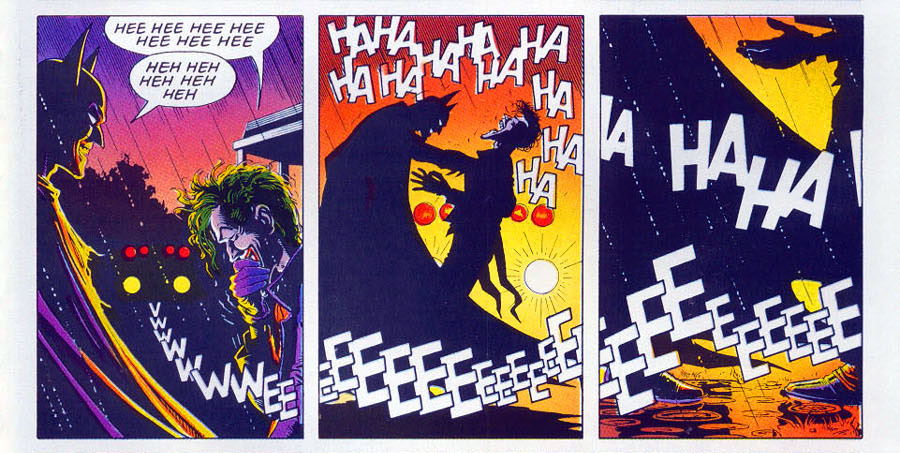
No one gets the end, because Batman kills the Joker. . . . That’s why it’s called The Killing Joke. The Joker tells the “Killing Joke” at the end, Batman reaches out and breaks his neck, and that’s why the laughter stops and the light goes out, ’cause that was the last chance at crossing that bridge. And Alan Moore wrote the ultimate Batman/Joker story—he finished it. . . . the laughter stops, it abruptly stops, it’s quite obvious. . . .

But he did it in such a way that it’s ambiguous, so people will never have to be sure, which means it doesn’t have to be the last Batman/Joker story. It’s brilliant!
This wasn’t a new theory. One can find traces of such speculation or interpretation on the internet for years. Artist Brian Bolland joked about the perceived ambiguity in his afterword to a recolored edition without resolving the questions. But letterer Richard Starkings recalls Bolland saying that he didn’t try to show Batman killing the Joker.

Prof. Scott Eric Kaufman rejected Morrison’s interpretation wholly, in part in a skilled interpretation of art and words and in part because it came from Morrison.

In fact, fans who think Batman kills the Joker don’t even agree on the method. Does he, as Morrison said, wring or snap the man’s neck (and, if so, where is the sound effect)? Or does Batman jab the Joker with one of his own poisoned needles (and does Joker venom even work on the Joker)?

The folks at Bleeding Cool did the important journalistic work of digging up Alan Moore’s script for that final page—which it say the site lifted material from the feed of transcriber Mr. Phil Jackson.

Moore didn’t write that Batman kills the Joker. He didn’t ask Bolland to depict the scene with any ambiguity, and he was quite explicit about motivation, symbolism, and multiple meanings elsewhere. (As I noted before, Moore opened this script by writing paragraphs about the endpapers of the book—that’s detailed.) Bolland’s drawings for the final page closely follow Moore’s very detailed descriptions.

But the sound-effects lettering is significantly different from what’s in the script. As Moore wrote the scene, the laughter ended in panel 5, the center of the nine-panel grid. Police sirens appeared in panels 5 through 7, in 8 “we can no longer hear the sirens” [I can’t bring myself to capitalize like Moore], and in 9 the sirens resume—presumably as the police take the Joker away.
Ultimately the book followed a different timing. The laughter continues for through panel 6 and off the right side of the grid. The sirens don’t recur for the last panel—which is a major improvement over having a bunch of EEEs breaking into what Moore sought for that image: “more an abstract design than anything else.”

Who made those changes and when? The evidence currently available doesn’t say. They probably occurred in the editing process as Moore, Bolland, and their editors discussed the book. So whatever Moore might have meant originally could have changed by the final product. But Bolland would still have needed to know what to draw.

Furthermore, Morrison’s interpretation puts a lot of weight on how “the laughter stops,” a phrase he repeated. But in the final book, the laughter doesn’t stop in panel 5 when Batman touches the Joker. Nor does it stop in panel 6—it continues off the right side.

So what have we learned or relearned from this worldwide discussion?
  • Grant Morrison likes people to think he has secret knowledge. (And to be fair, sometimes he really does.)
  • Superhero comics are a collaborative art form. The storytelling is the product of the writers, artists, letterer, and editors, with only the final product containing all their contributions.
  • A lot of fans really wish Batman could kill the Joker.

10 March 2013

Grant Morrison on the Dynamic of the Duo

Last month Kevin Smith’s Fat Man on Batman podcast featured a three-part conversation with Grant Morrison as he retires from scripting Batman, Incorporated. Most of the discussion appears in episodes #26 and #27, with five minutes about the imminent death of Damian Wayne moved to the start of #28 to avoid spoilers in a story that DC Comics eagerly spoiled.

About 31:30 into the second installment, Morrison once again explains his approach to the Batman mythos, deciding that every era of stories happened (in some form) to Bruce Wayne:

The feral young Batman from 1938 [sic] who’s out there with guns in his hands, and is fighting vampires and crooks, and I thought, well, imagine that’s Batman when he’s twenty. And then he meets this kid when he’s late twenty-one, and the kid’s this little working-class circus kid, who’s totally cocky, and this introverted young-Norman-Bates Batman is suddenly, “Wait a minute, this is the kid that died in me…this is everything I wanted to be.” And the two become friends, and it’s no creepy, no way, it’s just like, “He’s my best friend, my brother, and he’s everything I wish I could be,” and the kid’s looking at him and saying, “He’s everything I wish I could be.”
I had to transcribe and share that passage.

If you download the whole series, don’t miss the exchange at the end of #27 (starting at 55:50) about Morrison’s accent. Smith admits that he worried about being able to understand the interview. Morrison responds by demonstrating “the hard-core killer Glasgow accent.” Try it at home!

03 March 2013

The Death of Damian Wayne

The big Boy Wonder news of the week is, of course, the death of Damian Wayne in Batman, Incorporated, #8. Comics fans lamented his loss, even if they couldn’t all spell his name right. Just a fortnight ago the “Death of a Family” crossover climaxed with no actual deaths, leaving some fans disappointed. One hopes it’s not the same fans.

Of course, Damian Wayne’s death has no more correlation to death in the real world than his short life has to real lives. He was created in a milieu of artificial insemination, incubators, and genetic hybrids (which should give pause to those trying to calculate the timing of the DC Universe based on assumptions that he was conceived and raised naturally). Similarly, Damian died in a storyline that includes clones, resurrection pools, and time travel. The “Robin RIP” issue came at the beginning of a four-issue arc, and I wouldn’t be surprised to see hints of the character’s return in some form by the end.

What interests me most about this development is what it says about collaborative storytelling. Grant Morrison pitched the idea of Bruce Wayne and Talia al-Ghul having a son back in 2005, thinking he'd kill off the child right away if he proved interesting only as a plot point. But Damian’s extreme personality proved fun to write, not just for Morrison but for other Batman scripters.

Morrison told the adventures of a new Dynamic Duo—Batman the Boy Wonder and the goddamn Robin. Among DC’s other writers, Bryan Q. Miller might have been most successful with Damian in Batgirl because his personality made such a contrast with Stephanie Brown’s, but there were also fine stories from Paul Dini in Streets of Gotham and J. T. Krul in Teen Titans.

The result is a six-year storyline played out over multiple crossovers and two continuities. At heart, Morrison was expanding “Punish Not My Evil Son!” from The Brave and the Bold, #83, written by Bob Haney (and reprinted in the first volume of Neal Adams’s Batman work). As in that single-issue story, Bruce Wayne is surprised to become the father of a nasty brat, causing trouble for his household and everyone else. But eventually the moral example of Dick Grayson turns the kid around, and he dies heroically in the Robin costume.
Of course, the story of Damian Wayne is more complex, layered, and successful. It became intertwined with Batman seeming to die and with Dick Grayson, Tim Drake, and Stephanie Brown taking on new coming-of-age identities. Damian was a prize in a worldwide war between his parents. The one glitch: I don’t think anyone could have engineered a satisfying story about Dick Grayson’s return to being Nightwing. Instead, DC rebooted its whole universe.

Morrison’s fellow writers were privy to his ultimate plan for Damian Wayne, at least to the extent of being warned off storylines that might ruin that virgin territory. Scott Snyder, present writer of Batman and current primary plotter for the rest of the line, has tweeted that he learned about Morrison’s plan when he got the assignment to write about the Caped Crusader.

Even more interesting is the work of Peter J. Tomasi, who was the editor who first heard Morrison’s pitch. In 2008 he left the editorial desk to become a scripter, taking over Nightwing even though he knew that magazine would soon end. In 2011 he took over Batman and Robin while knowing that eventually that partnership would be ripped apart. Tomasi just gave interviews to Comic Book Resources and Newsarama about how he’d laced the latter magazine with intimations of Damian’s death. The immediate plan is to continue it with a focus on ex-Robins, but, like Batman, Incorporated, it might be in for more profound changes or retirement.

Damian’s death resets the life of Bruce Wayne in more ways than one. Not only does he no longer have a young boy to keep out of trouble, but he has a dead partner to mourn. From 1989 to 2004 the late Jason Todd filled that role. But it’s awfully hard to mourn a Robin who’s alive and well. (“The Joker killed me! And, um, I got better.”) Now Damian can haunt the family as Jason did. There’s even a trophy case waiting.

Robin has always been the littlest guy in the fight—that’s part of the character’s identity and appeal. In some previous DC Universes Dick Grayson took up the role at the age of eight, and artists have enjoyed depicting the contrast between the spindly little kid and the tall, muscular Dark Knight. In the rebooted universe, however, Dick didn’t meet Bruce Wayne until his teens, making Damian the youngest boy ever to have become Robin—thus the littlest guy of all. And yet, the only foe to take that Robin down turned out to be his own genetic twin, grown to fearsome size, assisted by other members of the League of Assassins.

What’s next among Robins? The odds favor a young woman whom Snyder has introduced in Batman named Harper Row. While it would be good to see a female Robin again (the first in the current continuity), I’m old enough to remember the obvious inspiration for that name: the venerable American publisher Harper & Row, now subsumed into the HarperCollins division of Newscorp. I keep wondering if the new Robin will carry a torch, as on the old Harper & Row colophon, and peddle Maurice Sendak books. >tt<

10 February 2013

“Roaming tribes of boy sidekicks”

This is how Grant Morrison and Frank Quitely let us know that one of the planes of existence in the Flex Mentallo miniseries is eeevil: the kid sidekicks have gone feral. Once that happens, there’s “No future. No hope.”

And they still don’t all have pants.

For anyone reading Flex Mentallo, I recommend also sampling Jason Craft’s online annotations, David Allison’s appreciation and lament for the recoloring, Sean Rogers’s critique for The Comics Journal and the many comments it produced, and Rich Johnston’s response to that critique. I’m not taking sides.

20 January 2013

Reading the Memo on Damian Wayne

One of the most interesting elements of Batman and Robin: Born to Kill, by Peter J. Tomasi and Patrick Gleason with Mick Gray, is the “story proposal” printed at the end of the book. Of its fourteen paragraphs, all but three are an analysis of the relationship between Bruce and Damian Wayne.

The other paragraphs introduce the story’s villain and his motivation, rooted in his history with Bruce Wayne, but not his powers or working methods. Also missing from the proposal is a storyline with plot points, emotional moments, rising action, and so on. It mentions only one corner of the plot, the climax at the end of what turned out to be issue #7.

Instead, Tomasi’s memo is all about Batman and Robin’s differing symbolism, motives, and approaches to attacking crime. All very important in the superhero genre, but I doubt such a memo would have been enough for DC Comics’s editorial team if it hadn’t come from Tomasi. He was a DC editor himself until a few years ago and a successful utility player since. As the company planned its “New 52” reboot, its honchos probably wanted to keep working with Tomasi. The question was how to make this Batman book different from half a dozen others. His proposal supplied an answer:
Our “A” story, the emotional and psychological backbone of the book[,] will be laser-focused on the relationship between Bruce and Damian.
Eventually the story reaches a common point in superhero comics: the hero appears to face dire consequences unless he compromises his values—in this case, Bruce Wayne’s commitment not to kill. Of course, Damian Wayne has a different approach to that dilemma.

Indeed, Damian is quite the troubled ten-year-old in this volume. He sits at a drawing board sketching gory pictures—a hobby that could lead only to the horror of being a comic-book artist. He crushes small animals. (The story proposal says he kills “a sick bat that’s fallen to the cave floor,” but that’s not how the scene plays out.)

I’ve seen some readers complain that this volume doesn’t show Damian having learned and grown from his training with Dick Grayson. In fact, some of the story’s noteworthy moments echo similar moments from earlier months: Damian insists on going out by himself, the R symbol gets ripped from his chest, another crime-fighter tempts him to change mentor, etc. And at the end, he can’t match his father’s commitment.

But if Damian changes greatly, there would be no story. The difference between the two Waynes isn’t simply the subject of this volume. It’s also the Unresolvable Foundational Conflict of this series. In issue #8 the villain is gone and there’s no trouble for the heroes after page 6—except the trouble they pose for each other. And that’s one of the most compelling chapters of the volume. The relationship really is the “A” story.

Tomasi expresses his theme as “nature versus nurture.” At least as Bruce sees it in issue #2, “I have to find a way to push him past the obscene indoctrination of his early years and hope nurture wins out over nature.” That seems like a misunderstanding of what “nature versus nurture” means, however. The conflict is between the two ways Damian has been nurtured by his two parents. We don’t know how he would have developed normally. We don’t know what his innate qualities are.

Another notable element of Tomasi’s proposal is how he linked his new villain with Grant Morrison’s Batman, Inc. narrative, about a worldwide crime-fighting enterprise led by Bruce Wayne and a worldwide criminal enterprise led by Damian’s mother. The villain had a personal reason to attack Batman, but Tomasi had him resent Batman, Inc. I think Tomasi is still loyal to the pitch he heard from Morrison as an editor years ago. The other main Batman comics seem to be working independently of Morrison’s storyline, but Tomasi is still trying to keep the continuity together.

29 January 2012

Three Dick Graysons and the Representation of Change

Reviewing the Robin news this week, I was struck by a statement in Vaneta Rogers’s interview at Newsarama with current Nightwing scripter Kyle Higgins:
Nightwing is one of those few characters that is actually defined and built on a core of change, which is very weird in an industry and a medium that relies on the illusion of change. Dick Grayson is one of the few characters that are built around the idea of growing up.
Dick started out serving Reason for Robin, #9: Robin is still a kid. He represented potential. He was learning, making mistakes, but held the promise of being better. For almost thirty years he barely changed, but he always represented the possibilities of change in the future.

When Dick Grayson became Nightwing in the 1980s, he gained a new symbolic significance. He had been a kid; now he was a young man. But he was still younger than Batman, Superman, and the other heroes he’d looked up to. As Higgins says, his growth now defined his role in the DC Universe saga. He was a twentysomething looking for his place in the world. Would he ever match up to his mentor, or had he unknowingly already done so?

Grant Morrison’s proposal to make Dick Grayson into Batman brought that grand storyline to a close. Dick stepped into his mentor’s boots, and successfully. There was no place new for him to go, or grow. DC Comics would almost certainly have made him Nightwing again, to preserve the trademark if for no other reason, but the company never came up with a satisfactory way for Dick to make that choice which would imbue his character with significance again.

Instead, for a variety of commercial, legal, and creative reasons, the publisher rebooted its entire universe. That change let the editors put Dick into a new Nightwing costume, a few years younger than before. We never saw his choice to step away from being Batman; characters seem to treat his time in the cape as a job everyone knew would be temporary, as in Batman: Prodigy. Once again Nightwing is a young man looking for his place in the world. Higgins’s first story even took him back to his roots at the Haly Circus.

I view the current Dick Grayson character as separate from the character of 1964 through 2011, just as that was a different character from the Dick Grayson of 1940 through 1964 and beyond on Earth-2. The original Dick Grayson came of age as an adult Robin. The second came of age as Nightwing and took over as Batman when almost everyone thought Bruce Wayne was dead. Now we have a third Dick Grayson, also Nightwing. What will his future hold? The possibilities are open once again; all we know is that he still symbolizes growth and change.

In other Robin news, Bleeding Cool reported a rumor that Jeff Lemire would write an adventure for the present DC Universe’s four former and current Robins. But can we trust a gossip website that can’t even spell Damian Wayne‘s name right?

Probably so, for two reasons. Once ideas leak, it appears they’ve been approved. Furthermore, this idea is a no-brainer in terms of serving fans’ wishes. Of course, the potential for disappointment is very high since no actual all-Robins adventure comic could satisfy everyone’s hopes. There’s too much nostalgia to compete with.

Finally, Bully had the Dynamic Duo meet the Infinite Canvas of Scott McCloud. Even more impressive, the little stuffed bull got that scene to work within the confines of a Blogger template!

05 May 2011

Grant Morrison Talks Method

I caught a glimpse of Grant Morrison’s current comics scripting method over a year ago when artist Cameron Stewart told me:
Grant's scripts have full page and panel breakdowns, but the dialogue is either very rough or not included. Most of his dialogue is written after the artwork is completed.
That question came up because of an error in Batman and Robin, #7. On looking at Stewart’s panels, Morrison felt the dialogue would flow best if one panel was flopped, moving the Caped Crusader from left to right. Stewart delivered the change, but an older file went to the letterer, and a confusing panel appeared in the magazine.

In a recent interview at Graphic Novel Reporter, Morrison described how his approach evolved over years of working for different companies and with different people: 
I used to do a film script and all the dialogue complete, but then as I started handing in scripts with preliminary guide dialogue, but all of the panel descriptions in place, all the visual information was there, but the dialogue was just purely to let the artist know where the beats came or who was talking first. And once I got the art back, I would then kind of tailor the writing to suit the artwork, and it allowed me to take out a lot of excess, which was good—because once you saw the artist was doing the acting and the nuances of expression really well, you could often drop a lot of the expository stuff. So it allowed me to streamline the process.

And, like I say, in this particular period where I'm doing three Batman books simultaneously, which thank goodness is almost over (laughs), I've been doing the same thing, but this time it's been going in six and eight pages at a time sometimes, so I'm seeing chunks of each issue coming in all the time. . . .

Well, the story is already there as a kind of structure in my head, and it comes into view. I always compare the way I do this stuff to a photograph developing. I kind of know what the photograph is going to be, but as it develops, I start to notice things about it that I hadn't seen before and only by the very end, when I put the last line on it, I get what exactly it's been about (laughs). So it tends to work with that sort of weird way, the work comes into focus for me. It's almost like bringing it into the light.
This back-and-forth is possible now, especially for a writer who lives in Scotland and California, because of digitized art and nearly instantaneous communication. Even so, it must be a challenge to manage, and there have been mistakes, timing problems, and perhaps some grumpiness from other creators who’ve had to fit their storytelling into Morrison’s complex and slowly developing narrative.

27 March 2011

Revisting the First Boy Wonder’s Boyhood

This cosplay in its purest form comes from the website of WSOC in Charlottesville. Evidently it’s Charlie, one of the station’s deejays, around age six.

And speaking of childhood, this week DC and Grant Morrison addressed a detail of the Batman and Robin saga that nagged me ever since I read Batman: From the ’30s to the ’70s when I was a little older than Charlie here.

The original Batwoman was Kathy Kane, a socialite/circus performer. (In the world Bob Kane created, almost all heroes had to be rich. And it didn’t hurt if they had names similar to the one he adopted.) Batman figured out Batwoman’s identity by noticing she used circus slang. Robin, despite having grown up in a circus, was left with the “Holy jargon, Batman! I never realized!” routine.

For a while I rationalized that by telling myself that Dick Grayson was just so used to those terms that he didn’t realize they were unusual. But then I read other comics fans expressing bother at the same detail, and I could acknowledge it a sign of disrespect for the Boy Wonder.

Thanks to the billions of dollars humans have invested in the internet, I can even pin that down on science-fiction novelist Edmond Hamilton (1904-1977). The Grand Comics Database credits him with scripting Batwoman’s debut in Detective, #233, published in 1956.

But Hamilton may not have known Dick Grayson’s background. He started writing regularly for DC in the late 1940s, years after Robin was introduced. Today’s superhero comics constantly refer back to major characters’ backgrounds and origins, but the comic books didn’t retell Robin’s backstory between his arrival as the sensational character find of 1940 and Batman, #129, twenty years later. (There was a 1943 pilot for radio, never broadcast, that made his doomed parents trapeze artists and FBI agents.)

As a result, most of Hamilton’s young readers had probably never read about Dick’s upbringing in a circus. But when I saw Robin’s origin in the same volume as Batwoman’s, the discrepancy popped out. As I’ve noted before, Grant Morrison read the same collection as a wee lad in Glasgow, and perhaps he had the same thought.

In the latest issue of Batman, Inc., Morrison reinterprets the first Batwoman’s role in Batman’s past, as he forecast doing two years ago in a story collected in Batman, RIP. But this time Dick gets to spot the circus slang. He doesn’t tell Bruce what he knows because he’s conflicted about his adoptive big brother falling in love. And because he’s a grumpy thirteen-year-old. Now that I can believe.

09 January 2011

Damian Wayne: “Being Robin Is…”

When Grant Morrison introduced the character of Damian Wayne in Batman and Son, the kid was clearly trouble. He was said to be Bruce Wayne’s biological son by Talia al-Ghul, though the genetic truth wasn’t confirmed for some months and the mechanics are still murky.

More to the point, Damian was violent, defiant, angry, and contemptuous. His grandfather’s League of Assassins had raised him to be a deadly fighter. He killed and beheaded a minor Batman villain called the Spook. He attacked Tim Drake, the latest Robin. In a word, Damian was evil. Morrison even said so in interviews.

Bruce’s response to meeting a dark-haired athletic boy lacking a father figure was, naturally, to suggest that he become some sort of Robin. Damian certainly had qualities that role required. Younger than Tim when he started and probably younger than Dick (there are competing legends), he was pound for pound the best fighter. He had the intellect, if not the interest, for detective work.

The nagging question was moral. Would Damian accede to the Batman’s no-killing ethos? Would he work well with his mentor and others? Could an evil child ever be Robin?

That question hung over Damian’s first year as Dick Grayson’s crime-fighting sidekick, told mostly in Batman and Robin but also in other DC comic books. As guided by the original Robin, could Damian fit into the role of Boy Wonder? The overarching storyline was a contest between Damian’s upbringing and personality on the one hand, and the tradition that Robin isn’t evil.

In the first three issues, Damian gets sick of taking orders from Dick, quits, and storms off; to his surprise, Dick rescues him because they’re still a team. The next two arcs bring on alternative versions of the Dynamic Duo: Jason Todd, former Robin, as the Red Hood and his created-for-the-moment sidekick Scarlett; and Britain’s Knight and Squire. Since the current Knight was formerly Squire, that means we see two former Robins, one former wannabe Robin, two wannabe Batmen, and two young redheaded female sidekicks. Plus, the new Batwoman (who also has red hair). Meanwhile, Damian has his injured spine repaired by his mother Talia’s surgeons.

The final three issues of the year brought the original conflict back home. Talia uses Damian’s new spinal implant to control his movements, turning him over to Dick’s arch-enemy, Deathstroke the Terminator. There’s a fight, of course, but the real confrontation occurs when Damian faces his mother. Evil never had a chance.

If Damian hadn’t proven commercially successful, DC Comics could still have killed him off, as Morrison originally planned when he first conceived of the character. He could have died heroically, like the kid in “Punish Not My Evil Son”; or “tragically,” doomed by the advanced medical process that created and aged him, as Peter Tomasi set up in his glimpse of Talia’s baby-making technology in Nightwing: Freefall. But either way, I’m convinced that Damian wouldn’t have died evil.

Of course, he’s still a little snot.

02 January 2011

Robin’s Hood, and How It Changes the Universe

I’ve written before about thinking that Grant Morrison’s most immediate inspiration for his long Batman and Robin arc that’s produced a (by my count) sixth Robin was Frank Miller and Jim Lee’s All Star Batman and Robin.

Of course, Morrison had many other inspirations as well, going back to the collection that he (and I) read as a wee lad, Batman: From the 30s to the 70s. But Miller’s vision of a “goddamn Batman” strikes me as the most likely jumping-off point for Morrison to think up Damian Wayne, the goddamn Robin.

In All Star Batman, Dick Grayson (age twelve) creates a crime-fighting costume for himself based on Robin Hood. (That legend was in fact Jerry Robinson’s principal inspiration in designing the character, which is why the original costume has a little medieval styling.) The goddamn Batman doesn’t like the long name “Robin Hood.” And he doesn’t like the hood. So far as I know, there’s no precedent for that moment in previous DC Comics, no previous portrayal of Dick wanting to wear a hood. It supposedly happens only on “Earth 31,” reserved for Miller’s vision of the goddamn Batman.

But in Batman and Robin Morrison scripted a moment (for Philip Tan to illustrate) that’s a direct response to Miller’s. Dick Grayson, now Batman, tries to pass on some of his mentor’s wisdom to Damian—wisdom we’ve never “officially” seen Bruce give. And this hood-wearing goddamn Robin responds in his own special way. (I only wish the word balloons were placed more gracefully.)

14 November 2010

The Return of Red Robin Reviewed

The great strength of scripter Christopher Yost’s twelve issues of Red Robin, as I discussed in the last weekly Robin, arises from how they fit into DC’s larger story for Tim Drake over the last several years.

That integration into the larger DC Universe also creates the biggest hole in Yost’s story, now collected in volumes subtitled The Grail and Collision.

As usual, there were crossovers between this magazine and others. Collision includes a necessary issue of Batgirl, and reads better if you also know the Superboy tale in Adventure Comics, #3. Between the two Red Robin volumes came DC’s “Blackest Night” saga, which doesn’t affect Tim’s story, despite all the times he refers to it.

But the big hole opened up because of a non-crossover. Red Robin has to fit into DC’s main storyline for Batman. For the last several years the person driving that bus has been scripter Grant Morrison. He came up with the ideas for Damian Wayne as a new Robin, Bruce Wayne being cast back in time, Dick Grayson taking over as Batman, Bruce coming back, and more. And it’s only fair that Morrison’s gotten to tell that big story.

Morrison doesn’t show much of a feel or feeling for Tim Drake, however. He’s been drawing inspiration from pre-1971 Batman stories and from friendly rivalry with highly touted tales by Frank Miller, Alan Moore, Mike W. Barr, and others. As for Tim, introduced in 1989 and not appearing in those graphic novels, Morrison has hardly used him at all.

Certain traits set Tim off from other Robins: computer savvy, detective skills, earnestness, particular friends. Some Batman stories feature Tim without showing any of those characteristics. Batman: City of Crime, for example, is a thought-provoking story of Gotham with a generic Robin in Tim’s costume. (The artist Ramon Bachs worked both on that book and some issues of Red Robin.)

The few times Grant Morrison has used Tim in his Batman tales fit that pattern. Morrison’s character fulfills several of the “Reasons for Robin” storytelling needs—sounding board, boy hostage, emotionally open contrast—but he’s not individuated. It’s been up to other writers to carry Tim Drake’s story along.

In Red Robin, #1, Yost shows Tim becoming convinced that Bruce Wayne isn’t dead, but the magazine doesn’t—can’t—show us why. We readers have to trust that Tim’s relying on clues, not wishful thinking. In issue #4, he comes across hard physical evidence that Bruce has been cast back in time. Those tidbits provide a motivation for Tim’s quest in Eurasia, and provided DC’s readers timely hints about how Bruce would return.

That beginning sets up Red Robin as a quest to find Bruce Wayne through detective work and rooftop combat, but Yost couldn’t follow through. Morrison was writing the main story of solving the mystery and retrieving the victim over in Batman and Robin and The Return of Bruce Wayne.

The result includes some awkward storytelling. Throughout Collision Tim’s narrative voice talks about not telling Dick of the evidence he’s found in the Mesopotamian desert, about how the knowledge that Bruce is stuck in time might die with him. Tim’s illogical silence was necessary to keep the mystery going in Batman and Robin.

In Red Robin, #12, on reuniting with Dick for the third time, Tim finally announces: “Bruce is alive. He’s lost in time, and I can prove it.” To which Dick answers, “...Okay. We’ve got a lot to talk about.” Because he’s already made the same discoveries, just a few months after Tim. One page at the end of that magazine confirms that back in issue #1 Tim saw the same clue Dick spotted in Batman and Robin, #10.

And by then the hole is wide open. Tim sets out on a quest, and never gets to fulfill it. Instead, he’s knocked off course by a collision with villain Ra’s al Ghul. In this twelve-issue saga, Tim succeeds in saving the lives of the people closest to Bruce, and Bruce’s fortune, but he doesn’t save Bruce, or even play a major role in doing so. There’s a gap between the story’s satisfying internal arc of character growth and change and its more constricted external arc.

That said, in follow-up magazines Tim plays a more important role in Bruce Wayne’s actual return, marshaling fellow heroes to help. And after taking over Red Robin, scripter Fabian Nicieza and artist Marcus To were free to show the moment when Tim welcomed back his adopted father.

10 October 2010

Can Batman Change the World for the Better?

This week invincible superblogger Chris Sims discussed the Robin phenomenon at Comics Alliance (leaving out Stephanie Brown, and immediately getting called on it).

Sims wrote:

Robin — specifically Dick Grayson — represents one of the most important aspects of Batman’s character, in that it shows just how much he's able to change the world. . . .

Bruce and Dick start at the same place — between the dead bodies of their parents, taken from them by crime and chance through no fault of their own — but because he’s taken in by someone who has been there and fought through it, Dick ends up at a dramatically different place. For all the fact that he’s surrounded himself with a network of sidekicks and has been a member of the Justice League for decades, Bruce is still characterized as grim and alone, but Dick? Dick’s no less driven or skilled, no less devoted to battling crime and injustice, but he's also happy.
Sims’s essay includes this panel from Batman, #700, which many comics analysts have used to illustrate the contrast between Bruce Wayne as Batman and Dick Grayson as Batman. Dick acts friendly to Officer Bailey, remembering his name and family situation. The Bruce Wayne of the last twenty years would offer a brusque comment at most. (Of course, the Bruce Wayne of 1945-1985 would also have remembered Officer Bailey’s name, possibly from the singalong at the precinct’s last holiday party. The character has changed greatly over the years.)

There’s something about that panel that I haven’t seen Sims or any other interpreter mention. As Batman fans with better memories than I noted, it fits with references in Batman, #666, and a later story in #700 to trace the life of Max Bailey, the wheelchair-bound policeman’s son. In the future that scripter Grant Morrison is dealing out card by card, that boy appears to grow up to be a supervillain named Max Roboto.

In that future, Dick Grayson has met an unspecified but terrible fate, and Damian Wayne has taken over as Batman—an even nastier Batman than the recent Bruce Wayne. He kills bad guys. Any kind of bad guys. He may or may not remember police officer’s names, but if they’ve been turned into Jokerzombies he uses satellite lasers to zap them dead. He defeats Max Roboto and leaves the formerly wheelchair-bound child to be eaten alive by mutant rats. Even though Dick Grayson was friendly to the guy’s dad.

In other words, the Max Roboto storyline suggests that—unlike Bruce Wayne’s Batman, as Sims describes him—Dick Grayson’s Batman doesn’t change the world for the better. Despite his efforts and friendliness, it gets worse. Dick might save Damian by making him Robin, as the Batman and Robin magazine suggests, but he can’t preserve Batman’s ideal in Damian’s hands. Gotham becomes a less nice place despite having had a nice Batman.

And that should worry everyone, not just Robin fans.

COMING UP: Robins and the problem of the future.

26 September 2010

Sometimes a Crowbar Is Just a Crowbar

How did the Joker kill Robin, the second Jason Todd?

If you’re like most comic-book fans, or this drunk guy, the first picture in your mind is a crowbar. Because the Joker beat Jason with a crowbar in a series of horrific panels drawn by Jim Aparo. But that wasn’t what killed Jason. In fact, he was still able to function after that beating. The Joker killed Jason with a bomb. (A bomb that somehow left his body intact, but that’s another story.)

There are moments in later comic boos when the Joker refers to that bomb: “I blowed him up real good!” he explains to young Impulse in Impulse, #50. But more often, especially since Jason Todd’s return from the dead in 2004-05, the violence of his murder is symbolized exclusively with a crowbar.

That shows the power of the graphic panels above. An off-screen, single-panel bomb just isn’t as affecting as what we see, over and over. Furthermore, a crowbar doesn’t have other connotations in superhero comics, leaving its symbolism pure.

As a result, there are Joker figurines with crowbars, and Joker cosplayers with crowbars. And there are Batman stories—so many stories—that play off the symbolism.

In the retrospective Batman, #683, Grant Morrison merely had to script a crowbar in a purple-gloved hand for readers to know what event in Bruce Wayne’s personal history that page alludes to.

In Battle for the Cowl, writer-illustrator Tony Daniel had skinny-replacement-Batman Tim Drake happen upon a crowbar during his fight with vicious-replacement-Batman Jason Todd. Given his history, it’s a bit odd for Jason to keep crowbars lying around. It’s even odder for Tim, a most cerebral and less evil Robin, to get that murderous. But this being superhero comics, he starts swinging.

Most recently, the little latest Robin, Damian Wayne, brought a crowbar into an interrogation room to use in “interrogating” the Joker. So far that’s turned out to be a poor idea. But at least everyone is speaking the same symbolic language.

29 August 2010

1989: Year Without a Robin?

As 1989 began, it was the first year since 1940 that DC Comics had no character named Robin appearing (at least occasionally) as Batman’s young assistant. Toward the end of the previous year, fans had voted to let the Joker kill Jason Todd, the latest Robin.

The Batman editorial team was reeling from fans’ criticism of the character of Jason and from wider criticism of the decision to show his death. Interviews and introductions to Batman collections published around that time show how editor Dennis O’Neil was feeling more than a little shell-shocked.

To be sure, the company was still publishing stories about Dick Grayson, the original Robin, in his new guise as Nightwing. Those stories, in The New Titans, were among the company’s top sellers. And DC still owned the Robin trademark, which had been a source of licensing revenue for decades. But there was no Robin in the Batman comic books, and at least a possibility that there would be no replacement.

That year looked like it would be huge for Batman. It was the fiftieth anniversary of when the character debuted (without Robin). Warner Bros. would bring out a major Batman movie by director Tim Burton in the summer (without Robin).

Furthermore, some graphic novels had pushed Batman into more adult territory, including Mike W. Barr and Jerry Bingham’s Son of the Demon (1987), and Alan Moore and Brian Bolland’s The Killing Joke (1988). Neither of those volumes included Robin.

Frank Miller’s future-set The Dark Knight Returns (1986) debuted a new Robin in Carrie Kelley, but also presciently portrayed Jason Todd as dead and Dick Grayson as estranged from his mentor—hinting that there had been no Robin for years.

In fact, some comics readers and creators were insisting that Robin no longer made sense in the Batman mythos. Grant Morrison couldn’t convince Dave McKean to include Jason in their Arkham Asylum: A Serious House on Serious Earth graphic novel, due to be published in 1989. Morrison later wrote:

The original first draft of the script included the character of Robin as Batman’s sidekick. Robin appeared in a few scenes at the beginning then remained at Police Headquarters for the bulk of the book, where he spent his time studying plans and histories of the house, in order to find a way in to help his mentor.

Dave McKean, however, felt that he had already compromised his artistic integrity sufficiently by drawing Batman and refused point blank to bend over for the Boy Wonder—so after one brave but ridiculous attempt to put him in a trench coat, I wisely removed him from the script.
Not entirely, though. The Joker tries to unnerve Batman by alluding to his unseen partner: “How is the Boy Wonder? Started shaving yet? . . . a cute little long-legged boy in swimming trunks?” Those remarks underscored how poorly the character seemed to fit in a more realistic, more dangerous crime-fighting world.

The Batman movie became a huge hit, spawning three sequels. (I didn’t care for it myself.) Arkham Asylum, benefiting from coming out alongside the movie, sold half a million copies. Batman comic-book sales soared. Those developments helped touch off a speculative boom in the comics industry over the next few years. In sum, it didn’t look like Batman needed Robin to be a hit anymore.

But O’Neil and his writers were already planning a replacement for Jason Todd.

COMING UP: Her name was the Huntress.

02 May 2010

Robin Isn’t Evil, But Batman…?

At last the weekly Robin returns to exploring how the tenet that Robin isn’t evil became an important part of what the character symbolized in the DC Comics mythos. Before the 1980s, all superheroes weren’t evil. Robin’s solo stories had depicted him as struggling to follow Batman’s model. But a new characterization showed him trying to help people with Batman as one inspiration among several.

Concurrently, DC writers were edging toward the possibility that Batman might be evil. In the early ’80s The Comics Journal quoted comics artist and writer John Byrne calling the character a “brooding psychopath.” Not everyone in the business agreed with him, of course, but that possibility became more and more central to Batman stories.

Does Batman operate so close to the edge of human endurance that he might go over at any time? Is he so driven by his mission that he’s willing to sacrifice ordinary human relationships? Is his life as Bruce Wayne such a sham that it’s made him as hollow as he acts? As his ward, Dick Grayson was Bruce Wayne’s natural foil in such stories.

In Detective, #500 (1981), scripted by Alan Brennert, Batman got a chance to enter an alternative universe where Bruce Wayne is still a boy and his parents haven’t been murdered—yet. He jumps at the chance at saving some version of his parents. Robin (already a star of New Teen Titans) races to accompany Batman because he doesn’t trust what Bruce might do when he sees his parents under attack. While Batman gets tunnel vision, Robin worries about disrupting this alternate universe before deciding what his values require. This story ends with a curious twist. Batman does save his parents, but his young alter ego nevertheless starts to dedicate himself to being a crime-fighter. That implies that Bruce wasn’t necessarily motivated by his parents’ murder; rather, their murder may have simply been his rationale for doing what he’d have been naturally driven to do anyway.

DC started to separate Batman from its other heroes with Batman and the Outsiders, #1 (1983). Scripter Mike W. Barr showed him storming out of the Justice League of America to start his own, more aggressive superhero team. A crossover with New Teen Titans a few issues later underscored the new rift and differences between Batman and Robin—the younger man is the better team leader.

Which brings us to Batman’s working methods. Back in 1939, Gardner Fox’s origin story explained that after his parents’ murder he chooses to dress as a bat to scare criminals. He became more cuddly under the Comics Code of the 1950s and early ’60s, then returned to the dark side. And any persona based on vengeance and fear naturally lends itself to questions of evil. In the early 1980s writers began to explore how close Batman came to that evil. Could Bruce Wayne be driven to kill? Does the Batman persona actually attract supervillains like the Joker? Might Batman’s methods end up producing the injustice that he wants to eradicate?

Frank Miller brought those themes to the fore in The Dark Knight Returns (1986). This volume also explored how Superman might become evil, so ready to serve “the American way” that he’s the tool of a repressive US government. Where in that book does the ideal of heroism shine purest? In its new Robin, of course: Carrie Kelley.

Miller’s vision of Batman fed into Alan Moore’s characterization of Batman in A Killing Joke and Grant Morrison’s in Arkham Asylum: A Serious House on Serious Earth, both depicting the Dark Knight as a mirror of his villains. These stories aren’t outliers in the modern Batman mythos; they’re fundamental. Most of the examples I’ve discussed are among the ten greatest Batman stories ever told as recently announced at Comics Should Be Good!

In the last two decades, Batman’s storytellers have maintained his potential for evil—never fully realized, of course—as part of his basic characterization, even in the DC Animated Universe. Meanwhile, the most successful young Robins provide solid examples of sanity and virtue. Some notable storylines:

  • Knightfall: After being injured, Bruce Wayne chooses a replacement Batman who can’t stand the pressure, goes crazy, and starts killing criminals. Meanwhile, Robin isn’t evil.
  • JLA: Tower of Babel: After suffering hideously effective attacks, members of the Justice League discover that Batman has assembled information on how to beat each of them, and a villain has obtained those files. The League members wonder if they can trust Batman, and their young counterparts in Young Justice wonder the same. But Robin isn’t evil.
  • In one of DC’s many lead-ups to its Infinite Crisis event, Batman has created a satellite called Brother Eye to keep watch over everyone on Earth with superpowers or criminal tendencies. Naturally, this gets out of his control and threatens everyone on Earth. Meanwhile, Robin and Nightwing aren’t evil.
We can see those themes in today’s magazines and movies: Batman being driven to kill in Final Crisis, the Joker’s soliloquies in The Dark Knight, Tim Drake putting on a dark cowl in Red Robin and then having to pull himself out of a dark place, and of course the “goddamn Batman” of Miller’s All-Star Batman and Robin.

COMING UP: But what about the second Jason Todd—wasn’t that Robin evil?

25 April 2010

Grant Morrison on His Robin

DC Comics has just published the first hardcover collection of Grant Morrison’s Batman and Robin comic book, with art penciled by Frank Quitely and Philip Tan, and is also promoting the simultaneous climax of that sixteen-issue magazine and the Return of Bruce Wayne miniseries. So naturally Morrison’s been doing interviews with comic-book and pop-culture websites.

Even more than many other storytelling forms, adventure comics depend on unexpected plot twists. In promotional interviews, therefore, creators and publishers have to conceal most of what’s coming up while piquing readers’ interest. This game is fairly transparent, yet so many fans don’t seem to see through it—nor to acknowledge that if we actually did know all about what will happen next, reading those stories wouldn’t be nearly as much fun.

The value in such interviews for me is their review of the recent past, the storylines that have been played out and are safe to talk about. Creators can discuss their thinking, working methods, abandoned paths, and serendipitous ideas. In Morrison’s recent interviews, he opened up more about his creation Damian Wayne. For example, he told Comics Alliance:

one of the first ideas I had was “Batman R.I.P.” when I got the “Batman” job back in 2005... all that stuff was there to begin with, the whole Dr. Hurt plotline and Black Glove plotline were there. And as it progressed, as with most of these things, when you get into the work and you start to understand the things that you’re doing, it takes on a life of its own and starts to expand. There are certain things that seem to make sense at the time like making Damian a little bastard and killing him off…
Morrison thus originally planned Damian Wayne as a short-term character, not a permanent addition to the bat-cave. He told Topless Robot of the source for that inspiration:
I always liked those old “Bat-Boy” stories where you would see another kid coming in and taking Robin’s place and Robin would sob in the background, that kind of thing. I wanted to do that story where suddenly Robin was confronted with a very real threat to what he was. So it was the idea of taking the various kind of versions of Batman’s child that we’d seen before, and doing a new one, a real one. . . .
I found that we were able to give him a son and that doesn't really mess up his mythology too much; it seemed like something Batman could have done and still stay true to the integrity of the character. I was quite surprised it worked, because we planned to kill Damian off in the first four issues, and then he seemed too full of potential. . . .

I knew I’d be doing RIP, but I kind of figured that was the end of the line for my story, and then the idea for Batman and Robin came along and the team just seemed such a great dynamic that I had to keep on with it. So no, it wasn’t planned. As I mentioned, we originally intended to kill Damian and do a poignant four-part storyline where he starts out as a really bad kid and ends up as a good kid but dies tragically.
In other words, Morrison intended to write his version of “Punish Not My Evil Son,” a Batman/Teen Titans crossover from 1969 written by Bob Haney and illustrated by Neal Adams.

In that tale, Bruce Wayne gains a new foster son, Lance Bruner, who’s, well, evil. He does things like fake his own kidnapping. Dick Grayson takes some of the blame for the kid’s misdeeds, to the disgust of his superpowered buddies. In the end, Lance is inspired by Robin’s heroism, puts on the red and green costume to help Batman, and gets fatally shot. And that’s all in one issue!

Despite that initial plan, Morrison and DC quickly saw enough potential in Damian Wayne to make him survive that first story arc (Batman and Son), reappear in another (The Resurrection of Ra’s al Ghul), and finally take over the role of Robin.

As I discussed back when the Batman and Robin series began, it reverses the usual dynamic of the Dynamic Duo, especially as exaggerated in Frank Miller’s All-Star Batman and Robin the Boy Wonder. Morrison spelled out that reversal once again in an MTV web interview:
It’s the opposite of the traditional Batman and Robin, because in this case, Batman is a little more happy-go-lucky, a bit more of a lighthearted, upbeat guy, and Robin’s a little bad-ass, scowling monster. We kind of reversed the dynamic, which makes it quite interesting.

I didn’t expect to be doing it, but once I got into it, it became so much fun. It’s really fresh, because these two characters can get involved in stories that might not suit Bruce Wayne, or had a lighter touch, a stranger touch, or some psychedelia. . . .

Dick Grayson makes a great Batman because he’s been developed over the years as this consummate superhero. He was Batman’s original partner, so he’s been trained by the best. So we kind of knew what he would be like, but to throw Damian into the mix and suddenly have Batman’s evil 10-year-old son as the new Robin really created the dynamic that makes the bit work.
It’s notable that Morrison continues to use the term “evil” for Damian, but no surprise. That given name has one overwhelming connotation for us guys who grew up in the 1970s: the devil-spawn in The Omen. All along Morrison’s character has been a test of what the Robin role can accommodate, and conversely whether this boy, even with all his physical talents and training, is up to the job. Because, as I’ve been exploring, Robin isn’t evil.

07 February 2010

Behind the Scenes of Battle for the Cowl

As I discussed last week, in 2005 Grant Morrison proposed a Batman storyline that would result in Dick Grayson inheriting the role of the Caped Crusader from Bruce Wayne, with a new character—apparently Wayne’s son—as his Robin. DC Comics signed onto that plan.

Morrison was obviously interested in telling the story of Bruce Wayne taken to his limits, and the story of Dick Grayson taking over. But he wasn’t interested in the transition between those stories. Perhaps he didn’t think much transition was needed. After all, Grayson was the first Robin, and Robin has always been Batman’s natural successor.

DC Comics, on the other hand, saw potential in that shift. Perhaps editors felt the characters would need time to work through their grief at Wayne’s apparent demise. Perhaps they thought fans of Wayne’s other adopted sons and Robins—the second Jason Todd and Tim Drake—would want to see them considered as potential Batmans. Most likely the editors saw a boatload of money to be made from a very special miniseries that could keep fans in suspense about how things would turn out.

The company went looking for someone to script a “Battle for the Cowl”! The first choice appears to have been Judd Winick, who had written Grayson in The Outsiders and scripted Todd’s return from the dead in Under the Hood. But that didn’t work out. Last March Winick told Comic Book Resources:

I was writing “Battle for the Cowl.” I actually wrote the first two issues. And I was very, very ahead of schedule. I knew where things were going to end and I was excited to do it, so I decided to get a jump on it. So I had two issues in the can and was moving along while the other six [related] titles were picking the creative teams and getting going.

But once I sat down with the editors for these books, Mike Marts being one of them, because of the immensity of the story I was writing, we found I was actually mining territory that they wanted to touch upon in the other monthlies. I was burning a lot of fire wood, because those were my marching orders. I was supposed to tell this big, gigantic story of what got us here. . . .

All the characters were going to be represented. And I was robbing, inadvertently, all of this great story from the monthlies. And a lot of their motivations for things they were going to come to and what not, I was covering.

So everyone took a breath and they came back to me and first they said, “We have to scale it back.” And then [DC Executive Editor] Dan [DiDio] and Mike Marts just said, screw it. “We’re going to take 1/8 of the story you are working on, just this part, this part right here, and that’s the part we’re doing for ‘Battle for the Cowl.’ You take the rest of what you’re working on and put it in the [Batman] monthly. But let’s take these elements out, so the other monthlies can have it and go to work.”

And I offered to finish “Battle for the Cowl.” And they were like, “No, screw it. Go keep running with the monthly.” And I was pretty much on fire at that point. So instead of me going back and re-working it, they said, “Let’s give it to Tony. He’s geared up. He’s working on this story anyway. He’s right here.” Because Tony and I were going to do it together. “Let him do that. And you just merrily march forward with the monthly.” Which is what I did.
“Tony” is Tony S. Daniel, who was penciling Morrison’s Batman RIP issues. Three months before Winick’s interview, Daniel had told Newsarama how DC editors had decided to hire him to write and draw Battle for the Cowl:
I was casually talking to [editor] Mike Marts about the story and my thoughts on how great it could be. I consider myself a storyteller, so in my mind I guess the wheels of the story were naturally spinning. And in this case, you couldn’t shut me up.

I mentioned how this could be something really great and not just a stop gap before Grant’s or my return to the title. That we can really get behind the feelings and motivations behind the characters with this. But at the same time thinking this should be “John Woo” style, crazy, epic action. . . .

So after spilling my guts for about 10 minutes about the ideas that were pouring out of my head, I jokingly told Mike that I would gladly accept the invitation to write Battle for the Cowl. Only he hadn’t done that and we both laughed. But I emailed him later after thinking about it more and it was too late. I was ramped up on my second cup of Starbucks and there was no turning back. I asked him to consider it.

Dan DiDio called me after speaking with Mike, and he had liked what he heard. So by then I had been thinking over the weekend more about the story, and at that point, it started to really come together as a story. So I relayed some of the same ideas I told Mike, but much more in depth since I had the advantage of the 48 hours of the story percolating.
DiDio and Marts thus took Winick off the transition story because they wanted to spread the changes over a larger number of titles, and probably a larger number of issues. After all, their job is to sell the maximum number of magazines. Just how many titles and characters orbit Batman can be seen in the pair of interviews Marts granted to yet another comics-news site, IGN, in the same period.

The editors narrowed Winick’s focus, and he produced some well-regarded Batman issues after the transition before moving on to other heroes. Daniel got the tough assignment of pumping out a “Battle for the Cowl” miniseries, both script and artwork, on a fast schedule.

In fact, the need to give Daniel time to work might have been why the final issues of Nightwing and Robin were stretched out. In addition, Morrison ended up writing two more Batman issues after Bruce Wayne had disappeared from Gotham.

That time also allowed a big marketing build-up for Batman RIP, Neil Gaiman and Andy Kubert’s elegiac Whatever Happened to the Caped Crusader?, Daniel’s Battle for the Cowl, and a largely unnecessary Battle for the Cowl Companion, collecting stories of other characters’ reactions to the change.

Daniel’s story showed Dick, Jason, and Tim sitting down and talking about what Bruce Wayne meant to them and how they would carry on—No, of course it didn’t! This is the superhero genre. Characters work out problems by hitting things, particularly each other. If they can make long speeches about their values while hitting, that’s fine, but they have to hit.

Daniel’s story consisted of Robin #2 hitting crooks harder than a real Batman should, Robin #3 hitting Robin #2, Robin #2 hitting Robin #3 back harder, Robin #1 getting upset about Robin #3 and hitting Robin #2,… Lest that seem too much to read, last month J. Caleb Mozzocco at Every Day Is Like Wednesday summed up those developments succinctly and completely in three panels, of which this is the first.
Those are Robins #1, 3, and 2. Click on the panel to see how this gets resolved.