Showing posts with label MOVIE Wizard of Oz. Show all posts

30 October 2025

At Last an Our Gang/Wizard of Oz Crossover

In 1962, as described yesterday, Starlight Musical Theatre of San Diego held tryouts for a production of The Wizard of Oz, using music from the MGM movie.

To play the Tin Woodman the company chose a local television personality: Johnny Downs!

Downs brought decades of experience as performer, starting with acting in Our Gang comedies in the mid-1920s. In fact, he had sung and danced alongside MGM’s Tin Man, Jack Haley, in such movies as Coronado and Pigskin Parade, which also featured fourteen-year-old Judy Garland.

Downs appears in this photograph scanned from the 3 June San Diego Union with Cammy Wesson as Dorothy, Ray Wilde as the Cowardly Lion, and John Bryce as the Scarecrow.

The director was Charlie Cannon, a co-founder of Starlight Musical Theatre (San Diego Civic Light Opera Company) years before. In 1978 the San Diego Evening Tribune reported:
Cannon is most proud of his “Wizard of Oz” production in 1962 featuring Johnny Downs, a TV personality, as the tin man. “We put close to 5,000 in the bowl for that one,” he said. “We even had people sitting in the aisles, and Downs would stay after the show for an hour signing autographs.”
That number may be an exaggeration since on 10 Aug 1964 the San Diego Union reported that 3,800 people was “a record crowd” at the Starlight Bowl. However, that record was set by the 1964 production of The Wizard of Oz—the show was so popular that the company brought it back after only two years.

In the revival Johnny Downs once again played the Tin Woodman, and was often listed first in newspaper notices. Cammy Wesson, now a college student, returned as Dorothy. Ole Kittleon played the Scarecrow and Forest Gantz the Cowardly Lion.

A new director reblocked the action for that run. In an interview with a high-school classmate for the 12 Aug 1964 Coronado Eagle and Journal, Wesson described having trouble at first knowing which way to turn. She added: “Johnny Downs, who plays the Tin Woodsman [sic], has adapted very well, but he’s a professional.”

Cammy Wesson went on to careers as an elementary school teacher, realtor, and financial advisor. As a sexagenarian back in Coronado, she took up marathon running.

29 October 2025

The Wizard of Balboa Park

The San Diego Civic Light Opera Association was founded in 1945. Its first show was Gilbert and Sullivan’s The Mikado in the Wegeforth Bowl at the San Diego Zoo.

Because of San Diego’s ideal weather, the organization staged its shows outside. It soon took on the name of the Starlight Opera.

On July 29, 1946, the San Diego Union and Daily Bee said: “If the new Starlight Opera company becomes any more popular it will have to move to Ford Bowl.” That was the amphitheater in Balboa Park built for a 1935 expo.

Indeed, the Starlight Opera Company was soon using that larger space. Around 1950 the amphitheater became known as the Starlight Bowl. (An amphitheater in Burbank was using the same name at that time, confusing matters.)

The Light Opera Association also widened its repertoire to include new, popular shows and operated under the same of Starlight Musical Theatre.

Because the amphitheater was right under the main flight path to Lindbergh Field, performers learned to freeze when a loud plane passed overhead. Starlight Musical Theatre’s old website called this “One of the most artistic innovations of productions at the Starlight Bowl.”

In 1962 the Starlight company planned a summer season of The Music Man, Can-Can, The Wizard of Oz, and Bye Bye Birdie.

About the third show the 7 Apr 1962 San Diego Evening Tribune explained:
“The Wizard of Oz,” was adapted originally for the stage by L. Frank Baum from his classic children’s story. It was first presented in 1903, starring the team of Fred Stone and David Montgomery. Their leading lady was Anna Laughlin, the mother of singer Lucy Monroe.

The version of “Wizard” which Starlight is using has been updated by Frank Gabrielson, and features the songs of Harold Arlen and E. Y. Harburg, composed for the highly successful 1939 movie.
That adaptation had originally been commissioned by the St. Louis Municipal Opera in 1942 and is therefore known as “the MUNY Version.” As the licensor says, it “features characters and events not seen in the MGM film”—and it also leaves out several characters and events.

The 1962 San Diego Evening Tribune article was headlined “Little Munchkins Needed for Starlight ‘Wizard of Oz’,” and its main news was:
Casting for Starlight’s production of “The Wizard of Oz” will be held for three days, instead of the usual two, due to the large number of children needed in the cast. . . .

The youngsters will be used for the Wizard of Oz’s “army,” composed of one private and 24 generals. They will also be used as munchkins—the little people enslaved by the Wicked Witch of the East and freed by Dorothy. . . .

Roles open for adults include that of the Scarecrow—which also requires dancing ability; the Tin Woodman and the Cowardly Lion. The leading role of Dorothy, calls for a teenage soprano with acting experience, age 18 at the maximum.
In 2010, after more than sixty straight years of productions, the San Diego Civic Light Opera Association went out of business. There’s now a Save Starlight campaign to fix up the abandoned amphitheater and stage new concerts and shows there.

TOMORROW: Crossing the streams.

25 July 2025

Marking the Many Media of Oz

Tori Calamito, host of the Oz Vlog, is doing a live online event called “Defying Gravity: The Evolution of Oz from Page to Stage to Screen” for local libraries.

The event description says:
This exclusive Zoom program offers a rare glimpse into over a century of Oz storytelling, from L. Frank Baum’s original book series to the latest Broadway productions and upcoming film. The Oz Vlog will share treasures from her extensive memorabilia collection while exploring how the Land of Oz has evolved across different media. Whether you’re a longtime fan of the 1939 MGM classic, a Broadway enthusiast who’s seen Wicked multiple times, or curious about the upcoming Wicked: For Good, this program has something magical for everyone.

Come prepared to be amazed by the depth and breadth of Oz’s influence on entertainment, and leave with a deeper appreciation for the wonderful world that has inspired some of the most popular characters of all time. This program is sponsored by The Oz Vlog who is donating her time to this event!
This event will take place on Wednesday, 30 July, starting at 7:00 Massachusetts time. Folks can register for this event through the Burlington Public Library.

In a similar vein, on Saturday, 16 August, Worldcon in Seattle will feature a panel discussion on “Oz: America’s First Multimedia Franchise,” organized and moderated by Eric Gjovaag.

That description is:
Known around the world for the famous film adaptation, The Wizard of Oz is back in everyone’s minds thanks to the current two-part Wicked movie. But Oz started life as a popular novel, which then spawned a Broadway musical, a series of other books, early silent movies, and more. Oz is a franchise that always grows and changes with the times. Learn more about the origins of The Wizard of Oz and how it has been reinterpreted on stage, television, and computers and in movies, comics, toys, games, and more from 1900 to the present day.
Panelists are A. J. Hackwith, J.R. Dawson, and Terri Ash. Eric will also moderate a panel the next day on “How The Wizard of Oz Has Shaped Science Fiction.”

20 March 2024

The Characters of Oz “a real treat”

In the latest Baum Bugle from the International Wizard of Oz Club, Scott Cummings calls The Characters of Oz “a real treat and a fresh addition to the Oz reference shelf.”

I’m flattered by the review’s praise for my essay on the Wizard himself, especially how the “insightful comment that ‘Baum built most of his characters around contradictions’ casts a valuable light on the entire volume.” I’d been looking for a place to install that comment in Oz commentary. Those paragraphs got some extra airing back here.

Part of the brief for contributors to this collection was to examine the characters through multiple forms of the Oz mythos. The story has long sprawled across stage, screen, comics, and other media. Thanks to the public domain, there has been an explosion of adaptations in the last few decades, though only a few have really embedded themselves deep in the culture.

I could have applied my lens of “a good man but a bad wizard” to such later retellings as The Wiz, Wicked, and Oz the Great and Powerful. But I felt on surer ground looking at the Wizard as he appeared in the first forty years, from the original book to the MGM movie. That allowed for a more manageable narrative, and narrative is how I naturally think.

That choice evidently worked out, with Cummings calling that chapter, “Perhaps because of the tighter focus,…especially successful.”

Looking back, I see that approach paralleled how I looked at the first thirty years of Dick Grayson for another collection from the same publisher. So I guess that’s what I like.

15 August 2023

“Dorothy the Conqueror” Now Online

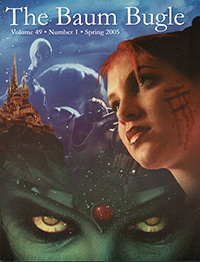
Back in 2005, the International Wizard of Oz Club’s journal, The Baum Bugle, published my article “Dorothy the Conqueror.”

It discussed the character of Dorothy Gale as L. Frank Baum developed her, from a little girl who called herself “small and meek” into a bold adventurer. That boldness had always been part of her character, but after her first trip to Oz she knew it. By the end of Baum’s series, she was happy to set out for unknown parts of Oz because “all excitement is fun.”

The article also points out ways that the MGM movie’s treatment of Dorothy doesn’t reflect that character, especially in her baffling speeches at the end.

The Oz Club has now made the text of “Dorothy the Conqueror” available for anyone to read through this webpage. It even comes with citations in both Chicago and MLA style.

04 July 2023

The Characters of Oz and the Character of Oz the Wizard

Later this year McFarland will publish The Characters of Oz: Essays on Their Adaptation and Transformation, edited by Dina Schiff Massachi of the University of North Carolina at Charlotte.

The publisher says, “This collection of essays follows Baum’s archetypal characters as they’ve changed over time in order to examine what those changes mean in relation to Oz, American culture and basic human truths.”

Among those essays is my own “A Good Man But a Bad Wizard?: The Shifting Moral Character of the Wizard of Oz.”

One of the few lines that appeared in both L. Frank Baum’s original novel and the 1939 MGM movie was the Wizard’s insistence that he was “a good man, but a bad wizard.” Within that first novel the Wizard was a humbug whom people believed in, a tyrant who benefited his people, but ultimately someone Dorothy couldn’t rely on.

Just a few years later, however, the American public knew the Wizard of Oz unambiguously as a bad man in the Wizard of Oz stage extravaganza. And a few years after that, Baum brought the Wizard back as a stalwart friend for Dorothy and eventually a real magic-worker. This essay analyzes those changes in his persona across media and moral boundaries.

Other articles in this collection include Katharine Kittredge on Dorothy, Dee Michel and James Satter on the Cowardly Lion, Walter Squire on Glinda, Paige Gray on Jack Pumpkinhead, and Angelica Carpenter on the Nome King, among many other experts. Dina Massachi wrangled the contributors and provided her own exploration of the Winged Monkeys.

30 April 2020

Love and the Law in a Terrific Tangle

A Stranger in Town is a competent B picture from MGM in 1943.

It starred Frank Morgan, best remembered as the title character in The Wizard of Oz. As Wikipedia says, a typical Morgan role was “a befuddled but good hearted middle-aged man.” In this case, his character spends much of the movie playing good-hearted and befuddled when in fact he’s a sharp and sometimes cranky Supreme Court judge on vacation in a small town.

The movie’s young couple was played by Richard Carlson, as the small-town lawyer, and Jean Rogers, as the justice’s prim clerk. Rogers had played Dale Arden in the Flash Gordon serials and was hoping for better roles at MGM. Carlson went on to star in Creature from the Black Lagoon before establishing himself in television as both actor and director. So all three principals are best known for their roles in fantastika.

It was refreshing to see a movie that reflected the New Deal belief that honest government was a good thing that people deserve. In real life, we’ve gone from the post-Reagan attitude that honest government was the best version of a bad thing that we could hope for to the current dismissal of good government being possible at all.

24 December 2019

Life Lessons from the MGM Movie

Emeralds of Oz: Life Lessons from Over the Rainbow is a short but not insubstantial riff on the MGM Wizard of Oz. The author, Peter Guzzardi, is a veteran book editor, but this is the first book published under his own name, several years in the making.

Emeralds of Oz is not based on the Oz mythos as a whole—just the famous movie. Guzzardi writes nostalgically about watching that film on television with his family but shares no fond memories of reading the Oz books as a child. He read a lot, but his taste leaned toward boys’ adventures. It takes over a dozen pages before Guzzardi even mentions L. Frank Baum, and there are only a couple of times when the book invokes parts of Baum’s story that didn’t make it into the movie.

Guzzardi isn’t just playing to the MGM movie’s larger contemporary fan base. That movie really defines his idea of Oz. At one point he recalls a difficult journey, noting he was about the same age as when Dorothy went to Oz. Context makes clear that he’s picturing the young adolescent Dorothy portrayed by Judy Garland, not the little girl drawn by W. W. Denslow.

The bulk of the book consists of lessons drawn from rewatching the MGM movie, rather like a sincere Mystery Science Theater 3000 viewing. A fair number of these homilies actually grow out of the vaudeville-style jokes mixed into the screenplay. There are longer meditations on the movie’s more explicit lessons, and of course a struggle at the end because of the screenplay’s ethical knots.

The “Emeralds of Wisdom” found in the movie tend toward pleasant reminders to keep doing what we normally do or know we should do, not deeper digs into the philosophical and ethical questions that the movie could raise. (Can one be a very good man while pretending to be a wizard?) The working title was All I Need to Know I Learned from the Wizard of Oz, with the implication that we knew it all from when we were young. Guzzardi drops mentions of the Kabbalah, mantras, Maslow’s hierarchy of needs, and other mainstays of modern self-help books. The more interesting commentary grows from his own life, however.

As an editor, Guzzardi’s specialty was crowd-pleasers, sometimes with fantastic results—Stephen Hawking’s A Brief History of Time, most notably. Emeralds of Oz grew out of that same commercial impulse. It’s designed as a gift, with glittery emerald endpapers, deckle edges, eye-catching interior design, and other hallmarks of the book as object. For people who like the movie and this sort of advice, it’s a fine package. But its strength comes from Guzzardi’s sincerity as he seeks guidance in the question, “What Would Dorothy Do?”

10 September 2019

Mid-Century Modern in the Emerald City

After the original publisher of The Wonderful Wizard of Oz went bankrupt, Bobbs-Merrill became the book’s one and only US publisher.

At first Bobbs-Merrill included W. W. Denslow’s illustrations, though not in the original ground-breaking multi-color design that integrated text and art. The company kept the book in print until the World War 2 paper shortages. As the war wound down, it looked for a way to reintroduce the title.

In 1944, Bobbs-Merrill commissioned entirely new art by Evelyn Copelman (1919-2003, also known as Evelyn Campbell and Evelyn Copelman Baker). She created black-and-white art on scratchboard and painted several color plates.

The title page of that new edition stated that Copelman’s art was “adapted from the famous pictures by W. W. Denslow.” Obviously those pictures weren’t the only source. Copelman’s Dorothy, Scarecrow, and Wizard are clearly designed like the characters in the 1939 MGM movie, and her Tin Woodman and Cowardly Lion look like hybrids.

Bobbs-Merrill had asked Copelman to create an edition that matched the movie, but it didn’t have rights to the MGM designs. It did own the rights to Denslow’s art, however. The title page claim apparently provided legal cover.

In 1949 MGM re-released its movie into cinemas. Not coincidentally, Bobbs-Merrill gave the book a new push. Copelman reworked her line art and added more plates.

With the book still under copyright, Bobbs-Merrill was the exclusive producer of new copies of The Wizard of Oz. Thus, for over a decade in the middle of the century, Evelyn Copelman’s artwork introduced young readers to Oz.

Then the copyright lapsed in 1956. Reilly and Lee, the publisher of the rest of the Oz series, created an edition with black-and-white reproductions of Denslow’s art in a trim that matched its other titles. Other publishers commissioned their own illustrations. As the years passed, Copelman’s art disappeared from bookstore shelves.

Archive.org, working with the San Francisco and other public library systems, has made a digital copy of a Copelman edition available for borrowing. This is a 1994 Illustrated Junior Library edition, with cover artwork by Michael Zimmer but Copelman’s line art and five plates inside. It’s worth a virtual thumb-through, especially if that’s the edition you remember.

20 August 2019

Television the Great and Terrible

The MGM Wizard of Oz has gone through three stages defined by how we the public got to watch it.

First was the reception that the filmmakers envisioned: exhibition in 1939 as a “prestige picture” in movie palaces, mostly owned by Loew’s Theatres. The movie was then moved to smaller venues and eventually taken out of circulation. MGM re-released the film in the same way in 1949 as the Hollywood studio system was under legal and financial siege.

That cinematic run was successful, if not immediately profitable. Even with reduced admission prices for children, The Wizard of Oz earned $3 million in its first release, enough to make it the second highest-grossing movie of 1939. It gained five nominations for Academy Awards, winning two. It established Judy Garland as a box-office star and enabled associate producer Arthur Freed to oversee many more movie musicals over the next two decades. Though most of the songs were novelty numbers, “Over the Rainbow” became a standard.

The next stage of the movie’s history started when MGM licensed the television rights to CBS in 1956. News reports about that deal marveled at how young Garland, Ray Bolger, and Bert Lahr had been when they made the picture—they were all major stars almost two decades later. In 1959 CBS took a further step and launched an annual showing, which the network touted as a major event for families to share.

The medium of television didn’t serve The Wizard of Oz well artistically. With more than 90% of American households in 1966 still watching TV in black and white, the movie’s shift to color as Dorothy arrives in Oz was invisible to most of the audience. Likewise, the nostalgic sepia tone of the Kansas scenes was printed in standard grays, and a bit of the opening was trimmed to free more time for commercials.

Culturally, however, television did wonders for The Wizard of Oz. Watching it once a year became almost required for American children, a common national experience. “Munchkin” entered the language, denoting small children and donut holes. Dorothy’s Ruby Slippers not only supplanted the book’s Silver Shoes in the public imagination but were enshrined in the Smithsonian’s National Museum of American History. In Marvel’s The Avengers, the Flying Monkeys are the one pop-culture reference that WW2 veteran Steve Rogers shares with his Gen-X colleagues and the audience. To be sure, there were American children who grew up without seeing The Wizard of Oz, or who didn’t like it enough to watch year after year, but most of them still knew its main points.

The third and current stage of the MGM movie’s life started with its release on VHS tape in 1980. It sped up as VCRs became standard household equipment and continues into today’s world of DVDs and streaming video. Now anyone ready to make an initial investment can watch The Wizard of Oz anytime they want to. No more waiting years for MGM to re-release the fabled movie into theaters, no more waiting months for the annual television airing.

Artistically, today’s media serve the movie much better than the last stage. Though we’re not watching the picture on giant movie screens as in 1939, the film has been restored to its pristine appearance and full length. What’s more, we can study scenes and frames and edited footage, and multiple behind-the-scenes books tell us about what went into this piece of popular art.

On the other hand, the MGM Wizard of Oz is no longer the cultural colossus it once was. The audience for popular entertainment has splintered, so families rarely gather around one screen to watch one channel. When one can watch the movie anytime, it no longer feels as urgent to watch it tonight. While the live-action recreations of the movie on stage and ice can provide families with a special shared experience as the movie itself once did, those productions are pale projections of the celluloid.

As a result, the fan base of the MGM movie appears to be shrinking and aging. The highest-profile works it inspired in the last three decades—Gregory Maguire’s novel Wicked, the subsequent Broadway musical, and and the movie Oz the Great and Terrible—were created for adult audiences, with sexual content and hardly any child characters. We once thought of The Wizard of Oz as a near-universal part of growing up in America. Now we see that only a couple of cohorts of Americans shared that experience.

Fortunately, the same abundance of entertainment media that swamps the annual airing of The Wizard of Oz offers many other ways to enjoy the Oz mythos. The original books, new books and comics inspired by them, virtually all the Oz movies and TV cartoons ever made—they’re all available for children to try. There are more doorways into Oz fandom now, not one big door that nearly all American children were funneled through to see if they liked it. But will more variety make up for smaller numbers?

[This essay was written at the behest of Michael Booth, to be published on his Facebook page in celebration of the 80th anniversary of the release of The Wizard of Oz on 25 August.

The picture above is PhotoShop art by LunaC, hosted on FreakingNews.com. The challenge was to slip a cathode ray TV into an old painting. LunaC chose Joseph Wright of Derby’s depictions of science in the eighteenth century.]

09 December 2015

The Feelings We Once Had

Of all the famous dramatic adaptations of L. Frank Baum’s The Wonderful Wizard of Oz, The Wiz in its original form is the most faithful. But of course the 1939 MGM movie is now more famous than either version.

As I observed yesterday, that movie clearly dominated Harvey Fierstein’s thinking about how to adapt the book of The Wiz for Broadway and TV today.

I spotted some other debts/homages to the MGM film that don’t come from the original Wiz:
  • Dorothy wears shiny red sneakers at the start, though public-domain silver shoes later.
  • Aunt Em’s farm employs three farmhands played by the men who (lots of makeup later) play the Scarecrow, Tinman, and Lion.
  • Dorothy is magically faced with the image of a maternal figure (Aunt Em/her late mother) calling for her.
  • We get a view of the distant green spires of the Emerald City across a red-poppy landscape.
  • The Wiz has a “Pay no attention to the man behind the curtain!” moment.
  • Glinda comes to the Emerald City for the penultimate scene instead of Dorothy and her friends going to Quadlingland.
Other elements of Baum’s original story that made it into The Wiz were dropped from this live-broadcast version, such as the Kalidahs as tiger-bear hybrids, the Lion falling asleep among the Poppies instead of outwitting them, and the need to wear green glasses in the Emerald City.

I saw the original Broadway production decades ago, and some elements of its stagecraft have stuck with me. Most memorable was the tornado depicted by a dancer with fabric billowing from her head, an image that inspired the play’s trademark art. The TV production simulated the tornado instead with projected images and wire-flying—much less magical.

The TV version of the Yellow Brick Road consisted of illuminated parts of the stage, like Michael Jackson’s “Billie Jean” video. The stage original was four men in yellow costumes with poles—another image that stuck with me strongly since I first saw it, probably because it was such a bold staging choice for my young mind.

Curiously, Baum’s Winged Monkeys, which became Flying Monkeys in the 1939 movie and Funky Monkeys in The Wiz, were referred to only as “Winged Warriors” here.

08 December 2015

Fierstein Adding “a Little More Sense” to Oz

Last week NBC broadcast a restaging of The Wiz that’s also slated for Broadway next year. It has a new book by Harvey Fierstein, who boasted about his improvements in an interview with BroadwayWorld:
I've loved Wizard of Oz my whole life but have had questions. I was always a questioning kind of kid. I got to answer all the questions that I had. Where did Dorothy's parents go? There's this girl living with her aunt and uncle... well I killed off the uncle; he doesn't do anything anyway. Do we care about him just sitting on the porch rocking away? You have a girl living with her aunt, and it's never mentioned what happened to her parents. Dorothy's such a victim. She didn't create that storm; she gets taken away. She doesn't kill the witch; the house falls on her. She doesn't kill the other witch; she throws water to save her friend. She's just a victim. I said, "Why should she be just a victim? It's her dream! It's her fantasy!"

So I gave her a story, and we open with her running away from home trying to get home to Omaha where she was actually born. Her parents are dead. She hates her school; she hates Kansas. "I hate this place; I hate being out in the cornfield. I want to go home." Her answer is this is your home but your too old for me to tell you what to do. I could keep you here and force you, but at some point in your life you have to figure out where you really belong. She's sent off on this very different journey of going home to Omaha. She ends up in this place that's not Omaha and becomes much more of an active participant in it. In the end, when the Wiz turns out to be from Omaha when they get in the balloon. Instead of missing the balloon, I have her walk away from the balloon an say you're going to your home, I'm headed somewhere else. She finally figures out home is not where your feet are; it's where your heart is.
Clearly Fierstein’s playing off the 1939 MGM adaptation rather than L. Frank Baum’s novel. In the original, Dorothy doesn’t throw water on the Wicked Witch of the West to save the Scarecrow; she does so because she’s ticked off (a situation Fierstein rediscovered). Uncle Henry does more than sit on a rocker.

Fierstein’s characterization of Dorothy makes sense only if she’s a teenager, like nineteen-year-old Shanice Williams. Judy Garland was a teen, of course, but she played a younger girl. The Dorothy of the books is younger still.

In Baum’s books, the Wicked Witch of the East enchants the Tin Woodman because she (or another old woman) doesn’t want to lose the services of his beloved. Fierstein instead put those three characters into a love triangle:
I gave each of those characters a backstory that makes a little more sense. The Tin Man got turned into the Tin Man by the Wicked Witch because she had a thing for him. She caught him with this girl, and she blasted his ass and stole his heart. She said, "If I can't have your heart, no one can."
That “makes a little more sense” for an older audience, perhaps. But children haven’t had trouble understanding Baum’s original motivation for the witch.

Evidently the choice to cast Queen Latifah as the Wiz prompted Fierstein’s thinking about that character:
Queen Latifah's backstory [as the Wiz] is that she was a magician's assistant at a carnival so they gave balloon rides and all of that but you ever meet the person that is not bad enough they're unhappy, they have to make everyone unhappy and that was this guy. She jumps in the balloon to piss him off and this balloon landed me in Oz. Everyone came running so I put on the magic hat and did the magic act. They put me in here and I've been hiding ever since so nobody finds out that I'm not anything. I was the assistant. She is a woman escaping the world of men, which I thought would give a different color to Dorothy as well. It all has to come out of a little girl's imagination. If you don't believe it came out of her imagination it doesn't work.
Because then Oz would just be real, and who wants that?

24 November 2015

“It was gingham, with checks of white and blue”

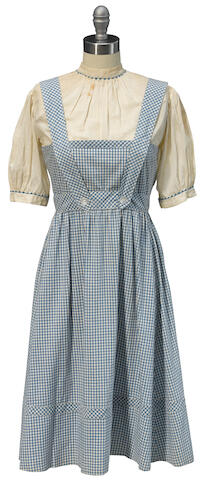
Yesterday Bonhams sold a dress for $1,565,000. It was made for a Kansas farmgirl in the early 20th century.

Now that sum’s only about half of the price of the Cowardly Lion costume Bonhams sold last year, but it’s still high enough to place this outfit fourth on this list of most expensive Hollywood costumes.

Two other garments on that list are also dresses made for Dorothy Gale, one used for only a couple of weeks of filming before the director was replaced.

This dress had an excellent provenance, starting with labels inside that identify its wearer as “Judy Garland” rather than a stand-in. As for after it left the studio, “This blouse and pinafore were retained by Kent Warner, the costume collector employed by David Weisz Co. to help organize the 1970 MGM Auction who subsequently cherry-picked many of the best pieces for himself.” It was last sold at a Christie’s New York auction in 1981.

29 September 2015

The Electric “Elements of Oz”

Elements of Oz is a new stage/video show that seems to combine an homage to the MGM movie with Ozma’s Magic Picture. (Which, as we all know, can show you any place or person you ask to see.)

Here’s a taste of the review in today’s New York Times:
At “Elements of Oz,” having its premiere as part of the Peak Performances season at Montclair State University here, viewers are encouraged to use smartphones or tablets during the performance. . . . You download a special app that instructs you to put your phone in airplane mode until the show starts. The app then provides access to various elements that enhance the production, primarily nifty filters that, when you point the phone at the stage, add new layers of imagery to the action. When Dorothy’s house in Kansas flies skyward, for example, you can hold up your phone and see a real corker of a tornado and slashing rain that isn’t apparent to the naked eye.

Directed by Marianne Weems, “Elements of Oz” was jointly created by James Gibbs and Moe Angelos. Ms. Angelos is also one of the three performers, alongside Sean Donovan and Hannah Heller. A loose, loopy and enjoyable seminar on the making of the movie and its influence on pop culture, the production combines live video and performance — several famous scenes from the movie are more or less filmed anew before us — with anecdotes about its production and other random arcana about the film and the book it was based on by L. Frank Baum. . . .

The live re-creations of scenes from the movie are technically marvelous; the digital video (by Austin Switser) is dazzlingly pristine, and it’s fun, at least for a while, to watch the wry comic impersonations of the performances in the movie. . . . But ultimately these sequences don’t provide enough comic stimulation to justify their length. It begins to feel a bit too much like a draggy day on the back lot, and you might find yourself tempted to escape the app and fire up the real movie on your phone…
The performers, who each play multiple roles, all get praise, as does Bert Lahr.

04 November 2014

The Return of the Cowardly Lion

On 24 November, the Bonham’s auction house will offer a collection of Hollywood memorabilia that includes Bert Lahr’s Cowardly Lion costume from the 1939 MGM Wizard of Oz.

The auction house says:
For famed MGM costume designer Gilbert Adrian, the only option for creating a realistic lion costume in 1938 was to fashion it out of actual lion hides. He was challenged with locating several that visually matched each other so a few costumes could be made and used interchangeably throughout filming. Adrian soon discovered, however, that every available lion hide had very distinctive colors, hair patterns and scars, so he had no choice but to dress Lahr in a single costume for much of the filming.
An auction house expert told the Los Angeles Daily News states:
“According to various histories of the film, Lahr’s costume was drenched with sweat at the end of every day, and so (it) was removed and placed in drying bins overnight so it could be used again the next (day),” Williamson says.
She added that another lion costume survives which Lahr probably wore for publicity stills, and there was at least one for Lahr’s double or stand-in as well. But only this one matches the details in scenes throughout the movie.

Back in 2006, the Profiles in History company sold that other Cowardly Lion costume for over $800,000. In 2011 the owner of this costume also offered it through Profiles in History with an estimated price of $2 to $3 million. Evidently bids didn’t meet the reserve because it’s available once again, in the movie’s 75th-anniversary year.

28 October 2014

Monkeying Around with Influences

This is Harry Bliss’s daily newspaper cartoon from 16 Oct 2014.

I like the way he’s combined the costuming from the MGM movie with the composition of one of W. W. Denslow’s color plates.

07 October 2014

Two Sides of The Little Tin Man

The Little Tin Man is a new film now opening on the art house circuit. It stars Aaron Beelner as Herman, a young little person who’s got limited talent and ambition as an actor but is galvanized by his mother’s death to try harder.

The New York Times liked it:
It’s not that Herman has been playing it safe so much as he’s resigned to being typecast, settling for roles that require a high-pitched voice and “candy cane spandex.” His mother’s dying wish for him to take his career more seriously sends Herman and a ragtag crew, including the delightful Kay Cannon, a writer (“30 Rock” and “Pitch Perfect”) in her first lead film role, on a wacky adventure around Manhattan in hopes of auditioning for Martin Scorsese, who’s remaking “The Wizard of Oz.” . . .

At its best, the movie has a sort of sitcom feel, with swift pacing and delivery, and the strong ensemble cast has a natural rapport.
The Village Voice was not so taken:
Instead of “settling to be a punchline to some bad joke,” Herman fights to audition for a much bigger role: the Tin Man. But neither he nor the film gives anyone else the respect that he demands. Herman rolls his eyes when flamboyantly gay brother Gregg (Jeff Hiller) comes out of the closet. And to his love interest Miller (Kay Cannon) he mocks heavily accented Latino friend Juan (Emmanuel Maldonado), warning her not to make fun of Juan’s pronunciation of “JewTube.”

Herman and Miller’s relationship isn't much more sensitive. . . . Herman eventually stops being so childishly possessive. But the fact that he spends much of the film demanding better treatment from others while preemptively condemning them says a lot about The Little Tin Man’s everyone-but-me progressivism.
Here’s the trailer so you can sample it yourself.

11 September 2014

Gauging Jason Segel’s Knowledge of Children’s Literature

The news that actor Jason Segel has published a children’s book made me wonder if he had produced good, or even adequate, literature or if this was yet another celebrity publication.

True, Segel wrote the script for The Muppets and other movies, and he’s not really a household name. But did the level of recognition he’s gained in Hollywood mean he received less editing and more resources than an average first-time children’s author? And why did this book need a coauthor, Kirsten Miller?

This afternoon I heard Segel interviewed about the book on Radio Boston. In response to the host’s mention of the scary bits of the Wizard of Oz movie, Segel immediately asked, “Have you seen Return to Oz?” He described that movie’s use of electroshock but also noted that other scary parts come “from the books.” So I’m ready to grant that Segel knows children’s literature.

One striking pattern in the interview is how Segel cited all sorts of children’s media together: Roald Dahl and The Goonies, the Oz books and the Oz movies, Coraline and The Muppet Show. Is that how young readers/viewers think of their stories in this world of quick and close cinematic adaptation?

14 August 2014

Wrapping Up the Winkie Convention, part 3

Here’s the final schedule for the final day of the 2014 Winkie Convention in San Diego—Sunday, 10 August.

Sunday, 8:30 am
Ozzy Tai Chi led by grandmaster Parker Linekin
Brunch at the Hotel Del Coronado, where L. Frank Baum wrote several books

Sunday, 10:00 am
“The Making of ‘The Wizard of Oz’” Documentary with movie historian Aljean Harmetz (reprise)
Baum’s Boys with authors Paul Dana, Jared Davis, J. L. Bell, and Michael Gessell

Sunday, 11:00 am
75 Years of the MGM Wizard of Oz with movie experts Aljean Harmetz, Priscilla Montgomery, Robert A. Welch, Steve Cox, and Anthony Tringali
A New Oz Series: A Look Back with The Emerald Wand of Oz and Trouble Under Oz author Sherwood Smith and illustrator William Stout, interviewed by J. L. Bell—the first time Smith and Stout had met
Walking Tour of Coronado with the Coronado Historical Association (reprise)

Sunday, 12:30 pm
The Adventures of Queen Ann in Oz with authors Eric Gjovaag and Karyl Carlson and illustrators Bill Campbell and Irwin Terry—the first time this creative team had met, on the occasion of their book’s republication

Sunday, 1:30 pm
The Tik-Tok Man of Oz Audience Talk-Back with producer Eric Shanower, lighting designer Christopher Boltz, set and costume co-designer David Maxine, and performers Eduard Cao, Taylor Hamilton, Taylor Schwartz, and Laura Bueno

Sunday, 2:30 pm
Upcoming Oz Events and Closing Ceremonies with convention organizers David Maxine, Freddy Fogarty, Eric Gjovaag, and Karyl Carlson

That programming could not have happened without the audiovisual equipment loaned by SanSFiS (more on that group later), the tireless work of SanSFiS volunteer Barney Evans, and the half-dozen presenters who made their laptops available for other sessions.

13 August 2014

Wrapping Up the Winkie Convention, part 2

The final, actual Winkie Con 2014 schedule continues with the official events of Saturday, 9 August. This was the biggest day of the convention with the highest attendance and the most events going on at once.

Saturday, 7:30 am
Army of Oogaboo Bootcamp led by the well-traveled Colin Ayres

Saturday, 9:00 am
Costume Contest hosted by Kurt Raymond and Lee Speth

Saturday, 10:00 am
The Winkie Con Quizzes administered by last year’s winners Jared Davis, Miriam Esther Goldman, and Susan Hall
Conversation with Movie Historian Aljean Harmetz with interviewer Anthony Tringali
Oz Collectibles with collectors Freddy Fogarty, Bill Campbell, and Kurt Raymond
Auction Preview
Dealers’ Room Reopens
Oz Research Table, Art Show, and Swap Table Reopen
Display of Judy Garland Movie Costumes Reopens with Michael Siewert

Saturday, 11:00 am
Friends of Dorothy: The LGBT Side of Oz with authors and artists Michael Cart, Dee Michel, Joe Phillips, Rachael Anderson, and Anthony Trujillo
The Oz Books for Beginners: Reading and Collecting with experts Eric Gjovaag and Paul Bienvenue
Mechanical Men and Dinosaurs in Oz with science-fiction fans William R. Lund, Susan Hall, Lee Speth, and Tim Tucker
Walking Tour of Coronado with the Coronado Historical Association (reprise)
Auction Session 1 with auctioneer Bill Thompson

Saturday, 12:00 noon
A. Arnold Gillespie: The Wizard of Special Effects with biographer Robert A. Welch (reprise)
Fictional Worlds and Fandoms: From Oz to Star Trek and Beyond with fandom veterans Bjo and John Trimble, Margaret Koontz, Michael Cart, and Tim Tucker
Soon As I Get Home: An Oz Lunch Concert with singer-songwriter Anthony Whitaker

Saturday, 1:00 pm
Oz and Tarot with publishers Anna Warren Cebrian and Mark Anthony Masterson and reader Gita Morena
Oz and the American Musical with musicologist Ryan Bunch
From Humbug to Hero: Getting to Know the Wizard of Oz with fans Stan Sieler, Atticus Gannaway, Carrie Hedges, John W. Kennedy, and J. L. Bell
Storytelling Workshop: From Character to Comic led by Anthony Nuñez
Auction Session 2 with auctioneer Bill Thompson

Saturday, 2:00 pm
Oz Tabletop Roleplaying Game led by Stephen Koontz
Toto of Oz, a Great and Powerful Film Career with Patricia Watson
Today’s Publishing Options with authors Henry Herz, Paul Dana, Edward Einhorn, and Kevin Gerard
Tarot Readings by Gita Morena

Saturday, 3:00 pm
Conversation with Bjo and John Trimble with interviewer Jack Plummer
Storytelling in Someone Else’s Sandbox with authors Melissa Wiley, Caroline Spector, Edward Einhorn, and Gina Wickwar

Saturday, 4:00 pm
Conversation with Priscilla Montgomery, an MGM Munchkin, with interviewer Anthony Tringali
Crafting Oz with artists Dave Kelleher, Karyl Carlson, and Bill Campbell
The Baum Bugle: Meet the Editors! with Craig Noble and Jared Davis

Saturday, 6:00 pm
The Grand Winkie Banquet and awards ceremony

Saturday, 8:00 pm
The Tik-Tok Man of Oz Musical Play directed by Chrissy Burns

Saturday, 11:00 pm
Tik-Tok’s Robotic Ragtime Revelry after-party with the Heliotrope Ragtime Ensemble

The image above is sheet music from The Tik-Tok Man of Oz, produced in 1913. That musical extravaganza was L. Frank Baum’s attempt to recreate the huge success he’d enjoyed with the 1902 stage version of The Wizard of Oz. What we saw on Saturday night was a game attempt to produce a coherent drama from the fragmentary surviving scripts and songs. Always lively, full of delights, and produced for just the right audience.