Showing posts with label AUTHOR Alexander Pope. Show all posts

26 March 2020

“Literary texts might be doubly infectious”
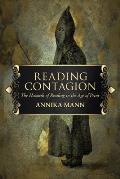
I just learned about this book, but I had a tag all set up for it already.

Reading Contagion: The Hazards of Reading in the Age of Print, by Annika Mann:
Eighteenth-century British culture was transfixed by the threat of contagion, believing that everyday elements of the surrounding world could transmit deadly maladies from one body to the next. Physicians and medical writers warned of noxious matter circulating through air, bodily fluids, paper, and other materials, while philosophers worried that agitating passions could spread via certain kinds of writing and expression. Eighteenth-century poets and novelists thus had to grapple with the disturbing idea that literary texts might be doubly infectious, communicating dangerous passions and matter both in and on their contaminated pages.

In Reading Contagion, Annika Mann argues that the fear of infected books energized aesthetic and political debates about the power of reading, which could alter individual and social bodies by connecting people of all sorts in dangerous ways through print. Daniel Defoe, Alexander Pope, Tobias Smollett, William Blake, and Mary Shelley ruminate on the potential of textual objects to absorb and transmit contagions with a combination of excitement and dread. This book vividly documents this cultural anxiety while explaining how writers at once reveled in the possibility that reading could transform the world while fearing its ability to infect and destroy.
This eighteenth-century worry seems to have resurfaced now that we’re are hunkering down with reading material and mail-order packages while word goes around that those same packages might carry the virus we’re hunkering down to avoid.

However, as science journalist Zeynep Tufekci tweeted: “Future generations will be driven batty by the amount of concern over contamination from cardboard boxes—a tail risk: porous surface, exponential decay—compared with protecting the pathways to OUR RESPIRATORY SYSTEM WITH MASKS FOR A RESPIRATORY ILLNESS WITH ASYMPTOMATIC SPREAD.”

04 July 2013

The Invention of Rewriting Revision?

Declaration of Independence.  ... Digital ID: psnypl_mss_1228. New York Public LibraryI’m looking at successive drafts of the Declaration of Independence while considering Craig Fehrman’s Boston Globe essay on revision in writing.

Fehrman says that Hannah Sullivan’s The Work of Revision posits that “revision as we now understand it—where authors, before they publish anything, will spend weeks tearing it down and putting it back together again—is a creation of the 20th century.”

More specifically, she argues that approach to rewriting is a product of the typewriter, cheaper typesetting, and word-processing programs. In days when paper and printing were rarer resources, authors didn’t see so many versions of their work and therefore took fewer opportunities to rewrite.

Yet the article omits some counterexamples. It cites John Milton’s “Lycidas” as an example of a writer making “local tweaks instead of significantly recasting.” It doesn’t mention that Milton issued Paradise Lost in two forms, the first divided into ten books and the second into twelve, as he revised his work. Alexander Pope published three versions of The Rape of the Lock within a decade.

Fehrman says Sullivan cites the Romantics as a school that “made resisting revision a virtue. The best literature, they believed, flowed from spontaneous and organic creative acts.” Yet no great English poem was more fussed over and rewritten (not always to good effect) than William Wordsworth’s verse autobiography, posthumously published as The Prelude.

The Work of Revision doesn’t appear to go deep into English literary history, or to find the same trends in the literature of other languages where the same typesetting technologies applied. The catalog copy names only Modernist authors, contrasted with a nameless swarm of “Romantics,” and the earliest name in the table of contents is Henry James.

It might be more accurate to say that the Modernists, in contrast to their immediate literary predecessors, talked a lot more about revision, and about what hard work it was. And that would be significant in how they, and we, think about art. But are writers really driven more to revise now, or do we just see and hear about it more often?

18 December 2009

Writing Advice on Responding to Criticism

There’s the wrong way, as in the recent case study dissected by Teresa Nielsen Hayden at Making Light. And there’s the right way, from an anecdote the poet Alexander Pope told about himself and the first Earl of Halifax, who actually did a spot of writing himself, what what:

When I had finished the two or three first books of my translation of the Iliad, that Lord desired to have the pleasure of hearing them read at his house. Addison, Congreve, and Garth were there at the reading.

In four or five places Lord Halifax stopped me very civilly, and with a speech each time of much the same kind, “I beg your pardon, Mr. Pope, but there is something in that passage that does not quite please me. Be so good as to mark the place, and consider it a little more at your leisure: I am sure you can give it a better turn.”

I returned from Lord Halifax’s with Dr. Garth, in his chariot; and as we were going along, was saying to the Doctor, that my lord had laid me under a good deal of difficulty, by such loose and general observations; that I had been thinking over the passages ever since, and could not guess what it was that offended his lordship in either of them.

Garth laughed heartily at my embarrassment; said I had not been long enough acquainted with Lord Halifax to know his way yet; that I need not puzzle myself in looking those places over and over again when I got home. “All you need do,” said he, “is to leave them just as they are; call on Lord Halifax two or three months hence; thank him for his kind observations on those passages; and then read them to him as if altered. I have known him much longer than you have, and will be answerable for the event.”

I followed his advice; waited on Lord Halifax some time after; said I hoped he would find his objections to those passages removed, and read them to him exactly as they were at first. His lordship was extremely pleased with them, and cried out, “Ay, now, Mr. Pope, they are perfectly right; nothing can be better.”
Of course, the famously thin-skinned Pope was probably a lot more emotional during the reading and the chariot ride than this story suggests. But Pope was also entirely dependent on rich patrons, so he had to grit his teeth. In 1714 he gave the same earl the first volume of his Iliad translation and wrote a fawning letter that said, in part: “It is indeed a high strain of generosity in you, to think of making me easie all my life, only because I have been so happy as to divert you an [h]our or two…”
