Showing posts with label nostalgia ain't what it used to be. Show all posts

29 October 2025

The Wizard of Balboa Park

The San Diego Civic Light Opera Association was founded in 1945. Its first show was Gilbert and Sullivan’s The Mikado in the Wegeforth Bowl at the San Diego Zoo.

Because of San Diego’s ideal weather, the organization staged its shows outside. It soon took on the name of the Starlight Opera.

On July 29, 1946, the San Diego Union and Daily Bee said: “If the new Starlight Opera company becomes any more popular it will have to move to Ford Bowl.” That was the amphitheater in Balboa Park built for a 1935 expo.

Indeed, the Starlight Opera Company was soon using that larger space. Around 1950 the amphitheater became known as the Starlight Bowl. (An amphitheater in Burbank was using the same name at that time, confusing matters.)

The Light Opera Association also widened its repertoire to include new, popular shows and operated under the same of Starlight Musical Theatre.

Because the amphitheater was right under the main flight path to Lindbergh Field, performers learned to freeze when a loud plane passed overhead. Starlight Musical Theatre’s old website called this “One of the most artistic innovations of productions at the Starlight Bowl.”

In 1962 the Starlight company planned a summer season of The Music Man, Can-Can, The Wizard of Oz, and Bye Bye Birdie.

About the third show the 7 Apr 1962 San Diego Evening Tribune explained:
“The Wizard of Oz,” was adapted originally for the stage by L. Frank Baum from his classic children’s story. It was first presented in 1903, starring the team of Fred Stone and David Montgomery. Their leading lady was Anna Laughlin, the mother of singer Lucy Monroe.

The version of “Wizard” which Starlight is using has been updated by Frank Gabrielson, and features the songs of Harold Arlen and E. Y. Harburg, composed for the highly successful 1939 movie.
That adaptation had originally been commissioned by the St. Louis Municipal Opera in 1942 and is therefore known as “the MUNY Version.” As the licensor says, it “features characters and events not seen in the MGM film”—and it also leaves out several characters and events.

The 1962 San Diego Evening Tribune article was headlined “Little Munchkins Needed for Starlight ‘Wizard of Oz’,” and its main news was:
Casting for Starlight’s production of “The Wizard of Oz” will be held for three days, instead of the usual two, due to the large number of children needed in the cast. . . .

The youngsters will be used for the Wizard of Oz’s “army,” composed of one private and 24 generals. They will also be used as munchkins—the little people enslaved by the Wicked Witch of the East and freed by Dorothy. . . .

Roles open for adults include that of the Scarecrow—which also requires dancing ability; the Tin Woodman and the Cowardly Lion. The leading role of Dorothy, calls for a teenage soprano with acting experience, age 18 at the maximum.
In 2010, after more than sixty straight years of productions, the San Diego Civic Light Opera Association went out of business. There’s now a Save Starlight campaign to fix up the abandoned amphitheater and stage new concerts and shows there.

TOMORROW: Crossing the streams.

06 May 2020

Looking Back on Claude Jarman’s Hollywood

I read about the child actor Claude Jarman, Jr., before I saw him in a movie, and it wasn’t a complimentary read. The Medved brothers’ Golden Turkey Awards listed Jarman in the category of Most Obnoxious Child Actor.

Though he didn’t have the dubious distinction of winning that award, Jarman’s entry dwelled on his debut performance as Jody in the 1946 MGM adaptation of Marjorie Kinnan Rawlings’s The Yearling.

Only later did I actually see that movie and assess Jarman’s performance for myself. He performed alongside Gregory Peck, Jane Wyman, and a herd of young deer selected to play one pet. Clearly someone who doesn’t like sentimental stories about wide-eyed children and animals wouldn’t like that film or Jarman’s performance. I think Peck as a young father carried the picture, but Jarman performed his major role just fine.

Of course, it helped that Jarman looked like the illustrations of Jody that Edward Shenton drew for the first edition of The Yearling. (Scribner’s commissioned more art from N. C. Wyeth for a deluxe edition the next year.) I came away thinking that Jarman’s performance might be a case of careful casting, director Clarence Brown finding a boy who looked and talked just as that one role required. But, if the Golden Turkey nomination was a fair indication, Jarman wasn’t up to any other part.

Later I ran across Brown’s adaptation of William Faulkner’s Intruder in the Dust (1947), which I’ve written about as one of the precursors to To Kill a Mockingbird. I hadn’t expected to see Jarman again—The Golden Turkey Awards didn’t mention that film at all. It’s a good movie, and Jarman did a fine job as a southern teenager realizing the racial injustice in his society.

Last week I watched John Ford’s Rio Grande (1950), discussed here. Again, there was Claude Jarman, this time playing the estranged son of cavalry officer John Wayne. Again, the Medveds didn’t mention this movie. And again, Jarman did fine with his part. It’s not a deeply nuanced role in a film whose biggest strength is the visuals, but he did all that was asked of him, including a crazy stunt.

How, I wondered, did this supposedly terrible young actor keep doing fine in good movies? In fact, Jarman made only about a dozen films in his whole Hollywood career, so for three to stand the test of time is an achievement. (Two more westerns, Roughshod [1949] and Hangman’s Knot [1952], also have fans, but I haven’t seen them.)

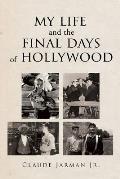
To understand Jarman’s work I sought out his autobiography, My Life and the Final Days of Hollywood, published in 2018. It’s a short book, straightforwardly told. Just as the title suggests, it combines Jarman’s own life with the change he saw happening around him during his stint in the movie capital in the late 1940s.

As MGM’s publicity machine trumpeted, Clarence Brown spotted Jarman at his school in Nashville taking down a Valentine’s Day display in 1945. Some versions of the story say Jarman had missed a haircut and was thus sporting a rustic look, suitable for Jody. A photo in My Life and the Final Days of Hollywood casts doubt on that; sent back to a producer in California, that image shows Jarman with hair much shorter than he wore in the movie.

In any event, Brown convinced MGM to bring Jarman and his father out to the coast for a screen test, then to cast the boy as Jody. The Yearling took almost a year and a half to make in Florida and California, released for Christmas season in 1946.

Jarman arrived in Hollywood (technically Culver City) when the studio system was still intact. MGM provided him with a weekly salary, drama lessons, publicity, and acting assignments whether he was interested in those movies or not. He went to school at the studio alongside other child actors like Elizabeth Taylor, Margaret O’Brien, and Dean Stockwell. It didn’t take him long to realize that he didn’t share their interest in acting or being a star.

A lot of successful child performers are naturally short or bloom late, so they can play younger roles. Jarman, in contrast, grew several inches in his early teens, meaning his height and body no longer fit his baby face. As Harry Carey, Jr., recalled, at fifteen Jarman “was 6'2" and weighed about 160 pounds.” That made it tough for MGM to cast him. In fact, in Rio Grande Jarman played a West Point dropout—a significantly older role, albeit one that needed an actor with a young face.

Meanwhile, the studio system was crumbling around him. Between television and the antitrust lawsuit that separated movie studios from cinema chains, the industry changed from assembly line to contingency projects. In 1949, Jarman happily went back to Tennessee. He was a star athlete at his prep school, then enrolled at Vanderbilt. Jarman spent summers or skipped classes to make a few more films, such as Rio Grande, and entered the business world.

Eventually, however, Jarman found himself back in a wing of show biz, running the San Francisco International Film Festival. He started in 1965, before revival cinema was everywhere, and he tapped his Hollywood contacts to bring special guests up from LA. That experience gave Jarman another couple of chapters of anecdotes and a perspective on the movie business that enriches his whole book.

Notably, Jarman refers to The Golden Turkey Awards at one point in his memoir, mentioning how his costar in Fair Wind to Java, Vera Ralston, was nominated for Worst Actress of All Time. Though he makes a point of saying he never read his own reviews, I can’t help but think he knew about the Medveds’ critique of his own acting career. Which I’ve now come to think of as unfair.

Jarman published his memoir through Covenant Books, a self-publisher that markets itself to Christian authors. That probably limits the reach of the book into physical stores and libraries, but there’s a digital edition available. The book is written and produced at a professional level. (Jarman credits Sloan de Forest with helping him write his story.)

People interested in the history of America’s movie studios should enjoy My Life and the Final Days of Hollywood, not because it reveals a great deal new but because it shows those details through one wide-eyed child’s perspective. Jarman’s Hollywood career was short and in many ways atypical. But he did fine, and he came out fine.

24 December 2019

Life Lessons from the MGM Movie

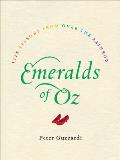
Emeralds of Oz: Life Lessons from Over the Rainbow is a short but not insubstantial riff on the MGM Wizard of Oz. The author, Peter Guzzardi, is a veteran book editor, but this is the first book published under his own name, several years in the making.

Emeralds of Oz is not based on the Oz mythos as a whole—just the famous movie. Guzzardi writes nostalgically about watching that film on television with his family but shares no fond memories of reading the Oz books as a child. He read a lot, but his taste leaned toward boys’ adventures. It takes over a dozen pages before Guzzardi even mentions L. Frank Baum, and there are only a couple of times when the book invokes parts of Baum’s story that didn’t make it into the movie.

Guzzardi isn’t just playing to the MGM movie’s larger contemporary fan base. That movie really defines his idea of Oz. At one point he recalls a difficult journey, noting he was about the same age as when Dorothy went to Oz. Context makes clear that he’s picturing the young adolescent Dorothy portrayed by Judy Garland, not the little girl drawn by W. W. Denslow.

The bulk of the book consists of lessons drawn from rewatching the MGM movie, rather like a sincere Mystery Science Theater 3000 viewing. A fair number of these homilies actually grow out of the vaudeville-style jokes mixed into the screenplay. There are longer meditations on the movie’s more explicit lessons, and of course a struggle at the end because of the screenplay’s ethical knots.

The “Emeralds of Wisdom” found in the movie tend toward pleasant reminders to keep doing what we normally do or know we should do, not deeper digs into the philosophical and ethical questions that the movie could raise. (Can one be a very good man while pretending to be a wizard?) The working title was All I Need to Know I Learned from the Wizard of Oz, with the implication that we knew it all from when we were young. Guzzardi drops mentions of the Kabbalah, mantras, Maslow’s hierarchy of needs, and other mainstays of modern self-help books. The more interesting commentary grows from his own life, however.

As an editor, Guzzardi’s specialty was crowd-pleasers, sometimes with fantastic results—Stephen Hawking’s A Brief History of Time, most notably. Emeralds of Oz grew out of that same commercial impulse. It’s designed as a gift, with glittery emerald endpapers, deckle edges, eye-catching interior design, and other hallmarks of the book as object. For people who like the movie and this sort of advice, it’s a fine package. But its strength comes from Guzzardi’s sincerity as he seeks guidance in the question, “What Would Dorothy Do?”

03 November 2019

Restorative Young Justice

I was intrigued by the news that Brian Michael Bendis was reviving DC Comics’s original Young Justice team, featured from 1998 to 2003. I didn’t pick up the comic books, however, because I was already confused enough by the publisher’s continuity changes in recent years. The alternate universes that got us to this reboot seemed even more tortuous.

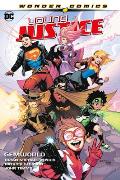
I’ve now read the first collected volume of that series, Young Justice: Gemworld, and I’m just as confused as I anticipated.

Bendis has indeed restored the core of the original team: Tim Drake as Robin, Conner Kent as Superboy, Bart Allen as Impulse, and Cassie Sandsmark as Wonder Girl. In addition, he’s added three more girls, versions of established heroes/trademarks: Jinny Hex, Amethyst, and Teen Lantern (leaving out the original Young Justice’s Secret, Artemis Arrowette, and later members). Bendis has also established that the team has always been part of this DC universe’s history but wiped from memory by a bunch of hand-waving—the same hand-waving that brought those characters back together. But as for the story itself, it felt thin.

Of course, the original Young Justice series was far from deep. Launched by Todd Dezago and then taken over and scripted almost entirely by Peter David, it was a sitcom. It had catch phrases, laugh lines, villains and supporting characters whose names were based on puns. Sure, there were many moments of teen angst and very special episodes and all that. But fundamentally that series didn’t take itself too seriously. This team formed because a bunch of young superheroes liked hanging out, not because they had a crucial mission or psychological need. That’s why the unorthodox artwork of Todd Nauck worked.

Bendis has restored the group, but he hasn’t restored that tone. To be sure, these first issues are devoted to reintroducing and introducing the team through one breathless flashback after another. But I recall only two jokes fondly, one of them repeated and the other almost lost in small panels.

The new series doesn’t need to follow the same path, of course. So far, however, there just isn’t enough adolescent drama (as in Teen Titans at its best) or threats to this world (as in the intermediate, TV-spin-off Young Justice magazine) to make up for the loss.

03 August 2019

Catching Bob le flambeur at Last

In my mid-teens I saw a bunch of movies at the now-closed Nickelodeon cinema, the type of theater that flourished in college towns before the art films they showed became available on VHS.

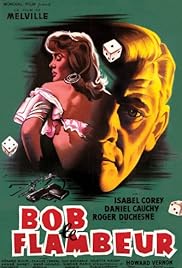
In front of every damn one of those movies, the cinema showed a preview of Bob le flambeur, a 1956 film by Jean-Pierre Melville that’s often pegged as the start of the French new wave. I saw that preview so many times that I could recite its voiceover: “…the story of a man who moves like a prince through the dark streets of Paris, gambling in back rooms until dawn. Then one day, down on his luck, he masterminds the biggest gamble of his life: the robbery of the Deauville casino…”

Almost forty years later, through my local library’s Kanopy subscription, I finally watched Bob le flambeur. I was expecting a heist film, but it’s really a character portrait with a heist attached. Bob doesn’t even come up with the robbery scheme until halfway through the movie, after we explore his relationships with a protégé, a young demimondaine, and a police inspector.

There are scenes of Bob walking his confederates through his robbery plan on a floor outline painted on a field, and of a safecracker at work. But to anyone who knows the rules of good storytelling, those scenes are a tip-off that we’ll never see the plan come off that way, and we don’t.

Instead, the movie is an homage to American gangster movies and what Melville’s colleagues dubbed film noir. Roger Duchesne has a ducal George Raft vibe at the center. Women, and the men who love them too much, prove to be the weak spots in the conspiracy. But in the end, it’s Bob’s character that matters.

06 October 2017

Choice Bits from M. T. Anderson

Entertainment Weekly’s interview with M. T. Anderson about his new novella, Landscape with Invisible Hand, focused on its timeliness and political overtones—which came as a surprise to the author. Here are some of his remarks, insightful as always:
I wrote the first version of it like four years ago at this point. Supposedly I had no idea what this political climate was. There is a health care element — like this kid has this weird disease, somehow alien-inspired disease, and his health care won’t cover it. And at the time I actually remember thinking “Oh, with the ACA going into effect, by the time this is published I bet that this will seem kind of backwards.” Like it would seem like a throwback. . . .

I think that the tension that was probably there in my mind — that I was expressing — was after the 2008 crash, suddenly a couple of years later, everyone is saying, “Look, the economy’s doing great!” But of course, the “economy” — that did not extend to about 95 percent of the population; 95 percent of the population was still in a horrible state. I didn’t think of this as I did it, but then it was immediately clear later: Even the fact that the wealthy now, literally, there is space between them and the rest of the population in this book because the wealthy are now hovering in aerial condos a mile above the Earth’s surface, with access to all this vuvv tech and all this alien tech and all this alien medicine and everything else, while the rest of us are falling around on Earth still. That is, in a sense, I feel also a great representation of how it feels right now. Kind of like a gap between that upper one percent and the rest of us. . . .

If you had talked to people 10 years ago to say that their book was somehow relevant to specific political events, it seemed really kind of embarrassing. It felt like that was a cop-out somehow. . . . there was a phase where dystopian fiction was in but it did not yet have that feeling of complete urgency, except for stuff like Cormac McCarthy. It was a little bit more fun window-dressing to suggest teen angst than it was about a truly political situation in some ways.
In an alternate universe, as the kids say, we’d still be talking about dystopian, apocalyptic near-future science fiction that way.

13 July 2017

What the New Spider-Man Comes Home to

Back in 2014, it was widely reported that Captain America: The Winter Soldier was a superhero movie crossed with a 1970s political thriller. That’s why the sight of Robert Redford, star of Three Days of the Condor, All the President’s Men, and Brubaker, in the film was so resonant.

In the same way, I think Spider-Man: Homecoming as a superhero movie crossed with a 1980s high-school romantic comedy. The sort of movie on which John Hughes made his name. The genre that such other talents as Cameron Crowe, Martha Coolidge, Amy Heckerling, and Savage Steve Holland contributed to.

In the midst of the usual superpowered action and angst, there are a lot of laughs about the culture of high school, as seen from the student perspective. Adults are either petty tyrants or ineffectual scolds (even Captain America). High-school rituals like the morning news bulletin, homecoming dance, and academic decathlon are both laughable and life-or-death important. Everyone else seems to be having more fun.

In many ways, the high school in Spider-Man: Homecoming is a welcome update to the schools in those earlier movies and in the original Spider-Man comics. Peter Parker attends a high school devoted to science and technology, so by older standards everyone’s already a nerd. His rival Flash Thompson isn’t the football captain; he just has a big mouth and sharp tongue. And the student body is very ethnically diverse.

Spider-Man: Homecoming doesn’t seem shy about its cinematic pedigree. The movie even includes a clip from Hughes’s Ferris Bueller’s Day Off, an iconic example of the genre. The soundtrack features the Ramones, the English Beat, and A Flock of Seagulls. The homecoming dance has an ’80s theme, which would be exotic for characters born in this century but is nostalgic for some of this movie’s target audience.

My friend Dan Mazur has said that he used to enjoy Spider-Man comics and their common theme of “With great power there must also come—great responsibility!” But eventually he noticed that almost every story came back to “With great power there must also come—great responsibility!” And he began to think that comics should find more to say. [More on that here.]

That’s not the theme of this Spider-Man movie, however. It’s not an origin story, as in Amazing Fantasy, #15. We don’t see Peter Parker bit by the spider, we don’t see him try pro wrestling, we don’t see him ignore the burglar who kills his uncle. At no point does he really think about tossing everything away or just showing off, as Peter has occasionally done in the comics and previous movies.

Instead, when Spider-Man: Homecoming starts, Peter is already determined to take on great responsibilities as a costumed crimefighter. Indeed, he’s too eager. The major moment of character growth is actually stepping away from big, flashy responsibilities in favor of staying home. The Homecoming subtitle refers to how the story immediately follows from Captain America: Civil War, the high school dance, and Peter’s decision to focus on his own neighborhood.

The main theme of this Spider-Man is thus the same as those earlier high-school movies: stay true to yourself and your real friends, and you’ll get through this.

16 November 2014

DC to Feed Nostalgia for Six to Twelve Years Ago

DC Comics executive Dan DiDio told USA Today that the company’s “Convergence” crossover event for next spring will return to older versions of its primary characters. “We’re picking up at points of their lives where we left them and finding out what’s gone on with them since then,” he said.

Closer examination at Comic Book Resources confirms that these stories hearken back to the company’s continuity before the “New 52.” But each tale seems designed to return its hero to a happy high point popular with his or her following. Back in June, the gossipy site Bleeding Cool heard from a creator that the upcoming project would be “a love letter to DC Comics fans.”

Thus, Wally West is not only the Flash once more, but he’s married to Linda and both their kids appear to have superpowers. (After 2010, only their daughter had powers.) In another nod to the domesticity of about eight years ago, Superman and Lois Lane are expecting a child.

Stephanie Brown will be back at Batgirl, with Tim Drake in his first Red Robin costume and Cass Cain as the Black Bat. That also reflects their situation in about 2010 (though we didn’t see much of Cass back then). Damian Wayne, who appears to be coming back in some form in the regular continuity, might well show up in one of these miniseries without ever having died.

“Convergence” thus gives DC a chance to “correct,” at least temporarily, recent developments that many fans vocally disliked, such as the murder of the Atom Ryan Choi and Roy Harper’s loss of both his arm and his little daughter.

Indeed, in some way, these series “correct” the entire “New 52” as they show the heroes fending off attacks from “Flashpoint versions” of other heroes; Flashpoint was a 2011 crossover presenting dystopic versions of the world which led to the “New 52.” The characters or versions of characters that disappeared in that transition have, the summaries suggest, been living under a protective “dome.”

I have particular questions about the Nightwing/Oracle title, to be scripted by Gail Simone. The teaser for the first issue says:
Dick Grayson and Barbara Gordon reevaluate their relationship under the dome (wedding!), but Flashpoint Hawkman and Hawkwoman attack, and everything changes.
For many fans, Dick and Barbara are meant to be together. But the last time they were talking marriage in DC’s regular continuity was back in 2006. So are they reevaluating from that perspective, or after all the events that happened between then and Flashpoint? If the latter, that means Dick has become Batman, and no one has successfully penned his decision to go back to being Nightwing. At least not yet.

23 September 2014

Finding Neverland Has a Lot to Answer For

In 2004 Miramax released Finding Neverland, with Johnny Depp playing a handsomer-than-real-life James M. Barrie, Kate Winslet as a more-widowed-than-real-life Sylvia Llewellyn Davies, and Freddie Highmore as one of her less-doomed-than-real-life sons.

It was a modern “prestige picture,” with a historical setting, literary roots, paeans to preserving childhood imagination, and a noble dying parent. All the odd aspects of Barrie’s relationship with the Llewellyn Davies family and of late-Victorian Britain were blurred away.

That movie made $116 million worldwide, more than four times its production budget. More important, it was nominated for seven Oscars and won one (for best score), which is what studios want in a prestige picture. Harvey Weinstein is now producing a Broadway musical based on it.

Two years later the Weinstein Company offered Miss Potter, starring Renee Zellweger as Beatrix Potter. Last year Disney (owner of Miramax) gave us Saving Mr. Banks, with Emma Thompson as P. L. Travers and Tom Hanks as Walt Disney; the company entered that deal to protect its brand, but the result was another prestige picture that distorted literary history.

There were, to be sure, earlier biopics about British children’s-book writers, such as Dreamchild (1985) with Ian Holm as Lewis Carroll and Shadowlands (1993) with Anthony Hopkins as C. S. Lewis. But those were about the contrasts between childhood literature and adult life, not about fantasy stories making everybody happy again.

It’s possible that Hollywood now thinks it’s run out of dead British children’s authors who are famous in the States. (Evidently E. Nesbit is not well known enough, and her solution to family troubles too worrisome.) The studios have therefore moved on to American children’s-book writers.

This week the Hollywood Reporter broke the news that New Line Cinema bought the script for Road to Oz, a biopic about L. Frank Baum. The writer, Josh Golden, has even been working with one of the Finding Neverland producers, Nellie Bellflower. (And somehow the team of Golden and Bellflower doesn’t seem like they would turn out an unflinching look at the human condition.)

The John Ritter TV movie The Dreamer of Oz (1990) already showed it’s possible to fit Baum’s life into the arc of a man prone to fantasizing who redeems himself through telling children’s stories. Oz proved its potential to generate international box-office success with Oz the Great and Powerful last year (and its potential to lay an egg with this year’s Legends of Oz: Dorothy’s Return). So this screenplay might actually get made.

Interestingly, New Line is part of the same Time Warner corporation that owns rights to the 1939 MGM movie. This biopic might therefore be able to use elements from that film, which Baum never saw, but which could trigger the requisite warm nostalgia from viewers who don’t know the real story.

15 April 2014

What Captain America Missed Around the World

At one point in the Avengers movie, Captain America is excited to finally recognize one of the pop-culture references people are throwing around: “Flying Monkeys.”

You see, Captain America was trapped in ice at the end of World War 2 and thawed out only recently. When I was a lad, “only recently” meant the early 1960s, which was no longer that recent, but the basic conceit was established.

The new movie series allowed the corporate storytellers to move the date of Cap’s thawing up to the twenty-first century. Chris Evans plays him as a refugee from the 1940s trying to keep up with modern times. He knows the MGM Wizard of Oz but not much since.

The new Captain America: The Winter Soldier movie carries on that theme by showing how Cap keeps a to-look-up list consists of topics he’s missed and needs to look into. These include I Love Lucy, the Moon landing, the Berlin Wall’s rise and fall, and someone named Steve Jobs.

However, As Comics Alliance reported, a Reddit user collected screenshots from different versions of Captain America: The Winter Soldier from around the world, showing that Marvel/Disney tailored the hero’s to-look-up list for different audiences.

For Russian audiences what’s self-evidently important about the last seventy years are Yuri Gagarin, Vladimir Vysotskiy, the USSR breakup, and Moscow Does Not Believe in Tears.

For South Koreans, it’s Dance Dance Revolution, Ji-Sung Park, Old Boy, and the 2002 World Cup in soccer.

For Mexicans, it’s the Chilean miners, Maradona’s “hand of God,” Shakira, and Neri Vela.

And so on. It would make an interesting social-studies lesson for teams to identify what all those variant items are, and why they’re as important to other culture as I Love Lucy is to ours. Every nation has a different perspective on space, it appears, and almost every nation but the US is mad about soccer.

14 April 2014

Reacting to “Kids React to…”

I grew up with dial telephones. The family of my best friend in first grade had a “princess” phone with a smaller dial in the handset, but that was as exotic as home phones got. Touchtone phones were confined to offices.

In fact, I grew up in a town that once had an exchange named “Woodland,” so a lot of the local numbers I dialed started 969- or 965-. I spent many seconds of my school years waiting for the dial to rotate almost the whole way back—and I’m never getting those seconds back.

Since dial telephones were already established when I was a kid, they seem indeterminably old to me. Yes, my mother had stories about something called a “party line,” which was clearly ancient, but I can easily accept dial telephones as historic.

I could therefore enjoy the “Kids React to Rotary Phones” video easily. Though these twenty-first-century kids are baffled by the old technology, they’re also smart and lively and often able to figure out the implications of that device once the video makers explain it to their incredulous ears.

The kids display those same qualities in “Kids React to Walkmans”, but there’s a sharper edge for me. Because I remember when the Walkman was new. And cool. And, like all widely used new technology, a cause for tsk-tsking social concerns. Yes, I understand that they’ve long been superseded by, well, phones. But they’re not really old, are they?

13 April 2014

Old Teen Titans for Old Fans

DC Comics made news a couple of weeks back by announcing the end of its Teen Titans series, and then last week by announcing the start of a new Teen Titans series. As to what was new—not that much. The team has had a small membership change, but nothing more significant than what happens regularly in superhero team stories.

Newsarama asked new writer Will Pfeifer, “As you start with a new #1 issue, what are your thoughts about relaunching the title? This team doesn't look that different from the last one — why the relaunch and new #1?”

To which the correct answer would be, “Why are you asking me? You know very well how editorially driven DC Comics is these days. You know that writers don’t decide on issue numbering. You know that for decades a #1 issue has been a way to sell extra copies and draw new attention to a title.”

But Pfeifer offers a game try by saying, “…that #1 lets the reader know that this isn’t just a continuation of the other series. Yes, the Titans are the same heroes, and no, we’re not going to kick things off with a year of origin stories, but we are heading in a new direction and exploring some new themes.”

Of course, he can’t say much about those new things because adventure comics depend on a series of surprises. And because they’re probably no different from the “new direction” at the end of any storyline and any writer’s tenure. One idea Pfeifer repeats a lot in this interview is that these Titans as teenagers are prone to overenthusiasm and mistakes. Will that resonate with teen readers and boost sales?

Former DC editor Janelle Asselin doesn’t think DC is even trying for that new audience. She unloaded on the cover for the new #1 issue, starting with how the image focuses one’s eyes on Wonder Girl’s breasts:
The problem is not that she's a teen girl with large breasts, because those certainly exist. The main problem is that this is not the natural chest of a large-breasted woman. Those are implants. On a teenaged superheroine. Natural breasts don't have that round shape (sorry, boys). . . .

A secondary problem is that no girl with breasts that large is going to wear a strapless top for anything, much less a career that involves a lot of physical activity. . . . we're one bounce away from a nipslip. On a teenager. In case you forgot that entirely relevant point.
Asselin also finds the cover to be lacking in visual coherence and perspective, full of distracting visual details from the paper airplane in the sky to the artist’s neon signature, and lacking the exciting action of previous Titans covers.

But the real lost opportunity in this relaunch, Asselin argues, is that DC’s aiming for an old audience instead of a new one.
You know who loves Teen Titans? People who enjoyed the early 2000s Teen Titans animated show, many of whom are female and many of whom are teenagers or young 20-somethings today. Market research could and does back this up. . . . Say a quarter of those fans actually tried a Teen Titans comic aimed at their demographic—you’re going to have a significantly higher number than the 26,000 copies Teen Titans is estimated to have sold in March. . . .

Virtually all of DC’s New 52 books appear to be aimed at the exact same demographic: Males 18-39. And this cover is made for that demographic. It shows that, once again, DC is relaunching a book with no thought to targeting wider demographics or a new audience. This is not a cover you run if you’re trying to appeal to teenagers, and it’s especially not going to appeal to teen girls.
That said, in one way DC is clearly pulling back from its ’90s-comics-inspired “New 52” revision and trying to appeal to the Titans’ TV audience: Gar Logan as Beast Boy is once again green and elfin, rather than red and badass.

01 December 2013

More Retrospective Than Retroactive

A while back I looked at DC Comics’s Legacies miniseries, a summary of its 1986-2011 superhero universe’s history. Just after Legacies the company announced a line called DC Retroactive, pitched as exercises in nostalgia.

Editor Ben Abernathy told Newsarama that “the opportunity to revisit that era, with the creators who made it great, is a welcome change from everything else going on in the industry these days.” It was almost an explicit admission that DC’s audience had become middle-aged folks chasing memories of their early teens.

That announcement ran in mid-April 2011. At the end of May, Newsarama was running breathless stories about DC’s “New 52,” which replaced the latest continuity with a new one. That news took up all the attention of comics fandom and critics, leaving little for the DC Retroactive magazines when they came out. I don’t know if this fact is at all pertinent, but Abernathy is no longer with DC Comics.

The idea behind DC Retroactive was to publish stories in the style of the ’70s, ’80s, and ’90s from creators who had worked on the properties then. There were triads devoted to Superman, Batman, Wonder Woman, the Flash, Green Lantern, and the Justice League. (There was no Teen Titans equivalent, but Marv Wolfman and George Pérez’s finally-completed Games would push similar buttons.)

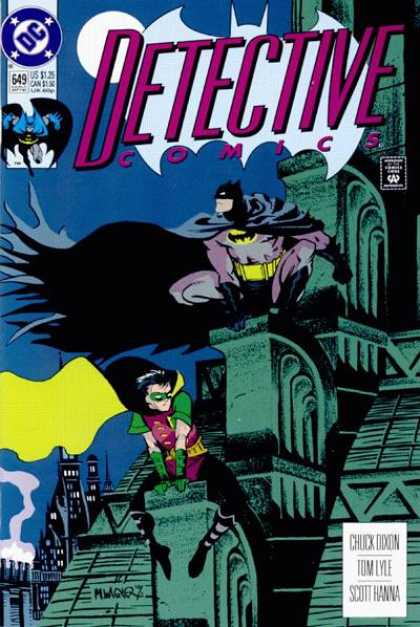
The only DC Retroactive book to feature a Robin was the 1980s Batman issue. It was created by Mike W. Barr and Jerry Bingham, collaborators on the Batman: Son of the Demon graphic novel from 1987. But Barr’s story has more connections with Detective Comics stories he created with Alan Davis featuring a young Jason Todd.

Thus, as in Barr’s issues of the digital Legends of the Dark Knight, we see a Batman who calls Robin “chum” and shouts to him not to look at one of the villains kills another. The bat-cave’s criminal files are actually file cabinets.

Robin adds puns to a fight scene and needs to sit on a Gotham phone book to drive the Batmobile. It would have been nice to see Davis‘s small, spindly Robin in these scenes instead of Bingham’s bigger, tougher-looking version.

Barr’s DC Retroactive story is also a sequel to his Year Two series from 1987, set before any Robin. (A previous sequel, Batman: Full Circle from 1991, had brought Dick Grayson into the story.) All these stories featured a murderous vigilante named the Reaper, a role taken on by a series of people.

Year Two has been controversial for many Batman fans because it shows Bruce Wayne thinking about using a gun in his war on crime—and not just any gun but the gun that killed his parents. The fact that the story ends with him deciding against that method doesn’t stop many readers from declaring that action completely out of character.

At the end of its 1994-95 Zero Hour crossover, DC apparently repudiated the Year Two story. Yet here the Reaper is back. The DC Retroactive: Batman—The ’80s comic book even reprints the story that ends with Bruce holding up the old gun. This magazine was thus an exercise in reclamation not just for old readers but for an old writer.

(As I composed this posting, I discovered that weekly Robin essays comprise this website’s discussion of Jason Todd. Needless to say, I agree with most of the insights there, but I disagree on reprinting them without permission, credit, quotation marks, or links.)

30 October 2013

The Editorial Wee

The New York Times obituary for Sid Yudain, rounder of the Capitol Hill newspaper Roll Call, contained an anecdote that seems like it should be in a children’s book—except that no child today would understand it.

Yudain was the seventh of eight children growing up in Connecticut in the 1920s and ’30s.
“For some reason or other, we were all spirited kids, but we didn’t have real fights,” Mr. Yudain recalled in an interview with Roll Call in 2005. “When we got mad at each other, we published these newspapers. We had a little Remington portable typewriter — I guess it was one of the first ones that came out, and we all learned how to use it, even when we were really small — and we published these newspapers, writing editorials against each other instead of staging fists or rocks or something.”
Typewriters? Household newspapers? Why go to all that trouble when you can use the internet to tell the whole world about your yucky sibling?

07 July 2013

The Batman ’66 Comic: Retro on the Digital Edge

I wasn’t a big fan of the 1960s Batman television show while growing up. I caught a few episodes, and, though I didn’t recognize the deliberate camp, I caught enough to sense that someone might be having a laugh at my expense.

So my response to the new Batman 66 comic isn’t colored by nostalgia—not by nostalgia for Adam West, that is. On the other hand, I can’t deny liking the return of straightforward heroes v. villain action, bright colors, and clear action from artist Jonathan Case. Writer Jeff Parker’s recreation of the Dynamic Duo’s earnest dialogue is just fine as well.

I recommend reading this comic in its digital form. There are some awkward signs that it’s been prepared for both digital and print publication (word balloons in different sizes, panels that look overly enlarged). But the digital version from ComiXology offers a lot that the print version won’t.

I previously wrote about the digital techniques that DC was touting, asking whether they’d amount to anything more than sound effects over the artwork or what Thrillbent was already doing. They do.

Yes, there are big sound effects popping up over the artwork. Yes, like Thrillbent’s stories Batman 66 adds balloons to panels, adds panels to pages, recolors art, or changes backgrounds while leaving other parts of the screen intact—something print comics can’t do. But the ComiXology platform also lets Batman 66 slide from one panel to the next.

And this story really milks those digital tricks. The first installment of Batman 66 is 95 screens. Some of those screens have multiple panels, some the same panel you just saw with a new detail. But that’s over 90 times something new has popped up in front of your eyes. And Parker’s story is just halfway done. [CORRECTION: Actually just one-third done.]

Even with those new digital tricks, however, the comic looks old-fashioned—on purpose. Case told the New York Post: “I wanted it to scream ‘retro’, so I'm doing some things to emulate old comics (mis-registration, screen tones, and punchy colors).” You can see some of those techniques, looking like mistakes, in his portrait of Robin above.

As a sign of Case’s attention to detail, look at Robin’s legs. While Mike and Laura Allred’s cover for the print edition (not part of the first digital bundle) colors Robin’s legs the same pink as his bare arms, Case shows him in the pallid tights that Burt Ward wore.

31 March 2013

Is One’s Choice of Best Robin Generational?

Chris Sims of Comics Alliance (and, earlier, the Invincible Super-Blog) posted a very good essay this week on the questions: “Who is or was the best Robin? What is the Best Robin moment in Comic Book History?”

Ultimately Sims decides that what defines Robin is helping Batman, and by that measure he chooses Tim Drake as the best. That approach allows him to praise Dick Grayson for having been Robin and leaving that role to become a major character in the DC Universe. He also finds the best Robin moment when Carrie Kelly fully adopts the role, not through any feat of acrobatics or detection but simply in assuring Batman that he has help.

I see only one major flaw in the essay, and it’s part of Sims’s argument in favor of Tim Drake:

Tim's not in it for himself, and a lot of that comes from the simple fact that he doesn't need to be. When he first appears, he doesn't have a tragedy that defines his past and drives him to seek vengeance. In fact, he has the exact opposite: It's not really exaggerating to say that he's the single most privileged, well-adjusted character in the entire Batman mythos. He's rich enough to live more-or-less next door to Wayne Manor, he has two loving (and living) parents. The one thing that drives him is that he's a kid who loves Batman.
But why does Tim (like Sims) love Batman? A big part of the reason, I think, is that he doesn’t have “two loving (and living) parents” with him anymore. When Tim first connects with Batman and puts on the Robin suit, his parents Jack and Janet have parked him at a boarding school while they travel the world doing business deals and sniping at each other. Tim’s interest in Dick Grayson isn’t fueled just by having met the young circus flyer on a bad night; he also hungers for a family. His interest in Batman isn’t just driven by justice; it’s also a desire for an admirable father in his life.

Soon after Tim starts interning in the bat-cave (though that was before the term “interning” had escaped the confines of the medical field), his mother is killed and his father paralyzed by a criminal in Haiti. DC Comics planned for Jack Drake to die soon as well, making Tim’s trajectory the same as the preceding Robins: orphaned by crime, taken in by Bruce Wayne. But scripter Chuck Dixon kept arguing (and demonstrating) that there was more drama in keeping the man alive.

Instead, for more than a decade Tim juggled life with his father and life with Batman, which set him apart from past Robins. And it’s tough to say which man caused Tim more trouble. Jack Drake fell in love with his physical therapist Dana and married her, moved the family out of Gotham and then back, sent Tim to another boarding school, lost all his money, found out about Tim’s double life, and so on. An underlying theme of the Robin comics then was that Tim was actually the more dependable and responsible of the Drakes, the one who was really looking after other people.

In other words, Tim still needed the strong father figure of Batman in his life, whether he could admit that or not. That’s why I don’t think Tim Drake became Robin just for justice. He also had private psychological needs compelling him to take on that role. (Another underlying theme, stronger in the 2000s, was that Tim was also often more mature than Bruce Wayne.)

I also suspect Chris Sims has a particular perspective on the Robins question based on his age—or more particularly on the age when he was reading superhero comics most avidly. Now I recognize that as a professional comics writer with a specialty in Batman he’s still reading superhero comics avidly, and that he’s consumed and considered the canon published back before he started. Nonetheless, I think that the stories one read as a child and young adolescent exert the strongest emotional tug and establish one’s expectations.

In another essay Sims has stated that he was twelve in 1994 when he started to collect back issues. In other words, he was at that crucial age when:
  • Tim Drake was established as Robin. Furthermore, by then Tim had his father and stepmother at home (hence the “loving parents” understanding).
  • Jason Todd was established as the dead Robin, the possibly homicidal Robin, the Robin that haunted Bruce Wayne. As I’ve written, this characterization didn’t solidify until after 1989.
  • Dick Grayson was established as Nightwing, the former Robin, but the New Titans were past their glory days.
  • Carrie Kelly was a possible future Robin who appeared in one revolutionary volume.
And it’s those figures that dominate Sims’s essay.

The Robin that came before—the first, red-haired Jason Todd—gets less than a sentence. Of the Robins that came later, Stephanie Brown is dismissed with a hand wave (“Stacy?”). Jason Todd’s return from the dead is treated as an unnecessary, unfortunate change that doesn’t affect his symbolic significance. Damian Wayne gets a longer analysis, and a good one, but it still seems clear that Sims’s heart is back in the 1990s.
Another essayist might conclude that Dick Grayson is the best Robin because he established the mold not just for that character but for all kid sidekicks in superhero comics; because he provided the emotion and humor that the first year of Batman stories lacked; because he was popular enough to appear on more DC covers of the 1940s than any other character; because his relationship with Bruce Wayne offered the only ongoing emotional depth in Batman comics for two decades; because he set the standard all subsequent sidekicks aspire to. And that reader probably read the comics of the 1940s and 1950s at a crucial age.

Yet another fan might argue that Dick is the best Robin because Batman could rely on him whether they were fighting gangsters or extraterrestrials; because he symbolized the best of America’s youth but would, both Alfred and Earth-2 agreed, grow up to be a crime-fighter; because he had no powers but was still the Teen Titans’ leader and badass; because as “Teen Wonder” he offered DC Comics a way to gingerly explore youth culture. And that reader probably read the comics of the 1960s and 1970s, and watched the ABC TV show, at a crucial age.

As I’ve written several times, my first prolonged exposure to superhero comics was the Batman: From the ’30s to the ’70s collection, which emphasized the stories between Robin’s arrival in 1940 and the “New Look” of 1964. And the last superhero comics I was reading in my late teens was the New Teen Titans series in which Dick Grayson made the leap to become Nightwing.

So for me that character wasn’t always a former Robin, and the goofy, shallow stories of the 1950s aren’t just quaint embarrassments—though they were juvenile adventures that Dick Grayson’s character helped lead the company away from as he matured in the early 1980s. Sims’s analysis is rooted in DC’s post-Crisis universe; my expectations were established before the Crisis struck.
For other readers, younger than both of us, Stephanie Brown’s brief period as Robin might loom much larger because it came at a crucial time in their own exploration of Batman comics, and Jason Todd might not be the dead Robin but the Robin who returned from the dead and is still not fully part of the family. Some such readers might prefer those other Robins, arguing that they had so few of Tim’s advantages (and so little of his support from the publisher and the fans he was clearly designed to reflect).

Even younger readers might have just had their expectations shaped by the presence of Damian Wayne for the past few years, seeing him as the best Robin (just as he’d want). Readers whose notions are being shaped by the “New 52” universe are also seeing quite a different Tim Drake, with a different family history and different challenges to overcome. So they may well come to a different conclusion about the best Robin.

I’m not saying that everyone of Sims’s comics-reading generation would agree with him while his arguments would fail on everyone else. I just think that his essay and its conclusions reflect the age when comics meant the most of him, and probably resonate most strongly with people of similar experiences.

Because my own experience starts before Dick Grayson was a former Robin, I’m inclined to see more of the essence of Robin in him, and to see Tim Drake as striving always to match that nearly Platonic model (which Dick might be the first to acknowledge he himself didn’t always attain).

But I’ve become very fond of the first Tim as well, and wouldn’t want to give up either character. As I wrote back here, I imagine Tim would agree that Dick was the best Robin and Dick would say Tim was.

Of course, Sims might argue that Tim’s ability to win over a crotchety reader who grew up with Grayson is actually evidence that Tim deserves top honors.

(And the best Robin moment of all time? It’s in The Dark Knight Returns, to be sure. But it’s when Carrie is ready to hold off Superman with an effin’ slingshot.)

21 March 2013

The Real Sources of Oz the Great and Powerful

Yesterday I noted how Oz the Great and Powerful credits “the Works of L. Frank Baum” as its source but doesn’t actually draw much from that source—and what it does draw is almost entirely filtered through MGM’s Wizard of Oz from 1939.

That beloved movie is of course the main source for the new one. Oz the Great and Powerful is quite obviously an attempt to create a prequel. Yet the new movie’s makers didn’t have the rights to do so, so they played an odd game of tiptoeing to the edge of fair use and stopping just an inch away from infringement.

Thus, MGM’s Wicked Witch of the West is green with a black gown, hat, and broomstick. (W. W. Denslow’s Wicked Witch is tan with an eyepatch, jacket and patterned skirt, and umbrella.) Sam Raimi and his team couldn’t exactly copy the previous movie, so they made the witch a different shade of green.

The New York Times reported on how Disney’s lawyers advised the moviemakers to alter one Munchkin’s whiskers to be less like those in the 1939 movie. But they’re still the same singing, dancing, particolored little people of that movie, not the dignified farmers all in blue of Baum’s book.

Similarly, the end of the yellow brick road goes in circles, but not in a spiral. There are brightly colored horses grazing outside the Emerald City, but they’re several colors at once instead of in succession. Glinda’s bubbles work a little differently. The green Wicked Witch says “my pretty one” instead of “my pretty.” Oz produces the illusion of a giant heading speaking from a cloud of smoke, but it’s a different giant head. And there are no ruby slippers or silver shoes.

At times, finding a way to evoke the MGM movie without directly copying some detail still under copyright produced new creativity. The winged baboons are even more frightening than MGM’s flying monkeys. The Emerald City’s towers are reminiscent of those from the older movie, but more angled. The landscape of Oz has a verticality that was hard to portray on 1939 sound stages, much easier with CGI.

At other time, the strain of aping the MGM movie is too great. There’s a scene at the end of the Wizard conferring gifts on his companions, but his remarks aren’t nearly as interesting as the dialogue Yip Harburg wrote for Frank Morgan in the equivalent scene, and most of those characters never asked him for stuff, so the scene has no greater meaning than triggering audience nostalgia.

Plotwise, the result doesn’t hang together. Like the 1939 film, the new movie’s screenplay provides for people whom Oz knows in Kansas to reappear as other characters in Oz. Yet there’s no hint that Oz is dreaming, as Judy Garland’s character was. Nor does Oz recognize the resemblance between his Kansas girlfriend and his Oz girlfriend.

And that girlfriend points to the second big influence: Wicked. (The hit stage show, not Gregory Maguire’s novel.) Again, the moviemakers didn’t have the rights to make Wicked, and they had a very different conception of the Wizard. But the screenplay is designed to set off the same nostalgic neurons that produce applause during the stage play, whenever the story foretells some detail from the movie: a cowardly lion, a scarecrow, and so on. And of course the Wicked Witch of the West starts out as sympathetic.

One of the biggest changes in Wicked’s journey from book to stage was the inclusion of a happy ending for Elphaba, with a boyfriend. Oz the Great and Powerful likewise ends with Oz and Glinda paired off. There’s no hint of that in the MGM movie, even less than none in Baum’s books, but apparently Hollywood demands a romantic ending. (To be fair, Baum inserted such pairings in most of his stage and screen adaptations of his books, and imported them back into books he based on his scripts.)

A third, smaller influence is Disney’s theme park and merchandising divisions. When the Wizard arrives in Oz, his balloon lands in a raging river, and we’re then treated to a water slide in 3-D. The climax involves fireworks bursting over the turreted city. I was pleased that Mari Ness also noted the similarity between that action and Disney’s nightly fireworks display. And the corporation already has a ton of collectibles on sale.

Indeed, the main takeaway from Oz the Great and Powerful isn’t a great screenplay or powerful acting (hard to do without a great screenplay), but spectacle and nostalgia. On that level it succeeds—quite well enough to make hundreds of millions of dollars. But I doubt it will have the real emotional impact as any of its predecessors and influences.

03 February 2013

What Legacies Left Us

DC Universe: Legacies was a comics series published in 2010-11 during an apparent wave of nostalgia at DC Comics. It was scripted by Len Wein, a top editor at the house in the early 1980s, and drawn by a stellar cast of established artists: Joe and Andy Kubert, Dave Gibbons, José Luis García-López, George Pérez, Jerry Ordway, Dan Jurgens, Brian Bolland, and so on.

As the series ended, DC trumpeted several single-issue stories about its top characters created in the style of the 1970s, 1980s, or 1990s, using talent that had worked on the characters in those decades. Those magazines had the umbrella label of DC Retroactive.

Legacies retold the entire history of the DC Universe as it then existed—the universe that had been created by merging several parallel continuities at the end of Crisis on Infinite Earths in 1986 and remade more gently at ten-year intervals in the Zero Hour and Infinite Crisis crossovers. For the purposes of the weekly Robin, the series notes the debut of the first two Robins, the first two versions of the Teen Titans, and Nightwing, but shows little of Tim Drake, Young Justice, or later Titans groupings.

Wein retold that super hero history through the eyes of a kid from Metropolis who grew up to be a police officer and detective. That approach was quite like the way Kurt Busiek and Alex Ross structured Marvels, a 1994 retelling of Marvel Universe highlights through the eye of a news photographer.

Legacies’ main storyline is thus a recap of the company’s mythos—just enough for new fans to figure out how events fit together and a trip down memory lane for folks who’d read the stories originally. Wein didn’t try to reconcile or “retcon” gaps in the continuity, which left such glitches as Depression kids becoming a young couple in the late 1980s. (Hey, it’s comics!) With so much “history” to get through, there’s a high panel-per-page ratio reminiscent of earlier decades, but not much chance for deep drama or characterization unaided by reader nostalgia.

Wein added eight-page back-up stories about some of the odd corners of the DC Universe: the World War 2 soldiers, the sci-fi adventure teams of the 1950s, Jack Kirby’s New Gods, and so on. Shoved to the back of the collected edition, those little tales might be the most fulfilling because they’re complete tales in themselves, not squeezed to rush on to the next event that might change the entire world.

Where does the volume leave readers? For decades the narrator collects accounts of those costumed heroes on pulp paper, filing them in plastic—just like DC Comics’s most devoted fans. And the final pages reveal that he’s an old man in a nursing home, repeating those stories every night for an uninterested and unbelieving audience of attendants. Hardly the portrait readers would want of themselves.

Furthermore, just after this series ended, DC had announced that the continuity it recounts would be set aside in favor of a new variation. Was Legacies therefore a test of whether the nostalgia market was big enough to sustain the operation? Was it a sincere attempt to give new readers a way to “jump in” and catch up to the existing universe, only for the company to decide it had to do something more dramatic? Or was it always designed to be what it and DC Retroactive became, a last hurrah for that continuity before the company swerved onto a new path?

08 December 2012

Argo Nots

The movie Argo is a triumph of production design, recreating the look and sound of Teheran, Washington, and Hollywood in 1980. Which is absolutely necessary for the picture to work since the story is so outlandish that without complete realism in everyday details it would seem like Hollywood bullshit.

Director Ben Affleck was nine years old when the Iran hostage crisis began. He was thus recreating the milieu of his childhood, from new Star Wars action figures to grown men in three-piece suits. Early on there’s a scene in which his character watches television, and he made sure to show us the man standing up and clicking the dial from one VHF station to another. Every time the scene shifts to an office, we hear the busy sound of a Selectric typewriter. With no answering machines in sight (though they were on the market), the story’s telephone connections become even more tenuous.

During the closing credits, the filmmakers show off their work, pairing period photographs of the Iranian Revolution or decaying Hollywood with their careful recreations of the same sights.

Those credits also show the fake passports of the real American diplomats at the center of Argo’s story, and their haircuts really did look like that. Again, such details helped immensely to make them seem real since we see little of those characters beyond their plight. Affleck’s own performance as CIA “exfiltration” specialist Tony Mendez consists mainly of looking serious in a beard. The acting energy comes from the pacing and the supporting cast of pros: Alan Arkin, John Goodman, Bryan Cranston, and Victor Garber.

It’s disappointing, therefore, to learn that the movie’s realism in little things masks big liberties with what actually happened. The movie’s basic concept is true: Mendez and the CIA used the production of a science-fiction epic in turnaround called Argo as cover to fly six American diplomats out of Teheran.

But the exciting scenes—the last-minute interventions, the Republican Guards tumbling to what’s happening, the airport chase—are completely fictional. The Tony Mendez character arc, from separation back into his family’s bosom and from professional exile back to being a CIA hero, also doesn’t seem to reflect reality. Argo is a movie about Hollywood bullshit proving useful in the real world that’s actually built of Hollywood bullshit.

In real life, all of the challenges in the movie’s tense, exciting third act had already been cleared away through the least exciting activity American filmmakers can probably imagine: careful, quiet work by Canadian bureaucrats.

One visual element of the real story that didn’t make it into Argo consists of Jack Kirby’s designs for the planned epic and its related theme park, Science Fiction Land. This PDF from the Kirby Museum uses Kirby’s drawings to illustrate interviews about that grand project. The image above is the original announcement that the movie would start filming soon.

12 September 2012

Our Anachronistic Equine Vocabulary

There’s no Y in “linchpin.” Lots of people have taken to spelling the word with a Y in place of the first I because we hardly ever see linchpins. Those used to be very important because they held wheels onto the axles of wagons. I guess people are more used to seeing variations on the word “lynching.”

There’s no G in “free rein” or “tight rein” or “to rein in someone.” Those are metaphors derived from a horse’s reins, but people now seem to interpret them as related to a monarch’s reign and add the G. That’s what linguists have lately taken to calling eggcorns, attempts to make better sense of a word when folks don’t know its original derivation or context.

Those terms have become unfamiliar because they grew out of a horse-based economy. We no longer have the daily context to remind us of their original usage and meaning.

Similarly, people are now saying they’re “straddled with” problems instead of “saddled with” them because horse saddles are no longer part of our lives. People wonder what “riding roughshot” means because we no longer have to wonder about having a horse “roughshod”; that refers to horses shoed with the nailheads sticking out a little for extra traction, and I had to look it up myself. “Souped up” started as racing-track slang; now some people are using “suped up,” probably inspired by Superman.

Our language has lots of terms derived from the horse-based economy. Some are obvious (looking a gift horse in the mouth), others less so (long in the tooth), and some on their way out through obscurity (kick over the traces).

Those phrases survive like the traces of our physical equine infrastructure. In the center of my home town there’s a flower planter at the ideal height for a horse—because it was originally a fountain where drivers and riders could water their animals. But most of the unneeded parts of that infrastructure—small ponds, hitching-posts, stables, ferriers’ shops—have disappeared, swept away like manure from the streets.

As technological change has sped up, we’re probably making once-familiar phrases into anachronisms faster than ever. Kids today have never touched a telephone or television “dial.” A friend told me about having to explain to a college student what “drop a dime” meant. When I was a lad, an “E ticket” meant you could go on the very best rides at Disneyland; now it’s what I don’t bring to the airport. Soon people may be interpreting “champing at the bit” to refer to data.

TOMORROW: The carrot and the stick.

(Image above from the Boston Public Library’s Flickr stream.)