Showing posts with label SERIES Wicked Years. Show all posts

25 July 2025

Marking the Many Media of Oz

Tori Calamito, host of the Oz Vlog, is doing a live online event called “Defying Gravity: The Evolution of Oz from Page to Stage to Screen” for local libraries.

The event description says:
This exclusive Zoom program offers a rare glimpse into over a century of Oz storytelling, from L. Frank Baum’s original book series to the latest Broadway productions and upcoming film. The Oz Vlog will share treasures from her extensive memorabilia collection while exploring how the Land of Oz has evolved across different media. Whether you’re a longtime fan of the 1939 MGM classic, a Broadway enthusiast who’s seen Wicked multiple times, or curious about the upcoming Wicked: For Good, this program has something magical for everyone.

Come prepared to be amazed by the depth and breadth of Oz’s influence on entertainment, and leave with a deeper appreciation for the wonderful world that has inspired some of the most popular characters of all time. This program is sponsored by The Oz Vlog who is donating her time to this event!
This event will take place on Wednesday, 30 July, starting at 7:00 Massachusetts time. Folks can register for this event through the Burlington Public Library.

In a similar vein, on Saturday, 16 August, Worldcon in Seattle will feature a panel discussion on “Oz: America’s First Multimedia Franchise,” organized and moderated by Eric Gjovaag.

That description is:
Known around the world for the famous film adaptation, The Wizard of Oz is back in everyone’s minds thanks to the current two-part Wicked movie. But Oz started life as a popular novel, which then spawned a Broadway musical, a series of other books, early silent movies, and more. Oz is a franchise that always grows and changes with the times. Learn more about the origins of The Wizard of Oz and how it has been reinterpreted on stage, television, and computers and in movies, comics, toys, games, and more from 1900 to the present day.
Panelists are A. J. Hackwith, J.R. Dawson, and Terri Ash. Eric will also moderate a panel the next day on “How The Wizard of Oz Has Shaped Science Fiction.”

18 March 2014

Oz and the Riverside Orchestra

On 13 April, the University of California at Riverside Orchestra will offer a program titled “American Fairy Tales,” celebrating the life and work of L. Frank Baum.

The orchestra’s description says:
We celebrate The Wizard of Oz and its creator, L. Frank Baum: the world premiere of Tim Labor’s A Royal Pair, musically telling two tales by Baum, and concert suites from The Wizard of Oz and its two offspring Wicked and Oz the Great and Powerful. The brilliant Johanna McKay returns as narrator.
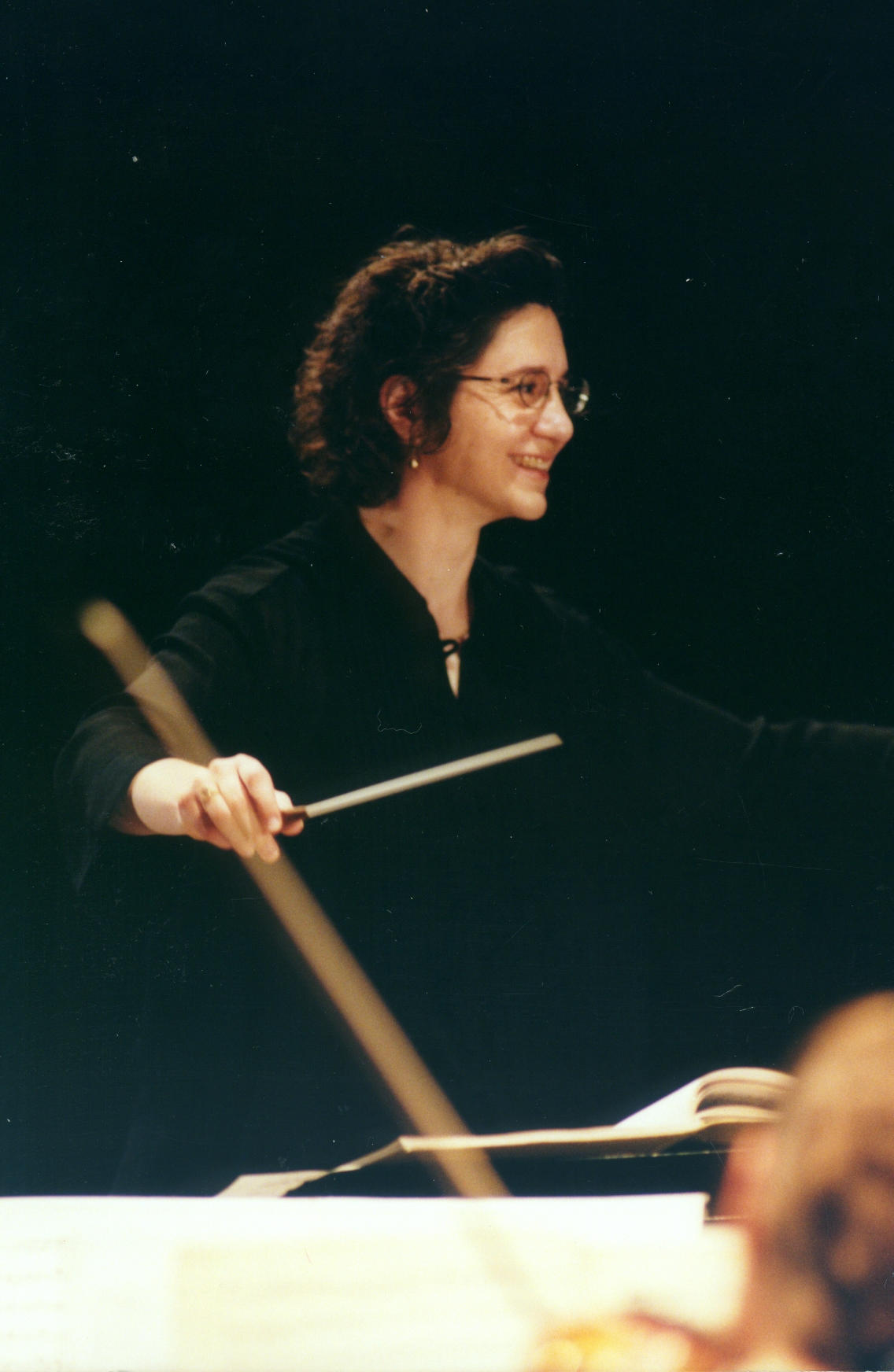
Ruth Charloff (shown here) will conduct.

On Facebook, Jane Albright reports that A Royal Pair is based on Baum’s “The Queen of Quok” from American Fairy Tales—and perhaps a second tale? Composer Tim Labor is on the UCR music faculty; on Facebook he mentioned only one tale, so perhaps plans changed.

I mention this not because I know any of the folks involved or expect to attend a concert on the other side of the country. Rather, it’s because I attended symphony concerts in Riverside while still in the womb, and my mother introduced me to the Oz books.

21 March 2013

The Real Sources of Oz the Great and Powerful

Yesterday I noted how Oz the Great and Powerful credits “the Works of L. Frank Baum” as its source but doesn’t actually draw much from that source—and what it does draw is almost entirely filtered through MGM’s Wizard of Oz from 1939.

That beloved movie is of course the main source for the new one. Oz the Great and Powerful is quite obviously an attempt to create a prequel. Yet the new movie’s makers didn’t have the rights to do so, so they played an odd game of tiptoeing to the edge of fair use and stopping just an inch away from infringement.

Thus, MGM’s Wicked Witch of the West is green with a black gown, hat, and broomstick. (W. W. Denslow’s Wicked Witch is tan with an eyepatch, jacket and patterned skirt, and umbrella.) Sam Raimi and his team couldn’t exactly copy the previous movie, so they made the witch a different shade of green.

The New York Times reported on how Disney’s lawyers advised the moviemakers to alter one Munchkin’s whiskers to be less like those in the 1939 movie. But they’re still the same singing, dancing, particolored little people of that movie, not the dignified farmers all in blue of Baum’s book.

Similarly, the end of the yellow brick road goes in circles, but not in a spiral. There are brightly colored horses grazing outside the Emerald City, but they’re several colors at once instead of in succession. Glinda’s bubbles work a little differently. The green Wicked Witch says “my pretty one” instead of “my pretty.” Oz produces the illusion of a giant heading speaking from a cloud of smoke, but it’s a different giant head. And there are no ruby slippers or silver shoes.

At times, finding a way to evoke the MGM movie without directly copying some detail still under copyright produced new creativity. The winged baboons are even more frightening than MGM’s flying monkeys. The Emerald City’s towers are reminiscent of those from the older movie, but more angled. The landscape of Oz has a verticality that was hard to portray on 1939 sound stages, much easier with CGI.

At other time, the strain of aping the MGM movie is too great. There’s a scene at the end of the Wizard conferring gifts on his companions, but his remarks aren’t nearly as interesting as the dialogue Yip Harburg wrote for Frank Morgan in the equivalent scene, and most of those characters never asked him for stuff, so the scene has no greater meaning than triggering audience nostalgia.

Plotwise, the result doesn’t hang together. Like the 1939 film, the new movie’s screenplay provides for people whom Oz knows in Kansas to reappear as other characters in Oz. Yet there’s no hint that Oz is dreaming, as Judy Garland’s character was. Nor does Oz recognize the resemblance between his Kansas girlfriend and his Oz girlfriend.

And that girlfriend points to the second big influence: Wicked. (The hit stage show, not Gregory Maguire’s novel.) Again, the moviemakers didn’t have the rights to make Wicked, and they had a very different conception of the Wizard. But the screenplay is designed to set off the same nostalgic neurons that produce applause during the stage play, whenever the story foretells some detail from the movie: a cowardly lion, a scarecrow, and so on. And of course the Wicked Witch of the West starts out as sympathetic.

One of the biggest changes in Wicked’s journey from book to stage was the inclusion of a happy ending for Elphaba, with a boyfriend. Oz the Great and Powerful likewise ends with Oz and Glinda paired off. There’s no hint of that in the MGM movie, even less than none in Baum’s books, but apparently Hollywood demands a romantic ending. (To be fair, Baum inserted such pairings in most of his stage and screen adaptations of his books, and imported them back into books he based on his scripts.)

A third, smaller influence is Disney’s theme park and merchandising divisions. When the Wizard arrives in Oz, his balloon lands in a raging river, and we’re then treated to a water slide in 3-D. The climax involves fireworks bursting over the turreted city. I was pleased that Mari Ness also noted the similarity between that action and Disney’s nightly fireworks display. And the corporation already has a ton of collectibles on sale.

Indeed, the main takeaway from Oz the Great and Powerful isn’t a great screenplay or powerful acting (hard to do without a great screenplay), but spectacle and nostalgia. On that level it succeeds—quite well enough to make hundreds of millions of dollars. But I doubt it will have the real emotional impact as any of its predecessors and influences.
14 August 2012

Critical Study of an American Myth

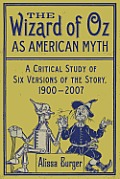
On his Tales from the Bookworm’s Lair blog, J. Andrew Byers just reviewed The Wizard of Oz as American Myth: A Critical Study of Six Versions of the Story, 1900-2007, by Alissa Burger, just published by McFarland.

Burger examined six versions of the story originally created by L. Frank Baum. In chronological order, they are:
The end of that sequence almost defines “anti-climax,” doesn’t it?

Burger’s book appears to hit on a lot of the current concerns of academia: gender, race, and adaptation and influence, as well as Baum’s overt themes of the value of “home” and the role of magic. Not that there’s anything wrong with those concerns, but in other times I might expect an academic critique to address economic classes, nature versus civilization, or stylistic tropes.

Byers writes:
Burger says she wants to examine gender in Oz. Fine and dandy. But as a historian of masculinity (among other things), I am particularly sensitive to “gender” being merely a code phrase for “women” or “femininity.” What we’re lacking here in Burger’s analysis is a look at masculinity in Oz. Men do, after all, possess gender, just as women do.

This is a significant omission, since all of the male characters in the story suffer from significant “lacks” (brains, heart, courage, magic) that the women in the story possess in abundance. None of them is what we might think of as a “traditional” male figure, in Baum’s time or our own. In other words, this is a clear area for further study and represents a missed opportunity in this one.

There are also a few additional areas I’d have liked to see Burger tackle. For example, in her discussion of magic, there’s almost no mention of the pivotal character of the Wizard in any of the texts/productions. He’s a self-proclaimed “humbug” without any access to real magic (at least in the first book), but everyone thinks he’s intensely magical. When coupled with the fact that he’s also the only male magical practitioner we encounter in Oz, I think there’s room for an interesting discussion here.
Byers notes that Burger doesn’t discuss Baum’s sequels, and his parenthetical remark reminds us that he knows those books show the Wizard learning real magic. He remains subordinate to Glinda, his tutor, and Ozma, his ruler, but also appears to be more ingenious than either. Because he’s older? Because he’s male? Because he had to get by for years without magic? Because he’s American? Or perhaps just because of the characters’ individual personalities? More grist for the analytical mill.

18 January 2012

Historicity as a Difference Between Baum’s Oz and Maguire’s Oz

Last month I had the pleasure of hearing Gregory Maguire interviewed about Out of Oz and his entire Wicked Years series at the Cambridge Forum. There’s an edited recording of that conversation here at the Forum Network.

Among other things, Maguire described his childhood experience with L. Frank Baum’s Oz books. His local library had only the first two: The Wonderful Wizard of Oz and The Marvelous Land of Oz. He read in Edward Eager’s novels that there were more, but he never saw them. Maguire therefore went on to Narnia, Prydain, Earthsea, Middle Earth, and other fantasy worlds.

As an adult studying children’s literature, Maguire returned to the Baum novels he had missed. “When I finally got to Oz,” he said [according to the best notes I could take at the time], “I found they were a lot thinner than the first two. It doesn’t matter in which order you read them. L. Frank Baum had not been a historian after the first two books. The country did not change as time passed.”

There is a great deal of change in the government of Oz in those first two books. In the Emerald City, the Wizard is swiftly succeeded by the Scarecrow, General Jinjur, and Ozma. Outside, the Wicked Witches perish, and the Tin Woodman becomes emperor of the Winkies. That could leave an impressionable lad with the idea that the other books would also show such historical changes.

But once Ozma takes the throne of the Emerald City and soon all of Oz, every book’s plot is basically a restoration of that status quo, except a little bit better. Ozma’s occasionally kidnapped, confined, and in one book (The Wishing Horse of Oz) magically deposed, but she’s always back in power at the end.

Dorothy and her family, the Wizard, and Button-Bright from The Road to Oz eventually come to live in the Emerald City. But those are the only characters we meet in one Baum Oz book whose lives change significantly later.

Oz not only doesn’t change, but becomes less changeable. Baum established new facts to keep it that way: ageless immortality for all residents, a barrier cutting off the outside world, restrictions on who could practice magic.

For most Oz fans, that’s not a problem—it’s part of the series’ appeal. Oz will always be as you remember. Later books that made major changes in the Emerald City or Ozma’s realm have tended to be less popular. The favorites always return to the beloved status quo.

Maguire acknowledges that his version is different: “What I left out of Out of Oz was that ability of Oz to be permanent in the present.” But since much of his series was fueled by politics, that mutable quality was important to him: “Unless things can change in time, we have no need or reason to work for them to change.”

Of course, unless we can imagine an ideal, we don’t know what change to work for.

01 November 2011

A Wizard of Oz by Way of New Delhi

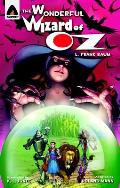
Last week I picked up a copy of the Campfire Classics graphic adaptation of L. Frank Baum’s Wonderful Wizard of Oz. This is one of a long list of public-domain stories brought to the US by Steerforth of New Hampshire and distributed by Random House.

Roland Mann, a veteran of Malibu Comics, is credited as “wordsmith.” Kevin (or K. L.) Jones is the credited “penciler.” All of the other names on the credits page are Indian.

[Comics publishers often print long lists of credits on a copyright page, including company executives with minimal involvement in that title. In contrast, a traditional children’s book usually doesn’t state its editor’s name anywhere. This is another of the curious cultural differences between the two industries.]

Campfire Classics are produced out of New Delhi. Back in 2010, Publishing Perspectives reported: “Among the advantages the company has is the ability to keep most of the work in-house. The company employs a bullpen of 20 full-time artists on staff to do with drawing and coloring.” As a result, a 76-page full-color Campfire book can retail for $9.99.

According to Mann, for the Classics series ”The goal is to stick very close to the original and get young readers visually interested in the work so that they might actually seek the original out.”

For him, that assignment meant reading The Wonderful Wizard of Oz for the first time. His blog shows how he discovered the obvious big differences between the book and the famous MGM movie.

Still, that movie exerted a heavy influence on the visuals of this adaptation. Jones and the bullpen depict Dorothy as an adolescent with brown braids; for much of the book she wears a blue-and-white checked dress. (In the Emerald City she changes into one of the least flattering dresses I’ve ever seen, shown here.)

The Wicked Witch of the West has the green skin and long fingernails that Margaret Hamilton wore in the 1939 movie, but (aside from the scars over her missing eye) has a young and attractive face—a sign of Wicked’s influence.
Campfire is aiming for the American and British markets, to judge by the titles and topics in its catalogue. I rather hoped to find details that struck me as a markedly Indian interpretation of the legend, but didn’t spot any. The biggest departure from the traditional range of Wizard of Oz characterizations is, as this picture shows, the Winkies as little yellow goblins. The lettering is unimaginative, possibly designed to stick as closely as possible to what readers might find in prose books.

As the publisher requested, Mann’s script sticks close to the source material. It includes the Winged Monkeys’ flashback and the visit to the China Country, two episodes that adapters often leave out. It skips only the visit to the family just outside the Emerald City, which offers characterization but not much action.

Indeed, Mann clearly concentrates his limited space on action scenes. The travelers’ confrontation with the Kalidahs takes nearly three pages. There’s a spread and more on Nick Chopper’s transformation into the Tin Woodman through multiple axe accidents, starting with the picture of young Nick at the right.

In contrast, the Wizard gives out brains, a heart, and courage in only three panels covering half a page. Those moments help to define the thematic core of the novel, but the script zips us through them. Similarly, there’s little pause for Dorothy’s sorrow after the Wizard’s balloon flies away.

As a result, I enjoyed moments of this adaptation, and found some of the creators’ other choices interesting to contemplate, but I didn’t think the overall storytelling was emotionally involving or fully successful.

One of Jones’s upcoming titles for Campfire is a comics biography of Abraham Lincoln. Mann, in contrast, is a neo-Confederate, so I don’t think he’ll be working on that one.

15 July 2011

Out Coming Out

And speaking of Oz books for adults, the Boston Globe let loose with some details about Gregory Maguire’s next novel:

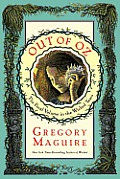
Concord writer Gregory Maguire has announced that he’ll release a book this fall that draws the curtain on his highly popular “Wicked [Years]” series. “Out of Oz,” which hits shelves Nov. 1, was mostly written at Maguire’s home in Concord, where he lives with his husband, painter Andy Newman, and their three kids.

The book weighs in at 550 pages and will contain three maps of Maguire’s Oz universe. The author told us today that he kept this last book under wraps during much of the writing process, just in case it didn’t work out—or he changed his mind. He also told us that he named the book before writing it, and that the title is a nod to “Out of Africa,” as well as an announcement of the end of the series, which spawned 1995’s “Wicked,” 2005’s “Son of a Witch,” and 2008’s “A Lion Among Men.”

“Look folks,” Maguire told us, with a laugh, “I’m out of here. I’m done.” He promises that the last book will keep Oz as it has been in his other novels—a gritty, political, sexual place where magic is possible. “People actually go to the bathroom,” he said, of his Oz. “There is sexual dysfunction.” He added that “Out of Oz” is as close to “Gone With the Wind” as a “Wicked” book can get.
Maguire dropped a couple of details in April 2010 to the Pittsburgh Post-Gazette, but the novel could have evolved greatly since then.

Other sources have told me that Out of Oz focuses on the Wicked Years version of Dorothy Gale. Tonight I heard that she’s quite unpopular among fans who identify with Elphaba, even though Wicked followed the MGM movie’s portrayal of her as wetting the witch accidentally rather than out of anger.

07 November 2008

Maguire Talks Lions

CNN interviewed Gregory Maguire on the publication of his latest latter-day Oz book, A Lion Among Men.

I would describe [my books] as being, not quite allegories, but commentaries on contemporary society--and indeed politics to some extent--enshrouded in, and disguised by, the guise of children's stories.

In other words, I use children's stories as kind of a snare and temptation and illusion to draw in readers who say this is going to be easy...and it's going to be fun. And indeed I hope it is fun. But once I get people involved in the plot, I hope to also communicate some of the questions I have about the way we live our lives in the 21st century.
Gregory's take on Oz has always been colored by the MGM movie (literally so, in the case of Elphaba the green-skinned Witch of the West). And the Cowardly Lion is no exception:
His character arises in the hollow space in our perceptions between that giant roaring lion at the MGM logo...the ideal lion, and the kind of sad, sacked, out of work, vaudeville performer in lion pajamas that we see when Dorothy actually runs into the lion on the Yellow Brick Road.

In other words, there's a huge disconnect between the image we project of ourselves--the best we might ever hope to possibly be--and the way we feel about ourselves at our absolute worst--when we're the most down in the dumps. There's a huge space in between there. So the novel's really in some ways about character and taking control of the destiny of your own character.
And on the challenge of writing for children, as opposed to adults:
Well, for one thing children are intensely more impatient than adults. So you have to start out active, you have to start out strong and you cannot be, for a moment, self-indulgent.

Everything has to be a sound bite or something that the children can visualize as if they're running a little Super 8 projector in their mind. Now I date myself with ancient technology, but you know what I mean...write the scene that you want Steven Spielberg to film, which means every sentence has to give us something to see. Make it intensely visual and this is, I think, the main rule for writing for children.

But in no way do I make it less thoughtful. I just actually have to work harder.
Thanks to Dr. Amberyl Malkovich for the link.