Showing posts with label ARTIST John R. Neill. Show all posts

15 September 2020

Turning Ojo into Woot

A recent online discussion about the relative ages of L. Frank Baum’s young male protagonists took me back almost twenty years to when Oziana magazine published my story “Woot Meets Yoop.”

Woot the Wanderer is one of the heroes of The Tin Woodman of Oz. He hikes around Oz, looking for distraction without danger—which of course makes it easy for a storyteller to get him into danger. In this story I had him run into Mr. Yoop, the caged and carnivorous giant from The Patchwork Girl of Oz.

As I recall, this issue of Oziana was being assembled in a rush to catch up to its annual schedule, so I offered to create illustrations for the story by digitally manipulating some of John R. Neill’s illustrations.

Most of the pictures I worked with came from The Tin Woodman of Oz and showed Woot. But one I wanted to use came from The Patchwork Girl of Oz and showed that book’s young hero, Ojo. This is where Neill’s tendency to draw the children in the Oz stories with quite similar faces became an advantage.

Here’s the picture of Ojo.


My oldest edition of The Patchwork Girl of Oz has no color printing, just line art, which was easier to work with. I removed Ojo’s Munchkin ruff and drew in Woot’s more ordinary Gillikin lapels. I shortened the tails of Ojo’s jacket to approximate Woot’s and added Woot’s knapsack.

Just as important, I stretched out the boy’s legs and body a little. Removing the ruff left plenty of room for a long neck. Because as Baum wrote him, and as Neill drew him, Woot is a bit older than Ojo, further into adolescence.

Here’s the resulting picture of Woot.

I just went back and superimposed these pictures to confirm the differences. With Neill’s standard young-person face at the same level, Woot is a little taller with longer legs. A teenager instead of a boy—at least as I picture him.

14 March 2020

The Magic Wand of Tudor Jenks

I’ve been enjoying the Magic Wand book set by Tudor Jenks, published in 1905.

This collection of modern fairy tales first came to my attention because the volumes were illustrated by John R. Neill in between his work on L. Frank Baum’s Marvelous Land of Oz and John Dough and the Cherub. His style is immediately and delightfully recognizable.

Tudor Jenks was Baum’s near contemporary, born in 1857 and dying in 1922. He was a child of New York City rather than Syracuse, however, and he enjoyed the benefits of Yale College and Columbia Law School.

Jenks started a career in the law, interrupted that to spend fifteen years as an associate editor of St. Nicholas Magazine, and then went back to the law. But he continued to churn out books for young people, mostly nonfiction.

It was shortly after stepping away from the editorial desk that Jenks wrote the Magic Wand series for the Henry Altemus Company. The series consists of six short books about magic:
Each volume is a little over 100 pages long, printed in black and red, with many simple line drawings by Neill. None appears to have been in print for a very long time, but I’ve linked to scans of them all.

The stories are all independent. Some are set in what seems like modern America with a touch of magic. Others take place in countries with kings, queens, dragons, fairies, witches, and similar elements of European fairy tales—but also party line telephones, bicycles, and corporations that offer princess-rescuing services.

The tales show lots of fondness for traditional fairy stories but not too much reverence. They remind me of E. Nesbit’s “The Deliverers of Their Country,” George MacDonald’s The Light Princess, and some of Baum’s American Fairy Tales from the same years.

The plots can be perfunctory, possibly cut off once word or page counts had been achieved. Jenks had what feels to me like a lazy habit of naming his characters after roles from Shakespeare or everyday objects, as in Duchess Darningneedle or the pony Gallopoff. But his narrative voice is charming.

It’s also striking how often Jenks tells stories from an adult’s point of view, even though the protagonists are almost always children or teens. The result is a series of magical tales that kids of 1905 might well have enjoyed but that really reflect the sensibility of adults who would rather not be working office jobs.

22 December 2015

Slice of Life

At the Hungry Tiger Talk blog, David Maxine has written about the one-of-a-kind Oz-related item that was part of our first meeting, when we were teenagers. This is my side of the story.

Back in 1979, at the age of thirteen, I attended my first International Wizard of Oz Club convention. This was the Munchkin Convention, meaning it drew Oz fans from the eastern part of the United States. In the books, you see, the Munchkins live in the eastern part of Oz. (In most of the books. It’s a long story, which David summarized here.)

That year the Munchkin Convention was in Cherry Hill, New Jersey, a reasonably short car ride from my grandparents’ home in suburban Philadelphia. I’d already done some air travel by myself, so I felt confident flying down to visit Grandpa and Grandma.

I wasn’t so confident about meeting the Munchkin conventioneers. I was a shy kid, and I’d never been at that sort of gathering before, much less on my own. It turned out to be a milestone event because it was the first time adult strangers treated me as a peer. For that, I’ll always be grateful to the Oz Club.

There were other teenagers there as well, or at least one: Judy Bieber. But she intimidated me. I was thirteen, and she was (and remains) a couple of years older, which felt like an incredibly significant gap. She was also smart, pretty, and seemingly very much at home in Munchkinland. She created the quiz about the Oz books for that year. She and her father Herm were selling older Oz editions. She appeared to have everything.

To the surprise of the room, and the astonishment of myself, I won Judy’s quiz. The Oz books were the first field of knowledge I really tried to master, and my brain is good at retaining trivial information. And, though I didn’t know it at the time, previous winners were probably sitting out that event. The prize that Judy supplied was an abridged “Junior” edition of Rinkitink in Oz with some John R. Neill color plates. I’m sure that was the first time I’d ever seen one of those abridgments. It may have been the first time I ever knew about them.

By the end of that day, while I was waiting for my grandmother to pick me up, I was already worrying about my responsibilities for the following year. The winner of each year’s quiz had to write the next year’s quiz and supply the prize. I remember another attendee congratulating me on winning and asking if I was already thinking about new questions, and me replying that I was already thinking about the prize.

Making the quiz was fun. I decided to base it on Neill’s pictures and books, and I had fun laying it out. But for a prize? I didn’t have much money to spend, I didn’t know the range of possibilities, and I wasn’t linked into collectors’ networks. I also wasn’t good at asking for help (I’m still not). I wanted to solve this problem on my own—since I was acting as an adult, and all that.

So I decided to use my time in woodworking class to make a prize. A pair of O and Z bookends didn’t work out, but I grabbed a piece of mahogany and figured out a design for a cheese board that incorporated Neill’s OZ symbol in its handle. I didn’t do a great job with the carving, but it was a one-of-a-kind Oz-related trophy. And its real value was symbolic, right?

As David guessed, during the 1980 Munchkin Convention I decided to augment that cheese board with an edition of The Wizard of Oz autographed by Margaret Hamilton, who was there. So now I can also say that I had a brief conversation with her. Very brief.

The person who won my quiz was David Maxine, who had come from out west all the way to Cherry Hill. He was also a teenager. But, like Judy, he was (and is) a couple of years older than me. The difference is minuscule now—we’re all part of what I called the “white cover generation” of Oz fans. But back then David was also daunting.

Looking back, I realize that my thinking at thirteen was skewed by the universal adolescent assumption that every other teen is having more fun than you. To me David seemed like an old hand at Oz conventions and collecting and life. I should have perceived that this was his first time at the Munchkins, and he had no idea I was at just my second gathering. We had more in common than I realized.

If I’d known the winner of my quiz was going to be another teen, I probably wouldn’t have made a kitchen implement. If I’d had the boldness to befriend Judy the year before, I could probably have asked her and Herm to snatch up one of those abridged editions for the 1980 prize. But I couldn’t see any of those possibilities at the time.

I also couldn’t see that David and I would reconnect in something called “online” almost twenty years later. During some Ozzy conversation he mentioned that he still had the cheese board, which was both astonishing and gratifying. (As he’s pointed out, it’s compact and almost impossible to break.) And now that we’re both adults and have had online exchanges about such things as Swiss chard, a kitchen implement turns out to have been more appropriate than we knew. It’s come to symbolize a real-world friendship rooted in Oz.

10 November 2015

The Emerald City in the Gutter

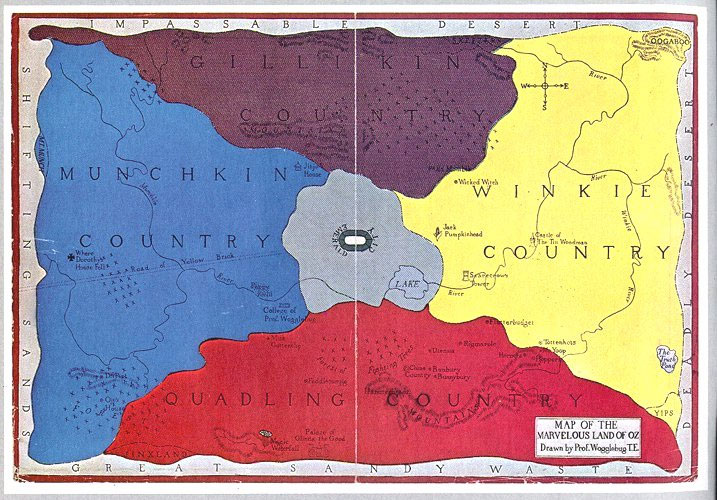
Here’s another view of the map of Oz as issued by Reilly & Lee. Can you spot two big differences between it and the map shown last week, from David Maxine’s Hungry Tiger Talk blog?

One difference is that this is a later reprinting of the map that first appeared in Tik-Tok of Oz (1914). As David discussed, the compass rose originally put east on the left and west on the right, contrary to the usual approach. At some point in subsequent decades, the publisher changed the labels so “E” was on the right as usual.

Of course, that change also meant the map showed the Winkie Country to be east of the Emerald City instead of west, as all of L. Frank Baum’s books described it. But his successors Ruth Plumly Thompson and John R. Neill started to state that the Winkies lived to the east, conforming to the reprinted map and its conventional compass.

Another difference is that the version of the map above is a broadside while the image David showed was scanned from an early copy of Tik-Tok of Oz, where it served as the endpapers. And that highlights a feature I find really interesting from the perspective of book design.

This map had to look good both as endpapers, when a thin strip of its middle would be concealed in the book’s binding, and as a poster or broadside lying flat. The artist accomplished that by making sure that almost no sites and no lettering fell within that central strip. Some large labels bridge the strip, such as the word “GILLIKIN” in the top quadrant—but there’s a little extra space between the second I and the K that could disappear into the binding.

The Emerald City was a challenge because Baum was clear that it’s in the middle of Oz—and thus in the middle of this map. How to keep it from vanishing into the gutter? The artist’s solution was to depict the city as a horizontal oval, with the word “Emerald” on the left and “City” on the right. (David Hulan once pointed out that the oval approximates an “emerald cut” in jewelry.) Then when the central strip of the map is hidden (look back on David’s map), the city appears as a circle and its full name remains legible.

On the accompanying map of Oz and surrounding countries, shown below, the Emerald City is safely off-center. And it appears as a circle, as it would appear in the endpapers form of the Oz map. This time the artist tried to keep other labels and locations out of the central strip. In the image from Wikipedia below, you can see where that got tough.

03 November 2015

zO fo paM suoiretsyM ehT

At the Hungry Tiger Talk blog, David Maxine has been presenting his research into the many maps of Oz. In his latest, he shares information about the map that appeared in Tik-Tok of Oz (1914), as shown above.

David quotes material showing that L. Frank Baum:
  • sketched a map of Oz for a young reader while working on the musical that became Tik-Tok of Oz, according to his composer, Louis F. Gottschalk.
  • sketched a supplemental map depicting the adventure in The Lost Princess of Oz (1917) based on the first.
He thus reaches the convincing conclusion that Baum himself sketched the preliminary version of the Tik-Tok map.

The main mystery of that map is why its compass is reversed, with east shown on the left and west on the right. Baum’s texts are consistent about east and west—the Winkie Country is always to the west of the Emerald City, for example, and traveling west in the Winkie Country takes one to the edge of Oz. Likewise, the Lost Princess map is consistent with the earlier Tik-Tok map, with west on the right. But if one were to hover in the air over Oz in a balloon facing north, would it look like that map?

For David, the consistency suggests that Baum actually pictured Oz that way, with east to the left and west to the right. I'm not so sure that’s the only explanation.

Even in its early years, the Reilly & Britton publishing firm seems to have been a bit slapdash in how it assembled the Oz books. A couple of years ago I wrote an article about the art program for The Patchwork Girl of Oz, which included reusing many of John R. Neill’s illustrations, including at least one that Baum had rejected.

I therefore think there’s a possibility the Tik-Tok map ended up with a reverse compass because no one noticed that mistake till all the hand-lettering was done. Then, with the book ready to go to the printers, everyone (including Baum) just decided to live with the oddity. As for the Lost Princess map, Baum clearly based that off the earlier one, and it would have been much easier for him to maintain its orientation than to redraw the borders in reverse.

Unfortunately, correspondence between Baum and his publisher during the time when the map was created appears to be lost. We therefore don’t know what Baum asked for or settled for. But it’s clear that he accepted the map as published, with its unorthodox orientation.

03 June 2014

Google’s Scalawagons

Various forms of The Wizard of Oz are so famous that it’s common to see allusions to that story. But The Scalawagons of Oz, written and illustrated by John R. Neill in 1941, is another matter. It’s one of the rarest of the official Oz series and perhaps the worst.

Yet this article at Seeking Alpha not only alludes to Scalawagons but is built around that allusion. David Zanoni writes:
…Scalawagons were smart vehicles that would take passengers wherever they desired. Just sit down in the car, tell the Scalawagon where you want to go and the car transports you to your destination without the need for using pedals and steering wheels.

Google (GOOG) is essentially taking this concept and turning it into a reality with its self-driving car. Google's car actually resembles the shape and look of the Scalawagon.
As I wrote back here, one of the problems of Scalawagons in Oz is that they minimized the possibility of adventure. I suppose that’s one of the advantages of Google cars for us.

28 November 2013

Let Us Be Thankful That This Isn’t Rerun Every Year

In 1980 the Muller Rosen animation company released a half-hour holiday special for television titled Thanksgiving in the Land of Oz. That show was then recut to remove the Thanksgiving references and released on video as Dorothy in the Land of Oz; as of this holiday, it can be watched in two parts on YouTube. In 1982 Romeo Muller adapted his screenplay into a short illustrated book titled Dorothy and the Green Gobbler of Oz.

Like most Oz videos in the television age, this cartoon was written to invoke MGM’s Wizard of Oz. Dorothy meets the Wizard in Kansas again, the Cowardly Lion is bipedal, there are songs, and so on. But the filmmakers also obviously knew the Oz books and used them as inspiration for characters, settings, and plots points, albeit without being faithful to those books.

Thus, for example, just as in L. Frank Baum’s original novel and the MGM movie, Dorothy and Toto accidentally travel to Oz and meet three male companions who help her on a quest to vanquish a villain. One of those companions is an animated refugee from a farm, another made of metal, and the third a big carnivore with gentle habits. But in this movie those characters are Jack Pumpkinhead, Tic Toc [sic], and the Hungry Tiger, whom Baum introduced in different ways in his second and third Oz books.

Jack lives in a pumpkin house, as John R. Neill drew it in The Road to Oz. Other Oz houses resembles those he and W. W. Denslow designed, and a sequence of children opening Christmas presents owes a lot to Denslow’s art, rendered with less character. However, a trip over a rainbow at the end is clearly inspired by the MGM movie’s most famous song.

The end of the cartoon shows Ozma as rightful ruler of the Emerald City, but there’s no explanation of how she came to the throne. This Ozma seems much older than Dorothy and more like the Glinda of the movie.

Another element that the filmmakers borrowed from Baum’s books appears at the start: Uncle Henry and Aunt Em are about to lose their farm to the bank. The couple plans to go into an “old folks’ home” while Dorothy will have to live somewhere far away with a cousin—perhaps Zeb Hugson from Dorothy and the Wizard in Oz. This is a better fate than what Baum wrote about in The Emerald City of Oz, which suggested Dorothy would have to go to work while her aged relatives might end up begging. Still, it was probably a shock to many viewers.

The big-name star of the production is Sid Caesar, who plays the Wizard and narrates the story in that role. Caesar also plays a mince pie that’s brought to life, takes the name U.N. Krust, and delivers every line in a different foreign accent. The pie and its speech patterns play no role in the plot; they seem to have been included just to put Caesar’s shtick to use. We haven’t seen so much ethnic humor in an Oz adaptation since the 1903 Broadway show.

Another notable casting detail: Joan Gerber supplied the voices for both Ozma and Tic Toc.

The cartoon includes a couple of forgettable songs. Dorothy uses one to convert the villain back into a benevolent toymaker, and at the same time deliver a paean to Christmas shopping. In that respect, this modestly produced special was a perfect start to commercial television’s holiday season.

11 September 2013

A Shirt Is a Terrible Thing to Waist

Yesterday I quoted L. Frank Baum’s description in The Patchwork Girl of Oz of a Munchkin boy wearing “a blue ruffled waist.” When I first read that book, I must have glossed over the phrase because:

  • John R. Neill’s pictures show Ojo wearing a white shirt with a ruff around his neck.
  • I had no idea what a “ruffled waist” might be.
This year, thanks to Google Books, I solved that mystery for myself. In 1897, the American Home Magazine published this picture of a ruffled waist.
Elsewhere in the magazine are examples of a shirt waist, blouse waist, silk waist, Norfolk waist, tucked waist, full waist, draped waist, and military waist.

The magazine also used “waist” to mean a person’s midriff or its circumference, as we still use the term (and once in a metaphor for how “the Chesapeake, like a great arm, reaches up and entwines itself about the waist of Maryland”). But obviously turn-of-that-century readers understood that the word could mean a garment of the sort we’d call a shirt.

Thus, Baum described Ojo wearing a blue ruffled shirt, perhaps with vertical ruffles like this lady. And Neill chose instead to draw Ojo with a ruff around his neck and a plainly sewn, if floppy, white shirt.

Baum used “waist” in similar ways in his other fantasy novels. In Sky Island he described the boy Button-Bright this way: “He wore a blouse waist, a short jacket, and knickerbockers.” And in The Scarecrow of Oz, Button-Bright looks like this: “He was dressed in a brown velvet jacket and knickerbockers, with brown stockings, buckled shoes and a blue shirt-waist that had frills down its front.”

Baum always portrayed Button-Bright as an upper-class, fairly precious (though indestructible) little American boy. His mother or governess (he had both) therefore dressed him in loose, frilly shirts. Or, as his contemporaries would say, waists.

10 September 2013

Ojo’s “Ruffled Waist”?

This is the cover of The Patchwork Girl of Oz as redesigned and redrawn by Dick Martin, based on John R. Neill’s art for the first edition’s dust jacket. (See David Maxine’s masterful dissection of this edition at the Hungry Tiger Press.) This is the cover art of the edition I read as a boy.

In chapter two, L. Frank Baum described the young Munchkin hero Ojo’s appearance this way:
He wore blue silk stockings, blue knee pants with gold buckles, a blue ruffled waist and a jacket of bright blue braided with gold. . . .
I don’t recall being held up by the phrase “blue ruffled waist,” though if I’d thought about it, it wouldn’t have made any sense to me. I could see in the illustrations that Ojo wore an elaborate ruff around his neck, not his waist. In fact, how could anyone wear a “waist” since that’s part of the body?

TOMORROW: What a waist was.

27 March 2013

Oh, Little China Girl

One of the new characters in Oz the Great and Powerful is the China Girl, an inhabitant of a village of china people who appear to have been genocidally destroyed by the Wicked Witch’s Flying Baboons. (She’s also the fairyland avatar of a disabled girl whom the carnival wizard can’t help back in Kansas.)

The china village is obviously inspired by a chapter L. Frank Baum interpolated into The Wonderful Wizard of Oz, in which Dorothy and her companions visit a China Country on their way south to Glinda’s palace. In that chapter, Dorothy wants to take a China Princess home to her aunt but is dissuaded. In the movie, China Girl demands that Oz take her along on his adventure.

There are various ways to read the character’s behavior in that scene. On the one hand, China Girl is insistent on her right to go on an adventure. On the other hand, she casts herself as a fragile little creature who shouldn’t be left on the Yellow Brick Road alone. Of course, she is a fragile little creature; we just saw her legs broken, and she’s less than a foot tall. China Girl clings weepily to Oz’s leg, but as soon as he agrees to take her she trots off happily. I think it’s clear that China Girl’s behavior is a ploy to manipulate Oz, the master manipulator. But in that effort she invokes gender stereotypes.

During the movie’s climax, China Girl plays an important role, bravely bringing Glinda her wand. (The fact that China Girl doesn’t use the wand herself implies the magic of this Oz differs from that in Baum’s Oz, where most magical tools can be wielded by anyone who holds them.) She’s also one of the two characters who asks anything specific of Oz beyond regime change, and ends the movie as his informally adopted daughter.

Illustrator Ben Wood noted a resemblance between the design of China Girl and how John R. Neill drew Dorothy in later Oz books, as he showed in the image above. He wrote, “It was a smart way to add her in without really adding her.” I’m not sure that’s what the moviemakers had in mind, but China Girl does provide more interest and, ironically, someone to identify with.

19 March 2013

Inspiration Bubbling Up

Even with the relatively awkward special effects of 1939, Glinda’s pink bubble in The Wizard of Oz is an American icon. So much so that the Wicked stage show reproduced that entrance.
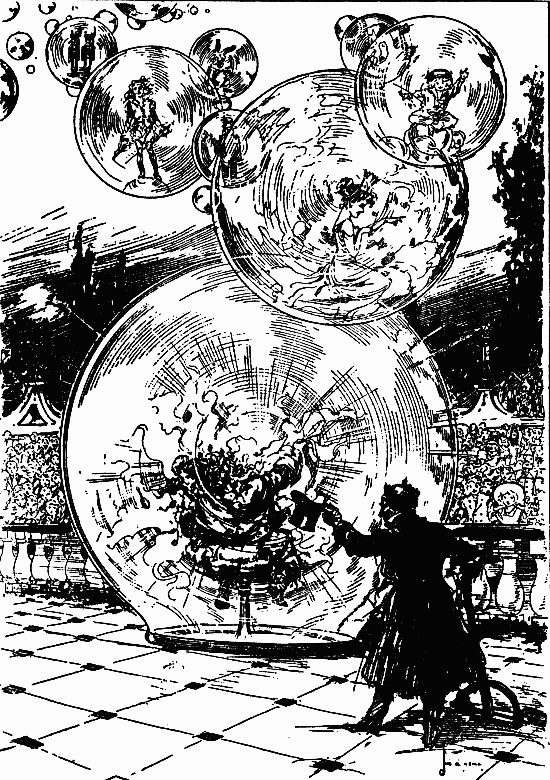
The new Oz the Great and Powerful movie is not supposed to infringe on the 1939 film’s copyright, however. Fortunately for its makers, L. Frank Baum and John R. Neill portrayed travel in giant bubbles at the end of The Road to Oz. (Curiously, it’s one of the few adventures Dorothy turns down.)
With that book in the public domain, Sam Raimi and company could show people in bubbles, and even make them Glinda’s thing, as long as they weren’t perfectly round and pink. In fact, with CGI animation they could show the Wizard’s weight bending his bubble out of its spherical shape. But there’s really no doubt those bubbles are supposed to evoke the 1939 movie, not Baum’s lesser-known 1909 sequel.
For the next couple of days I’ll discuss the sources of Oz the Great and Powerful—the official sources and the real ones.

08 January 2013

Prince Bobo’s Place in Nature

This is the frontispiece from Thomas Huxley’s Evidence as to Man’s Place in Nature (1863). It shows the skeletons of four apes and a human being.

Huxley’s point was that these skeletons had so much in common that they showed a common ancestry. However, it was easy for Englishmen, reading left to right, to view this lineup as the track of evolution itself rather than the present state of five parallel species. (In other words, to come away with the understanding that the human was supposed to have evolved from the gorilla rather than the human and gorilla having a common ancestor in the past.)

For an article in progress, I’m wondering whether I can make the case that that illustration inspired this lineup of characters drawn by John R. Neill in Rinkitink in Oz (1916).

.
These drawings show the series of transformations that Glinda performs to ***SPOILER*** turn Bilbil the Goat back into his rightful form as Prince Bobo of Boboland.

In that scene L. Frank Baum defined the Tottenhot as “a lower form of man,” closest to animals, echoing a racist western belief about the “Hottentots” almost two centuries old by that point. That idea connects to the medieval concept of the Great Chain of Being. But did it also link, perhaps by parody, to the late Victorian understanding of human evolution?

03 April 2012

Changes in Oz We Can Believe In

At VoVatia (mirrored at the Royal Blog of Oz), Nathan DeHoff extended the discussion begun in part here of the power and appeal of the status quo in the Oz books.

After L. Frank Baum’s first two Oz novels, nearly all those stories are structured around the preservation of and return to the status quo. Ozma remains in charge of the Emerald City. Some kids get to go home, others find a home in that city, and still others (especially in Ruth Plumly Thompson’s sequels) are restored to their rightful royal roles. That pattern’s surely a big part of the series’ appeal.

Books that make too great a change in that status quo are unpopular with fans. For example, most Oz fans dislike the way John R. Neill portrayed life in the Emerald City in the three books he wrote. Suddenly the houses become sentient, as Xamyul catalogues. Soon sentient cars roam the streets. Characters like Ojo, Kabumpo, and Sir Hokus don’t have the identities and homes that preceding books established. No later official Oz authors followed up on Neill’s stories, and the few examples of fanfiction that I’ve seen use some of his characters set his biggest changes aside.

The problem isn’t just consistency with the rest of the series, however. In fact, Baum was inconsistent on details large and small. He described characters dying in Oz and wrote that no one died in Oz, cut Oz off from the outside world and showed people traveling there with little trouble, said that magical artifacts could not travel to Kansas and depicted Dorothy encountering a magical artifact in Kansas. Oz fans don’t reject those contradictions; instead, spotting and if possible explaining them is part of the fun.

What makes Baum’s inconsistencies acceptable but Neill’s irksome? I suspect fans would accept the changes Neill made to the Emerald City more readily if his stories were any good. A talented fantasy illustrator, he didn’t have a good sense of character or narrative, nor good editors. As a result, it’s very hard to make any sort of emotional connection to Neill’s books and thus to become fond of them.

Had Neill written stories that readers deeply wanted to be part of the Oz series, we readers would be quicker to accept that the Emerald City became a stranger place in those years. More of us would accept the unexplained changes in the status quo that other books had established.

Edward Einhorn’s Paradox in Oz shows this rule in action from the other direction. It requires deep changes in our understanding of the Oz universe, with all versions of the myth existing in parallel. Yet I haven’t found any Oz fan expressing deep distaste for how that book changes Baum’s creation, probably because it’s a more enjoyable story.

07 February 2012

A Lesson from Sir Hokus

My thoughts on the value of a ongoing characters having an unresolvable foundational conflict have their roots, I realize, in thinking about a character far less known than Superman.

It was Sir Hokus of Pokes, the first recurring character that Ruth Plumly Thompson added to Oz. He’s an old knight that Dorothy and the Cowardly Lion find in The Royal Book of Oz (1921). He moves to the Emerald City and plays a supporting role in several more adventures, rather as L. Frank Baum used the Shaggy Man. He’s not rounded, and I doubt he’s many people’s favorite, but he becomes a comfortable part of the fabric of Thompson’s Oz.

As such, Sir Hokus reflects Thompson’s sensibility, based on older European fairy tales. In contrast, Baum’s usually tried to find magic in contemporary American culture for Oz.
I think Sir Hokus’s unresolvable foundational conflict is that he’s a man out of time. He speaks in a medieval lingo, constantly expressing a wish to rescue fair maidens and slay dragons. His anachronism is underscored by his age. Like Lewis Carroll’s White Knight, he’s an old man, still active but gray. In both respects, he’s removed from his prime period, no longer able to undertake all the quests he yearns for.

In The Yellow Knight of Oz (1930), Thompson made Sir Hokus one of her protagonists. He goes off on a solo quest at last. Along the way, complications ensue. By the end of that book, Sir Hokus is no longer a man out of time; he’s ensconced in a medieval-style culture. Furthermore, he’s young again.

As a result, the character is no longer the least bit interesting. Sir Hokus’s foundational conflict has been resolved. Even though Dorothy looks in the younger man’s eyes and says he’s the same friend she knew, it’s no surprise that he makes only token appearances in the rest of Thompson’s series.

John R. Neill liked drawing Sir Hokus so much, evidently, that he brought the old knight back in his three Oz books, once more chasing dragons without being able to slay them. Neill offered no explanation of how, but neither consistency nor logic was part of his storytelling.

06 December 2011

Our First Glimpse of Evardo XV

The picture above, by John R. Neill, comes from the end of Ozma of Oz. It shows the dowager queen of Ev and her eldest son, the new King Evardo XV.

L. Frank Baum earlier described Evardo this way: “He was a grave and quiet youth, and would doubtless rule his people wisely and with justice.” He narrates this scene thusly:
Then the Queen took her eldest son out upon a balcony that overlooked the crowd of subjects gathered below, and said to them:

“Here is your future ruler, King Evardo Fifteenth. He is fifteen years of age, has fifteen silver buckles on his jacket and is the fifteenth Evardo to rule the land of Ev.”

The people shouted their approval fifteen times, and even the Wheelers, some of whom were present, loudly promised to obey the new King.

So the Queen placed a big crown of gold, set with rubies, upon Evardo’s head, and threw an ermine robe over his shoulders, and proclaimed him King; and he bowed gratefully to all his subjects and then went away to see if he could find any cake in the royal pantry.
He is fifteen, after all.

Baum has even less to say about most of the queen’s other children, aside from the youngest: Prince Evring, whom Dorothy rescues. The rest of the siblings are simply names: “The Princesses were named, Evanna, Evrose, Evella, Evirene and Evedna, while the Princes were Evrob, Evington, Evardo and Evroland.”

Baum derived the names of Evrob and Evedna from those of one son and his fiancée. Robert Baum was also inspiration for the young hero of Baum’s science-fiction novel The Master Key, and Edna Drucker was a family neighbor. They were in their early twenties when Ozma of Oz appeared, clearly older than the queen’s children.

As to other details of the Ev princes and princesses, especially as individuals, Baum’s book is basically silent.

TOMORROW: Filling in the gaps, one way or another.

29 November 2011

Kaliko Vision

In L. Frank Baum’s Ozma of Oz, Roquat the Nome King is served by a Nome introduced this way:
Meantime the King ordered refreshments to be served to those waiting, and at his command a rudely shaped Nome entered, bearing a tray. This Nome was not unlike the others that Dorothy had seen, but he wore a heavy gold chain around his neck to show that he was the Chief Steward of the Nome King, and he assumed an air of much importance, and even told his majesty not to eat too much cake late at night, or he would be ill.
Later, thinking himself out of the hearing of the guests, the Chief Steward tells the king, “You are a fool to waste so much time upon these people” from Oz.

Baum next visited the Nomes in The Emerald City of Oz, and in that book stated that the king’s steward was named Kaliko. He’s “frightened” by his master, “trembling and white with fear.” Baum offers this exchange:
“Fetch my pipe!” yelled the King.

“Your pipe is already here, your Majesty,” replied Kaliko.

“Then get my tobacco!” roared the King.

“The tobacco is in your pipe, your Majesty,” returned the Steward.

“Then bring a live coal from the furnace!” commanded the King.

“The tobacco is lighted, and your Majesty is already smoking your pipe,” answered the Steward.

“Why, so I am!” said the King, who had forgotten this fact; “but you are very rude to remind me of it.”

“I am a lowborn, miserable villain,” declared the Chief Steward, humbly.
Obviously that exchange shows a interpersonal dynamic very different from the earlier one.

In Who’s Who in Oz, Jack Snow stated that Kaliko first appeared in Ozma—in other words, that he was the Chief Steward in that book as well as the later one. As a young reader, I adopted that interpretation without question. It suggests that the Nome King’s anger over losing his Magic Belt in the earlier book makes it much more dangerous to talk back to him in the later.

More recently, however, such Oz scholars as David Hulan convinced me that might be too much of an assumption. What if the Nome King got rid of the first Chief Steward between the two books? In that case, Kaliko didn’t change his behavior drastically; rather, he could be obsequious enough to manage the angry monarch. What happened to the earlier Chief Steward? Based on what the Nome King orders for some Nome army officers in Emerald City, it would be nothing good.

The Marvel Comics adaptation of Ozma of Oz comes down firmly on the first interpretation, with the Chief Steward being named “Kaliko.” Scripter Eric Shanower’s choice makes for a smaller, more unified cast of characters for the series, and there’s certainly tradition behind it.

Artist Skottie Young also makes an interesting choice in how he designed the Nomes. His Nome King looks much like John R. Neill’s, with a human face, hair, and beard; five-fingered hands; and a caricatured but recognizably humanoid body. In contrast, Young draws the rest of the Nomes as little imps, basically isosceles triangles with tiny limbs and snappish personalities. And Kaliko is among them, as the picture below shows.
Looking ahead, will we see this little Kaliko assuming the Nome Kingdom’s throne?

22 November 2011

The Tin Woodman’s Head on My Mind

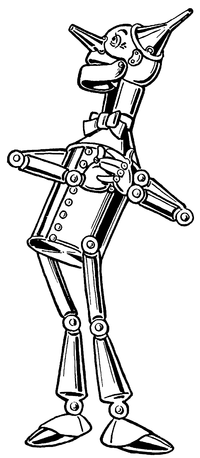
In The Wonderful Wizard of Oz, W. W. Denslow gave the Tin Woodman a skull-shaped head.

Of course, the long nose and ears riveted on that dome, as well as the lively eyes, make it possible to overlook the resemblance most of the time. But the rounded cranium and hinged jaw are quite reminiscent of fleshless human anatomy.

John R. Neill followed Denslow’s model in his illustrations for Ozma of Oz and Dorothy and the Wizard in Oz. As in the series’s first book, the tin man’s head bulges out at the back.

However, in The Marvelous Land of Oz, published before those two titles, and in all the Oz books that followed them, Neill used a different character design, with a cylindrical head. The neck varied at first, but eventually settled on the vague sort of attachment Denslow has used.

In most of those books, when the Tin Woodman takes off his funnel cap, we see that the top of his head is a rounded dome. Neill used the same design for Captain Fyter, the tin emperor’s doppelgänger in The Tin Woodman of Oz (1918).

Toward the end of his career, starting with Ozoplaning with the Wizard of Oz (1939), Neill made yet another variation: he drew the tin man’s head as flat on top, like a tin can. I suspect Neill was out of practice drawing his Tin Woodman; Ruth Plumly Thompson made little use of Baum’s more mature male characters.

I review this history to acknowledge that even within the Oz books there’s a significant variation in the Tin Woodman’s character design. On top of that, we have the costumes created for David Montgomery and Jack Haley, which have to allow a man to fit inside. Thus, people can imagine many things when they think of Nick Chopper.

Lots of comics artists like to depict the Tin Woodman as a robot. That’s doesn’t really fit his origin, in which he’s a living man whose body is gradually replaced with tin parts, and it leaves less room in the saga for Tik-Tok, an actual robot. But some artists just love drawing robots.

One example of that trend is David Hutchison in his Oz: The Manga series, as shown at right. His Tin Woodman’s head is a smokestack, and the robotic characterization extends to gear-shaped speech balloons.

Skottie Young avoided that temptation in helping to adapt the series for Marvel Comics. Indeed, his character design plays up the characters’ old-fashioned, rural beginning. (The man harvested wood, after all.) The tin mustache is reminiscent of L. Frank Baum himself.

And I have a hard time warming to the result. I think the problem for me is that as colored in a pale, tinny way, the mustache looks white. The character’s smooth round head and old-fashioned style reinforce that impression. As a result, this Tin Woodman always looks to me like an old man.

Based on Neill and Denslow’s art, and Baum’s writing, I think of Nick Chopper as a man in his twenties, preserved agelessly by being made into tin (and by living in Oz). Though the Tin Woodman has excellent and kind instincts, and matures somewhat over the series, he’s not old enough to have become wise. He makes mistakes and still regards his appearance with more than a little vanity.

I have trouble imagining the Tin Woodman as a Richard Farnsworth type, much as I admire that actor and some of the characters he’s played. Of course, it’s better than a robot.

15 November 2011

Cartoon Art Museum Has Gone to Oz

Last week the Cartoon Art Museum in San Francisco opened an exhibit on Oz comics. It draws heavily on the collection of Peter Maresca, publisher of Sunday Press (which would be a small press except that its books are so big).

Early comics artists in the exhibit include Walt McDougall (working with L. Frank Baum), W. W. Denslow (competing with him), and John R. Neill (before becoming Baum’s main illustrator). More recent ones include Eric Shanower, Skottie Young, Anna-Maria Cool, and Ramona Fradon.
Among the pages on display is one Eric Shanower drew for Oz-Story magazine a while back, showing moments in the Oz series illustrated in the styles of different famous cartoonists.

I visited the Cartoon Art Museum on my last trip to San Francisco beyond the airport, and admired how much good stuff it displayed in a small space. Definitely worth a visit. [Hey, there’s Jerry Robinson!]

08 November 2011

The Influence of Scalawagons

Scalawagons of Oz might well be John R. Neill’s most influential book. Not because it’s good. In fact, it’s the worst of the three or four Oz books Neill wrote. He was a talented illustrator, but had no apparent sense of narrative structure.

Among Neill’s other Oz books, The Wonder City of Oz was rewritten by a Reilly & Lee editor, and A Runaway in Oz was rewritten (with far more attention to the original story) by Eric Shanower.

Neill’s Lucky Bucky in Oz benefits from a conventional Oz-book narrative: An American child cast into fairyland by random disaster gathers companions and makes his adventurous way to the Emerald City. However, despite having such a simple plot laid out, Neill managed to make his timeline loop back on itself in an impossible way.

Even among that bunch, however, Scalawagons of Oz is the worst. Events happen randomly. Hardly any character is really likable. The storyline, such as it is, accumulates the tension of a sagging strand of chewing gum.

Furthermore, the book introduces mass-manufactured sentient automobiles into Oz, reason enough for some fans to reject the book. While L. Frank Baum established that Oz had electricity, and even some electrical communications systems (controlled by the elite), he made sure not to include modern transportation technology: no trains, steamboats, aeroplanes, or motorized runabouts. Having to travel by foot or Sawhorse guaranteed that people had adventures. Those cars called Scalawagons (Neill tried too hard on his puns) could have ruined life in Oz for readers. Therefore, none of Neill’s official successors as Oz authors, and few of his unofficial ones, have incorporated the Scalawagons into their stories.

So how is that book influential? Because, as David Maxine recently wrote at Hungry Tiger Talk, reading it pushed other authors into writing their own, better Oz books. The first was Rachel Cosgrove Payes, then a housewife biologist, who offered Reilly & Lee The Hidden Valley of Oz in 1951. About a decade later, she embarked on a long career writing other types of novels.

As the second example, David’s posting displays a copy of Scalawagons inscribed by three-time Newbery Honor winner Eloise Jarvis McGraw with these words:
This book…came into the possession of my daughter (and co-author) Lauren Lynn McGraw, who was reading it one day in 1962, looked up at me and said, ”We could write a better Oz book!” Whether we did or not is not for me to say, but we tried
The McGraws’ Merry Go Round in Oz (1963) was one of the best in the series, certainly by conventional measures of writing style.

Finally, a less worthy example of Scalawagons’ influence might be a curious story from Wow Comics, #48 (1946), which shows Mary Marvel fighting robots shaped like Oz characters. Alongside the easily recognized Scarecrow and Tin Woodman is a strange creature called the What-is-it. As David pointed out in reprinting this tale in Oz-Story, #2, that creature looks like the main villain in Scalawagons, published five years earlier and quite possibly still sitting unsold on a bookstore shelf.

23 August 2011

Knitting Needles in Oz

The September/October 2011 issue of Piecework magazine (current link here, but it won’t last) has the theme of “needlework in literature.” Among the knitting and crochet patterns tied ever so gently to books is Joanna Johnson’s “Jinjur’s Jumper,” accompanied by an article on that character from L. Frank Baum’s The Marvelous Land of Oz.

I’m sorry to say that Johnson’s dress pattern isn’t designed like the outfit that General Jinjur and her soldiers wore in John R. Neill’s illustrations, one of which accompanies the article and another of which appears below. Nonetheless, it’s rooted in Victorian style, pretty, and impressively seamless.

The magazine’s little model for that dress wears a knitting needle in her hair, as Jinjur’s soldiers did. They used those sharp sticks to attack men who tried to stop their conquest of Oz. But knitting needles proved no match for the spears and swords of Glinda’s army.

While Baum never shows Jinjur or her soldiers actually knitting, he depicts a number of other female characters doing so:
  • Mme. Grogrande in John Dough and the Cherub.
  • Grandmother Gnit (of course) of the Fuddlecumjigs in The Emerald City of Oz.
  • Trot’s mother in Sea Fairies and Sky Island.
  • Reera the Red, a reclusive and powerful magic-worker, in Glinda of Oz.
There’s something magical about knitting and crochet—taking a cord that seems one-dimensional and producing something two- or three-dimensional out of it.

Johnson’s article provides a brief introduction to Baum, his Oz books, and his support for women’s suffrage. It unfortunately repeats a myth that he and artist W. W. Denslow struggled to find a publisher for The Wonderful Wizard of Oz: “nearly every publisher in Chicago refused the book initially because of its fantastic subject matter and extensive color plates, which were very expensive to print.” Really?

In fact, as Michael Patrick Hearn traces in The Annotated Wizard of Oz, Baum completed his first draft on 9 Oct 1899; he preserved his pencil with the date. By that time, Baum and Denslow’s Father Goose was a big hit, and the Geo. M. Hill Company had an option on their next book.

That small publisher asked the team to pay for the color plates and cover dies—not uncommon terms at the time. Baum and Denslow agreed, and they signed a publishing contract on 16 November. Less than six weeks passed between complete draft and contract, and I know of no evidence that the creators even spoke to other publishers.