Showing posts with label mysteries of mysteries. Show all posts

03 February 2026

Two More Tales of Oz

The 2025 edition of Oziana, the International Wizard of Oz Club’s creative magazine, is now available for purchase through Lulu.

This issue contains two stories by me.

“The Piglets and the Tin Soldier” is another short slice-of-life tale inspired by L. Frank Baum’s Little Wizard Stories of Oz, taking a couple of his established characters and bouncing them off each other.

The Nine Tiny Piglets first appeared from the Wizard’s pockets in Dorothy and the Wizard of Oz and made small cameos in the Emerald City after that, never getting individual names. 

Captain Fyter, the Tin Soldier, marched onto the scene in The Tin Woodman of Oz. At one point in that book the heroes meet the piglets’ parents. Afterward the soldier says, “I hope I’m not too particular about my associates, but I draw the line at pigs.” So there was a natural tension to work with.

David Valentin created digital artwork of the Tin Soldier and his basket of piglets for this story of a journey through the Munchkin Country.

“The Missing Key” is a mystery featuring Snip, the button boy who was a protagonist of Ruth Plumly Thompson’s The Lost King of Oz. She introduced Snip sneaking into Mombi’s kitchen and then spying on her, establishing him as a curious kid. Several years ago, I used that trait to bring Snip into a story called “Invisible Fence.” More recently I realized that would make him a good investigator for a mystery.

In this story, Snip sets out to retrieve the wind-up key that’s vanished from Tik-Tok’s back. David Lee Ingersoll supplied the illustrations, including one of Snip pinned to the ground by string-wielding field mice, inspired by scenes in The Wonderful Wizard of Oz and Gulliver’s Travels.

06 March 2025

Raskin Returns, the Sequel

As Publishers Weekly points out, there’s poetic irony in two previously unknown literary projects surfacing from the literary estate of Ellen Raskin, author of The Mysterious Disappearance of Leon (I Mean Noel) and The Westing Game.

The industry organ reports:
International Literary Properties—a global company that invests in and manages literary estates—has acquired Raskin’s estate and, along with it, two previously unpublished manuscripts by the late author, including a sequel to her Newbery Award–winning mystery, The Westing Game. . . .

John Silbersack of the Bent Agency took on the role of Raskin’s literary agent nearly two decades ago, when Ellen’s daughter Susan Moore and son-in-law John first approached him to represent the estate. . . . Silbersack shared that at the time of Raskin’s death in 1984, “she had been working on—and had very nearly completed—a marvelous new story, very much in the vein of The Westing Game, titled A Murder for Macaroni and Cheese.

“Ellen’s practice was to rewrite and re-edit each prior chapter on the completion of a new chapter, so the earliest sections of the book were pored over time and again, while the very final chapters were more sketched out.” In an example of life imitating art, he said, “Ellen’s daughter, Susan, devoted herself to ‘solving’ the mystery and tying up all the loose ends, and the manuscript awaits a final polish and a worthy collaborator to bring it to a finale, which is at the top of our to-do list.”

Of the second book, a Westing Game sequel, he said, “Crafting a follow-up to one of the most beloved titles of all time is no small task. In conjunction with ILP, we’re currently in the process of bringing in another iconic middle grade author to work with us on this eagerly anticipated literary event. Watch this space!”
So in fact Ellen Raskin left two unfinished manuscripts, both needing considerable work by others to complete. A “global company” in now investing in those projects, seeking “a worthy collaborator” and “another iconic middle grade author” to make her notes publishable.

If Raskin told us anything, however, it’s to look beyond the surface. Back in 2012, Betsy Bird dug up a report from Publishers Weekly in 2007:
Stephanie Owens Lurie and Mark McVeigh at Dutton have acquired five books by Newbery Award–winner and The Westing Game author Ellen Raskin in a major six-figure deal negotiated by Alex Glass and John Silbersack at Trident on behalf of the Raskin estate. The books include two new puzzle mystery novels: The Westing Quest, a sequel to The Westing Game, and A Murder for Macaroni and Cheese, a never-before-seen manuscript nearly completed at the author’s death in 1984.
Bird then noted, “Years go by and not a peep is made about these books again.” Dutton reissued other Raskin titles in 2011. In the same year, the company announced A Murder for Macaroni and Cheese, issuing a brief blurb and an ISBN (9780525422914). But then that was pulled back.

The internet working as it does, lots of book websites (GoodReads, StoryGraph, Google Books, BooksWagon, etc.) sucked up the data attached to that ISBN and produced pages for A Murder for Macaroni and Cheese. So it already has the online profile of an out-of-print book when it’s never seen print at all.

17 January 2025

A Mystery Tale from the Early Emerald City

Oziana is the International Wizard of Oz Club’s creative magazine for fiction and art inspired by the Oz books. It’s been published annually for about half a century now.

The latest issue, printed at the end of last year, includes my short story “The Soldier with the Green Whiskers and the Guardian of the Gates,” delightfully illustrated by Rob Lauer.

This story is set shortly after the end of The Wonderful Wizard of Oz. The Wizard has flown away, leaving the Emerald City under the rule of the now-brainy Scarecrow. And then the Scarecrow departed to escort his friend Dorothy to the castle of Glinda the Good. So the soldier and the guardian are the highest-ranking officials in town when Winged Monkeys start tearing a hole in the city wall.

I wrote the first version of this story when I was in junior high or high school, but was never fully satisfied with it. A few years ago I realized that it fit into a couple of trends in my newer Oz writing:
  • It was a mystery, and could be a better one.
  • It paired two recurring characters, a form L. Frank Baum used in his Little Wizard Stories of Oz and which I’ve been using to springboard other tales.
I wrote the story again from scratch, hopefully better. At the time I didn’t have a copy of the first version. Since then I came across an old photocopy, but I haven’t dared to read it, lest it be so much worse or even a tiny bit better.

If you care to read “The Soldier with the Green Whiskers and the Guardian of the Gates,” plus six more stories about the early history of Oz, all illustrated, and a closing poem, please order Oziana 2024 from Lulu.

18 June 2024

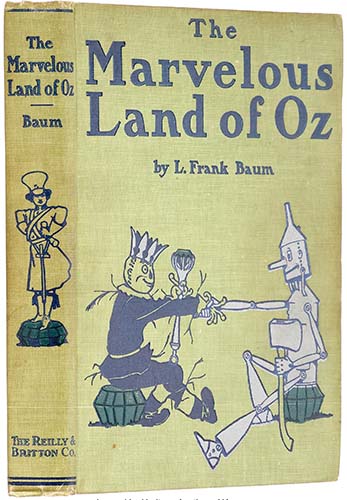
The Missing Princess of the Marvelous Land

I’ve been thinking about how The Marvelous Land of Oz could be more of a mystery. As it is, the book is a roller-coaster ride of political events. Every so often it raises the question of who should rule the Emerald City. But the book doesn’t give us all the clues to its ultimate answer until quite late.

Baum and his colleagues had introduced the character of Pastoria, former king of Oz, in the 1902 stage extravaganza The Wizard of Oz. Therefore, when the Scarecrow mentions his name in the sixteenth chapter of Land, it wouldn’t have been a complete surprise to all readers.

Nonetheless, that was two-thirds of the way through the book. Furthermore, Glinda doesn’t drop the bombshell that Pastoria left a missing daughter until four chapters later. That means readers have only three chapters to be thinking about this mystery, on which the conclusion of the story will hinge.

There are plenty of signs that Baum didn’t like going back to revise. He occasionally excised whole chapters or inserted new passages, but his surviving manuscripts and correspondence show none of the fiddling with details that other writers regularly performed.

I don’t think it would have taken much revising to cue readers into thinking about Pastoria and his daughter for much of the book. Here are some slightly rewritten passages in which characters discuss the history of Oz.

In Chapter 3, the boy Tip is trying to orient his creation, Jack Pumpkinhead:
“Where are we going?” asked Jack, when they had resumed their journey.

“I’m not exactly sure,” said the boy; “but I believe we are headed South, and that will bring us, sooner or later, to the Emerald City.”

“What city is that?” enquired the Pumpkinhead.

“Why, it’s the center of the Land of Oz, and the biggest town in all the country. I’ve never been there, myself, but I’ve heard all about its history. It was built by a mighty and wonderful Wizard named Oz, around the estate of the former king Pastoria, and [later] . . . the people of the Emerald City invited the Scarecrow to rule them.”

“Dear me!” said Jack. “I’m getting confused with all this history. Who is the Scarecrow?”

“Another friend of Dorothy’s,” replied Tip.

“And who is Dorothy?”

“She was a girl that came here from Kansas, a place in the big, outside World. She got blown to the Land of Oz by a cyclone, and while she was here the Scarecrow and the Tin Woodman accompanied her on her travels.”

“And where is she now?” inquired the Pumpkinhead.

“Glinda the Good, who rules the Quadlings, sent her home again,” said the boy.

“Oh. And what became of the Scarecrow?”

“I told you. He rules the Emerald City,” answered Tip.

“I thought you said it was ruled by a wonderful Wizard,” objected Jack, seeming more and more confused.

“Well, so I did. Now, pay attention, and I’ll explain it,” said Tip, speaking slowly and looking the smiling Pumpkinhead squarely in the eye. “Around the time King Pastoria vanished, the Wizard came and built the Emerald City and ruled for many years. Dorothy went to the Emerald City to ask the Wizard to send her back to Kansas; and the Scarecrow and the Tin Woodman went with her. But the Wizard couldn’t send her back, because he wasn’t so much of a Wizard as he might have been. And then they got angry at the Wizard, and threatened to expose him; so the Wizard made a big balloon and escaped in it, and no one has ever seen him since.”

“Now, that is very interesting history,” said Jack, well pleased; “and I understand it perfectly all but the explanation.”
After Jack and Tip get separated, the boy meets a pretty young woman in a colorful military uniform. With a little tweaking, this conversation could have been part of that Chapter 8:
“I am General Jinjur,” was the brief reply.

“Oh!” said the boy surprised. “What sort of a General?”

“I command the Army of Revolt in this war,” answered the General, with unnecessary sharpness.

“Oh!” he again exclaimed. “I didn’t know there was a war.”

“You were not supposed to know it,” she returned, “for we have kept it a secret; and considering that our army is composed entirely of girls,” she added, with some pride, “it is surely a remarkable thing that our Revolt is not yet discovered.”

“It is, indeed,” acknowledged Tip. “But where is your army?”

“About a mile from here,” said General Jinjur. “The forces have assembled from all parts of the Land of Oz, at my express command. For this is the day we are to conquer His Majesty the Scarecrow, and wrest from him the throne. The Army of Revolt only awaits my coming to march upon the Emerald City.”

“Well!” declared Tip, drawing a long breath, “this is certainly a surprising thing! May I ask why you wish to conquer His Majesty the Scarecrow?”

“Because the Emerald City has been ruled by men long enough, for one reason,” said the girl. “Before the Scarecrow there was the Wizard, and before the Wizard, or even the city as it stands today, there was King Pastoria. Some people say Pastoria had a daughter who was meant to rule over us, meaning that we should have had a girl ruler by this time, but no one has seen that child for years.”

That lost heir was not part of the history of Oz that Tip had heard from Mombi. He puzzled over this rumor as Jinjur went on:

“Moreover, the City glitters with beautiful gems, which might far better be used for rings, bracelets and necklaces; and there is enough money in the King’s treasury to buy every girl in our Army a dozen new gowns. So we intend to conquer the City and run the government to suit ourselves.”
Tip and Jack Pumpkinhead reunite in the Scarecrow’s palace, only for General Jinjur to seize the Emerald City. Later the Scarecrow seizes the palace back with the help of his close friend, the Tin Woodman. But at that point in Chapter 16, the straw-man ruler is ready to abdicate:
Tip soon cut the stitches that had fastened the crown to the Scarecrow’s head, and the former monarch of the Emerald City removed it with a sigh of relief and hung it on a peg beside the throne.

“That is my last memento of royalty,” said he; “and I’m glad to get rid of it. The former King of this City, who was named Pastoria, lost the crown to the Wonderful Wizard, who passed it on to me. Now the girl Jinjur claims it, and I sincerely hope it will not give her a headache.”

“A kindly thought, which I greatly admire,” said the Tin Woodman, nodding approvingly.

“Have you ever heard,” Tip asked the straw man, “that King Pastoria had a daughter who disappeared?”

“Some people do say that,” answered the Scarecrow, “and some say otherwise. That happened well before my time, so I cannot say anything about it. Why—do you think General Jinjur is this lost heir to Pastoria?”

Tip shook his head. After all, Jinjur was the person who had first told him about the missing princess, and she had made no claim to rule the Emerald City other than by force and cunning.

“Well, now I will indulge in a quiet think,” continued the Scarecrow, lying back in the throne.
Finally, the Scarecrow and his supporters reach Glinda’s palace in Chapter 20:
“Therefore I have come to beg your assistance,” resumed the Scarecrow, “for I believe you are always glad to succor the unfortunate and oppressed.”

“That is true,” replied the Sorceress, slowly. “But the Emerald City is now ruled by General Jinjur, who has caused herself to be proclaimed Queen. What right have I to oppose her?”

“Why, she stole the throne from me,” said the Scarecrow.

“And how came you to possess the throne?” asked Glinda.

“I got it from the Wizard of Oz, and by the choice of the people,” returned the Scarecrow, uneasy at such questioning.

“And where did the Wizard get it?” she continued gravely.

“I am told he took it after Pastoria, the former King, had not been heard from for some time,” said the Scarecrow, becoming confused under the intent look of the Sorceress.

“Then,” declared Glinda, “the throne of the Emerald City belongs neither to you nor to Jinjur, but to this Pastoria from whom the Wizard usurped it.”

“That is true,” acknowledged the Scarecrow, humbly; “but Pastoria has been gone for many years now, and some one must rule in his place.”

“Pastoria had a daughter, who is the rightful heir to the throne of the Emerald City. Did you know that?” questioned the Sorceress.

“Not for certain,” replied the Scarecrow. “But if that girl still lives I will not stand in her way. It will satisfy me as well to have Jinjur turned out, as an impostor, as to regain the throne myself. In fact, it isn’t much fun to be King, especially if one has good brains. I have known for some time that I am fitted to occupy a far more exalted position. But where is the girl who owns the throne, and what is her name?”

“Her name is Ozma,” answered Glinda. “But where she is I have tried in vain to discover. For the Wizard of Oz, when he stole the throne from Ozma’s father, hid the girl in some secret place; and by means of a magical trick with which I am not familiar he also managed to prevent her being discovered—even by so experienced a Sorceress as myself.”
By that point, readers would have been thinking about the Emerald City’s deep history for most of the book, and the mystery of the missing heir for a dozen chapters. Where could that child be?

19 January 2024

Detecting Style

“Red Eye” is a short story by Michael Connelly and Dennis Lehane. It was published in Face Off and then in The Best American Mystery Stories 2015, where I read it.

David Baldacci, the editor of Face Off, invited established crime writers to write short stories that brought their lead characters together. In “Red Eye,” Connolly’s L.A. police detective Harry Bosch meets Lehane’s Boston private eye Patrick Kenzie.

It looks like Connolly and Lehane traded sections, Connolly writing those parts told by following Bosch and Lehane those tracking Kenzie. Usually Kenzie is the narrator of the novels that feature him, but to match Connolly Lehane wrote in the close third person.

Even beyond the central characters, the sections are easily distinguished by the authors’ styles. Connolly is stripped down, short sentences and terse observations.

Lehane’s sections, in contrast, are full of sentence fragments, aphroisms, metaphors. It’s still hard-boiled prose, but it’s not afraid of style.

The contrast reminds me of the difference between Dashiell Hammett’s The Maltese Falcon and Raymond Chandler’s The Big Sleep. And I like a little more ornament in my prose.

27 November 2023

The Man with a Butler Did It

This month I read two British murder mysteries, published twenty years apart, in which the culprit turned out to be the local bigwig killing someone who was blackmailing him.

(I’m withholding the names of those books to protect the dénouements.)

Now I’m trying to figure out if that trope suggests an ingrained suspicion of privilege, showing that the local wealthy squire is not to be trusted.

Or do those books reinforce social hierarchies, since both these murderers had risen from the lower classes to their high places in society through blackmailable methods?

29 August 2022

The First Part of “The Donnington Affair”

In 1914, Max Pemberton published part of a murder mystery in a magazine called The Premier. It was titled “The Donnington Affair.”

Pemberton sent proofs of the story to G. K. Chesterton, inviting him to complete the mystery with a pleasing solution.

Chesterton obliged, bringing in his sleuth Father Brown. The result is an oddity in Chesterton’s oeuvre, not included in the first Father Brown omnibuses.

After Chesterton fans rediscovered the story, anthologists began to include “The Donnington Affair” in collections of the Father Brown stories—but usually only Chesterton’s part. The result is less than fully coherent. (A 2012 edition of The Complete Father Brown is indeed complete.)

Pemberton lived until 1950, so his work remained under copyright protection in the U.K. until 2020. That year, the Chesterton Review published the whole story, but that issue is behind a paywall.

Fortunately for people who like a complete narrative, Metropolitan Magazine bought the U.S. serial rights in the story, and Google has digitized the issue that includes Pemberton’s part. So you can start reading the tale here. There’s even a picture by Dalton Stevens.

The same volume of Metropolitan includes stories by Booth Tarkington, Mary Roberts Rinehart, Richard Harding Davis, Joseph Conrad, E. C. Bentley, and more; nonfiction by John Reed, Lincoln Steffens, Walter Lippmann, Francis Ouimet, and H. G. Wells; and humorous tales each with one illustration (not, unfortunately, comics) by Harry Grant Dart.

07 September 2020

Did Wodehouse Influence Christie?

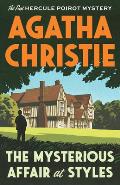
The Mysterious Affair at Styles made me wonder if Agatha Christie’s portrayal of the relationship between Capt. Arthur Hastings and Hercule Poirot might have been influenced by P. G. Wodehouse’s stories of Bertie Wooster and Jeeves.

In both cases, the narrator is a young upper-class Englishman with no professional responsibilities, affable manners, a weakness for pretty ladies, and modest intellectual ambitions that nonetheless exceed his capacities. This narrator describes how a punctilious man from a lower social class uses his brilliant mind to deduce solutions and put things right. Hastings and Bertie admire Poirot and Jeeves, but they also resent being pulled along, which produces some of the stories’ entertainment.

On the question of influence, the first factor I examined was when Christie wrote The Mysterious Affair at Styles. She reported writing the first draft in 1916, taking two weeks off work to check into a Torquay hotel to finish.

But then, I presume, Christie revised the manuscript. One strong indication of that is how subsequent Poirot stories (“The Affair at the Victory Ball,” The Murder on the Links) make clear that the action of the novel starts in July 1917 after Hastings has spent “some months” recuperating from being wounded in the Battle of the Somme, which took place in late 1916. Christie thus came to conceive of her first novel as taking place months after she had written her first draft.

It also took Christie years to find a publisher. When John Lane agreed to issue the book at the Bodley Head press, he insisted that Poirot reveal the murderer by gathering all the suspects in the drawing room, a device that had already become standard in murder mysteries. (Christie originally had Poirot share his revelations in court.) The book thus went through a final revision stage before it was published in 1920.

Therefore, we can date Christie’s creation of the full text of The Mysterious Affair at Styles to the period from 1916 to 1920. But we don’t know when in that period she cemented the characterization of Hastings and Poirot. Did she start with the characters and find a mystery for them, or start with the plot and develop the characters around it?

The next question is whether Agatha Christie read P. G. Wodehouse. Decades later, when they were both internationally bestselling authors, the two became friendly correspondents. In her first letter to Wodehouse, Christie said she enjoyed his 1913 novel The Little Nugget, which involves kidnappers, an upper-class hero at loose ends, and a Pinkerton detective working as a butler. But there’s no way to know when she read that book—as early as 1913 or just a few years before her letter. We also have no indication of whether Christie read the short stories Wodehouse sold to British magazines in the 1910s, which are the crucial texts in this question.

P. G. Wodehouse spent most of that decade in New York City, enjoying the excitement of America and the rewards of selling the same work to both American and British publishers. Many of his tales involved Englishmen in America, and among those was a series of short stories about a young gentleman named Bertie and his gentleman’s gentleman.

Those characters made their first appearance in the story “Extricating Young Gussie,” published in America’s Saturday Evening Post in September 1915 and in Britain’s The Strand Magazine in January 1916 (and of course it’s the latter date that pertains to the Christie question). At that point, Bertie didn’t have a last name, though he already had an Aunt Agatha. Jeeves was simply a generic valet. With “The Artistic Career of Corky”/“Leave It to Jeeves” (The Strand, June 1916), Wodehouse hit on the idea of Jeeves being a problem-solving genius.

Finally, Wodehouse started to explore the frictions between Bertie and Jeeves in “The Aunt and the Sluggard” (The Strand, August 1916) and “Jeeves and the Unbidden Guest” (The Strand, March 1917). He also wrote “Jeeves Takes Charge,” providing an origin story for the team, but that wasn’t published in Britain until 1923. In these tales we see Bertie pushing back against Jeeves’s sartorial advice, resenting his silences, and finally coming around to realizing his brilliance.

That’s the same dynamic I see in Capt. Hastings and Poirot, already fully realized in the published text of The Mysterious Affair at Styles. Comparing the dates show it was possible Christie was inspired by Wodehouse’s magazine stories as she developed her novel, particularly after the first draft. But there’s no conclusive clue about influence. The similarity might simply be the result of similar ideas occurring to two authors around the same time, like two separate characters out to snatch the same diamond necklace or handwritten will.

01 September 2020

Captain Hastings’s True Worth

In the end, after the drawing-room revelations that the publisher demanded, I enjoyed Agatha Christie’s The Mysterious Affair at Styles more as a series of character sketches and dialogues than as a murder mystery.

For me, the solution relied too much on esoteric aspects of poisons. (Christie was working at a wartime pharmacy.) The number of people administering said poisons, sneaking into bedrooms at night, and trying to frame or shield other people became incredible. In an excellent mystery, everything comes together at the end with an almost audible click. There was still a bit of scraping in this debut.

That said, the character of Hercule Poirot seems to have come out fully formed and delightful. There’s a rich vein of supporting characters with distinct personalities and speech patterns, most of whom pair off at the end like a Shakespearean comedy. And for the first time I appreciated Capt. Arthur Hastings as a comedic character.

Christie clearly took inspiration from Arthur Conan Doyle’s Holmes and Watson when she wrote about Poirot and Hastings, especially in the short stories that followed the success of this novel, in which the men share rooms in London. But Dr. John Watson was an intelligent, resourceful man, appearing incapable only because he was standing next to an obsessed genius. He helped Sherlock Holmes in many ways. He never came across as a doofus until the character was written that way for Nigel Bruce in the movies.

Hastings, in contrast, provides only one type of assistance to Poirot: entrée into upper-class British society. Well, two things if we add light entertainment in the course of a trying case, as shown in this discussion of the likely murderer:
“Someone with a good deal of intelligence,” remarked Poirot dryly. “You realize that he chose the one place in the house to hide it where its presence would not be remarked? Yes, he is intelligent. But we must be more intelligent. We must be so intelligent that he does not suspect us of being intelligent at all.”

I acquiesced.

“There, mon ami, you will be of great assistance to me.”

I was pleased with the compliment. There had been times when I hardly thought that Poirot appreciated me at my true worth.
Early in the book, Hastings, who’s recovering from a battlefield wound, speaks of becoming a detective. He coddles easy theories about the murder and records lots of clues whose significance passes him by completely. (Poisons not among them.)

Hastings’s attention is easily caught by beautiful women, though his code means he doesn’t pursue another man’s wife and impulsively proposes marriage to an unmarried woman he thinks is about to cry. As a narrator, Hastings alternately admires Poirot, feels baffled by his momentary “mistakes,” and occasionally resents his superiority and secrecy.

To sum up, in The Mysterious Affair at Styles Capt. Hastings behaves very much like Bertie Wooster toward Jeeves.

COMING UP: The Code of the Wodehouses?

26 August 2020

Christie Exercises the Little Grey Cells

Reading Agatha Christie’s first novel, The Mysterious Affair at Styles, for the first time, I was struck by how she used dialogue to give hints about action that she never described.

Examining those passages further, it seems clear that Christie uses that technique to make readers’ brains work a little harder—to different purposes.

During an early visit to a pharmacy department of the sort Christie herself was working in, the pharmacist says:
“If you people only knew how fatally easy it is to poison someone by mistake, you wouldn’t joke about it. Come on, let’s have tea. We’ve got all sorts of secret stories in that cupboard. No, Lawrence—that’s the poison cupboard. The big cupboard—that’s right.”
By making us perform a little extra effort to understand that Lawrence is interested in the poison cupboard, Christie implants him in our minds as a suspect. Actual culprit or red herring? We find out in the end.

About midway through the book comes another example of the same technique as our narrator, Col. Hastings, interviews a local rustic.
“Why, do the gentlemen from the Hall come here often?” I asked, as carelessly as I could.

He winked at me knowingly.

“One does, mister. Naming no names, mind. And a very liberal gentleman too! Oh, thank you, sir, I’m sure.”
Christie never tells us outright that Hastings has responded to the farmer’s hint by giving him a little tip for his information. We have to recreate that bit of business from the farmer’s words.

And our brains are so occupied with reassembling that interaction from clues that we don’t notice the farmer hasn’t actually specified which gentleman from the hall has been visiting. Hastings is sure he knows, but, of course, he’s barking up the wrong tree entirely.

07 November 2019

The Real Legacy of He Walked by Night

He Walked by Night didn’t influence The Third Man, but it definitely did influence American popular entertainment.

To start with, it appears to be the first movie that includes a scene of self-surgery. The bad guy stitches himself up after being shot, using a mirror and a lot of grit. I’ve seen variations of that scene in The Terminator, Ronin, and Master and Commander, but this might be the original.

Even more clearly, He Walked by Night gave birth to the most visible and long-lasting form of the dramatized police procedural. It even starts with an announcement that the story was based on real crimes, and that “names have been changed to protect the innocent.”

One of the supporting characters in the movie is a police lab technician played by Jack Webb. He’s young and almost winsome in the role.

At the time, Webb’s most prominent parts were as the star of the radio dramas Pat Novak, for Hire, about an unlicensed investigator who works at a pier, and Johnny Madero, Pier 23, about a pier manager who undertakes investigations. As was standard in hard-boiled mysteries, the cops in those stories were at best a rival for the hero, at worst a hindrance.

While working on He Walked by Night, Webb met the movie’s technical advisor, Detective Sergeant Marty Wynn of the Los Angeles Police Department. Their conversations and the movie’s format gave Webb the idea of creating a radio drama about a police detective, inspired by real crimes and portraying realistic law-enforcement techniques.

The LAPD also loved that idea and got behind it. Dragnet premiered in June 1949 with Webb in the starring role of Sgt. Joe Friday. It ran for more than eight years on radio. For most of those years, a version also ran on television for nine years, and there was a movie adaptation as well. Then the TV show was revived in 1966 with a TV movie and more than four more years of episodes. Webb expanded the procedural franchise in the 1970s by producing Adam-12 and Emergency!

Dragnet made Webb’s Joe Friday character a national icon, cementing his image as an actor and even his politics. That means it’s very striking to see him play a different personality in He Walked by Night, or to hear him as a cornet player during Prohibition in the fine radio drama Pete Kelly’s Blues.

30 September 2017

Pocketing the Bad Machinery Series

I heartily enjoy John Allison’s Bad Machinery graphic novels, following a team of teen detectives in the fictional mid-sized city of Tackleford, England.

Allison created these stories first as webcomics, and they retain that form’s rhythm. Each page has a payoff of its own. The narrative can jerk ahead in time from one to the next. That serves the sprawling stories well since they’re as much about upper-school personalities and the British class system as that term’s mystery.

Allison drew his pages to the dimensions of a computer screen, about half again as wide as they are tall. As a result, the first print editions were more than a foot wide, floppy and hard to shelve. I loved the stories, but I didn’t have space for them all.

Oni Press has started to reissue the Bad Machinery books in “Pocket Editions,” a shade less than nine inches wide. That makes them the same size as the seventh and latest volume, The Case of the Forked Road, which Allison created in a more traditional vertical format for print.

I was worried, however, that my aging eyes wouldn’t be able to read the balloons on the smaller pages. But I took a chance on the first two volumes, The Case of the Team Spirit and The Case of the Good Boy, and my eyes worked fine. While I still don’t see as many commas of direct address as I’d like, Allison’s verbal wit comes through just as well as his visuals.

(In addition to the seven Bad Machinery novels, one of the Tackleford teens, Charlotte, crosses over into another of Allison’s series in Murder, She Writes, set in the cutthroat world of children’s publishing. It’s a fine introduction to Allison’s work.)

29 August 2017

No Need to Visit Skull Castle

Seeing Dirk Gringhuis’s 1964 Mystery at Skull Castle in David Maxine’s collection made me curious about it. Fortunately, David has already shared a thorough review that answers nearly all my questions about the book and its connections to the Oz series.

Just a taste:
The boys [Bram and Piet] are secretly saving money to purchase a new buggy for Piet's uncle. They move their savings to the old burnt-out castle for safekeeping. While at the castle they find a stash of jewels and seconds later meet Major Willoughby, supposedly the long lost heir to the man who built the castle, and his East Indian servant, Singh. The Major cons the boys into leaving their money in the same niche that the jewels were in and tells them to keep quiet about the discovery. . . .

Bram and Piet are stupid and oblivious. They are gullible to every idiotic suggestion and notion the Major tells them. They ignore the truth even when little Bertram is telling them flat out he just watched the Major steal the jewels. Even after they manage to escape their bonds in the castle they don't run for help in town but allow themselves to be cornered on the shore of Lake Michigan where they cower until Piet's uncle solves the mystery (he recognized the red mud of the castle grounds on the major's wagon wheels) and comes down to the shore where he hears the commotion and shoots the Major. In a children's mystery, shouldn't the main characters be the ones to find the solution?

Not only do Bram and Piet not solve the mystery, their primary goal at the beginning comes to nothing, since the uncle has no interest in a new buggy.
Kirkus Reviews was no more complimentary in 1964: “An incredible, poorly plotted story . . . In the story which amounts to little more than a wild chase, the boys and lesser figures are paper thin.”

17 July 2017

Airlocked-Room Mystery

In 2002, M. T. Anderson began his novel Feed with the line, “We went to the moon to have fun, but the moon turned out to completely suck.”

The first narrative page of Stuart Gibbs’s Space Case from 2015 includes the line, “Life in outer space sucks. Believe me, I know.”

I note that parallel not to underscore the similarity of the two books in the science fiction mode, but to introduce how they zoom off in different directions from that point.

Anderson wrote a young adult novel that took place mostly in its enervated narrator’s head and conversations. The big dramatic turns are shopping expeditions and a fatal disease. It turns out the moon isn’t the only place that completely sucks.

Space Case, in contrast, is for “Ages 8-12.” It’s plot-driven, not character-driven. The hero’s sucky life on the Moon gets a jolt of excitement from a mysterious death that only a twelve-year-old can solve. With a limited cast of characters, the lunar base a fine set-up for a murder mystery.

In the end, however, the science fiction wins out over the mystery in Space Case. The explanation for the death turns out to involve a scientific discovery that the narrator and readers weren’t privy to earlier in the story. Though that resolution’s beyond the bounds of current science, it’s not beyond the bounds of a science-fiction fan’s imagination.

25 August 2014

The Sheriff of Loving County

This New York Times article about radioactive waste and a very small county in west Texas included the photo shown above.

You might spot the detail that sent me on a research journey which ended at this Find-a-Grave page about Edna Reed Clayton Dewees, along with some Wikipedia entries. And that led to this set-up for a series of murder mysteries—

It’s January 1945 in a very small county in west Texas called Loving, tucked alongside the Pecos River. Twenty-three-year-old Edna Reed has been working at Pecos Army Air Field, having previously contributed to the war effort by operating a lathe in a Fort Worth aircraft plant. But before those jobs, Edna was Deputy District Clerk in another county, so she knows the levers of the local government.

When the position of Loving County sheriff becomes vacant and there aren’t enough young men around, the town fathers ask Edna to accept the post. Then she finds that she likes being sheriff. So, even though no woman has ever been elected sheriff in Texas, Edna Reed decides to run for the job.

For a wide-open place, Loving has a shady history. It was first incorporated by out-of-state businessmen who fled with all the official records when their fraud was exposed, then reincorporated in 1931 as its population was rising suddenly.

Now the war has ended and soldiers are coming back to Loving County. How will the local establishment deal with those men’s new ambitions, values, and troubles? Does any of them want to become sheriff, or become Edna’s husband? The place has very little reported crime, but what secrets lurk in its past? Can young Edna Reed keep the peace in Loving County without carrying a gun?

And so far, all that is nonfiction.

19 August 2014

J. A. Jance and the Oz Books

I’ve been hearing about the mystery writer J. A. Jance’s appearance at the Moravian Bookshop in Bethlehem, Pennsylvania, so I decided to highlight how she became a writer.

She’s told this story in many brief ways, but this essay for the Seattle Post-Intelligencer seems to have the most detail:
I ended up in Mrs. Spangler’s [second-grade] class, and that, too, was a life-changing event. On a shelf under the window, Mrs. Spangler had a collection of books. If we finished our work early, we were allowed to go to the bookshelf and choose a book. I always finished my work early, and that’s where I discovered The Wizard of Oz–not the movie, but the book by Frank Baum. And not just that one book, either, the whole series, all of them. For me, it was love at first sight.

Some kids encountering The Wizard of Oz focus on the Wizard himself, the funny little guy hiding behind his green curtain. What I saw was Frank Baum hiding behind the words, and as soon as I realized someone had put those words on paper, that’s who I wanted to be and what I wanted to do. I wanted to write books; tell stories; put words on paper.
In another interview, Jance also highlighted John D. McDonald’s Travis McGee thrillers: “That was when I realized it was possible to write series books for grown-ups. There were of course other authors who wrote series books for grown-ups, but that was one that was readily accessible for me.”

I was struck by how the card page (i.e., the “Other Books by This Author” page) in Jance’s latest books, listing two hefty mystery series and a bunch of other titles, has the same sense of promise as the long list printed in some Oz books.

17 July 2013

Rowling as a Mystery Writer All Along

Last week’s revelation that J. K. Rowling has published a pseudonymous murder mystery sent folks back to the archives for clues they wished they had seen all along: her remarks that she might publish under another name, a brief mention of a Scottish mystery she was trying out.

But the most perspicacious commenter was probably trivia master Ken Jennings, who wrote back in 2007:

I read the Harry Potter books as enormously sophisticated Scooby-Doo mysteries.

Structurally, these aren’t fantasy novels at all. They’re fair-play mysteries in wizard’s clothing–novels with not just plots and characters and setpieces, but “solutions” as well. J. K. Rowling is justly praised for her elaborate and meticulous world-building, but I’m convinced that a lot of that endless detail is just there for standard detective-novel purposes: to distract, to confound, to envelop the real “clues” in a Cloak of Invisibility. . . .

Rowling seems to draw more from the Agatha Christie tradition: a multiplicity of colorful “suspects,” many with hidden agendas; red herrings galore; and a final drawing-room exposition-fest in which Hercule Dumbledore explains How It Was Done.

Just as in a murder mystery, the guilty party is always the least likely suspect. . . . Some of these reveals even involve the Hogwarts equivalent of a Scooby-Doo rubber mask coming off the crotchety caretaker: Quirrell’s turban, Pettigrew’s Animagus disguise, Barty Crouch, Jr.’s Polyjuice Potion. “Like, zoiks, Hermione–it was Old Man Milligrew all along!” . . .

I bet Rowling’s first post-Harry Potter book–talk about a hard act to follow–will be a classic mystery of some kind. I don’t know if it’ll be a hard-boiled gumshoe case, a true-crime police procedural, a classic manor-house throwback, or what, but it’ll be a mystery novel. She’s been writing them all along, after all. It’s just that no one’s noticed.
And couldn’t Rupert Grint play a fine Shaggy?

TOMORROW: What this should tell us about genre.

15 April 2013

The Mystery

You might remember this photograph from 2007. That is Godson’s Brother, engrossed in a mystery.

For their shared birthday I usually send Godson and his Brother books, sometimes comics and sometimes prose. My choice for Godson last month was Tui and Kari Sutherland’s The Menagerie. For Godson’s Brother, who reads everything that his eyes fall on, I sprang for two paperbacks: Ellen Raskin’s The Mysterious Disappearance of Leon, I Mean Noel and The Westing Game.

Their mother is a stickler for thank-you notes, which arrived this weekend. Godson’s says in part:
I am very much looking forward to reading them. Captain Awesome away!
(Captain Awesome, the other side of the notecard makes clear, has telekinesis.)

Godson’s Brother wrote:
I really enjoyed reading them!
Well, I thought, that’s what I should expect. Two books couldn’t keep him occupied for long. Probably onto four more by now. Hardly made a dent.

But it looks like Godson’s Brother’s use of the past tense might have been a little poetic license. Today their mother emailed me that Godson’s Brother
ran into our bedroom at 6:10 this morning and exclaimed, “EUREKA! I GOT IT! I FIGURED OUT”…waving The Westing Game around. He sat on the floor, started to read again and said “Ohhhhhhh…”, got up, and wandered out.

10 April 2013

A Mystery with Not-So-Secret Identities

A while back, I had the idea for a mystery story set in the world of mid-1900s American comics publishing. I’m still working on that, but in the meantime I sampled Max Allan Collins’s A Killing in Comics, the first in a series of mystery novels set, well, in the world of mid-1900s American comics publishing.

I should have expected Collins to have worked out this idea already. He’s written many comics himself, including the Dick Tracy newspaper strip for many years, the Ms. Tree private-eye stories, and The Road to Perdition. Collins was the Batman scripter who gave the second Jason Todd his past as a runaway with criminal parents.

Collins is also a prolific writer of prose mysteries, including his award-winning Nathan Heller books, another series built around major modern disasters, and numerous novelizations. So basically he’s already worked out every idea for a mystery story.

A Killing in Comics is clearly inspired by Gerard Jones’s Men of Tomorrow, which has become the authoritative history of the start of the American comic-book industry. It’s a roman à clef about the first generation of DC Comics, or more particularly about the men who worked on its most famous creations, Superman and Batman. But in this book those trademarks are cleverly disguised as Wonder Guy and Batwing.

Thus, instead of Jerry Siegel and Joe Shuster, the book gives us Harry Spiegel and Moe Shulman—but they’re almost exactly as Jones characterized the Superman creators. On the Batman side, Bob Kane becomes Rod Krane, Bill Finger becomes Will Hander, and Jerry Robinson becomes…nothing, because unlike the other creators there’s no clear moral conflict in his career. Editor Mort Weisinger is on the scene at Sy Mortimer but as of 1948 hasn’t reached his full potential as a villain.

The detective, Jack Starr, is the troubleshooting vice president of a newspaper syndication service. Though he refers to his father as “the major,” reminiscent of Maj. Malcolm Wheeler-Nicholson, this business is actually successful. It’s also run by a version of Gypsy Rose Lee, a retired stripper of an intellectual kind. That’s the most fictional part of the book.

As with Oz the Great and Powerful, the story is a little less interesting than watching it play out just on the edge of its source material without stepping over the line onto that territory. In this case, the mystery depends on all those comics pros being capable of killing the equivalent of the president of DC Comics. So of course “any resemblance to actual persons…is entirely coincidental,” as the copyright page says.

Further volumes in Collins’s Jack Starr series appear to be inspired by the Li’l Abner Broadway show of 1956 and its roots in newspaper comics, and by Dr. Fredric Wertham’s anti-comics crusade.

28 February 2013

The Lost Opportunity in Zero Dark Thirty

In turning the evacuation of six American diplomats out of Teheran in 1979 into a Hollywood movie, Argo had to distort the historical events, as I discussed back here. There simply could not have been a mass-market movie any other way.

In contrast, the historical distortions of Zero Dark Thirty are less apparent but also less necessary. The major issue, which has reached the level of critical letters from a bipartisan group of US Senators, is whether torturous interrogation methods led to information necessary for finding Osama bin Laden in Abbottabad, Pakistan. Much of the historical record is secret and debated, but there have been enough revelations to say that Zero Dark Thirty skews reality.

The movie opens with a harsh, extended torture-interrogation scene, the first that heroine Maya watches. As Steve Coll in The New York Review of Books explains:
There can be no mistaking what Zero Dark Thirty shows: torture plays an outsized part in Maya’s success. The first detainee she helps to interrogate is Ammar. He is tortured extensively in the film’s opening sequence, immediately after we hear the voices of World Trade Center victims. Ammar’s face is swollen; we see him strung up by ropes, waterboarded, sexually humiliated, deprived of sleep through the blasting of loud music, and stuffed into a small wooden box. During his ordeal, Ammar does not initially give up reliable information. After he has been subdued and fooled into thinking that he has already been cooperative while delirious, however, he gives up vital intelligence about the courier over a comfortable meal.

Some viewers might regard Ammar’s final confession in the midst of warm hospitality as an example of torture that did not work, or worked only partially. In fact, this sequence of the film depicts precisely how the CIA’s coercive interrogation regime was constructed to break prisoners…
Another prisoner gives Maya information while telling her, “I have no desire to be tortured again.” Coll concludes, “In virtually every instance in the film where Maya extracts important clues from prisoners, then, torture is a factor.” Those particular detainees are fictional composites, though the movie refers to other, real prisoners, such as “KSM,” or Khalid Sheikh Muhammed.

I think Zero Dark Thirty also suggests that the torture is horrifying, undesirable, even possibly harmful to everyone involved. It seems to burn out Maya’s mentor from the first scene. There’s a strong but implicit theme that Maya’s dogged, generally nonviolent techniques are better. In essence, the movie implies that she and her CIA colleagues have to grow beyond the violent interrogations. But the movie leaves out historical details that would have strengthened that theme.

First of all, the movie doesn’t show Maya or other investigators being thrown off by false leads that prisoners offered just to stop torture. It shows other sorts of dead ends and a sneak attack on Maya’s agency by Islamist terrorists. But Zero Dark Thirty ignores the drama inherent in one powerful argument against torture: it doesn’t produce reliable information.

Though the movie shows Maya debating with her colleagues and higher-ups about her conclusions, it never shows how some officials, notably the FBI, objected to the use of torture. The filmmakers bypassed that source of drama and the chance to show character growth.

Furthermore, Zero Dark Thirty presents torture sessions as directed, indeed improvised, by a CIA agent in the field. It doesn’t show the whole bureaucratic apparatus that our government built around the practice, with lawyers, psychologists, and physicians involved in planning and supervising interrogation sessions. Some intelligence professionals have called that inaccurate. The narrative effect is that Zero Dark Thirty insulates its audience from how the harsh treatment we’re seeing isn’t the tactic of one desperate agent but the considered policy of the US government.

I call those omissions unnecessary because a more accurate portrayal could have been just as dramatic, perhaps more so. Until the final raid on Abbottabad, the movie gets its drama from Maya’s push against her agency’s entrenched thinking, her struggle to find useful leads in a haystack of vague hints. Showing her come to doubt the value of the torture policy and struggle with false leads would have fit right into that storyline—and presented a more accurate history.