Showing posts with label Trot. Show all posts

30 July 2019

Sea Fairies and Sea Sirens

Sea Sirens is a new middle-grade graphic novel by Amy Chu and Janet K. Lee. It’s subtitled A Trot & Cap’n Bill Adventure, and the back cover says it was “inspired by L. Frank Baum’s classic adventure The Sea Fairies, the ‘underwater Wizard of Oz.’” The story’s last page promises more Trot & Cap’n Bill Adventures.

However, this is not a story about Trot and Cap’n Bill from The Sea Fairies and Sky Island, whom Baum settled in the Emerald City in The Scarecrow of Oz. It’s a remix of elements from The Sea Fairies including the names of major characters, the setting in and off the coast of southern California, and the general idea of being able to breathe underwater to visit mermaids.

Baum’s Sea Fairies is one of his weaker fantasies, though it introduces some of his most winning characters and one of his scariest villains. As in Jules Verne’s Twenty Thousand Leagues Under the Sea, a lot of pages are taken up by underwater tourism with little plot (but, in Baum’s case, plenty of puns). Though Trot is a winning personality already distinct from Dorothy Gale, she functions mostly as an observer; she becomes more of a plot driver in Sky Island.

Lee, who created the striking Return of the Dapper Men, had the idea to pull from The Sea Fairies to create a modern adventure. Like Trot, the Trot* in Sea Sirens lives along the southern California coast with her mother and a disabled older man—not a one-legged sailor but her grandfather, who suffers from intermittent dementia. The new Cap’n Bill* is one-eyed cat.

Trot* is a Vietnamese-American surfer. About twenty years ago I wrote an Oz novel featuring a Vietnamese-American surfer as the child who travels to the Emerald City. I’m therefore particularly intrigued by Trot*. Both stories hinge on the powerful allure of surfing, particularly as a respite from domestic tensions.

In The Sea Fairies, Trot and Cap’n Bill are boating off the coast when the mermaids of the title appear and invite them to visit. They want to disabuse Cap’n Bill of his superstitious ideas about mermaids luring sailors to their deaths. Once underwater, Trot and Cap’n Bill meet many creatures, culminating in a gigantic, ancient sea serpent named King Anko, who presides over the Pacific. Then they get captured by the villainous Zog.

Sea Sirens strives for more conflict from the start. (Perforce this paragraph and the following contain SPOILERS.) Trot* is at odds with her mother over whether it’s safe to leave her wandering grandfather to go surfing. Trot* and Cap’n Bill* almost drown before a mermaid princess with her own mother issues rescues them and empowers them to breathe underwater. The mermaid queen Aquareine* is imperious instead of just friendly. The mermaids are close to war with a nation of underwater serpents, and Trot*’s grandfather wanders into their possession.

However, in the end that conflict washes away in a few pages. The King Anko* in Sea Sirens is a former cabin boy with more than a little resemblance to Maurice Sendak’s Max, Mikey, Jack, and Guy, who in turn harken back to Winsor McCay’s Nemo. Anko* is delighted to find other humans underwater at last. Trot* asks him and Aquareine* to pull back their armies, and they do. Problem solved.

Even Trot*’s fear of her mother worrying that she and her grandfather have drowned evaporates quickly. It turns out the entire underwater adventure takes only an hour in surface time. (In The Sea Fairies, Baum had the mermaids cast a spell on Trot’s mother so that she slept peacefully through her daughter’s absence.) There’s a final fear that Cap’n Bill* has drowned, but he hasn’t.

In sum, Sea Sirens ends up being even slighter than The Sea Fairies. The pictures are lovely, and the graphic storytelling successful on a page-by-page, moment-by-moment basis. The character-based jokes land, especially when Trot* learns there’s more to Cap’n Bill* than she thought. Jimmy Gownley, creator of the Amelia Rules! series, provides fine lettering. Now that the characters are established, we can hope the next graphic Trot & Cap’n Bill Adventure is more of an adventure.

16 September 2014

Breakfast in Oz

Perhaps L. Frank Baum’s biggest strength (and occasional weakness) as a writer was in how he exhibited all of his characters’ different outlooks and habits—usually without judgment.

For example, here’s a moment from The Lost Princess of Oz, as Scraps the Patchwork Girl, who doesn’t have to sleep, explains what she’s found in the night, and other characters eat their morning meals:
“The Sawhorse and I made a journey in the dark, while you were all asleep, and we found over there a bigger city than Thi. . . . It isn’t far to the city. We can reach it in two hours after you’ve had your breakfasts.”

Trot went back and, finding the other girls now awake, told them what Scraps had said. So they hurriedly ate some fruit—there were plenty of plums and fijoas in this part of the orchard—and then they mounted the animals and set out upon the journey to the strange city. Hank the Mule had breakfasted on grass and the Lion had stolen away and found a breakfast to his liking; he never told what it was, but Dorothy hoped the little rabbits and the field mice had kept out of his way. She warned Toto not to chase birds and gave the dog some apple, with which he was quite content. The Woozy was as fond of fruit as of any other food, except honey, and the Sawhorse never ate at all.
It all sounds very pleasant, except for those little rabbits and field mice Dorothy is worried about. But nobody says nothing.

07 March 2013

Of Witches and Women

At Film.com, Elisabeth Rappe offers an essay titled “Why ‘Oz the Great and Powerful’ Is a Major Step Back for Witches and Women.” It builds on the questions that Aisha Harris raised in Slate last fall, but Rappe has the advantage of having actually seen the movie.

Rappe makes some mistakes in describing L. Frank Baum’s work. She says, “He wrote 17 Oz books,” though the usual enumeration is fourteen Oz novels. We can get to seventeen by adding the Little Wizard Stories of Oz collection and the allied books Sea Fairies and Sky Island, but should we then also add Baum’s other non-Oz fantasies tied into the same magical region?

More problematic, the essay later lists Trot among the series’ male heroes, and says she, Cap’n Bill, and Ojo are “one-offs, never to return.” It would strengthen the essay’s argument about the importance of Baum’s female characters to note that Trot is a little girl, and she plays a major role in four of the seventeen books listed above as well as going along on two more adventures.

Later Rappe says Susan B. Anthony was a “frequent visitor” at Baum’s house. Anthony definitely visited his mother-in-law Matilda Joslyn Gage’s house in Fayetteville, New York, but I’m not sure she dropped in on the next generation. Again, Rappe’s underlying statement that Baum wrote from within the first wave of American feminism is accurate, but unreliable details undercut the essay’s authority.

The essay states:
Baum…made a decided choice to make women front and center of the series. They’re princesses, ordinary farmgirls, witches (both good and bad), rag dolls, generals, pastry chefs, and problem-solving faeries. They have adventures, lead search parties, rescue one another, solve difficulties, and challenge the Nome King in combat. Perhaps most significantly, none of the characters—not Ozma, Glinda, Betsy or Dorothy—ever engage in romantic relationships. Baum made a point of avoiding such trappings as love interests, because he believed children would find passionate romance boring, and an emotional element which they wouldn’t truly understand.
All true, except that Baum included romantic subplots in Tik-Tok of Oz and The Scarecrow of Oz. He maintained Dorothy, Ozma, and his other main heroines as preadolescent, not ready for romance. In Baum’s books, only Glinda is eligible for a love interest, and she’s not interested in men.

Which brings us to Rappe’s critique of the new movie’s storyline:
In a bitter reversal of Baum’s stories, “Great and Powerful” casts the women as the sidekicks, standing by to aid the Wizard should he need it. No longer instigators of action, the witches Glinda, Theodora, and Evanora now clasp their hands at arrival, thrilled the prophesied hero has arrived (“Aren’t you the great man we’ve been waiting for?” asks Theodora, voice trembling. Actually, all the female dialogue seems to be on the wobbly verge of tears). Whereas Baum’s charlatan Wizard accidentally became ruler of Oz, making a mess of things in the process, now we have one who has a place carved out for him, and is hailed as the man “who can set things right” . . .

Yes, Michelle Williams’ Glinda is smart enough to see through our hero’s lies and bluster, but otherwise she’s completely stripped of any real agency. “Great and Powerful” corrects Baum’s grievous abstinence, and reminds us all women must fall for a handsome traveler. The modern day Wizard now wins at least 2/3 of the onscreen hearts instead of being shamed as a liar.
Again, this overstates the case a bit. Baum’s books didn’t say the Wizard “accidentally became ruler of Oz, making a mess of things in the process.” He carved out a witch-free zone in the center of the country, built the land’s major metropolis, and maintained a peaceful prosperity for his subjects for many years. Of course, it took Dorothy and Glinda to restore the proper Ozian order, but the humbug Wizard was actually a moderate success.

That sort of slant makes me wonder if Oz the Great and Powerful really shows its Wizard succeeding so easily, or whether most of the movie is his struggle to fill the role the witches expect of him when he arrives, reforming himself in the process? Is Glinda truly “stripped of any real agency,” or is she happy to let this new arrival bumble along as she protects her own realm and bides her time? I suspect Rappe is on target about the movie, but the essay’s little errors make room for doubt.

Gili Bar-Hillel, a scholar of fantasy literature who’s seen the movie already, responded to the critiques from Rappe and others by noting that Oz the Great and Powerful doesn’t pass the Bechdel Test: “(1) It has to have at least two women in it, (2) who talk to each other, (3) about something besides a man.” As a Hollywood picture made by men and titled for a male character, that’s not surprising. But considering the feminist source material, it’s a missed opportunity.

13 November 2012

Sky Island Gets Real

From artist Willie Real, here’s another interpretation of the protagonists of L. Frank Baum’s Sky Island.

That’s Trot, Button-Bright, and Cap’n Bill.

Real also shared a picture of this Button-Bright inside the Boolooroo’s treasure chamber, with the blue wolf behind him. Thank goodness he’s carrying a pillow. You can read that chapter of Sky Island here.

30 October 2012

“A terrible storm”

The opening paragraphs of Ozma of Oz, by L. Frank Baum:
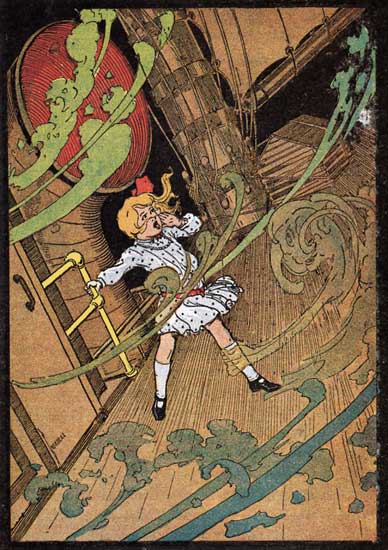
The wind blew hard and joggled the water of the ocean, sending ripples across its surface. Then the wind pushed the edges of the ripples until they became waves, and shoved the waves around until they became billows. The billows rolled dreadfully high: higher even than the tops of houses. Some of them, indeed, rolled as high as the tops of tall trees, and seemed like mountains; and the gulfs between the great billows were like deep valleys.

All this mad dashing and splashing of the waters of the big ocean, which the mischievous wind caused without any good reason whatever, resulted in a terrible storm, and a storm on the ocean is liable to cut many queer pranks and do a lot of damage.
Having sent Dorothy Gale to fairyland by cyclone (tornado), for her second trip Baum turned to this storm at sea. Next, in Dorothy and the Wizard in Oz, he used an earthquake. And then, since he’d exhausted the range of natural disasters, her next two trips were caused by magic from the Emerald City.

In The Scarecrow of Oz Baum had Trot and Cap’n Bill start their journey via a whirlpool—another type of nautical disaster. As with the earthquake suddenly opening a huge crack in the ground in Dorothy and the Wizard, people in the 1910s believed that such whirlpools existed in nature, but they don’t really. Does that mean magic must have been at work in those journeys too?

24 July 2012

“I’ve the right to make new laws, haven’t I?”

For the last two Tuesdays I’ve been following L. Frank Baum’s discussion of governance in the Pink Country in Sky Island. What Polychrome called “the customs of the country, absurd though they may be,” require that:

Because of the first rule, the book’s heroine, Trot, is made Queen of the Pinks, and because of the second she has to wear a plain pink dress with no flounces and live in a rough hut.
Trot and Button-Bright, with Cap’n Bill and Rosalie the Witch, went to the humble palace, where they had a simple supper of coarse food and slept upon hard beds. In the houses of the City, however, there was much feasting and merrymaking, and it seemed to Trot that the laws of the country which forbade the Queen from enjoying all the good things the people did were decidedly wrong and needed changing.

The next morning Rosalie said to the little girl, “Will you make Tourmaline the Queen again when you go away?”

“I’ll send for her and see about it,” replied Trot. But when Tourmaline arrived at the palace, dressed all in lovely, fluffy robes and with a dainty pink plume in her pink hair, she begged most earnestly not to be made the Queen again.

“I’m having a good time just now after years of worry and uncomfortable living in this uncomfortable old hut of a palace,” said the poor girl, “so it would be cruel for you to make me the servant of the people again and condemn me to want and misery.”

“That seems reason’ble,” replied Trot thoughtfully.

“Rosalie’s skin is just as light a pink as my own,” continued Tourmaline. “Why don’t you make her the Queen?”

“I hadn’t thought of that,” said Trot. Then she turned to Rosalie and asked, “How would you like to rule the Pinkies?”

“I wouldn’t like it,” replied the Witch with a smile. “The Queen is the poorest and most miserable creature in all the kingdom, and I’m sure I don’t deserve such a fate. I’ve always tried to be a good witch and to do my duty.”

Trot thought this over quite seriously for a time. Then one of her quaint ideas came to her—so quaint that it was entirely sensible. “I’m the Queen of the Pinkies just now, am I not?” she asked.

“Of course,” answered Rosalie. “None can dispute that.”

“Then I’ve the right to make new laws, haven’t I?”

“I believe so.”

“In that case,” said the girl, “I’m goin’ to make a law that the Queen shall have the same food an’ the same dresses an’ the same good times that her people have; and she shall live in a house jus’ as good as the houses of any of her people, an’ have as much money to spend as anybody. But no more. The Queen can have her share of ever’thing ’cordin’ to the new law, but if she tries to get more than her share, I’ll have the law say she shall be taken to the edge an’ pushed off. What do you think of that law, Rosalie?”

“It’s a good law and a just one,” replied the Witch approvingly. So Trot sent for the Royal Scribbler, who was a very fat Pinky with large, pink eyes and curly pink hair, and had him carefully write the new law into the Great Book of Laws. The Royal Scribbler wrote it very nicely in pink ink, with a big capital letter at the beginning and a fine flourish at the end.
Trot then makes Rosalie her successor as queen because, she explains, “you’ve got more sense than Tourmaline has and your powers as a witch will help you protect the people.” That perpetuates the benevolent dictatorship usually found in children’s fairylands.

Baum thus had Trot institute equality between the governor and the governed, but not interfere with a law that conferred elite status on the color of a person’s skin. Did that reflect the dominant values among American progressives in 1912, when Sky Island was published?

Baum’s Sky Island is one of the books highlighted in the program at the Winkie Convention, which starts this Friday in Asilomar, California. I’ll moderate a panel on Oz blogs on Sunday morning.

17 July 2012

Queen by the Color of Her Skin

A week ago, I quoted the passage from Sky Island in which L. Frank Baum revealed how the Queen of the Pink Country must live in poverty in exchange for her authority. But how does one become queen?

A later chapter explores that aspect of the country’s governance. As the Pinkies plan to toss our heroes off the island because “They do not harmonize with our color scheme,” Polychrome the Rainbow’s Daughter (introduced in The Road to Oz) arrives and starts to research their laws:

Polychrome began turning over the leaves, while the others all watched her anxiously and in silence. “Here,” she said presently, “is a Law which reads as follows: ‘Everyone in the Pink Country is entitled to the protection of the Ruler and to a house and a good living, except only the Blueskins. If any of the natives of the Blue Country should ever break through the Fog Bank, they must be driven back with sharp sticks.’ Have you read this Law, Tourmaline?”

“Yes,” said the Queen, “but how does that apply to these strangers?”

“Why, being in the Pink Country, as they surely are, and not being Blueskins, they are by this Law entitled to protection, to a home and good living. The Law does not say ‘Pinkies,’ it says any who are in the Pink Country.” . . .

“I am indeed relieved to have you interpret the Law in this way,” declared Tourmaline. “I knew it was cruel to throw these poor people over the edge, but that seemed to us the only thing to be done.”

“It was cruel and unjust,” answered Polychrome as sternly as her sweet voice could speak. “But here,” she added, for she had still continued to turn the leaves of the Great Book, “is another Law which you have also overlooked. It says, ‘The person, whether man or woman, boy or girl, living in the Pink Country who has the lightest skin shall be the Ruler—King or Queen—as long as he or she lives, unless someone of a lighter skin is found, and this Ruler’s commands all the people must obey.’ Do you know this Law?”

“Oh yes,” replied Tourmaline. “That is why I am the Queen. You will notice my complexion is of a lighter pink than that of any other of my people.”

“Yes,” remarked Polychrome, looking at her critically, “when you were made Queen without doubt you had the lightest-colored skin in all the Pink Country. But now you are no longer Queen of the Pinkies, Tourmaline.”

Those assembled were so startled by this statement that they gazed at the Rainbow’s Daughter in astonishment for a time. Then Tourmaline asked, “Why not, your Highness?”

“Because here is one lighter in color than yourself,” pointing to Trot. “This girl is, by the Law of the Great Book, the rightful Queen of the Pinkies, and as loyal citizens you are all obliged to obey her commands. Give me that circlet from your brow, Tourmaline.” Without hesitation Tourmaline removed the rose-gold circlet with its glittering jewel and handed it to Polychrome, who turned and placed it upon Trot's brow. Then she called in a loud, imperative voice, “Greet your new Queen, Pinkies!”
Trot Griffith thus follows Dorothy Gale in overturning the governments of about half the countries she visits. And she becomes queen herself, not simply putting one of her companions on the throne.

But, as last week’s extract showed, it’s a hard life being Queen of the Pinkies.

COMING UP: Queen Trot’s reforms.

(Incidentally, Baum’s incomplete sentence in the last paragraph above was itself mistranscribed in the electronic text of Sky Island that circulated since at least 2003 and is the basis of some reprints. The line is corrected in the latest Project Gutenberg text released on 15 Mar 2012.)

10 July 2012

What We Can Learn from Tourmaline the Poverty Queen

L. Frank Baum’s 1912 fantasy novel Sky Island is one of the themes of the Winkie Convention taking place in California later this month. In that book, Baum continued his pattern of cheekily examining how nations organize themselves politically. As usual, he presented the governors of those nations as monarchs, simplifying the world to match how most children experience it. But he discarded the west’s traditional hereditary way of choosing rulers.

On the blue side of the island, the Boolooroo is supposed to rule for only 300 years, and is further be term-limited by the 600-year ceiling on his life. And on the pink side of the island:

The Queen gazed upon our friends with evident interest. She smiled—a little sadly—at Trot, seemed to approve Button-Bright’s open, frank face, and was quite surprised because Cap’n Bill was so much bigger than her own people. “Are you a giant?” she asked the sailor in a soft, sweet voice.

“No, your Majesty,” he replied, “I’m only—“

“Majesty!” she exclaimed, flushing a deeper pink. “Are you addressing that word to me?”

“O’ course, ma’am,” answered Cap’n Bill. “I’m told that’s the proper way to speak to a Queen.”

“Perhaps you are trying to ridicule me,” she continued, regarding the sailor’s face closely. “There is nothing majestic about me, as you know very well. Coralie, do you consider ‘majesty’ a proper word to use when addressing a Queen?” she added, appealing to the Pinky woman.

“By no means,” was the prompt reply.

“What shall I call her, then?” inquired Cap’n Bill.

“Just Tourmaline. That is her name, and it is sufficient,” said the woman.

“The Ruler of a country ought to be treated with great respec’,” declared Trot a little indignantly, for she thought the pretty little queen was not being properly deferred to.

“Why?” asked Tourmaline curiously.

“Because the Ruler is the mos’ ’risticratic person in any land,” explained the little girl. “Even in America ever’body bows low to our President, an’ the Blueskins are so ’fraid o’ their Boolooroo that they tremble whenever they go near him.”

“But surely that is all wrong,” said Tourmaline gravely. “The Ruler is appointed to protect and serve the people, and here in the Pink Country I have the full power to carry out the laws. I even decree death when such a punishment is merited. Therefore I am a mere agent to direct the laws, which are the Will of the People, and am only a public servant obliged constantly to guard the welfare of my subjects.”

“In that case,” said Button-Bright, “you’re entitled to the best there is to pay for your trouble. A powerful ruler ought to be rich and to live in a splendid palace. Your folks ought to treat you with great respect, as Trot says.”

“Oh no,” responded Tourmaline quickly. “That would indeed be very wrong. Too much should never be given to anyone. If, with my great power, conferred upon me by the people, I also possessed great wealth, I might be tempted to be cruel and overbearing. In that case my subjects would justly grow envious of my superior station. If I lived as luxuriously as my people do and had servants and costly gowns, the good Pinkies would say that their Queen had more than they themselves, and it would be true. No, our way is best. The Ruler, be it king or queen, has absolute power to rule, but no riches, no high station, no false adulation. The people have the wealth and honor, for it is their due. The Queen has nothing but the power to execute the laws, to adjust grievances and to compel order.”

“What pays you, then, for all your bother?” asked Trot.

“I have one great privilege. After my death a pink marble statue of me will be set up in the Grand Court, with the statues of the other Kings and Queens who have ruled this land, and all the Pinkies in ages to come will then honor me as having been a just and upright queen. That is my reward.”

“I’m sorry for you, ma’am,“ said Cap’n Bill. “Your pay for bein’ a queen is sort o’ like a life-insurance. If don't come due till after you’re dead, an’ then you can’t get much fun out o’ it."
Ironically, the Americans—particularly the little girl Trot—want to treat Queen Tourmaline with more deference than her own society accords her.

American society in Baum’s lifetime had struggled with the Pinkies’ problem of how to motivate government employees to work for the good of the people, resisting the temptation to work for themselves. The solution—the federal civil service system—was instituted in 1871. It promised protection from political shifts in exchange for salaries less volatile than in the private sector, pensions to reduce the motivation to amass money, and respect.

Currently a lot of American governments are cutting back on compensation and breaking contracts to public workers. I fear we’ve forgotten the original reasoning behind that social compact. Civil service systems aren’t perfect and can be exploited, but they’re one of those flawed arrangements that’s nonetheless better than anything else we’ve come up with. As Baum went on to explore, the Pinkies’ solution of an impoverished ruler with no respect until death had its own problems.

COMING UP: Choosing the Queen of the Pink Country.

15 May 2012

“We ought to be friends.”

From the first chapter of L. Frank Baum’s Sky Island:
The boy sat down beside her on the flat rock.

“Do you like girls?” asked Trot, making room for him.

“Not very well,” the boy replied. “Some of ’em are pretty good fellows, but not many. The girls with brothers are bossy, an’ the girls without brothers haven’t any ‘go’ to ’em. But the world’s full o’ both kinds, and so I try to take ’em as they come. They can’t help being girls, of course. Do you like boys?”

“When they don’t put on airs or get roughhouse,” replied Trot. “My ’sperience with boys is that they don’t know much, but think they do.”

“That’s true,” he answered. “I don’t like boys much better than I do girls, but some are all right, and—you seem to be one of ’em.”

“Much obliged,” laughed Trot. “You aren’t so bad, either, an’ if we don’t both turn out worse than we seem, we ought to be friends.”
Sky Island is one of Baum’s best novels, and one of the books that will be commemorated at this summer’s Winkie Convention at the Asilomar Conference Center in Pacific Grove, California. I plan to be there, moderating a panel on Oz blogs and judging a writing contest or two. I’ve also submitted an unconventional piece for the convention booklet.

13 March 2012

One Hundred Years of Sky Island

This year is the centenary of Sky Island, one of L. Frank Baum’s very best fantasy novels. It tells the further adventures of Trot and Cap’n Bill, the little girl and one-legged old sailor Baum introduced in Sea Fairies, with the addition of Button-Bright and Polychrome from The Road to Oz. Unlike those books, Sky Island has a real plot.

However, it didn’t earn Baum as much as he wanted, so for his next fantasy novel he returned to the Oz series. Eventually he merged the two series by bringing Trot, Cap’n Bill, and Button-Bright to the Emerald City, but since Sea Fairies and Sky Island don ’t have the word “Oz” in their title they’ve never attracted so many readers. In the latter case, that’s a shame.

Last May, artist Kevin Merriman posted some unusual character designs for Button-Bright and Trot. Check out the link for his take on Cap’n Bill as well.

02 February 2012

The Second Oz Series

When L. Frank Baum returned to the Oz series, he had left Dorothy and Ozma in a good place. Too good a place, in fact. Supposedly he wasn’t even able to contact them any more. Solving that problem (through the new technology of wireless) was less challenging, however, than coming up with a new fuel for stories about Oz now that Dorothy could live with her family in the Emerald City and Ozma could feel safe about Oz.

Furthermore, since Baum evidently now planned to keep writing Oz books as long as he could, he was no longer thinking ahead to a series end. He needed to keep his characters interesting, or come up with new ones.

With a story called “Little Dorothy and Toto” in The Little Wizard Stories of Oz (written for younger readers than the novels), Baum found a new unresolvable foundational conflict for Dorothy. Though she has a perfectly comfortable, safe home in the royal palace, she insists on wandering into the countryside and heading off on dangerous missions. In that story, the Wizard tries to cure Dorothy of this bad habit. It doesn’t work.

Thus, in The Magic of Oz, Dorothy’s idea of birthday shopping means going into a forest of wild beasts and asking to borrow a dozen monkeys. In Glinda of Oz she’s eager to go to the edge of Prof. Wogglebug’s map to get involved in a war. In The Patchwork Girl of Oz she invites herself on Ojo’s quest, and in Rinkitink in Oz she heads to the Nome Kingdom.

As for Ozma, she continues to be so kind-hearted that she has trouble governing. In Glinda of Oz, the title character advises her to stay out of the turmoil in one corner of Oz, and she insists on heading there anyway and telling her subjects they should be nice. In The Lost Princess of Oz she gets kidnapped, and Dorothy (of course) heads out to rescue her.

But for most of in his second series of Oz books, Baum had antagonists drive the plot, or found other young protagonists: Ojo, Betsy, Trot, Button-Bright, Inga, and Woot. Most of those new kids didn’t hold up for more than one adventure because they didn’t have unresolvable foundational conflicts. Once Inga rescues his parents, or Betsy finds a home, there’s nothing left for their characters to do.

The two young characters who play important, distinct roles in more than one of Baum’s novels came with foundational conflicts that continued to drive them into adventures. Trot is little, but curious and just as brave as Dorothy. Button-Bright gets lost whether he means to or not. If either of those sources of conflict ever disappeared, so would their stories. Like Dorothy and Ozma, Trot and Button-Bright are built for an open-ended series.