The big
Boy Wonder news of the week is, of course, the death of Damian Wayne in
Batman, Incorporated, #8. Comics fans lamented his loss, even if they couldn’t all spell his name right. Just a fortnight ago the “Death of a Family” crossover climaxed with no actual deaths, leaving some fans disappointed. One hopes it’s not the same fans.
Of course, Damian Wayne’s death has no more correlation to death in the real world than his short life has to real lives. He was created in a milieu of artificial insemination, incubators, and genetic hybrids (which should give pause to those trying to calculate the timing of the DC Universe based on assumptions that he was conceived and raised naturally). Similarly, Damian died in a storyline that includes clones, resurrection pools, and time travel. The “Robin RIP” issue came at the beginning of a four-issue arc, and I wouldn’t be surprised to see hints of the character’s return in some form by the end.
What interests me most about this development is what it says about collaborative storytelling.
Grant Morrison pitched the idea of Bruce Wayne and Talia al-Ghul having a son back in 2005, thinking he'd kill off the child right away if he proved interesting only as a plot point. But Damian’s extreme personality proved fun to write, not just for Morrison but for other
Batman scripters.
Morrison told the adventures of a new Dynamic Duo—Batman the Boy Wonder and the goddamn Robin. Among DC’s other writers,
Bryan Q. Miller might have been most successful with Damian in
Batgirl because his personality made such a contrast with Stephanie Brown’s, but there were also fine stories from Paul Dini in
Streets of Gotham and J. T. Krul in
Teen Titans.
The result is a six-year storyline played out over multiple crossovers and two continuities. At heart, Morrison was expanding “Punish Not My Evil Son!” from
The Brave and the Bold, #83, written by
Bob Haney (and reprinted in the first volume of
Neal Adams’s Batman work). As in that single-issue story, Bruce Wayne is surprised to become the father of a nasty brat, causing trouble for his household and everyone else. But eventually the moral example of Dick Grayson turns the kid around, and he dies heroically in the Robin costume.
Of course, the story of Damian Wayne is more complex, layered, and successful. It became intertwined with Batman seeming to die and with Dick Grayson, Tim Drake, and Stephanie Brown taking on new coming-of-age identities. Damian was a prize in a worldwide war between his parents. The one glitch: I don’t think anyone could have engineered a satisfying story about Dick Grayson’s return to being Nightwing. Instead, DC rebooted its whole universe.
Morrison’s fellow writers were privy to his ultimate plan for Damian Wayne, at least to the extent of being warned off storylines that might ruin that virgin territory.
Scott Snyder, present writer of
Batman and current primary plotter for the rest of the line, has tweeted that he learned about Morrison’s plan when he got the assignment to write about the Caped Crusader.
Even more interesting is the work of
Peter J. Tomasi, who was the editor who first heard Morrison’s pitch. In 2008 he left the editorial desk to become a scripter, taking over
Nightwing even though
he knew that magazine would soon end. In 2011 he took over
Batman and Robin while knowing that eventually that partnership would be ripped apart. Tomasi just gave interviews to
Comic Book Resources and
Newsarama about how he’d laced the latter magazine with intimations of Damian’s death. The immediate plan is to continue it with a focus on ex-Robins, but, like
Batman, Incorporated, it might be in for more profound changes or retirement.
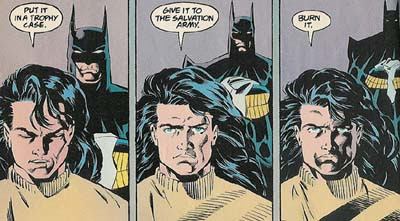
Damian’s death resets the life of Bruce Wayne in more ways than one. Not only does he no longer have a young boy to keep out of trouble, but he has a dead partner to mourn. From 1989 to 2004 the late Jason Todd filled that role. But it’s awfully hard to mourn a Robin who’s alive and well. (“The Joker killed me! And, um, I got better.”) Now Damian can haunt the family as Jason did. There’s even a
trophy case waiting.
Robin has always been the
littlest guy in the fight—that’s part of the character’s identity and appeal. In some previous DC Universes Dick Grayson took up the role at the age of eight, and artists have enjoyed
depicting the contrast between the spindly little kid and the tall, muscular Dark Knight. In the rebooted universe, however, Dick didn’t meet Bruce Wayne until his teens, making Damian the youngest boy ever to have become Robin—thus the littlest guy of all. And yet, the only foe to take that Robin down turned out to be his own genetic twin, grown to fearsome size, assisted by other members of the League of Assassins.
What’s next among Robins? The odds favor a young woman whom Snyder has introduced in
Batman named Harper Row. While it would be good to see a female Robin again (the first in the current continuity), I’m old enough to remember the obvious inspiration for that name: the venerable American publisher Harper & Row, now subsumed into the HarperCollins division of Newscorp. I keep wondering if the new Robin will carry a torch, as on the old
Harper & Row colophon, and peddle
Maurice Sendak books. >tt<