Showing posts with label marketing marketing marketing. Show all posts

30 March 2026

“The 3-year-old comedian is so proud of his injury”

The 22 Oct 1922 Portland Oregonian, and probably some other newspapers around the same time, ran this story from Hollywood:
Jackie Condon, the little tousled-haired kid playing in Pathé’s “Our Gang” comedies, is the proudest kid around the Hal Roach Studios. Jackie broke his right arm in two places the other day while working on a new picture—hence his proudness.

Bob McGowan was directing the scene in which the youngsters stage a county fair. Little Jackie fell from a “death-defying slide” and became unconscious. He was rushed to Dr. Hull of Culver City, who diagnosed the injury as a compound fracture.

The arm was placed in splints and Jackie taken home, but he is so intent on his screen career that he appeared on the Roach lot in the afternoon, ready for work. The 3-year-old comedian is so proud of his injury that he exhibits it on the slightest provocation to everyone who comes near him.
Jackie Condon (1918–1977) was actually four years old at this time, but Hollywood publicists routinely underreported child actors’ ages.

The article glossed over the circumstances of Jackie’s fall. Was he doing a scene or playing unsupervised? Was this a foreseeably dangerous stunt? Was he simply too short to go on that ride? Emphasizing his plucky return and pride smooths over the fact of a four-year-old with a compound fracture.

According to Rob DeMoss’s Lucky Corner website, Hal Roach Studio records show Jackie suffered his injury on 8 August during the filming of what became “The Big Show!”

The still photo above was taken as that movie was made. It shows most of that season’s gang posed on a merry-go-round built to be whirled around by their dog. The kids never appear in this configuration in the finished film, so this shot was most likely constructed for the poster.

Jackie Condon sits on an arm of the merry-go-round at the left. His right forearm is obviously not injured, meaning this picture was taken before his fall. Knowing what lies ahead, one wishes he had a better grip on the apparatus.

Though the news story about Jackie’s injury uses the present tense to describe him showing off his splint, more than two months had passed since his fall.

The first Our Gang movies were screened for the industry early in 1922 and garnered enough enthusiasm for Hal Roach to order up more that summer. But the series didn’t launch into wide release until September. Pathé offered the second film, “Firefighters” on 8 October; Jackie Condon played a prominent role in that one as the smallest boy who gets to be the fire chief because he’s the only fellow who has the right hat.

That explains why the movie publicists were pumping the story of Jackie’s injury in October. Publicity back in August, before the Our Gang movies were in cinemas, wouldn’t have benefited the series.

COMING UP: Working around an injury.

09 February 2026

Another Addition to the Jackie Condon Filmography

Discontented Wives was a five-reel melodrama directed by and starring J. P. McGowan, released in September 1921.

The American Film Institute summarized it this way:
Ruth Gaylord gives up her home in New York to marry John Gaylord but grows discontented with the loneliness and desolation of life in the West and leaves her husband. After returning home, she hears that he has struck one of the richest gold veins in California. A letter surrendering her interests in the mine falls into the hand of Kirk Harding, an eastern capitalist; and John, tricked into surrendering his rights and discovering the truth, struggles with Harding. Ruth awakens, discovering it was all a dream, and decides not to leave her dedicated husband after all.
At the end of a review in the 16 October 1921 Seattle Daily Times came this paragraph:
The cast in Mr. McGowan’s support, besides Fritzi Brunette, includes Jean Perry, Andy Waldron, C. S. McGregor and little Jackie Condon.
Now lost, Discontented Wives is thus another entry in Jackie Condon’s pre-Our Gang filmography.

The mention of Jackie’s name might imply that his face and tousled hair were becoming known to movie exhibitors or audiences.

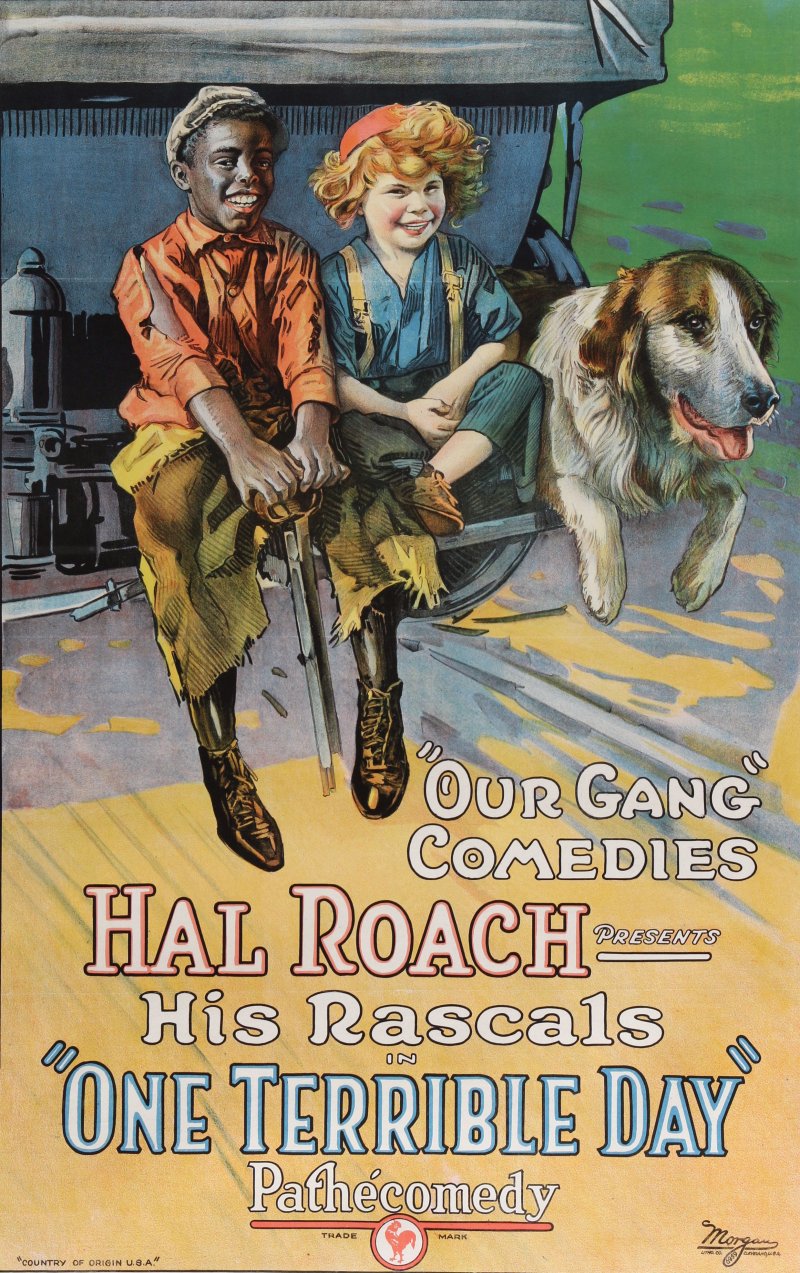
The first short in the Our Gang series that Hal Roach and Pathé released in September 1922 was “One Terrible Day.” The poster for that film, shown above, doesn’t depict the whole gang. Instead, it features only the two kids who would have been most familiar to viewers because of their previous work: Ernie “Sunshine Sammy” Morrison and little Jackie Condon.

11 July 2023

Contents of The Characters of Oz

Last week I introduced The Characters of Oz, a collection of essays that I contributed to, edited by Dina Schiff Massachi.

Since I don’t yet see this information on the web in a form easy to search out, I’m sharing the contents of this book.
  • Introduction — Dina Schiff Massachi
  • Dorothy and the Heroine’s Quest — Mark I. West
  • But First, There Was a Scarecrow... — Katharine Kittredge
  • Heart Over Head: Evolving Views on Male Emotional Intelligence and the Tin Woodman — Dina Schiff Massachi
  • The Proto-Sissy, the Sissy, and Macho Men: The Cowardly Lion in The Wonderful Wizard of Oz, the MGM The Wizard of Oz, and Dark Oz Stories — Dee Michel and James Satter
  • A Good Man but a Bad Wizard? The Shifting Moral Character of the Wizard of Oz — J. L. Bell
  • Witches, Wicked and Otherwise — Robert B. Luehrs
  • Witch's Familiars or Winged Warriors? Liberating the Winged Monkeys — Dina Schiff Massachi
  • Glinda and Gender Performativity — Walter Squire
  • Ozma, Sorceresses, and Suffrage: Women, Power, and Politics in L. Frank Baum's Land of Oz — Mary Lenard
  • A Living Thing: The Very American Invention of Jack Pumpkinhead — Paige Gray
  • Trading Knitting Needles for Pistols: The Feminist, Violent, and Sexual Evolution of General Jinjur — Shannon Murphy
  • The Nome King — Angelica Shirley Carpenter
  • Piecing Together the Patchwork Girl of Oz — Gita Dorothy Morena
  • Afterword: Frank and His Imagination — Robert Baum
  • Bibliography: Further Oz Readings, Fiction and Nonfiction — Dina Schiff Massachi
In other (surprising) news about this book, it’s been printed, and McFarland is taking orders.

16 September 2020

Coming Over the Wire

KidLit411 is featuring an interview with my writing colleague Lisa Robinson about her new picture book Madame Saqui: Revolutionary Rope Dancer, illustrated by Rebecca Green.

Here’s a sampling:
When Madame Saqui was briefly mentioned in a book I was reading about circus history, I knew her story needed to be told. Here was a daring woman who wirewalked over the Seine and between the towers of Notre Dame during the French Revolutionary era. . . .

Before I learned about Saqui, we owned a low tight wire that lives inside our house or in the yard during good weather. We got the wire for my children who love circus arts and go to Circus Smirkus camp during the summer. It wasn’t until I discovered Madame Saqui’s story that I decided to learn to wire walk, too.

The hardest part about wire walking is the fear and the tedium; the fear of falling and sustaining an injury; the fear of not being able to handle the next challenge, like completing a turn or a new dance step; the fear of humiliating yourself in front of an audience. It’s not a forgiving art — one misstep and you’re on the ground.

The tedium comes from the need to practice practice practice in order to progress. Once I decided I would wire walk at book stores to promote my book, I committed to walking on the wire for 30 minutes a day, every day, in order to build my confidence and skill enough to perform in front of an audience (which never happened due to the coronavirus pandemic).
And here’s Lisa as we don’t get to see her performing in person this pandemic year.

06 August 2020

Hondo from Story to Screenplay to Novel

In a collection of Louis L’Amour stories, I came across this passage in Jon Tuska’s introduction, explaining how L’Amour’s first sale in the western genre eventually produced his first bestseller:
L’Amour sold his first Western short story to a slick magazine a year later, “The Gift of Cochise” in Collier’s (7/5/52). Robert Fellows and John Wayne purchased screen rights to this story from L’Amour for $4,000 and James Edward Grant, one of Wayne’s favorite screenwriters, developed a script from it, changing L’Amour’s Ches Lane to Hondo Lane. L’Amour retained the right to novelize Grant’s screenplay, which differs substantially from his short story, and he was able to get an endorsement from Wayne to be used as a blurb, stating that Hondo was the finest Western Wayne had ever read. Hondo (Fawcett Gold Medal, 1953) by Louis L’Amour was released on the same day as the film, Hondo (Warner, 1953), with a first printing of 320,000 copies.
Making the Hollywood connection was clearly important to L’Amour’s career path, which at this critical point hardly followed the model of a lone author sticking to his creative vision, unswayed by money and celebrity.

The movie Hondo couldn’t match up to George Stevens’s Shane, a masterpiece released a few months earlier. Jack Schaefer’s novel Shane is quite good as well. As with L’Amour, it was Schaefer’s first successful foray into the western genre, and it defined his career.

16 May 2020

New Fun with Jack and Bill

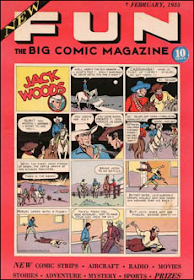
In 1935, National Publications issued its first magazine collection of original comics. New Fun was thus the first comic book from the company founded by Malcolm Wheeler-Nicholson that eventually became DC Comics.

That magazine basically tried to replicate a Sunday newspaper comics section. It was as large as a tabloid newspaper. Though the interior was all black and white, the company quickly moved to color printing, suggesting that was always the plan.

Most significant for the storytelling, the magazine offered twenty different comics, each on a single page. (Twelve more interior pages were filled with prose and advertising.) Some of those comics ended in gags, but most were serialized adventures. Most were also obvious knock-offs of popular newspaper strips or genres. The stories were aimed at different audiences, from little kids to adults looking for thrills.

The advertising reflected that same hope that the magazine would appeal to a broad audience. There were ads for model airplanes, for example, but also ads for job seekers. There were multiple ads for razor blades, indicating that the publisher expected a significant portion of the readers to be shaving. Some ads were aimed at men and a few at women. As National Publications narrowed its target audience to kids, some of those ads went away while others stuck around for decades.

One of the latter was for Charles Atlas’s bodybuilding lessons. From the start Atlas built his campaign around the graphic story of “The Insult that Made a Man out of ‘Mac’.” A scrawny young man gets humiliated in front of a girl on the beach, builds up his muscles, and returns to beat up that bully—in front of more admiring girls. The art was later redrawn, but the script didn’t change much.

One New Fun page turn later, however, came another bodybuilding ad built around another little story, but with a different message. The Jowett Institute of Physical Culture titled its comic “Jack ‘Puts One Over’ on His Boy Friend!” Girls appear in only half of its six panels (instead of seven out of nine in the Charles Atlas story). The relationship between Jack and his pal Bill is more developed than the one between Jack and Hannah. The institute also offered a “FREE Book with Photos of Famous Strong Men.” A different sort of appeal.


18 November 2014

The Wizard of Oz teapot tempest”

In 1957 Ralph Ulveling, director of the Detroit Public Library, received nationwide criticism for remarks he was reported as having made about the Oz books.

I’ve been looking into that story, and this is part of one of the documents from it: Ulveling’s counterattack in the October 1957 American Library Association Bulletin.

Ulveling insisted that his library system hadn’t gotten rid of The Wizard of Oz—it simply wasn’t in the children’s rooms. To be fair to him, that decision had been made “More than thirty years ago,” or shortly after L. Frank Baum’s death. On the other hand, his endorsement of that policy acknowledged rather than refuted the anti-Oz-book sentiments attributed to him.

Ulveling went on to accuse the Michigan State University Press, of all people, of ginning up the controversy to sell books.

And you know, he might have been right.

11 April 2014

Getting the Message on OIP Derangement Syndrome

This week’s study in OIP Derangement Syndrome is Rep. Jack Kingston of Georgia, one of three members of Congress running for the Republican nomination for that state’s Senate seat.

As Talking Points Memo reported, Kingston’s campaign released an ad featuring a Barack Obama impersonator supposedly leaving a voicemail for Kingston saying he doesn’t want the man in the Senate.

And here I thought we learned from Clint Eastwood in 2012 that having angry conversations with a wholly imaginary “President Obama” simply makes one look like a crazy person.

But the really crazy part is that in this Senate race Kingston is being attacked from the right.

02 March 2014

Kyle Higgins’s Last Words on Dick Grayson?

DC Comics is touting an upcoming issue of Secret Origins as writer Kyle Higgins’s last word on Dick Grayson, whom he’s been writing in Nightwing for the past two and half years.

Higgins sounded a bit bemused when he told Kiel Phegley at Comic Book Resources about that story:
The Secret Origins one-shot is a little weird. It’s something they asked me to do while I was wrapping my run on Nightwing, and in some ways, I did a lot on Dick’s early days in our issue #0. So this was about trying to find a different point of view on a lot of the ideas we’d already introduced. . . . Honestly, my final issue of Nightwing kind of says everything I have to say about the character, so it’s a little weird to be doing this origin story too, but it’s fun.
I should note that Higgins’s last issue of Nightwing will be followed by a final issue written by a different team, which completes a story being told in a miniseries titled Forever Evil. That magazine has already shown Dick Grayson being unmasked, which would certainly force major changes in his career as a mysterious vigilante. DC is of course trying to play up fears that that storyline will end with Dick dying.

But back to Higgins and “Dick’s early days”:
The one story point that I really wanted to explore was the Robin name. It’s something I hadn’t done in issue #0, and it was something that I’d had an idea for for a while. We had kind of touched on the bracelet [with a robin motif] that Dick gave his mother in issue #0 as the origin of why he ultimately took the Robin name, but there’s a little bit more to it than that. What a Robin actually means to Dick Grayson hasn’t been defined, and that’s something I wanted to bring into his origin. Originally, the Robin identity came out of Errol Flynn and the Robin Hood movie, but that’s not exactly the direction DC wanted to go with the New 52 version, so this was all about finding a new spin on the Robin moniker. We’ll show where it comes from and what it means to Dick in this Secret Origins story in a pretty cool way.
Actually, Jerry Robinson’s inspiration for Robin came from his memory of N. C. Wyeth paintings of Robin Hood, not the 1938 Errol Flynn movie (though its popularity couldn’t have hurt). Narrative captions in the first comics that featured Robin made that link to British mythology explicit. But it wasn’t till later retellings of Robin’s origin that DC’s writers showed Dick identifying himself as a Robin Hood fan. Subsequently a Robin Hood painting became a staple of his bedroom in Wayne Manor.

And there’s a curious story from Detective Comics, #226, in 1955 called “When Batman Was Robin,” which showed young Bruce Wayne dressing in the oh-so-inconspicuous Robin costume to get tutoring from the famous detective Harvey Harris. Seeing the kid in the red jerkin, Harris says he looks “as brilliant as a robin redbreast” and dubs him Robin.

That story by Edmond Hamilton undercuts the Dynamic Duo mythos in a couple of ways. Since it was set before Bruce’s parents were killed, it meant their murder wasn’t actually what set him to dressing up in a cape and mask and fighting crime. And it meant Bruce gave Dick the name Robin and the same type of costume he’d worn as a teenager without ever explaining their history.

But to get back to Higgins once more, is this really his farewell to Dick Grayson, or just to DC’s main, official, present-day version of that character? In January Higgins told Vaneta Rogers at Newsarama, “I’ve got some huge Dick Grayson/Nightwing stuff coming up in Batman Beyond 2.0…which I can’t urge you enough to pick up. . . . It’s the best stuff I’ve done at DC.” That digital-first magazine is set in one possible future for the DC heroes, spun off the animated cartoons rather than the main comic books, so it’s not quite so official.

In addition, Higgins has an upcoming series from Image called C.O.W.L., set in an original superhero universe. Higgins started to build that world with his student film The League, which featured an equivalent of Dick Grayson named the Sparrow or, later, the Wraith. Interviews don’t indicate if that character shows up in The C.O.W.L., but a version of his mentor does, so there’s a strong possibility.

03 February 2014

Right Wing Just Can’t Say Cheerio to Bigotry

In May 2013, Cheerios ran a commercial featuring a family with a black father, white mother, and cute little girl. That prompted a spew of racist tweets.

Last month, Cheerios previewed a new commercial featuring the same family. On 29 January, someone at MSNBC tweeted: ”Maybe the right-wing will hate it, but everyone else will go awww: the adorable new #Cheerios ad w/biracial family.”

A couple of hours later, MSNBC tweeted: “Earlier, this account tweeted an offensive line about the new Cheerios ad. We deeply regret it. It does not reflect the position of msnbc.”

Nevertheless, the next day Reince Priebus, chairman of the Republican National Committee, complained that MSNBC had “denigrated and demeaned Americans -- especially conservative and Republican Americans,” and ordered his staff not to appear on the network. MSNBC issued another apology.

On Sunday, the commercial appeared during the Super Bowl. It prompted some racist tweets, but more supportive ones.

However, a patriotic commercial for Coca-Cola got much more vitriol, including bigoted complaints from former Republican Congressman Allen West, radio hosts Glenn Beck and Todd Starnes, and others from “the right-wing.”

As of today, Reince Priebus, defender of “denigrated and demeaned Americans,” has not been heard from. Meanwhile, despite his effort to spin away the awkward fact, “the right-wing” continues to perpetuate its own stereotype.

03 December 2013

Parade Balloons Over 75 Years

Macy’s 1939 parade included a Tin Man balloon to promote MGM’s new movie, The Wizard of Oz.

For the movie’s seventy-fifth anniversary (which is actually next year), the movie’s current owner, Time Warner, paid for another balloon. According to Yahoo TV, “Macy's repurposed an older balloon. . . . The designers took a balloon shaped like a — see if you can follow — hot-air balloon and decorated it with images of the beloved L. Frank Baum characters.” The portraits were hand-painted.

03 July 2013

Missing Voices in the Discussion of Multicultural Book Sales

Last month Lee and Low asked on its blog, “Why Hasn’t the Number of Multicultural Books Increased In Eighteen Years?” That’s an important question, and the posting attracted a lot of attention, mostly echoing the concern without offering new insight. Roger Sutton at The Horn Book was one of the few I saw who asked some follow-up questions.

I didn’t see anyone noting the huge missing voice in the discussion. Lee and Low had invited responses to its question from six professors of children’s literature, one book review editor, two authors, and one librarian/author, Betsy Bird. All important perspectives, but by no means a cross-section of people in the American children’s-book field.

In those responses, Kathleen Horning of Wisconsin’s Cooperative Children’s Book Center explicitly blamed Barnes & Noble, though not based on direct knowledge. Poet Nikki Grimes spoke of “blockbuster-craving bookstore markets.” Rudine Sims Bishop of Ohio State mentioned ”my closest big chain bookstore” as an example. Several people spoke of the lack of “marketing.”

And yet the discussion didn’t include one bookseller or person working with booksellers. None of the respondents described working in a bookstore. None described seeing how most families actually buy or choose books. None indicated any experience in marketing a product, much less in working with the publishing industry’s minuscule marketing budgets.

And information from the commercial sector is vital to this conversation because individual sales are more important and influential in children’s publishing than ever before.

At one point, libraries and schools comprised a large and influential segment of the market for children’s books. Today they represent a much smaller portion of the overall sales. Professional book reviewers have become less influential and ordinary readers’ feedback more so.

At one point, publishers and bookstores were mostly family-run, and managers could take a risk or even a loss on certain books they thought were important without having to justify their actions to higher powers. (Lee and Low is a mission-driven press of that sort.) Today most children’s books come from publicly-traded corporations under pressure from stockholders to maximize profits, and bookselling is dominated by two more publicly-traded corporations, B&N and Amazon.

At one point, booksellers and publishers had no real-time systematic data about what books were selling. Now they have weekly reports from BookScan, Ingram, the big chains, and other sources. Amazon can track not only what its customers buy but what other titles those customers buy and what they look at without buying.

The strength and danger of profit-seeking corporations is that they want to make money any way they legally can. They may forgo immediate opportunities to increase long-term profitability (e.g., stepping away from a deal with cookbook author Paula Deen after she became a shameful punchline), but they’re always chasing those profits. And with the data that companies like Amazon and BookScan are collecting on book traffic, they can spot and chase unexpected areas of sales.

When Horning wrote, “I’ve heard many times from publishers that the ‘buyers at B&N’ believe multicultural books don’t sell,” the obvious next question is whether that’s true. Do B&N buyers still believe that? Does any data support that belief? Does data from other booksellers refute it? Have things changed over the past two decades? Only when we’ve probed the reality of bookselling can we dismiss any such belief as “a self-fulfilling prophecy.”

I understand why Lee and Low’s round-up didn’t include voices of booksellers. Chain buyers are a private bunch. Sales data is proprietary. Sales and marketing people at publishing companies (including Lee and Low itself) wouldn’t want to upset their major customers by complaining. And no one in this discussion would want to be the sole voice saying that “multicultural” books are less profitable than mainstream books.

But if the problem is, say, the inequities of wealth and education in a country affected by structural racism and growing inequality, with one result being disproportionately low sales and profits for books that are clearly about non-white children, then we’re not going to find the solution within the profit-seeking corporate sector.

03 February 2013

What Legacies Left Us

DC Universe: Legacies was a comics series published in 2010-11 during an apparent wave of nostalgia at DC Comics. It was scripted by Len Wein, a top editor at the house in the early 1980s, and drawn by a stellar cast of established artists: Joe and Andy Kubert, Dave Gibbons, José Luis García-López, George Pérez, Jerry Ordway, Dan Jurgens, Brian Bolland, and so on.

As the series ended, DC trumpeted several single-issue stories about its top characters created in the style of the 1970s, 1980s, or 1990s, using talent that had worked on the characters in those decades. Those magazines had the umbrella label of DC Retroactive.

Legacies retold the entire history of the DC Universe as it then existed—the universe that had been created by merging several parallel continuities at the end of Crisis on Infinite Earths in 1986 and remade more gently at ten-year intervals in the Zero Hour and Infinite Crisis crossovers. For the purposes of the weekly Robin, the series notes the debut of the first two Robins, the first two versions of the Teen Titans, and Nightwing, but shows little of Tim Drake, Young Justice, or later Titans groupings.

Wein retold that super hero history through the eyes of a kid from Metropolis who grew up to be a police officer and detective. That approach was quite like the way Kurt Busiek and Alex Ross structured Marvels, a 1994 retelling of Marvel Universe highlights through the eye of a news photographer.

Legacies’ main storyline is thus a recap of the company’s mythos—just enough for new fans to figure out how events fit together and a trip down memory lane for folks who’d read the stories originally. Wein didn’t try to reconcile or “retcon” gaps in the continuity, which left such glitches as Depression kids becoming a young couple in the late 1980s. (Hey, it’s comics!) With so much “history” to get through, there’s a high panel-per-page ratio reminiscent of earlier decades, but not much chance for deep drama or characterization unaided by reader nostalgia.

Wein added eight-page back-up stories about some of the odd corners of the DC Universe: the World War 2 soldiers, the sci-fi adventure teams of the 1950s, Jack Kirby’s New Gods, and so on. Shoved to the back of the collected edition, those little tales might be the most fulfilling because they’re complete tales in themselves, not squeezed to rush on to the next event that might change the entire world.

Where does the volume leave readers? For decades the narrator collects accounts of those costumed heroes on pulp paper, filing them in plastic—just like DC Comics’s most devoted fans. And the final pages reveal that he’s an old man in a nursing home, repeating those stories every night for an uninterested and unbelieving audience of attendants. Hardly the portrait readers would want of themselves.

Furthermore, just after this series ended, DC had announced that the continuity it recounts would be set aside in favor of a new variation. Was Legacies therefore a test of whether the nostalgia market was big enough to sustain the operation? Was it a sincere attempt to give new readers a way to “jump in” and catch up to the existing universe, only for the company to decide it had to do something more dramatic? Or was it always designed to be what it and DC Retroactive became, a last hurrah for that continuity before the company swerved onto a new path?

12 December 2012

Top Ten Trendiest Trends

In December 2010, Scholastic’s book club, book fair, and publishing editors looked back at the preceding months and agreed on “Ten Trends in Children’s Books from 2010.” They were:

  1. The expanding Young Adult (YA) audience.
  2. The year of dystopian fiction.
  3. Mythology-based fantasy.
  4. Multimedia series.
  5. A focus on popular characters – from all media.
  6. The shift in picture books [actually a shift from them, with picture-book characters “showing up in Beginning Reader books”].
  7. The return to humor.
  8. The rise of the diary and journal format.
  9. Special-needs protagonists.
  10. Paranormal romance beyond vampires.

This year (I couldn’t find if editors prognosticated in 2011), Scholastic’s editors looked ahead and “Forecast Top 10 Trends In Children's Books For 2013.”

  1. Bullying is THE Timely Topic in Kids’ Books.
  2. ’13 Will be a Lucky Number for Science Fiction Fans.
  3. Intriguing Nonfiction.
  4. Novels-in-Cartoons.
  5. Kid Lit on the Screen.
  6. War.
  7. Tough Girls.
  8. Survival Stories.
  9. Spotlight on Diversity.
  10. Nature Runs Amok.

These predictions come with “hot” titles attached, some from Scholastic and others, I bet, carried by its book clubs. So does this list simply reflect what the editors already believe? Is it a form of marketing within the industry? Or does the company’s market share mean that this is a self-fulfilling prophecy?

10 November 2012

Ahoy! A Little More Teen Boat!

This week I ran up against a short Teen Boat! story that didn’t make it into the collection.

Okay, it’s a promotion for the last Toronto Comic Arts Festival. But it’s got some nice gags and cameos.

23 October 2012

Finally an Explanation for Dorothy’s Strange Dream

Caleb Crain alerted me to the existence of this public safety poster from the Allegheny County (Pennsylvania) Health Department:
Dorothy lived in the midst of the great Kansas prairies, with Uncle Henry, who was a farmer, and Aunt Em, who was the farmer’s wife. Their house was small, for the lumber to build it had to be carried by wagon many miles. There were four walls, a floor, and a roof, which made one room. One day after returning from the outhouse, Aunt Em forgot to wash her hands, which caused a bacterial infection to spread among the whole family, including the dog. In addition to severe stomach cramps and a dreadful fever, Dorothy started to have some really strange dreams.
Okay, there are less appealing Oz stories than Dorothy Return to Oz.

This poster was part of an award-winning public health campaign. There are also germ-driven versions of Treasure Island; Are You There, God? It’s Me, Margaret; and other classics.

22 October 2012

Lemony Fish

Yesterday the Boston Globe ran an interview with Daniel Handler, representative of Lemony Snicket, which included this exchange about childhood reading:
BOOKS: What was the first adult book you read?

HANDLER: It was “Fish Preferred” by P.G. Wodehouse. I picked that one for its title…
If young Daniel had expected a story about a liking for fish, he would have been disappointed. Fish Preferred refers to the novel’s male lead, Ronnie Fish, and the ups and downs of his stock—not as in “fish stock” but as in “the stock market.”

When Fish Preferred was published in July 1929, speculating in the stock market was all the rage. Even ordinary readers knew the difference between “preferred stock” and “ordinary stock.” Of course, speculation by ill-informed investors was part of the stock bubble that burst just a few months later.

Wodehouse had originally titled that novel Summer Lightning. That was the name of the serialized versions that appeared in both the US and UK earlier that year, and that was the name on the British edition published the same month as the American.

The British edition includes a preface from Wodehouse that explains the situation:
It is related of Thackeray that, hitting upon Vanity Fair after retiring to rest one night, he leaped out of bed and ran seven times round the room, shouting at the top of his voice. Oddly enough, I behaved in exactly the same way when I thought of Summer Lightning. I recognized it immediately as the ideal title for a novel.

My exuberance has been a little diminished since by the discovery that I am not the only one who thinks highly of it. Already I have been informed that two novels with the same name have been published in England, and my agent in America cables to say that three have recently been placed on the market in the United States. As my story has appeared in serial form under its present label, it is too late to alter it now. I can only express the modest hope that this story will be considered worthy of inclusion in the list of the Hundred Best Books Called Summer Lightning.
That preface also contains Wodehouse’s reply to a common criticism:
A certain critic—for such men, I regret to say, do exist—made the nasty remark about my last novel that it contained “all the old Wodehouse characters under different names”. He has probably now been eaten by bears, like the children who made mock of the prophet Elisha; but if he still survives he will not be able to make a similar charge against Summer Lightning. With my superior intelligence, I have outgeneralled this man by putting in all the old Wodehouse characters under the same names. Pretty silly it will make him feel, I rather fancy.
And indeed, Summer Lightning/Fish Preferred is a sequel, one of the early Blandings Castle novels. Apparently all current editions have reverted to Wodehouse’s preferred title.

01 October 2012

Baum and The Inland Printer

In the 1890s L. Frank Baum and his family moved to Chicago. He supported them as a freelance journalist and traveling salesman before parlaying his (brief and unsuccessful) experience as a shopkeeper in Aberdeen, South Dakota, into a job editing The Show Window.

In 1900 a Chicago-based trade magazine called The Inland Printer described Baum’s magazine in a squib that might have been supplied by the editor himself:
The Show Window, edited by L. Frank Baum, Chicago, is growing in interest from month to month. It is the official organ of the National Association of Window Trimmers of America, and contains an amount of information in this line to be had through no other source. Its half-tone illustrations of window display are worth more than the price of the publication. No storekeeper can afford to be without such a magazine. Its suggestions for Easter window decorations in the special Easter number are a treat to even the uninitiated.
By then Baum also had a second career as a children’s author. The Inland Printer noted that as well a few issues later:
The author of “Father Goose,” Mr. L. Frank Baum, has followed up his success with a remarkable juvenile entitled “A New Wonderland,” which is shortly to be issued by R. H. Russell, of New York. The reader is introduced to a marvelous and hitherto undiscovered country, peopled with the quaintest and merriest characters ever conceived to delight childish hearts. Frank Ver Beck has made many colored pictures for the new book, which bids fair to attain a popularity seldom accorded a juvenile publication.
That book is better known now under its reissue title, The Magical Monarch of Mo.

The Inland Printer didn’t take note of Baum’s other fantasy for children published in 1900, The Wonderful Wizard of Oz. However, that year’s volume did feature illustrations from W. W. Denslow, including the spooky “What’s the Use?” and three bookplates for the Wilkins family (two reproduced here via Google Books, and thus at less than optimum crispness).

So we know Baum was almost certainly reading The Inland Printer, and probably contributing to it. Which gives more significance to another item from the 1900 volume, a response to a reader’s proofreading inquiry on whether “climb up” was incorrect.

The Inland Printer’s editors said the word “up” was unnecessary and noted other common phrases that were equally redundant. The column added:
No dictionary except one even mentions the phrase “climb down,” and that one, the Funk & Wagnalls Standard, says that it is a United States colloquialism.
Thus, when Baum had Dorothy Gale pass on a lesson from her teacher not to say “climb down,” he was echoing advice he’d probably read a few years before.

TOMORROW: But did that usage bother Baum?

18 September 2012

Allegro non Toto

Some puns work better than others.

This is from an ad for the New England Conservatory’s Contemporary Improvisation training, celebrating its 40th year. It deserves points for trying.

17 September 2012

Dark Horse Stumbles?

There’s only one reason that Dark House Books reprinted It Rhymes with Lust, script credited to Drake Waller and art to Matt Baker and Ray Osrin: it’s one of the first American attempts to publish a novel-length story in comics form. In other words, it’s a candidate for being the earliest graphic novel.

But you couldn’t tell that from the reprint. Nowhere on or inside the book is the date of its original publication in 1950; instead, the date on the copyright page in 2007, when Arnold Drake wrote the afterword. Nowhere does the book state that its author is a pseudonym for Drake and Leslie Waller. Indeed, Drake’s afterword doesn’t even make clear that what it calls “that first story” is the same volume one is holding.

Nowhere on or inside the book is a statement—even a single sell line—about the book’s significance in comics history. Instead, Dark Horse has carefully recreated the front and back covers of the original, with all the breathless, melodramatic text. In combination with a 2007 copyright date, the result looks like a parody or a nostalgic attempt to recreate comic noir.

Given that the market for stories about family dysfunction and corruption in post-WW2 mining towns is probably small, I think Dark Horse missed a bet in how they packaged this book. They found space on the copyright page for a list of publishing personnel (something one rarely sees from mainstream American publishers), yet nowhere said, “This book is a piece of comics history, and here’s why…”

I guess the company thought its target readers would find the book in comics shops and recognize its significance from Wikipedia. And some people might say those assumptions reflect a larger problem with the American comics industry.