Showing posts with label national portraits thru children's literature. Show all posts

19 April 2014

What Will “On Your Left” Mean?

In the discussion of the political implications of Captain America: The Winter Soldier, Greg Carpenter at Sequart found a key in the movie’s strong opening scene. Steve Rogers and Sam Wilson are jogging around the reflecting pool in Washington, the former (having been injected with the super-soldier serum) much faster than the latter:
Each time Rogers approaches Wilson, he gives the same cautionary warning: “On your left.” They are the first words spoken in the new film, Captain America: The Winter Soldier, and they lay the groundwork for much of the political perspective of the film. While this Captain America may sneak up on you—you’ll find him “on your left.”
Not everyone caught that, as Alyssa Rosenberg shows in the Washington Post:
“Captain America: The Winter Soldier” returns time and time again to the idea that the biggest issue in national security is who controls the apparatus, rather than whether we should use certain technologies or techniques at all.
To be sure, there’s an inherent tension between the superhero narrative, or any hero narrative that focuses on an individual or small group of individuals, and spread-out popular power. As a result, some critics have trouble noting the moments built into superhero films that celebrate the crowd: the scenes in the first two Spider-Man movies in which groups of ordinary New Yorkers stand up to villains when Spider-Man is in trouble, for example.

In Winter Soldier, the conflict ends with the spy agency’s (unspecified) secrets being dumped out onto the internet. The directors, Joe and Anthony Russo, noted that as they were filming Edward Snowden released some secret files from the National Security Agency with the same idea. Of course, Wikileaks and Bradley/Chelsea Manning had done something similar already.

Granted, heroic narratives aren’t good at exploring the actual challenges of broad-based decision-making. Jonathan Stroud’s original Bartimaeus trilogy gets to that at the end of the third volume. George Lucas’s Star Wars films and J. K. Rowling’s Harry Potter series declare the superiority of democracy over dictatorship, but they show actual politicking as pretty feckless. L. Frank Baum’s Oz and other magical kingdoms tend to settle for benevolent dictatorships. But the larger the fictional universe, the more stories bottom-up authority allows.

In an article for Business Insider, Jeff Gomez and one-time Robin/Red Robin scripter Fabian Nicieza analyzed how developments in Winter Soldier open up possibilities for Marvel’s overarching movie narrative:
Feige faced a daunting creative challenge for his thriving film series: while Nick Fury and SHIELD served as the perfect impetus for uniting a disparate band of dysfunctional superheroes [in The Avengers], now the filmmakers were stuck with global icons like Hulk, Thor, and Iron Man effectively bowing to a secret American military organization. That had to end, but the choice of making Captain America cut the umbilical cord? Genius. . . .

The result is the fall of SHIELD, and the vast U.S. military-industrial complex no longer stands as the leash-holder to Captain America and his superhero allies. Steve Rogers becomes apolitical, while still representing the world’s perception of American selflessness, justice, and heroism dating back to World War II.
Already the Agents of SHIELD television show is reflecting the new situation (not that I’ve watched it since the pilot). We’ll see if the next set of Marvel moviemakers can fulfill that promise.

17 April 2014

Some People Just Can’t Lego

When The Lego Movie came out this spring, it prompted debate about its political implications. Kyle Smith at the New York Post offered a round-up of different interpretations, including:
The Economist noted that whatever its story might imply, “The film is also an hour-and-a-half-long commercial for costly toys made by a multinational corporation based in Denmark; a commercial, moreover, that people must pay to see.”

Almost alarmingly full of spectacle and movement, The Lego Movie offers us storytelling irony with sprinkles on top and let us eat it, too. It made fun of the clichés of “chosen one” plots, and it still showed the designated hero saving the day. It let us laugh at the notion of a made-up prophecy that must be true because it rhymes, and it let us believe wise words must be true because they come in the voice of Morgan Freeman. It offered a chance to laugh at cookie-cutter, feel-good pop culture, and it costarred Lego Batman.

The political “message” of the movie came in how its chief villain is Lord Business, who has also made himself President Business. Different critics emphasize different parts of his symbolic meaning, depending on how they feel about business or, at this historical moment, Presidents. In fact, he’s a plastic avatar of a suburban father who doesn’t have time to play with his son (though he does have time to play with his Legos). “Business” here has no economic or political import; it’s just what keeps Dad in the office.

The end of the movie assures us that it’s crucial to express yourself fully and flexibly, and spend time with your family, as long as you do that with lots of Legos. Lots and lots of Legos.

(I have to acknowledge here that I hardly ever played with Legos at home. We were a Tinkertoy family.)

15 April 2014

What Captain America Missed Around the World

At one point in the Avengers movie, Captain America is excited to finally recognize one of the pop-culture references people are throwing around: “Flying Monkeys.”

You see, Captain America was trapped in ice at the end of World War 2 and thawed out only recently. When I was a lad, “only recently” meant the early 1960s, which was no longer that recent, but the basic conceit was established.

The new movie series allowed the corporate storytellers to move the date of Cap’s thawing up to the twenty-first century. Chris Evans plays him as a refugee from the 1940s trying to keep up with modern times. He knows the MGM Wizard of Oz but not much since.

The new Captain America: The Winter Soldier movie carries on that theme by showing how Cap keeps a to-look-up list consists of topics he’s missed and needs to look into. These include I Love Lucy, the Moon landing, the Berlin Wall’s rise and fall, and someone named Steve Jobs.

However, As Comics Alliance reported, a Reddit user collected screenshots from different versions of Captain America: The Winter Soldier from around the world, showing that Marvel/Disney tailored the hero’s to-look-up list for different audiences.

For Russian audiences what’s self-evidently important about the last seventy years are Yuri Gagarin, Vladimir Vysotskiy, the USSR breakup, and Moscow Does Not Believe in Tears.

For South Koreans, it’s Dance Dance Revolution, Ji-Sung Park, Old Boy, and the 2002 World Cup in soccer.

For Mexicans, it’s the Chilean miners, Maradona’s “hand of God,” Shakira, and Neri Vela.

And so on. It would make an interesting social-studies lesson for teams to identify what all those variant items are, and why they’re as important to other culture as I Love Lucy is to ours. Every nation has a different perspective on space, it appears, and almost every nation but the US is mad about soccer.

19 December 2013

Merlin Then and Now

A year ago, Yale University Press published Anne Lawrence-Mathers’s A True History of Merlin the Magician. It was a “densely written monograph,” according to Publishers Weekly, which explored the cultural manifestations of Merlin in late medieval Europe, starting with mentions in Geoffrey of Monmouth’s supposedly nonfiction history of Britain.

The Guardian’s Kathryn Hughes just decided to review the book, and her review focuses on the shocking revelation that Merlin was fictional: “It turns out that Merlin isn't real. He is, in fact, a big fat hoax, made up by a writer who had run out of things to say and was getting desperate.”

Hughes highlights how Geoffrey’s original presentation of a British prophet at “a time of great dynastic insecurity” was reassuring, and even told his local readers that “Britain had always played a special part in God's great plan. In the process, a small island stuck on the edge of the known world started to believe that it might just matter.”

Does that mean Britain’s special place is based on fraud? Hughes’s review seems to suggest Britain is really special in another way: as a cultural leader, creating in Merlin a shape-shifting trickster that becomes popular across Europe and across time.

But note the comments on the article, with Welsh readers insisting that Merlin was a real figure from Welsh myth and that non-Welsh authors have robbed the nation of its cultural heritage.

17 October 2013

A Grim Tale from Australia

The New York Times’s obituary for Australian criminal turned author Mark “Chopper” Read contained an eye-catching paragraph:
His children’s book, “Hooky the Cripple: The Grim Tale of a Hunchback Who Triumphs” (2002), tells of a boy who is abused by the village butcher and who, on his 21st birthday, lashes back. Illustrated with Gothic intensity by the Australian artist Adam Cullen — Hooky brandishes a bloodied knife on the cover — the book was described by a Melbourne reviewer as “curiously poetic.”
I’ve long thought that Australian children’s media played rougher than its American and British counterparts, but this seemed extreme even for the antipodes.

I found a different assessment in the Network Review of Books via something called the Australian Public Intellectual Network:
Read has turned to the seemingly unlikely genre of fairy tale, to produce what might be, nominally and controversially, considered a children’s text, although one certainly more suitable for the upper end of the juniors’ market. Adults too, as the general tenor of the work’s subtitle - The Grim Tale of a Hunchback Who Triumphs - indicates, will find here the disturbing blend of dark humour and perverse personal morality that characterises the ‘Chopper’ world-view.
I’ve therefore concluded that Hooky the Cripple merely borrows the the form of the illustrated storybook. It really belongs in the category of books made to remind adults of children’s books and sold on the basis of their authors’ celebrity.

03 October 2013

Daniel Pucca’s Mini, and Adolescent Memories

Yesterday I discussed Daniel Pucca’s mini-comic My Dutch Foreskin, focusing on the lettering. Because that’s the first thing you think of when you read that title, right?

Pucca was an American in a Dutch intermediate school when word came down that the health exam would require boys to roll back their foreskins. He didn’t know what that meant. (The comic establishes that at that moment Daniel was living with his grandmother, so he didn’t have anyone he felt comfortable asking.) When he found out, he thought something was terribly wrong with him.

Like Pucca, I was born in the period when almost all American boys were circumcised soon after birth. So was my father. I don’t think I saw an uncircumcised penis until I was in junior high, when gym class included showers with a single classmate, a newcomer from Australia, who still had a foreskin. He was thus in the opposite position from young Daniel in Holland. I didn’t know that fellow well, so I have no idea of how his experiences mirrored Daniel’s, but that memory helped me appreciate My Dutch Foreskin.

A few years further on, I recall another immigrant classmate—a nice guy from Russia—feeling acutely embarrassed on a high-school trip to Montreal when he had only a tiny European-style men’s bathing suit while the rest of us boys were in baggy American trunks. (Mind you, the baggy shorts of the 1980s were nothing compared to the voluminous fashions of more recent decades.)

I remember my immigrant classmate standing at the side of the Montreal Olympic pool in his snug swimsuit, asking if anyone had another suit to lend him. But of course we were all away from home, and in the pool besides. We kept telling him to just get in the water where none of the girls could see clearly. But of course the only cure for adolescent self-consciousness is time.

10 January 2013

“Nothing but the great gray prairie on every side”

This year’s Modern Languages Association meeting is barely over, and it’s already time to start planning for next year’s. This call for papers came across the Child_Lit list:
“Deliver Us to Normal: Children’s Literature and the Midwest”

This panel will consider the ways Midwestern children’s literature both reproduces recognizable tropes associated with the region and subverts or challenges them, often within the same text. Like the Midwest itself, child characters and child readers are highly contested constructions, in a state of continual oscillation between adult desires for them and their own developing agencies. Located in a geographic and discursive middle, sometimes outwardly simple and often deceptively complex, the Midwest finds a fitting home in its children’s literature, which mirrors its critical concerns.

Topics prospective panelists might wish to address include, but are not limited to:
  • children’s literature and competing definitions of the Midwest
  • the roles of Chicago, Detroit, and other Midwestern urban centers in works for children
  • children’s authors who live or lived in the Midwest
  • the Midwest as a colony and/or racial and cultural contact zone
  • the relationship between written text and pictures about/of the Midwest in children’s literature
  • museums and other tourist sites in the Midwest with a relationship to children’s literature, such as the Laura Ingalls Wilder museums in Missouri, Kansas, South Dakota, and Wisconsin [There are a lot of ’em, aren’t there?]
  • depictions of agriculture, farming, and rural life for children
Please send 500-word abstracts by March 15, 2013 to Kate Slater.
The 2014 MLA will take place in Chicago, capital of the Midwest, 9-12 January.

27 December 2012

A Clearly Important Manga

Over thirty years ago, I sat down to read Barefoot Gen, Keiji Nakazawa’s graphic novel about the aftermath of the Hiroshima bombing. The Cold War was still cold, and I was in the movement for a nuclear-weapons freeze. I was also reading American comics on a monthly basis.

Barefoot Gen was the first manga I saw, I now realize. And I didn’t get it. I couldn’t reconcile the “cartoony” art with the story’s casual violence plus the nuclear ultraviolence. I didn’t get the pace, especially after vaguely realizing that Nakazawa continued his story in more volumes. At least the pages had been flopped for the English edition; if I’d been trying to read right to left, I would have been completely lost.

I like to think that with more background information about how Japanese comics were created and published I would have gotten much more out of Barefoot Gen. As it was, I got only the vague guilt of not being able to appreciate something that was Clearly Important.

Nakazawa, who was six when the bomb dropped, just died from lung cancer. Barefoot Gen remains in print around the world and has inspired three cinematic adaptations.

26 December 2012

How Tolkien Built His Mythology Gradually

PBS’s Art Beat blog ran an interview with Jason Fisher about J. R. R. Tolkien’s creative process, starting with his language study:
Once Tolkien had made a thorough study of the history of English and its literary artifacts, he discovered the native English had actually lost their mythology when the French came during the Norman conquest. So Tolkien became interested in trying to figure out whether he could restore some of that mythology. Eventually he gave up the idea that he would be restoring an actual mythology for England. But this mythological backdrop continued to permeate everything that he wrote for the rest of his life.
Tolkien’s paternal ancestors apparently arrived in England half a millennium after the Norman Conquest, but he identified with the earlier Anglo-Saxons. The notion that England lost its original Good Things to the Norman Conquest was also part of Whig political thinking in the eighteenth century. So in that respect The Lord of the Rings is a cultural cousin of the Declaration of Independence, sharing an intellectual root.

Fisher also notes that The Hobbit was originally more tweely English and contemporary in its first edition:
Tolkien was actually an inveterate niggler. He constantly tinkered with his works. For most people, The Hobbit that they know today is the version that includes all of these changes and revision. But if you read the first edition of The Hobbit you see all kinds of strange things, like references to policemen on bicycles, references to Lilliputians, a reference to the Gobi Desert, the wild wireworms of the Chinese, all of these references to the real world. After the first edition, Tolkien cut all of those references and made it more of its own separate world.
Eventually, it appears, Tolkien tumbled to the fact that he was creating a mythology not for England but for himself.

31 October 2012

Nostalgia Was Originally a Disease

This summer I stumbled across bits of my childhood entertainment on YouTube.

Back when Bill Bixby was getting unlikably angry on CBS, he also hosted a kids’ version of Masterpiece Theater on public television called Once Upon a Classic.

Most of its drama specials and serials from Britain were based on classic (i.e., public-domain, no need to pay for rights) literature. When the supply ran low, however, the show broadcast some original shows, which I vaguely remembered.

There was also a Saturday-morning (or early afternoon) anthology show on one of the American commercial networks that broadcast an English slapstick comedy series called something like “The Jiffy Kids.”

That turned out to be “The Chiffy Kids,” and “Chiffy” referred to the Children’s Film Foundation (later Children’s Film and Television Foundation) in Britain. Financed by a tax on cinema tickets, the foundation cranked out a steady stream of domestic drama and comedy for school-age audiences.

TV Cream explains the CFF films’ place in British culture:
A joint enterprise between Rank Film Distributors and the most out-of-touch government you ever did see,…the Children’s Film Foundation turned out mini-masterpieces of pre-pubescent crime-solving about five times annually for over 35 years. . . .

crooks were foiled, bullies were trounced, pompous council officials were brought to rights and wacky inventions exploded on a regular basis on some waste-ground just outside London in much the same manner for over three decades, with a few, mainly cosmetic, alterations – the widening of the trousers, the democratisation of the protagonist’s accents – along the way.

The CFF films remain one of those odd cubbyholes of popular culture that are fondly recalled almost by default – not because of any inherent greatness in the films themselves, or any general joy to be had in watching them at the time, but more because they were so heavily plugged by local fleapits, the Beeb and well-meaning headmasters at end of term film shows, that they formed a part of the patina of everyday life, in the manner of the Toffo ads or Nationwide. In short, they were always on, we can’t not remember them.
And through 1970s American television’s need for material that might seem vaguely educational, or at least not completely commercial, some of those movies got broadcast here, too.

Then came the 1980s. In Britain, Margaret Thatcher‘s Tory government ended the tax that provided the funding for the C.F.F. In the US, Ronald Reagan and George W. Bush’s Republican governments pulled back on standards for children’s television.

The foundation tried to revive itself in 2006 with a new website listing all its productions. But that soon became a cobwebsite.

Before disappearing, the foundation created a YouTube channel with the handle CFandTF to show the first five or so minutes of many of its movies. The channel is no longer active, but the individual shows can be found by their titles. Certain clips last just long enough to trigger memories in my brain: The ominous truck in “The Battle of Billy’s Pond”! The odd politics of “Robin Hood Junior”! And of course “The Chiffy Kids” as interior decorators! (In terms of a compelling plot, that’s rather like, “In this one, the Stooges are firemen.”)

Now if only I could find any mention of the Westinghouse Television special from about 1978 that involved Huck Finn being picked up in a helicopter to participate in interviews with modern troubled youth? He talked with pregnant teens and played basketball.

03 September 2012

Hang On a Minute

Among the public artworks commissioned in Britain in conjunction with the Olympics is Richard Wilson’s monumental statue atop the De La Warr Pavilion in Bexhill.

Titled “Hang on a minute lads, I’ve got a great idea…,” it’s a replica of a tour bus (coach) teetering over the edge of the building. And it really does teeter. With hydraulics attached to the underside of the bus, and firmly to the roof, the bus rocks randomly.

The Guardian explains; there’s also a video interview with the artist at that site. Actor and comedian Eddie Izzard, who helped to sponsor this artwork, explained the motivation behind it:
By the end of 2012 I would hope the word goes out from our country that not only do we run excellent world events, but we also balance coaches on the edges of buildings like no one else ever could.
I was actually disappointed to read that the artwork and its title refer to the 1968 heist movie The Italian Job, which ends with Michael Caine delivering that line in a similar situation. That turned a sculpture I’d imagined as a humorous yet existential comment on life into an homage to pop culture—like a bronze statue of Fonzie. However well made that bronze statue is, it has kitsch mixed into the metal.

So perhaps my loyalties in Britain’s new public art will shift to “Sacrilege,” Jeremy Deller’s full-scale recreation of Stonehenge as an inflatable bouncy castle. It raises such important questions as: Is it possible to imagine large numbers of American parents taking their children to anything called “Sacrilege”?

02 August 2012

What Wattle?

Years back, Daniel Pinkwater had an essay about listening to a slow-speaking public radio announcer (obviously Robert J. Lurtsema) announce an upcoming musical commission by “Dan…iel……Pink…”

And Pinkwater had a second of worry about some commitment he’d forgotten before hearing the announcer conclude, “…ham.”

I had somewhat the same feeling when I read that antipodean artist Ben Wood has a new picture book coming out with John Bell.

A while back I drafted Ben to illustrate a story for Oziana magazine, and enthusiastically shared news of his Oztober events last year. But I didn’t remember the Wattle Tree picture book. In fact, I wasn’t even sure what a wattle tree is.

I’ve since learned that a wattle tree is one of a number of types of acacia growing in Australia.

And Ben created The Wattle Tree with another John Bell, who also goes by John Gascoigne. Hachette’s page for the book says, “A former nanny, he has decided to return to higher education and is currently studying to complete BA at Sydney University.”

Ben is using his blog to document how the two of them created The Wattle Tree, starting with the sketchbook drawing that inspired it all.

24 July 2012

“I’ve the right to make new laws, haven’t I?”

For the last two Tuesdays I’ve been following L. Frank Baum’s discussion of governance in the Pink Country in Sky Island. What Polychrome called “the customs of the country, absurd though they may be,” require that:

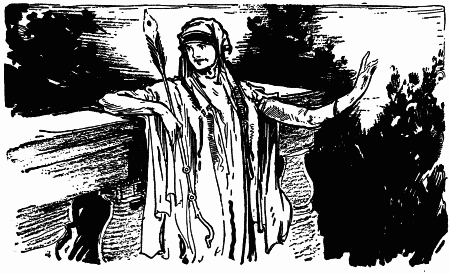
Because of the first rule, the book’s heroine, Trot, is made Queen of the Pinks, and because of the second she has to wear a plain pink dress with no flounces and live in a rough hut.
Trot and Button-Bright, with Cap’n Bill and Rosalie the Witch, went to the humble palace, where they had a simple supper of coarse food and slept upon hard beds. In the houses of the City, however, there was much feasting and merrymaking, and it seemed to Trot that the laws of the country which forbade the Queen from enjoying all the good things the people did were decidedly wrong and needed changing.

The next morning Rosalie said to the little girl, “Will you make Tourmaline the Queen again when you go away?”

“I’ll send for her and see about it,” replied Trot. But when Tourmaline arrived at the palace, dressed all in lovely, fluffy robes and with a dainty pink plume in her pink hair, she begged most earnestly not to be made the Queen again.

“I’m having a good time just now after years of worry and uncomfortable living in this uncomfortable old hut of a palace,” said the poor girl, “so it would be cruel for you to make me the servant of the people again and condemn me to want and misery.”

“That seems reason’ble,” replied Trot thoughtfully.

“Rosalie’s skin is just as light a pink as my own,” continued Tourmaline. “Why don’t you make her the Queen?”

“I hadn’t thought of that,” said Trot. Then she turned to Rosalie and asked, “How would you like to rule the Pinkies?”

“I wouldn’t like it,” replied the Witch with a smile. “The Queen is the poorest and most miserable creature in all the kingdom, and I’m sure I don’t deserve such a fate. I’ve always tried to be a good witch and to do my duty.”

Trot thought this over quite seriously for a time. Then one of her quaint ideas came to her—so quaint that it was entirely sensible. “I’m the Queen of the Pinkies just now, am I not?” she asked.

“Of course,” answered Rosalie. “None can dispute that.”

“Then I’ve the right to make new laws, haven’t I?”

“I believe so.”

“In that case,” said the girl, “I’m goin’ to make a law that the Queen shall have the same food an’ the same dresses an’ the same good times that her people have; and she shall live in a house jus’ as good as the houses of any of her people, an’ have as much money to spend as anybody. But no more. The Queen can have her share of ever’thing ’cordin’ to the new law, but if she tries to get more than her share, I’ll have the law say she shall be taken to the edge an’ pushed off. What do you think of that law, Rosalie?”

“It’s a good law and a just one,” replied the Witch approvingly. So Trot sent for the Royal Scribbler, who was a very fat Pinky with large, pink eyes and curly pink hair, and had him carefully write the new law into the Great Book of Laws. The Royal Scribbler wrote it very nicely in pink ink, with a big capital letter at the beginning and a fine flourish at the end.
Trot then makes Rosalie her successor as queen because, she explains, “you’ve got more sense than Tourmaline has and your powers as a witch will help you protect the people.” That perpetuates the benevolent dictatorship usually found in children’s fairylands.

Baum thus had Trot institute equality between the governor and the governed, but not interfere with a law that conferred elite status on the color of a person’s skin. Did that reflect the dominant values among American progressives in 1912, when Sky Island was published?

Baum’s Sky Island is one of the books highlighted in the program at the Winkie Convention, which starts this Friday in Asilomar, California. I’ll moderate a panel on Oz blogs on Sunday morning.

10 July 2012

What We Can Learn from Tourmaline the Poverty Queen

L. Frank Baum’s 1912 fantasy novel Sky Island is one of the themes of the Winkie Convention taking place in California later this month. In that book, Baum continued his pattern of cheekily examining how nations organize themselves politically. As usual, he presented the governors of those nations as monarchs, simplifying the world to match how most children experience it. But he discarded the west’s traditional hereditary way of choosing rulers.

On the blue side of the island, the Boolooroo is supposed to rule for only 300 years, and is further be term-limited by the 600-year ceiling on his life. And on the pink side of the island:

The Queen gazed upon our friends with evident interest. She smiled—a little sadly—at Trot, seemed to approve Button-Bright’s open, frank face, and was quite surprised because Cap’n Bill was so much bigger than her own people. “Are you a giant?” she asked the sailor in a soft, sweet voice.

“No, your Majesty,” he replied, “I’m only—“

“Majesty!” she exclaimed, flushing a deeper pink. “Are you addressing that word to me?”

“O’ course, ma’am,” answered Cap’n Bill. “I’m told that’s the proper way to speak to a Queen.”

“Perhaps you are trying to ridicule me,” she continued, regarding the sailor’s face closely. “There is nothing majestic about me, as you know very well. Coralie, do you consider ‘majesty’ a proper word to use when addressing a Queen?” she added, appealing to the Pinky woman.

“By no means,” was the prompt reply.

“What shall I call her, then?” inquired Cap’n Bill.

“Just Tourmaline. That is her name, and it is sufficient,” said the woman.

“The Ruler of a country ought to be treated with great respec’,” declared Trot a little indignantly, for she thought the pretty little queen was not being properly deferred to.

“Why?” asked Tourmaline curiously.

“Because the Ruler is the mos’ ’risticratic person in any land,” explained the little girl. “Even in America ever’body bows low to our President, an’ the Blueskins are so ’fraid o’ their Boolooroo that they tremble whenever they go near him.”

“But surely that is all wrong,” said Tourmaline gravely. “The Ruler is appointed to protect and serve the people, and here in the Pink Country I have the full power to carry out the laws. I even decree death when such a punishment is merited. Therefore I am a mere agent to direct the laws, which are the Will of the People, and am only a public servant obliged constantly to guard the welfare of my subjects.”

“In that case,” said Button-Bright, “you’re entitled to the best there is to pay for your trouble. A powerful ruler ought to be rich and to live in a splendid palace. Your folks ought to treat you with great respect, as Trot says.”

“Oh no,” responded Tourmaline quickly. “That would indeed be very wrong. Too much should never be given to anyone. If, with my great power, conferred upon me by the people, I also possessed great wealth, I might be tempted to be cruel and overbearing. In that case my subjects would justly grow envious of my superior station. If I lived as luxuriously as my people do and had servants and costly gowns, the good Pinkies would say that their Queen had more than they themselves, and it would be true. No, our way is best. The Ruler, be it king or queen, has absolute power to rule, but no riches, no high station, no false adulation. The people have the wealth and honor, for it is their due. The Queen has nothing but the power to execute the laws, to adjust grievances and to compel order.”

“What pays you, then, for all your bother?” asked Trot.

“I have one great privilege. After my death a pink marble statue of me will be set up in the Grand Court, with the statues of the other Kings and Queens who have ruled this land, and all the Pinkies in ages to come will then honor me as having been a just and upright queen. That is my reward.”

“I’m sorry for you, ma’am,“ said Cap’n Bill. “Your pay for bein’ a queen is sort o’ like a life-insurance. If don't come due till after you’re dead, an’ then you can’t get much fun out o’ it."
Ironically, the Americans—particularly the little girl Trot—want to treat Queen Tourmaline with more deference than her own society accords her.

American society in Baum’s lifetime had struggled with the Pinkies’ problem of how to motivate government employees to work for the good of the people, resisting the temptation to work for themselves. The solution—the federal civil service system—was instituted in 1871. It promised protection from political shifts in exchange for salaries less volatile than in the private sector, pensions to reduce the motivation to amass money, and respect.

Currently a lot of American governments are cutting back on compensation and breaking contracts to public workers. I fear we’ve forgotten the original reasoning behind that social compact. Civil service systems aren’t perfect and can be exploited, but they’re one of those flawed arrangements that’s nonetheless better than anything else we’ve come up with. As Baum went on to explore, the Pinkies’ solution of an impoverished ruler with no respect until death had its own problems.

COMING UP: Choosing the Queen of the Pink Country.

03 July 2012

Nobody Eats Dogs Here!

Artist Billy Nunez shares his concept sketches for “The Wizard of Oz in China” (which include some touches from other parts of the Pacific’s western rim).

(Hat tip to Bookshelves of Doom and io9.)

04 June 2012

The Game of Life, the Universe, and Everything

This weekend the Boston Globe reviewed Jill Lepore’s The Mansion of Happiness, an examination of American life and values through board games—particularly the game Life itself.

Reviewer Buzzy Jackson wrote:
Lepore, a staff writer at The New Yorker and a professor of American history at Harvard who has written about the intellectual and political history of Colonial and 19th-century America, isn’t really interested in board games. Instead, she wants to know what [Milton] Bradley’s game can tell us about American values and aspirations. As in the game of Life, each chapter takes the reader a little further along the path of human development. . . .

The marriage chapter examines the life and work of Paul Popenoe, famous for posing the eternal question, “Can this marriage be saved?” The oddly contentious story behind E.B. White’s story, “Stuart Little,” makes up the chapter on childhood, and Lepore dismantles the myth of Taylorized efficiency in “Happiness Minutes,” the chapter on working.
Now did Lepore actually start her investigations and ruminations with board games, or did she realize that Bradley’s Life provided a structure to unite essays on several disparate concerns?

Lepore will speak about this book and the history of American board games, with pictures, at the American Antiquarian Society in Worcester on 5 June at 7:30. This illustrated lecture is free and open to the public.

09 May 2012

Gandalf the Oppressor?

From Damien G. Walter’s unfathomably headlined article “Is science fiction literature's first international language?” in the Guardian:
Russian SF has a long and well-documented history as an outlet for political perspectives that were otherwise repressed. But it is as a critique of the values of western capitalism that the genre has recently caught attention.

The Last Ringbearer by Kirill Eskov is set in the Middle Earth of JRR Tolkien, immediately after the climatic [sic] battle of The Return of the King, and has recently been issued in its second edition translation free online, despite objections from the Tolkien estate. The book reimagines Lord of the Rings as a history written by the victors, with Mordor recast as an emergent industrial nation crushed under the heel of a war-mongering western alliance lead by Gondor, and Gandalf described as "engineering a final solution to the Mordorian problem".

If this mirrors a large proportion of European / Russian history it seems entirely valid, given how easily exactly the same reading can be made of Tolkien's fantasy epic.
Now is this really a critique of Lord of the Rings or a rip-off of it? Or does a rip-off constitute a form of political critique of such a dominant intellectual property?

What does it mean to identify with orcs, even if you present them as misrepresented? Is the “war-mongering western alliance” that Eskov and Walter see the Axis or NATO?

12 January 2012

Limits to Anglophilia

I’m happy to acknowledge my Anglophilia, but even I found the Anglophilia in Jane Louise Curry’s The Bassumtyte Treasure over the top.

It’s not just ordinary Anglophilia, even. It’s all about the aristocracy, indeed the old aristocracy that remained loyal to Catholicism and Mary, Queen of Scots. The book asks us to root for the aristocratic Bassumtyte family to keep their big house and grounds and servants in the 1970s.

Since it would be awkward to delve into how that wealth was accumulated in previous centuries, or the value of the public services that the tax revenue is now funding, Curry instead embodies that threat as an off-stage villain who’s eager to buy a house. And wouldn’t you know, he’s an Arab prince with lots and lots of money. Arabian aristocracy isn’t so appealing as English.

As with The Lost Farm, Curry starts with a young protagonist—in this case, ten-year-old Tommy Bassumtyte—and his problems—suddenly being sent from New Hampshire to England. The opening chapters are firmly and consistently in his point of view.

But the story doesn’t stick with Tommy. By the second half of the book, the point of view is shifting suddenly among him, his older cousin, an aged ancestor, and other adults as need be. Though Tommy plays a part in the unfolding plot, just as often he’s standing aside as adults do things. And the book’s language doesn’t seem particularly kid-friendly, even for young Anglophiles:
Old Sir Thomas’s plan for the Tudor garden consisted of [a] planting diagram in which each box tree was indicated by a small circle representing its trunk and, on following pages, a series of elevations and one perfectly round tree drawn separately like a lollipop on a short, thick stick. The elevations were side views which showed a long expanse of severe, flat-topped hedge surmounted at each corner and at the pathway opening by a leafy ball. Unlike the present arrangement (or as much as could be judged of it in its shaggy state), on only one of the four sides was there an opening through the outer ledge. Through it could be seen a sketchy representation of another, inner hedge.
Finally, the book is a mix of fantasy and mystery without being really satisfactory as either. As a fantasy it’s timid, with three short visits of a ghost and one peek through time. As a mystery it relies on those fantasy-aided insights rather than rational thinking to reveal crucial details.

14 September 2011

Political Authority in Children’s Fantasy

Political scientist Jay Ulfelder just wrote about the prevalence of monarchs in children’s fantasy:
In every major book or series I can think of–Harry Potter, the Percy Jackson books, The Chronicles of Narnia, the Gregor the Overlander series–political authority either resides in monarchies or is controlled by some other self-selected group of elites, often with special powers.

A few of the books we’ve read [in the family] have raised tough questions about these authoritarian arrangements and the injustices they entail. Right now, for example, I’m reading the excellent Bartimaeus trilogy to my sixth grader and appreciating the story of popular resistance against a tyrannical aristocracy of greedy magicians. Most of the time, though, poor governance is implicitly blamed on flaws in the character of individual leaders. Villains bring us down, and heroes make things right. Institutions, it seems, are irrelevant.

As a scholar of democratization and a liberal by political philosophy, I really don’t like the message this pattern sends to my kids. Governance is a very hard and perpetual problem, and the parade of gods, kings, and magicians traipsing through kids’ fiction reinforces the authoritarian fantasy that benevolent dictators offer an elegant solution. I realize that fiction isn’t meant to mimic reality, and I understand how these struggles between powerful beings of good and evil make a terrific scaffolding for storytelling. Still, I can’t help but wonder how this steady diet of government by kings and wizards prepares kids to make sense of the politics they will encounter as they grow up.
That’s because those fantasies don’t replicate the larger democratic society in which most of their readers are living. They reflect the smaller, more dictatorial societies of family and school, with rules set by “self-selected group of elites, often with special powers,” called adults.

Furthermore, most children’s novels in any mode focus on individual characters and their choices in life. As a result, they present a world in which individual morality is crucial, pushing institutional structures into the background.

That pattern affects even stories which explicitly promote democratic values, such as the Harry Potter and Star Wars series. Both of those sagas show parliamentary governments in action. However, those institutions appear ineffectual, and dependent on an elite of innately powerful individuals.

04 July 2011

The First Avenger Overseas

The New York Times reported somewhat surprising news about the marketing of the new Captain America movie:
Marvel and Paramount Pictures, which is distributing "Captain America: The First Avenger," figured they would simply release the film as the truncated "The First Avenger" in foreign countries. But in a surprise, Paramount's overseas operation objected, arguing that Captain America had too much brand value, even in spots like France that are leery of embracing Team America too readily. . . .

In the end, the studios decided that Captain America would keep his name in all but three countries: Russia, Ukraine and South Korea. 
Ironically, this movie is set during World War 2, when the US and USSR were allies. There are tales of Captain America fighting against the Nazis alongside the Soviet Army. Of course, the 1950s version of the character was anti-communist, but those years were officially written out of Steve Rogers’s life story when Stan Lee and Jack Kirby revived the character in early 1964.

Since that resurrection, Captain America has usually represented the struggle between America’s high ideals and the realities of our culture and foreign policy. He’s not just chest-beating; sometimes he’s proud and sometimes he’s embarrassed for us all. I suspect Europe respected that idealism.

I’m still surprised about South Korea, though.