Showing posts with label AUTHOR Donald J. Sobol. Show all posts

11 February 2013

“This infinitely just place called Idaville”

Nonfiction author Katherine Boo told the New York Times Book Review about some of her favorite childhood reading:
My sister and I loved Encyclopedia Brown, the fifth-grade nerd/observer who seldom took more than a day to unravel the nefarious conspiracies of childhood. Every child detective requires a sidekick, obviously, and I thought Encyclopedia’s sidekick, Sally Kimball, was way cooler than any of Nancy Drew’s. In addition to being smart, Sally was the only kid in town who could beat up Bugs Meany.

About the particular criminals Encyclopedia and Sally outwitted, the only one I remember is a cheater in a disgusting-sneakers competition. But as a child I treasured the idea of this infinitely just place called Idaville. In Idaville the weak were rarely bullied for long, and the bad guys didn’t get away.
The actual mysteries of Donald J. Sobol’s series were less important, I contend, than the notion they imparted that knowledge and ratiocination could make the world a better place for everyone.

21 July 2012

Farewell to Idaville

Donald J. Sobol’s Encyclopedia Brown series proffers a world amenable to reason and knowledge—a world that people could figure out, even if most of the time we had to peek at the answers. Sobol’s death this month cued an outpouring of internet nostalgia for many readers’ “gateway detective.”

I want to praise Sobol for a less obvious, less appreciated aspect of his series: world-building. He presented Idaville as a typical American small town, but it was an unusual place, and not just because of its inexplicably low rate of unsolved crimes.

The series’s first book, Encyclopedia Brown, Boy Detective, shows the title character setting up his agency in the garage for the first time, and then spending a lonely and embarrassing day waiting for his first client. That book also shows our hero’s first meeting with Bugs Meany and the Tigers; despite his knowledge of African zoology and Civil War nomenclature, Encyclopedia’s unaccountably ignorant of Idaville’s gang scene. Fortunately, we also soon meet Sally Kimball, voice for female capability from the start.

After that, the books can be read in any order. Idaville stays the same. More important, Idaville is chock full of young eccentrics like Encyclopedia, and nobody sees anything wrong with that.

Encyclopedia’s good friend Charlie Stewart, for example, collects teeth. Human teeth, animal teeth. In a big jar. In one story he and Encyclopedia go tooth-hunting, and Charlie takes off his shoes so as to sense half-buried teeth more easily. Then Charlie gets shot in the foot. (Life in Idaville can be rough.) But no one tells Charlie that he’s weird. In fact, a surprising number of kids want to get their hands on his teeth.

Cicero Sturgess is “the greatest child actor in Idaville.” Of course, a small town doesn’t have many outlets for child actors, so he’s forced to produce his own plays in churches. Cicero also hates boats, having gotten sick on a submarine sandwich; he seems to be a drama queen. But everyone accepts Cicero’s interests.

Similarly, Pablo Pizzaro is an abstract artist who wears floppy clothes. Sally actually develops a crush on him. (Encyclopedia always undercuts Sally’s dates; one of these years he might even work up the courage to ask her out himself.) Despite a rocky start stealing a wheel from another kid known for having two bikes, Pablo eventually becomes integrated into the kids’ community.

Nearly every kid has some distinctive trait. Tyrone Taylor is the town’s “youngest ladies’ man,” escorting one girl after another; “He was the only boy in Idaville who got up to give a girl his seat—even when they were the only two passengers on the bus.” Benny Breslin is known for thunderous snoring; everyone likes him awake, but the boys know not to invite him on a camping trip or a sleepover. And so on.

Even the villains—Bugs the bully, Wilford Wiggins the teen-aged con artist—are basically eccentrics in their way. Their quirks just happen to infringe on other kids’ property and rights. So Encyclopedia, Sally, and the threat of adult intervention tamp them back down.

The youth of Idaville do normal things like school, baseball, clubs, and camping. But they also, say, go watch Miguel Sebastian put on a bullfighting demonstration with a dog. (Encyclopedia attends to help rescue Charlie’s tooth collection.) And none of this is presented as outlandish, just interesting. I know Sobol built that world in part to justify his mysteries, but his picture of society encourages readers to develop their individual interests to the fullest, not just to be one of the crowd.

Furthermore, the Idaville kids’ society is largely governed by the kids themselves. Encyclopedia helps his dad the police chief out on a couple of cases each volume, but Sobol wrote that he doesn’t tell his parents how he helps out the other kids. That probably reflects a now old-fashioned culture of play, unlike the way most of today’s readers are probably being raised. Encyclopedia collects his agency fees on an old gasoline can—how many of today’s American parents would even let their kids touch a gasoline can? (Not that I had one to play with.)

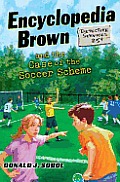
The New York Public Library is collecting donations in Sobol’s memory. Penguin will publish Sobol’s final collection, Encyclopedia Brown and the Case of the Soccer Scheme, this fall.
13 January 2011

More on Max Finder

Further investigation of the Encyclopedia Brown and Max Finder mystery series yields an explanation of why so many characters in the latter seem to be up to no good.

In most of the cases that Donald J. Sobol set in Idaville, the culprit is fairly obvious: Bugs Meany, a recent parolee, the snotty braggart who’s taking Sally out to the movies, and so on. The young detective’s task is usually to spot an incongruous detail in that suspect’s alibi or behavior which cracks open his façade of innocence.

In contrast, the mysteries that Liam O’Donnell concocts for Max Finder are true whodunits. A wrong has been committed, and there are at least two suspects, often more. Readers are challenged to identify not only how the brainy detectives solve the crime, but who committed it. To make that hard, those suspects need to be equally suspicious, and perhaps the culprit should be the least suspicious of the lot. Hence the treacherous employees, frame-ups, and cutthroat competitors.

When I first wrote about this series, I was responding to Snow Wildsmith’s praise for how it gives Max’s friend Alison Santos “moments to shine.” Indeed, that aspiring journalist solves several of the mysteries before he does—though Max still gets top billing.

The town of Whispering Meadows is also notably multicultural. The kids have surnames like Diallo, Chang, Hajduk, and Kanwar. Artist Michael Cho draws Max so readers might be able to interpret him as Caucasian, Eurasian, or even Inuit. The character sketches break kids out of types. Tony, “an all-around athlete,” also “cries at sad movies,” and Nanda, who likes “the latest CDs and clothes,” is “a hockey goalkeeper.”

Only one role seems to be reserved for European-Canadian males: the bully. “Basher” McGintley and Lucas Hajduk are as white as, well, Bugs Meany.

12 January 2011

Whispering Meadows, Den of Thieves

Crime and misbehavior in Encyclopedia Brown’s home town of Idaville tends to come from three sources:

  • Criminals passing through town, or recently out of jail.
  • New kids trying too hard to show off.
  • Bugs Meany and his Tigers.
The bulk of the local young population—the kids obsessed with teeth or animals or lacrosse or whatever—come across as well-meaning and good-hearted. Trouble comes from outsiders, and the community’s recognized bullies.

I found Whispering Meadows, the home town of young sleuths Max Finder and Alison Santos, to be a more treacherous place. The first volume of this series, by Liam O’Donnell and Michael Cho, contains ten short, comics-style mysteries originally published in OWL Magazine.

In three stories, the culprits turn out to be trusted employees of the damaged businesses. In a couple more, one friend victimizes another. Several stories contain red herrings as the guilty person tries to frame an innocent bystander. And whenever there’s a contest, the kids compete in cut-throat fashion.

Punishment for the transgressions tends to be mild. Of the ten cases, only one involves action by legal authorities; in another, a summer camp sends some kids home early. But a more typical dénouement in the back of the book is along the lines of: “Jeremy apologized for breaking Sally’s stereo, and for making the scene look like Hector did it, and after a while they all became friends again.”

Which might make sense, since a lot of the kids in Whispering Meadows have a common interest in bad behavior. In the next story, Hector might well be vandalizing someone’s bike while Sally blames Angela for beating her in the spelling bee.

Whispering Meadows sounds like a horrible place to grow up.

26 July 2010

Equal Work for Lower Billing?

Back in March, Snow Wildsmith reviewed the first Max Finder Mystery collection of middle-grade mysteries in comics form with this praise:

Both boys and girls should enjoy the stories as each of the two detectives has their moment to shine, so even though the series is named for Max, it’s obvious that they are equal partners.
Except that one gets his name in the title, and the other doesn’t. So are they really equal?

In the Encyclopedia Brown books, the hero also had a female helper, Sally Kimball—though she wasn’t in on every case. In a break with gender stereotypes, Donald J. Sobol made Sally the muscle of the outfit; she was tough enough to keep Bugs Meany from beating up brainy Leroy Brown. But she was clearly in a supporting role, and the guy got top billing.

Are there counterexamples for this pattern? For example, what about the Sammy Keyes mysteries, by Wendelin Van Draanen? Those have a young female detective front and center.

Well, not front. The current paperback packaging features the villains, not the detective, on the front covers. Sammy does appear on the hardcover jackets, but as one element in a design, sometimes hard to recognize in the background.

But everyone knows Sammy’s a girl’s name, right?

16 April 2009

Winston Breen Throws a Puzzle Party Starting Today

Today is the start of the Puzzle Party blog tour and puzzle challenge heralding the publication of The Potato Chip Puzzles, by Eric Berlin. Find all the contest details at the Puzzle Party website, including news of the impressive grand prize supplied by G. P. Putnam's Sons.

Each stage of the blog tour will offer a link to one more downloadable puzzle:

Yes, the tour winds up here! You can't solve the final puzzle and win the grand prize unless you come back.

On the 22nd I'll post, in addition to the link to that final puzzle, an interview with author Eric Berlin. Here's a little preview of our colloquy:
I'm guessing you were a fan of Encyclopedia Brown when you were young. What did those books mean to you as a reader? What lessons did you take from them as a writer? Any other childhood favorites?

I was indeed a fan of Encyclopedia Brown--I pretty much swallowed those books whole. I don’t know that I extracted any meaning from them at the time....but in retrospect it’s clear how pivotal they were in helping me discover who I am. I’m sure I read a sports story or two as a child, but I have no memory of it. No, for me, it was mysteries and puzzles: Encyclopedia Brown, Scott Corbett’s wordplay-drenched The Big Joke Game, and Alvin’s Secret Code by Clifford Hicks.
I made my guess not just because Eric's a puzzle fan and the Encyclopedia Brown books are built around solve-it-yourself mysteries. Rather, as I read The Potato Chip Puzzles I thought that Winston Breen and some of his friends would fit right into Donald J. Sobol's Idaville. In that town all the kids have individual quirks: collecting teeth, bull-fighting, running con games, animal welfare, solving mysteries. Winston's quirk is solving and making puzzles. Everyone knows that's what Winston likes, and his friends are cool with that.

10 March 2007

Parodying the Encyclopedia

Last month I had occasion to reread a couple of Encyclopedia Brown books, and realized that I was borrowing Donald J. Sobol’s vision of kid society for one of my current writing projects.

Each of the kids in Sobol’s books has his or (less often) her own idiosyncratic obsession: the boy who collects teeth, the kindergartner who publishes a newspaper even though he can’t read or write, the gallant ladies’ man, the rabid animal lover, the skinflint, and so on.

Of course, Encyclopedia is the same, a kid with a photographic memory sitting in his garage waiting for clients to come pay him a quarter. (He actually has some anxious moments in the first book, wondering if anyone will show up and validate him.)

In a way, Bugs Meany is the most rounded kid in Idaville: at least he’s willing to try a new scheme every couple of stories.

Do American kids today recognize such a world, where kids make their own fun instead of rushing from one scheduled activity to another? Or was Encyclopedia Brown< always secretly a parody of childhood?

In any event, it’s no surprise that such a delightfully mannered series has attracted more than its share of parodies. A selection for your entertainment: