In 1980 the Muller Rosen animation company released a half-hour holiday special for television titled
Thanksgiving in the Land of Oz. That show was then recut to remove the Thanksgiving references and released on video as
Dorothy in the Land of Oz; as of this holiday, it can be watched in
two parts on YouTube. In 1982 Romeo Muller adapted his screenplay into a short illustrated book titled
Dorothy and the Green Gobbler of Oz.
Like most Oz videos in the television age, this cartoon was written to invoke MGM’s
Wizard of Oz. Dorothy meets the Wizard in Kansas again, the Cowardly Lion is bipedal, there are songs, and so on. But the filmmakers also obviously knew the Oz books and used them as inspiration for characters, settings, and plots points, albeit without being faithful to those books.
Thus, for example, just as in L. Frank Baum’s original novel and the MGM movie, Dorothy and Toto accidentally travel to Oz and meet three male companions who help her on a quest to vanquish a villain. One of those companions is an animated refugee from a farm, another made of metal, and the third a big carnivore with gentle habits. But in this movie those characters are Jack Pumpkinhead, Tic Toc [sic], and the Hungry Tiger, whom Baum introduced in different ways in his second and third Oz books.
Jack lives in a pumpkin house, as John R. Neill drew it in
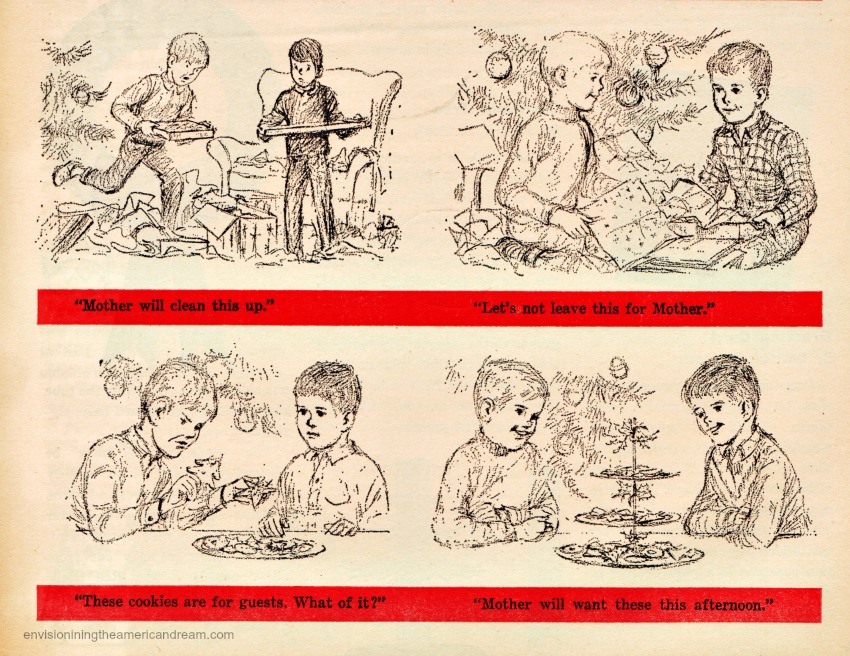
The Road to Oz. Other Oz houses resembles those he and W. W. Denslow designed, and a sequence of children opening Christmas presents owes a lot to Denslow’s art, rendered with less character. However, a trip over a rainbow at the end is clearly inspired by the MGM movie’s most famous song.
The end of the cartoon shows Ozma as rightful ruler of the Emerald City, but there’s no explanation of how she came to the throne. This Ozma seems much older than Dorothy and more like the Glinda of the movie.
Another element that the filmmakers borrowed from Baum’s books appears at the start: Uncle Henry and Aunt Em are about to lose their farm to the bank. The couple plans to go into an “old folks’ home” while Dorothy will have to live somewhere far away with a cousin—perhaps Zeb Hugson from
Dorothy and the Wizard in Oz. This is a better fate than what Baum wrote about in
The Emerald City of Oz, which suggested Dorothy would have to go to work while her aged relatives might end up begging. Still, it was probably a shock to many viewers.
The big-name star of the production is Sid Caesar, who plays the Wizard and narrates the story in that role. Caesar also plays a mince pie that’s brought to life, takes the name U.N. Krust, and delivers every line in a different foreign accent. The pie and its speech patterns play no role in the plot; they seem to have been included just to put Caesar’s shtick to use. We haven’t seen so much ethnic humor in an Oz adaptation since the 1903 Broadway show.
Another notable casting detail: Joan Gerber supplied the voices for both Ozma and Tic Toc.
The cartoon includes a couple of forgettable songs. Dorothy uses one to convert the villain back into a benevolent toymaker, and at the same time deliver a paean to Christmas shopping. In that respect, this modestly produced special was a perfect start to commercial television’s holiday season.







 My visitor might not have meant any harm, but whoever it was had sidestepped the alarms. I threw on a bathrobe and killed all the lights to see out the windows and scan that dark night.



