Showing posts with label public art that's actually good. Show all posts

21 April 2020

The Strange Death of the Virus Vanguard!

On 20 April, the government of Singapore presented a new tool in the public-health armamentarium fighting the coronavirus epidemic: superheroes!

The Virus Vanguard team, created with the help of a large collective named Band of Doodlers, consisted of five heroes:
  • Dr Disinfector, who can spot, smell, and hear viruses and bacteria.
  • Fake News Buster, wielding his Mallet of Truth against false claims and fake news.
  • Circuit Breaker, a solar-powered robot mentally controlled by a young girl who volunteers at a nursing home.
  • Care-Leh Dee, pronounced “care lady,” who “uses empathy to absorb all negativity.”
  • MAWA Man, who Must Always Walk Alone, pushing people away with force beams.
A day later, the government took down the webpage and disavowed the team.

What happened? It looks like the saga began with a large collective named Band of Doodlers who do public art in a graffiti style.

On 7 April, on the Band of Doodlers’ Facebook page, an artist named Mas Shafreen presented the first proposal for the Covid Warriors, including Safe-Distancing Girl, Santizer Soze, Contact Tracer, Expressman, and the Nurse. They fought the evil King Corona. It looks like other artists and writers joined in the fun.

At some point, it appears, the government got involved. The heroes probably went through a committee process, emerging with a team that conformed to epidemiological priorities.

Once the Virus Vanguard was official, however, it became fair game for much more criticism than just a bunch of superheroes created by a friendly band of artists stuck at home with lots of time.

People complained that for the government to promote superheroes as thousands of people got sick and died was a waste of time and in poor taste.

Critics judged that not only were the characters derivative [duh!—they’re superheroes], but some of the artwork was clearly traced from others’ work.

But the most passionate criticism seems to have focused on MAWA Man. He’s of course supposed to embody the virtue of keeping two meters away from everyone. Mas Shafreen and his colleagues gave MAWA Man this tragic backstory: “a fanatical Manchester United fan who grew up in the 80s when Liverpool kept winning titles and he was constantly taunted by his two Liverpool fan brothers. This made him despise everything Liverpool including their motto You’ll Never Walk Alone (YNWA).”

Now that seems obviously satirical to me, but many football fans are passionate about their teams and their fight songs. Liverpool fans probably feel such slights even more keenly now that Man U has been on top for several years. Those fans, too, complained volubly about the Virus Vanguard and even started an online petition.

So the Singapore government took the webpage down, Mas Shafreen has apologized and even offered to leave the Band of Doodlers, and the world is bereft of the only Covid-19-fighting superheroes.

But wait! Now there’s a growing backlash against the backlash, supporting Band of Doodlers for its efforts.

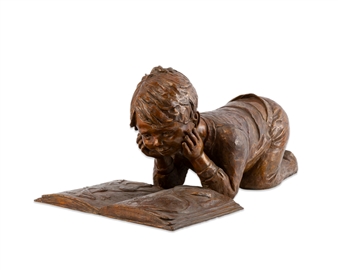
03 October 2019

Hard to Read

One reason the Waukegan Public Library may have chosen not to portray native son Ray Bradbury as a little boy (as I discussed yesterday) is that the site is already chock full of metal kids with books.

The library’s Stimson Sculpture Garden contains no fewer than seven bronze sculptures depicting ten little kids reading, along with a few fairy-tale animals.

There used to be two more children reading, but in 2012 they were stolen and melted down as scrap. Since those statues were bronze, other castings survive, such as Jane Rankin’s “Little Scholar” shown here.

Last time I checked, my public library has two such bronze statues of little kids with books. It looks like this is a genre with solid demand, and artists like Gary Lee Price, Randolph Rose, and Rankin are happy to supply the market.

Someday art historians will write monographs on this form and the studios and patrons behind it, like the studies of Civil War statuary.

02 October 2019

Ray Bradbury’s Rocket

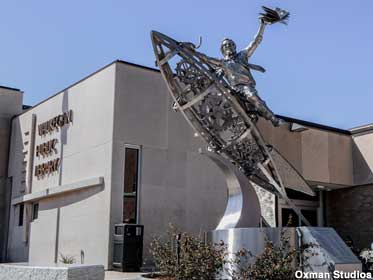
I am not taken with the Ray Bradbury sculpture erected in his native town of Waukegan, Illinois, and unveiled this summer.

Zachary Oxman sculpted the figure of a young Bradbury riding the outline of a rocket, steampunk gears inside. The steel figure waves a copy of Fahrenheit 451.

The design is deliberately “retro” to fit with the mid-20th-century library building nearby, where Bradbury bequeathed his book collection. But the result strikes me as cheesy, diminishing the themes he wrote about instead of celebrating them. “I send my rockets forth between my ears,” Bradbury wrote in a poem, and this turns that metaphor into something solid and heavy again.

I also wouldn’t recognize Bradbury from this statue. I picture him from photos and TV appearances in my youth as a somewhat rounded bespectacled middle-aged man, a chatty dean of American science fiction.

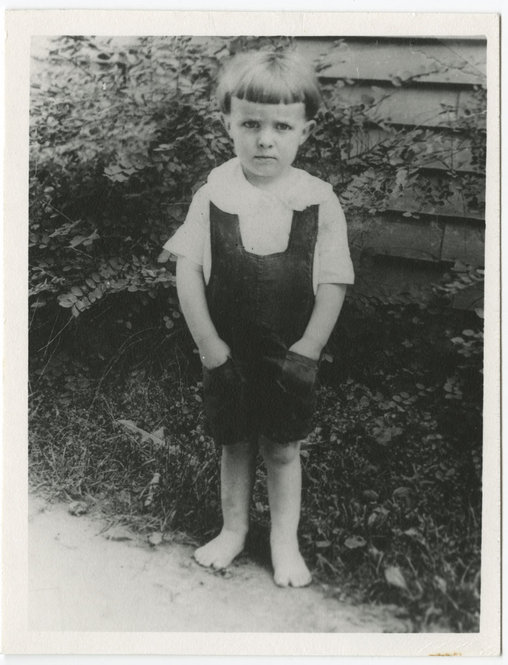
It would make sense for a Bradbury statue in Waukegan to depict him as he looked when he was living in Waukegan. That would be a little kid since the family moved to Arizona when he was six. A young boy dreaming of the future could be iconic but not recognizable. Here’s Bradbury at age three, from the Knopf collection of the Harry Ransom Center. Here he is again, said to be in 1923 but probably a couple of years later.

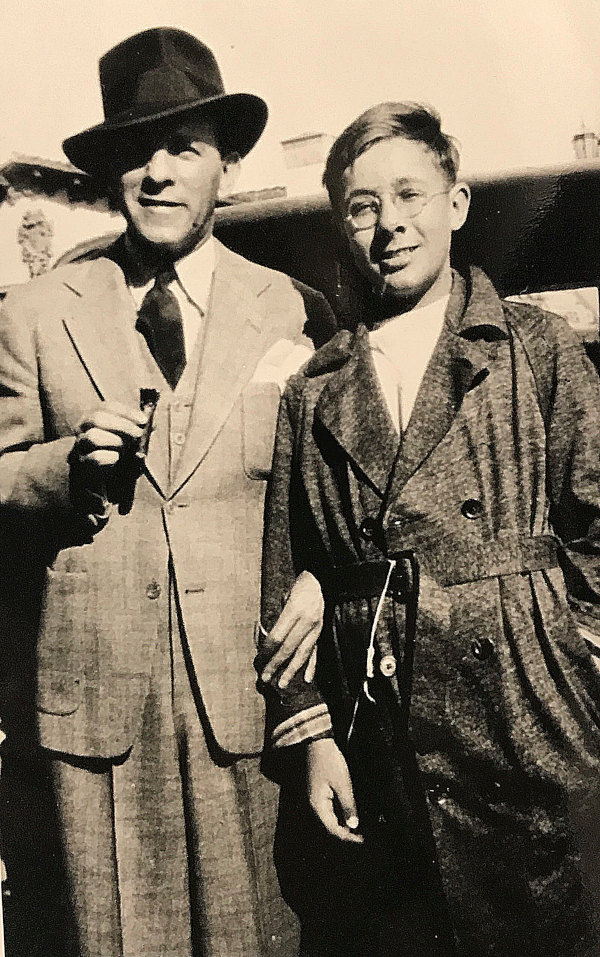
By age 14, Bradbury was a working writer in LA with hints of how he’d appear as an adult. But I haven’t found any photo of Bradbury looking like the young man in that sculpture. He didn’t wear his glasses for photos in the 1940s, and he had a crew cut through the 1950s. The statue’s combination of spectacles, floppy hair, and svelteness seems like a composite. (Or perhaps Oxman worked from family photos I haven’t seen.)

Lastly, I have to admit, when I see someone clinging to a rocket like that, I can’t help but think of Bucky Barnes about to be blown up by Baron Zemo.

18 July 2017

The Tin Woodman of Forkland

Starting in 1993, Jim Bird has been building statuary out of old farm equipment and hay bales on his fields in Forkland, Alabama.

Among those figures is this “32-foot sculpture of the tin man from Oz, assembled from old bathtubs, 55-gallon drums and a discarded fuel tank—and topped with an old fertilizer spreader.”

As of 2015, this was the most expensive of Bird’s statues since he spent $40 on paint; otherwise, he has a rule not to spend more than $5. The heart has text which reads, “Jim loves Lib.” That’s a message for Bird’s wife Lib; he started building his figures when she was on a trip and he missed her.

(Photo courtesy of the Library of Congress.)

23 November 2015

Giddap

I was impressed by Brooklyn artist Adrian Landon’s mechanical horse.

Click on the picture to see a video.

I was a little disappointed to read that it’s powered by a small electric motor rather than by the wind. I guess the Strandbeests have spoiled me.

15 September 2014

Another Childhood Illusion Shattered

Tonight I attended Leonard Marcus’s talk about Robert McCloskey on the centenary of the author-illustrator’s birth. (It turns out he was born in Hamilton, Ohio, now home of this sculpture. But I digress.)

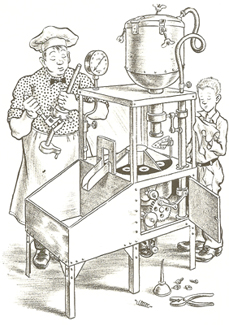
Marcus showed a photo of the doughnut-making machine from Homer Price and remarked how there are only two places to see such a machine now.

“Well, it’s good that someone preserved that model of doughnut-maker,” I thought. “I’m surprised there are so few left—maybe it really didn’t work well, so most of the machines were pulled apart.”

But that wasn’t what Marcus was saying. If I understood him correctly, only two examples of that machine were ever made. One was for the Walden Wood film studio when it adapted Homer Price as a short film in 1963. McCloskey was a friend of the studio owner and spent a lot of time there in later life; as a lifelong tinkerer, he might well have helped to build that machine.

The other was a replica built and displayed in the Municipal Building back in Hamilton, amid McCloskey’s architectural decorations. It’s not clear whether that one was made to work or just to look like the picture in the book.

All along I’d thought that was a standard type of doughnut-maker from the 1940s. After all, I’d seen it in action in that movie, operated by a boy who looks just like Homer Price (and couldn’t act for beans).

But it sounds like McCloskey made it up, based on real, less compact doughnut-making machinery. I feel like Freddy and Louis discovering that the Super Duper can’t lift his car out of the ditch.

13 February 2014

Art for a Winter’s Day

With yet another snowstorm piling up outside my door, I’m sharing some of the beautiful and transient artwork that Andy Goldsworthy sculpted out of ice in Cumbria and other parts of England in the 1980s.


At Publishers Weekly’s Shelftalker blog, Elizabeth Bluemle recently wrote about a nephew so enamoured of Goldsworthy’s work that he had a birthday party with a snow-sculpting theme.

27 January 2014

Alice in Guildford

Charles Dodgson settled his sisters in Guildford, England, and died there in 1898. In 1990, the town commemorated his most famous work by installing a couple of impressive statues.

On the grounds of Guildford Castle, near the Dodgson home, is Jeanne Argent’s statue of Alice going through the looking-glass. Details include striped stockings. The glass can make impressive effects on film.
On a river bank sits Edwin Russell’s “Alice and the White Rabbit.” Though her hair and dress may seem more modern, this Alice looks more like the real Alice Liddell.

06 January 2014

More Hastings

Leigh Dyer is a self-taught metal sculptor working out of Hastings, the English town best down for a battle that took place nearby nearly a millennium ago.

Hunt, who heads Incurva Studios, is adorning the town with statues that combine sea life with giant chess pieces. As the English Chess Federation reported, the town already had a giant chess board in a park. But now it also has:
In addition, Dyer’s giant winkle on a column with fish, a separate work, looks a lot like a pawn.

25 December 2013

The Tradition of the Gävle Goat

For this holiday, Oz and Ends brings you the story of the Gävle Goat.

As Slate describes, the Gävle goat was instituted all the way back in 1966, when two brothers—an advertising consultant and a fire department chief—organized an effort in the city of Gävle to build a large straw statue of a goat for Christmas season. The goat represented one of the two that pull Odin’s chariot in Scandinavia’s pre-Christian pagan lore. It lasted just a few minutes into the New Year before it burned down.

Now you’d think that building a forty-foot-tall statue out of straw (over a metal frame) in honor of the winter solstice would just invite a bonfire. Even in Sweden, where there’s such a steady supply of snow to keep the straw cold and wet. But Gävle works to prevent its goat from burning. There are flame retardant chemicals, volunteer watches, police patrols, and webcams.

And those measures usually don’t work. The news reports I’ve seen differ on how often the Gävle Goat has been torched, though they agree that number is in the high twenties—i.e., more than half the time. The counts might be confused by the fact that it’s been destroyed in other ways: hit by cars and dismantled by hand (and foot). In 1970 the goat survived less than a day, though those young arsonists were caught. In 2005 people costumed as Santa Claus and the Gingerbread Man shot a flaming arrow at the goat and escaped.

In 2010 the goat survived the entire season, though there was a plot to steal it by helicopter. In 2011 it went up in flames on 2 December. In 2012 it survived until 12 December. This year, the goat went up in flames over the weekend. So at least it’s lasting longer.

Despite the widely reported tradition of destroying the Gävle Goat, it’s illegal to do so. In 2001 a visitor from Cleveland torched the goat, thinking he was participating in a local tradition. He was arrested, jailed for eighteen days, and fined SEK100,000, which he didn’t pay. Apparently the tradition is to set fire to the goat and get away.

03 December 2013

Parade Balloons Over 75 Years

Macy’s 1939 parade included a Tin Man balloon to promote MGM’s new movie, The Wizard of Oz.

For the movie’s seventy-fifth anniversary (which is actually next year), the movie’s current owner, Time Warner, paid for another balloon. According to Yahoo TV, “Macy's repurposed an older balloon. . . . The designers took a balloon shaped like a — see if you can follow — hot-air balloon and decorated it with images of the beloved L. Frank Baum characters.” The portraits were hand-painted.

22 August 2013

The Visual Display of Edward Tufte

About a quarter-century ago, I was a young Editorial Assistant at a publishing company, and someone handed me a copy of Edward Tufte’s The Visual Display of Quantitative Information.

I already had a copy of that book, a holiday present from my mother. (I think I’d entered a “hard to shop for” period after years of easily identified obsessions.) I’d found The Visual Display of Quantitative Information quite interesting, both in its content and in its backstory: Tufte had self-published the book back when desktop-publishing programs were new and Amazon and print-on-demand barely conceived of. I read that he was making big money from the book and/or speeches and consulting contracts based on it.

That success evidently caught the attention of higher-ups at my employer. One of them sent a copy of the book down to the editors on my floor along with a memo to look into this and do something about it. I saw one of those editors carrying around the book and naively piped up that I was familiar with it already. That was how I came into possession of a second copy of The Visual Display of Quantitative Information.

I was too new to realize that corporate activity around the book wasn’t really driven by a wish to start publishing oversized volumes on quantitative displays. Rather, it was driven by a wish to satisfy the higher-ups’ desire to have someone handle this matter. The book was like the monkey in the old Harvard Business School analogy: passed off from one desk to another within the organization until someone figures out a way to toss it back outside.

I don’t clearly recall how the episode ended. I think I was still wrestling with how best to explain “We can’t afford him” when word arrived that our department’s higher-up had passed along the book because an even higher higher-up had given it to her, so she wasn’t really pushing for any action. Tufte went on to self-publish more volumes without being bothered by us.

All of which leads up to the news that for several years Edward Tufte has been working on large-scale sculptural installations, sometimes in collaboration with stone worker Dan Snow. Three that caught my eye are:
Tufte’s website says the next open-house viewing at Hogpen Hill Farms in Woodbury, Connecticut, will be on 5 Oct 2013.

15 August 2013

Where to Find the Runaway Bunny

Fuse #8’s catalogue of public children’s-literature statuary in the US alerted me to the Runaway Bunny statue outside the Westerly Public Library in Rhode Island. The bronze figure, by Connecticut sculptor Joan Binney Ross, was installed in 1998.

Earlier this summer the sculpture was vandalized, painted with “vulgar graffiti and the letters ‘KKK’,” as the Providence Journal reported, based on now-unavailable story from the Westerly Sun. Depending on the grammatical connection between the vulgarity and the initials, that could have been either a pro-KKK or anti-KKK message.

The library and park staff had difficulty removing the paint, so they contacted Ross, who recommended a cleaner. The AP reported that the bunny was restored to its original condition.

The Stonington-Mystic Patch carried an image of the vandalized bunny. Noting that similar graffitti had been painted elsewhere in the area, it asked readers if they recognized the “tag,” but there don’t appear to have been any breakthroughs. That site also posted a video of the cleanup.

Some of those articles referred to Margaret Wise Brown, author of The Runaway Bunny, but none named the book’s artist and designer of the original bunny, Clement Hurd.

21 July 2013

Robin Statuary at Comic-Con

This weekly Robin features photos of two statues of the Boy Wonder on display at this year’s San Diego Comic-Con.

On the left is an inflatable figure of Robin from the Teen Titans Go! cartoon, about two stories tall, courtesy of Bleeding Cool. I think he’s supposed to be pointing the team into battle (“Teen Titans, GO!”), but given the way the balloon was positioned, I couldn’t help but perceive him as making fun of Raven.

Below is a smaller sculpture of Robin as he appears in the Batman Live arena show—the US version, not the British one I saw. (The US costume includes extra arm pads and those red patches on the outer thighs.) This life-sized figure was constructed of Lego blocks.

For someone who started reading comics forty years ago, it’s striking how “off model” these images of Robin are. Back in 1964, DC Comics felt it had to trumpet “New Look” when it modernized the style of its Batman comics to make them more like the rest of the line.

Twenty years later, the company had to show Jason Todd wearing the exact same costume as Dick Grayson and dyeing his red hair black so as to mollify its licensees. Already readers (and characters) were pointing out the deficiencies of that outfit. And surely some folks in Gotham City might have noticed that a young former circus flyer started dyeing his hair (how many young teen boys do that?) just when Robin reappeared at Batman’s side. But the need to keep the art “on model” trumped logic.

The success of Carrie Kelley in The Dark Knight Returns might have assured DC that its fans didn’t need all Robins to look alike. A couple of years later the company commissioned a new costume from Neal Adams for Tim Drake.

That costume in turn influenced how Dick Grayson dressed in DC’s Animated Universe and, with futher modifications, in its televised Teen Titans offshoot. We’ve since seen new designs for the 1990s Batman movies, for new Robins, for Batman Live, for the Arkham videogames. Each variation, of course, makes it easy for established fans to identify which Robin is which, and each represents a new possibility for collectibles.

It now appears that the original “model” Robin costume never existed in the “New 52” universe. In other words, as these competing statues demonstrate, we’re all “off model” now.

19 June 2013

Suburb Reverting to Nature?

Early this month, a coyote bit the dog of one of my writing-group friends, Karen Day. This was, the local newspaper reported, one of more than fifty recent coyote sightings in town.

In addition, our suburb’s police killed a black bear that was hanging in a tree over the highway. Wild turkeys are walking the roads—twenty roosted in my side yard a couple of years ago. I routinely see rabbits on the sidewalks.

Indeed, there are so many rabbits in the suburbs close to Boston that Longfellow House–Washington’s Headquarters has invested in a artificial coyote (as shown above) to scare them away from the plantings. It doesn’t seem to be working; the site’s Facebook page featured a photo of a rabbit sitting happily beside the coyote figure. But perhaps the coyote that bit Karen’s dog will make its way there.

I grew up in this area, and the only wild mammals I remember seeing are raccoons, squirrels, and chipmunks. I saw ducks and geese down at the ponds but no turkeys. I was a kid; I would’ve gotten all excited about bunnies, and my parents would certainly have taken note of coyotes and bears.

What’s changed? One possibility is that we’re simply seeing the result of population cycles among those species. Another is that decades of environmental improvements have made this neighborhood more hospitable to turkeys, rabbits, and other wildlife, and the predators have followed. And then there’s the opposite explanation: that more development further out from the city has driven those animals out of their previous homes into ours.

26 September 2012

Birthday for Ducklings

This Saturday, 29 September, the Friends of the Public Garden in Boston will celebrate the 25th anniversary of the installation of Nancy Schön’s Make Way for Ducklings sculpture.

The duck family from Robert McCloskey’s book were already local heroes when these bronze statues were installed, but they’re now truly iconic. Every seven years or so someone on a drunken lark steals one of the ducklings, only to return it sheepishly and anonymously a few mornings later, so the ducklings remain in the news and public hearts.

The celebration is scheduled from 10:00 am to 1:00 pm.
The party features a variety of games and activities including music, magic, and juggling. Children may create their own birthday card to wish Mrs. Mallard and her ducklings well on their birthday, and be sure to stay for a reading of Make Way for Ducklings.

Of course, a birthday party isn't complete without singing "Happy Birthday" to the ducks!
Last month Anita Silvey shared some behind-the-scenes stories of how McCloskey created the book on her Book-A-Day Almanac:
He went to the parks and the Museum of Natural History—and hundreds of duck drawings emerged from his pen. Finally, in an act of desperation, he went down to a market in Greenwich Village, bought some ducks, and brought them back to his apartment and put them in his bathtub. Then, every day, he woke up with a tissue to clean up after them in one hand and a sketchbook in the other. But the ducks still moved too quickly for McCloskey to capture them in detail.
The solution was perhaps too typical for mid-20th-century American authors and artists: liquor!

03 September 2012

Hang On a Minute

Among the public artworks commissioned in Britain in conjunction with the Olympics is Richard Wilson’s monumental statue atop the De La Warr Pavilion in Bexhill.

Titled “Hang on a minute lads, I’ve got a great idea…,” it’s a replica of a tour bus (coach) teetering over the edge of the building. And it really does teeter. With hydraulics attached to the underside of the bus, and firmly to the roof, the bus rocks randomly.

The Guardian explains; there’s also a video interview with the artist at that site. Actor and comedian Eddie Izzard, who helped to sponsor this artwork, explained the motivation behind it:
By the end of 2012 I would hope the word goes out from our country that not only do we run excellent world events, but we also balance coaches on the edges of buildings like no one else ever could.
I was actually disappointed to read that the artwork and its title refer to the 1968 heist movie The Italian Job, which ends with Michael Caine delivering that line in a similar situation. That turned a sculpture I’d imagined as a humorous yet existential comment on life into an homage to pop culture—like a bronze statue of Fonzie. However well made that bronze statue is, it has kitsch mixed into the metal.

So perhaps my loyalties in Britain’s new public art will shift to “Sacrilege,” Jeremy Deller’s full-scale recreation of Stonehenge as an inflatable bouncy castle. It raises such important questions as: Is it possible to imagine large numbers of American parents taking their children to anything called “Sacrilege”?

07 June 2012

“You are approaching the periphery shield of Vortex Four”

So I was thinking, “Where on Earth could we find the right sets for an affordable remake of Zardoz?” And then I realized that the former Yugoslavia is available.


These are all monuments to World War 2 erected under the Tito regime, photographed by Jan Kempenaers of Belgium and published in his book Spomenik. (Hat tip to the Crack Two blog.)

26 May 2012

Swell in Possibility

From the Boston Globe and Jeannine Atkins come descriptions of the “Little White House Project: Dwell in Possibility,” an art installation at the Emily Dickinson Museum in Amherst, Massachusetts.

It consists of 34 white sheds displayed on five contiguous acres.
Each house is made from sustainably harvested wood and features a line from a Dickinson poem; a word or two is stenciled on each of its four outer walls and the roof panels.
The black serif type on the white boards reminds me of pages from a book. (Or those refrigerator magnets.)

The artist is Peter Krasznekewicz, a junior at Deerfield Academy. His original installation was on the grounds of that school, but a flood meant the athletic teams needed more land. (Stop me when this sounds too much like a YA novel.) The museum and its neighbors offered a wider canvas.

For fundraising, publicity, and archiving the project, Krasznekewicz launched the Action Art website, which shows the little houses in Deerfield over the New England winter.

“The Little White House Project” will be up at the Dickinson Museum through the end of June.

18 February 2012

Apparently It’s Art

The New England Journal of Aesthetic Research has listed the art edition of Hellbound 2, a horror-comics anthology produced by Riverbird Studios for the Boston Comics Roundtable, as a nominee for its 2011 New England Art Award in the Book category.

A story that Andy Wong and I created, “RobMeBlind.com,” is in that collection, along with many other originals from local artists and writers.

Voting is open until 24 Feb 2012. I’m just saying.

I must admit, however, that I’m even more excited to see the journal’s page on Worst Public Art in New England, and particularly that the godawful Irish Famine Memorial near Old South is at the top of that list.