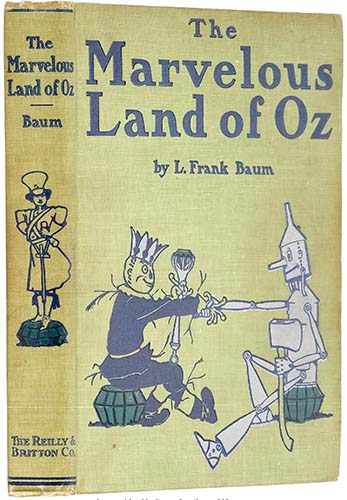
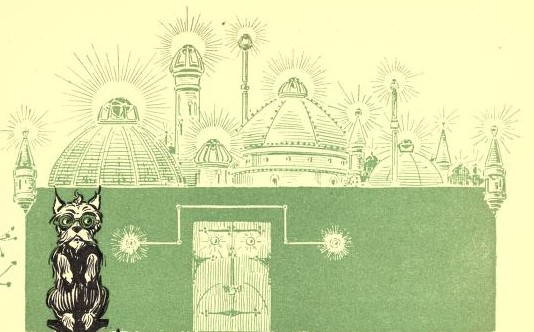
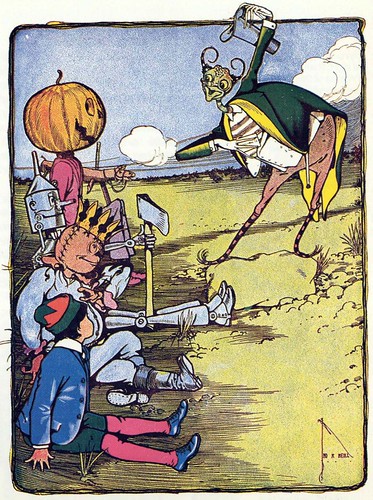
Showing posts with label BOOK Marvelous Land of Oz. Show all posts

02 May 2026

Assessing the Ultimate Oz Universe for the Baum Bugle

The spring 2026 issue of The Baum Bugle contains my review of The Lost Lands, the first volume of the Ultimate Oz Universe graphic retelling of L. Frank Baum’s Oz books.

There’s a big team behind this comic, some of them having worked for years to develop this version of Oz for various media. But the main creators of what we see on the book’s pages are the writers Cullen Blum and Larry King and the artist Mike Deodato, Jr.

My bottom line is that The Lost Lands is interesting to sample as an alternate version of Oz and often visually striking, but sadly not as original as it presents itself.

Firstly, there have been many “dark” adaptations of the Oz books in comics form over the years. The Ultimate Oz Universe is far from the first to recast Dorothy as a teenager, the Tin Woodman as a robot, the Scarecrow as truly scary, and so on.

Second, this graphic novel is a streamlined retelling of The Marvelous Land of Oz. Nothing wrong with that, but the project also draws without acknowledgment on work still under copyright, including later books and the syncretic maps created by James E. Haff and Dick Martin for the Oz Club.

Third, Deodato’s art is notable not only for its dramatic hyperrealism and solid comic-page design but its inconsistency on the details. I spent two paragraphs listing examples, such as:
Over one action sequence, Glinda’s sleeves grow from being short and off-the-shoulder to long and puffy. Mrs. Yoop’s shoes have straps in one panel but not the next. On a single spread, the Cowardly Lion’s belt takes on three separate designs.
Based on such discrepancies, other comics artists have accused Deodato of using AI imagery. He’s denied doing that. (Using AI should have been disclosed during the book’s Kickstarter campaign.) I don’t have hard evidence on that question, so I wrote simply about sloppiness in the visual details.

The overall lack of originality limits how compelling this volume can be. Fans of the Oz books already know the twist at the end of The Marvelous Land of Oz. Seeing the same basic story play out with a teen-aged Tip, a bipedal Cowardly Lion and Hungry Tiger, and other changes doesn’t make it a different story.

Other articles in thus Bugle issue cover the release of Wicked: For Good, a detailed analysis of the art of John R. Neill, a tour of the Hotel del Coronado, and a look at the Australian textile artist Raquel Caballero’s Ozzy work (showcased with eight pages of color), as well as many other reviews.

18 June 2024

The Missing Princess of the Marvelous Land

I’ve been thinking about how The Marvelous Land of Oz could be more of a mystery. As it is, the book is a roller-coaster ride of political events. Every so often it raises the question of who should rule the Emerald City. But the book doesn’t give us all the clues to its ultimate answer until quite late.

Baum and his colleagues had introduced the character of Pastoria, former king of Oz, in the 1902 stage extravaganza The Wizard of Oz. Therefore, when the Scarecrow mentions his name in the sixteenth chapter of Land, it wouldn’t have been a complete surprise to all readers.

Nonetheless, that was two-thirds of the way through the book. Furthermore, Glinda doesn’t drop the bombshell that Pastoria left a missing daughter until four chapters later. That means readers have only three chapters to be thinking about this mystery, on which the conclusion of the story will hinge.

There are plenty of signs that Baum didn’t like going back to revise. He occasionally excised whole chapters or inserted new passages, but his surviving manuscripts and correspondence show none of the fiddling with details that other writers regularly performed.

I don’t think it would have taken much revising to cue readers into thinking about Pastoria and his daughter for much of the book. Here are some slightly rewritten passages in which characters discuss the history of Oz.

In Chapter 3, the boy Tip is trying to orient his creation, Jack Pumpkinhead:
“Where are we going?” asked Jack, when they had resumed their journey.

“I’m not exactly sure,” said the boy; “but I believe we are headed South, and that will bring us, sooner or later, to the Emerald City.”

“What city is that?” enquired the Pumpkinhead.

“Why, it’s the center of the Land of Oz, and the biggest town in all the country. I’ve never been there, myself, but I’ve heard all about its history. It was built by a mighty and wonderful Wizard named Oz, around the estate of the former king Pastoria, and [later] . . . the people of the Emerald City invited the Scarecrow to rule them.”

“Dear me!” said Jack. “I’m getting confused with all this history. Who is the Scarecrow?”

“Another friend of Dorothy’s,” replied Tip.

“And who is Dorothy?”

“She was a girl that came here from Kansas, a place in the big, outside World. She got blown to the Land of Oz by a cyclone, and while she was here the Scarecrow and the Tin Woodman accompanied her on her travels.”

“And where is she now?” inquired the Pumpkinhead.

“Glinda the Good, who rules the Quadlings, sent her home again,” said the boy.

“Oh. And what became of the Scarecrow?”

“I told you. He rules the Emerald City,” answered Tip.

“I thought you said it was ruled by a wonderful Wizard,” objected Jack, seeming more and more confused.

“Well, so I did. Now, pay attention, and I’ll explain it,” said Tip, speaking slowly and looking the smiling Pumpkinhead squarely in the eye. “Around the time King Pastoria vanished, the Wizard came and built the Emerald City and ruled for many years. Dorothy went to the Emerald City to ask the Wizard to send her back to Kansas; and the Scarecrow and the Tin Woodman went with her. But the Wizard couldn’t send her back, because he wasn’t so much of a Wizard as he might have been. And then they got angry at the Wizard, and threatened to expose him; so the Wizard made a big balloon and escaped in it, and no one has ever seen him since.”

“Now, that is very interesting history,” said Jack, well pleased; “and I understand it perfectly all but the explanation.”
After Jack and Tip get separated, the boy meets a pretty young woman in a colorful military uniform. With a little tweaking, this conversation could have been part of that Chapter 8:
“I am General Jinjur,” was the brief reply.

“Oh!” said the boy surprised. “What sort of a General?”

“I command the Army of Revolt in this war,” answered the General, with unnecessary sharpness.

“Oh!” he again exclaimed. “I didn’t know there was a war.”

“You were not supposed to know it,” she returned, “for we have kept it a secret; and considering that our army is composed entirely of girls,” she added, with some pride, “it is surely a remarkable thing that our Revolt is not yet discovered.”

“It is, indeed,” acknowledged Tip. “But where is your army?”

“About a mile from here,” said General Jinjur. “The forces have assembled from all parts of the Land of Oz, at my express command. For this is the day we are to conquer His Majesty the Scarecrow, and wrest from him the throne. The Army of Revolt only awaits my coming to march upon the Emerald City.”

“Well!” declared Tip, drawing a long breath, “this is certainly a surprising thing! May I ask why you wish to conquer His Majesty the Scarecrow?”

“Because the Emerald City has been ruled by men long enough, for one reason,” said the girl. “Before the Scarecrow there was the Wizard, and before the Wizard, or even the city as it stands today, there was King Pastoria. Some people say Pastoria had a daughter who was meant to rule over us, meaning that we should have had a girl ruler by this time, but no one has seen that child for years.”

That lost heir was not part of the history of Oz that Tip had heard from Mombi. He puzzled over this rumor as Jinjur went on:

“Moreover, the City glitters with beautiful gems, which might far better be used for rings, bracelets and necklaces; and there is enough money in the King’s treasury to buy every girl in our Army a dozen new gowns. So we intend to conquer the City and run the government to suit ourselves.”
Tip and Jack Pumpkinhead reunite in the Scarecrow’s palace, only for General Jinjur to seize the Emerald City. Later the Scarecrow seizes the palace back with the help of his close friend, the Tin Woodman. But at that point in Chapter 16, the straw-man ruler is ready to abdicate:
Tip soon cut the stitches that had fastened the crown to the Scarecrow’s head, and the former monarch of the Emerald City removed it with a sigh of relief and hung it on a peg beside the throne.

“That is my last memento of royalty,” said he; “and I’m glad to get rid of it. The former King of this City, who was named Pastoria, lost the crown to the Wonderful Wizard, who passed it on to me. Now the girl Jinjur claims it, and I sincerely hope it will not give her a headache.”

“A kindly thought, which I greatly admire,” said the Tin Woodman, nodding approvingly.

“Have you ever heard,” Tip asked the straw man, “that King Pastoria had a daughter who disappeared?”

“Some people do say that,” answered the Scarecrow, “and some say otherwise. That happened well before my time, so I cannot say anything about it. Why—do you think General Jinjur is this lost heir to Pastoria?”

Tip shook his head. After all, Jinjur was the person who had first told him about the missing princess, and she had made no claim to rule the Emerald City other than by force and cunning.

“Well, now I will indulge in a quiet think,” continued the Scarecrow, lying back in the throne.
Finally, the Scarecrow and his supporters reach Glinda’s palace in Chapter 20:
“Therefore I have come to beg your assistance,” resumed the Scarecrow, “for I believe you are always glad to succor the unfortunate and oppressed.”

“That is true,” replied the Sorceress, slowly. “But the Emerald City is now ruled by General Jinjur, who has caused herself to be proclaimed Queen. What right have I to oppose her?”

“Why, she stole the throne from me,” said the Scarecrow.

“And how came you to possess the throne?” asked Glinda.

“I got it from the Wizard of Oz, and by the choice of the people,” returned the Scarecrow, uneasy at such questioning.

“And where did the Wizard get it?” she continued gravely.

“I am told he took it after Pastoria, the former King, had not been heard from for some time,” said the Scarecrow, becoming confused under the intent look of the Sorceress.

“Then,” declared Glinda, “the throne of the Emerald City belongs neither to you nor to Jinjur, but to this Pastoria from whom the Wizard usurped it.”

“That is true,” acknowledged the Scarecrow, humbly; “but Pastoria has been gone for many years now, and some one must rule in his place.”

“Pastoria had a daughter, who is the rightful heir to the throne of the Emerald City. Did you know that?” questioned the Sorceress.

“Not for certain,” replied the Scarecrow. “But if that girl still lives I will not stand in her way. It will satisfy me as well to have Jinjur turned out, as an impostor, as to regain the throne myself. In fact, it isn’t much fun to be King, especially if one has good brains. I have known for some time that I am fitted to occupy a far more exalted position. But where is the girl who owns the throne, and what is her name?”

“Her name is Ozma,” answered Glinda. “But where she is I have tried in vain to discover. For the Wizard of Oz, when he stole the throne from Ozma’s father, hid the girl in some secret place; and by means of a magical trick with which I am not familiar he also managed to prevent her being discovered—even by so experienced a Sorceress as myself.”
By that point, readers would have been thinking about the Emerald City’s deep history for most of the book, and the mystery of the missing heir for a dozen chapters. Where could that child be?

14 November 2023

“In the Land of Oz they use no money at all”

In The Road to Oz (1909), L. Frank Baum wrote:
“Money! Money in Oz!” cried the Tin Woodman. “What a queer idea! Did you suppose we are so vulgar as to use money here?” . . .

“If we used money to buy things with, instead of love and kindness and the desire to please one another, then we should be no better than the rest of the world,” declared the Tin Woodman. “Fortunately money is not known in the Land of Oz at all. We have no rich, and no poor; for what one wishes the others all try to give him, in order to make him happy, and no one in all Oz cares to have more than he can use.”
That contradicts this detail in The Wonderful Wizard of Oz (1900):
…a man was selling green lemonade, and when the children bought it Dorothy could see that they paid for it with green pennies.
And also The Marvelous Land of Oz (1904), in which a ferryman asks for money before rowing Tip across a river, the Emerald City and the Winkie castle have treasuries, and all the characters recognize “dollar bills—and two-dollar bills—and five-dollar bills—and tens, and twenties, and fifties.”

Apparently something happened after Ozma came to the throne of Oz at the end of the latter book, producing an entirely different economic system that Baum explained more fully in The Emerald City of Oz (1910).

However, I was surprised to see that the very first mention of Oz doing without money actually appeared outside the series, and outside the canon. The Woggle-Bug Book, a storybook Baum wrote in 1905, contains this paragraph:
You see, in the Land of Oz they use no money at all, so that when the Woggle-Bug arrived in America he did not possess a single penny. And no one had presented him with any money since.
That book doesn’t offer any ethical lesson to go along with the lack of money, as the Tin Woodman would volunteer in The Road to Oz. It’s just another way that the Woggle-Bug’s native land differs from America.

While featuring a character from Oz, The Woggle-Bug Book is set in America, where we use money. It’s one of what I call Baum’s urban fantasies, taking place in a contemporary, multiethnic American city which nonetheless has magic (in that way contradicting the rules of the Oz books he wrote in the same period).

The Woggle-Bug Book and the Queer Visitors from the Marvelous Land of Oz comic page that preceded it were never listed as part of the Oz series, and Baum never referred back to them in his later stories. Thus, fans don’t treat whatever those books say about Oz as reliable for the rest of the series. Nonetheless, in that book Baum first tried out what would become a crucial detail of the Ozian utopia.

04 April 2022

The Opening of the Emerald City

My last posting explored the location of the original gateway into the Emerald City, the one Dorothy and her friends use in L. Frank Baum’s The Wonderful Wizard of Oz.

The travelers come to an emerald-studded gate at the end of the Yellow Brick Road. That outer gate leads to a room inside the thick wall with an inner gate on the other side. The little man inside is therefore called the “Guardian of the Gates” even though there is only one opening the in wall. (With his typical inconsistency, Baum also called this character the “Guardian of the Gate,” sometimes within the same chapter.) Thus, the many early references to the city “gates” don’t mean there’s more than one gateway through the wall.

When characters arrive at the city in The Marvelous Land of Oz, Baum describes their experiences in much the same way as in the first book. The Guardian of the Gates greets them and hands them off to the Soldier with the Green Whiskers. Characters speak of “the gate” of the city.

At the same time, it’s clear that there have been changes in the Emerald City. While before the gate was studded with emeralds, the jewels inside the city only appeared to be emeralds because people wore green spectacles. In Land the city contains some real jewels. General Jinjur and her soldiers don’t fear blindness without the spectacles.

More pertinent to this inquiry, in Wizard the Guardian tells Dorothy and her friends there’s no road to the west because no one ever travels that way for fear of the Wicked Witch. In Land the Sawhorse follows “the road to the West.” It’s not clear whether this path begins at the same gate where the Yellow Brick Road ends.

Finally, toward the end of Land Baum tells us that “Jinjur had closed and barred every gateway” into the city. While other passages in that book refer to “the gate” as if there’s still only one, the phrase “every gateway” definitely implies that by the time of Jinjur’s brief rule the city had more entrances.

Once again, this fits with what we know about overall politics in Oz. When the Scarecrow becomes ruler of the Emerald City at the end of Wizard, the Wicked Witches of the East and West have been eliminated. He’s on good terms with Glinda to the south. His friend the Tin Woodman will now govern the west. It would be safe to welcome visitors to his city.

I therefore surmise that between Wizard and Land the Scarecrow began the process of building more gates into the Emerald City walls. Perhaps not as large as the original gate, or perhaps (given the peacetime conditions) larger. Likewise, the Scarecrow and Tin Woodman probably promoted the new road from the city to the west.

Commerce and travel between the parts of Oz was probably still slow in this period. The Scarecrow met Gillikins so rarely that by the time of Land he hadn’t learned they speak his language. Yet General Jinjur could assemble an Army of Revolt of young women from all four outer realms of Oz. (Indeed, Jinjur’s uprising might have been the first pan-Oz movement, at least for several decades.)

Another sign of Oz opening up to travelers appears when we consider the “road to the South” to Glinda’s castle. At the time of Wizard, that route ran into the Fighting Trees, the walled China Country, a dark and boggy forest, and the Hammerheads, who refused to let anyone hike over their hill. None of those obstacles ever appear in the Oz books again, and characters make many easy land journeys from the Emerald City to Glinda’s home. 

What could produce that change? The most likely answer is Glinda the Good Sorceress. With the Wizard in power, she might well have appreciated having several difficult obstacles between his power base and her castle. But once the Emerald City was under a friendly straw-man regime, Glinda probably preferred easier travel.

In The Emerald City of Oz we learn that Glinda has established several protected little communities in Quadlingland and even manipulates the weather over one of them, Miss Cuttenclip’s village. At the end of that book she unilaterally cuts all of Oz off from our Great Outside World. Tik-Tok of Oz shows us Glinda’s moving a mountain pass to divert a hostile army outside of Oz—and so casually she doesn’t bother to remember that she’s done so.

Given that record, it’s easy to imagine Glinda magically shifting the road from the Emerald City to her castle to be straighter or safer, or shifting the Fighting Trees, Hammerheads, and other relentlessly hostile obstacles away from it.

The process of connecting the Emerald City to the rest of Oz no doubt accelerated after Princess Ozma took the throne at the end of Land. Unlike the Scarecrow, she claimed dominion over all of Oz. Her realm is largely peaceful and her rule increasingly secure. It’s no surprise, therefore, that years later The Patchwork Girl of Oz assures us there are four gateways into the city, one for each quadrant of Oz.

02 April 2022

Seeking the Original Gateway into the Emerald City

For fictive purposes, I’ve been trying to figure out the location of the original gate to the Emerald City and when more gates were added.

L. Frank Baum’s The Wonderful Wizard of Oz makes clear the city has only one gateway, which Dorothy and her companions use to enter and exit. That makes sense historically. Oz the Wizard built the Emerald City as a citadel against the witches, especially the Wicked Witches, so he wanted to minimize the entry points. He claimed no authority over the lands of the Munchkins, Winkies, Quadlings, and Gillikins and therefore didn’t need to welcome them.

Several adventures later, The Patchwork Girl of Oz states that by then there are four gates in the city walls, one pointing in each cardinal direction. Presumably one of the four gates of the later city was the Wizard’s original. That means the original gate faces north, south, east, or west—but which one?

We know that it doesn’t face to the west or south because when Dorothy and her friends leave the gate to head in those directions, Baum wrote that they “turned toward the West” and “turned their faces toward the Land of the South.” Turning would be unnecessary if they were already facing either of those directions as the gate opened.

Baum described the travelers’ first glimpse of the gate this way:
As they walked on, the green glow became brighter and brighter, and it seemed that at last they were nearing the end of their travels. Yet it was afternoon before they came to the great wall that surrounded the City. It was high and thick and of a bright green color.

In front of them, and at the end of the road of yellow brick, was a big gate, all studded with emeralds that glittered so in the sun that even the painted eyes of the Scarecrow were dazzled by their brilliancy.
Likewise, in The Marvelous Land of Oz travelers from the Gillikin Country to the north follow another Yellow Brick Road to what appears to be the same gate. And in The Patchwork Girl of Oz we learn there’s another Yellow Brick Road in Munchkinland.

We must presume that when there was only one gateway into the city, all those roads merged at some place in the green country surrounding the city. That leads to the possibility that one or more of the Yellow Brick Roads didn’t head straight to the city from east or north but first led to the merge point—perhaps why Dorothy’s approach seeemed to take so long.

In contrast, the Sawhorse and Jack Pumpkinhead’s arrival at the gate from the north in Land seems more direct. To me that gives a slight edge to the original gateway being at the Emerald City’s north.

Again, that seems to fit with what we know of the history of Oz’s reign. Wicked Witches ruled to the east and west, so the Wizard wouldn’t have built an entrance in either of those directions. The most powerful magician in Oz, Glinda, controlled the south; though she was not a hostile power, she was still a threat to the humbug ruler.

In contrast, the Good Witch of the North dominating the Gillikin Country was a lesser danger to the Wizard. And as for the wicked witch in that territory, Mombi, he actually had personal dealings with her. A gateway to the north would have made the most sense to the great Oz.

COMING UP: Adding more gateways.

15 December 2015

Marvelous Land in Minneapolis

Back in 1981, the Children’s Theatre Company and School of Minneapolis staged a production of L. Frank Baum’s The Marvelous Land of Oz. On its blog the company has posted some photographs and videos of the show, along with these production notes:
Originally, the production was to be mounted by a guest writer/director but, ultimately, his concepts were felt not to be a good aesthetic match with the Company and so, fairly last-minute, the production team changed. Artistic Director John Clark Donahue assumed the role of stage director and Thomas W. Olson, resident playwright who previously that season had created the scripts for "The Story of Babar, the Little Elephant" and "The Clown of God," quickly began working on a new adaptation, while Gary Briggle was engaged to write lyrics with Richard A. Dworsky's music. . . .

At the time, ticket prices were $6.95 for adults and $4.95 for children, general seating. . . .

With "The Marvelous Land of OZ," the Company embarked on a three-year relationship with professional video producers The Television Theatre Company, shutting down the theatre for two weeks at the end of the season and transforming the auditorium into a video soundstage. The following winter, "The Marvelous Land of OZ" was distributed by MCA/Universal for cablecast on Showtime/HBO (winning a cable ACE award for outstanding family entertainment) and was also made available for home purchase on videocassette.
I saw the show when it was on cable TV and was impressed by how closely it followed the book. It was obviously a filmed stage production, not a movie, but it was a good one.

At the bottom of this posting about the CTC’s 1980-81 season are more photos from The Marvelous Land of Oz, what looks like a complete scan of the program, and the Minneapolis Tribune review. Plus some shots of Edward Albee looking grumpy and (connected to a previous show) Tomie De Paola looking svelte.

11 November 2014

“Perhaps the women are made of cast-iron”

In The Marvelous Land of Oz, L. Frank Baum introduces the character of General Jinjur, leader of an army of girls. She aims to depose the Scarecrow as ruler of the central part of Oz. Why? “Because the Emerald City has been ruled by men long enough, for one reason,” she says.

Jinjur is thus a comedic version of turn-of-the-century suffragists. And soon she succeeds in conquering the Emerald City. When the Scarecrow returns with his friend the Tin Woodman and others, they find domestic society turned upside-down:
As they passed the rows of houses they saw through the open doors that men were sweeping and dusting and washing dishes, while the women sat around in groups, gossiping and laughing.

“What has happened?” the Scarecrow asked a sad-looking man with a bushy beard, who wore an apron and was wheeling a baby-carriage along the sidewalk.

“Why, we’ve had a revolution, your Majesty as you ought to know very well,” replied the man; “and since you went away the women have been running things to suit themselves. I’m glad you have decided to come back and restore order, for doing housework and minding the children is wearing out the strength of every man in the Emerald City.”

“Hm!” said the Scarecrow, thoughtfully. “If it is such hard work as you say, how did the women manage it so easily?”

“I really do not know” replied the man, with a deep sigh. “Perhaps the women are made of cast-iron.”
At the end of the book, Glinda conquers Jinjur and crowns the young princess Ozma. As for the conflict between the genders, Baum writes:
At once the men of the Emerald City cast off their aprons. And it is said that the women were so tired eating of their husbands’ cooking that they all hailed the conquest of Jinjur with Joy. Certain it is that, rushing one and all to the kitchens of their houses, the good wives prepared so delicious a feast for the weary men that harmony was immediately restored in every family.
Baum was on record as a supporter of woman suffrage, and had even written about a female US President by the 1990s. His mother-in-law, Matilda Gage, was one of America’s most radical feminist authors. Without that history, however, I don’t know if people would be so quick to read this part of the book as a gentle parody of feminism rather than a dismissal of it.

11 February 2014

Shirley Temple in Oz

Shirley Temple was known in her childhood as an Oz fan, mentioning the books in interviews and being photographed with them. Her name was attached to MGM’s Wizard of Oz for a while, but since she was under contract to another studio, that possibility was always slim.

Instead, Temple produced and starred in an adaptation of The Land of Oz for television in 1960 as part of her Shirley Temple Storybook series. As a middle-aged mother she made a somewhat awkward Tip but a fine Ozma. Agnes Moorehead as Mombi stole the show.

02 April 2013

“He wasn’t so much of a Wizard as he might have been.”

This is how Tip, the young hero of L. Frank Baum’s second Oz book, explains the first to his creation Jack Pumpkinhead:

“Where are we going?” asked Jack, when they had resumed their journey.

“I’m not exactly sure,” said the boy; “but I believe we are headed South, and that will bring us, sooner or later, to the Emerald City.”

“What city is that?” enquired the Pumpkinhead.

“Why, it’s the center of the Land of Oz, and the biggest town in all the country. I’ve never been there, myself, but I’ve heard all about its history. It was built by a mighty and wonderful Wizard named Oz, and everything there is of a green color. . . And in the Country of the Munchkins, over at the East, everything is blue; and in the South country of the Quadlings everything is red; and in the West country of the Winkies, where the Tin Woodman rules, everything is yellow.”

“Oh!” said Jack. Then, after a pause, he asked: “Did you say a Tin Woodman rules the Winkies?”

“Yes; he was one of those who helped Dorothy to destroy the Wicked Witch of the West, and the Winkies were so grateful that they invited him to become their ruler,—just as the people of the Emerald City invited the Scarecrow to rule them.”

“Dear me!” said Jack. “I’m getting confused with all this history. Who is the Scarecrow?”

“Another friend of Dorothy’s,” replied Tip.

“And who is Dorothy?”

“She was a girl that came here from Kansas, a place in the big, outside World. She got blown to the Land of Oz by a cyclone, and while she was here the Scarecrow and the Tin Woodman accompanied her on her travels.”

“And where is she now?” inquired the Pumpkinhead.

Glinda the Good, who rules the Quadlings, sent her home again,” said the boy.

“Oh. And what became of the Scarecrow?”

“I told you. He rules the Emerald City,” answered Tip.

“I thought you said it was ruled by a wonderful Wizard,” objected Jack, seeming more and more confused.

“Well, so I did. Now, pay attention, and I’ll explain it,” said Tip, speaking slowly and looking the smiling Pumpkinhead squarely in the eye. “Dorothy went to the Emerald City to ask the Wizard to send her back to Kansas; and the Scarecrow and the Tin Woodman went with her. But the Wizard couldn’t send her back, because he wasn’t so much of a Wizard as he might have been. And then they got angry at the Wizard, and threatened to expose him; so the Wizard made a big balloon and escaped in it, and no one has ever seen him since.”

“Now, that is very interesting history,” said Jack, well pleased; “and I understand it perfectly all but the explanation.”
A number of touches show the influence of the Wizard of Oz stage extravaganza that debuted to great crowds in 1902:

  • the vaudeville crosstalk of the conversation itself. Baum’s first Oz book has relatively little dialogue, and much of it is straightforward and declaratory. With this sequel he began writing patter. That offered more chance to distinguish his characters, but also more chance to stretch for cheap laughs.
  • the omission of the Cowardly Lion as one of Dorothy’s companions, just as Baum omitted him from this book. The big stars of the stage show were the Scarecrow and the Tin Woodman, and this sequel was designed to give the public more of them. 
  • the portrayal of the Wizard as a villainous fraud, as he appeared in the stage show, rather than a good-hearted humbug. In The Wonderful Wizard of Oz, the Wizard builds a balloon in a sincere attempt to take Dorothy home to Kansas, but he can’t stop it once it’s launched. As Tip retells the story, the Wizard built the balloon simply to escape before Dorothy and her companions could reveal his secrets.

Or is that actually how the people of Oz came to look upon the Emerald City’s former ruler?

05 December 2012

Glinda as a "respectable sorceress”

As I wrote yesterday, in The Marvelous Land of Oz (1904) L. Frank Baum started describing Glinda the Good as a “Sorceress” instead of a “Good Witch.” In later books he referred to her as “the Royal Sorceress” or “the Good Sorceress.” But Glinda wasn’t his first sorceress.

The first in Baum’s oeuvre was Maetta, a Glinda-like character in A New Wonderland, completed in the mid-1890s and finally published in early 1900. Three years later that book was republished as The Magical Monarch of Mo. The second sorceress was Gayelette, who created the Golden Cap that enslaved the Winged Monkeys at some unspecified time before the Wizard’s arrival in Oz.

The Wonderful Wizard of Oz mentions sorceresses elsewhere as well. The Good Witch of the North says, “In the civilized countries I believe there are no witches left, nor wizards, nor sorceresses, nor magicians.” The Munchkins keep calling Dorothy a sorceress because she’s killed the Witch of the East and taken her shoes, and because she wears white: “only witches and sorceresses wear white.”

Those statements suggest that “witch” and “sorceress” are similar, overlapping categories. But then there’s this remark early in The Marvelous Land of Oz:
Mombi was not exactly a Witch, because the Good Witch who ruled that part of the Land of Oz had forbidden any other Witch to exist in her dominions. So [she], however much she might aspire to working magic, realized it was unlawful to be more than a Sorceress, or at most a Wizardess.
That implies that a Wizardess was somehow superior to a Sorceress, and both inferior to a Witch.

However, later in that same book Glinda herself suggests that a major difference between a Sorceress and a Witch involves the type of magic each does:
“Really,” said the Sorceress, “that is beyond my magic. I never deal in transformations, for they are not honest, and no respectable sorceress likes to make things appear to be what they are not. Only unscrupulous witches use the art…”
That said, in Rinkitink in Oz (1916), Glinda disenchants a character without discussing such scruples. So it’s not that she can’t do transformations as a sorceress; with Mombi available to reverse her own spell, Glinda chooses not to.

Baum often has characters discuss different types of magic, as in Ozma’s remark to Dorothy in his last book, Glinda of Oz (published 1920):
“I am a more powerful fairy than any other inhabitant of Oz, I am not as powerful as Glinda the Sorceress, who has studied many arts of magic that I know nothing of. Even the little Wizard of Oz can do some things I am unable to accomplish, while I can accomplish things unknown to the Wizard. This is to explain that I’m not all-powerful, by any means. My magic is simply fairy magic, and not sorcery or wizardry.”
That novel also introduces a “krumbic witch,” who esoteric spells baffle even Glinda, and offers our second view of a “yookoohoo,” a magician who specializes in transformations.

Baum was not a consistent writer, and he never laid out all his different forms of magic and which type of magician was more powerful than another. If he had done so, he might well have contradicted that system a few books later when he had a better idea.

But one thing Baum was consistent about was that Glinda is the most powerful magician in Oz. That might imply that a Sorceress is more powerful than a Witch, but perhaps that particular Sorceress is simply more powerful than any Witch. In any event, if Glinda wants to call herself a Sorceress, not many people would dare to object.

04 December 2012

“Baum’s audience sensed a threat”?

In an essay on witches in The New Yorker last month, Michelle Dean wrote:
We’ve always had a good witch to go with the bad, of course. Glinda, the Good Witch of the North (though it was South in the books) was no innovator there. She was just a modern ambassador for an ancient tradition of wise women and cunning folk, her powers submerged in yards of tulle and masked by a treacly voice. But as Alison Lurie once pointed out, just the word “witch,” applied to an allegedly good character, once held enough menace for [L. Frank] Baum to be forced to change it (Glinda is called a “sorceress”). Baum’s audience sensed a threat in there, the kind of thing feminists will tell you is really an instance of the fear of the uncontrollable wildness of the feminine. The good witch was not approachable, because even in her beneficence she had a certain unpredictability; hold her close, and she might cut you.
I agree that Glinda is a formidable character, though not unpredictable. And Lurie is a true Oz fan. But I think she read too much into Baum’s choice to change Glinda from a “Good Witch” to a “Good Sorceress.”

It’s true that once Baum reintroduced Glinda in The Marvelous Land of Oz (1904), he referred to her only as a “Sorceress,” no longer a “Witch.” However, in Dorothy and the Wizard in Oz (1908), the Wizard recalls Glinda as a “Good Witch,” and Ozma doesn’t correct him.

Furthermore, Baum continued to refer to the Good Witch of the North by that name in The Road to Oz (1909) and other books. Sky Island (1912) introduces an admirable character named Rosalie the Witch, who tells Trot, “I've always tried to be a good witch and to do my duty." For Glinda of Oz (published 1920) Baum created the Three Adepts of Magic, using a theosophical term; they “practiced only good witchcraft,” he wrote.

Baum’s clearest statement about “good witches” appears in his short story “The Witchcraft of Mary-Marie,” added to American Fairy Tales in 1908. A character tells the heroine: “You may find good people and bad people in the world; and so, I suppose, you may find good witches and bad witches.” Read the full conversation here.

Baum’s writings thus show that he never backed away from the concept of a “good witch.”

TOMORROW: So why did he make Glinda a sorceress?

16 October 2012

Theories of the Great Book of Records

In the third issue of his Ozopolis comic book (available here), Kirk Kushin offers a theory about Glinda the Good’s Great Book of Records.

L. Frank Baum introduced that book at the end of The Emerald City of Oz. It records everything that happens in the world—with very little detail, naturally. Glinda reads the book regularly to keep watch on threats to Oz.

Sometimes the Book of Records is useful for setting plots in motion, as when Dorothy and Ozma read about a war between the Skeezers and Flatheads in Glinda of Oz and decide to go put things right. At other times the book provides a quick explanation for a necessary plot twist, as in Tik-Tok of Oz. But most often it, like Ozma’s Magic Picture, is an obstacle to building a suspenseful plot. Since the rulers of Oz can very quickly learn what’s going on, how can anyone threaten Oz? How can anybody from the Emerald City get into trouble?

Despite all he and his successors wrote about the Great Book of Records, Baum never explained how it worked (besides “magic”) and how Glinda came to possess it. In The Marvelous Land of Oz, Glinda tells the Scarecrow that she has a book with lots of facts about the Wizard, of the same level of triviality and limited helpfulness that the Book of Records is later shown to provide. But the sorceress says she came by that information from spies.

The Ozopolis theory ties the Great Book of Records to the beautiful young women whom Glinda recruits as her handmaidens. Baum mentioned them multiple times, always describing them doing ordinary genteel handwork.

Kushin’s artist, Gonzalo Martinez, instead shows a couple dozen seated in front of a giant crystal, blindfolded and writing with quills in small notebooks. “The same thaumaturgical engine that powers Ozma’s Magic Picture enhances the scope of my maidens’ visions,” says Glinda. What they write in those notebooks gets magically transcribed into the Great Book. This system “was created soon after Ozma’s coronation,” Glinda says, and the passive voice doesn’t conceal that she herself seems to be the driving force behind the creation.

I have a different theory, but I view Glinda as practicing more realpolitik and secrecy than some like. I posit that the fairy queen Lurline created the Great Book of Records for Ozma’s adoptive father Pastoria, king of Oz. He wasn’t able to keep up with its information before being kidnapped and enchanted. Glinda took possession of the book for the sake of the country, at first concealing its existence through her cover story about the spies. After Glinda helped Ozma ascend to the throne, Lurline gave the new little queen the Magic Picture and Glinda got to keep the book. As for how it actually works, I go back to “magic” and let the handmaidens tend to their embroidery.

There are no doubt other theories to explain the Great Book of Records. In fact, there’s probably a one-to-one correlation between Oz fans and theories about Oz’s mysteries.

30 May 2012

Reconciling with the Wizard of Oz

Yesterday I described a review of a latter-day Oz book by Hugh Pendexter III. Among Oz fans he’s best known for his short book Oz and the Three Witches, published in 1977. It was inspired by two contradictory passages that L. Frank Baum left us about the Wizard of Oz, the evil witch Mombi, and the baby princess Ozma.

First, near the end of The Marvelous Land of Oz (1904), Baum narrated Glinda the Good’s interrogation of Mombi this way:
“I will ask my first question: Why did the Wizard pay you three visits?”

“Because I would not come to him,” answered Mombi.

“That is no answer,” said Glinda, sternly. “Tell me the truth.” . . .

Mombi now saw how useless it was to try to deceive the Sorceress; so she said, meanwhile scowling at her defeat:

“The Wizard brought to me the girl Ozma, who was then no more than a baby, and begged me to conceal the child.”

“That is what I thought,” declared Glinda, calmly. ”What did he give you for thus serving him?”

“He taught me all the magical tricks he knew. Some were good tricks, and some were only frauds; but I have remained faithful to my promise [to hide] the Princess Ozma—the child brought to me by the Wizard who stole her father’s throne.“
Baum wrote that book because of the popularity of the 1902 stage extravaganza adapted from The Wonderful Wizard of Oz. That show used the Wizard as an antagonist, a charlatan and mountebank who had stolen the rightful king’s throne, and the book reflected that characterization.

But in Dorothy and the Wizard in Oz (1908), Baum brought the Wizard back as a capable and reliable protector for Dorothy. What happened when they reached the Emerald City and the Wizard met up with its new ruler, Princess Ozma? She asks him about his first arrival in Oz.
“At that time,” continued the Wizard, busily eating his soup while talking, “there were four separate countries in this Land, each one of the four being ruled by a Witch. But the people thought my power was greater than that of the Witches; and perhaps the Witches thought so too, for they never dared oppose me. I ordered the Emerald City to be built just where the four countries cornered together, and when it was completed I announced myself the Ruler of the Land of Oz. . . .”

“That is quite a history,” said Ozma; “but there is a little more history about the Land of Oz that you do not seem to understand—”
Aha—the J’accuse moment when Ozma confronts the Wizard with his misdeeds: “Do you remember the child you handed over to an evil crone? I, sir, was that little baby you sold into slavery!”

But no. She continues:
“Many years before you came here this Land was united under one Ruler, as it is now, and the Ruler’s name was always ‘Oz,’ which means in our language ‘Great and Good’; or, if the Ruler happened to be a woman, her name was always ‘Ozma.’ But once upon a time four Witches leagued together to depose the king and rule the four parts of the kingdom themselves; so when the Ruler, my grandfather, was hunting one day, one Wicked Witch named Mombi stole him and carried him away, keeping him a close prisoner. Then the Witches divided up the kingdom, and ruled the four parts of it until you came here. That was why the people were so glad to see you, and why they thought from your initials that you were their rightful ruler.”

“But, at that time,” said the Wizard, thoughtfully, “there were two Good Witches and two Wicked Witches ruling in the land.”

“Yes,” replied Ozma, “because a good Witch had conquered Mombi in the North and Glinda the Good had conquered the evil Witch in the South. But Mombi was still my grandfather’s jailor, and afterward my father’s jailor. When I was born she transformed me into a boy, hoping that no one would ever recognize me and know that I was the rightful Princess of the Land of Oz. But I escaped from her and am now the Ruler of my people.”

“I am very glad of that,” said the Wizard, “and hope you will consider me one of your most faithful and devoted subjects.”
And nothing more is said of kidnapping and baby-selling and other disagreeable subjects.

Ruth Plumly Thompson explored the history of Ozma’s father and Mombi in The Lost King of Oz (1925), but many gaps and inconsistencies remained. (Indeed, we haven’t even touched Baum’s later statement that Ozma was really a fairy left by a fairy queen in the far distant past.)

Pendexter’s Oz and the Three Witches picks up after the second conversation above as Glinda comes to the Emerald City to quiz the Wizard about the whole Ozma matter. The result is a lively little tale of the Wizard trying to fend off the Wicked Witches of East and West through his humbug illusions while navigating the tricky politics of pre-Dorothean Oz. He doesn’t realize who Mombi is, and he’s very, very sorry. All in all, it’s about as good a reconciliation of Baum’s contradictory statements as possible.

First published in 1977, Oz and the Three Witches was reprinted in its entirety with Patricia Ambrose’s quite competent illustrations in Oz-Story, #6.

24 January 2012

Developing the Deadly Desert

The new issue of The Baum Bugle, the International Wizard of Oz Club’s main journal, includes two articles about the Deadly Desert that surrounds and protects Oz.

The desert wasn’t deadly at first; like a lot of details about Oz, L. Frank Baum developed the desert gradually as ideas and plot points occurred to him. In The Wonderful Wizard of Oz, a sandy waste cuts Oz off from the rest of the world, particularly that odd place (the Midwest) where the Wizard and Dorothy came from.

In The Marvelous Land of Oz, the Scarecrow, the Tin Woodman, and their companions fly over that desert out of Oz, where they find a country that apparently uses paper money denominated in dollars. As Michael O. Riley pointed out in Oz and Beyond, Baum’s first two books implied that Oz was nestled somewhere in arid southwestern North America.

But then in Ozma of Oz, Baum had Dorothy travel to Oz by starting in the Pacific Ocean, landing in a fairyland called Ev, and finally crossing the desert on an unrolling carpet. So the countries beyond the desert from Oz are definitely not America. In fact, they seem far from America. Furthermore, while the previous book showed characters standing on the desert, this one implied that doing so would be harmful, or at least unpleasant.

A couple of books later, Baum introduced the alliterative phrase “Deadly Desert.” He quoted this sign erected in front of it:
ALL PERSONS ARE WARNED NOT
TO VENTURE UPON THIS DESERT

For the Deadly Sands will Turn Any Living Flesh
to Dust in an instant. Beyond This Barrier is the

LAND OF OZ

But no one can Reach that Beautiful Country
because of these Destroying Sands

Curiously, that signs stands in an inhospitable, unpopulated spot, so we have to assume that either (a) it was placed there for the benefit of Dorothy and her companions at that moment, or (b) there are a lot more signs elsewhere along the edge of the sand.

Thereafter, the Deadly Desert is always said to be deadly, even when characters like the Wise Donkey manage inexplicably to cross it. In Baum’s penultimate book, The Magic of Oz, it even gives off nauseating fumes that force birds to fly at high altitudes.

And yet, for all the desert’s deadliness, in the entire Oz series no one ever dies on it.

TOMORROW: Tossing out a theory.

27 September 2011

The Darkness of Dorothy and the Wizard in Oz

Eric Shanower and Skottie Young have reached Dorothy and the Wizard in Oz, the fourth title, in their adaptation of L. Frank Baum’s Oz novels for Marvel Comics. When Newsarama interviewed the team, Shanower spoke to the book’s “darkness”:
The villains introduced in Dorothy and the Wizard in Oz are among Baum’s scariest. The Mangaboos, the underground vegetable people, are just creepy. The man-eating invisible bears are terrifying because you can’t tell whether one’s standing next to you ready to slash your guts out at any moment. The silent wooden Gargoyles are so alien—I can’t wait to see how Skottie draws them. . . .

To say that Dorothy and the Wizard in Oz is one of the darkest Oz books is no joke. The characters are in danger of imminent death in nearly every chapter. Baum’s evocation of the underground caverns they’re trapped in is oppressive. It’s weird and creepy, and those are reasons I love this book.
In an essay published in The Baum Bugle on the centenary of this book, I called Dorothy and the Wizard “one of Baum’s most breathlessly exciting fairy tales”:
The middle chapters, starting when the Mangaboos stuff the party into the Black Pit, resemble nothing so much as an action-filled videogame. Dorothy, the Wizard, and their friends run, jump, stab, and shoot their way up from one level to the next. Enemies become more formidable, the path harder to climb.
That essay also tabulated how often Dorothy and the Wizard uses forms of the words “die” and “kill”: 36 times. As early as chapter 2, during the earthquake, Baum tells us that young Dorothy and Zeb felt “the natural fear that sudden death was about to overtake them at any moment.” Chapter 4 ends with the Mangaboo prince saying, “Follow me, please, to meet your doom”—a powerful cliffhanger, but poor bedtime reading for small children. After being captured by the Gargoyles, Dorothy and her friends “expected nothing less than instant death.”

In his previous two Oz books, Baum had played down such talk; variations on the words “die” and “kill” appear only 13 times altogether in Ozma of Oz, for example. His young heroes in those books worry about being turned into statuary, not about being killed.

On the other hand, death hovers over the action in The Wonderful Wizard of Oz. During that adventure, Dorothy and her companions end up killing two witches, two Kalidahs, a wildcat, forty wolves, forty crows, and a giant spider, plus uncounted bees. And the book uses the word “kill” 34 times. So one could argue that Dorothy and the Wizard of Oz was really a return to form.

23 August 2011

Knitting Needles in Oz

The September/October 2011 issue of Piecework magazine (current link here, but it won’t last) has the theme of “needlework in literature.” Among the knitting and crochet patterns tied ever so gently to books is Joanna Johnson’s “Jinjur’s Jumper,” accompanied by an article on that character from L. Frank Baum’s The Marvelous Land of Oz.

I’m sorry to say that Johnson’s dress pattern isn’t designed like the outfit that General Jinjur and her soldiers wore in John R. Neill’s illustrations, one of which accompanies the article and another of which appears below. Nonetheless, it’s rooted in Victorian style, pretty, and impressively seamless.

The magazine’s little model for that dress wears a knitting needle in her hair, as Jinjur’s soldiers did. They used those sharp sticks to attack men who tried to stop their conquest of Oz. But knitting needles proved no match for the spears and swords of Glinda’s army.

While Baum never shows Jinjur or her soldiers actually knitting, he depicts a number of other female characters doing so:
  • Mme. Grogrande in John Dough and the Cherub.
  • Grandmother Gnit (of course) of the Fuddlecumjigs in The Emerald City of Oz.
  • Trot’s mother in Sea Fairies and Sky Island.
  • Reera the Red, a reclusive and powerful magic-worker, in Glinda of Oz.
There’s something magical about knitting and crochet—taking a cord that seems one-dimensional and producing something two- or three-dimensional out of it.

Johnson’s article provides a brief introduction to Baum, his Oz books, and his support for women’s suffrage. It unfortunately repeats a myth that he and artist W. W. Denslow struggled to find a publisher for The Wonderful Wizard of Oz: “nearly every publisher in Chicago refused the book initially because of its fantastic subject matter and extensive color plates, which were very expensive to print.” Really?

In fact, as Michael Patrick Hearn traces in The Annotated Wizard of Oz, Baum completed his first draft on 9 Oct 1899; he preserved his pencil with the date. By that time, Baum and Denslow’s Father Goose was a big hit, and the Geo. M. Hill Company had an option on their next book.

That small publisher asked the team to pay for the color plates and cover dies—not uncommon terms at the time. Baum and Denslow agreed, and they signed a publishing contract on 16 November. Less than six weeks passed between complete draft and contract, and I know of no evidence that the creators even spoke to other publishers.

13 November 2009

Let’s Examine That

I enjoyed the great march of Bill Willingham and (mostly) Mark Buckingham’s Fables comic to issue #75. In fact, I’ve been planning a “Willingham week” for a while; that prospect was both strengthened and postponed when I received a review copy of his new novel, Peter and Max.

Nonetheless, I haven’t read either of the Fables volumes that followed War and Pieces, the one that brought the heroes’ war against their Adversary to an end. I fear that further Fabletown stories would be an anticlimax, and am instead thinking about picking up the first issues in the deluxe edition.

But now I understand that a young magic-worker named Ozma is a major character in the current story arc. Here she is illustrated by Buckingham in issue #90, with the telltale poppy in her hair.

But didn’t John R. Neill drew Ozma with dark hair in most of the Oz books? Yes, but in the character’s first appearance in The Marvelous Land of Oz L. Frank Baum described Ozma’s hair as “tresses of ruddy gold,” and Neill’s one portrait of her is consistent with that. Only when Neill had started drawing Dorothy Gale as a blonde did he make Ozma and brunette. When Dorothy is brunette, as in the Return to Oz movie and in Fables, Ozma becomes blonde.

This isn’t the first time Willingham has borrowed characters from the Oz books for Fables. Early on we had glimpses of Dorothy and her companions, and of Glinda in her swan chariot. A bibulous winged monkey named Buffum is an ongoing presence, but his personality is Willingham’s own invention. Ozma seems to be the most prominent ongoing character from the Oz books to also become a prominent ongoing character in Fables.

However, there’s a lot more to Ozma than simply having a flower in her hair and being able to work magic (a talent she developed only late in Baum’s series). And the few preview pages I’ve seen don’t convince me that this girl is the real Ozma.

10 September 2009

The Woggle-Bug’s Thorough Command of the Language

One of L. Frank Baum’s creations in his second Oz book, The Marvelous Land of Oz, was H.M. Woggle-Bug, T.E.

The “H.M.” stood for “highly magnified,” because this insect had been expanded (through a school overhead projector of a sort no longer made) to human size. “T.E.” stood for “thoroughly educated,” the degree the Woggle-Bug had conferred on himself after leaving that school.

Like Lewis Carroll’s Humpty Dumpty, the Woggle-Bug felt that to be educated meant to have control over words. Here is a passage shortly after he joins the Scarecrow, Tin Woodman, and their motley friends:

They soon discovered that the Saw-Horse limped, for his new leg was a trifle too long. So they were obliged to halt while the Tin Woodman chopped it down with his axe, after which the wooden steed paced along more comfortably. But the Saw-Horse was not entirely satisfied, even yet.

"It was a shame that I broke my other leg!" it growled.

"On the contrary," airily remarked the Woggle-Bug, who was walking alongside, "you should consider the accident most fortunate. For a horse is never of much use until he has been broken."

"I beg your pardon," said Tip, rather provoked, for he felt a warm interest in both the Saw-Horse and his man Jack; "but permit me to say that your joke is a poor one, and as old as it is poor."

"Still, it is a Joke," declared the Woggle-Bug; firmly, "and a Joke derived from a play upon words is considered among educated people to be eminently proper."

"What does that mean?" enquired the Pumpkinhead, stupidly.

"It means, my dear friend," explained the Woggle-Bug, "that our language contains many words having a double meaning; and that to pronounce a joke that allows both meanings of a certain word, proves the joker a person of culture and refinement, who has, moreover, a thorough command of the language."

"I don't believe that," said Tip, plainly; "anybody can make a pun."

"Not so," rejoined the Woggle-Bug, stiffly. "It requires education of a high order. Are you educated, young sir?"

"Not especially," admitted Tip.

"Then you cannot judge the matter. I myself am Thoroughly Educated, and I say that puns display genius. For instance, were I to ride upon this Saw-Horse, he would not only be an animal he would become an equipage. For he would then be a horse-and-buggy."

At this the Scarecrow gave a gasp and the Tin Woodman stopped short and looked reproachfully at the Woggle-Bug.
Eventually the Tin Woodman has to twirl his sharp axe meaningfully to make the Woggle-Bug drop this line of argument.

(And eventually Baum began to write of “the Wogglebug” and “the Sawhorse.”)

23 June 2009

Magical Money

The end of the academic year has brought a bountiful crop of CFPs, or calls for papers. I'm going to feature some of my favorites on Oz and Ends this week.

On 1-3 Oct 2009, the University of Southern Mississippi at Hattiesburg will play host to an academic conference on “Fairy Tale Economies.” Its call for papers wins the award for most thorough use of bullet points; just when you think you're out, they pull you back in:

Mindful of our own global economies, this colloquium addresses economies in fantastic literature and culture. We shall identify economy both as a theme within literatures and as a way of thinking about the value of fantastic literature itself. . . .

We encourage scholars to think creatively about this conference theme, and invite papers on topics including but not limited to:

Economy of fairy tales
  • As a genre: the brevity of its narrative, the economy of its words, the size of its books.
  • The economy of fairy tale publications and adaptations: the market for fairy tales, production and consumption costs (both literal and figurative), the careers of writers.
Economy in fairy tales
  • Economic systems within fairy tales
  • The worth of people and things
  • Economies of the body and social body
  • Discourses of poverty, wealth, and class status
Economy and fairy tales
  • Ideas of worth and value associated with the fairy tale
  • The fairy tale as a renewable resource or recycled form across genres and eras.
  • The ways in which various (current or past) economic discourses have been shaped by fairy tale structures, motifs and themes
Even more broadly, we invite proposals that investigate ideas of “value,” “worth,” “profit,” as well as “conservation,” “sustainability,” and “recycling” with reference to:
  • Book history and genre adaptation
  • Narrative “unrealism”--the Gothic, supernatural, or uncanny
  • Fantastic and uncanny bodies of all kinds
Proposals should outline topic, as well as theoretical and disciplinary framework. Please send proposals (300 word maximum), together with a brief biography that indicates academic affiliation and scholarly activity by June 30, 2009 to Dr. Molly Clark Hillard. (We also invite proposals from graduate students: please indicate status in your biography.)
One of my own favorite fairylands doesn't use money--but of course it still has an economy. Yet the most widely repeated economic interpretation of that fairyland remains worthless.

(Picture above courtesy of Old Book Art's posting on John R. Neill's color plates for The Marvelous Land of Oz. It shows the Scarecrow at a time when he was stuffed with money instead of straw.)

09 June 2008

John Dough Cut Up to Make a New Book

When I started researching John Dough and the Cherub, one of my to-do's was to find a copy of The Gingerbread Man, an "Oz-Man Tale" that L. Frank Baum published with Reilly & Britton in 1917. Bill Campbell at The Oz Enthusiast offers a look at the other five in this six-volume series. (Click on his big photo for an even bigger one.)

I thought there was a chance that The Gingerbread Man might reveal Baum's initial plans for John Dough, before he received Edward Bok's rejection of the manuscript and advice to include a young co-protagonist. Given what I knew about Baum, it seemed conceivable that he'd grabbed a chance to publish a "Gingerbread Man" manuscript he'd set aside.

Instead, The Gingerbread Man and another volume in the same series, Jack Pumpkinhead, displayed a level of recycling that I hadn't imagined.

To create these 64-page books, the publisher took the plates of the first 50+ pages of John Dough and the Cherub and The Marvelous Land of Oz, added new frontmatter, and had (I presume) Baum draft a quick ending to the stories.

Thus, The Gingerbread Man ends with John Dough finding a new home on the Island of Phreex. Someone traced John R. Neill's drawing of the Fresh Air Fiend who welcomes John to create a slapdash decoration for that final chapter. (The firm didn't try to duplicate Neill's handsome illustrated and hand-lettered chapter titles.) This book has no Chick the Cherub, no Para Bruin, no Mifkets, no hero's journey for John.

In the end, The Gingerbread Man did offer me a clue about what Baum had submitted to Bok. It confirmed how willing he was to milk his existing material. That convinced me that he took off from his initial chapters for Bok in a new direction but didn't rewrite a word of what he already had.

As for the Jack Pumpkinhead volume, it ends with Tip, Jack, and the Sawhorse arriving together at the Emerald City and deciding it will be a nice place to stay. They don't get separated along the yellow brick road, Tip doesn't meet General Jinjur, and Jack doesn't have his comically translated conversation with the Scarecrow. Most significantly, in this version of Oz, there's no Princess Ozma. It's the start of an alternative Oz universe--published under Baum's own name.