Showing posts with label what's so funny. Show all posts

18 September 2026

“We better stick at comedies and make good ones”

The Pathé company, founded in 1896 as Société Pathé Frères, was a giant in early cinema. In the first decade of the twentieth century, it was the largest producer of film equipment and films in the world.

Pathé established the system of renting prints to exhibitors instead of selling them. It invented the newsreel, distributed on its own non-flammable film stock for faster shipping through regular mail. It owned a large chain of cinemas in Europe.

In 1914 Pathé wanted a bigger presence in the US market. Its executives were already frustrated with its main American distributor, and then the World War stifled production, distribution, and attendance in Europe.

Pathé opened new studios in New Jersey. It produced the hit Perils of Pauline serial. And it invited small producers to submit their short films for distribution by its new subsidiary, Pathé Exchange.

In early 1915, Dwight Whiting traveled to the East Coast to present Pathé managers with a dozen films that the new Rolin Picture Company had made the previous year. Rolin had already seen two prospective new distributors fail before any of its movies got to theaters. The corporation was nearly dormant. Founder Hal Roach had taken a directing job at Essanay, and the acting company had dispersed.

The Pathé screening committee watched Rolin’s films and didn’t like them. According to Richard Lewis Ward’s History of the Hal Roach Studios, the company’s gatekeepers “completely dismissed the three dramas and complained that the nine comedies were crude and vulgar, full of censorable material,” “imitations and not very good ones,” poorly photographed and directed.

Whiting nonetheless convinced Pathé to accept one one-reel short for distribution: “Just Nuts.” In 1916 Roach described this movie as a “last attempt” made “With capital down to the zero point.” It featured Harold Lloyd as “Willie Work,” a blatant imitation of Charlie Chaplin, harassing people in a park. Roach admitted, “There was no story and no rhyme or reason to it.” Here’s a sample.

As quoted by Craig Calman in 100 Years of Brodies with Hal Roach, Whiting wrote to Roach from New York in March 1915 with what he’d learned from Pathé: “They seem to like the wrong party getting hit, so stick in a lot of it. [They] Say you work up to climax then fall down. Take more time and figure it out better at first and we will show them.” A few days later Whiting passed on more feedback from Pathé: “your work amateurish in all ways but we better stick at comedies and make good ones.”

Whiting then added, “I have faith in your ability. Go to it.” Whiting would have the title of production manager under Roach as studio president, but those aren’t the words of an employee to his boss. They’re the words of an investor, or a patron. Whiting was giving Roach the go-ahead to spend more money—his money.

In March 1915 Hal Roach went back to running Rolin. There was still no solid distribution—he would make more movies on spec for Pathé to evaluate in hopes that it would offer a contract. But with Whiting’s support he had the resources to resume filming.

Roach leased studio space in Edendale from the Norbig company. Pathé thought three Rolin actors had shown potential, but Roach could hire back only one: Harold Lloyd. With his father’s help, Lloyd designed a less obvious Chaplin imitation eventually dubbed “Lonesome Luke.”

In October 1915, Pathé Exchange looked at the first Lonesome Luke one-reelers and offered Rolin a distribution deal—though it would still reject any movies not up to its standards.

At last Rolin had audiences for its productions and money coming in. Whiting could offer the older films to minor distributors on fire-sale terms (and even then most of them didn’t sell).

Meanwhile, Hal Roach’s marriage to Helen G. Woodbury was on the rocks.

TOMORROW: Can this marriage be saved?

(Lonesome Luke’s Lively Life by Steve Massa, published in 2025, is the first study and probably the last word on the comedy series that established Harold Lloyd and Hal Roach in the movie business.)

19 September 2025

“The urchin who treads on the garden hose”

Film narrative began with the figure of a mischievous child.

The very first movies were “actualités” documenting how people, animals, or machines moved around in real life. The novelty and spectacle of seeing those actions on screen provided all the entertainment.

As one famous example, in early 1895 Louis and Auguste Lumière first exhibited their improved cinématographe with footage of workers leaving their factory. Exciting!

That summer, the brothers decided instead to stage a fictional event for their camera. The result is the oldest known movie with a plot (beginning, middle, and end) and the oldest film comedy.

The Lumières claimed to take inspiration from a prank played by their baby brother Edouard, born in 1884. If so, Edouard may have taken inspiration from comics, since cartoonists had been drawing variations on this prank since he was a baby. Antoine Sausverd rounded up examples in this article for Topfferiana. Lance Rickman discussed their cinematic influence in an article titled “Bande dessinee and the cinematograph: visual narrative in 1895.”

A journalist for the newspaper Les Allobroges published an interview about this movie with the Lumières’ former gardener Jean-François Clerc in 1949. In translation:
Suddenly, one fine summer morning, the two young men came to find me at the end of the garden where I was working, followed by that little rascal Edouard, all three carrying an extraordinary set of equipment. Louis set up the tripod, Auguste added his crank box on top, and Edouard went to get a garden hose a few steps away. Here was a dark lurking mystery in which I was to pay the price, while raising myself to the rank of the world’s leading film actor.

When everything was set up, while Louis was already holding the handle of his curious box, Auguste said to me: “François, take the jet and water in front of you, without worrying about us. Edouard, by pressing with his foot on the hose, will give you or take away water.” Things went as agreed and that’s how I watered in jerky jets, the water sometimes splashing in my face, while Louis and Auguste kept turning their famous handle, continually directing the glass eye of this box at me.
No footage of this action featuring Edouard has survived. Clerc may have misremembered his costar, or that first footage was a test of concept and the brothers came back for a more planned filming. Louis Lumière himself said in a 1948 interview:
Although my recollections are not very accurate, I think I may say that the idea of the scenario was suggested to me by a farce by my younger brother Edouard, whom we unhappily lost while an airman during the 1914-1918 war. He was then too young to play the part of the urchin who treads on the garden hose. I replaced him by a young apprentice from the carpenter’s workshop of the factory, Duval, who died after performing his duties as chief packer of the works for almost forty-two years. As regards the waterer, the part was played by our gardener M. Clerc, who is still alive after being employed at the works for forty years.
Different sources say young Duval’s first name was Daniel or Benoît.

In late 1895 the Lumières began to exhibit a 40-second movie variously titled “Le jardinier (The Gardener),” “Le jardinier et l’espiègle (The Gardener and the Mischief-Maker),” and finally “L’arroseur arrosé (The Sprinkler Sprinkled).” That movie has a clear plot. The boy steps on the gardener’s hose. Puzzled, the gardener peers at the nozzle, The boy hops off the hose, making water squirt into the gardener’s face. The gardener chases down the prankster and spanks him. The gardener goes back to work while the chastened boy walks off (with a glance at the camera).

The next year, the brothers filmed another version in a different garden with more depth of scene. This time, the prankster was played by a 22-year-old factory employee named Léon Trotobas. In 45 seconds the action comes full circle with the gardener spraying him back. (Some writers treat this as the first version. I’m agreeing with the sequence described by Movies Silently and others.)

“L’arroseur arrosé” was such a hit that the Lumières commissioned Marcellin Auzolle to draw a poster showing an audience enjoying it—the oldest known movie poster to show part of an actual movie.

Other moviemakers like George Méliès copied “L’arroseur arrosé,” sometimes exactly, sometimes trying to top the action. The 1899 British version, “The Biter Bit,” runs more than a minute and shows the gardener chasing the prankster (another man) around a tree before spraying him. Thus film slapstick grew.

28 February 2025

Who Stepped into Buddy McDonald’s Shoes?

This is a footnote to my remarks on the short show-business career of Buddy McDonald.

I posited that because one day Buddy showed up for work from the small town of Bell, California, with no shoes, he became the Hal Roach Studios’ choice to play country boys.

In early 1935, a year and a half after the studio lost touch with Buddy, the Switzer family arrived at the Hal Roach Studios from little Paris, Illinois. Their sons, Harold and Carl Switzer, performed a musical act in the company café. Their number fit right into the current Our Gang short, “Beginner’s Luck” (IMDB; YouTube; Lucky Corner).

Harold’s face went blank when he focused on playing his mandolin. That led to the studio nickname “Deadpan” and very little to do in the movies, but he appeared as a background player and occasional stunt double for years.

In contrast, Carl Switzer had an expressive face (with no front teeth then) and an irrepressible personality. He got all the brothers’ lines and closeups in “Beginner’s Luck.” To secure him, the company offered both Switzers a long-term contract.

The studio reportedly debated what Carl’s character should be called, choosing “Alfalfa” over “Hayseed.” Either way, he was the gang’s new country boy.

At first Alfalfa dressed as a cowboy, wearing chaps and denim. (Only when he went to church in “Little Sinner” did he wear the undersized suit that later became his standard costume.)

Carl Switzer also played other roles that would once have gone to Buddy McDonald. In 1933 Charley Chase had made a comedy about visiting hillbilly country named “One of the Smiths,” with Buddy as a young hick.

Two years later, Chase returned to that rural setting in “Southern Exposure” (IMDB; YouTube). The script called for a little kid to deliver a telegram on muleback, and that became Carl Switzer’s second movie appearance.

In his 2001 interview with Richard W. Bann, Buddy McDonald recalled working with Chase:
He was a funny, funny man. His humor was droll. In one of the pictures, my line was, “Help! I swallowed twenty-five cents!”

He said, “You mean you swallowed a quarter?”

I said, “No, it was two dimes and a nickel.” I think he was playing a druggist.
That exchange doesn’t appear in any Chase short that I’ve found, so it may have ended up on the cutting room floor.

However, that routine does show up in the 1936 feature Kelly the Second, with Chase second-billed as a pharmacist. And the part of the jingly little boy was played by Carl Switzer.

The scene appears in this fan’s video, starting about 3:35 in. The jokes work, though they’re surprisingly scatalogical for the Hays Code.

30 November 2024

“You can’t throw pies in comedies anymore!”

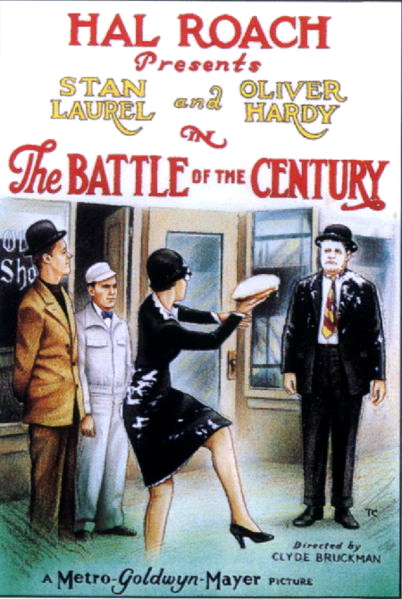
Laurel and Hardy’s “The Battle of the Century” didn’t immediately rehabilitate the pie fight in Hollywood at the end of 1927. But here are three data points that show the trope moving back to acceptance, if never full respectability.

Sometime in the late 1920s the Weiss brothers’ Artclass company produced a short featuring young actors Bobby Nelson (1922–1978) and Albert Schaefer (1916–1942) and a pie fight. This picture was obviously made on the cheap, shot outdoors to avoid having to build sets. It shows no logic in character, plot, or basic physics.

This movie survives in a German print, in loose footage, and in the Weiss Brothers Collection at UCLA. I’m guessing at the date based on the apparent age of Bobby Nelson, between his waifish appearances in “The Doughboy” (1926), “Sunshine of Paradise Alley” (1926), and “Perils of the Jungle“ (1927) and his post-haircut westerns.

The only title I’ve found linked to this footage is “Bobby’s Pie Fight”—“Bobby’s Kuchenschlacht” in Germany and “Il combattimento di Bobby” in Italy. However, that title might have been attached when the Weiss brothers recut their 1920s films for television syndication in the series Chuckle Heads.

Unfortunately, the Weiss brothers were near the bottom of the barrel among Hollywood producers. They saved money by skipping such steps as registering copyrights and screening movies for critics. As a result, scholars can’t even say when most of their movies were released. “Bobby’s Pie Fight” has no IMDB listing, so I can’t confirm its original title or date.

Assuming that “Bobby’s Pie Fight” was the title, that shows Artclass believed that subject would attract rather than turn off its target audience. At the same time, the company made sure the pie wagon was crudely labeled “Hokum Pie Co.” to signal to adults that they knew they were slinging an old joke. This pie fight was just for the kids.

Next comes the Our Gang comedy “Shivering Shakespeare,” directed by Anthony Mack in 1929 and released in January 1930 (IMDB; YouTube; Lucky Corner; Lord Heath).

Like several other early talking pictures in the series, this was a remix of silent films from a few years before. As in “Stage Fright” (1923), it showed the gang being dragooned into putting on a play set during Nero’s reign. As in “Uncle Tom’s Uncle” (1926), the kids in the audience pelt the kids on the stage with food.

“Uncle Tom’s Uncle” (and its direct remake, “Spanky” [1932]) showed the audience throwing vegetables. For “Shivering Shakespeare,” in contrast, the theatergoers are supplied with two booths full of pies, apparently from a fundraising bake sale. Furthermore, that audience includes both kids (rowdies led by Jack McHugh) and dignified-looking adults.

The result is a pie fight much like “The Battle of the Century”—the first in a talking picture, some scholars posit. As in that earlier Roach studio film, there’s a gradual build-up of pie-throwing, trying to make the action meaningful instead of just messy. Mack filmed some of that action in slow motion, leaving those shots with no sound. The result isn’t entirely satisfactory, but five years earlier no respected studio would have even tried such hokum.

Finally, in 1931 Educational Films released “The Lure of Hollywood,” part of the Hollywood Girls series (IMDB; YouTube). These were definitely movies about and for adults, not children.

In “The Lure of Hollywood” a mix-up leads a young studio props man to think that a movie star is hitting on his hopeful-starlet girlfriend. During the filming of a big musical number on the theme of custard pies, therefore, the props man throws a pie at the movie star. That devolves into a pie fight, the two cameras still rolling.

A studio executive bustles onto the set and shouts: “You can’t throw pies in comedies anymore! The public won’t laugh at it.” That was, of course, the standard wisdom of movie makers and critics for a decade from the late 1910s to the late 1920s.

The film’s heroines leave Los Angeles in a cheap used car, their Hollywood dreams in ruins. But then the studio staff views the rushes from that supposedly ruined scene. The screening room erupts in laughter. The same executive says: “That’s the funniest thing we’ve ever photographed. We should have gone in for that pie-throwing long ago!”

Pie-throwing thus appears restored to its status as a Hollywood gag—a classic gag, in fact. Being able to depict that turnaround was undoubtedly gratifying for the director of “The Lure of Hollywood”: credited as William Goodrich, that was actually the Keystone veteran Roscoe “Fatty” Arbuckle.

29 November 2024

The Significance of “Playin’ Hookey”

“Playin’ Hookey,” credited to director Anthony Mack (IMDB; YouTube; The Lucky Corner; Dave Lord Heath), is not one of the more inspired Our Gang comedies. Like a number of the series’ other silent shorts, it feels like two half-developed stories with only a loose connection between them.

In the first half, Joe Cobb’s dog Pansy gets blamed for scaring chickens and destroying property. Pansy’s misbehavior is actually the fault of Joe’s little brother Wheezer, played by Bobby Hutchins. In this stretch of the series, Wheezer was an unstoppable engine of chaos.

Joe’s dad prepares to kill the dog with a shotgun. [Kids’ comedy, folks!] But Joe unloads the gun and tells Pansy to play dead. He sneaks her away and tries to find her refuge with Farina and his little sister, portrayed by Sunny and Jannie Hoskins. Jannie’s character is called Zuccini because almost all the series’ black kids got assigned food names; usually Farina’s sister was named Mango, but other exceptions were Arnica and Trellis.

Then a police chase happens nearby. All the big kids run to see. That action turns out to be a scene from a movie being filmed on the streets of Culver City. By a stroke of luck, the movie crew is looking for a dog that can play dead. Joe offers to bring Pansy to the studio for $5. His pals sneak in after him.

In fact, the gang sneaks into the All-American Studios by pretending to be dummies in a truck, the exact same way the gang got into the West Coast Studios in “Dogs of War” (1923). That short also began as one story—an elaborate parody of trench warfare—and turned into a romp through movie sets. William Gillespie appeared in both films, in the first as a harried director and in the second as a harried actor.

For the rest of “Playin’ Hookey,” the kids and dog run around the studio, disrupt scenes being filmed in a variety of genres, and tangle with actors and security guards. At one odd moment we see the Triceratops costume from Laurel and Hardy’s “Flying Elephants,” filmed in early May 1927. Indeed, that Triceratops gets more screen time in “Playin’ Hookey” than in the surviving “Flying Elephants.”

Eventually, the action shifts to a set in a kitchen filled with custard pies and buns, the latter for some reason being filled with gunpowder. Charlie Hall plays a comedian made up to look as much like Chaplin as possible without risking a lawsuit. There’s a line of cops in old-fashioned helmets and long coats, looking nothing like the police officers earlier in this film. In short, we’ve entered a travesty of the Keystone Studio as it was more than a decade before.

The kids run onto that set. They see the comedian being chased by a knife-wielding chef. The gang’s current freckled boy—skinny, bespectacled Jay R. Smith—picks up a pie and throws it at the chef. Soon the other kids are tossing pies, as well as those exploding buns. Chaos ensues, but not hilarity.

Critics might quibble that this isn’t a full pie fight since nobody throws anything back at the kids. But the action does include the usual detail of pastry flying wild and hitting people not part of the initial conflict. Among the adults struck with pies are those Keystone-style cops, an actress played by Dorothy Coburn, and her hairdresser played by Edith Fortier (usually on set as the Hoskinses’s aunt and chaperone).

Eventually the studio security team led by Tiny Sandford catches the gang and literally throws them out of the studio. We never learn what will happen to Pansy. That concern was back in the first half of the movie, after all.

“Playin’ Hookey” isn’t a very interesting film. Even the backstage look at the Roach lot is unrevealing since the set-ups are so artificial; “Dogs of War” shows more. But “Playin’ Hookey” is significant as an example of a pie fight shortly before Laurel and Hardy’s lauded “Battle of the Century,” reflecting how the studio viewed that trope (IMDB; YouTube).

But wait! you say. “The Battle of the Century” is a 1927 film. “Playin’ Hookey” is listed as from 1928.

Quite true, I reply. But “Playin’ Hookey” was made in the summer of 1927 while “The Battle of the Century” went into production on 5 October. (For a complex discussion of when “Playin’ Hookey” was made, see its page at the Lucky Corner. For equivalent information about “The Battle of the Century,” see Dave Lord Heath’s page.)

MGM released “The Battle of the Century” on the very last day of 1927. Roach’s previous distributor, Pathé, had the rights to “Playin’ Hookey,” and it held that picture back until the first day of 1928. As a result, its significance has been masked.

“The Battle of the Century” starts as a boxing movie, inspired by the Gene Tunney–Jack Dempsey fight of 22 Sept 1927. In talking about where to go from there, someone on the writing staff suggested a pie fight.

The Hal Roach Studio was small and friendly. Hall, Coburn, Sandford, and other players in the Our Gang picture also acted in Laurel and Hardy movies that summer. Stan Laurel and his fellow writers had to have known about the making of “Playin’ Hookey.”

That picture reflected the dominant industry thinking about pie fights at the time: they were hokum, a relic of the previous decade, entertaining only for kids. A couple of years later, Laurel told Philip K. Scheuer of the Los Angeles Times that simply throwing pies “really had passed out with Keystone”—exactly as depicted in the Our Gang film.

Looking for something new, Laurel rethought the trope. “We made every one of the pies count,” he said. The scene wasn’t just messy chaos. It was messy chaos that built up gradually from character interactions. “The Battle of the Century” was a hit, and it resurrected the pie fight as nostalgic fun.

COMING UP: A changed Hollywood.

27 November 2024

“Real honest to goodness…pie slinging contests”

Mass pie-tossing definitely returned to American movies in 1927, and not just in Laurel and Hardy’s “Battle of the Century,” released in December.

The surviving examples appeared first in a particular type of movie: the kid gang comedy. That makes sense because the core viewers of those movies were so young they weren’t:

  • tired of the Keystone-style comedy of the previous decade, given that they had probably never seen those films.
  • influenced by what the press deemed properly funny for modern audiences.
In May 1927, the Bray Studios registered a short called “The Big Pie Raid,” directed by Stan De Lay (IMDB; YouTube; clearer extract on YouTube). This was part of the McDougall Alley series, running from 1926 to 1928—an obvious imitation of the Our Gang comedies, but with even more blatant racism.

The Library of Congress filing for “The Big Pie Raid” summarized its plot like this:
The two gangs are having it out on the football field. The winning team has been promised a party by one of the girl spectators. Oatmeal, a little colored lad, wins the day for his side and the result is that the team goes down to enjoy the blowout. After much ice cream and cake and speech making they adjourn to the lawn to play games.

The losers of the football game however are on the job and attack the party with mud pies. Real honest to goodness mud pie slinging contests ensue with the victors of the morning coming out victorious but not until all the pies of a bakery wagon had been used and not until Oatmeal had come to the rescue with his little friend Farina [sic—Fatima], that gasser of animals, the skunk.
At around the twelve-minute mark, a wagon helpfully labeled PIES loses a wheel near the kids’ mud fight. That leads to a “Real honest to goodness” pie fight, with combatants and one spectator hit. Since Bray named the movie after that part of the scenario, the studio clearly saw the pie fight as an attraction for its target audience.

The typographical error inserting the name Farina into the synopsis of “The Big Pie Raid” shows how much the makers of this series had the Our Gang movies on their minds. McDougall Alley featured a little black child called Oatmeal, played by Hannah Washington. Just as the character of Farina was variously identified as a girl or a boy in early years, “The Big Pie Raid” presents Oatmeal as a boy so that he can play in the football game.

Even though Oatmeal is the hero of both the football game and the subsequent fight, he and his Chinese-stereotype friend Free-Gin have to be snuck into the older white kids’ party. One difference between this movie and the typical Our Gang shorts is that the McDougall Alley kids are more bourgeois than their rivals rather than poorer.

In December 1927, Fox released “Wild Puppies,” directed by Clyde Carruth (IMDB; YouTube; Library of Congress shot list). Like “The Big Pie Raid,” this short comedy moves from a football game to a gang fight that parodies trench warfare. However, its special effects are more elaborate and amusing. While most of the missiles are vegetable, ultimately fat boy Albert Schaefer throws pies down onto three members of the rival gang. The climactic bits show the bad guys trying to escape a lion, scenes that actor Coy Watson, Jr., wrote about in The Keystone Kid.

In both “The Big Pie Raid” and “Wild Puppies,” the leader of the rival gang, and the person whose face takes the most mess, was Jack McHugh. He’d been the center of an earlier kid gang series from Century before being upstaged by Malcolm Sebastian as “Big Boy,” his little brother.

McHugh would make one appearance in an Our Gang film: “Shivering Shakespeare” (1930). Once again, he played a rival gang leader who starts a pie fight. It seems to have been a specialty.

COMING UP: But that wasn’t the first pie-throwing in an Our Gang movie.

26 November 2024

“Extracted from a pie slinging episode”

In 1916 Charlie Chaplin released a movie called “Behind the Screen,” in which his character worked in the props department of a movie studio (IMDB; YouTube).

At the time Chaplin was under contract with Mutual, having moved on from Mack Sennett’s Keystone Studios. In this movie he made fun of one of Keystone’s trademarks, the thrown pie, with a scene labeled “The comedy department rehearsing a new idea.”

That involved a Keystone-style cop throwing pies incompetently, then Chaplin throwing a lot of pies at big Eric Campbell while ducking most of the pies thrown back at him. It went well beyond what surviving Keystone movies show, leaving that studio with no new territory to explore.

If Chaplin wanted to convey that pie-throwing was now old hat, some critics were already ahead of him on that score. The Moving Picture World review of “Behind the Screen” said:
There is throughout a distinct vein of vulgarity which is unnecessary, even in slapstick comedy. A great deal of comedy is intended to be extracted from a pie slinging episode which occurs during the rehearsal of a couple of scenes in a moving picture studio.
Soon Hollywood filmmakers were assuring people they had moved beyond pie-throwing. The comedian Lloyd Hamilton wrote in an essay in Motography in 1918:
There is not one phase in the production of motion picture comedies today that isn’t a great improvement over the fun film of the past. Of course everyone has his opinion as to the cause of the great improvement. The biggest reason is the public or fans themselves. They have become tired of the old hokum comedy, the poor sets, hideous make-ups and other stuff such as throwing pies. A year or two an audience would scream if someone was hit in the face with a pie–but today the kids are the only ones who seem to enjoy it…
In addition to quoting that essay, Silentology also showed an advertisement for a 1918 Eddie Lyons and Lee Moran movie that promised “No pie throwing.”

Over the next several years, many newspapers and magazines used “pie throwing” or “pie fight” as a synecdoche for all old-fashioned comic gags that sophisticated modern moviegoers would surely shun.

This despite the fact that there had been few to no fights with pies (as opposed to a pastry thrown singly) in movies aside from “Behind the Screen.” Like “bra burning,” the “pie fight” went straight from one isolated example to cliché without ever actually having been common.

The silent movie musician and scholar Ben Modell has written:
The confusing thing about the custard pie equivalent of a snowball fight is that it appears nowhere in silent movies except in this short [“Behind the Screen”] and in [Laurel and Hardy’s] “Battle of the Century” (1927). There are individual pies thrown in Keystone films, but no pie fights. Are all the pie fights in films from the Nickelodeon era…and are all lost films?
In fact, at least a couple of Hollywood pie fights appeared shortly before “Battle of the Century,” one filmed at the same Hal Roach Studio. How did they slip past critical opprobrium? The answer lies in that Lloyd Hamilton quotation above.

TOMORROW: “the kids are the only ones who seem to enjoy it.”

26 August 2024

Falling for Farina

As related back here, Hal Roach and the makers of the Our Gang comedies modeled the character of Farina, played by Allen “Sunny” Hoskins, on the pickaninny stereotype.

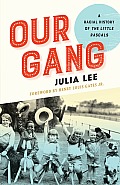
Gloria Lee writes in Our Gang: A Racial History of the Little Rascals:
His hair was tied in pigtails and white ribbons. He ate watermelons, fell into vats of flour, and smoked a corncob pipe. He wore the clownlike, oversized shoes of a minstrel. . . .

Farina became the vehicle of all the most hackneyed and racist sight gags. He appeared in whiteface while his white friends appeared in blackface. When he got the measles, white spots were painted on his face instead of black ones. He clutched voodoo amulets and was terrified of ghosts. He was called “Shine” while Mickey was called “Freckles” or “Speck” and Joe Cobb was called “Fatty.”

But something strange started to happen. Despite his genesis in the flattest of stereotypes, Farina started to become—how else to put it?—human. He went through the minstrel motions, but even the narrowness of his scripted roles couldn’t suppress his outsized personality. The public fell in love with him.
Just as rival studios needed an equivalent of Ernie Morrison in their kid gangs, many also had a younger black child in this stereotypical form. In the McDougall Alley Kids and Buster Brown series that counterpart was a girl named “Oatmeal,” played by Hannah Washington.

One manifestation of public interest the character, and of recognizing that a real child played the role, was the demand to know if Farina was a boy or a girl. For a while the movies were ambiguous, as were newspaper stories. Roach milked the question, playing coy in press releases.

Eventually, however, the studio acknowledged that “Sunny” Hoskins and the character of Farina were little boys. The costume changed to have pants, but it retained a couple of the pickaninny traits. Sunny wore one pair of shoes inside another because Farina had flat oversized feet. He kept his hair long enough for pigtails for years. Farina continued to suffer a disproportionate amount of mess and rough treatment.

From 1925 to 1931 Farina was the series’ main black character. In several films he was clearly the lead: “Your Own Back Yard,” “One Wild Ride” (1925), “Monkey Business” (1926), “Love My Dog,” “Chicken Feed” (1927), “Spook-Spoofing,” “The Smile Wins” (1928), “Election Day,” “Fast Freight” (1929). In some movies Sunny’s sister Jannie played Farina’s little sister, often called Mango.

Sunny made the transition to talkies while some other Our Gang kids struggled. Lee notes that one issue in that shift was that he’d been born in Boston and grown up in Los Angeles, so he didn’t speak in the broad “Southern” dialect the intertitles had assigned to Farina. It looks like he figured out how to deliver those lines for the microphones not quite as broadly but still with enough rural character to please the public.

Ultimately, Sunny Hoskins outlasted a second generation of fellow players. His seniority in the series matched his line deliveries, which projected a long-suffering personality. Having started as a toddler, he ended up appearing in more Our Gang movies than any other actor.

This series of postings started by noting the roots of the Farina persona in the character of Topsy in stage productions and parodies of Uncle Tom’s Cabin. Farina actually played Topsy in the 1926 short “Uncle Tom’s Uncle,” when the gang put on their own version of the show. Pudgy Joe Cobb portrayed the title character in blackface, his mom repeatedly telling him to wash his face and do his chores. That reflected the ongoing influence of Harriet Beecher Stowe’s novel on American culture.

19 August 2024

Who Could Replace “Sunshine Sammy”?

Ernie “Sunshine Sammy” Morrison was the Hal Roach Studio’s first child star and the highest-paid of the original Our Gang cast. All the more remarkable since Ernie was a black kid in 1920s America.

After a couple of years of those movies being increasingly successful, Ernie’s father asked for a raise. Hal Roach didn’t renew the Morrisons’ contract.

In early 1924, Ernie went off to make more money in vaudeville, though he returned that summer to complete “Fast Company,” a short started the previous year but delayed by the director’s injury.

Roach’s competitors appear to have seen Ernie as a key to the appeal of Our Gang. Many of the rival series that sprang up in this period also featured an African-American boy of the same age.

For example, James Berry played “Bubbles” in some of the Century Kids films—made up in one with white lipstick to look like a minstrel-show caricature. His brother Ananias appeared in the rival McDougall Alley Kids shorts. The Mickey Maguire series featured Jimmy Robinson as “Hambone Johnson,” the hero’s closest friend.

Roach himself recognized Ernie Morrison’s value by trying to replace him. Later in 1924 “The Sun Down Limited” introduced Flemon Miller as “Powder-Puff.” I can’t help but think there was some knowing irony in how that character appeared with the intertitle, “He wanted to join the ‘Gang’—But the quota was exhausted.” Flemon lasted for only one more film, “Every Man for Himself.”

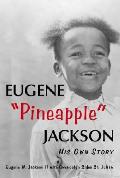
The studio then hired Eugene Jackson from the competing Reg’lar Kids series, at first as “Snowball.” Roach renamed him “Pineapple” after someone combed his hair so it stood up like pineapple leaves—i.e., he was made to look like a joke. Like Ernie Morrison, “Pineapple” was usually older brother to “Farina.” Gene made six shorts from the middle of 1924 to the start of 1925 and went on to a long show-biz career.

After letting Gene Jackson go, the studio’s next Our Gang film was “Official Officers.” Its gang included a black boy played by Todd Roark, who had won a Los Angeles Evening Express Baby Contest with the prize of one week’s work in an Our Gang movie for $100. Todd didn’t stand out, but it’s interesting that the studio brought him on as a gang member, not an incidental extra.

In this same period, George “Sonny Boy” Warde played Sing Joy, a Chinese boy in the gang, over nine shorts. Sonny Boy’s own ancestry was Japanese and French, though there are questions even about that; later he adopted the stage name Luis Cordova before shifting back to Sonny Loy. The point is that the Hal Roach Studio appears to have been trying to present Our Gang as racially inclusive, even while presenting the non-white kids in stereotypical forms.

Meanwhile, every one of those mid-1920s shorts included Allen “Sunny” Hoskins as “Farina,” then four and five years old. In a couple of those movies he was the only black kid. And it turned out he was Ernie Morrison’s replacement all along.

15 August 2024

From Uncle Tom’s Cabin to Our Gang

As influential as Uncle Tom’s Cabin was on ante-bellum American culture and politics, stage adaptations of Harriet Beecher Stowe’s novel continued to shape popular culture for the next century.

In the theater, both straight and parodic, the novel’s black characters turned into racist caricatures. The Uncle Tom of the novel resists cruelty, dispenses moral wisdom, and becomes a martyr. In plays for post-Civil War white audiences and in minstrel-show offshoots, that character became old, feeble, and subservient.

The novel also included a young black girl named Topsy. In those dramatic adaptations, and especially in minstrelsy, Topsy became a comic grotesque, the prototype of the racist caricature of a pickaninny. In her book Racial Innocence: Performing American Childhood from Slavery to Civil Rights Robin Bernstein writes:
The pickaninny was an imagined, subhuman black juvenile [with…] dark or sometimes jet-black skin, exaggerated eyes and mouth, the action of gorging (especially on watermelon), and the state of being threatened or attacked by animals (especially alligators, geese, dogs, pigs, or tigers). Pickaninnies often wear ragged clothes (which suggest parental neglect) and are sometimes partially or fully naked. . . . the figure is always juvenile, always of color, and always resistant if not immune to pain.
The shadow of the theatrical Uncle Tom’s Cabin falls on Hal Roach’s Our Gang comedies—despite those movies being relatively progressive in showing black and white children playing together.

Racial inclusion was part of Roach’s plan for the movies from the start. In 1921 he built a short movie around one of his studio’s most popular supporting players, nine-year-old Ernie “Sunshine Sammy” Morrison. That movie was called “The Pickaninny” even though Ernie didn’t conform to that stereotype in his looks or persona. It didn’t do well enough for the distributor to want a series, perhaps because of resistance from Southern cinemas.

Roach then assembled a team of kids around Morrison, calling them his “Rascals.” The industry instead took the title of the first release, “Our Gang,” as the name of the series. From the start in 1922, those movies featured a bunch of white kids plus Ernie—usually from a poorer family, but always welcomed as a playmate and sometimes as a leader. At times his character would be called something cliché like “Booker T.,” but more often he was just “Ernie,” like the other actors using their own names.

Later in the spring of 1922, the Our Gang series brought on Allen “Sunny” Hoskins, less than two years old. His character, named “Farina,” was designed to match the pickaninny type: pigtails, shapeless sack dress, and oversized flat shoes. For months the movies presented Farina as Ernie’s baby sister, thus closer to Topsy.

The white filmmakers gave Farina other traits based on racist stereotypes. In “Giants vs. Yanks” (1923) toddler Farina carries a straight razor, as so many black men supposedly did, according to the cliché of the time. “One Wild Ride” (1925) ends with Farina literally buried in watermelons. The intertitles rendered his lines in a broad dialect with more malapropisms than the other gang members. 

Most troubling, there’s a pattern of Farina enduring more physical punishment and mess than the other kids, reflecting the notion that pickaninnies didn’t feel as much pain. Of course these are slapstick comedies, so the whole cast fell about, but “Sunny” Hoskins went through more than others.

The Our Gang movies never made a direct connection between Farina and Topsy, but they didn’t have to. Minstrel-show stereotypes were pervasive in early-20th-century American culture. In “The Big Show!” (1923), the gang acts out famous movies, several of the kids impersonating older movie stars of the day. What role was there for Ernie Morrison? He played Uncle Tom.

24 July 2024

The Mystery of “Honeymoon Hardships”

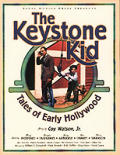
In his memoir, The Keystone Kid: Tales of Early Hollywood, Coy Watson, Jr., devoted considerable space to the Mack Sennett Comedies short “Honeymoon Hardships” (1925).

That section, headed “The Craziest Picture I Ever Worked On,” runs for nine pages, longer than any other in the book.

About half those pages are about learning to swim, which young Coy did in order to work on that movie safely. The rest describe the filming, limited of course to the scenes Coy himself appeared in.

Watson recalled two scenes in detail: a dinner party interrupted by the explosion of a water heater upstairs and a car full of relatives driving into and out of a lake.

According to Watson, the dinner party involved some pratfalls and gags with mashed potatoes, followed by the rain of lots of debris. The drive into the lake was performed in a disguised swimming pool, and the principal difficulty was getting all the cast, including plump actress Sunshine Hart, to fully submerge. On top of it all, some of the cast (including young Coy) were to find this all extremely laughable while others acted aghast and dead-pan.

“Honeymoon Hardships” can now be viewed on Youtube and the Internet Archive. It contains neither of those scenes.

Some other details of the movie don’t match what Watson wrote. He recalled the director as Del Lord. Modern references credit Ralph Ceder. Watson described his fellow child actors, the White triplets, as playing “city kids”; they appear to be from another country family. He dated the film to 1924, which was when he worked on it, but it was released in January 1925.

Filmographers have found inaccuracies in The Keystone Kid, not surprising in a memoir about working as a child in a poorly documented industry decades earlier.

In this case, however, Watson’s book offers two stills taken on the set, clearly showing him interacting with the White triplets and the movie’s adult cast: Hart, Billy Bevan, Alice Day, Raymond McKee, and so on.

Coy, Jr., barely appears in the surviving print, but he can be glimpsed in a couple of scenes—as the family decides to go fishing and then piles into their car, there are four boys instead of just three. So he was there.

Furthermore, the dynamic Watson described with a rural family laughing at one disaster after another while visiting honeymooners try to endure is indeed the main theme of the movie. The scenes Watson recalled could easily fit into the scenario on screen. He also wrote about his father working on special effects for those scenes, and we know Coy Watson, Sr., had that specialty.

My first thought about this discrepancy is that the 21-minute version on the web had been edited down from a longer original to fit the needs of a reissue or for television. However, an advertisement for “Honeymoon Hardships” said it was two reels, or about 20 minutes long. In all likelihood, we’re seeing what Sennett released to theaters.

I therefore conclude that the scenes Coy Watson, Jr., worked on so hard and remembered so vividly decades later were left out of the final cut.

The Sennett studio may have felt the movie needed a stronger climax. “Honeymoon Hardships” now ends with a train chase and the husband rescuing his new wife from a charging cow, with a hint that they’re never going back to their country cousins. That provides an ending to the story arc. Maybe Del Lord filmed the original scenes and Ralph Ceder oversaw the reshoots, thus getting final credit for the picture.

However it happened, there’s a version of “Honeymoon Hardships” with some elaborate special-effect scenes that survived only in Coy Watson, Jr.’s memories.

07 October 2013

Al Jaffee Archive Folded into Columbia Library Collection

When I was a boy, my favorite in MAD’s “usual bunch of idiots” was Al Jaffee. I especially liked his Snappy Answers to Stupid Questions series. I can’t really say why I bought those paperbacks more than those from any other cartoonist in the magazine, but I did. Jaffee was also known, of course, for the magazine’s last-page fold-ins.

In July, the Rare Book and Manuscript Library at Columbia University announced that it had acquired Jaffee’s archives. Its press release stated:
Jaffee was in the first graduating class of the LaGuardia-founded High School of Music & Art, where he met his long-time colleagues Will Elder, Harvey Kurtzman, and Al Feldstein. Jaffee began his cartooning career working for Stan Lee on comic books such as Patsy Walker and Ziggy Pig and Silly Seal, and his Tall Tales comic strip appeared in the New York Herald Tribune for six years.
Plus MAD, which Jaffee has contributed to for nearly sixty years.

The New York Times just reported on the impending arrival of the first batch of material, and also provided more facts on the gift. Most notably, the librarian who approached Jaffee at last year’s New York Comic-Con, Karen Green, started as a specialist in ancient and medieval history. But she also “led a secret life as a cartoon and comic book fan.”

Green is now the library’s graphic novels specialist. And the Rare Book and Manuscript Department also houses material from former Columbia student Jerry Robinson (I think he dropped out after finding work on Batman) and X-Men scripter Chris Claremont.

18 July 2013

Sorting Out Genres and Modes

J. K. Rowling’s Harry Potter books are overstuffed (sometimes literally). Fellow fantasist Bruce Coville credited her, especially at the start of the series, with putting more neat stuff into every chapter than anyone else. But the books also hit all the buttons for several storytelling genres at once.

There’s the genre of the British school story, itself a subsection of coming-of-age narratives. There’s the mystery genre, as Ken Jennings noted. In some books there’s the sports-book genre, where conflicts get worked out on the playing field. And of course there’s the chosen-one-battles-against-evil genre, which many people mistake for all fantasy.

In fact, I don’t think fantasy is a genre at all. It’s what I call a mode. Genres are defined by the plots readers expect: detective solves puzzling crime, couple gets together, gang pulls off heist (or not), soldiers carry out mission, chosen one defeats evil, and so on.

In contrast, modes are defined by their settings and what is possible in those fictional worlds. The major modes I see are:

  • contemporary realistic—stories set in the world that readers recognize as like their own.
  • historic, and thus constrained to some extent by past events.
  • fantastic, breaking the currently known laws and limits of physics. This mode could be defined through science (science fiction) or magic (fantasy). 
  • heightened, in which coincidences, emotions, and stakes are turned up a couple of notches above the realistic. When played for laughs, this produces farce. When played seriously, it’s melodrama.   

Genre stories can be told within each of those modes. Thus, there are mysteries set in a fantasy world, romances told in the historical mode, sports stories with extraterrestrials, crime novels either farcical and melodramatic, and so on.

27 June 2013

Big-Budget Action Movies Losing Their Wit

Last night I saw Man of Steel. It reminded me of Oz the Great and Powerful in that both movies are carefully made to trigger our memories of modern American myths, and in doing so both put spectacle over coherence, character, or wit.

Man of Steel does a fine job of showing us exactly what, say, a punch-out between two superpowered humanoids on a satellite would look like. Likewise, Oz the Great and Powerful swoops all over its digital locations, making them more convincing than the plot twists.

But does either of those movies have more than three quotable lines? (Check out these attempts to muster a quota of quotes.)

There’s no wit in either movie’s screenplay. Almost all their dialogue sounds like it was the first choice of tired screenwriters at the end of a long day. Most characters speak in simple, unimaginative ways, stating their emotions or desires baldly. (All the better, perhaps, for easy translations for the international market?) And the actors usually deliver that dialogue slowly, either to fill time or to ensure that no one in the audience can fall behind.

Consider Oz’s arrival in the strange fairyland:
Oz: Where...Where am I exactly?
Theodora: Where do you think you are?
Oz: I have no idea. It’s...It’s like no place I've ever seen.
Theodora: You’re in Oz.
And compare that to the hero’s lines from the parallel scene in MGM’s 1939 film:
Dorothy: Toto, I’ve a feeling we’re not in Kansas any more. . . . We must be over the rainbow! [Glinda arrives in her bubble.] Now I...I know we’re not in Kansas!
Okay, Dorothy’s speech includes #4 on the American Film Institute’s list of all-time best movie quotes. But those words are powerful because they’re understated and fresh. They could therefore be delivered with emotion instead of stating emotion. And the next line is actually metaphorical.

Even throwaway lines in the 1939 movie are evocative: “Now you go feed those hogs before they worry themselves into anemia!” “Of course, some people do go both ways.” “And the last to go will see the first three go before her.” Yes, sometimes the vaudeville shtick underlying that script shows through, but the words are still entertaining. It’s not just that repeated viewings have made the movie memorable. Rather, lines with verve have made it possible to view the movie over and over.

Last year’s big-budget popcorn movies showed that they don’t have to lack wit: The Avengers and Skyfall are powerful action movies with good scripts. They offer a lot to look at, but also a lot to hear besides explosions. Oz the Great and Powerful and Man of Steel offer only half that package.

09 May 2013

The Tie That Binds

Speaking of British publishing’s fanfiction, this autumn will bring the first authorized revival of P. G. Wodehouse’s Jeeves and Bertie series, as The Independent reported in March. Hutchinson will publish Jeeves and the Wedding Bells in Britain, and St. Martin’s will publish it in the US.

The authorized author is Sebastian Faulks, a respected British novelist (Birdsong, A Week in December) who already wrote a well received pastiche of Ian Fleming’s James Bond novels in Devil May Care.

In The New Statesman, Michael Moran wrote:
I don’t describe Wodehouse as inimitable because I like his stuff. I describe Wodehouse as inimitable because he cannot be imitated. One might imagine Craig Brown or Hugo Rifkind making a decent fist of a Wodehouse knockoff for a page or so but a whole novel? This is hubris. We already have in the 11 Jeeves novels and 35 short stories an ample supply of Wodehouse's wit. We have no need of ersatz Plum.
And Wodehouse biographer Robert McCrum told The Guardian:
Wodehouse is a much tougher egg than Fleming and 007/Bond. For a PG Wodehouse fan to write a new Jeeves novel is a bit like asking a devout Christian to come up with a fifth gospel. . . . It looks perilously like Mission Impossible to me, but I wish Faulks the very best of luck. If anyone can pull it off, he can.
McCrum was himself authorized by the Wodehouse estate to write that biography, but it’s no hagiography.

05 April 2013

Jetmore, Kansas, and Its Lee Harvey Oswald Fan Club

The Boston Globe’s Matt Viser visited a part of rural Kansas to learn about the district of two-term Republican Representative Tim Huelskamp, known for alienating his own party leaders in the House with his refusal to compromise.

Among the residents is Norman Bamberger, a cattle rancher who wants to cut the federal budget—except all the parts he depends on for his business:

Bamberger has 900 cattle, and he’s going on his second bad year in a row. Meat prices are high, good for reaping a profit, but a drought has caused increases in prices of grain he needs to buy to feed his cattle. He supports the automatic budget cuts of earlier this year, except for the one that threatens to reduce the number of federal meat inspectors—which could affect his own business.

“It’s just stupid,” he said. Then, in a jarring attempt at dark humor that most would find offensive, he added: “Where’s Lee Harvey when you need him?”

Concerned about seeming harsh with his reference to the man who assassinated President John F. Kennedy, he quickly added, “That wasn’t very nice.”
Of course, the automatic budget cuts were forced by Republicans, like his own Representative. And I’m sure there are other benefits and subsidies for farmers that Bamberger would to see preserved as well.

Bamberger wasn’t the only person in Jetmore talking about political murder. At a gathering of leading citizens—“The group included the mayor, a retired farmer, and the editor of the ­local newspaper, the Jetmore Republican”—Viser heard the owner of an appliance repair shop (shown above) complain the same way:
“Hell, we ought to impeach the little bastard,” [Charles] Leet said. “Asleep at the switch. I keep ­donating to the Bring Back Lee Harvey Committee. It hasn’t worked yet.”

The group chuckled.

“We aren’t rabble-rousers. We don’t want to cause ­trouble,” [newspaper editor Mike] Thornburg said a few minutes later.
In that case, the men of Jetmore might want to make fewer jokes about Presidential assassinations. That habit makes them look like they have OIP Derangement Syndrome.

18 September 2012

Allegro non Toto

Some puns work better than others.

This is from an ad for the New England Conservatory’s Contemporary Improvisation training, celebrating its 40th year. It deserves points for trying.

02 June 2012

Old Impulse Visits New Young Justice

“Look, pal! A superhero team needs only one comic-relief guy, and this season it’s me!”

04 November 2010

Homer Price in Capes?

Last week and month I had an intriguing online exchange with author Gail Gauthier about the notion of “Homer Price in space.”

Was it possible, I questioned, to replicate the tone of Robert McCloskey’s books in an environment that wasn’t familiar to the point of quaintness. Homer’s adventures depend on ordinary things—ragweed, balls of twine, visting movie stars, tunes that get in your head—being just a little bit off. But if we readers don’t have a deep sense of where the “on” setting should be, how can we be sure what’s off? To repeat the analogy I used in Gail’s comments section, maybe all donut machines work that way in zero gravity.

After signing off, I realized that I’d just read a book that contained a lot of what I enjoy about the Homer Price novels, yet set in a rather wild supernatural environment. That book was G-Man: Cape Crisis, by Chris Giarrusso. It’s in comics form, and stars several young superheroes with a somewhat addled wizard mentor. The kids are generally eager and well-meaning, and the adults generally too bothered to get a clue or do useful work.

That story gets its grounding, I think, in the clichés and givens of superhero tales. Mikey’s magic cape lets him fly, be super-strong, and super-tough. (Not invulnerable, as other kids point out at the start.) Those powers make sense because we’re used to seeing superheroes with them. Mikey’s circle of young heroes contains three who can fly and blast things in different ways, one who’s superfast, and one who can turn different colors—easily portrayed on the brightly tinted pages.

But Giarrusso doesn’t try to incorporate rarer, less easy to understand powers, such as controlling one’s body density (the Vision), tactile telekinesis (the second Superboy), or shape-changing within certain rather arbitrary parameters (Beast Boy). Depicting those powers might raise more questions about what’s ordinary in this world, and what’s off.

Lots of the humor (and there is a lot of it, in forms that made me laugh out loud) grows from our expectations: the boys questioning the science behind holding a buttercup under your chin, the fact that broomsticks can fly but clearly aren’t designed to be ridden, the hope that if you foil a bank robbery you’ll get some of the money as a reward. Some of those expectations reflect everyday life, but others simply reflect experience with fantasy adventures.

So a “Homer Price in space” could work, I guess, as long as it’s grounded in our received understandings of what space is like, and doesn’t drift too far into novelty or scientific exactitude. Maybe it’s even worked already; I haven’t read the Danny Dunn books in decades.

18 September 2009

Far From the Great American Superhero Novel

Captain Freedom: A Superhero’s Quest for Truth, Justice, and the Celebrity He So Richly Deserves, by G. Xavier Robillard, is a satirical novel that aspires to do for America’s superhero mythology what Christopher Moore’s You Suck did for vampires or Lamb did for the Jesus legend.

But the book feels more like a minor movie from the Zucker-Abraham-Zucker school of comedy: throw any joke you can think of at the screen, and hope some of it will stick.

Captain Freedom addresses every common aspect or cliché of superhero mythology: sidekicks, arch nemeses, aliens, time travel, love affairs, mother issues, father issues, adopted-son issues, etc.

And for the sake of attempted laughs it swipes at many and varied aspects of modern American culture: celebrity rehab, comic-book censorship, kitchen decorating, color coordination, dinosaur rehabilitation, interventions, file-sharing, etc.

Here from page 136 is a passing bash at one aspect of the culture, which gives a sense of the book’s tone and targeting:

We contract a few secret polls and learn that the best thing I can do to improve my image is to produce a children’s book. . . .

Before long, my children’s book, Brush Away Fear, is published! It contains illustrations by the best artists and the delightful prose of an unknown writer who agreed to take the job after I offered to pay off her gambling debts. True, I did not author this book myself, but it embodies the Captain Freedom spirit, and I answered the very important questions put forth by my creative staff. Should it rhyme? No. Does it have to have a moral? Heavens, yes. To keep the project honest, I write the acknowledgments myself.

The difference between mine and other celebrity kids’ books is that mine is nonfiction. There aren’t enough nonfiction children’s books out there. Fiction itself is a form of lying, and that’s not an appropriate message for youngsters.
Years back I also criticized Perry Moore’s Hero for piling on too many plot points and letting its main story get lost in the swirl. But that book had a valuable and affecting main story of a young man coming to terms with being both gay and super-powered. Captain Freedom and his book don’t come to terms with anything.

As you can tell from that extract, the novel is written in present tense—Robillard even hangs out a lampshade about that choice. Captain Freedom exists in a blissfully ignorant present, and says as much: “People who enjoy history are always appallingly obsessed with it.” But the result is that there’s no real sense of time passing, and thus no narrative arc. Or, for that matter, narrative.

(Captain Freedom was one of three review copies I was offered over a short period that came with comparisons to John Kennedy Toole’s A Confederacy of Dunces. Not one of those books was a Southern gothic satire of morals featuring an overeducated, overweight egomaniac. But this one at least had an egomaniac.)