Showing posts with label COMIC Superman. Show all posts

12 November 2015

Kryptonian Babysitting Service

There’s a lot to like in the new Supergirl television series, but there’s one detail in the introductory voiceover that I don’t like at all.

That line repeats a detail from the pilot, which shows Kara’s family sending her from Krypton to Earth. Her mother is a judge, showing how Kryptonian women could exercise authority.

In those scenes, Kara is about thirteen years old. Her cousin Kal-El is still a little baby. And their parents know that when the kids arrive on Earth they’ll have extraordinary powers—the yellow sun, you know.

But the women don’t tell Kara that she’ll have to be careful not to hurt the natives, or that she can be a hero. They say her job is “to look after your baby cousin, Kal-El.”

Kara replies, “I won’t fail Kal-El, or you.”

The grown-ups don’t tell Kara that she should do this “because you’re older, and he’s just a baby.” They don’t say she should do this “until he can look after himself.” They present this as her one and only mission in life.

The credits go on to explain that Kara’s spaceship was knocked off course, causing her not to arrive on Earth until her cousin has already grown up and become Superman. But she’s still in her teens. The series picks up a few years later when she’s in her early twenties. (Most comic-book versions of Supergirl are in their teens, but there is some precedent for a twentysomething.)

At first Kara says, “I didn’t have a mission anymore. But even though I had all the same powers he did, I decided the best thing I could do was fit in. After all, Earth didn’t need another hero.” Over the first couple of episodes, she decides to discard that attitude and be a superhero as good as her cousin.

Comics writers have gotten a lot of stories out of Supergirl’s wish to match her older, established cousin’s heroism. I have no problem with that being a big theme in this series. But here that theme is tied onto the notion that her job was to look after the family’s sole surviving male.

16 November 2014

DC to Feed Nostalgia for Six to Twelve Years Ago

DC Comics executive Dan DiDio told USA Today that the company’s “Convergence” crossover event for next spring will return to older versions of its primary characters. “We’re picking up at points of their lives where we left them and finding out what’s gone on with them since then,” he said.

Closer examination at Comic Book Resources confirms that these stories hearken back to the company’s continuity before the “New 52.” But each tale seems designed to return its hero to a happy high point popular with his or her following. Back in June, the gossipy site Bleeding Cool heard from a creator that the upcoming project would be “a love letter to DC Comics fans.”

Thus, Wally West is not only the Flash once more, but he’s married to Linda and both their kids appear to have superpowers. (After 2010, only their daughter had powers.) In another nod to the domesticity of about eight years ago, Superman and Lois Lane are expecting a child.

Stephanie Brown will be back at Batgirl, with Tim Drake in his first Red Robin costume and Cass Cain as the Black Bat. That also reflects their situation in about 2010 (though we didn’t see much of Cass back then). Damian Wayne, who appears to be coming back in some form in the regular continuity, might well show up in one of these miniseries without ever having died.

“Convergence” thus gives DC a chance to “correct,” at least temporarily, recent developments that many fans vocally disliked, such as the murder of the Atom Ryan Choi and Roy Harper’s loss of both his arm and his little daughter.

Indeed, in some way, these series “correct” the entire “New 52” as they show the heroes fending off attacks from “Flashpoint versions” of other heroes; Flashpoint was a 2011 crossover presenting dystopic versions of the world which led to the “New 52.” The characters or versions of characters that disappeared in that transition have, the summaries suggest, been living under a protective “dome.”

I have particular questions about the Nightwing/Oracle title, to be scripted by Gail Simone. The teaser for the first issue says:
Dick Grayson and Barbara Gordon reevaluate their relationship under the dome (wedding!), but Flashpoint Hawkman and Hawkwoman attack, and everything changes.
For many fans, Dick and Barbara are meant to be together. But the last time they were talking marriage in DC’s regular continuity was back in 2006. So are they reevaluating from that perspective, or after all the events that happened between then and Flashpoint? If the latter, that means Dick has become Batman, and no one has successfully penned his decision to go back to being Nightwing. At least not yet.

09 November 2014

“No other comic-book character has lasted as long”

In articles derived from her new book, The Secret History of Wonder Woman, Jill Lepore has been talking up that comic-book heroine’s place in superhero history.

In Smithsonian:
Wonder Woman is the most popular female comic-book superhero of all time. Aside from Superman and Batman, no other comic-book character has lasted as long.
In The New Yorker:
Superman débuted in 1938, Batman in 1939, Wonder Woman in 1941.
Who’s missing from this discussion? “The Sensational Character Find of 1940,” of course.

Dick Grayson has appeared in stories for nearly three-quarters of a century, about a year and a half longer than Wonder Woman. He’s been a major character in two movie serials, a television series, and two feature films. Plus, half a dozen television cartoons have featured some version of Robin.

I suspect Robin is a pop-culture reference as recognizable as Wonder Woman. In fact, the name “Dick Grayson” might be better known than Wonder Woman’s occasional alias, “Diana Prince.”

Of course, Robin has always been a sidekick to Batman, and thus a supporting character or one in an ensemble instead of a lead. Though he appeared on more comic-book covers in the 1940s than Batman, not until the 1990s was there a comic book with the Robin name in its official title. In contrast, there’s been a Wonder Woman magazine since 1942 (with a yearlong break in 1986-87), and she’s usually worked on her own as well as with the Justice Society and Justice League.

So I’m not arguing that Wonder Woman is less prominent than Robin, just that he qualifies as a famous, long-lasting comic-book crime-fighter on the same level.

(And I won’t even mention that Archie Andrews made his debut in comic books in the same month as Wonder Woman, so those two comic-book characters have lasted the same time.)

26 October 2014

What Is Dick Grayson’s Core?

Kyle Higgins appears to be wrapping up his current work on the Dick Grayson character. The latest stories in Batman Beyond 2.0, including an upcoming chapter titled “The Final Fate of Dick Grayson,” have Alec Siegel’s name as co-writer, and Siegel’s the one signing the footnoted cross-references. (Wasn’t that once the editor’s prerogative?)

Therefore, even though Higgins is back on the Batman beat as one of the writers scripting the final stretch of Batman Eternal, and though he says he’ll likely return to Dick Grayson someday, his recent interview with Crave Online reads like a farewell retrospective:
Your work on Nightwing really expanded the character. Was everything in place from day one, or did it come as you wrote the story?

I had an idea from the start, but I learned so much along the way. I remember having a conversation with one of my best friends, who is an incredibly talented writer who works in TV and did some Gates Of Gotham with me [Ryan Parrot]. We said, when you boil Dick Grayson down, how do you describe him in a few sentences. What is his core? We did it as an exercise with Superman, Spider-Man, Batman, and boiled all them down to their central drive.

With Dick Grayson I couldn’t do it, I had a really hard time with it. I realized that was a problem. I know who the character is, but I can’t fully articulate why I love the character. It wasn’t until I settled on this idea that he grew up in a circus, so he’s all about catching people when they fall. That’s actually the final line of my final issue. I sat on that for over a year.

Dick seems more involved with the people he’s helping.

It’s about the empathy for who he saves. Every superhero, in one way or another, does it for the good of so-and-so, and they want to help people, but Dick Grayson more than all is about the people. He’ll save you from a mugger, tie your shoe and buy you a beer.

Dick and Bruce are very similar, but very different. Why?

Well, in a weird way one is more focused on his parents’ deaths, and the other is more focused on his parents’ lives. To me Dick and his Nightwing persona is more about spectacle than Batman. He’s sailing between buildings, it’s a performance and people can see him. He’ll operate in the daylight. It’s much more about the circus life and how he was brought up and the show. Nobody wants a brooding mopey Dick Grayson.
Another reason why the grim, one-eyed Dick Grayson in Batman Beyond 2.0 is a signal of a dystopic future.

Higgins continues to work on C.O.W.L., his story of a superhero labor politics in post-WW2 Chicago, for Image. We have yet to see the equivalent of Dick Grayson in those comics, but one did appear in Higggins’s student film, apparently set in the same world. And, to be frank, that character’s kind of mopey.

23 October 2014

No Justifiable Homicides for Superheroes

Recapping network television episodes seems to be big business for entertainment websites these days. I did it myself for Den of Geek and the first season of Turn.

For the new Flash series, Playboy evidently has the money to go straight to the top because the magazine’s recapper is Mark Waid, who wrote scores of highly regarded issues of that comic book and its spin-offs in the 1990s.

In his discussion of episode 3, Waid starts by analyzing a superhero trope that goes all the way back to when the genre was codified in the 1940s. He recaps his argument with an iconoclastic comic-book publisher about the rule against superheroes solving problems by killing bad guys:
Yes, there is absolutely such a thing as justifiable homicide, but it’s a last resort, not a method of operation. The concept that life in all forms is sacred isn’t just a throwback to fairy tales or simpler times, I argued; it’s a philosophy as old as realized religion.

Okay, yeah. Cops have to shoot robbers sometimes. Soldiers have to kill. Homicide detectives and private investigators, real or fictional, sometimes kill. They’re people just like you and me, with limited abilities and limited tools.

But super-heroes were created specifically, from the imaginations of the young and the young at heart, to do the impossible — to defy gravity or bounce missiles off their chest or outrun speeding bullets. It’s baked into their DNA. To find a perpetual audience, super-heroes must seem relevant and relatable and admirable, but they are still creations of fantasy.

We read their comics and watch their TV shows and movies to see them do the things we can’t, to triumph heroically against odds that would flatten you and me...not to suffer with them as they’re forced into the trauma of making the same real-world choices that you and I, mere humans, would have to make if we [were] caught helpless with our only available weapon one that was designed explicitly to kill.
To be sure, some costumed heroes, like Marvel’s Punisher and DC’s Vigilante, are specifically designed to go against the no-killing rule. But it’s notable that neither of those characters has fantastic powers. And the companies’ biggest brands avoid killing even if (as in the case of Wolverine) they talk about being willing to do it.

Waid’s faith in that dictum is what got him in trouble in viewing Man of Steel a couple of years back, as he so memorably described:
Superman wins by killing Zod. By snapping his neck. And as this moment was building, as Zod was out of control and Superman was (for the first time since the fishing boat 90 minutes ago) struggling to actually save innocent victims instead of casually catching them in mid-plummet, some crazy guy in front of us was muttering “Don’t do it…don’t do it…DON’T DO IT…” and then Superman snapped Zod’s neck and that guy stood up and said in a very loud voice, “THAT’S IT, YOU LOST ME, I’M OUT,” and his girlfriend had to literally pull him back into his seat and keep him from walking out and that crazy guy was me.

That crazy guy was me, and I barely even remember doing that, I had to be told afterward that I’d done that, that’s how caught up in betrayal I felt. And after the neck-snapping, even though I stuck it out, I didn’t give a damn about the rest of the movie.
And in that Waid was exactly right. Flash is not exhibiting the same problem.

19 October 2014

Loeb’s Untraveled Road

This month John Siuntres’s Word Balloon podcast reran excerpts from some past years’ interviews with Batman story creators. Starting about 54 minutes into the recording, scripter Jeph Loeb described a story of the Dynamic Duo that never got off the ground:
My pitch on the original All-Star Batman and Robin, which is a book that I was writing when I left for Marvel and then got replaced by Frank Miller—and if you've got to get replaced by somebody, that's not a bad choice—…was going to be Jim [Lee’s] and my return to the character. . . .

At the beginning we really didn’t understand what All-Star was. The first time it was pitched, it was, “Take these characters as though it’s 1968, that’s the continuity you’re using.” And I was like, “So, basically, what you’re saying is that Barbara Gordon hasn’t been shot. I mean, is there anything different?” Because I really thought it all should have been Year One, and you should take it from there, and that way you could do whatever you wanted. And then I didn’t know how much you could change stuff around. I never had any idea they were going to change things as much as they were, like, you know, the Black Canary playing such an important role in Batman’s world. . . .

The story that I wanted to tell was that Jason was the first Robin, and that he’d been killed, and that Batman…hid the fact that Jason had died, and then met Dick in the same way that he always met Dick. And decided that there was a way that all the mistakes that he had made with Jason he could rectify with Dick. Which is a little bit more like what he did with Tim Drake, having failed with Jason.

But what I liked about this story was that the only two people who knew what he had done were Gordon and Superman, both of whom came to Bruce and said, “What the hell are you doing? Like you’ve already gotten one child killed, why would you do this again?” And then you really saw Batman’s arrogance about it, that he thought that he could make up for the death of this child by making it right with another child.

But that was not a story that ever got told.
That apparently would have been Loeb’s second take on how Dick Grayson came to be Robin, following Dark Victory. Then again, considering that All-Star Batman and Robin the Boy Wonder fans are still waiting for Lee to finish the issues Miller mapped out years ago, it might be more accurate to say it would have Loeb’s take one-and-a-half.

23 August 2014

Putting Distance between Green Arrow and Batman

As I described on Thursday, DC Comics’s syncretism meant the company sometimes ended up owning two quite similar characters/trademarks. That pushed its staffers to come up with creative ways to distinguish them, expanding the bounds of its superhero stories.

Thus, in 1986 the company put Superman and his most successful equivalent from another publisher, Captain Marvel, in the same universe. And the editors and writers started emphasizing what made them different.

The fact that Captain Marvel is really a kid named Billy Batson—i.e., even more of a naïf than Kansas farmboy Clark Kent—became the defining aspect of his character. Storytellers also found more significance in how Captain Marvel’s powers arose from some form of magic (rather than, like Superman’s, through science).

Wonder Woman didn’t present such problems because no other company had such a powerful female hero. Instead, DC had to struggle with America’s changing picture of the ideal woman—and that’s another story.

As for Batman’s equivalents, it’s important to note what defined that character for most of his 75-year history. It wasn’t being dark and brooding and driven by vengeance. In fact, from the early 1940s through the mid-1980s, Batman was a cheery special independent agent of the Gotham police who just happened to dress as a bat. What defined him was:
  • He had no special powers beyond being a very smart, very athletic man.
  • He wore a mask to preserve his real identity.
  • He was an immensely rich socialite.
  • He had a lot of cool bat-themed gadgets and vehicles to deploy in a fight.
  • He worked with a teen-aged assistant.
That formula proved so popular that in 1941 DC’s sibling company, All-American Publications, created its own version: Green Arrow. He, too, wore a mask to disguise his life as Oliver Queen, an immensely rich bachelor. He used trick arrows, an Arrow Car, an Arrow Plane, an Arrow Signal, and even an Arrow Cave. And of course Green Arrow had his own kid sidekick, Speedy.

For a long time, DC kept Batman and Green Arrow apart. While Batman was an occasional member of the Justice Society of America, Green Arrow was relegated to a lesser hero team, the Seven Soldiers of Victory. Stories about him and Speedy appeared in World’s Finest after Batman and Robin’s, but the heroes never met. Green Arrow survived in backup stories through the early-1950s crash of superhero comics, probably because DC editor Mort Weisinger had co-created him, but he never had his own magazine.

When DC launched the Justice League of America, first in The Brave and the Bold and then in its own title, Batman made brief appearances. But Green Arrow didn’t show up at all, prompting fans to ask why he was left out. The problem, I suspect, was that he seemed too similar to Batman—why would the team need them both?

After popular demand, Green Arrow finally joined that group in Justice League of America, #4. Batman then stopped appearing so often, and it wasn’t until issue #10 that both characters showed up on the same cover.

Eventually the proximity of two similar characters prompted a new generation of creative minds to come up with ways to distinguish them—and to take superhero comics in a new direction. In 1969 artist Neal Adams gave Green Arrow a new look with a Van Dyke beard (at a time when facial hair had a politic meaning). Writer Dennis O’Neil made radical changes in the character of Oliver Queen. He lost all his money—no longer a millionaire with an unending supply of gadgets. He started a romance with an independent crime-fighting colleague, Black Canary.

While Bruce Wayne was then showing a new sort of social conscience with the Wayne Foundation, O’Neil had Oliver Queen start speaking loudly for political justice and change. Now the character stood out in Justice League meetings—in fact, he came to alienate some members of the group. It wasn’t just his politics but his temper and attitude. Green Arrow thus became one of DC’s first examples of a superhero who wasn’t a paragon in every way.
As a result, Green Arrow became an interesting character, perhaps for the first time. O’Neil and Adams partnered him with Green Lantern in a series of stories exploring social issues in America. Those highly regarded tales didn’t sell well enough to keep the Green Lantern magazine from cancellation in 1972, but they did cement the new character of Oliver Queen for readers. As a result, it became possible for him to be a foil for Bruce Wayne/Batman in subsequent decades rather than a pale green copy.

A similar process occurred in the late 1980s after DC introduced the Charlton character of Ted Kord, the Blue Beetle, into its main line. He, too, was a masked man without powers but with a lot of gadgets and smarts. He ended up on the Justice League with Batman. But that was the start of the grim, antisocial Batman we know today, and the magazine’s creators moved that Blue Beetle in the opposite direction, toward comedy.

With the “New 52,” DC brought Wildstorm Comics’s Batman equivalent, Midnighter, into its standard universe. Already Midnighter had been established as gay and happily partnered with the Wildstorm equivalent of Superman, providing more distance from the Caped Crusader. Now Midnighter is showing up in Grayson, actually offering storytelling value in how the character is a version of Batman.

20 August 2014

The Syncretism of DC Comics

In religion, the term syncretism refers to the amalgamation of different religious traditions, or possibly the absorption of one faith’s traditions into another. It’s how, for example, the mythology of Greek gods expanded to incorporate other cultures’ deities, either as aspects of that established pantheon or as new members of it.

Some of the pagan traditions that early Christianity syncretically absorbed in its spread across Europe still define how we celebrate Easter and Christmas. Christian missionaries tended to build churches on ground that previous religions already considered sacred, which is why we have the French locale of Saint-Michel-Mont-Mercure (Saint Michael/Mount Mercury) and an English cathedral right beside the hot springs at Bath.

Of the two major US publishers of superhero comics, Marvel has resisted syncretism but DC has grown through it. In nearly every decade since it was founded, DC has absorbed a publishing competitor, not just taking over its past publications but eventually bringing its characters into the “DC Universe.”

Indeed, this pattern was built into the company’s operations soon after it introduced the first comics superhero, Superman. What we now call “Golden Age DC” consisted of three comics companies with overlapping ownership: National Allied Publications, Detective Comics, and and All-American Publications. The last operated out of separate offices, but in mid-1940 its heroes started appearing alongside some of the other companies’ in All Star Comics. In 1946 National/DC bought out All-American, obtaining complete ownership of the Flash, Wonder Woman, the Spectre, the Sandman, Hawkman, and other trademarks.

Superhero stories went into a decline in the following decade, but DC was able to maintain sales of Superman, Batman and Robin, Wonder Woman, and a few backup characters. Other companies stopped publishing in the genre, or publishing altogether. In some cases, DC stepped in to buy their trademarks.

Eventually, superhero stories became popular again, along with the idea that all of a company’s heroes operated in the same universe and could meet, fight, and then go after common foes. In 1961 editor Julius Schwartz and writer Gardner Fox created parallel universes, which gave DC room for all the heroes it had accumulated over the years.

At first DC editors confined each parent company’s legacy mostly to one version of Earth. Thus, Fawcett Comics’s Captain Marvel and his family and villains were on Earth-S or Earth-5; Quality Comics’s Freedom Fighters were on Earth-X. But then the Crisis on Infinite Earths miniseries of 1985-86 ended with all those different realities being amalgamated into one common history and reality—full syncretism at last!

Here’s DC’s acquisition timeline and how it incorporated its new intellectual properties:
  • Quality Comics acquired 1956, Blackhawk kept in publication, Plastic Man syncretized in 1966, Quality’s other superheroes syncretized in 1973.
  • Fawcett Comics’s Captain Marvel and family licensed and syncretized in 1972, acquired outright in 1991.
  • Charlton Comics’s “action heroes” acquired in 1983, syncretized in 1986.
  • Milestone Comics partnered from its start in 1993, Static and others syncretized starting in 2009.
  • Wildstorm Comics acquired in 1999, some characters syncretized in 2011.
In 2006 DC tried splitting up its heroes into separate universes again, with fifty-two realities promised (though not all explored). The “New 52” of 2011 cut back on that scheme, but there are at least a handful of alternate universes in the company’s comics today, and since characters can (with effort) cross over, it’s all one reality.

TOMORROW: The problems with superhero syncretism.

23 March 2014

Who Controls Superheroes’ Family Lives?

Back in September 2013 I cogitated on whether DC Comics’s heroes could have happy family lives without that interfering with the sort of melodrama that modern superhero stories are built on. I promised a follow-up, and never completed it. So here it is.

That discussion had been set off by a comment from Dan DiDio, co-publisher of DC Comics, about why he hadn’t approved a storyline about Batwoman marrying her girlfriend: “It’s wonderful that they [superheroes] try to establish personal lives, but it’s equally important that they set them aside. That is our mandate, that is our edict and that is our stand.” That’s partly a matter of heroics—heroes are expected to sacrifice for a greater good—and partly, I think a matter of economics.

Gavin Jasper summed up DiDio’s comment as: “DC Comics appears to simply hate marriage, whether it be straight or gay.” Which is typical of internet comics fandom, expressing corporate policy as personal antipathy.

DC Entertainment doesn’t hate anything except declining sales and profits. If superhero marriage could make sales go up, then we’d see more marriages. Indeed, over many years wedding issues did make sales go up, and they were often reserved for landmark issues. But family life? That’s another story.

In 2005-06, DiDio was DC’s Executive Editor when it entered a period of trying out parenthood for several leading characters. Clark Kent and Lois Lane adopted a young Kryptonian refugee with superpowers they named Christopher Kent (shown above). Wally and Linda West had twins, who quickly grew out of the infant stage; for a while Iris and Jae were running in costume alongside their dad, the Flash. Bruce Wayne discovered he’d fathered a boy named Damian. Even Selina Kyle, Catwoman, had a child.

Was that a reaction to Identity Crisis, a 2004 crossover story that had destroyed DC’s oldest superhero marriage (Ralph and Due Dibney), plumbed the deep dark side of another (Ray Palmer and Jean Loring), and killed the first Tim Drake’s father?

Or was it an attempt to appeal to older comics readers who were becoming parents themselves, and might identify with those new challenges for Superman, the Flash, and Batman? I certainly see story potential in Wally West as the Flash trying to find reliable babysitters or rushing to keep up with his kids’ after-school activities. Caring for a kid did take the Clark Kent/Lois Lane relationship in a new direction.

But not enough comics readers evidently wanted to follow those storylines. DC’s sales continued a slow decline during that period. Within a couple of years Chris Kent had been quickly aged to be an independent teenager. Wally West was supplanted by the original, childless Flash. Catwoman’s daughter disappeared into adoption, never mentioned again.

The only child who stuck around was Damian Wayne, and he was the least conventional of those children. (Which says a lot about Damian, given how most of the others had superpowers.)

The market had spoken. Indeed, we might say it had given DC’s leaders a “mandate.” The only DC superhero to have a spouse and kids would remain Animal Man, a third-tier hero whom Grant Morrison had established as fodder for wild experiments years before. (The latest Animal Man series is just ending, critically acclaimed but earning only mediocre sales.)

A couple of years later, another crossover story ended with the death of Lian Harper, daughter of Roy Harper (Speedy/Arsenal/Red Arrow/Arsenal), who had come on the scene as a baby in the late 1980s, as shown above. That might have been a step too far in the other direction; few people praised that series, and it was followed rather quickly by a total reboot of the DC Universe.

But it seems significant that in the “New 52” none of DC’s top-tier heroes restarted with a spouse or child (once again with the exception of Damian Wayne, now dead). That’s not because DC hates marriages and family life; it’s because most superhero-comics readers today have shown themselves to be uninterested in reading about those topics.

23 February 2014

Neal Adams on Robinson’s Robin

In the third part of Kevin Smith’s podcast interview with artist Neal Adams, Smith asks whom Adams sees as the creator of Batman. Earlier in the conversation Adams mentioned both Bob Kane and Bill Finger, and he didn’t evince a lot of respect for either man. Rather, he says, he sees Batman as a collective creation, not any one person’s character.

But Adams goes on to say:
I think of Robin as Jerry Robinson’s, for sure. That bouncy…Robin that I put in Batman: Odyssey. Like, I have Man-Bat right at the beginning of the story. . . . Man-Bat comes into the cave and just grabs Robin and starts flipping him up into the rafters. And so they fight up in the rafters, but while they’re fighting Robin is talking to Batman, and Batman is talking to Robin.

And for Robin, that’s great. First of all, he’s hearing from his mentor,…and yet he’s flying around in the top of the cave…with Man-Bat, and they’re spinning on stuff and doing all this shit. That’s Jerry Robinson’s Robin to me. He doesn’t stand there and have a conversation, boy, if he can be up in the rafters and spinning around. That’s Robin. And I love that Robin.
That said, Adams dressed the Dick Grayson in Batman: Odyssey in the costume he’d designed for Tim Drake back in 1989 or so, rather than in Robinson’s costume. There are limits, after all. Or maybe royalties.

Adams and Robinson were both crusaders during the 1970s fight for creators’ rights. In the middle third of Smith’s interview Adams described how they teamed up to win recognition and pensions for Superman creators Jerry Siegel and Joe Shuster, as shown above. (Robinson is on the right, pre-toupée. Adams is the young man.) So I suspect Adams saw Robinson as standing out from the collective a bit.

19 January 2014

The New Team

Fans eagerly looking forward to the new Superman/Batman team-up movie were disappointed this week with news that their cinematic meeting would be postponed because Ben Affleck, cast as Bruce Wayne, broke his leg. That report turned out be false, though the delay is real, hopefully because the studio thinks this movie could be better than the two heroes’ last ones with a good script.

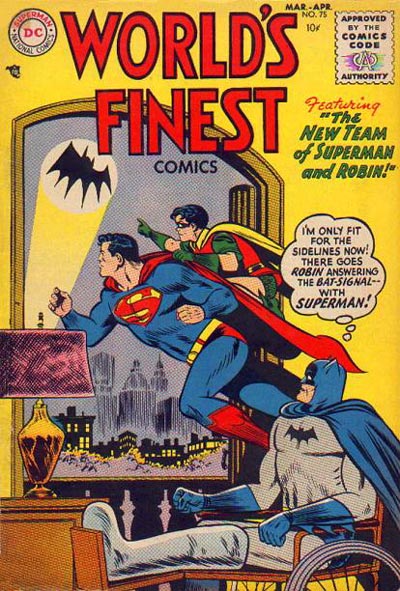
Still, the whole situation put us in mind of the lead story in World’s Finest, #75 (March 1955), written by Bill Finger and drawn by Curt Swan: “The New Team of Superman and Robin!”

Like other memorable stories that appeared at regular intervals in the 1940s and ’50s, the premise of this adventure was a threat to the Dynamic Duo’s partnership. Batman is laid up with a broken leg, so Superman comes to Gotham City and teams up with Robin to track down the fearsome Purple Mask Gang.

The tale’s emotional focus is lonely Batman moping around his cave, sadly poking at clues, and worrying that the Boy Wonder won’t want to return to their old methods now that he’s had a taste of flying. Of course, like nearly all the stories of that period, it ends with a return to the status quo ante. And, as with Ben Affleck, Batman’s leg turns out to be just fine.

“The New Team of Superman and Robin!” was reprinted in Superman in the Fifties, as well as other collections.

24 November 2013

Counting All Covers

In preparation for the “Celebrating 75 Years of Dick Grayson” anniversary, I got a question about the assertion that Robin was on the cover of more DC comic books of the 1940s than any other costumed hero.

A commenter told me that fact soon after I started the weekly Robin, saying it was a good way to win bar bets. (Not at any sort of bar I know, but okay.) A quick check of titles confirmed the fact, but I decided to do a more careful accounting.

In the 1940s, Superman appeared on the covers of:
  • Action Comics, #20-139 (120 comic books).
  • Superman, #3-61 (59).
  • World’s Fair, #1, and World’s Finest, #2-42 (42).
  • All-Star Comics, #36 (1).
  • Superman’s Christmas Adventure for 1940 and 1944 (2).
  • Superboy, #1 (1).
Total: 225 comic books.

Batman appeared on:
  • Detective Comics, #35-154 (120).
  • Batman, #1-56 (56).
  • World’s Fair, #1, and World’s Finest, #2-42 (42).
  • All-Star Comics, #36 (1).
  • Star Spangled Comics, #88-94 (7).
Total: 225 comic books.

Robin appeared on:
  • Detective Comics, #38-152 and #154 (116).
  • Batman, #1-46 and #48-56 (55).
  • World’s Fair, #1, and World’s Finest, #2-42 (42).
  • Star Spangled Comics, #65-95 (31).
Total: 244 comic books.

I might have missed some of the more obscure guest appearances, but Superman and Batman still have a lot of ground to cover before they catch up to the Boy Wonder. His usually-solo run on Star Spangled at the end of the decade put him in the lead.

Now I can’t claim that Robin was more prominent or popular than Superman or Batman in the 1940s. On many of those covers he appears subordinate to Batman, as a background assistant, observer, or boy hostage in need of rescuing. When Superman and Batman guest-starred on All-Star Comics with the Justice Society, Robin didn’t come along. When sales of Star Spangled featuring Robin began to slip, the editor added Batman to the cover before finally replacing the Boy Wonder with Tomahawk.

Furthermore, if we count the appearances of Superboy on the covers of More Fun Comics, #104-106; Adventure Comics, #103-147; and Superboy, #2-5 (52 more comic books in all) in Superman’s column, then he’s the clear leader. Superman was undoubtedly DC’s flagship property, with a national comic strip, radio show, movies, and novelizations. Starting in 1942 the company even included the name of Superman in its logo. But the US courts have decided that Superboy is a separate legal property.

So those are the numbers.

08 September 2013

The Amorality of Teen Titans Go

I had something else in mind for this weekly Robin, but today I saw reports of DC Comics’s plan to publish a Teen Titans Go comic book (the second of that name, the first being a spin-off its earlier Teen Titans cartoon). Comics Alliance says this will be a digital comic, taking advantage of ComiXology’s “guided-view” feature to create more page turns, before being printed in a standard magazine format. And I doubt I’ll be buying it.

Bleeding Cool’s article “Could Teen Titans GO! Be The Most Amoral Comic That DC Publishes?” echoes why I gave up on the show:
It’s actually quite vicious and surreal, often ending with all the Titans dead or permanently maimed. . . .

The most subversive episode is one where Robin decides he’s sick of being the only one without superpowers on the team because he has to work harder than everyone else. They tell him that superpowers are a curse. A CURSE! He will be forever a stranger, an outsider.

He insists he wants powers, so Raven gives him the gamut of powers, warning him he’ll live to regret it. NOPE. He goes off and solves all crime, ends world hunger and everything’s great. Except that means superheroes are out of a job. The team disbands. Robin has to find a crappy, boring 9 to 5 job. He toils at this job for the next 50 years until he falls over and ends up in the hospital on his death bed. . . .

The sheer amorality of the characters throughout the series is brilliant.
I recognize the talent and imagination involved in these stories. For instance, when Robin gets superpowers, he also gains a Superman-style spit curl. The show doesn’t call attention to that detail, Superman himself never appears in this universe—it’s just a little touch for fans.

The problem is that in any episode featuring Robin, he comes across as egotistical, bossy, short-sighted, lazy, and otherwise less than heroic. And so do all of the other male Titans, and sometimes the females. We hardly ever see them do anything nice for each other, or for anyone else.

What’s worse, in that episode Robin does end crime and save the world, as the summary says. And the show depicts that as a bad thing. Robin becomes a middle-aged adult (always a bad sign) and dies in a hospital bed. Because, you know, kids love that stuff.

At his Batwatch site Jeremy Sims mixes up “amoral” and “immoral,” but recognizes the same problem:
I really enjoy Teen Titans Go! but I'm not sure that I would want my kids to watch it. The characters almost always act immorally and almost never suffer the consequences, and they are supposed to be heroes.
As I groused back in June, “There is, as far as I can tell, almost no heroism in Teen Titans Go.” And the overarching theme of superhero stories, I think, is the nature of heroism in different circumstances. Teen Titans Go is no more concerned with heroism than the average Heckle and Jeckle cartoon.

As is to be expected, the cover of the first issue of the new comic book shows the Titans, particularly Beast Boy, eating.

27 June 2013

Big-Budget Action Movies Losing Their Wit

Last night I saw Man of Steel. It reminded me of Oz the Great and Powerful in that both movies are carefully made to trigger our memories of modern American myths, and in doing so both put spectacle over coherence, character, or wit.

Man of Steel does a fine job of showing us exactly what, say, a punch-out between two superpowered humanoids on a satellite would look like. Likewise, Oz the Great and Powerful swoops all over its digital locations, making them more convincing than the plot twists.

But does either of those movies have more than three quotable lines? (Check out these attempts to muster a quota of quotes.)

There’s no wit in either movie’s screenplay. Almost all their dialogue sounds like it was the first choice of tired screenwriters at the end of a long day. Most characters speak in simple, unimaginative ways, stating their emotions or desires baldly. (All the better, perhaps, for easy translations for the international market?) And the actors usually deliver that dialogue slowly, either to fill time or to ensure that no one in the audience can fall behind.

Consider Oz’s arrival in the strange fairyland:
Oz: Where...Where am I exactly?
Theodora: Where do you think you are?
Oz: I have no idea. It’s...It’s like no place I've ever seen.
Theodora: You’re in Oz.
And compare that to the hero’s lines from the parallel scene in MGM’s 1939 film:
Dorothy: Toto, I’ve a feeling we’re not in Kansas any more. . . . We must be over the rainbow! [Glinda arrives in her bubble.] Now I...I know we’re not in Kansas!
Okay, Dorothy’s speech includes #4 on the American Film Institute’s list of all-time best movie quotes. But those words are powerful because they’re understated and fresh. They could therefore be delivered with emotion instead of stating emotion. And the next line is actually metaphorical.

Even throwaway lines in the 1939 movie are evocative: “Now you go feed those hogs before they worry themselves into anemia!” “Of course, some people do go both ways.” “And the last to go will see the first three go before her.” Yes, sometimes the vaudeville shtick underlying that script shows through, but the words are still entertaining. It’s not just that repeated viewings have made the movie memorable. Rather, lines with verve have made it possible to view the movie over and over.

Last year’s big-budget popcorn movies showed that they don’t have to lack wit: The Avengers and Skyfall are powerful action movies with good scripts. They offer a lot to look at, but also a lot to hear besides explosions. Oz the Great and Powerful and Man of Steel offer only half that package.

15 June 2013

Timberline and Sprayberry

Six years ago I marveled at the Dickensian names of two young actors in 28 Weeks Later.

Today I’m celebrating the Pynchonian names of two younger actors:

Cooper Timberline and Dylan Sprayberry

They play the young Clark Kent at different ages in Man of Steel. Both are acting in other projects.

For nostalgia’s sake, here are pointers to Marc Tyler Nobleman’s interviews with the actors who played young Clark Kent back in 1978.

10 April 2013

A Mystery with Not-So-Secret Identities

A while back, I had the idea for a mystery story set in the world of mid-1900s American comics publishing. I’m still working on that, but in the meantime I sampled Max Allan Collins’s A Killing in Comics, the first in a series of mystery novels set, well, in the world of mid-1900s American comics publishing.

I should have expected Collins to have worked out this idea already. He’s written many comics himself, including the Dick Tracy newspaper strip for many years, the Ms. Tree private-eye stories, and The Road to Perdition. Collins was the Batman scripter who gave the second Jason Todd his past as a runaway with criminal parents.

Collins is also a prolific writer of prose mysteries, including his award-winning Nathan Heller books, another series built around major modern disasters, and numerous novelizations. So basically he’s already worked out every idea for a mystery story.

A Killing in Comics is clearly inspired by Gerard Jones’s Men of Tomorrow, which has become the authoritative history of the start of the American comic-book industry. It’s a roman à clef about the first generation of DC Comics, or more particularly about the men who worked on its most famous creations, Superman and Batman. But in this book those trademarks are cleverly disguised as Wonder Guy and Batwing.

Thus, instead of Jerry Siegel and Joe Shuster, the book gives us Harry Spiegel and Moe Shulman—but they’re almost exactly as Jones characterized the Superman creators. On the Batman side, Bob Kane becomes Rod Krane, Bill Finger becomes Will Hander, and Jerry Robinson becomes…nothing, because unlike the other creators there’s no clear moral conflict in his career. Editor Mort Weisinger is on the scene at Sy Mortimer but as of 1948 hasn’t reached his full potential as a villain.

The detective, Jack Starr, is the troubleshooting vice president of a newspaper syndication service. Though he refers to his father as “the major,” reminiscent of Maj. Malcolm Wheeler-Nicholson, this business is actually successful. It’s also run by a version of Gypsy Rose Lee, a retired stripper of an intellectual kind. That’s the most fictional part of the book.

As with Oz the Great and Powerful, the story is a little less interesting than watching it play out just on the edge of its source material without stepping over the line onto that territory. In this case, the mystery depends on all those comics pros being capable of killing the equivalent of the president of DC Comics. So of course “any resemblance to actual persons…is entirely coincidental,” as the copyright page says.

Further volumes in Collins’s Jack Starr series appear to be inspired by the Li’l Abner Broadway show of 1956 and its roots in newspaper comics, and by Dr. Fredric Wertham’s anti-comics crusade.

14 February 2013

A Real Reason to Boycott

Facing criticism from fans for hiring Orson Scott Card, an outspoken opponent of homosexuality and marriage equality, to write a Superman story, DC Comics issued this statement:

As content creators we steadfastly support freedom of expression, however the personal views of individuals associated with DC Comics are just that - personal views - and not those of the company itself.
Questions of free speech, political acceptability, and the free market are one thing. But splicing independent clauses with the word “however”—that’s intolerable.

13 February 2013

“A special devotee of Batman”? Not Really

The latest irregularly scheduled Oz and Ends award for Batman research goes to Carol Tilley, professor of library and information science at the University of Illinois, who recently published a paper comparing Dr. Fredric Wertham’s statements about comics in Seduction of the Innocent with his actual research notes.

The university released an unfortunately headlined press release that says:
For example, in “Seduction,” Wertham links “Batman” comic books to the case of a 13-year-old boy on probation and receiving counseling for sexual abuse of another boy: “Like many other homo-erotically inclined children, he was a special devotee of Batman: ‘Sometimes I read them over and over again. … It could be that Batman did something with Robin like I did with the younger boy.’ ”

What Tilley found in Wertham’s notes, however, was that the boy preferred “Superman,” “Crime Does Not Pay” and “war comics” over “Batman,” and that he had previously been sexually assaulted by the other boy – all information that Wertham left out.
That change was crucial because Wertham’s book linked Batman and Robin to homosexuality but didn’t make the same link for the comics that young patient actually preferred.

The press release notes other examples where Wertham’s notes and final text don’t match. For example, he left out a lot of pertinent risk factors in troubled young patients’ lives. When a patient described learning crime techniques from “the movies” as well as comics, Wertham mentioned only the comics.

I’ve previously noted how Wertham retold a news story about a boy who put on a cape and jumped off a cliff without acknowledging that the character the boy was imitating wasn’t Superman but Mighty Mouse, a character created for the movies.

(Thanks to E. J. Barnes for the alert.)

13 January 2013

A Duo with an Unhealthy Dynamic

This month Mark Waid, Peter Krause, and team finished the first storyline of their superhero adventure Insufferable on Waid's digital comics site Thrillbent. Since the concept is obviously inspired by the Dynamic Duo, it's an appropriate topic for the weekly Robin.

For BOOM! comics, Waid wrote two linked series called Irredeemable (drawn primarily by Krause) and Incorruptible, which explored what could happen if one of the cornerstones of the Superman mythos was kicked away. What if the alien with powers beyond anyone else on Earth suddenly turned hateful and destructive? And, conversely, what if one of his worst nemeses decides that it’s now up to him to turn his life around and save the planet?

Insufferable starts by remixing some basic ingredients of the Batman and Robin mythos. Nocturnus is a dark, unemotional, technology-driven crusader against crime. Kid Galahad was his young sidekick. But there are two major differences:
  • Nocturnus is Kid Galahad's real father, not a father figure.
  • Kid Galahad is not Dick Grayson; he's just a dick.
In other words, what if Robin is, if not evil, far from a good role model?

Years before this story begins, Kid Galahad broke with his father and blew their secret identity. Since then he’s built a lucrative business around his persona, and Nocturnus has retreated further into the shadows. But a new threat from an old villain forces them to work together again. There are, of course, layers within layers, betrayals, unforeseen allies, and so on. Waid knows how to write superhero stories.

Some aspects of the original Batman and Robin’s relationship are replicated here: Kid Galahad is more emotive, Nocturnus a better planner. As Waid has acknowledged in a summer 2012 interview, the opening chapters were designed to show Galahad’s perspective: “Nocturnus doesn’t seem to get as much play, but that’s only because we’ve made a conscious choice to not look too deeply at his thoughts and to veil him in mystery.” Meanwhile, Galahad just can’t keep his feelings to himself.

Yet the story’s sell line invites readers into Nocturnus’s point of view: “What happens when you’re a crimefighter and your sidekick grows up to be an arrogant, ungrateful douchebag? What on Earth could draw the two of you back together again?” Despite (or because of) his vociferousness, the story strongly implies that Kid Galahad’s big problem is Kid Galahad, and Nocturnus’s big problem is…Kid Galahad. If the kid sidekick is bad, the whole universe goes to pot.

Another theme that Waid explores in Insufferable is the power of social media. Kid Galahad has a big online following. His fans tweet about his latest appearances and exploits. (The Twitter handles of some of those fans match those of real comics fans.) Cameras are everywhere to catch Galahad’s mistakes and boasting. His smartphone plays a role in several scenes. To some extent that reflects the way we live today. But it’s in part also a commentary on online comics discussion, where vitriol goes well beyond what’s merited by fiction about people kicking each other in the face.

TOMORROW: The Thrillbent format.

09 January 2013

Oz from Oz

You’ll be pleased to know you can get this cartoon as a t-shirt from Mike Jacobsen’s Neato Shop.

Jacobsen is also the creator of this Superman brilliance.


And this warning about the dangers of science going too far.

Jacobsen shares new work regularly from Australia at See Mike Draw.