Showing posts with label PLAY Wizard of Oz. Show all posts

30 October 2025

At Last an Our Gang/Wizard of Oz Crossover

In 1962, as described yesterday, Starlight Musical Theatre of San Diego held tryouts for a production of The Wizard of Oz, using music from the MGM movie.

To play the Tin Woodman the company chose a local television personality: Johnny Downs!

Downs brought decades of experience as performer, starting with acting in Our Gang comedies in the mid-1920s. In fact, he had sung and danced alongside MGM’s Tin Man, Jack Haley, in such movies as Coronado and Pigskin Parade, which also featured fourteen-year-old Judy Garland.

Downs appears in this photograph scanned from the 3 June San Diego Union with Cammy Wesson as Dorothy, Ray Wilde as the Cowardly Lion, and John Bryce as the Scarecrow.

The director was Charlie Cannon, a co-founder of Starlight Musical Theatre (San Diego Civic Light Opera Company) years before. In 1978 the San Diego Evening Tribune reported:
Cannon is most proud of his “Wizard of Oz” production in 1962 featuring Johnny Downs, a TV personality, as the tin man. “We put close to 5,000 in the bowl for that one,” he said. “We even had people sitting in the aisles, and Downs would stay after the show for an hour signing autographs.”
That number may be an exaggeration since on 10 Aug 1964 the San Diego Union reported that 3,800 people was “a record crowd” at the Starlight Bowl. However, that record was set by the 1964 production of The Wizard of Oz—the show was so popular that the company brought it back after only two years.

In the revival Johnny Downs once again played the Tin Woodman, and was often listed first in newspaper notices. Cammy Wesson, now a college student, returned as Dorothy. Ole Kittleon played the Scarecrow and Forest Gantz the Cowardly Lion.

A new director reblocked the action for that run. In an interview with a high-school classmate for the 12 Aug 1964 Coronado Eagle and Journal, Wesson described having trouble at first knowing which way to turn. She added: “Johnny Downs, who plays the Tin Woodsman [sic], has adapted very well, but he’s a professional.”

Cammy Wesson went on to careers as an elementary school teacher, realtor, and financial advisor. As a sexagenarian back in Coronado, she took up marathon running.

29 October 2025

The Wizard of Balboa Park

The San Diego Civic Light Opera Association was founded in 1945. Its first show was Gilbert and Sullivan’s The Mikado in the Wegeforth Bowl at the San Diego Zoo.

Because of San Diego’s ideal weather, the organization staged its shows outside. It soon took on the name of the Starlight Opera.

On July 29, 1946, the San Diego Union and Daily Bee said: “If the new Starlight Opera company becomes any more popular it will have to move to Ford Bowl.” That was the amphitheater in Balboa Park built for a 1935 expo.

Indeed, the Starlight Opera Company was soon using that larger space. Around 1950 the amphitheater became known as the Starlight Bowl. (An amphitheater in Burbank was using the same name at that time, confusing matters.)

The Light Opera Association also widened its repertoire to include new, popular shows and operated under the same of Starlight Musical Theatre.

Because the amphitheater was right under the main flight path to Lindbergh Field, performers learned to freeze when a loud plane passed overhead. Starlight Musical Theatre’s old website called this “One of the most artistic innovations of productions at the Starlight Bowl.”

In 1962 the Starlight company planned a summer season of The Music Man, Can-Can, The Wizard of Oz, and Bye Bye Birdie.

About the third show the 7 Apr 1962 San Diego Evening Tribune explained:
“The Wizard of Oz,” was adapted originally for the stage by L. Frank Baum from his classic children’s story. It was first presented in 1903, starring the team of Fred Stone and David Montgomery. Their leading lady was Anna Laughlin, the mother of singer Lucy Monroe.

The version of “Wizard” which Starlight is using has been updated by Frank Gabrielson, and features the songs of Harold Arlen and E. Y. Harburg, composed for the highly successful 1939 movie.
That adaptation had originally been commissioned by the St. Louis Municipal Opera in 1942 and is therefore known as “the MUNY Version.” As the licensor says, it “features characters and events not seen in the MGM film”—and it also leaves out several characters and events.

The 1962 San Diego Evening Tribune article was headlined “Little Munchkins Needed for Starlight ‘Wizard of Oz’,” and its main news was:
Casting for Starlight’s production of “The Wizard of Oz” will be held for three days, instead of the usual two, due to the large number of children needed in the cast. . . .

The youngsters will be used for the Wizard of Oz’s “army,” composed of one private and 24 generals. They will also be used as munchkins—the little people enslaved by the Wicked Witch of the East and freed by Dorothy. . . .

Roles open for adults include that of the Scarecrow—which also requires dancing ability; the Tin Woodman and the Cowardly Lion. The leading role of Dorothy, calls for a teenage soprano with acting experience, age 18 at the maximum.
In 2010, after more than sixty straight years of productions, the San Diego Civic Light Opera Association went out of business. There’s now a Save Starlight campaign to fix up the abandoned amphitheater and stage new concerts and shows there.

TOMORROW: Crossing the streams.

18 June 2024

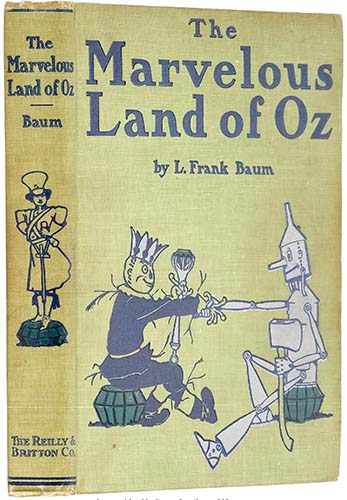
The Missing Princess of the Marvelous Land

I’ve been thinking about how The Marvelous Land of Oz could be more of a mystery. As it is, the book is a roller-coaster ride of political events. Every so often it raises the question of who should rule the Emerald City. But the book doesn’t give us all the clues to its ultimate answer until quite late.

Baum and his colleagues had introduced the character of Pastoria, former king of Oz, in the 1902 stage extravaganza The Wizard of Oz. Therefore, when the Scarecrow mentions his name in the sixteenth chapter of Land, it wouldn’t have been a complete surprise to all readers.

Nonetheless, that was two-thirds of the way through the book. Furthermore, Glinda doesn’t drop the bombshell that Pastoria left a missing daughter until four chapters later. That means readers have only three chapters to be thinking about this mystery, on which the conclusion of the story will hinge.

There are plenty of signs that Baum didn’t like going back to revise. He occasionally excised whole chapters or inserted new passages, but his surviving manuscripts and correspondence show none of the fiddling with details that other writers regularly performed.

I don’t think it would have taken much revising to cue readers into thinking about Pastoria and his daughter for much of the book. Here are some slightly rewritten passages in which characters discuss the history of Oz.

In Chapter 3, the boy Tip is trying to orient his creation, Jack Pumpkinhead:
“Where are we going?” asked Jack, when they had resumed their journey.

“I’m not exactly sure,” said the boy; “but I believe we are headed South, and that will bring us, sooner or later, to the Emerald City.”

“What city is that?” enquired the Pumpkinhead.

“Why, it’s the center of the Land of Oz, and the biggest town in all the country. I’ve never been there, myself, but I’ve heard all about its history. It was built by a mighty and wonderful Wizard named Oz, around the estate of the former king Pastoria, and [later] . . . the people of the Emerald City invited the Scarecrow to rule them.”

“Dear me!” said Jack. “I’m getting confused with all this history. Who is the Scarecrow?”

“Another friend of Dorothy’s,” replied Tip.

“And who is Dorothy?”

“She was a girl that came here from Kansas, a place in the big, outside World. She got blown to the Land of Oz by a cyclone, and while she was here the Scarecrow and the Tin Woodman accompanied her on her travels.”

“And where is she now?” inquired the Pumpkinhead.

“Glinda the Good, who rules the Quadlings, sent her home again,” said the boy.

“Oh. And what became of the Scarecrow?”

“I told you. He rules the Emerald City,” answered Tip.

“I thought you said it was ruled by a wonderful Wizard,” objected Jack, seeming more and more confused.

“Well, so I did. Now, pay attention, and I’ll explain it,” said Tip, speaking slowly and looking the smiling Pumpkinhead squarely in the eye. “Around the time King Pastoria vanished, the Wizard came and built the Emerald City and ruled for many years. Dorothy went to the Emerald City to ask the Wizard to send her back to Kansas; and the Scarecrow and the Tin Woodman went with her. But the Wizard couldn’t send her back, because he wasn’t so much of a Wizard as he might have been. And then they got angry at the Wizard, and threatened to expose him; so the Wizard made a big balloon and escaped in it, and no one has ever seen him since.”

“Now, that is very interesting history,” said Jack, well pleased; “and I understand it perfectly all but the explanation.”
After Jack and Tip get separated, the boy meets a pretty young woman in a colorful military uniform. With a little tweaking, this conversation could have been part of that Chapter 8:
“I am General Jinjur,” was the brief reply.

“Oh!” said the boy surprised. “What sort of a General?”

“I command the Army of Revolt in this war,” answered the General, with unnecessary sharpness.

“Oh!” he again exclaimed. “I didn’t know there was a war.”

“You were not supposed to know it,” she returned, “for we have kept it a secret; and considering that our army is composed entirely of girls,” she added, with some pride, “it is surely a remarkable thing that our Revolt is not yet discovered.”

“It is, indeed,” acknowledged Tip. “But where is your army?”

“About a mile from here,” said General Jinjur. “The forces have assembled from all parts of the Land of Oz, at my express command. For this is the day we are to conquer His Majesty the Scarecrow, and wrest from him the throne. The Army of Revolt only awaits my coming to march upon the Emerald City.”

“Well!” declared Tip, drawing a long breath, “this is certainly a surprising thing! May I ask why you wish to conquer His Majesty the Scarecrow?”

“Because the Emerald City has been ruled by men long enough, for one reason,” said the girl. “Before the Scarecrow there was the Wizard, and before the Wizard, or even the city as it stands today, there was King Pastoria. Some people say Pastoria had a daughter who was meant to rule over us, meaning that we should have had a girl ruler by this time, but no one has seen that child for years.”

That lost heir was not part of the history of Oz that Tip had heard from Mombi. He puzzled over this rumor as Jinjur went on:

“Moreover, the City glitters with beautiful gems, which might far better be used for rings, bracelets and necklaces; and there is enough money in the King’s treasury to buy every girl in our Army a dozen new gowns. So we intend to conquer the City and run the government to suit ourselves.”
Tip and Jack Pumpkinhead reunite in the Scarecrow’s palace, only for General Jinjur to seize the Emerald City. Later the Scarecrow seizes the palace back with the help of his close friend, the Tin Woodman. But at that point in Chapter 16, the straw-man ruler is ready to abdicate:
Tip soon cut the stitches that had fastened the crown to the Scarecrow’s head, and the former monarch of the Emerald City removed it with a sigh of relief and hung it on a peg beside the throne.

“That is my last memento of royalty,” said he; “and I’m glad to get rid of it. The former King of this City, who was named Pastoria, lost the crown to the Wonderful Wizard, who passed it on to me. Now the girl Jinjur claims it, and I sincerely hope it will not give her a headache.”

“A kindly thought, which I greatly admire,” said the Tin Woodman, nodding approvingly.

“Have you ever heard,” Tip asked the straw man, “that King Pastoria had a daughter who disappeared?”

“Some people do say that,” answered the Scarecrow, “and some say otherwise. That happened well before my time, so I cannot say anything about it. Why—do you think General Jinjur is this lost heir to Pastoria?”

Tip shook his head. After all, Jinjur was the person who had first told him about the missing princess, and she had made no claim to rule the Emerald City other than by force and cunning.

“Well, now I will indulge in a quiet think,” continued the Scarecrow, lying back in the throne.
Finally, the Scarecrow and his supporters reach Glinda’s palace in Chapter 20:
“Therefore I have come to beg your assistance,” resumed the Scarecrow, “for I believe you are always glad to succor the unfortunate and oppressed.”

“That is true,” replied the Sorceress, slowly. “But the Emerald City is now ruled by General Jinjur, who has caused herself to be proclaimed Queen. What right have I to oppose her?”

“Why, she stole the throne from me,” said the Scarecrow.

“And how came you to possess the throne?” asked Glinda.

“I got it from the Wizard of Oz, and by the choice of the people,” returned the Scarecrow, uneasy at such questioning.

“And where did the Wizard get it?” she continued gravely.

“I am told he took it after Pastoria, the former King, had not been heard from for some time,” said the Scarecrow, becoming confused under the intent look of the Sorceress.

“Then,” declared Glinda, “the throne of the Emerald City belongs neither to you nor to Jinjur, but to this Pastoria from whom the Wizard usurped it.”

“That is true,” acknowledged the Scarecrow, humbly; “but Pastoria has been gone for many years now, and some one must rule in his place.”

“Pastoria had a daughter, who is the rightful heir to the throne of the Emerald City. Did you know that?” questioned the Sorceress.

“Not for certain,” replied the Scarecrow. “But if that girl still lives I will not stand in her way. It will satisfy me as well to have Jinjur turned out, as an impostor, as to regain the throne myself. In fact, it isn’t much fun to be King, especially if one has good brains. I have known for some time that I am fitted to occupy a far more exalted position. But where is the girl who owns the throne, and what is her name?”

“Her name is Ozma,” answered Glinda. “But where she is I have tried in vain to discover. For the Wizard of Oz, when he stole the throne from Ozma’s father, hid the girl in some secret place; and by means of a magical trick with which I am not familiar he also managed to prevent her being discovered—even by so experienced a Sorceress as myself.”
By that point, readers would have been thinking about the Emerald City’s deep history for most of the book, and the mystery of the missing heir for a dozen chapters. Where could that child be?

04 July 2023

The Characters of Oz and the Character of Oz the Wizard

Later this year McFarland will publish The Characters of Oz: Essays on Their Adaptation and Transformation, edited by Dina Schiff Massachi of the University of North Carolina at Charlotte.

The publisher says, “This collection of essays follows Baum’s archetypal characters as they’ve changed over time in order to examine what those changes mean in relation to Oz, American culture and basic human truths.”

Among those essays is my own “A Good Man But a Bad Wizard?: The Shifting Moral Character of the Wizard of Oz.”

One of the few lines that appeared in both L. Frank Baum’s original novel and the 1939 MGM movie was the Wizard’s insistence that he was “a good man, but a bad wizard.” Within that first novel the Wizard was a humbug whom people believed in, a tyrant who benefited his people, but ultimately someone Dorothy couldn’t rely on.

Just a few years later, however, the American public knew the Wizard of Oz unambiguously as a bad man in the Wizard of Oz stage extravaganza. And a few years after that, Baum brought the Wizard back as a stalwart friend for Dorothy and eventually a real magic-worker. This essay analyzes those changes in his persona across media and moral boundaries.

Other articles in this collection include Katharine Kittredge on Dorothy, Dee Michel and James Satter on the Cowardly Lion, Walter Squire on Glinda, Paige Gray on Jack Pumpkinhead, and Angelica Carpenter on the Nome King, among many other experts. Dina Massachi wrangled the contributors and provided her own exploration of the Winged Monkeys.

08 September 2020

A Scarecrow in Wodehouse

“The Aunt and the Sluggard,” one of P. G. Wodehouse’s earliest stories about Bertie Wooster and Jeeves, turns out to have an Oz connection.

The plot revolves around an eccentric aunt who insists on her nephew taking in the thrills of 1916 New York City and relaying them to her so she can live vicariously. With Jeeves’s help, Bertie’s friend the nephew writes letters with passages like this:
We were quite a gay party. Georgie Cohan looked in about midnight and got off a good one about Willie Collier. Fred Stone could only stay a minute, but Doug. Fairbanks did all sorts of stunts and made us roar.
Fred Stone had become a huge Broadway star a bit over a decade earlier by playing the Scarecrow in the musical extravaganza The Wizard of Oz.

In reviewing the show Jack O’Lantern for Vanity Fair in 1917, Wodehouse wrote, “Fred Stone is unique. In a profession where the man who can dance can’t sing and the man who can sing can’t act he stands alone as one who can do everything.” So spotting him at one’s party would indeed be a big thrill.

To everyone’s surprise, the aunt shows up at Bertie’s apartment to enjoy New York herself.
“Good afternoon,” I managed to say.

“How do you do?” she said. “Mr. Cohan?”

“Er—no.”

“Mr. Fred Stone?”

“Not absolutely. As a matter of fact, my name’s Wooster—Bertie Wooster.”

She seemed disappointed. The fine old name of Wooster appeared to mean nothing in her life.
The nephew has to take the aunt out to nightclubs, and he gives Bertie this report by phone:
“She keeps asking me when Cohan and Stone are going to turn up; and it’s simply a question of time before she discovers that Stone is sitting two tables away.”
Fred Stone is thus an actual character in this story, not merely an allusion.

In contrast, Wodehouse named the rip-roaring evangelist who plays a role in the resolution as Jimmy Mundy, forbearing to import Billy Sunday into his version of New York. But to get the full power of theatrical celebrity, it seems, he had to use a real star.

Toward the end of this story, after the aunt and nephew have happily gone their separate ways, Bertie echoes Oz again: “Jeeves, there’s no place like home—what?”

To be sure, that’s a line Baum quoted from John Howard Payne’s 1823 song “Home, Sweet Home!” But Bertie gives it his own spin, what?