Showing posts with label BOOK John Dough and the Cherub. Show all posts

02 July 2010

Tigers and Dogs and Blogs, Oh My!

Hungry Tiger Press now has a blog. Of course, the specialized press has been sharing goodies on its website for many years, but this format looks like it will allow publisher David Maxine more flexibility to share announcements of new books, stories behind one of the country’s great Oz collections, and little-known writing and art from Oz creators. Forgive me if I suggest entering by this door.

Eric Gjovaag’s Wonderful Blog of Oz notes that tonight Turner Classic Movies is showing the 1939 Wizard of Oz musical, and that this year the channel focuses on one featured performer: Terry.

Terry? That’s the little Cairn terrier who played Toto. TCM will run two more movies in which she played significant roles, Fury and George Washington Slept Here. See Classic Movie Musicals for more of Terry/Toto’s films.

10 June 2008

John Dough on Demand

Last week Bowker, the Books in Print people, issued a report on the state of the American book industry, which Publishers Weekly summarized in this article.

Bowker now counts new print-on-demand books separately from books printed in a traditional way instead of including everything with an ISBN in the same count. That's because the new p.o.d. technology is causing a huge spike in the availability of books that don't physically exist until someone orders them. In 2007 the number of new traditionally printed titles (or editions) rose only 1%, to about 277,000. However, "the output of on-demand, short run and unclassified titles soared from 21,936 in 2006 to 134,773 last year."

According to PW:

The new segment includes traditional books printed by mainstream publishers using print-on-demand technology, public domain titles published through p-o-d as well as titles from self publishers and very small independent press[es] that use p-o-d.
One of those small presses is Hungry Tiger Press, publisher of the new edition of John Dough and the Cherub that I've been pushing discussing in a detached, scholarly manner over the past week or so.

David Maxine started Hungry Tiger Press before print-on-demand books were possible, and has issued many books (and a Grammy-nominated CD) using older manufacturing methods. But p.o.d. makes the economics of niche publishing much more workable. With good design and production values, a volume published through p.o.d. technology looks just as good as a volume published the usual way.

Some people associate p.o.d. publishing with self-publishing. And indeed the new technology makes it easier than ever to print a poorly written, unedited, ineptly laid out, and unproofread manuscript. A lot of those 135,000 new p.o.d. titles issued last year are public-domain books churned out by "presses" that are nothing more than websites.

However, print-on-demand offers many benefits, such as making a book like John Dough and the Cherub available once again to libraries, researchers, and Baum fans. With, I hope I can say, some added value in its new introduction. Last week, Public Affairs turned to p.o.d. to fulfill the big demand for Scott McClellan's confessional. In the next few years, scholarly publishing and other niches will migrate to that form of manufacturing, and it will be fully integrated into the traditional book industry.

09 June 2008

John Dough Cut Up to Make a New Book

When I started researching John Dough and the Cherub, one of my to-do's was to find a copy of The Gingerbread Man, an "Oz-Man Tale" that L. Frank Baum published with Reilly & Britton in 1917. Bill Campbell at The Oz Enthusiast offers a look at the other five in this six-volume series. (Click on his big photo for an even bigger one.)

I thought there was a chance that The Gingerbread Man might reveal Baum's initial plans for John Dough, before he received Edward Bok's rejection of the manuscript and advice to include a young co-protagonist. Given what I knew about Baum, it seemed conceivable that he'd grabbed a chance to publish a "Gingerbread Man" manuscript he'd set aside.

Instead, The Gingerbread Man and another volume in the same series, Jack Pumpkinhead, displayed a level of recycling that I hadn't imagined.

To create these 64-page books, the publisher took the plates of the first 50+ pages of John Dough and the Cherub and The Marvelous Land of Oz, added new frontmatter, and had (I presume) Baum draft a quick ending to the stories.

Thus, The Gingerbread Man ends with John Dough finding a new home on the Island of Phreex. Someone traced John R. Neill's drawing of the Fresh Air Fiend who welcomes John to create a slapdash decoration for that final chapter. (The firm didn't try to duplicate Neill's handsome illustrated and hand-lettered chapter titles.) This book has no Chick the Cherub, no Para Bruin, no Mifkets, no hero's journey for John.

In the end, The Gingerbread Man did offer me a clue about what Baum had submitted to Bok. It confirmed how willing he was to milk his existing material. That convinced me that he took off from his initial chapters for Bok in a new direction but didn't rewrite a word of what he already had.

As for the Jack Pumpkinhead volume, it ends with Tip, Jack, and the Sawhorse arriving together at the Emerald City and deciding it will be a nice place to stay. They don't get separated along the yellow brick road, Tip doesn't meet General Jinjur, and Jack doesn't have his comically translated conversation with the Scarecrow. Most significantly, in this version of Oz, there's no Princess Ozma. It's the start of an alternative Oz universe--published under Baum's own name.

07 June 2008

Is the Cherub a Girl or a Boy?

In some ways, L. Frank Baum's John Dough and the Cherub is deeply rooted in fairy-tale traditions. It was clearly inspired by the folktales of a gingerbread man or other baked good running away from its makers, and there are stock characters like the dying little girl and the ruthless Arab.

But one aspect of this fantasy was revolutionary: the character of Chick the Cherub has no gender. Chick acts just as boisterous as a stereotypical male and just as loving as a stereotypical female. Living in a somewhat futuristic society, the Cherub is dressed loose pajamas and sandals, and the hairstyles of that decade (as well as ours) meant that long hair was no clue to a child's gender.

Furthermore, as I discussed in this posting, being gender-neutral isn't what makes Chick unusual. Rather, that appears to be a natural outcome of being an Incubator Baby--the equivalent then of a test-tube baby today. In essence, Baum was telling Americans that the same modern world that could now save their little premature babies was also rendering their notions of masculinity and femininity obsolete. Baum was the son-in-law of suffrage activist Matilda Joslyn Gage, after all.

Baum had played with the idea of switching genders in several preceding books. The young hero of The Marvelous Land of Oz becomes the young title character of Ozma of Oz. A fairy in The Enchanted Island of Yew experiences a year as a young prince. In Queen Zixi of Ix and the short story "The Witchcraft of Mary-Marie," magic-workers put on the form of the opposite sex.

But Chick is different. Chick isn't spending some time as a female and some as a male. Chick is happy and healthy with no gender identity at all. I don't know of any other example of children's literature asking readers to identify with such a child until the didactic Free to Be You and Me in 1972.

Baum and his publisher made this mystery the center of John Dough and the Cherub's marketing campaign. The first printings of the book included a form on which children could write essays of 25 words or less saying why they thought Chick must be either male or female. A reproduction of one of those now-rare contest forms appears in the new Hungry Tiger Press edition of John Dough. The newspapers that serialized the tale encouraged contest entries with ads like the one above.

And the outcome? According to Baum's son, Frank Joslyn Baum, the contest ended with the awarding of two prizes: one to a girl who said Chick was a girl, and one to a boy who said Chick was a boy. The younger Baum's biography isn't always reliable, but that sounds just like something his father would do.

06 June 2008

Para Bruin and the Mifkets

The Cowardly Lion in The Wonderful Wizard of Oz was a type L. Frank Baum returned to in several of his other fantasy stories: a big, carnivorous beast who looked frightening but was a real sweetie underneath. At the end of Wizard, the Lion has gained courage and is once again king of beasts, but what's interesting about that? Starting with Ozma of Oz (1907), Baum made the Cowardly Lion cowardly again, or at least fearful, and for good measure added a Hungry Tiger too troubled by his conscience to eat the fat babies he craves.

In John Dough and the Cherub, published between those two Oz books, the fearsome-looking animal is named Para Bruin. John Dough and his young friends meet Para on an island dominated by primitive imps called Mifkets. Here's the scene:

The bear was fat and of monstrous size, and its color was a rich brown. It had no hair at all upon its body, as most bears have, but was smooth and shiny. He gave a yawn as he looked at the new-comers, and John shuddered at the rows of long, white teeth that showed so plainly. Also he noticed the fierce claws upon the bear's toes, and decided that in spite of the rabbit's and the Princess' assurances he was in dangerous company.

Indeed, although Chick laughed at the bear, the gingerbread man grew quite nervous as the big beast advanced and sniffed at him curiously--almost as if it realized John was made of gingerbread and that gingerbread is good to eat. Then it held out a fat paw, as if desiring to shake hands; and, not wishing to appear rude, John placed his own hand in the bear's paw, which seemed even more soft and flabby than his own.

The next moment the animal threw its great arms around the gingerbread man and hugged him close to its body.

John gave a cry of fear, although it was hard to tell which was more soft and yielding--the bear's fat body or the form of the gingerbread man.

"Stop that!" he shouted, speaking in the bear language. "Let me go, instantly! What do you mean by such actions?"

The bear, hearing this speech, at once released John, who began to feel of himself to see if he had been damaged by the hug.

"Why didn't you say you were a friend, and could speak my language?" asked the bear, in a tone of reproach.

"You knew well enough I was a friend, since I came with the Princess," retorted John, angrily. "I suppose you would like to eat me, just because I am gingerbread!"

"I thought you smelled like gingerbread," remarked the bear. "But don't worry about my eating you. I don't eat."

"No?" said John, surprised. "Why not?"

"Well, the principal reason is that I'm made of rubber," said the bear.

"Rubber!" exclaimed John.

"Yes, rubber. Not gutta-percha, you understand, nor any cheap composition; but pure Para rubber of the best quality. I'm practically indestructible."

"Well, I declare!" said John, who was really astonished. "Are your teeth rubber, also?"

"To be sure," acknowledged the bear, seeming to be somewhat ashamed of the fact; "but they appear very terrible to look at, do they not? No one would suspect they would bend if I tried to bite with them."

"To me they were terrible in appearance," said John, at which the bear seemed much gratified.

"I don't mind confiding to you, who are a friend and speak my language," he resumed, "that I am as harmless as I am indestructible. But I pride myself upon my awful appearance, which should strike terror into the hearts of all beholders. At one time every creature in this island feared me, and acknowledged me their king, but those horrid Mifkets discovered I was rubber, and have defied me ever since."
Para's remark about the Mifkets' discovery inspired John R. Neill's endpapers illustration for John Dough. He drew a scene of the imps stretching Para across the breadth of the book--a scene that doesn't appear in the story and must take place before it.

Here's half of that picture, as it appears in my Reilly & Britton copy of John Dough:

The right endpaper shows the other half of this scene. To obtain the whole image, you either need to track down an old Reilly & Britton/Lee copy of John Dough and the Cherub, or order the new Hungry Tiger Press edition.

05 June 2008

Edward Bok and John Dough

In the first decade of the 20th century, Edward Bok was without doubt the leading magazine editor in America. Born in Holland in 1863, he had come to America as a child, entered publishing, and taken the reins of The Ladies' Home Journal at the age of 26.

By filling that magazine with a not-unfamiliar combination of advice, practical and moral; contests; and celebrity names, Bok pushed its circulation to record numbers. It was the first magazine in the world with more than a million subscribers. (The picture of Bok here comes courtesy of the Historic Bok Sanctuary, an elaborate public garden in Florida that he helped to establish after retiring from being a famous editor and becoming a famous author.)

When I say "celebrity names," I don't mean Bok traded in gossip. Rather, in those pre-broadcasting days, the Ladies' Home Journal and similar magazines were where middle-class Americans turned for entertaining stories to enjoy at home. Bok pursued big-name authors of both fiction and nonfiction. For example, he commissioned some of Rudyard Kipling's Just-So Stories. Bok paid very well, but he paid only after an author had delivered something he thought was worth publishing.

And that's where L. Frank Baum ran into trouble. Around 1904 he was as hot as he'd ever be, with two nationwide bestsellers (Father Goose and The Wonderful Wizard of Oz) and a smash stage show (freely adapted from Wizard). Bok talked to Baum about writing an original fairy tale for The Ladies' Home Journal, floating a figure of $2,500 for serial rights.

Baum responded with "John Dough," about a life-sized gingerbread man brought to life in an American city. Years ago, I had the impression that Baum sent Bok an entire story, most of which he later rewrote. I now think Baum sent only what would become the first four chapters of John Dough and the Cherub. My study of his manuscript for The Magic of Oz indicates that Baum rewrote as little as possible.

Bok looked at that story and felt it needed significant rewriting. In particular, he suggested that Baum should include a child character for young readers to relate to. Indeed, the first four chapters of John Dough contain only one child, and not a very sympathetic one.

I think the irony of the situation is that Baum had probably written while thinking of Bok's typical readers: contemporary American homemakers. John Dough starts out in a small bakery and then moves to the streets of an American city, places that Ladies' Home Journal readers would have known well. Two of the strongest characters in those first chapters are the baker's wife and a housewife who thinks the gingerbread man is just right for eating. In the introduction to the new edition of John Dough I note other ways that Bok's magazine might have influenced Baum's creation.

After Bok turned down "John Dough" in its current form, Baum put it aside and nursed his grievances for a while. Eventually he went back and resumed the story in a more fantastic and broadly comical vein. Baum even added the child Bok recommended, one whom both sexes might relate to: the genderless Chick the Cherub. But he never sent it to Bok again; instead, he offered it to the more malleable small publishing firm of Reilly & Britton. John Dough left America and the Ladies' Home Journal world behind forever.

04 June 2008

Why Does the Gingerbread Man Run?

I’ve had a draft of this posting on my Blogger site since November 2006, and the publication of the Hungry Tiger Press edition of John Dough and the Cherub spurred me to finish it.

In researching the introduction for that edition, I dug into the folktale that obviously inspired L. Frank Baum to write that novel: the story of the Gingerbread Man. That’s a version of the tale called “The Runaway Pancake,” classified by folklore scholars as Aarne-Thompson type 2025. Examples have been documented in many European cultures, from Ireland to Russia, Norway to Slovenia. (See Prof. D. L. Ashliman's folktexts website for examples of other widespread tales.)

As I understand it, one basis of the study of folklore is that the more widespread a story or motif within a story is, the older it probably is. Conversely, a variation on a story or song that shows up in only a few collected versions is more likely to be a recent creation or addition.

The story of the gingerbread man provides an interesting case study for those guidelines. “The Runaway Pancake” is widespread enough that it must be quite old. In most cases the runaway breadstuff is simpler than a gingerbread man: it’s a “thick, fat pancake” in the earliest printed version (from Germany in 1854), a “wee bunnock” in an early Scottish version, a johnny-cake in a tale from the American South. Gingerbread shaped like a human entered the scene in St. Nicholas magazine in 1875; while that’s an early printed example of the tale, the gingerbread is rare in other versions, indicating it was a recent ingredient.

All the versions of “The Runaway Pancake” have the same middle of the story: the breadstuff rolls or runs away from the people who made it. They give chase, joined by other people and animals. The pancake taunts an increasingly long list of pursuers.

The versions diverge at the ending. In some tales, a wily animal--a fox, a pig--fools the pancake into coming too close, and then gobbles it up. (The picture above, from Joseph Jacobs’s More English Fairy Tales of 1894, shows a fox feigning deafness so Johnny-Cake comes closer.) One version of the story has a fox offering to carry the gingerbread man across a river and gobbling him up on the way.

The variations I find most interesting are those that hint at why a pancake or gingerbread man would up and move in the first place. Sometimes it just doesn't want to be eaten. Other versions offer different explanations with implied moral lessons.

The St. Nicholas retelling, which was printed syllable by syllable for young children to sound out, starts like this:

There was once a lit-tle old man and a lit-tle old wom-an, who lived in a lit-tle old house in the edge of a wood. They would have been a ver-y hap-py old coup-le but for one thing,--they had no lit-tle child, and they wished for one ver-y much. One day, when the lit-tle old wom-an was bak-ing gin-ger-bread, she cut a cake in the shape of a lit-tle boy, and put it into the ov-en.

Pres-ent-ly she went to the ov-en to see if it was baked. As soon as the ov-en door was o-pened, the lit-tle gin-ger-bread boy jumped out, and be-gan to run a-way as fast as he could go.
That version implies that the old woman’s wish for a child was so strong it brought the gingerbread to life. For wanting what she can’t have, she has to chase after her gingerbread, and never catches it.

“Johnny-Cake,” documented in the American South in 1889, starts like this:
Once upon a time there was an old man, and an old woman, and a little boy. One morning the old woman made a Johnny-Cake and put it in the oven to bake.

“You watch the Johnny-Cake while your father and I go out to work in the garden.”

So the old man and the old woman went out and began to hoe potatoes and left the little boy to tend the oven. But he didn’t watch it all the time, and all of a sudden he heard a noise, and he looked up and the oven door popped open, and out of the oven jumped Johnny-Cake and went rolling along end over end towards the open door of the house.
Here the runaway breadstuff becomes a lesson for children about carelessness.

And way back in that German “Thick, Fat Pancake” of 1854, the ending is:
Then three children came by. They had neither father nor mother, and they said, “Dear pancake, stop! We have had nothing to eat the entire day!” So the thick, fat pancake jumped into the children’s basket and let them eat it up.
Once again, there’s a clear moral--but that appears to be a late addition to the tale.

All those variations make me think that the oldest, central part of the story is the pursuit of the pancake or gingerbread man, and his taunting chant at the pursuers. Over the centuries, storytellers in different cultures added different details to explain that core story and invest it with a moral meaning.

03 June 2008

Celebrating John Dough and the Cherub

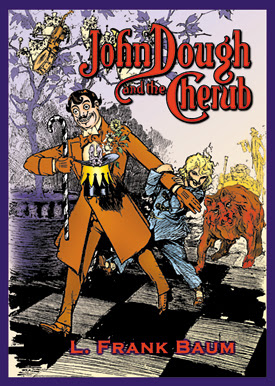
This will be JOHN DOUGH WEEK at Oz and Ends, celebrating the arrival of the 102nd-anniversary edition of L. Frank Baum's John Dough and the Cherub from Hungry Tiger Press. Yes, it's fully baked at last!

L. Frank Baum started to write John Dough on spec for Edward Bok, editor of The Ladies' Home Journal, as I'll discuss later in the week. After Bok declined to publish the story, Baum rethought and finished it for the publishing firm of Reilly & Britton, founded to issue his Marvelous Land of Oz in 1904. As with Land, Reilly & Britton commissioned John R. Neill to illustrate the book. Baum, Neill, and the firm went on to collaborate on twelve more Oz novels and many other books.

The first printings of John Dough had three-color artwork: black, red, and either yellow, green, or blue, depending on the signature. Eventually Reilly & Britton (which became Reilly & Lee) stopped printing the colored inks, and sometime in the mid-1900s let the book go out of print.

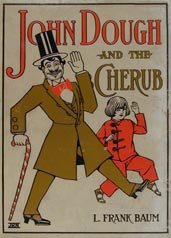
John Dough was unavailable for decades. In 1966, March Laumer's Opium Press in Hong Kong issued a small edition with new illustrations in a modern cartoony style by Lau Shiu Fan. Then in the 1970s Dover released a paperback reprint of the first printing with an introduction by Martin Gardner; that's how I first read the book. That paperback went out of print years ago. Project Gutenberg makes the text of John Dough available for free, but Neill's delightful artwork has not been republished in years.

The new Hungry Tiger Press edition of John Dough and the Cherub offers these features:

  • It's a handsome hardcover, with a trim size closer to the original than the shrunken Dover paperback, giving a better sense of the package Baum and Neill created for their original readers.
  • Although this book doesn't reproduce Neill's illustrations in color, it offers them all in crisp black and white. This is the first edition since Reilly & Britton/Lee's to include Neill's endpaper art, which I'll discuss later in the week.
  • The edition also reproduces Neill's two drawings of John Dough and friends from The Road to Oz, Frank Kramer's rendering of the Fairy Beaver King in The Shaggy Man of Oz, a reprint of the 1906 contest form that invited readers to decide whether the character Chick the Cherub was male or female, and other ancillary material.
  • In preparing this edition, publisher David Maxine discovered a previously undocumented change from the first printing to the later ones. In a note at the front of the book, he makes a strong case that the later printings reflect Baum's original wording--that someone at Reilly & Britton had tried to clean up some of Chick's slang, spoiling a joke, and the author got the firm to change his text back. This edition offers the slangy version.
Finally, while this edition doesn't include the insights of Martin Gardner, you get to read me discoursing on the book's historical roots and narrative structure. I used some of that material in a 2006 article for The Baum Bugle, but other parts are available only in the introduction to this Hungry Tiger Press edition.

05 July 2007

A Clearer Peek at John Dough and the Cherub

The latest issue of The Baum Bugle, dated winter 2006, includes an article from me analyzing L. Frank Baum's fantasy John Dough and the Cherub, published in 1906. (The Bugle, published three times a year by the International Wizard of Oz Club, is devoted to scholarship about the Oz books and related matters.)

Because of an error at the printer, some images in this Bugle were reproduced poorly. I'm therefore posting links to where I found two of the images that appeared with my article, for anyone who's interested.

The photo on top of page 9 shows the INFANT INCUBATORS building at the 1901 Pan-American Exposition in Buffalo, New York. That image and another from Buffalo appear on Dr. Ray Duncan's fine website Neonatology.org, which archives a great deal of material about the medical care of newborns.

At the bottom of page 9 is an illustration by May Wilson Preston from Ellis Parker Butler's "gently satirical novel" [did I write that phrase? I like it] The Incubator Baby. That was published in book form the same year as John Dough and the Cherub but had started to appear in a magazine a couple of years before. Here is a clearer image of spectators peering at the little baby at an exposition. Neonatology.org offers page scans of the entire novel.

I included links to other interesting Neonatology.org items back in this posting about John Dough. My article in the Bugle goes over some of the same ground as my introduction in the Hungry Tiger Press edition of Baum's book (hyped at right), but each version contains material not in the other. The book introduction, for instance, starts with how Baum started to write his story for Ladies' Home Journal editor Edward Bok, and how that relationship affected the story. The article has more to say about John R. Neill's art.

For another John Dough image, Jared Davis offers a comparison between Marcus Mébès's colorization of a Neill image for the cover of the Bugle above and the picture as originally printed in only three colors.

09 August 2006

Rolling in John Dough

On Friday evening, I'll speak at the Munchkin Convention in Princeton, New Jersey, about John Dough and the Cherub, L. Frank Baum's fantasy novel for 1906.

More peculiarly, I plan to speak about the roots of this book in:

Can I pull this off? Come to the Munchkin Convention and find out!

04 July 2006

John Dough celebrates the Fourth

John Dough and the Cherub was written by L. Frank Baum, illustrated by John R. Neill, and published (in 1906) by Reilly & Britton, but (unlike all the other books that fit those criteria) it wasn't an Oz book. Then in The Road to Oz (1909), Baum made the John Dough story part of his Oz universe by bringing John and companions to Oz to celebrate Ozma's birthday party. This would later be called "cross-selling."

John is a giant gingerbread man, about the size of an adolescent boy (and drawn larger than that). He's one of several characters whom Baum portrayed being brought to life and then struggling to adjust to the world. More famous examples are the Scarecrow, Jack Pumpkinhead, and the Patchwork Girl.

John differs from those Ozzy examples in that he magically comes to life in America, not a fairyland. In fact, he's animated on the Fourth of July, and he experiences America's national holiday like this:

As he hurried along he met with few people on the streets; and these, in the dark, paid little attention to the gingerbread man. . . . By and by he heard a strange popping and hissing coming from the direction of the square in the center of the town, and then he saw red and green lights illuminating the houses, and fiery comets go sailing into the sky to break into dozens of beautiful colored stars.

The people were having their Fourth of July fireworks, and John Dough became curious to witness the display from near by. So, forgetting his fears, he ran through the streets until he came to a big crowd of people, who were too busy watching the fireworks to notice that a gingerbread man stood beside them.

John Dough pressed forward until he was quite in the front row, and just behind the men who were firing the rockets.

For a time he watched the rush of the colored fires with much pleasure, and thoroughly enjoyed the sputtering of a big wheel that refused to go around, merely sending out weak and listless spurts of green and red sparks, as is the manner of such wheels.

But now the event of the evening was to occur. Two men brought out an enormous rocket, fully fifteen feet tall and filled with a tremendous charge of powder. This they leaned against a wooden trough that stood upright; but the rocket was too tall to stay in place, and swayed from side to side awkwardly.

"Here! Hold that stick!" cried one of the men, and John Dough stepped forward and grasped the stick of the big rocket firmly, not knowing there was any danger in doing so.

Then the man ran to get a piece of rope to tie the rocket in place; but the other man, being excited and thinking the rocket was ready to fire, touched off the fuse without noticing that John Dough was clinging fast to the stick.

There was a sudden shriek, a rush of fire, and then--slowly at first, but with ever-increasing speed--the huge rocket mounted far into the sky, carrying with it the form of the gingerbread man!
John Dough thus became one of the earliest examples of someone traveling from America to fairyland by rocket.