Showing posts with label SERIES Spiderwick Chronicles. Show all posts

06 August 2008

A Somewhat Familiar Unfamiliar World

Economic straits force a newly single mom and her kids to move into an old family mansion, long deserted. As the kids explore their new home, they discover odd creatures--some friendly but trying, others outright hostile.

It turns out the ancestor who lived in that house was studying the fantastic beings around him, and has disappeared into their world. Then the creatures kidnap a member of the family. An older sister and younger brother left behind have to venture into the dangerous, fantastic, parallel world to restore their family.

The Spiderwick Chronicles, by Tony DiTerlizzi and Holly Black? Yes, that and probably some other stories, too.

But right now I'm looking at the first volume of Amulet, a graphic-novel series by writer-illustrator Kazu Kibuishi from Scholastic's Graphix imprint. Kibuishi also edited last year's Cybils nominee Flight, volume 4. Since this book ends at a cliffhanger and Book 2 (of three to five total) is scheduled for fall 2009, I don't feel up for assessing the story yet. The character development seems still to be at a very early stage.

Of course, if Kibuishi continues to finish a new volume every year and a half, the initial target readership will have grown up by the time the story is done. That may not matter with a series like Harry Potter, in which each installment has its own narrative arc, but this first volume of Amulet is definitely only part of a whole.

29 July 2008

Wrong Answer in Spiderwick Movie

While traveling last month, I saw the film adaptation of The Spiderwick Chronicles on an airplane. Not the best place to see any movie, to be sure, but in this case I didn't feel I'd missed too much. The movie had far too little griffin, and the story felt small compared to the books. Of course, when most of the speaking roles are handled through computer graphics and the two main roles are played by the same actor, the cast is bound to seem small.

However, what really bothered me about the movie adaptation was the ending. Did that happen in the books? I wondered. This week I found an essay on Nick Owchar's Jacket Copy blog for the Los Angeles Times that expressed my feelings very well [***SPOILERS*** and all]:

In both cases -- books and movie -- the villainous ogre, named Mulgarath, is confronted by the children. And in both cases, the wily shapechanger tries to fool the children by taking the form of their father. It doesn’t work. In the books, Jared suspects that "Dad" is a phony and tells him so, causing the ogre to give up his ruse and resume his monstrous shape, tree-limbs and all. A showdown ensues in the ogre's shabby palace.

In the movie? Quite a different climax.

Here, we get a heavy undercurrent of family unhappiness, of marital collapse; the mother is a wreck and the father’s absence is painfully felt. When the father (played by Andrew McCarthy) finally does appear at the movie’s end, he gets asked a question by Jared as he walks through the mansion’s front door. Jared’s question is extremely general: He wants to know what message his father promised to give him when he arrived at the estate for a visit. Of course, it’s a test to confirm his father’s identity.

With a puzzled look on his face, Mr. Pretty in Pink says plainly: “I love you.”

There is no menace, no sarcasm nor any irony, nothing to cue us that lurking behind his aging boyish face might be a yellow-eyed creature of nightmares. He sounds like any beleaguered parent facing a child unhappy that his parents have split up.

What is Jared’s response?

“Wrong answer!” he declares, and then -- the horror of it -- he stabs his father in the chest with a kitchen knife. The father gasps in disbelief, and then, he hunches over and begins a transformation that makes his skin bubble and stretch as the true villain is revealed.

What’s going on here?

Why turn Jared's defiant challenge into a stabbing? Kids are savvy, I agree, but why force such an ugly scene on them?

Irony rules the day in Hollywood. I’m sure that Jared’s stabbing of “his father” was explained in some concept meeting as being a powerful expression of how much pain he feels because of his father’s desertion.

On the screen, though, it only makes Jared seem vicious, especially because it comes in response to being told he is loved. Jared’s brilliant ability to detect elfin fakery is never established, and Mulgarath’s shapechanging early in the movie is so minimal that it’s easy to forget. This change to the story loses sight of the bright tones and adventurous spirit in the series. The filmmakers evidently forgot something important: This is a story for children, not adults. Save the parricides for your R movies. Oedipus doesn’t play well with kids, ok?
And right after the stabbing, Andrew McCarthy reverts back into Nick Nolte--which is even more scary.

20 February 2008

How Artemis Fowl Goes Graphic

When Eoin Colfer's Artemis Fowl was first published in 2001, Miramax/Hyperion marketed it as a counterpoint to Harry Potter. Of course, back then every book from presidential memoirs on down was being compared to Harry Potter. At least Colfer had actually written in the same genre as J. K. Rowling.

Artemis is an anti-hero, angling to be a master criminal rather than a magical law enforcer. He has vast resources and loyal support. Though eventually we learn he's as hungry for a happy family as Harry is, long before then the reader might feel that what Artemis deserves most is a punch in the face.

Perhaps as a result, Colfer and Rowling used different storytelling strategies. The Harry Potter novels stick closely to Harry's point of view. When they narrate events through into someone else's eyes, as in the start of HP4, there must be a very important reason: in that case, to show Voldemort killing so we understand the stakes.
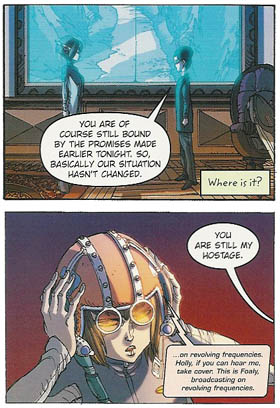
In contrast, Artemis Fowl was never all about Artemis Fowl. Yes, the story starts by tracking his scheme to steal fairy secrets and gold, but Colfer shifts to narrating over the shoulder of a young fairy law enforcer named Holly Short--a more upright and sympathetic character. For the rest of the novel, the point of view bounces among different characters, including Holly's gruff but dedicated boss, one of Artemis's household servants, and a dwarf expert in breaking and entering.

Comic books have shifted like that for years. The visual dimension makes it easier for readers to follow the change: we turn the page, see a new character in a new locale, and we get it. We don't even need "Meanwhile,..." captions anymore.

In the last couple of decades, the omniscient narrator who used to fill the captions of comic books with bombastic explanations has disappeared. Instead, most captions are in the first-person, present-tense voice of the main character. That technique has developed its own symbolic grammar: those captions often have different colors, symbols, and fonts for different characters. That lets comics delineate two or more points of view in the same scene, even the same panel.

Indeed, I think a great potential strength of the comics form is its ability to show two parties working against each other without making readers take sides (if the creators wish to remain neutral, of course).

Artemis Fowl: The Graphic Novel uses that comics technique to replicate the prose novel's shifting points of view. Contrast the caption in the first of the four stacked panels above, its font and coloring, with the caption in panel three. The first is the fairy Holly's thought as she searches for her helmet. The second is Artemis's reflection as he sees Holly about to punch him in the face. The comics form offers both characters' thoughts in the same scene.

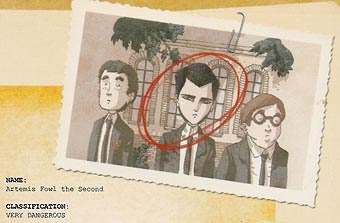
Another comic-book technique that pops up in Artemis Fowl: The Graphic Novel is the character profile; the top illustration is a bit of Artemis's. Each full-page profile offers a combination of words and image to introduce a magical creature or locale. Novels can't lay out such information without breaking the narrative flow, but such profiles are a comic-book tradition. DC publishes a whole series offering such dossiers on its heroes and villains: Secret Files. Another inspiration is probably card games like Magic: The Gathering. (It's no surprise that similar pages appear in The Spiderwick Chronicles; coauthor and artist Tony DiTerlizzi worked on Magic cards.)

There are other big points of overlap between Colfer's Artemis Fowl and comic-book adventures:

The second of those qualities is a flaw in any kind of novel, but the last one is a plus for the graphic form. The action allows visual storytelling in the hyped-up style that comic-book creators have developed to a high effect over the years. It's another way that, I found, Artemis Fowl: The Graphic Novel works as an over-the-top adventure comic.

Bottom line: A novel that reads a lot like a comic book makes a good comic book.

29 July 2006

Shooting Spiderwick in September

The Spiderwick Chronicles, by Caldecott Honoree Tony DiTerlizzi and Norton Award winner Holly Black, is a recent fantasy series that transcended its initial impression (to me, at least) of Harry Potter dressed up in Lemony Snicket packaging. It never got deep, I thought, but it got darker than I expected, and many of the fantastic details are truly chilling. I think my favorite is how goblins stick broken glass, metal, and stones in their gums in place of teeth.

The inevitable movie adaptation has come from the word processor of John Sayles, of all people. The director will be Mark Waters, best known for the superior remake of Freaky Friday. In May, Hollywood North Report ran an interview with Waters in which he said:

For Spiderwick in particular, the reason I'm talking to you is because we're heading into the big unknown of finding these identical twin brothers and you're just not going to find identical twins who have acting experience and are ages 9-11 that have the look and the quality that is necessary for this movie.
Translated, that meant the Sprouse twins had no chance at the roles.

But Waters evidently gave up on finding North American twins who could act, and chose a young British actor who has the chops to act for two: Freddie Highmore of Finding Neverland and Charlie and the Chocolate Factory. Highmore looks right, too. Older sister Mallory the fencer will be played by Sarah Bolger of Jim Sheridan's exercise in personal nostalgia, In America--another young actor from the British isles. Will the script be rewritten to make the children British? Or will there be dialogue coaches galore when shooting starts in September?

More news via Waters and Hollywood North Report:
I know that Tony and Holly are writing another trilogy on top of these five, which means the (people) we cast in the movie could most likely be in more movies down the line if it becomes a big franchise.
