Showing posts with label CRITIC Leonard Marcus. Show all posts

15 September 2014

Another Childhood Illusion Shattered

Tonight I attended Leonard Marcus’s talk about Robert McCloskey on the centenary of the author-illustrator’s birth. (It turns out he was born in Hamilton, Ohio, now home of this sculpture. But I digress.)

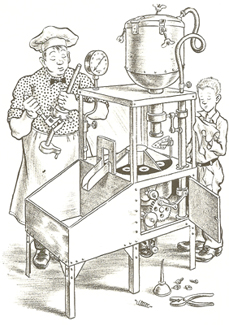
Marcus showed a photo of the doughnut-making machine from Homer Price and remarked how there are only two places to see such a machine now.

“Well, it’s good that someone preserved that model of doughnut-maker,” I thought. “I’m surprised there are so few left—maybe it really didn’t work well, so most of the machines were pulled apart.”

But that wasn’t what Marcus was saying. If I understood him correctly, only two examples of that machine were ever made. One was for the Walden Wood film studio when it adapted Homer Price as a short film in 1963. McCloskey was a friend of the studio owner and spent a lot of time there in later life; as a lifelong tinkerer, he might well have helped to build that machine.

The other was a replica built and displayed in the Municipal Building back in Hamilton, amid McCloskey’s architectural decorations. It’s not clear whether that one was made to work or just to look like the picture in the book.

All along I’d thought that was a standard type of doughnut-maker from the 1940s. After all, I’d seen it in action in that movie, operated by a boy who looks just like Homer Price (and couldn’t act for beans).

But it sounds like McCloskey made it up, based on real, less compact doughnut-making machinery. I feel like Freddy and Louis discovering that the Super Duper can’t lift his car out of the ditch.

26 November 2012

The Life Behind A Wrinkle in Time

Yesterday’s New York Times Book Review asked Anne Lamott, “What book changed your life?” And she answered:
“A Wrinkle in Time” saved me because it so captured the grief and sense of isolation I felt as a child. I was 8 years old when it came out, in third grade, and I believed in it — in the plot, the people and the emotional truth of their experience. This place was never a good match for me, but the book greatly diminished my sense of isolation as great books have done ever since. I must have read it a dozen times.
The book never grabbed me that way, but it spoke deeply to many readers. Cynthia Zarin’s 2004 profile of Madeleine L’Engle included the author’s response to their passion:
One evening, while we were having supper together, I asked L’Engle about her relationship with her readers. “It scares me shitless!” she said. “Because it’s a responsibility. Over time, someone reads your book, and something happens. People want intimacy, and I have a terrible time saying no.” When people tell her, “You’ve helped me grow up, you’re my mother,” she tends to brush it off: her job, as she sees it, is to write stories, not to be known.
That warts-and-all profile appears to be a touchstone for many of the interviews in Listening for Madeleine, Leonard Marcus’s new oral history of L’Engle. The Book Reporter says of the book:
Most interesting are the voices from L’Engle’s childhood, through whom we learn about her distant relationship with her parents, particularly her father, and about her tendency to live her life through her imagination rather than through social relationships—more than one interviewee describes L’Engle as aloof or standoffish compared to her peers. Marcus seems to suggest that her lonely childhood and longing for her dad contributed to the number of absent fathers in her work, most notably Meg’s quest to rescue her father in A Wrinkle in Time.
One of those interviews, with a L’Engle cousin, is available from Macmillan. Publishers Weekly published three from colleaguesKirkus noted in its review:
An actor by training, L’Engle consciously constructed her own public persona, transforming her biography and history into “mythic material,” as with the ever-expanding number of rejections she received for A Wrinkle in Time.
The Oz and Ends take on that legend back here.

17 May 2012

Sendak as a Born Curmudegon

Among all the encomia for Maurice Sendak that have appeared in recent days, I particularly appreciated Michael Patrick Hearn’s clear-eyed remembrance posted at Educating Alice. Rather than focus exclusively on Sendak’s storytelling talent and contrarian statements about childhood, Hearn wrote about the personality that produced that work:
Almost every conversation began with the kvetching. Oh the kvetching! It was not a word I really knew until I met Maurice Sendak. He was constantly upset with this and that, with that person and this person. His anger fueled him. Look in the dictionary under the noun kvetch and you will find:
  1. A chronic, whining complainer.
  2. A nagging complaint.
  3. Maurice Sendak, American picture book artist-author.
But once he got that off his chest, he was the funniest person you could ever meet.
Hearn also writes about how Sendak “loved being the provocateur,” and “was emotionally needy.”

Such comments reminded me of Leonard Marcus’s recollection of meeting Sendak in Publishers Weekly:
I arranged to be introduced to Maurice at the giant children’s breakfast at ABA, and at first he didn’t really look me in the eye. “Another interview?” he must have been thinking, as he commented on the banquet hall’s sprinkler system, which he said reminded him of a Nazi gas chamber.
That remark would make sense for someone who’d actually been threatened by, you know, a Nazi gas chamber. But Sendak was born in Brooklyn in 1928. He lost Polish relatives in the Holocaust (the same sort of foreign relatives he cited as the scary inspiration for the Wild Things), and later described that news as introducing him early to thoughts of death. But Sendak was already eleven when Hitler invaded Poland, and I’m pretty sure every American child growing up during World War 2 had to think about death.

As with the Lindbergh kidnapping (another memory Sendak invoked, this one really from his early childhood), the Holocaust seems more likely to have provided a focus for his anxiety and fears rather than their cause or inspiration. He explored themes of endangered children in his later books, when he could tell any story he wanted, because that situation struck deep chords with him.

Not that Sendak wasn’t also a charming person and a terrific picture-book creator, as both Hearn and Marcus describe. His critical writing was often very insightful, but I think it was at its best when he wrote about other people’s work rather than when he made pronouncements about childhood and literature based on his own idiosyncratic world-view.

Back to Hearn:
No matter how many other directions he went into and how far he grew as an artist, everyone wanted another Wild Things. Once a book was published, he was through with it. He did not go back. He never wanted to repeat himself. He was constantly evolving. He called Wild Things the first in a trilogy that also embraced In the Night Kitchen and Outside Over There. But their artistic connection is dubious. What they did have in common was that Maurice was working out his therapy through them. The traumas of his childhood came out as metaphors. The books are fraught with Freudian symbols.
Hearn calls attention to Sendak’s 2005 edition of Ruth Krauss’s Bears, a “sequel of sorts” to Wild Things since it included a wolf-suited Max. It was “one of the most delightful of Sendak’s books in many years,” Hearn says, but “almost universally ignored by the reviewers and the public.”
04 November 2011

Synesthesia, the Phantom Phenomenon

Leonard Marcus’s interviews for the new Annotated Phantom Tollbooth and the recent New Yorker article by Adam Gopnik bring out what seems to be new information on the source of author Norton Juster’s “nonsense”: it reflected how he actually saw the world as a child.

Juster told Gopnik:
“I had an ailment called synesthesia,” Juster explained, pronouncing the word carefully. “I could only do numbers by colors.” His mind—in a way that will be familiar to readers of the memoirs of that fellow-synesthete [Vladimir] Nabokov—made instant, inescapable associations between a number and a color. “I can still remember a few: 4 was blue, 7 was black, and so the only way I could do math was by associating colors.”
In the novel, at the Dictionopolis marketplace Milo nibbles on some letters, gaining the sensation of tastes. Later he conducts an orchestra that produces colors. And of course the whole book concretizes the abstract.

Some readers, such as Patricia Lynne Duffy in Blue Cats and Chartreuse Kittens: How Synesthetes Color Their Worlds and this article in LinguaPhile, had already recognized that Juster’s text described that mental phenomenon. But I don’t recall him speaking of his experience before.

01 October 2011

Cute Couples

Yesterday Anita Silvey’s Book-a-Day Almanac spotlighted The Rabbits’ Wedding by Garth Williams:
Published first in 1958, The Rabbits’ Wedding features black and white rabbit protagonists. The artist most likely chose these colors to help delineate the two characters in a limited-color book, but adults interpreted this lovely romp in the forest as an endorsement of interracial marriage.

As Leonard Marcus recounts the controversy in Minders of Make-Believe, the Montgomery Home News condemned the book, then Alabama politicians rallied against the book and spoke out against the director of the Alabama Public Library Service Division, Emily Reed.
Showing how much things have changed, the most frequently challenged book in America last year was And Tango Makes Three by Peter Parnell and Justin Richardson, a picture book about two male penguins who raise a chick together. Adults interpret that true story as an endorsement of same-sex marriage.

Some people just don’t like seeing certain cute little animals happy together.

08 May 2010

Another Recollection of Tolkien

Back in March I quoted recollections of Prof. J. R. R. Tolkien from Diana Wynne Jones and Susan Cooper, found in Leonard Marcus book of interviews, The Wand in the Word.

Yet another future children’s-book author who encountered Tolkien at Oxford was Philip Pullman. He’s a decade younger than Jones and Cooper, so by the time he was at university Prof. Tolkien was a wealthy celebrity, retired from the classroom. Pullman told Marcus:

He was a genial old fellow in his seventies, world famous by then. The rector of our college…invited me and a couple of my friends to dinner to meet the great man. . . . it was Tolkien who fought the great battle to retain Anglo-Saxon as a subject of study at Oxford. Because he won that battle, every undergraduate had to read and study—and suffer—Anglo-Saxon.

And so we were all introduced and sat down to dinner. One of my friends was on one side of him; the other friend was on the other side. I was seated across the table. Professor Tolkien turned to the first fellow and said, “How are they pronouncing Anglo-Saxon these days?” That was one of the things the scholars argued over, you know: the different ways of pronouncing the wretched language! My friend had done as little work as I had, and had no idea. So he just sort of gaped and goggled and tried to make up an answer.

Which displeased Tolkien, who turned to the other fellow and said, “Now then, you man, did you enjoy The Lord of the Rings?”

My other friend had to say, “Well, I’m awfully sorry but I haven’t read it.“

I could have answered that question, at least. But that was the end of Tolkien’s conversation. He never got round to asking me anything.
The young Pullman was a fan of Tolkien, but he’s become more critical. Perhaps if the professor had paid him more attention back then…

29 March 2010

Conflicting Recollections of Prof. Tolkien

In his book The Wand and the Word: Conversations with Writers of Fantasy, literary scholar Leonard S. Marcus asked a number of established fantasy writers about their influences, particularly J. R. R. Tolkien.

Diana Wynne Jones (born in 1934) and Susan Cooper (born in 1935) attended Oxford University at about the same time, and they gave Marcus completely different memories of Tolkien.

Cooper said:

I never met him, but I went to his lectures on Anglo-Saxon literature, along with hundreds of other students. He was a wonderful lecturer. Like C. S. Lewis, whose lectures I also attended, he was a tweedy, pipe-smoking, middle-aged man. We were all waiting for the third volume of The Lord of the Rings to come out.
But Jones told Marcus:
I went to his public lectures. They were absolutely appalling. In those days a lecturer could be paid for his entire course even if he lost his audience, provided he turned up for the first lecture. I think that Tolkien made quite a cynical effort to get rid of us so he could go home and finish writing The Lord of the Rings.

He gave his lectures in a very, very small room and didn’t address us, his audience, at all. In fact he looked the other way, with his face almost squashed up against the blackboard. He spoke in a mutter. His mind was on finishing The Lord of the Rings, and he was really musing to himself about the nature of narrative.

But I found this so fascinating that I came back week after week, as did one other person. I’ve always wondered what became of him, because he was obviously equally fascinated. And because we stuck there, Tolkien couldn’t go away and write Lord of the Rings!

He would say the most marvelous things about the way you take a very basic plot and twitch it here and twitch it there—and it becomes a completely different plot.
Perhaps these writers are remembering different series of lectures, and Tolkien was more engaged in the topic of Anglo-Saxon than in his “public lectures.” Perhaps Cooper’s memory of Tolkien is mixed with her memory of Lewis, whom Jones recalls as a polished, popular speaker in a large, packed auditorium.