Showing posts with label AUTHOR Shaun Tan. Show all posts

02 July 2009

It Turns Out He Can Write

Shaun Tan is best known in the US for The Arrival, his wordless picture book in comics form. His Tales from Outer Suburbia is a collection of surreal vignettes told, for the most part, in a more traditional illustrated-book format. There are a couple of spreads with art and text mixed together, but more often we see narrative prose matched with full-page illustration.

Almost like a real picture book, one might say. Except that the reading level is higher, and the sensibility much higher, probably even adult. Yes, most of the vignettes include a child's point of view and are perfectly readable, but I suspect it requires more perspective to appreciate them fully.

Tan's illustrations come in a variety of styles--some color, some grayscale or sepia; some sketchy and others rendered in detail; some heavy with lines and cross-hatching, others painted in splots of color. Yet they share a common visual style that links them to The Arrival.

Similarly, Tan's prose has hallmarks that extend through most of these pieces. Even though some of the anecdotes take place at specific times and others are general descriptions of Life (or How It Used to Be), they share a sense of absolutes. Such words as "always," "never," and "everyone" appear a lot.

We don't get a chance to know many individual characters; the pieces are too short, and I also feel a sense of distance or disconnect between people on top of the surrealism. But we do get a sense of this suburban society--or is it societies? In other words, we do get a sense of everyone.

To my tastes, nothing in the book surpasses the first two vignettes, "The Water Buffalo" and "Eric." But all together Tales from Outer Suburbia adds up to an experience as well as a book.

[ADDENDUM: And it turns out Tan can speak, too. But I need time to tune into his Australian accent. Graphic Novel Reporter is featuring three videos of Tan drawing and talking about the friendly creature from The Arrival. At least I think that's what he's talking about.]

12 May 2009

Voices from the “World Voices” Festival

Last week Publishers Weekly ran several reports from the PEN "World Voices" literary festival in New York. I've gleaned bits that struck me, starting with a remark from a a session on “Visual Storytelling”:

The use of comics illustration, [Israeli artist David] Polonsky explained, to depict the narrative was apt because the “ability to show things that don’t have any material existence” corresponds to the volatility of memories.
Or, as I've been calling it, "showing the invisible."

And in another panel, on the future of children's books:
[Francine] Prose also recounted a story of speaking before a group of New York University students who questioned the need for reading when there are so many good interactive video games that let you “become the character.” In response, Prose said she told them, “The whole point of literature is reading about people who are not you, to get into someone else’s head.”
Indeed, while videogames let players experience many unusual situations, no matter where you go--there you are.

Finally, in a discussion of growing up, Shaun Tan recalled one influential book from his childhood:
Shaun Tan, who was raised in an Australian community that he fondly described as “idyllic yet boring,” explained how his mother, who wanted her two sons who receive a better education than she did, read Animal Farm aloud to Shaun and his brother, thinking that it was a children’s book. Tan said that he and his brother loved the story, as “it related to everything that went on at the playground every day”...

04 October 2008

From The Horn Book

Yesterday I attended the Boston Globe/Horn Book Awards, sitting amidst Dave Elzey, Boston Athenaeum children's librarian Suzanne Terry, and a bunch of folks from the Foundation for Children's Books. These ceremonies are getting more high-tech and visual, with images and videos projected on the Athenaeum's big screen, nearly always at the right times. I think that's a good idea when we're celebrating picture books.

Among the awards this year was a "Special Citation" for The Arrival, by Shaun Tan. Back at the beginning of the year, Dave and I and three other Cybils judges wrestled with whether to name that as one of the year's best graphic novels. The big sticking-point was the age of its readership. It's a wordless book (younger) with a complex visual language (older) telling a simple story (younger) that depends on knowledge of modern immigration patterns (older). Scholastic published the book for "12+," so we finally stuck with that categorization. It looks like the Horn Book judges felt The Arrival deserved an honor, but weren't certain how to classify it either.

Everyone at the ceremony received a copy of the latest issue of The Horn Book, for September/October 2008. This issue contains my first review for that journal, an evaluation of the picture book biography The Road to Oz: Twists, Turns, Bumps, and Triumphs in the Life of L. Frank Baum, written by Kathleen Krull and illustrated by Kevin Hawkes.

I liked a lot of things about that book while disliking a few touches; see the magazine for details. Its narrative arc left me with questions on the challenge of fitting a real life into 48 illustrated pages in a way that produces a satisfying story.

The Wonderful Wizard of Oz (1900) is without doubt the most successful and influential thing L. Frank Baum ever wrote. It's tempting, therefore, to treat its successful publication as the climax of his life story, the reward for his many failed ventures.

But Baum actually became a best-selling children's author the year before with Father Goose, a forgotten book of comic verse that this biography doesn't mention. And what made him really famous and rich for a while was the stage version of Wizard, now largely forgotten, which followed in 1903. Neither book nor show saved Baum from more business failures, as Krull has to acknowledge in an afterword. But would all those messy details mess up the basic story?

I just noticed that although my shorthand for The Wonderful Wizard of Oz is Wizard, to distinguish it from all other Oz books, the Horn Book's abbreviation is Oz, to distinguish it from all other wizard books.

16 April 2008

Eyeing the Eisners

The just-announced 2008 Eisner Award nominations for best work in the comics form include three for Shaun Tan's The Arrival:

  • Best Graphic Album--New
  • Best US Edition of International Material
  • Best Writer/Artist
However, that book is not listed in the categories of Best Publication for Kids and Best Publication for Teens. (This despite the break-up of the previous category Best Title for a Younger Audience into two, providing twice the slots for nominations.)

Thus continues the long discussion of the most appropriate audience for The Arrival.

Other comics mentioned here on Oz and Ends that were nominated for some award or another include: However, as usual, most of the nominated works are new to me.

29 February 2008

Shadowy Dragons’ Tails in The Arrival

In his New York Times review of The Arrival, Gene Luen Yang mentioned one striking detail of the early scenes: "Shadowy dragons’ tails haunt the Old Country..." But what do those tails represent?

Publishers Weekly said, "Shadowy dragon tails trawl the sky of the man's homeland, suggesting pogrom or famine..." The Washington Post, on the other hand, saw "the dragon shadow of totalitarianism."

Quiet Bubble suggested:

The drawing doesn’t want us to believe the city actually swarms with giant dragons--in a later full-page spread, as the wife and daughter walk home to the now-empty house, the tails look like shadows and smoke, which doesn’t make them any less threatening. Rather, Tan’s using fantasy in the right way--as a bravura, overloaded way of conveying symbolically the urgency of real-world terrors and hopes. The family isn’t actually beset by dragons, but oppressive governments and societies sure feel monstrous.
As does war. In calling the book one of 2007's Top Five Children's Books Between Cultures, Mitali Perkins described the story "as a young father escaping an unnamed war-torn country in search of a better life for his family in a new world."

Jetse de Vries at In the Plane of the Ecliptic sees the dragon tails as one of the book's "strong indirect autobiographical hints" that it's the story of artist Shaun Tan's own family, his father having emigrated from Malaysia to Australia.

Finally, Piers Kelly at the Compulsive Reader wrote, "The ambiguous reasons for his departure are suggested by sinister and threatening shadows that swirl like dragons' tails along the empty streets."

My own guess: In the course of the book, Tan has his hero take in the stories of a couple of other immigrants. One has escaped from oppression, the other from a war. Though those episodes are fantastic in their imagery, there's not much room for other interpretations. I suspect Tan wanted to depict all the major aspects of the immigration experience, and I don't see such immediate physical dangers threatening the central man and his family. So I think the dragon-tail shadows represent the threat of want, spurring the man to migrate for new opportunities.

In other words, The Arrival asks us to feel sympathy for not a refugee from violence, but an "economic migrant." That's not so fashionable, so societies create laws against it. But economic migrants are, after all, what most of our own ancestors were.

28 February 2008

Who Should Welcome The Arrival?

Shaun Tan's The Arrival was one of the five titles on the shortlist for the 2007 Cybils Award for Best Graphic Novels for teens and young adults. And that proved to be a problem.

Because we Cybils judges weren't all sure it was for teens and young adults. Or at least for those readers exclusively. We discussed the possibility of naming The Arrival as 2007's best graphic novel for middle-grade readers. It just screams "award-winner": it's beautiful; it's serious; even if it's not strictly speaking historical fiction, it has historical resonance; it leaves us with a "sense of hope." It's one artist's vision, not a shiny corporate product.

But The Arrival wasn't nominated in the middle-grade category. After we raised the question of age range, we learned that the organizing/nominating committee had already had long discussions about how to categorize this book. In the end we respected their decision.

After all, those organizers had checked with The Arrival's US publisher, Scholastic, which markets the book for ages "12+". Amazon and the ALA have put it on their lists of best books for teens (though other authorities have said it's simply one of the year's best books for children). For another insightful perspective on this discussion, see Dave Elzey's "what was i thinking? notes of a cybils judge".

All of that thinking raises interesting questions about how to determine the reading level for a wordless comic. Extrapolation says that almost anyone should be able to read them. Fewer words = younger readers. Shorter words = younger readers. So no words at all = ?

Of course, not having any words to guide us makes The Arrival harder to read, not easier. Indeed, making us struggle to interpret a strange world is how the book coveys the immigrant experience. It also demands some knowledge of history and population movements. So perhaps teen readers are the right audience after all.

On the other hand, The Arrival's underlying story, once decoded, is very simple. It's a cycle: one immigrant finds a place in a new society, and ultimately his daughter welcomes another. The protagonist never seems to face problems that last more than a page spread. For all its strangeness, he's found himself in a very friendly world. Even the strange creature infesting his new apartment...
...turns into a pleasant, helpful pet.

The Arrival simply doesn't have the levels of plotting, characterization and tone of The Professor's Daughter, which was our top choice for teen graphic novel. Tan's book was one of my top choices in its age category, but not the top. So perhaps it would be better for younger readers.

But would those readers relate to a protagonist who's a grown man rather than a child? I actually don't think this should be a big problem. The first pages establish that that man isn't just any man: he's a daddy. I bet young readers would have an immediate feeling for a parent going off to work and hoping to see his child again. Throw in the funny pet and the daughter's role in closing the cycle, and I think The Arrival holds plenty of emotional meaning for younger readers.

I think the real challenge for The Arrival is not being mistaken for a picture book. It looks an awful lot like one, with its oversized trim and its many pictures. So parents might be tempted to treat it as a story they can read aloud to a child in one sitting. That won't work. The book's four times as long as the usual picture book. And how does one share a wordless book with a child?

The Arrival demands--and deserves--a new approach. Instead of reading the text together, an adult and child probably have to discuss the pictures. They can take turns narrating what's happening on the pages with many drawings, or picking out favorite details in the two-page cityscapes. They can track visual motifs through the book. They can talk about their own family histories. They can puzzle over mysterious pages--like a whole page spread of small pictures of clouds--without the adult having all the answers. (My best guess: Each cloud shows a day passing on the protagonist's voyage.) The Arrival has chapters: it doesn't have to be read in one sitting.

Of course, I don't have an elementary/middle-grade child to experiment on. So I might give copies of The Arrival to different families and monitor from afar.

27 February 2008

Interpreting The Arrival

Shaun Tan designed The Arrival to look like a weathered scrapbook. The paper-over-boards cover shows a fraying leather binding. The tones of the interior art are muted to sepias, their lines blurred, all to recall photographs from a century ago.

As this sample from New York magazine shows, many of those images are reminiscent of photographs of Ellis Island in New York harbor. Indeed, Tan writes in his author's note of studying pictures of immigrants arriving there from Europe.

Interestingly, Tan himself is Australian, not American. Like his main character, he appears to be from Asia, not Europe. Apparently the Ellis Island experience not only stands for all US immigrant experiences, but carries similar resonance in some places overseas.

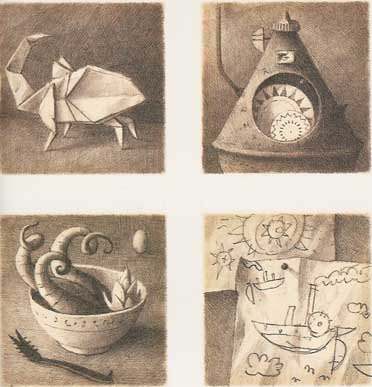
The book opens with a page of small drawings of household objects that any reader would recognize: an origami bird, a clock, a cooking container, a child's drawing of her family, and more.
The pictures then follow a man as he leaves his family and boards a steamship, eventually arriving in a strange harbor.
And strange the book becomes at that point. Everything appears in unfamiliar forms, from the immigration authorities' uniforms and examination instruments to this society's writing system and modes of transportation. Even the animals and vegetables are like nothing we've seen before (though they're shaped oddly much like each other).

All this comes at us in a series of sequential images, somewhere between that album of snapshots and the well defined panels of a traditional comic. There are no word balloons or captions. What labels and writing appear in the images are unintelligible to us.

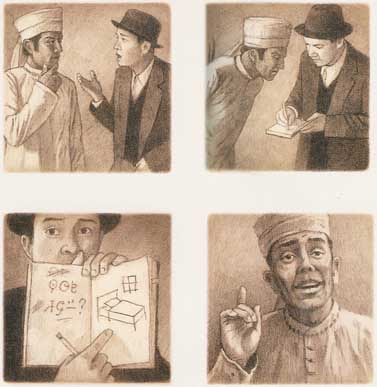
That lack of words and explanations plunges us readers into the immigrant experience. We watch the man walk down the street, a street in a strange world. He doesn't speak the language, he holds no currency. As the protagonist struggles to express himself across the language barrier (as shown yesterday), we struggle to follow what happens to him.

The man finds an apartment, though the appliances take a lot of getting used to. He gets a job hanging posters, but he pastes them upside-down because he doesn't know the lettering. Eventually he ends up working on an assembly line; the factory's product, like so many other objects in the book, is impossible to identify.

Occasionally The Arrival breaks for some side narratives, two- or three-page stories of other immigrants. There's a woman fleeing oppression, a man caught up in a war, a shopkeeper with a young son. But we come back to the initial protagonist as the months pass. Finally he is able to send for the wife and young daughter we saw in the first pages.

Toward the end of the book, we see another page of objects from the family's life, the equivalents of the first. But now those objects reflect the flora, fauna, and culture of their new country. They have arrived.

The Arrival was shortlisted for the 2007 Cybils Awards in the category of graphic novels for teens--more about that tomorrow.

26 February 2008

A Few Words on Wordlessness

In The Art of the Comic Book (University Press of Mississippi, 1996), R. C. Harvey states: "A cartoonist is one who creates in the visual-verbal mode of the comics--someone who is a writer-artist. And in the creative processes of the cartoonist, neither words nor pictures take precedence over the other: they blend."

Harvey is expert in cartooning, comics history, and literary analysis, and this is a very good book on the form. However, his attempt to locate the essence of the comics art form in a half-and-half blend of words and pictures is untenable. (Dylan Horrocks has complained that Harvey's adherence to this theory leads him into "some rather asinine critical judgements." I wouldn't go that far, not when I can simply link to Horrocks's essay.)

The most obvious problem with Harvey's hypothesis is that it offers no space for wordless comics. He acknowledges that some exist, offering an example from a daily strip, but treats them as exceptional. Most comics creators and readers would probably say that comics without words and comics with them share more qualities than not. Both are sets of sequential pictures, they usually adopt the same visual vocabularies and techniques, and we interpret them through similar processes.

Shaun Tan's wordless The Arrival was one of the 2007 Cybils finalists in the graphic novels category (older readers division). I think its wordlessness is crucial to how it works, as I plan to discuss tomorrow. Tan even includes an episode about communicating through pictures instead of words:


The label "wordless" seems to mean something different when applied to children's picture books. As Scholastic published Sara Varon's Chicken and Cat in 2006, the catalogue copy labeled it a "wordless picture book." Booklist and The Horn Book echoed that label. School Library Journal called it a "wordless story." But the book contains words, as this detail from one spread shows.

In fact, out of sixteen page spreads in Chicken and Cat, ten contain words. Some are labels on shops, products, or structures that appear in the scenes (e.g., on the seed packets in the picture above). Others are sound effects and motion labels (e.g., "pat pat pat"), as I described back here.

Chicken and Cat got labeled as "wordless" because it doesn't have words where most picture books do. There's no narration explaining the scenes and the transitions between them. As with truly wordless picture books, an adult can't read it aloud to a child. And of course adults need some sort of warning.

Varon's Robot Dreams was another Cybils graphic novel finalist this year. It, too, was described by its publisher as "without words," but again it has a few. Unlike The Arrival, however, that seems simply to reflect Varon's storytelling style; it's not thematically linked to the book's story.