Showing posts with label BOOK Magic of Oz. Show all posts

23 July 2020

Making the Most of the Magic of Oz Manuscript

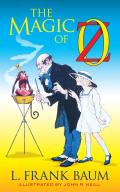
Back in 2005 I examined L. Frank Baum’s handwritten manuscript of The Magic of Oz at the Harry Ransom Center in Austin, Texas, comparing it to the finished book. I published my findings and analysis in an article for the Oz Club’s Baum Bugle called “The Magic Manuscript.” Since then, the Ransom Center has digitized the manuscript pages, letting everyone see how Baum worked.

My article noted how when Baum sat down to write his first draft for The Magic of Oz (or maybe The Magic of the Wizard of Oz), he hadn’t decided on important details, such as the name of a major character and the exact spelling of the crucial magic word. Those vary from one page to the next, and sometimes even on the same page.

Paradoxically, that study also showed how little revising Baum did on his way to publication. As he wrote, Baum wrestled with some small details, such as how to describe Ozma’s age. He later polished his phrasing in little ways, usually by hand and sometimes at the missing typescript stage. But that was fussing over small stuff.

Baum inserted one short episode while still writing in hand and later added another to tie off a loose end at the request of his publisher, Frank Reilly. A couple of times he deleted sentences from the first draft that opened plot possibilities which he had never followed up on. But the manuscript shows no other major rewriting—no shuffling scenes, no big cuts or reworking. At least at this late stage of his career, Baum stuck to the structure of his first draft.

Another question about Baum’s writing process that I addressed in that article was the sequence in which he drafted his last three Oz books. The most recent Baum biographies posited that he didn’t compose those books in the order they were published: The Tin Woodman of Oz (1918), The Magic of Oz (1919), and Glinda of Oz (1920).

In L. Frank Baum: Royal Historian of Oz, Angelica Shirley Carpenter and Jean Shirley suggested the sequence was Magic, Glinda, Tin Woodman. The first two were “a kind of insurance” for his family if he took sick, this book said, and he completed the third after gall bladder surgery in 1918.

The Magic of Oz manuscript makes that sequence untenable, however. The handwritten manuscript includes a mention of the Tin Soldier, a character introduced in The Tin Woodman of Oz. Baum therefore must have written Tin Woodman before Magic.

Baum’s Magic manuscript offers two more clues about the timing of his last books. He wrote two pages of his story on the back of an accounting of money raised at a local D.A.R. war relief event in June 1917. And on the first page a relative wrote, “This was next to the last book Father ever wrote. It was written in the fall of 1917.” Since Tin Woodman could not have come after Magic, Baum must have moved on to Glinda of Oz. In sum, he wrote the books in the order they were published.

COMING UP: Glinda of Oz and the end.

21 July 2020

Plotting Magic

The Magic of Oz remains one of my most favorite Oz books by L. Frank Baum because of how its plot works so well.

The book has three narrative threads:
  • A sulky Munchkin adolescent and the exiled Nome King plot to take over Oz using a secret word that can transform anything or anyone into something else.
  • Dorothy leads the Wizard, the Cowardly Lion, and the Hungry Tiger to the Gillikin Forest to recruit monkeys as part of a birthday present for Ozma.
  • Trot and Cap’n Bill follow the Glass Cat to another wild part of the Gillikin Country to retrieve a magic flower for Ozma.
Ultimately, each of these plots intersects and helps to resolve the other two. Dorothy and the Wizard’s unexpected arrival in the forest disrupts the villains’ plans. After Trot and Cap’n Bill are trapped and dwindling away, the Glass Cat rushes to fetch help and ends up both finding the Wizard’s bag of magic and bringing him back. And the only way the Wizard can rescue Trot and Cap’n Bill, it turns out, is using the secret word of transformation.

And then…there’s a bit more book. The Magic of Oz was running short, under 40,000 words. The average of the previous six Oz books, since Baum resumed the series in 1913, was over 50,000 words. He thus still had pages to fill.

Baum therefore wrote a bit more action as the adventurers return to the Emerald City, and then as they celebrate Ozma’s birthday, and finally as they deal with the villains. That’s a long denouement that I must admit borders on the anticlimactic.

Along with how slipshod some of Baum’s other plots were, it reminds me that he probably just lucked into the cleverly intersecting plot lines I described above rather than building The Magic of Oz around them.

21 August 2012

Ozma, the Birthday Girl

Though L. Frank Baum probably never intended to convey this information, today is the birthday of Ozma, fairy queen of Oz. Some passages in The Road to Oz mention that her birthday is on the 21st of the month. Another passage says that the month is August. So there we go.

One of Baum’s longest descriptions of Ozma comes in The Magic of Oz, his penultimate novel:
Ozma, the beautiful girl Ruler of the Fairyland of Oz, was a real fairy, and so sweet and gentle in caring for her people that she was greatly beloved by them all. She lived in the most magnificent palace in the most magnificent city in the world, but that did not prevent her from being the friend of the most humble person in her dominions. She would mount her Wooden Sawhorse, and ride out to a farm house and sit in the kitchen to talk with the good wife of the farmer while she did her family baking; or she would play with the children and give them rides on her famous wooden steed; or she would stop in a forest to speak to a charcoal burner and ask if he was happy or desired anything to make him more content; or she would teach young girls how to sew and plan pretty dresses, or enter the shops where the jewelers and craftsmen were busy and watch them at their work, giving to each and all a cheering word or sunny smile.

And then Ozma would sit in her jeweled throne, with her chosen courtiers all about her, and listen patiently to any complaint brought to her by her subjects, striving to accord equal justice to all. Knowing she was fair in her decisions, the Oz people never murmured at her judgments, but agreed, if Ozma decided against them, she was right and they wrong.

When Dorothy and Trot and Betsy Bobbin and Ozma were together, one would think they were all about of an age, and the fairy Ruler no older and no more “grown up” than the other three. She would laugh and romp with them in regular girlish fashion, yet there was an air of quiet dignity about Ozma, even in her merriest moods, that, in a manner, distinguished her from the others. The three girls loved her devotedly, but they were never able to quite forget that Ozma was the Royal Ruler of the wonderful Fairyland of Oz, and by birth belonged to a powerful race.
Ozma is clearly devoted first to her ideals and second to the protection and rule of her country. I think those priorities present a challenge for people who want to write adventures for her. Ozma leaves her capital for extended periods in order to carry out what she sees as important duties (e.g., Glinda of Oz, The Magical Mimics of Oz), she can be kidnapped (e.g., The Lost Princess of Oz, Grampa in Oz, Kabumpo in Oz, The Hungry Tiger of Oz), and she can even suffer amnesia about her duties (e.g., The Forbidden Fountain of Oz). But I don’t see it as in her character to “go off on an adventure” the way Dorothy does. She’s got things to do.

24 January 2012

Developing the Deadly Desert

The new issue of The Baum Bugle, the International Wizard of Oz Club’s main journal, includes two articles about the Deadly Desert that surrounds and protects Oz.

The desert wasn’t deadly at first; like a lot of details about Oz, L. Frank Baum developed the desert gradually as ideas and plot points occurred to him. In The Wonderful Wizard of Oz, a sandy waste cuts Oz off from the rest of the world, particularly that odd place (the Midwest) where the Wizard and Dorothy came from.

In The Marvelous Land of Oz, the Scarecrow, the Tin Woodman, and their companions fly over that desert out of Oz, where they find a country that apparently uses paper money denominated in dollars. As Michael O. Riley pointed out in Oz and Beyond, Baum’s first two books implied that Oz was nestled somewhere in arid southwestern North America.

But then in Ozma of Oz, Baum had Dorothy travel to Oz by starting in the Pacific Ocean, landing in a fairyland called Ev, and finally crossing the desert on an unrolling carpet. So the countries beyond the desert from Oz are definitely not America. In fact, they seem far from America. Furthermore, while the previous book showed characters standing on the desert, this one implied that doing so would be harmful, or at least unpleasant.

A couple of books later, Baum introduced the alliterative phrase “Deadly Desert.” He quoted this sign erected in front of it:
ALL PERSONS ARE WARNED NOT
TO VENTURE UPON THIS DESERT

For the Deadly Sands will Turn Any Living Flesh
to Dust in an instant. Beyond This Barrier is the

LAND OF OZ

But no one can Reach that Beautiful Country
because of these Destroying Sands

Curiously, that signs stands in an inhospitable, unpopulated spot, so we have to assume that either (a) it was placed there for the benefit of Dorothy and her companions at that moment, or (b) there are a lot more signs elsewhere along the edge of the sand.

Thereafter, the Deadly Desert is always said to be deadly, even when characters like the Wise Donkey manage inexplicably to cross it. In Baum’s penultimate book, The Magic of Oz, it even gives off nauseating fumes that force birds to fly at high altitudes.

And yet, for all the desert’s deadliness, in the entire Oz series no one ever dies on it.

TOMORROW: Tossing out a theory.

13 July 2010

How Much Can Change in Two Years

Eric Gjovaag’s Wonderful Blog of Oz notes an Ozzy challenge on Jeopardy last night, and notes that the “answer” was inaccurately worded in two ways. The more interesting error was that, having died in 1919, L. Frank Baum was in no position to publish or manage any active verb a year later.

I’d seen this challenge in the show’s daily New York Times ad, and also noted that inaccuracy. In addition, I was struck that the category for this challenge was “1920s LIT.” Glinda of Oz was published in 1920, and thus indeed entered the cultural discourse of that decade. But it could only reflect the previous decade when Baum wrote. Like Billy Budd, which Herman Melville left unfinished when he died in 1891 but came into print in 1924, the book is part of two cultural eras.

Of course, a lapse of two years between composition and publication doesn’t mean much for Glinda. Hey, authors today have to expect to wait at least that long! (Good thing they can work on their book trailers.) But in one respect I think we can see that time gap affecting Baum’s last three Oz books.

Baum apparently wrote The Tin Woodman of Oz, The Magic of Oz, and Glinda of Oz one after another in 1917-18. He finished Magic in the fall of 1917, and Glinda in February 1918 (as I reconstructed events in an article for The Baum Bugle a few years back).

All three of those books depict soldiers or war, none in particularly favorable terms. They don’t show the boosterism of Baum’s Army Alphabet and Navy Alphabet rhyming books from 1900. We don’t see any military as an efficient source for good, like Glinda’s army in The Marvelous Land of Oz (1904).

Instead, Baum’s last two books revolve around wars motivated by egotistic, greedy manipulators. The Tin Soldier in the preceding novel is a stiff personality, not particularly useful, and harder to love than the Tin Woodman. We never see the harmless bumbling of Ozma’s army in Ozma of Oz.

However, larger events soon changed the environment for those books. In mid-1917 Woodrow Wilson decided not to keep us out of war after all. Baum’s eldest son, Frank Joslyn Baum, rejoined the army. (He’d previously served in the US attempt to subjugate the Philippines.) Both personally and politically, poking fun at warriors probably became harder for Baum.

I think we can see that atmosphere affect The Magic of Oz, even though the World War was over by the time it was published in 1919. At one point a villain plots to turn each of several monkeys into “a giant man, dressed in a fine uniform and armed with a sharp sword.” The “sword” suggests Baum pictured the sort of comic-opera soldiers who had appeared in his previous stories. But John R. Neill drew those giants as modern US soldiers straight off a recruiting poster.

Similarly, Magic shows the Nome King conning animals into a war that’s in nobody’s best interest, the way people against US entry into the World War described that situation. Yet Baum’s dedication says:

I dedicate this Book to the Children of our Soldiers, the Americans and their Allies, with unmeasured Pride and Affection.
Baum’s manuscript indicates that he added that line months after writing his story.