Showing posts with label AUTHOR Devin Grayson. Show all posts

08 November 2015

“Some outstanding work” in Dick Grayson, Boy Wonder

Here are nice quotes from reviews of Dick Grayson, Boy Wonder, edited by Kristen L. Geaman and published this year by McFarland.

John DeNardo, Kirkus Reviews:

“Dick Grayson, aka. Robin, Batman’s young sidekick, [has] been around nearly as long as the caped crusader but rarely sees any media attention. That is, until now, with this collection of scholarly essays. Dick Grayson, Boy Wonder: Scholars and Creators on 75 Years of Robin, Nightwing and Batman is an interesting collection that features critical analyses and essays about the most overshadowed sidekick in comics. Also included are interviews with the Boy Wonder’s past and current creators Chuck Dixon, Devin Grayson and Marv Wolfman. Collectively, these essays examine Robin’s place in comics and his evolution across the decades—all within various contexts like trauma, friendship, feminism and masculinity.”
Nick Smith, ICv2 (4 Stars out of 5):
“Some outstanding work . . . for anyone who wants insights into the detailed history of Dick Grayson, as Robin and as Nightwing, and into the creative processes that have guided the character over such a long time, this is a valuable work, well worth reading. It should also be of interest to anyone interested in writing any company-owned character, because the history and interviews may prevent career-threatening pitfalls. Its price may keep it out of the hands of some fans, but it belongs in most libraries, at the least.”
As I wrote last week, the preview function on Barnes and Noble and Amazon websites offers an overview of the book and a good chunk of the first essay, by me.

20 October 2013

More on Nightwing, #93

A couple of weeks ago I wrote about the controversy over Nightwing, #93 (published in 2004), and how Wikipedia’s one-sentence description of that comic book’s script was rewritten in 2010 to say the opposite of what it originally said.

Another source in assessing that situation was Birds of Prey scripter Gail Simone’s conversation with Nightwing scripter Devin Grayson in The Pulse website in June 2004, while the storyline was playing out. I found the text of the relevant exchange, copied before the interview disappeared from the web. Here it is for the record:
THE PULSE: Another reason this year has been hard for Nightwing is the breakup of his relationship with a very smart redhead whose book I happen to write [i.e., Barbara Gordon]. Dick’s obviously a physical character, especially lately, and I think you and other writers have clearly established that he’s not a loner. Without giving too much away, the ending of #93 had rather a shocking event in Dick’s love/sex life. Was this a one-time thing, a moment of weakness and disorientation, or is Tarantula something more to Dick?

GRAYSON: That particular moment was actually not consensual. Dick’s body sometimes has a mind and life of its own, and in this case, his heart was very clear (as were his words) about not wanting to be engaged that way at that time. But Catalina [a.k.a. Tarantula] overwhelms him to some extent, both physically and emotionally. He feels responsible now for, essentially, the destruction of her soul, and as of issue 93 (and this continues into 94), he’s not yet sure how to redeem her or himself, so she’s really got an odd kind of control over him while he tries to catch his breath and figure that out. She’s crystal clear about what she wants to be doing and how she wants him to factor into it – utterly undaunted by recent events – and Dick is, at this point, basically being dragged around behind her (this actually becomes literal in 94). Through a combination of shock and moral anguish, Dick has, to some extent, surrendered to her will. And in that particular situation, the sex itself was practically allegorical. I don’t mean it didn’t really happen, but rather that it was a final physical manifestation of an emotional violation that went much deeper.
Two months later Devin Grayson had the Q&A with fans in which she referred back to this conversation: “For the record, I’ve never used the word ‘rape,’ I just said it was nonconsensual (I know, aren’t writers frustrating? *smiles*).”

Curiously, in an exchange on the Legions of Gotham message board dated June 2004 (though at one point I recorded it as having occurred in January 2005), Devin Grayson was explicit:
from aneurysm: Theres been alot of online debate about what actually happened at the end of Nightwing #93. Was Dick raped? Was it consensual? Did they actually do anything other than a bit of dry humping? Everyone seems to be debating this and coming up with crazy explanations (the weirdest I've heard is that Tarantula drugged Dick!).

Devin Grayson: Okay, let’s see if I can clear this up while still retaining some necessary vagueness. The facts: if you’re over seventeen, that was way more than dry-humping. If you’re a younger reader, well, they were just being friendly. ;-) There were no drugs involved beyond the very potent chemical cocktails of pheromones with which we all come naturally equipped. The act was not consensual – Dick did not want to be touched, as he stated, and physical intimacy – especially with Catalina – was the last thing in his head or heart. He was, essentially, raped, though I think in an emotional and spiritual sense even more than in the physical sense. He almost certainly has the power to best Tarantula physically, but she definitely overwhelms him in other ways.
I think it’s significant that Devin Grayson said she had to maintain “some necessary vagueness” and attributed her frustrating coyness in the other Q&A to being a writer. Those phrases are why I read her combination of statements as signs of a storyteller trying to balance between giving readers the information they need to interpret her narrative and not spelling out that story before it concluded (several issues and one Batman crossover later).

The result was clumsy and, especially in combination with the delayed conclusion, frustrating and even infuriating for fans. Devin Grayson herself expressed regrets in a mid-2005 Q&A:
What made you come up with the idea to have Nightwing being raped in Nightwing #93?

What happened between him and Catalina on that rooftop was a physical manifestation of a much deeper marginalization of power. In hindsight, I regret it — not because it was controversial, but because readers have paid more attention to that moment than to the one that truly shattered Dick — the moment when he stood by passively in the face of someone’s murder. That was a far worse subjugation of everything he stands for than the subsequent physical violation.
At that point the story of Dick and Catalina’s relationship had ended—though Dick would continue working out his feelings about the murder in hard-to-follow ways over another year of issues.

06 October 2013

Unanswered Questions about Nightwing, #93

Nightwing, #93, is undoubtedly the most controversial issue of that magazine. It’s the low point of a long story arc that writer Devin Grayson was creating. The villain Blockbuster had destroyed most of Dick Grayson’s life in Blüdhaven. In this issue the beautiful vigilante Tarantula shot Blockbuster dead in front of Dick, wracking him with guilt for not stopping her, and then forced him to have sex with her.

That magazine came out in the late spring of 2004 with a July cover date. In #94, Nightwing’s voice disappeared from the narration—a loss of self. The book then went into a Batman crossover, and in #100 that part of Devin Grayson’s long arc culminated with Dick regaining his initiative and capturing Tarantula for trial.

In August 2004, as that narrative was still unfolding, Devin Grayson sat for this interview. Like any good storyteller being paid to maintain suspense, she didn’t give away the ending to the arc. And part of that ending was Dick coming to terms with what had happened to him, identifying himself as a victim rather than someone to be blamed.

As a result, Devin Grayson resisted explaining what to make of that scene with Tarantula, writing, “For the record, I’ve never used the word ‘rape,’ I just said it was nonconsensual (I know, aren’t writers frustrating? *smiles*).” But she practically begged readers to stay tuned for the story’s resolution:
I think if you read through issue 100, you’ll see some of the response you’ve been waiting for. . . . The nature of stories is to set up and resolve conflict. We’re just not at the resolution stage with this story yet, and I apologize if it’s taking too long. . . . I really wish we could have this discussion after issue 100, because then I could see if you felt that any of your questions were answered in the normal course of the story, which is of course always the goal. This is meant to be a story about heroism and identity – how do we respond heroically (if that’s our default or aspired-to setting) when we lose all indication of our heroic identity?
As I read those comments, Nightwing’s realization that he’d been raped was a crucial part of the narrative. Though that was part of Devin Grayson’s story all along, she didn’t want to reveal that resolution prematurely in an interview; her coy language kept the question alive for readers. Many of those readers reacted angrily to the suspense and the language, accusing her of fogging the difference between “nonconsensual” sex and rape when her real point may have been that there’s no difference.

Was that theme indeed part of Devin Grayson’s story proposal and scripts? I’ve seen reports that the #93 script was available online at one point, but by now it’s disappeared. And the record of that script is getting muddied on that authoritative source of comic-book history, Wikipedia.

On 27 Sept 2006, an anonymous Wikipedia editor added this sentence to the “Controversy” section of Wikipedia’s entry on Tarantula:
This is further confused by the script for Nightwing #93 specifically mentioning (in parentheses) that this scene was a rape.
But 20 Oct 2010 that sentence was changed by another anonymous editor to:
This is further confused by the script for Nightwing #93 specifically mentioning (in parentheses) that this scene was sex and not a rape.
The citation that followed both sentences in fact predated them both, and really belongs to the preceding sentence. It pointed back to the interview quoted above—which reveals nothing about the script.

Thus, Wikipedia has contained two contradictory statements, both purporting to be based on the same document. It’s possible that the first statement was false, though it survived without correction for four years when the script might still have been available for confirmation. It’s possible that the second statement is false. But they can’t both be true.

Thus, not only is Nightwing, #93, a controversial narrative, but someone has distorted the publishing history of that narrative and falsely reinforced a particular view of the controversy.

11 November 2012

The Exaggerations of Dick Grayson’s Love Life

A couple of weeks ago, the weekly Robin discussed how in 1984 Dick Grayson was the first hero DC Comics clearly showed having a sex life—and outside of marriage yet! However, his relationship with fellow Titan Koriand’r was always presented as a long-term commitment.

Indeed, for the rest of the 1980s that relationship was one of the tent poles of the Titans franchise—which meant Marv Wolfman and his artists were constantly shaking it to make readers worry. Kory contracted a political marriage for the sake of her home planet, and Dick couldn’t handle it. Teammate Raven had sexual fantasies about Dick, and Kory could handle it. A freedom fighter from an alternate future disguised herself as Kory to have sex with Dick.

The relationship endured until New Titans, #100, when Dick and Kory tried to get married and everything went horribly, horribly wrong. Dick and Kory broke up, and that Titans team itself went separate ways—which just shows how much of a tent pole it was.

That left Dick Grayson unattached for the first time in years. He kept busy being Batman for a while, but then DC’s writers happily seized the chance to use “Dick has a new girlfriend” as the starting-point for stories.

Meanwhile, the internet enabled fanfiction to spread, and that area of writing has never been bound by what official continuities say about heroes’ love lives. As a result, Dick Grayson became a “fandom bicycle” on which everyone got a ride. TV Tropes lists him as DC’s top “Launcher of a Thousand ’Ships,” saying: “It's a running gag in the DC Universe that virtually every female that comes in contact with Nightwing falls in love with him.” In fanfiction, that group expands to include every male.

Despite Dick being a symbol of sexual appeal, however, his romantic/sexual activity within the comics was exaggerated. Here’s a conversation on the topic between Dick and Tim Drake, his successor as Robin, in Nightwing, #25 (dated October 1998, script by Chuck Dixon, art by Scott McDaniel). The boys are, naturally, standing on the back of a freight train while blindfolded—Dick’s told Tim this is good training. Tim manages to say the only thing that can throw Dick off balance.
Dick asks Tim if perhaps he could choose a girlfriend who’s not an “Afterschool Special,” knowing that won’t happen. Tim responds by showing off how much of a Dick Grayson fan he is.
Tim lists six women whom Dick has had a relationship with since Crisis on Infinite Earths. But in fact that list is exaggerated, even more than Dick’s response in the following panel lets on.

His relationship with Koriand’r was more than “a need…for affection”—it was a multi-year, live-in relationship that came close to marriage. It was precisely the opposite of casual.

As Dick reminds Tim, he and Donna Troy never “really dated.” They never dated at all. Wolfman did propose to “have very slowly had Dick and Donna get together,” “if only for them to see that they were too similar to be together.” But that never happened.

Miggie Webster appeared in the Nightwing miniseries by Dennis O’Neil and Greg Land. Dick was apparently depressed at the time—or maybe just weighed down by his hair. In any event, he became briefly infatuated with Miggie because he thought she represented a normal, happy family life—only to see her kill her abusive father. And as far as I can tell, they never even went on a date.

Emily Washburn married Dick in Nightwing Annual, #1 (cover shown above). That was part of a 1997 DC tribute to pulp fiction, and the story was a James M. Cain-style take on a murderous marriage. Dick married Emily as part of his investigation. After he identified the killer, he offered to remain her husband and help raise her son—again with the monogamous values!—but she declined. It’s unclear whether the marriage was consummated, but given scripter Devin Grayson’s take on Dick as a very physical and open person, it probably was.

Meanwhile, in 1996 DC launched the Nightwing series written by Dixon. Among its subplots was Dick’s friendship—or would it be something more?—with the superintendent of his apartment building in Blüdhaven, Bridget Clancy. Dixon was a master at playing out conflicts over many issues, but this relationship never reached the level of dating.

Instead, at the time of this train-top conversation, Dixon was gradually moving Dick toward a second serious, multi-year relationship: with Barbara Gordon, daughter of the Gotham police commissioner, former Batgirl, and at that time Oracle. Dick had shown interest in her in the 1970s, but fans then pointed out that she was several years older than he. At the time of this issue, Nightwing, #25, it was still unclear whether they would become an item.

Thus, of the six women Tim reeled off, Dick had actually had serious and/or sexual relationships with only two, and in one of those (Emily Washburn) he was working on a case. That exchange thus leaves a misleading impression.
Of course, I have to acknowledge a seventh relationship that Tim, despite his snooping, doesn’t know about until Dick reveals it. Dick is just coming off the 1998 Nightwing/Huntress miniseries, once again scripted by Devin Grayson and drawn by Land. That shows his brief affair with Helena Bertinelli, the Huntress. It’s clearly sexual. (“Tunnel”!)

But in that miniseries Dick is looking for something long-lasting. (He’s evidently drawn to strong women who need rescuing.) The story ends with Helena seeing the chemistry between him and Barbara and chuckling that they don’t notice it themselves. In other words, even this example of Dick having a sexual fling points to him as a man seeking a committed love.

From the No Man’s Land crossover (1999) through Infinite Crisis (2006), Dick and Barbara were usually a couple. Since then, each new regular Nightwing scripter came up with a new love interest: a fashion designer, a criminal who lured a teen-aged Dick away from Wayne Manor, a librarian. Judd Winick has put him back in bed with Kory a couple of times. But only the unfortunate Nightwing Annual, #2, portrayed him as anything other than a one-woman man.

20 November 2011

Eleven Nightwings in One Panel

Earlier this month Miguel Rosa at Comics Without Frontiers set himself to “find a panel that shows a character doing multiple actions.”

This was because Devin Grayson had advised novice comics scripters to be sure they ask artists to depict only one action per panel, something she had to learn early on. In that respect, comics panels are not like shots in a movie.

Rosa found two examples of multiple-action panels from Frank Miller’s Daredevil. Yet another appears in this month’s Nightwing, drawn by Eddy Barrows:

There are also plenty of examples in the Flash comics: a speedster moves so fast that he or she appears in several places at once (yet another form of “showing the invisible”). But the relative rarity of such panels supports Devin Grayson’s point, that generally comics scripts need to specify one moment per image.

Artists pull out the technique of showing one person several times in one big panel to portray that character’s exceptional speed (as with the Flashes) or exceptional grace (as with Nightwing and Daredevil). Those images achieve their power because they’re unusual, and break the expected rules.

Furthermore, those panels almost always show only the main character doing multiple actions, and that character has a single goal and mood throughout. It would be much harder for one image to comprehensibly show two characters reacting to each other multiple times, or changing goals or emotions as they move.

Occasionally artists use the technique symbolically, as in the lower example showing how Dick Grayson grew up. This particular image demands that readers already know that history, however.

To make such panels easier to interpret, as Rosa’s examples and the picture above show, colorists usually render most of the figures in lighter shades. Motion lines can also guide our eyes from one figure to another in the proper order.

(The larger point of Rosa’s post is about how motion lines are vanishing from recent American superhero comics, along with other “show the invisible” techniques. He complains that pencilers are acting as “nothing more than glorified illustrators” rather than using the form’s full potential.)

17 July 2011

“The whole thing about her being Robin, was simply a trick”?

The comic book gossip website Bleeding Cool just highlighted a video from a New Zealand writers’ convention in which Batgirl scripter Dylan Horrocks shared his perspective on the Batman: War Games crossover of 2004-05.

In particular, Horrocks spoke about the death of Stephanie Brown, who had entered the Batman saga years before as a teen crime-fighter named Spoiler:
It was one of the most depressing weeks of my life, because we basically spent the whole week in this horrible office planning how to kill this poor teenage girl who I really liked. I thought she was a great character and she was one of the few friends that my character had, and I tell you the whole thing about her being Robin, was simply a trick.

The whole way through it was planned purely as a trick to play on the readers, that we would fool them into thinking that the big event was that Stephanie Brown would become Robin but we knew all along it was a temporary thing, and she was then going to die at the end of this crossover story.

It was really seedy, and I think about two days into it, I basically said look, I don’t want… because they planned this big long torture scene, I said I don’t want to really have anything to do with that. . . .

So when there was that big online debate about Stephanie Brown’s death I felt kind of really pleased and vindicated, and the other person who I think was probably happy about that but I don’t think she’s ever said so in interviews was Devin Grayson who was writing Nightwing at the time… she raised several issues during this meeting, she was one of the other writers in the meeting who said how come we’re always killing off the girls, and also how come we’re killing off the ethnic characters, there was a lot of debate in that meeting, well ultimately it all came down to this is what we’re going to do.
Another of the scripters in that conversation was Bill Willingham, then writing Robin. In 2005 he talked about suggesting that Stephanie Brown become the Teen Wonder:
The death of Spoiler was locked in before I was asked to take over the series, but it was my idea to let her become Robin for a short time before that. My thinking is that it would be nice to give her at least one moment of glory, accomplishment and success, before all of those horrible things that were destined to happen to her.
Thus, Stephanie’s death was long part of the company’s thinking, probably as part of a plan for Tim Drake’s maturation. Her becoming Robin was a later addition.

Horrocks’s perception of the storyline was: “we would fool them into thinking that the big event was that Stephanie Brown would become Robin.” Yet the new Robin debuted in several magazines that preceded War Games (many collected as War Drums). Readers knew that there would be another “big event” in the much-hyped crossover.

Did DC Comics raise the hopes of Stephanie’s fans by making her Batman’s sidekick? Certainly. Did they set up the progressive situation of a female Robin, only to snatch it away? No doubt. Was that in itself a “trick”? Not, I think, within the context of the genre.

Sudden narrative reversals have long been an integral part of superhero storytelling. The genre is designed to produce a roller-coaster ride for readers, with defeat snatched from the jaws of victory and vice versa. That’s why young acrobat Dick Grayson fell down so much. In recent decades, the low points of those rides have included the sudden deaths of major characters, even the most prominent.

At the 2004 Comic-Con, DC’s editorial and writing team promised just such a ride in War Games. While keeping tight-lipped about specific plot points, editor Bob Schreck said, “There’s stuff that's going to go on that’s going to aggravate people, hopefully in good way. . . . There’s going to be blood.”

Some savvy (or cynical) readers foresaw what would happen. In July 2004, before he became “Grumpy Old Fan” at Newsarama and Robot6, Tom Bondurant wrote:
Readers could be forgiven for any cynicism at this development. After all, this was the third Robin in twenty years. Besides, DC would never let Robin stay a girl — they’d have to crank out a whole new set of action figures, for one thing. (Female Robins had shown up in The Dark Knight [Returns] and other alternate-history stories, but never before in the “real” books.) For 64 years, in the comics, on TV, and in the movies, Robin has been a dark-haired boy, not a blonde. Changing the costume, as DC did with Tim in 1990, was one thing, but changing gender was something entirely different. Furthermore, DC is cranking up for a major storyline involving Gotham City gang wars, and promising carnage — and Stephanie would be a bigger casualty as Robin than as Spoiler. The whole thing smelled of marketing. . . .

I don’t hate Stephanie, but I can’t see her staying Robin for very long; so it looks like the wait is on for Tim’s comeback.
A clear sign of DC’s lack of commitment to Stephanie as Robin appears on the cover of Detective Comics, #796, the only issue of the two main Batman books to show her in the Robin costume before her death. “Batman & Robin… Together Again?” it asked. Not exactly a ringing endorsement, or a promise of a long partnership.

COMING UP: But it turned out that the trick was on DC.

03 July 2011

Inheritance and the Edges of Fanfiction

Inheritance, by Devin Grayson, is a novel about the relationships among three older DC heroes—Batman, Green Arrow, and Aquaman—and their three grown-up sidekicks—Nightwing (formerly Robin), Arsenal (formerly Speedy), and Tempest (formerly Aqualad).

It’s not a very good novel. The prose is pulpy in the way that some comics writers fall into when they can finally stretch out in prose after years of minimizing their word count, but forget they don’t have to spell out emotions and symbolism. The ending is hurried, hinting that a deadline or maximum length suddenly reared up. And of course the story can’t really resolve the issues it brings up because they’re the fuel for further stories about the same characters.

What makes Inheritance stand out from DC Comics’s other prose publications is how it acknowledges its characters’ potential sexuality, the subtext that writers and readers of “slash” fanfiction like to highlight. Oh, all right, one little taste:
A few paces ahead, Aquaman had caught up with Green Arrow.

“Your boy’s looking good,” he commented, both because it was true and because he was making an effort to honor the role he had assumed as Green Arrow’s chief entertainment.

“Yeah, he is, isn’t he?” Ollie sounded pleased. “That kid’s always been a looker. They all are. No wonder people like to speculate.”

Arthur frowned slightly as Ollie laughed. “I meant he looked healthy,” Arthur clarified.

“Oh, yeah.” Ollie was undaunted. “I meant the hero-sidekick thing, how everyone assumes we’re doing dirty things with these gorgeous kids in the—”

Arthur used his most regally authoritative voice to cut his friend off. “I know what you meant.”

“You never got that as much. Guess the whole breathing underwater thing is freaky enough. But Bats, man! Well, look at that kid, no wonder.”
(Oh, I itch to edit that passage. To move Arthur’s interruption to right after the em-dash where it belongs, for starters. But I digress.)

Soon after Inheritance was published in 2006, Graeme McMillan at Newsarama noted the surfaced subtext, and GalleyCat interviewed Grayson about the story behind the story.
she’s careful to point out that Inheritance is about father/son dynamics, not gay culture. “But are the characters in Inheritance aware of gay culture?” she asks rhetorically. “Sure. And they get to joke about it, just like I, as the narrator, get to joke about it. I’m joking with the reader, the characters are joking with each other.”

Grayson says DC knows her well enough by now to know what she’s doing, “and they seem to enjoy it.” They’ve asked for changes in previous stories, but Inheritance went through without any complications.
The book continues to produce a strange reaction from fans of its characters. Some of those readers simply aren’t “slash” fans. But others are. One widely noted reaction came from Maelithil:
I'm on page 60 and have had to leave the room to scream into a pillow. Repeatedly. . . .

I've reached the phase wherein I'm too embarrassed to continue, and too curious to stop. It's too rich to be subtextual porn, it's too laden with innuendo to be textual and serious.
And that from a blogger whose userpic says, “Batman was only defeated once and that was by Dick Grayson’s thighs.”

Recently Discowing’s postings on Tumblr hinted at the same open-mouthed shock, despite his being quite comfortable with “slash” art.

Inheritance is far less sexual than many stories (and I use that term loosely) we could read on the internet anytime. So why does it produce such gasps and squeals? It’s not the content, I think; it’s the origin of the object. This book comes from DC Comics itself. It’s “official,” and that carries certain expectations and standards.

The fan reaction reminds me of how teenagers can take pride in talking dirty to each other, but feel incredibly embarrassed at the thought of their own parents having sex.

01 June 2008

Repeated Robins

One of the visual techniques of comics that I find most interesting is a sequence of similar panels. I'll explain what I mean with help from--who else?--Robin the Boy Wonder.

It's relatively rare to find such repetitive images in modern picture books because that form has come to emphasize visual variety and richness, usually just one full-spread image at a time. The technique depends on the readers' eyes quickly comparing two juxtaposed images, which is harder with a page turn in between. There are exceptions to that rule, of course; Ellen Raskin was a master at producing meaning from repetitive illustration, spread to spread.

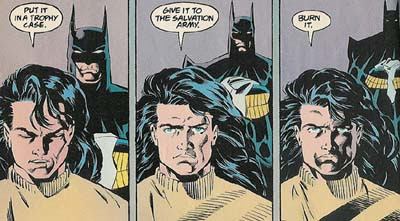
One version of this technique is to show several instants in one scene from the same angle, with the same framing and the same background. That directs our eyeballs to what changes from one image to the next, usually the characters in action. This sequence of panels featuring the current Robin, Tim Drake, comes from Robin Plus Fang, script by Chuck Dixon, art by Anthony Williams and Andy Lanning.

The changes in similar panels don't have to be so physical, though. Here's a sequence from the first Nightwing miniseries, collected in Ties That Bind, by Dennis O'Neil and Greg Land. Dick Grayson has decided to get out of the vigilante business. (I suspect that his hair was taking up a lot more of his time than he'd expected.) He's telling Batman what to do with his costume.
With each panel, Dick's face grows darker, and the Batman more distant. The similar but changing images convey the protagonist's mood.

Repetitive images can also focus our attention on one changing detail which might otherwise be lost, such as the grin that appears on "Batman's" face in the second panel below. That's all the clue that Nightwing needs, trained detective that he is.
That sequence is from JLA/The Titans: The Technis Imperative, by Devin Grayson and Phil Jimenez.

Repetitive images are also a tool for pacing. Seeing two similar panels, especially with no word balloons, tells us that time passes even when we don't see change. In the next sequence, Batman asks the third Robin, Jason Todd, to explain what happened to the rape suspect who was just with him on that balcony.
Batman's figure stays the same, so we sense he's waiting and waiting for an answer. These panels are from Batman, #424, script by Jim Starlin, art by Mark "Doc" Bright and Steve Mitchell.

Given how repetitive panels affect pacing, they can also be used for comic effect. After all, what's the key to comedy?


Timing. In the next sequence, the adult mentor of the teen-aged superhero group Young Justice orders Tim Drake as Robin and his speedy friend Impulse not to search for their missing comrade Secret.
This page comes from an uncollected issue of Young Justice, script by Peter David and drawing by Todd Nauck.

The brief, silent passage of time created by wordless panels in each of the last three examples is the equivalent of what screenwriters have come to call a beat. Such a silence can be hard to convey in prose, and The New Yorker has caught some lazy novelists instructing readers that characters "waited a beat" before they speak.

The visual dimension of comics makes it easy to convey that silent moment. Here's yet another example, from the current teen-superhero magazine to feature Robin, the third volume of The Teen Titans.
This deathless conversation was published in the volume Teen Titans/Outsiders: The Insiders. Scripted by Geoff Johns, penciled by Matthew Clark, inked by Art Thibert.

That last example also hints at something I don't like about how comics artists are applying this technique today. Many artists now work on computers ("penciled" and "inked" are just digital metaphors). That makes it awfully tempting to copy and paste an image from one panel to the next, especially when working under a tight deadline. The three-panel sequence of Nightwing and his hair far above is obviously hand-drawn, and the artists made many changes, large and subtle, from one panel to the next. But the two images of Robin above are identical down to the cross-hatched shadows and coloration.

A growing number of copy-and-paste jobs strike me as having been done without enough regard for the dramatic needs of the scene. This last example comes from Outsiders: Looking for Trouble, script by Judd Winick, art by Todd Raney and Scott Hanna. In these panels, it makes sense to draw the redhead the same because he's making a deadpan joke. His expression shouldn't change. But doing the same for Nightwing just looks like laziness. And using the same image for two panels with different characters talking apparently means that neither can be shown with his mouth open.
The only place I enjoy watching cardboard cutouts talk to each other like that is Wondermark.