Showing posts with label AUTHOR Jim Shooter. Show all posts

13 March 2013

Powers that Comics Editors Need

Comic Book Resources carried an interesting dialogue between Louise Simonson and Ann Nocenti, two comics writers who first edited superhero comics for Marvel in the 1980s.

It included this discussion of editing methods:

Nocenti: I worked with Jim Shooter first and, whatever ill things you want to say about him, he was obsessed with basic Aristotelian plot structure: introduce a character visually, introduce a conflict, what’s the theme? He had a really good grounding in how to tell a story.

Then I worked with Al Milgrom, and what was great about Milgrom was, he’d take the pages that came in and put a piece of tracing paper over them and physically scribble over and re-do the artist’s layouts to show how you could do them better.

Then, when I worked with Weezie, I learned—this is one of the biggest things I learned from you, Weezie—how to get what you want from the writers and artists and have them leave the office with their tails wagging, not realizing they had to re-do everything!

Simonson: [Laughs] I think that's just a legend. I can’t believe I actually did that!

Nocenti: You did! You would sit there and say, “This is really great, this plot is great, but maybe you should make sure this happens,” and they would be like, “Oh yeah!” And then they’d go home and rewrite! We used to say that Weezie’s superpower was she had the power to cloud men’s minds.
Did Simonson’s kindness toward creators grow from her upbringing as a woman at a particular time in the twentieth century? Certainly there were male editors notorious for treating creators badly.

Later Nocenti talks about the different experiences of editing comic books for one of the big companies and creating them for pay:
As an editor, you just have to get something to the printer. You have to make tough decisions, you have to fire people, it has to sell. Then, as a freelancer, you’re at home and you’re lonely and you’re writing by yourself. You’re scared and you don’t know what’s going on with all the corporate people above you. So if you’ve been on both sides, you’re a better editor and a freelancer.
That’s one way to develop empathy if you don’t have it already.

28 April 2012

Cold Wind and the Limits of the Superhero Genre

Cold Wind is a short adventure comic written by Dan Mazur and drawn by Jesse Lonergan, independently published by Mazur’s Ninth Art Press.

I saw this story grow from a script that Dan shared with the Boston Comics Roundtable to its final form. Dan writes in screenplay format, not breaking his story into pages and panels. Often he draws his own art, so that’s obviously not a problem. In this case, he left it up to Jesse—who’s scripted his own Flower and Fade, Joe and Azat, and other tales—to divide the screenplay into images. Yet another approach to collaboration.

Dan’s told me a couple of times how he’s no longer a fan of superhero comics because of their repetitive themes. He reads one Spider-Man story, learns that “With great power comes great responsibility,” reads another story—and learns the same thing.

As former Marvel editor Jim Shooter has commented:
Comic books have become like opera. You go to see a particular performance of an old story, not a new story. How will this performer handle that familiar role...?
That familiarity is part of the appeal of a series, or a genre.

At the last roundtable meeting, Dan wondered aloud if Cold Wind is a superhero comic. I said it qualified, despite his ambivalence about the genre. It’s a pumped-up action story taking place against a fantastic landscape. Its characters are largely symbolic, and they work out the fate of the world through violence.

But Cold Wind reflects Dan Mazur’s take on the superhero genre, with the theme that things don’t change significantly. For all the adventure’s sound effects and fury, its surviving characters achieve only a short pleasure before the world spins on.

Cold Wind is on sale today at the MoCCA Festival, in the better Boston-area comics shops, and over the web.

23 June 2011

“Just an amazingly good looking guy.”

Folks in the Boston Comics Roundtable alerted me to a new blog by Jim Shooter, editor-in-chief at Marvel Comics during the late 1970s and 1980s, when the company overtook DC not only in innovation but in sales. He began work in the industry at thirteen, scripting stories for DC’s Legion of Super Heroes.

After work at other companies, DC hired Shooter to script some new Legion stories in the past decade. Among the assignments was to take a stab at creating a new Superboy since the courts might assign the copyright of that character to the heirs of co-creator Jerry Siegel. (Long story.) Shooter shared his response in a posting titled “Super Lad.”

I’m among the many people who can’t keep the Legion straight, and I don’t care about the original Superboy. What interested me about Shooter’s posting is what he, as an industry vet, saw as the necessary essence of Superman. In other words, what DC had to retain for a “Super” character if they couldn’t use any of the character history that would become the intellectual property of the Siegel family:
If a Super were anything but a noble being with an iron will and tremendous self control, impervious to the failings bad writers nonetheless foisted upon him or her, the Super would have been a villain. Period. And all the rest of the heroes, all the world for that matter, would have had nothing on their minds, and nothing else worthy of devoting their efforts to than destroying the Super. Period. 
. . .

I see him as a genuine good guy. Someone who does the right thing, who has tremendous willpower and courage, who is smart and reasonable. Smart about using his powers, as he learns how. The nicest, best guy you ever met. NOBLE, in the best senses of the word. Not that he can't make mistakes, not that he doesn't have humanity--but he's the best of humankind, one of the few survivors of his particular kind, determined, therefore, to give a good account of himself. 


Elliot S! Maggin once wrote an imaginary story in which Kal-el did not become Superman. Since that didn't occur, he was chosen as the Green Lantern of his sector because he among all beings there had the greatest courage, greatest will and noblest spirit. Right on. That was ES!M's finest hour.

Fair enough. But comics are a visual as well as verbal medium. How would that character be embodied in art? Shooter wrote:
- A strong, young man's physique. NOT overbuilt, NOT Hercules. Strong-looking but slim. Like Ditko's early Spider-man. An ATTAINABLE build. He's Kryptonian. He doesn't have to be absurdly musclebound.


- Handsome. A really, really good looking guy. No lantern jaw, no jock sensibility. Just an amazingly good looking guy. 


- Haircut: timeless. A haircut that wouldn't look out of place in almost any era. I wouldn't mind something pretty close to Superman's. Nothing dated or trendy. No mullet, no crew cut, no high-and-tight, no long hair, no Pet Detective, no spike-y do, no dreads, no curls, no mop. Timeless.
In sum, a good superhero has to look good. Really good. Even if he’s not musclebound or lantern-jawed, he has to be “amazingly good looking.” Or, as critic Douglas Wolk put it in Reading Comics:
The default style of the superhero mainstream [is] designed to read clearly and to provoke the strongest possible somatic response. You’re supposed to react to it with your body before you think about it. Most of its characters, especially the heroic ones, are drawn to look as “sexy” as possible…
The result is that the most underrepresented group among superheroes isn’t women, or non-white ethnic groups, or sexual minorities—not that those people aren’t underrepresented relative to their proportion of the general public. It’s people who are plain or unattractive.

Male or female, young or old, whatever color or orientation, superheroes are almost all drawn as physically attractive people. The main alternative is physically attractive people who turn into wildly exaggerated monsters.

Comics readers have long pointed out how artists routinely draw female heroes with big busts and little costumes, but are there any female heroes who aren’t conventionally attractive to begin with? As for men:
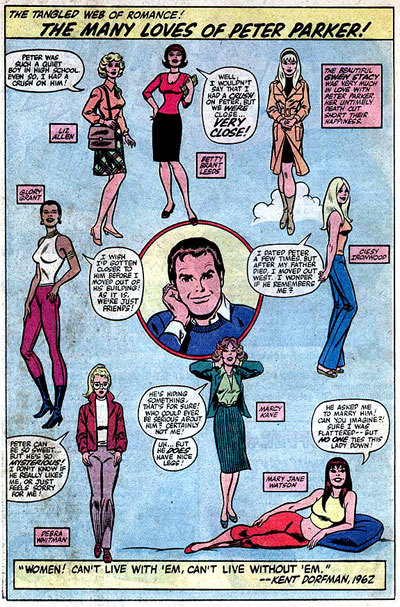
This is, after all, a genre in which Peter Parker was created to represent nerdy guys.