Showing posts with label AUTHOR L. Frank Baum. Show all posts

03 February 2026

Two More Tales of Oz

The 2025 edition of Oziana, the International Wizard of Oz Club’s creative magazine, is now available for purchase through Lulu.

This issue contains two stories by me.

“The Piglets and the Tin Soldier” is another short slice-of-life tale inspired by L. Frank Baum’s Little Wizard Stories of Oz, taking a couple of his established characters and bouncing them off each other.

The Nine Tiny Piglets first appeared from the Wizard’s pockets in Dorothy and the Wizard of Oz and made small cameos in the Emerald City after that, never getting individual names. 

Captain Fyter, the Tin Soldier, marched onto the scene in The Tin Woodman of Oz. At one point in that book the heroes meet the piglets’ parents. Afterward the soldier says, “I hope I’m not too particular about my associates, but I draw the line at pigs.” So there was a natural tension to work with.

David Valentin created digital artwork of the Tin Soldier and his basket of piglets for this story of a journey through the Munchkin Country.

“The Missing Key” is a mystery featuring Snip, the button boy who was a protagonist of Ruth Plumly Thompson’s The Lost King of Oz. She introduced Snip sneaking into Mombi’s kitchen and then spying on her, establishing him as a curious kid. Several years ago, I used that trait to bring Snip into a story called “Invisible Fence.” More recently I realized that would make him a good investigator for a mystery.

In this story, Snip sets out to retrieve the wind-up key that’s vanished from Tik-Tok’s back. David Lee Ingersoll supplied the illustrations, including one of Snip pinned to the ground by string-wielding field mice, inspired by scenes in The Wonderful Wizard of Oz and Gulliver’s Travels.

17 January 2025

A Mystery Tale from the Early Emerald City

Oziana is the International Wizard of Oz Club’s creative magazine for fiction and art inspired by the Oz books. It’s been published annually for about half a century now.

The latest issue, printed at the end of last year, includes my short story “The Soldier with the Green Whiskers and the Guardian of the Gates,” delightfully illustrated by Rob Lauer.

This story is set shortly after the end of The Wonderful Wizard of Oz. The Wizard has flown away, leaving the Emerald City under the rule of the now-brainy Scarecrow. And then the Scarecrow departed to escort his friend Dorothy to the castle of Glinda the Good. So the soldier and the guardian are the highest-ranking officials in town when Winged Monkeys start tearing a hole in the city wall.

I wrote the first version of this story when I was in junior high or high school, but was never fully satisfied with it. A few years ago I realized that it fit into a couple of trends in my newer Oz writing:
  • It was a mystery, and could be a better one.
  • It paired two recurring characters, a form L. Frank Baum used in his Little Wizard Stories of Oz and which I’ve been using to springboard other tales.
I wrote the story again from scratch, hopefully better. At the time I didn’t have a copy of the first version. Since then I came across an old photocopy, but I haven’t dared to read it, lest it be so much worse or even a tiny bit better.

If you care to read “The Soldier with the Green Whiskers and the Guardian of the Gates,” plus six more stories about the early history of Oz, all illustrated, and a closing poem, please order Oziana 2024 from Lulu.

17 December 2024

Maps and More in the Fall 2024 Baum Bugle

The latest triennial issue of the International Wizard of Oz Club’s Baum Bugle is the 200th. It’s arriving, wrapped in seasonal colors, at club members’ houses now.

I’m honored to be one of the contributors to this issue, in the midst of many Oz experts I like and admire:
  • Ruth Berman on the launch of the club and its journal.
  • Scott Cummings on a stage show that would have reunited L. Frank Baum with his first illustrator, the since-famous artist Maxfield Parrish.
  • Peter Hanff on the work of longtime Bugle editor and art director Dick Martin, with more samples of Martin’s work from David Maxine.
  • Memories of editing the Bugle in different periods from Bill Stillman, Michael Gessell, and John Fricke.
My article is about the maps of Oz and its neighbors published in Tik-Tok of Oz in 1914—how they came about and how they affected Baum’s storytelling in the novels that followed. Up until that book, Baum had never mentioned any maps. Afterwards, every book alluded to the map of Oz in one way or another.

That essay owed a lot to two studies of Oz and its representations. First, Michael O. Riley’s Oz and Beyond: The Fantasy World of L. Frank Baum (University Press of Kansas, 1997) snapped me out of the childhood habit of thinking of Oz as a stable place that the books gradually revealed and empowered me to think of Baum making it up as he went along. To be sure, by the time I read that book I’d studied literature in college, edited books for a decade, and even published my own fiction. But old habits stick around. Now I find it more interesting to analyze the fairyland from multiple perspectives.

Starting in 2012, David Maxine has shared a series of essays about the maps of Oz through the Hungry Tiger Press blog. This analysis starts with the earliest map, made for a theatrical presentation and now lost, and has worked its way to the Oz Club’s 1960s publication of maps that incorporated locations from the whole series and other Baum books as well.

Like other Oz fans, I enjoyed looking at the 1914 maps I first saw in Michael Patrick Hearn’s The Annotated Wizard of Oz. I had the Oz Club’s maps pinned on the bulletin board in my room for years. As many other fantasy authors and publishers discovered after Baum, there’s nothing like a map to make a fairyland seem more real.

30 July 2024

“The Dorothy Paintings” and More in South Yarmouth

The Cultural Center of Cape Cod is hosting a summer celebration of The Wonderful Wizard of Oz.

The executive director of the institution, Molly Demeulenaere, says: “The Wonderful Wizard of Oz is more than just a story; it's a timeless exploration of what it means to find and appreciate the complex emotions around the concept of home. Dorothy’s journey, alongside her wonderfully loyal and caring friends, mirrors the universal quest for belonging and self-discovery, making it a story that truly resonates across generations.”

Its description of the event says:
At the beating heart of this enchanting exhibition is Christina Schlesinger’s “The Dorothy Paintings.” This compelling collection of thirteen mural-sized canvases reimagines Dorothy’s adventures with a freshness of perspective that aptly portrays her as the symbol of youthful resilience and independence. Schlesinger’s work demands attention while simultaneously depicting a delicateness and vulnerability rarely seen successfully in combination.
Some of Schlesinger’s paintings can be seen here. The Cape Cod Times offers additional photographs of the space, showing how there are hands-on activities for families, inside and out.

This exhibit will be at the center’s Flagship Bass River Campus, 307 Old Main Street in South Yarmouth. The gallery is open Tuesday through Friday from 10 to 5, and Saturday from 10 to 3. The show will run through 7 September.

18 June 2024

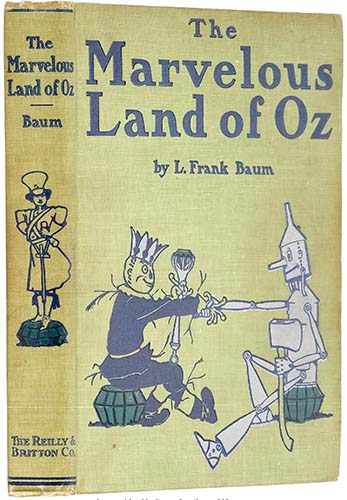
The Missing Princess of the Marvelous Land

I’ve been thinking about how The Marvelous Land of Oz could be more of a mystery. As it is, the book is a roller-coaster ride of political events. Every so often it raises the question of who should rule the Emerald City. But the book doesn’t give us all the clues to its ultimate answer until quite late.

Baum and his colleagues had introduced the character of Pastoria, former king of Oz, in the 1902 stage extravaganza The Wizard of Oz. Therefore, when the Scarecrow mentions his name in the sixteenth chapter of Land, it wouldn’t have been a complete surprise to all readers.

Nonetheless, that was two-thirds of the way through the book. Furthermore, Glinda doesn’t drop the bombshell that Pastoria left a missing daughter until four chapters later. That means readers have only three chapters to be thinking about this mystery, on which the conclusion of the story will hinge.

There are plenty of signs that Baum didn’t like going back to revise. He occasionally excised whole chapters or inserted new passages, but his surviving manuscripts and correspondence show none of the fiddling with details that other writers regularly performed.

I don’t think it would have taken much revising to cue readers into thinking about Pastoria and his daughter for much of the book. Here are some slightly rewritten passages in which characters discuss the history of Oz.

In Chapter 3, the boy Tip is trying to orient his creation, Jack Pumpkinhead:
“Where are we going?” asked Jack, when they had resumed their journey.

“I’m not exactly sure,” said the boy; “but I believe we are headed South, and that will bring us, sooner or later, to the Emerald City.”

“What city is that?” enquired the Pumpkinhead.

“Why, it’s the center of the Land of Oz, and the biggest town in all the country. I’ve never been there, myself, but I’ve heard all about its history. It was built by a mighty and wonderful Wizard named Oz, around the estate of the former king Pastoria, and [later] . . . the people of the Emerald City invited the Scarecrow to rule them.”

“Dear me!” said Jack. “I’m getting confused with all this history. Who is the Scarecrow?”

“Another friend of Dorothy’s,” replied Tip.

“And who is Dorothy?”

“She was a girl that came here from Kansas, a place in the big, outside World. She got blown to the Land of Oz by a cyclone, and while she was here the Scarecrow and the Tin Woodman accompanied her on her travels.”

“And where is she now?” inquired the Pumpkinhead.

“Glinda the Good, who rules the Quadlings, sent her home again,” said the boy.

“Oh. And what became of the Scarecrow?”

“I told you. He rules the Emerald City,” answered Tip.

“I thought you said it was ruled by a wonderful Wizard,” objected Jack, seeming more and more confused.

“Well, so I did. Now, pay attention, and I’ll explain it,” said Tip, speaking slowly and looking the smiling Pumpkinhead squarely in the eye. “Around the time King Pastoria vanished, the Wizard came and built the Emerald City and ruled for many years. Dorothy went to the Emerald City to ask the Wizard to send her back to Kansas; and the Scarecrow and the Tin Woodman went with her. But the Wizard couldn’t send her back, because he wasn’t so much of a Wizard as he might have been. And then they got angry at the Wizard, and threatened to expose him; so the Wizard made a big balloon and escaped in it, and no one has ever seen him since.”

“Now, that is very interesting history,” said Jack, well pleased; “and I understand it perfectly all but the explanation.”
After Jack and Tip get separated, the boy meets a pretty young woman in a colorful military uniform. With a little tweaking, this conversation could have been part of that Chapter 8:
“I am General Jinjur,” was the brief reply.

“Oh!” said the boy surprised. “What sort of a General?”

“I command the Army of Revolt in this war,” answered the General, with unnecessary sharpness.

“Oh!” he again exclaimed. “I didn’t know there was a war.”

“You were not supposed to know it,” she returned, “for we have kept it a secret; and considering that our army is composed entirely of girls,” she added, with some pride, “it is surely a remarkable thing that our Revolt is not yet discovered.”

“It is, indeed,” acknowledged Tip. “But where is your army?”

“About a mile from here,” said General Jinjur. “The forces have assembled from all parts of the Land of Oz, at my express command. For this is the day we are to conquer His Majesty the Scarecrow, and wrest from him the throne. The Army of Revolt only awaits my coming to march upon the Emerald City.”

“Well!” declared Tip, drawing a long breath, “this is certainly a surprising thing! May I ask why you wish to conquer His Majesty the Scarecrow?”

“Because the Emerald City has been ruled by men long enough, for one reason,” said the girl. “Before the Scarecrow there was the Wizard, and before the Wizard, or even the city as it stands today, there was King Pastoria. Some people say Pastoria had a daughter who was meant to rule over us, meaning that we should have had a girl ruler by this time, but no one has seen that child for years.”

That lost heir was not part of the history of Oz that Tip had heard from Mombi. He puzzled over this rumor as Jinjur went on:

“Moreover, the City glitters with beautiful gems, which might far better be used for rings, bracelets and necklaces; and there is enough money in the King’s treasury to buy every girl in our Army a dozen new gowns. So we intend to conquer the City and run the government to suit ourselves.”
Tip and Jack Pumpkinhead reunite in the Scarecrow’s palace, only for General Jinjur to seize the Emerald City. Later the Scarecrow seizes the palace back with the help of his close friend, the Tin Woodman. But at that point in Chapter 16, the straw-man ruler is ready to abdicate:
Tip soon cut the stitches that had fastened the crown to the Scarecrow’s head, and the former monarch of the Emerald City removed it with a sigh of relief and hung it on a peg beside the throne.

“That is my last memento of royalty,” said he; “and I’m glad to get rid of it. The former King of this City, who was named Pastoria, lost the crown to the Wonderful Wizard, who passed it on to me. Now the girl Jinjur claims it, and I sincerely hope it will not give her a headache.”

“A kindly thought, which I greatly admire,” said the Tin Woodman, nodding approvingly.

“Have you ever heard,” Tip asked the straw man, “that King Pastoria had a daughter who disappeared?”

“Some people do say that,” answered the Scarecrow, “and some say otherwise. That happened well before my time, so I cannot say anything about it. Why—do you think General Jinjur is this lost heir to Pastoria?”

Tip shook his head. After all, Jinjur was the person who had first told him about the missing princess, and she had made no claim to rule the Emerald City other than by force and cunning.

“Well, now I will indulge in a quiet think,” continued the Scarecrow, lying back in the throne.
Finally, the Scarecrow and his supporters reach Glinda’s palace in Chapter 20:
“Therefore I have come to beg your assistance,” resumed the Scarecrow, “for I believe you are always glad to succor the unfortunate and oppressed.”

“That is true,” replied the Sorceress, slowly. “But the Emerald City is now ruled by General Jinjur, who has caused herself to be proclaimed Queen. What right have I to oppose her?”

“Why, she stole the throne from me,” said the Scarecrow.

“And how came you to possess the throne?” asked Glinda.

“I got it from the Wizard of Oz, and by the choice of the people,” returned the Scarecrow, uneasy at such questioning.

“And where did the Wizard get it?” she continued gravely.

“I am told he took it after Pastoria, the former King, had not been heard from for some time,” said the Scarecrow, becoming confused under the intent look of the Sorceress.

“Then,” declared Glinda, “the throne of the Emerald City belongs neither to you nor to Jinjur, but to this Pastoria from whom the Wizard usurped it.”

“That is true,” acknowledged the Scarecrow, humbly; “but Pastoria has been gone for many years now, and some one must rule in his place.”

“Pastoria had a daughter, who is the rightful heir to the throne of the Emerald City. Did you know that?” questioned the Sorceress.

“Not for certain,” replied the Scarecrow. “But if that girl still lives I will not stand in her way. It will satisfy me as well to have Jinjur turned out, as an impostor, as to regain the throne myself. In fact, it isn’t much fun to be King, especially if one has good brains. I have known for some time that I am fitted to occupy a far more exalted position. But where is the girl who owns the throne, and what is her name?”

“Her name is Ozma,” answered Glinda. “But where she is I have tried in vain to discover. For the Wizard of Oz, when he stole the throne from Ozma’s father, hid the girl in some secret place; and by means of a magical trick with which I am not familiar he also managed to prevent her being discovered—even by so experienced a Sorceress as myself.”
By that point, readers would have been thinking about the Emerald City’s deep history for most of the book, and the mystery of the missing heir for a dozen chapters. Where could that child be?

16 March 2024

“Historic Children’s Voices” Coming from American Antiquarian Society

The American Antiquarian Society in Worcester will launch a website on “Historic Children’s Voices, 1799-1899.”

Its introductory page explains: “The holdings to be digitized are not children’s literature, i.e., works created BY adults FOR children, but rather are direct testimony as well as imaginative works created BY children. As such, they constitute an archive of historical evidence not previously accessible.”

The materials to be digitized include diaries, letters, stories, poems, and the AAS’s “large amateur newspaper collection—most printed on home parlor presses.” There will be 15,000 pages of content in all.

Those presses were very popular in the late 1800s. When L. Frank Baum issued the Rose Lawn Home Journal and later self-published works on stamp collecting and chicken farming, he was among thousands of young people working their own small presses.

Accompanying the website, the AAS will host an in-person and online symposium on 2–3 May featuring panel discussions on “Authentic Children’s Voices,” “Archival Silences,” “Visual Culture of Children’s Production,” and “Hearing the Child’s Voice.”

On 5–9 August, the AAS will host an institute for K-12 teachers on the subject, with hands-on workshops using the collection and a field trip to Lowell National Historical Park.

14 November 2023

“In the Land of Oz they use no money at all”

In The Road to Oz (1909), L. Frank Baum wrote:
“Money! Money in Oz!” cried the Tin Woodman. “What a queer idea! Did you suppose we are so vulgar as to use money here?” . . .

“If we used money to buy things with, instead of love and kindness and the desire to please one another, then we should be no better than the rest of the world,” declared the Tin Woodman. “Fortunately money is not known in the Land of Oz at all. We have no rich, and no poor; for what one wishes the others all try to give him, in order to make him happy, and no one in all Oz cares to have more than he can use.”
That contradicts this detail in The Wonderful Wizard of Oz (1900):
…a man was selling green lemonade, and when the children bought it Dorothy could see that they paid for it with green pennies.
And also The Marvelous Land of Oz (1904), in which a ferryman asks for money before rowing Tip across a river, the Emerald City and the Winkie castle have treasuries, and all the characters recognize “dollar bills—and two-dollar bills—and five-dollar bills—and tens, and twenties, and fifties.”

Apparently something happened after Ozma came to the throne of Oz at the end of the latter book, producing an entirely different economic system that Baum explained more fully in The Emerald City of Oz (1910).

However, I was surprised to see that the very first mention of Oz doing without money actually appeared outside the series, and outside the canon. The Woggle-Bug Book, a storybook Baum wrote in 1905, contains this paragraph:
You see, in the Land of Oz they use no money at all, so that when the Woggle-Bug arrived in America he did not possess a single penny. And no one had presented him with any money since.
That book doesn’t offer any ethical lesson to go along with the lack of money, as the Tin Woodman would volunteer in The Road to Oz. It’s just another way that the Woggle-Bug’s native land differs from America.

While featuring a character from Oz, The Woggle-Bug Book is set in America, where we use money. It’s one of what I call Baum’s urban fantasies, taking place in a contemporary, multiethnic American city which nonetheless has magic (in that way contradicting the rules of the Oz books he wrote in the same period).

The Woggle-Bug Book and the Queer Visitors from the Marvelous Land of Oz comic page that preceded it were never listed as part of the Oz series, and Baum never referred back to them in his later stories. Thus, fans don’t treat whatever those books say about Oz as reliable for the rest of the series. Nonetheless, in that book Baum first tried out what would become a crucial detail of the Ozian utopia.

15 August 2023

“Dorothy the Conqueror” Now Online

Back in 2005, the International Wizard of Oz Club’s journal, The Baum Bugle, published my article “Dorothy the Conqueror.”

It discussed the character of Dorothy Gale as L. Frank Baum developed her, from a little girl who called herself “small and meek” into a bold adventurer. That boldness had always been part of her character, but after her first trip to Oz she knew it. By the end of Baum’s series, she was happy to set out for unknown parts of Oz because “all excitement is fun.”

The article also points out ways that the MGM movie’s treatment of Dorothy doesn’t reflect that character, especially in her baffling speeches at the end.

The Oz Club has now made the text of “Dorothy the Conqueror” available for anyone to read through this webpage. It even comes with citations in both Chicago and MLA style.

04 July 2023

The Characters of Oz and the Character of Oz the Wizard

Later this year McFarland will publish The Characters of Oz: Essays on Their Adaptation and Transformation, edited by Dina Schiff Massachi of the University of North Carolina at Charlotte.

The publisher says, “This collection of essays follows Baum’s archetypal characters as they’ve changed over time in order to examine what those changes mean in relation to Oz, American culture and basic human truths.”

Among those essays is my own “A Good Man But a Bad Wizard?: The Shifting Moral Character of the Wizard of Oz.”

One of the few lines that appeared in both L. Frank Baum’s original novel and the 1939 MGM movie was the Wizard’s insistence that he was “a good man, but a bad wizard.” Within that first novel the Wizard was a humbug whom people believed in, a tyrant who benefited his people, but ultimately someone Dorothy couldn’t rely on.

Just a few years later, however, the American public knew the Wizard of Oz unambiguously as a bad man in the Wizard of Oz stage extravaganza. And a few years after that, Baum brought the Wizard back as a stalwart friend for Dorothy and eventually a real magic-worker. This essay analyzes those changes in his persona across media and moral boundaries.

Other articles in this collection include Katharine Kittredge on Dorothy, Dee Michel and James Satter on the Cowardly Lion, Walter Squire on Glinda, Paige Gray on Jack Pumpkinhead, and Angelica Carpenter on the Nome King, among many other experts. Dina Massachi wrangled the contributors and provided her own exploration of the Winged Monkeys.

04 April 2022

The Opening of the Emerald City

My last posting explored the location of the original gateway into the Emerald City, the one Dorothy and her friends use in L. Frank Baum’s The Wonderful Wizard of Oz.

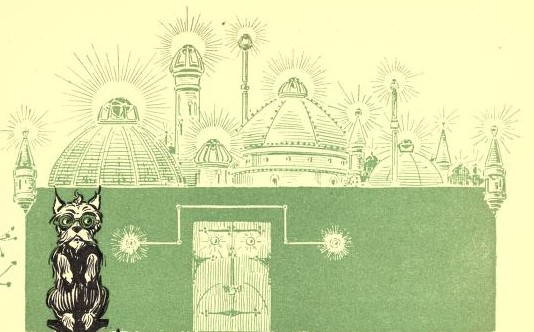
The travelers come to an emerald-studded gate at the end of the Yellow Brick Road. That outer gate leads to a room inside the thick wall with an inner gate on the other side. The little man inside is therefore called the “Guardian of the Gates” even though there is only one opening the in wall. (With his typical inconsistency, Baum also called this character the “Guardian of the Gate,” sometimes within the same chapter.) Thus, the many early references to the city “gates” don’t mean there’s more than one gateway through the wall.

When characters arrive at the city in The Marvelous Land of Oz, Baum describes their experiences in much the same way as in the first book. The Guardian of the Gates greets them and hands them off to the Soldier with the Green Whiskers. Characters speak of “the gate” of the city.

At the same time, it’s clear that there have been changes in the Emerald City. While before the gate was studded with emeralds, the jewels inside the city only appeared to be emeralds because people wore green spectacles. In Land the city contains some real jewels. General Jinjur and her soldiers don’t fear blindness without the spectacles.

More pertinent to this inquiry, in Wizard the Guardian tells Dorothy and her friends there’s no road to the west because no one ever travels that way for fear of the Wicked Witch. In Land the Sawhorse follows “the road to the West.” It’s not clear whether this path begins at the same gate where the Yellow Brick Road ends.

Finally, toward the end of Land Baum tells us that “Jinjur had closed and barred every gateway” into the city. While other passages in that book refer to “the gate” as if there’s still only one, the phrase “every gateway” definitely implies that by the time of Jinjur’s brief rule the city had more entrances.

Once again, this fits with what we know about overall politics in Oz. When the Scarecrow becomes ruler of the Emerald City at the end of Wizard, the Wicked Witches of the East and West have been eliminated. He’s on good terms with Glinda to the south. His friend the Tin Woodman will now govern the west. It would be safe to welcome visitors to his city.

I therefore surmise that between Wizard and Land the Scarecrow began the process of building more gates into the Emerald City walls. Perhaps not as large as the original gate, or perhaps (given the peacetime conditions) larger. Likewise, the Scarecrow and Tin Woodman probably promoted the new road from the city to the west.

Commerce and travel between the parts of Oz was probably still slow in this period. The Scarecrow met Gillikins so rarely that by the time of Land he hadn’t learned they speak his language. Yet General Jinjur could assemble an Army of Revolt of young women from all four outer realms of Oz. (Indeed, Jinjur’s uprising might have been the first pan-Oz movement, at least for several decades.)

Another sign of Oz opening up to travelers appears when we consider the “road to the South” to Glinda’s castle. At the time of Wizard, that route ran into the Fighting Trees, the walled China Country, a dark and boggy forest, and the Hammerheads, who refused to let anyone hike over their hill. None of those obstacles ever appear in the Oz books again, and characters make many easy land journeys from the Emerald City to Glinda’s home. 

What could produce that change? The most likely answer is Glinda the Good Sorceress. With the Wizard in power, she might well have appreciated having several difficult obstacles between his power base and her castle. But once the Emerald City was under a friendly straw-man regime, Glinda probably preferred easier travel.

In The Emerald City of Oz we learn that Glinda has established several protected little communities in Quadlingland and even manipulates the weather over one of them, Miss Cuttenclip’s village. At the end of that book she unilaterally cuts all of Oz off from our Great Outside World. Tik-Tok of Oz shows us Glinda’s moving a mountain pass to divert a hostile army outside of Oz—and so casually she doesn’t bother to remember that she’s done so.

Given that record, it’s easy to imagine Glinda magically shifting the road from the Emerald City to her castle to be straighter or safer, or shifting the Fighting Trees, Hammerheads, and other relentlessly hostile obstacles away from it.

The process of connecting the Emerald City to the rest of Oz no doubt accelerated after Princess Ozma took the throne at the end of Land. Unlike the Scarecrow, she claimed dominion over all of Oz. Her realm is largely peaceful and her rule increasingly secure. It’s no surprise, therefore, that years later The Patchwork Girl of Oz assures us there are four gateways into the city, one for each quadrant of Oz.

02 April 2022

Seeking the Original Gateway into the Emerald City

For fictive purposes, I’ve been trying to figure out the location of the original gate to the Emerald City and when more gates were added.

L. Frank Baum’s The Wonderful Wizard of Oz makes clear the city has only one gateway, which Dorothy and her companions use to enter and exit. That makes sense historically. Oz the Wizard built the Emerald City as a citadel against the witches, especially the Wicked Witches, so he wanted to minimize the entry points. He claimed no authority over the lands of the Munchkins, Winkies, Quadlings, and Gillikins and therefore didn’t need to welcome them.

Several adventures later, The Patchwork Girl of Oz states that by then there are four gates in the city walls, one pointing in each cardinal direction. Presumably one of the four gates of the later city was the Wizard’s original. That means the original gate faces north, south, east, or west—but which one?

We know that it doesn’t face to the west or south because when Dorothy and her friends leave the gate to head in those directions, Baum wrote that they “turned toward the West” and “turned their faces toward the Land of the South.” Turning would be unnecessary if they were already facing either of those directions as the gate opened.

Baum described the travelers’ first glimpse of the gate this way:
As they walked on, the green glow became brighter and brighter, and it seemed that at last they were nearing the end of their travels. Yet it was afternoon before they came to the great wall that surrounded the City. It was high and thick and of a bright green color.

In front of them, and at the end of the road of yellow brick, was a big gate, all studded with emeralds that glittered so in the sun that even the painted eyes of the Scarecrow were dazzled by their brilliancy.
Likewise, in The Marvelous Land of Oz travelers from the Gillikin Country to the north follow another Yellow Brick Road to what appears to be the same gate. And in The Patchwork Girl of Oz we learn there’s another Yellow Brick Road in Munchkinland.

We must presume that when there was only one gateway into the city, all those roads merged at some place in the green country surrounding the city. That leads to the possibility that one or more of the Yellow Brick Roads didn’t head straight to the city from east or north but first led to the merge point—perhaps why Dorothy’s approach seeemed to take so long.

In contrast, the Sawhorse and Jack Pumpkinhead’s arrival at the gate from the north in Land seems more direct. To me that gives a slight edge to the original gateway being at the Emerald City’s north.

Again, that seems to fit with what we know of the history of Oz’s reign. Wicked Witches ruled to the east and west, so the Wizard wouldn’t have built an entrance in either of those directions. The most powerful magician in Oz, Glinda, controlled the south; though she was not a hostile power, she was still a threat to the humbug ruler.

In contrast, the Good Witch of the North dominating the Gillikin Country was a lesser danger to the Wizard. And as for the wicked witch in that territory, Mombi, he actually had personal dealings with her. A gateway to the north would have made the most sense to the great Oz.

COMING UP: Adding more gateways.

15 September 2020

Turning Ojo into Woot

A recent online discussion about the relative ages of L. Frank Baum’s young male protagonists took me back almost twenty years to when Oziana magazine published my story “Woot Meets Yoop.”

Woot the Wanderer is one of the heroes of The Tin Woodman of Oz. He hikes around Oz, looking for distraction without danger—which of course makes it easy for a storyteller to get him into danger. In this story I had him run into Mr. Yoop, the caged and carnivorous giant from The Patchwork Girl of Oz.

As I recall, this issue of Oziana was being assembled in a rush to catch up to its annual schedule, so I offered to create illustrations for the story by digitally manipulating some of John R. Neill’s illustrations.

Most of the pictures I worked with came from The Tin Woodman of Oz and showed Woot. But one I wanted to use came from The Patchwork Girl of Oz and showed that book’s young hero, Ojo. This is where Neill’s tendency to draw the children in the Oz stories with quite similar faces became an advantage.

Here’s the picture of Ojo.


My oldest edition of The Patchwork Girl of Oz has no color printing, just line art, which was easier to work with. I removed Ojo’s Munchkin ruff and drew in Woot’s more ordinary Gillikin lapels. I shortened the tails of Ojo’s jacket to approximate Woot’s and added Woot’s knapsack.

Just as important, I stretched out the boy’s legs and body a little. Removing the ruff left plenty of room for a long neck. Because as Baum wrote him, and as Neill drew him, Woot is a bit older than Ojo, further into adolescence.

Here’s the resulting picture of Woot.

I just went back and superimposed these pictures to confirm the differences. With Neill’s standard young-person face at the same level, Woot is a little taller with longer legs. A teenager instead of a boy—at least as I picture him.

25 July 2020

The Mystery of Baum’s Final Book

This year I reread L. Frank Baum’s final Oz book: Glinda of Oz, published one hundred years ago.

Unlike the preceding book, The Magic of Oz, it has a single, focused plot. Ozma and Dorothy venture to the northern edge of Gillikin Country to intervene in a war between two small communities. They get trapped there. Glinda leads an expedition to save them. With the help of local magic-workers, the rescuers succeed. Glinda repairs the war damage, and Ozma installs new rulers in the two communities.

And there the book ends. There’s no detailed return journey to the Emerald City, no celebration in Ozma’s palace, no concluding discussion among Ozma, Dorothy, and Glinda. Ozma says to no one in particular, “it is always wise to do one’s duty, however unpleasant that duty may seem to be.” Done. Baum had filled his requisite number of pages, composing 40,000 words.

The manuscript for Glinda of Oz survives at the Library of Congress. The only parts that have been digitized appear in this online exhibit, and they say contradictory things about who Baum wrote it.

The title page has a note in Baum’s own handwriting that says: “MS. Completed Feb 17th / 1917 by L. Frank Baum.” But the first manuscript page also has a note in his handwriting: “L. Frank Baum / Feb. 1918.” A note added to the manuscript by Baum’s family says, “Written January & February 1917. finished the night before L F entered hospital,” but we know Baum went in for surgery on his gall bladder on 18 Feb 1918. He had alerted his publisher, Reilly and Lee, to the new book just four days before.

Those contradictory clues convinced Baum’s biographer Katharine M. Rogers to theorize that he finished a first draft of Glinda in February 1917 and a second version a year later. Exactly a year later, which seems like a mighty coincidence.

I think Baum simply wrote down the wrong year on his title page. February was still early in the new calendar year, and he had a lot weighing on his mind as he prepared for surgery. That title page in turn confused the relative who knew he finished just before the operation. All the other clues about how Baum wrote his last three Oz books fall into place. He drafted them in the order they were later published over the eighteen months between August 1916 and February 1918, finishing just before he went into the hospital.

Mostly bedridden after that surgery, Baum spent his last year working with his family to polish those texts and prepare typescripts to send to his publisher. Baum died on 6 May 1919. The Magic of Oz was published a month later, and Glinda of Oz eleven months after that.

Someday, after this pandemic is over, I hope to visit the Library of Congress and examine the full manuscript of Glinda of Oz in the same way that I looked at The Magic of Oz. Does it match the book’s final text as closely? Rogers reported one scene revised to be less scary and a few other small changes. I’m curious about a passage describing the famous residents of the Emerald City that strikes me as stylistically distinct from the surrounding prose. Does that appear in Baum’s handwriting?

Still, even if someone else—a relative or an editor—filled out Glinda of Oz for Baum, they didn’t tack on a more detailed ending.

23 July 2020

Making the Most of the Magic of Oz Manuscript

Back in 2005 I examined L. Frank Baum’s handwritten manuscript of The Magic of Oz at the Harry Ransom Center in Austin, Texas, comparing it to the finished book. I published my findings and analysis in an article for the Oz Club’s Baum Bugle called “The Magic Manuscript.” Since then, the Ransom Center has digitized the manuscript pages, letting everyone see how Baum worked.

My article noted how when Baum sat down to write his first draft for The Magic of Oz (or maybe The Magic of the Wizard of Oz), he hadn’t decided on important details, such as the name of a major character and the exact spelling of the crucial magic word. Those vary from one page to the next, and sometimes even on the same page.

Paradoxically, that study also showed how little revising Baum did on his way to publication. As he wrote, Baum wrestled with some small details, such as how to describe Ozma’s age. He later polished his phrasing in little ways, usually by hand and sometimes at the missing typescript stage. But that was fussing over small stuff.

Baum inserted one short episode while still writing in hand and later added another to tie off a loose end at the request of his publisher, Frank Reilly. A couple of times he deleted sentences from the first draft that opened plot possibilities which he had never followed up on. But the manuscript shows no other major rewriting—no shuffling scenes, no big cuts or reworking. At least at this late stage of his career, Baum stuck to the structure of his first draft.

Another question about Baum’s writing process that I addressed in that article was the sequence in which he drafted his last three Oz books. The most recent Baum biographies posited that he didn’t compose those books in the order they were published: The Tin Woodman of Oz (1918), The Magic of Oz (1919), and Glinda of Oz (1920).

In L. Frank Baum: Royal Historian of Oz, Angelica Shirley Carpenter and Jean Shirley suggested the sequence was Magic, Glinda, Tin Woodman. The first two were “a kind of insurance” for his family if he took sick, this book said, and he completed the third after gall bladder surgery in 1918.

The Magic of Oz manuscript makes that sequence untenable, however. The handwritten manuscript includes a mention of the Tin Soldier, a character introduced in The Tin Woodman of Oz. Baum therefore must have written Tin Woodman before Magic.

Baum’s Magic manuscript offers two more clues about the timing of his last books. He wrote two pages of his story on the back of an accounting of money raised at a local D.A.R. war relief event in June 1917. And on the first page a relative wrote, “This was next to the last book Father ever wrote. It was written in the fall of 1917.” Since Tin Woodman could not have come after Magic, Baum must have moved on to Glinda of Oz. In sum, he wrote the books in the order they were published.

COMING UP: Glinda of Oz and the end.

21 July 2020

Plotting Magic

The Magic of Oz remains one of my most favorite Oz books by L. Frank Baum because of how its plot works so well.

The book has three narrative threads:
  • A sulky Munchkin adolescent and the exiled Nome King plot to take over Oz using a secret word that can transform anything or anyone into something else.
  • Dorothy leads the Wizard, the Cowardly Lion, and the Hungry Tiger to the Gillikin Forest to recruit monkeys as part of a birthday present for Ozma.
  • Trot and Cap’n Bill follow the Glass Cat to another wild part of the Gillikin Country to retrieve a magic flower for Ozma.
Ultimately, each of these plots intersects and helps to resolve the other two. Dorothy and the Wizard’s unexpected arrival in the forest disrupts the villains’ plans. After Trot and Cap’n Bill are trapped and dwindling away, the Glass Cat rushes to fetch help and ends up both finding the Wizard’s bag of magic and bringing him back. And the only way the Wizard can rescue Trot and Cap’n Bill, it turns out, is using the secret word of transformation.

And then…there’s a bit more book. The Magic of Oz was running short, under 40,000 words. The average of the previous six Oz books, since Baum resumed the series in 1913, was over 50,000 words. He thus still had pages to fill.

Baum therefore wrote a bit more action as the adventurers return to the Emerald City, and then as they celebrate Ozma’s birthday, and finally as they deal with the villains. That’s a long denouement that I must admit borders on the anticlimactic.

Along with how slipshod some of Baum’s other plots were, it reminds me that he probably just lucked into the cleverly intersecting plot lines I described above rather than building The Magic of Oz around them.

07 April 2020

Reading the Monkey

In this time of pandemic throughout the Great Outside World, Prof. Dina Massachi and the International Wizard of Oz Club have organized a video reading of L. Frank Baum’s The Wonderful Wizard of Oz.

All the videos are on the Oz Club’s YouTube channel, as well as various Facebook, Instagram, and Twitter feeds. Yesterday there was even a report on the project in Philadelphia keyed to local reader Ryan Bunch.

Other readers have included Baum’s granddaughter Gita Morena, novelist Gregory Maguire, biographer Michael Patrick Hearn, historian of feminism Sally Roesch Wagner, and many friends I’ve made through the Oz conventions.

Dina asked me to tackle Chapter 14, “The Winged Monkeys.” In this chapter Dorothy learns the secret of the Golden Cap she took from the Wicked Witch of the West—that it can summon the Winged Monkeys to fulfill her wish. She then hears the story of how those Winged Monkeys became enslaved to the cap.

A large part of the chapter consists of the King of the Winged Monkeys’ story from his grandfather’s day. There are other long flashbacks in the book, such as when the Tin Woodman and the Wizard explain how they ended up in the fixes where Dorothy found them. This flashback is unusual in going so far back to tell a story about characters we never see elsewhere in the book—or elsewhere in Baum’s other books, either.

All the characters in the chapter are matter-of-fact about the Monkeys being compelled to obey the owner of the Golden Cap. The present King of the Winged Monkeys expresses no resentment about the sorceress who enslaved them, or his grandfather who angered her, or the Wicked Witch for ordering them around. Dorothy never considers freeing the monkeys from slavery as she’s inadvertently freed the Munchkins and the Winkies.

Glinda the Good does free the Winged Monkeys at the end of the book, but then in the sequel, The Marvelous Land of Oz, Baum describes them still as enslaved to the cap, so evidently that moment in his story hadn’t meant much to him. I doubt an author today could write so casually about slavery.

Reading Chapter 14 therefore presented a challenge. How to voice the King of the Winged Monkeys in a way that made him more than a docile servant by preserving the sense of mischief he acknowledges. Plus, that story of people we’d never meet again had to be interesting. In my telling, the king’s voice came out like a Bowery Boy.

Here’s the result for Chapter 14. Or you can start from the beginning in the great Kansas prairies.

30 July 2019

Sea Fairies and Sea Sirens

Sea Sirens is a new middle-grade graphic novel by Amy Chu and Janet K. Lee. It’s subtitled A Trot & Cap’n Bill Adventure, and the back cover says it was “inspired by L. Frank Baum’s classic adventure The Sea Fairies, the ‘underwater Wizard of Oz.’” The story’s last page promises more Trot & Cap’n Bill Adventures.

However, this is not a story about Trot and Cap’n Bill from The Sea Fairies and Sky Island, whom Baum settled in the Emerald City in The Scarecrow of Oz. It’s a remix of elements from The Sea Fairies including the names of major characters, the setting in and off the coast of southern California, and the general idea of being able to breathe underwater to visit mermaids.

Baum’s Sea Fairies is one of his weaker fantasies, though it introduces some of his most winning characters and one of his scariest villains. As in Jules Verne’s Twenty Thousand Leagues Under the Sea, a lot of pages are taken up by underwater tourism with little plot (but, in Baum’s case, plenty of puns). Though Trot is a winning personality already distinct from Dorothy Gale, she functions mostly as an observer; she becomes more of a plot driver in Sky Island.

Lee, who created the striking Return of the Dapper Men, had the idea to pull from The Sea Fairies to create a modern adventure. Like Trot, the Trot* in Sea Sirens lives along the southern California coast with her mother and a disabled older man—not a one-legged sailor but her grandfather, who suffers from intermittent dementia. The new Cap’n Bill* is one-eyed cat.

Trot* is a Vietnamese-American surfer. About twenty years ago I wrote an Oz novel featuring a Vietnamese-American surfer as the child who travels to the Emerald City. I’m therefore particularly intrigued by Trot*. Both stories hinge on the powerful allure of surfing, particularly as a respite from domestic tensions.

In The Sea Fairies, Trot and Cap’n Bill are boating off the coast when the mermaids of the title appear and invite them to visit. They want to disabuse Cap’n Bill of his superstitious ideas about mermaids luring sailors to their deaths. Once underwater, Trot and Cap’n Bill meet many creatures, culminating in a gigantic, ancient sea serpent named King Anko, who presides over the Pacific. Then they get captured by the villainous Zog.

Sea Sirens strives for more conflict from the start. (Perforce this paragraph and the following contain SPOILERS.) Trot* is at odds with her mother over whether it’s safe to leave her wandering grandfather to go surfing. Trot* and Cap’n Bill* almost drown before a mermaid princess with her own mother issues rescues them and empowers them to breathe underwater. The mermaid queen Aquareine* is imperious instead of just friendly. The mermaids are close to war with a nation of underwater serpents, and Trot*’s grandfather wanders into their possession.

However, in the end that conflict washes away in a few pages. The King Anko* in Sea Sirens is a former cabin boy with more than a little resemblance to Maurice Sendak’s Max, Mikey, Jack, and Guy, who in turn harken back to Winsor McCay’s Nemo. Anko* is delighted to find other humans underwater at last. Trot* asks him and Aquareine* to pull back their armies, and they do. Problem solved.

Even Trot*’s fear of her mother worrying that she and her grandfather have drowned evaporates quickly. It turns out the entire underwater adventure takes only an hour in surface time. (In The Sea Fairies, Baum had the mermaids cast a spell on Trot’s mother so that she slept peacefully through her daughter’s absence.) There’s a final fear that Cap’n Bill* has drowned, but he hasn’t.

In sum, Sea Sirens ends up being even slighter than The Sea Fairies. The pictures are lovely, and the graphic storytelling successful on a page-by-page, moment-by-moment basis. The character-based jokes land, especially when Trot* learns there’s more to Cap’n Bill* than she thought. Jimmy Gownley, creator of the Amelia Rules! series, provides fine lettering. Now that the characters are established, we can hope the next graphic Trot & Cap’n Bill Adventure is more of an adventure.

18 September 2018

More on Woodman and Woodsman

My examination of the shifting prevalence of “woodman” and “woodsman” and what that implies for how people speak of L. Frank Baum’s character the Tin Woodman brought this comment:

You don't seem to address the difference in the two professions, Woodman vs. Woodsman, though I'm not sure how well you could specify that in the search. But the word usage rates are clearly dependent on such, IMHO.

A woodman chopped and/or delivered firewood (like the Iceman or Milkman or Postman. A "Woodsman" is a forest ranger, naturalist, etc., that specializes in knowing about "the woods" and the failure to realize this difference in professions is what galls some of us - not the slight change to the spelling. Nick Chopper is a lumberjack not a forest ranger.
When did such a distinction arise, and how established is it?

Dr. Samuel Johnson’s 1755 dictionary didn’t include the word “woodsman” at all. And his definition for “woodman,” with citations from his beloved Shakespeare, said nothing about chopping or delivering wood.
Instead, for Johnson a “woodman” was someone who hunted for sport in the woods.

Let’s jump ahead to Noah Webster’s dictionary in 1828. Once again, there was no entry for “woodsman.” And according to Webster, a “woodman” was:
1. A forest officer, appointed to take care of the kings wood.
2. A sportsman; a hunter.
It would be good to check an American dictionary from the 1860s when Baum was a boy, because that would be the best reflection of usage when he was learning the language. But I couldn’t find one on the web.

So let’s jump again to the 1903 edition of Chambers’s Twentieth Century Dictionary of the English Language, published close to the time of The Wonderful Wizard of Oz, albeit in Britain. It included a subentry for the word “woodsman”—but defined that word simply as a synonym for “woodman.” As for “woodman,” for the first time we see the word defined as Baum used it—but alongside the older definitions: “a man who cuts down trees : a forest officer : a huntsman.”

Finally, the 1913 edition of Webster’s had separate but overlapping entries for the two words. A “woodsman” was “A woodman; especially, one who lives in the forest.” A “woodman” had a more detailed definition, including all of the earlier meanings plus a new one:
1. A forest officer appointed to take care of the king's woods; a forester. [Eng.]
2. A sportsman; a hunter.
3. One who cuts down trees; a woodcutter.
4. One who dwells in the woods or forest; a bushman.
Today’s Merriam-Webster website shows how the popularity of the two terms has flipped: the entry for “woodman” points to “woodsman.” As for the definition of the latter term, the site says: “a person who frequents or works in the woods / especially one skilled in woodcraft.”

The Oxford Dictionaries site likewise has overlapping definitions. Woodman: “A person working in woodland, especially a forester or woodcutter.” Woodsman: “A person living or working in woodland, especially a forester, hunter, or woodcutter.”

The Collins Dictionary site offers the added complication of different entries for American and British usage, but the definitions still overlap. Woodman:
1. a person who looks after and fells trees used for timber
2. another word for woodsman
3. obsolete: a hunter who is knowledgeable about woods and the animals living in them
Woodsman:
1. a person who lives or works in the woods, as a hunter, woodcutter, etc.
2. a person at home in the woods or skilled in woodcraft
Thus, there never appears to have been a widespread understanding that the two words have distinct and different meanings, with “woodman” meaning a woodchopper and “woodsman” meaning a forester. What’s more, the way Baum used the word—to mean someone who made his living chopping down trees—came late to the standard dictionaries of English.

21 August 2018

Discovering Lost Tales of Oz

Joe Bongiorno’s Royal Publisher of Oz releases its latest book today: the short-story anthology Lost Tales of Oz, featuring illustrations by the multiple-Eisner winning artist Eric Shanower. This volume contains eighteen stories—over 500 pages of new fiction in all—inspired by and adhering to the Oz book series.

One of those stories is a little piece by me called “Ojo and the Woozy.” For folks who haven’t read The Patchwork Girl of Oz, in the jacket art above Ojo is the boy dressed in Munchkin blue and frills near the left side, and the Woozy is the cubist blue creature at the far left.

In the same year that he released The Patchwork Girl of Oz, L. Frank Baum wrote six short books collectively titled Little Wizard Stories of Oz. Each was about two established characters, such as Dorothy and Toto, or Jack Pumpkinhead and the Sawhorse, having a brief adventure together.

Several years back, I set out to create a new story along those lines, using some pair of characters Baum didn’t get to. Ojo and the Woozy felt like a natural choice. In Baum’s seventh Oz book they travel together to the Emerald City. The Woozy is almost always calm, cheerful, and straightforward while Ojo is a moody fellow, so their personalities can play off each other.

My “Little Wizard” story ended up never leaving the vicinity of the Emerald City. The drama of Ojo and the Woozy’s adjustment to life there after having spent years in isolated forests was too interesting. As a result, this tale offers its heroes no greater challenge than being a shy new boy who doesn’t know how to play the local sports.

Which is, of course, a great challenge indeed. I may have given Ojo some of my own childhood experiences.

Lost Tales of Oz is available in hardcover and paperback via Lulu.

15 December 2015

Marvelous Land in Minneapolis

Back in 1981, the Children’s Theatre Company and School of Minneapolis staged a production of L. Frank Baum’s The Marvelous Land of Oz. On its blog the company has posted some photographs and videos of the show, along with these production notes:
Originally, the production was to be mounted by a guest writer/director but, ultimately, his concepts were felt not to be a good aesthetic match with the Company and so, fairly last-minute, the production team changed. Artistic Director John Clark Donahue assumed the role of stage director and Thomas W. Olson, resident playwright who previously that season had created the scripts for "The Story of Babar, the Little Elephant" and "The Clown of God," quickly began working on a new adaptation, while Gary Briggle was engaged to write lyrics with Richard A. Dworsky's music. . . .

At the time, ticket prices were $6.95 for adults and $4.95 for children, general seating. . . .

With "The Marvelous Land of OZ," the Company embarked on a three-year relationship with professional video producers The Television Theatre Company, shutting down the theatre for two weeks at the end of the season and transforming the auditorium into a video soundstage. The following winter, "The Marvelous Land of OZ" was distributed by MCA/Universal for cablecast on Showtime/HBO (winning a cable ACE award for outstanding family entertainment) and was also made available for home purchase on videocassette.
I saw the show when it was on cable TV and was impressed by how closely it followed the book. It was obviously a filmed stage production, not a movie, but it was a good one.

At the bottom of this posting about the CTC’s 1980-81 season are more photos from The Marvelous Land of Oz, what looks like a complete scan of the program, and the Minneapolis Tribune review. Plus some shots of Edward Albee looking grumpy and (connected to a previous show) Tomie De Paola looking svelte.