Showing posts with label SERIES Harry Potter. Show all posts

18 July 2013

Sorting Out Genres and Modes

J. K. Rowling’s Harry Potter books are overstuffed (sometimes literally). Fellow fantasist Bruce Coville credited her, especially at the start of the series, with putting more neat stuff into every chapter than anyone else. But the books also hit all the buttons for several storytelling genres at once.

There’s the genre of the British school story, itself a subsection of coming-of-age narratives. There’s the mystery genre, as Ken Jennings noted. In some books there’s the sports-book genre, where conflicts get worked out on the playing field. And of course there’s the chosen-one-battles-against-evil genre, which many people mistake for all fantasy.

In fact, I don’t think fantasy is a genre at all. It’s what I call a mode. Genres are defined by the plots readers expect: detective solves puzzling crime, couple gets together, gang pulls off heist (or not), soldiers carry out mission, chosen one defeats evil, and so on.

In contrast, modes are defined by their settings and what is possible in those fictional worlds. The major modes I see are:

  • contemporary realistic—stories set in the world that readers recognize as like their own.
  • historic, and thus constrained to some extent by past events.
  • fantastic, breaking the currently known laws and limits of physics. This mode could be defined through science (science fiction) or magic (fantasy). 
  • heightened, in which coincidences, emotions, and stakes are turned up a couple of notches above the realistic. When played for laughs, this produces farce. When played seriously, it’s melodrama.   

Genre stories can be told within each of those modes. Thus, there are mysteries set in a fantasy world, romances told in the historical mode, sports stories with extraterrestrials, crime novels either farcical and melodramatic, and so on.

17 July 2013

Rowling as a Mystery Writer All Along

Last week’s revelation that J. K. Rowling has published a pseudonymous murder mystery sent folks back to the archives for clues they wished they had seen all along: her remarks that she might publish under another name, a brief mention of a Scottish mystery she was trying out.

But the most perspicacious commenter was probably trivia master Ken Jennings, who wrote back in 2007:

I read the Harry Potter books as enormously sophisticated Scooby-Doo mysteries.

Structurally, these aren’t fantasy novels at all. They’re fair-play mysteries in wizard’s clothing–novels with not just plots and characters and setpieces, but “solutions” as well. J. K. Rowling is justly praised for her elaborate and meticulous world-building, but I’m convinced that a lot of that endless detail is just there for standard detective-novel purposes: to distract, to confound, to envelop the real “clues” in a Cloak of Invisibility. . . .

Rowling seems to draw more from the Agatha Christie tradition: a multiplicity of colorful “suspects,” many with hidden agendas; red herrings galore; and a final drawing-room exposition-fest in which Hercule Dumbledore explains How It Was Done.

Just as in a murder mystery, the guilty party is always the least likely suspect. . . . Some of these reveals even involve the Hogwarts equivalent of a Scooby-Doo rubber mask coming off the crotchety caretaker: Quirrell’s turban, Pettigrew’s Animagus disguise, Barty Crouch, Jr.’s Polyjuice Potion. “Like, zoiks, Hermione–it was Old Man Milligrew all along!” . . .

I bet Rowling’s first post-Harry Potter book–talk about a hard act to follow–will be a classic mystery of some kind. I don’t know if it’ll be a hard-boiled gumshoe case, a true-crime police procedural, a classic manor-house throwback, or what, but it’ll be a mystery novel. She’s been writing them all along, after all. It’s just that no one’s noticed.
And couldn’t Rupert Grint play a fine Shaggy?

TOMORROW: What this should tell us about genre.

20 June 2013

Raised on Harry Potter

One of the calls for papers from the Northeast Modern Language Association reads:

Into The Pensieve: The Harry Potter Generation in Retrospect

As professors, we now teach the first generation of students to grow up reading Rowling’s books and watching the movies based on them. How have a generation of children, now adults, been shaped by this phenomenon? What future is there for Harry Potter studies? Are we still in the Harry Potter Age, or have we entered a Post-Potter age? This panel seeks papers that address the idea of a Harry Potter Generation broadly, with perspectives including fan studies, pedagogy, and traditional theoretical lenses. Abstracts to lauere@sunysuffolk.edu.
Back in 2007 I noted how kids all over the English-speaking world were sharing the same experience. Some of the links are broken now, but the generational milestone—perhaps one of the last of its sort?—remains.

(H/t to Comic Book Masculinity.)

14 June 2012

The First Thing We Do, Let’s Kill All the Mothers

From Dwight Garner’s review in the New York Times of Colm Tóibín’s New Ways to Kill Your Mother: Writers and Their Families:
His essential point, driven home in an essay about all the motherless heroes and heroines in the novels of Henry James and Jane Austen, is that “mothers get in the way of fiction; they take up the space that is better filled by indecision, by hope, by the slow growth of a personality.” To put it another way, he writes, “The novel is a ripe form for orphans.”
That’s long been true of children’s fiction, where even young heroes who leave the protection of home (e.g., Dorothy Gale, Huckleberry Finn, Harry Potter) don’t have living mothers to begin with. Of course, there are also many classic and popular children’s novels in which mothers are a strong presence (Little Women, the Little House books, and Harry Potter again).

25 April 2012

Harry Potter Changes the Rules Again

Every new Harry Potter book changed the rules of American publishing. The first book signaled the resurgence of fantasy after years of doldrums. Then readers started using Amazon.co.uk to get the second volume. That necessitated worldwide publication dates, which led to midnight book parties.

The New York Times changed its bestseller lists to keep those darned kids from annoying authors of adult fiction. Volumes 4 and above showed that ten-year-olds gladly read books more than twice as long as people expected, and so on.

I thought that the end of the series might mean the end of its disruptions. But the recent release of J. K. Rowling’s digital editions is making the same sort of waves. Not only is she managing those rights herself through her Pottermore site, but her team decided to release the ebooks without digital rights management (DRM) protection.

Mike Shatzkin passes on the results he heard from Charlie Redmayne of Pottermore:
The key to Charlie’s disruption was his willingness to substitute watermarking for DRM. He said it definitely made him nervous to do it, but he couldn’t see any other way to achieve what he wanted for Pottermore. He had to be able to sell to any device; he wanted to be able to allow any purchaser complete interoperability. There was no way to do that and maintain DRM. . . .

Apparently, Potter ebook files started showing up on file-sharing sites pretty much right away after they opened. But before they could serve any takedown notices, Charlie says the community of sharers reacted. They said “C’mon now. Here we have a publisher doing what we’ve been asking for: delivering content DRM-free, across devices, at a reasonable price. And, by the way, don’t you know your file up there on the sharing site is watermarked? They know who you are!” And then the pirated content started being taken down by the community, before Pottermore could react. And very quickly, there were fewer pirated copies out there than before.
Shatzkin also reports that major British publishers were saying they might discard DRM as well. Already Tor announced that it would stop using it. Paid Content quoted an anonymous publishing executive saying that he or she now breaks DRM on ebooks. The industry may decide that going DRM-free is the only way to stem the rising flood of Amazon.

Of course, whenever the Harry Potter books shift the ground in publishing, the big question is whether those changes will benefit, or even affect, ordinary titles. Most books don’t have thousands of people lined up to buy them before pub date. Most authors haven’t become richer than the queen of England and therefore able to take chances with their digital domain.

14 September 2011

Political Authority in Children’s Fantasy

Political scientist Jay Ulfelder just wrote about the prevalence of monarchs in children’s fantasy:
In every major book or series I can think of–Harry Potter, the Percy Jackson books, The Chronicles of Narnia, the Gregor the Overlander series–political authority either resides in monarchies or is controlled by some other self-selected group of elites, often with special powers.

A few of the books we’ve read [in the family] have raised tough questions about these authoritarian arrangements and the injustices they entail. Right now, for example, I’m reading the excellent Bartimaeus trilogy to my sixth grader and appreciating the story of popular resistance against a tyrannical aristocracy of greedy magicians. Most of the time, though, poor governance is implicitly blamed on flaws in the character of individual leaders. Villains bring us down, and heroes make things right. Institutions, it seems, are irrelevant.

As a scholar of democratization and a liberal by political philosophy, I really don’t like the message this pattern sends to my kids. Governance is a very hard and perpetual problem, and the parade of gods, kings, and magicians traipsing through kids’ fiction reinforces the authoritarian fantasy that benevolent dictators offer an elegant solution. I realize that fiction isn’t meant to mimic reality, and I understand how these struggles between powerful beings of good and evil make a terrific scaffolding for storytelling. Still, I can’t help but wonder how this steady diet of government by kings and wizards prepares kids to make sense of the politics they will encounter as they grow up.
That’s because those fantasies don’t replicate the larger democratic society in which most of their readers are living. They reflect the smaller, more dictatorial societies of family and school, with rules set by “self-selected group of elites, often with special powers,” called adults.

Furthermore, most children’s novels in any mode focus on individual characters and their choices in life. As a result, they present a world in which individual morality is crucial, pushing institutional structures into the background.

That pattern affects even stories which explicitly promote democratic values, such as the Harry Potter and Star Wars series. Both of those sagas show parliamentary governments in action. However, those institutions appear ineffectual, and dependent on an elite of innately powerful individuals.

20 August 2011

“The gates of magic were open to everyone…”

This afternoon I happened to be thinking about how L. Frank Baum portrayed Dorothy in his Oz books as an “ordinary little girl,” not inherently magical or unlike her readers. Of course, if she got her hands on the Magic Belt, watch out!

That presents a world of possibility fundamentally different from what’s proffered in series like Susan Cooper’s Dark Is Rising, J. K. Rowling’s Harry Potter, and Rick Riordan’s Percy Jackson. Those portray an innate, unbreachable divide between people who can work magic and those who can’t.

Jonathan Stroud’s Bartimaeus books depict a situation in between, a world where some people are have natural magical aptitude but—to the magicians’ dismay—“ordinary” humans can break the barrier.

This evening I found that novelist David Liss has been pondering the same issues in an essay at io9:
In my research, what I found most interesting was how common and ordinary magic was to people in the past. There was also dark and mysterious magic, which was part of a hidden world populated by unknowable beings, but mostly there was ordinary, routine magic that was incorporated into everyday life. It was part of this world and part of nature, and most people didn't trouble themselves too much with how or why it worked. That it did work was taken for granted.

In the past, people generally believed they could acquire magic in two ways: through learning the craft, either from another practitioner or from books; or through obtaining magic from a powerful being-think Faust or the classic, demonized witch, both of whom get their mojo from Satan. Anyone could learn magic as long as he or she had access to the knowledge or could make a connection with the right supernatural entity. The important point is that in theory, the gates of magic were open to everyone, and what I find most interesting is how that has changed in popular culture. . . .

Magic has gone from being an open system to a closed one. Their massive popularity make the Harry Potter novels and films the most glaring example, but it's everywhere, and has been for decades now: TV shows like Charmed and Wizards of Waverly Place, books like those of Laurell K. Hamilton and Charlaine Harris. More often than not, magical practitioners are born, not made. Magic is an exclusive club. You can watch and be envious, but you can't join.

I can't prove it, but I strongly suspect the turning point is the TV show Bewitched.
Of course, that show was inspired by the 1942 film I Married a Witch, itself adapted from the novel The Passionate Witch, and the 1958 film Bell, Book, and Candle. All three use innate magic as a metaphor for the power a woman might sacrifice in marrying. The theme of innate, unobtainable powers has been around for a long time. What may be new is the dominance of one approach over others.

In response to Liss’s essay, Alyssa Rosenberg at Think Progress writes, “I wonder if a sense of biological magic also correlates to a sense of unease about how much power we have to impact our lives and to change the world”—by which she means how little power. Of course, kids fantasize about getting the call to Hogwarts or Camp Half-Breed, not being left behind.

21 July 2011

Male and Female Storytelling Energies?

Last week, in a discussion on Facebook of whether Harry Potter is a feminist saga (prompted by this essay), author Bruce Coville shared some interesting thoughts about what defines a “boy book”:
It's not the gender, it's the energy. I've spent a couple of decades thinking about this, in no small part because of the reaction to MY TEACHER IS AN ALIEN. This is a book I wrote first person female, yet it is still considered a "boy's book." I cracked my brain over this for a long time, and in the end I came to the conclusion that it's about the "storytelling energy" of a story. . . .

The very best (and most successful) books partake equallly of male storytelling energy (action!) and female storytelling energy (relationship).

Jo Rowling merges them seamlessly.
Coville has been talking about that blend for years, which is why I feel comfortable quoting his Facebook comments.

I think gender roles are one of the areas in which Rowling’s execution actually undercuts the values on the surface of her books. But Coville is correct about the types of energy she’s combined in her story, whether or not those are intrinsically male and female.

15 April 2011

Harry Potter and the Caped Crusader

At ComicsAlliance, columnist Chris Sims has tackled the burning question of who would win in a fight, Batman or Harry Potter? That extremely stupid question produced quite a smart and funny analysis, albeit one that in its original form uses both italics and boldface.

Sims tells the reader who posed the question:

For starters, though, I have to say that you're way off-base in your assessment of Harry. The characterization of him as a "whiny brat" is one that I see cropping up all over the place, and it's a complete misreading of the character. Yes, he can be moody and petulant, but he's a teenager. And let's be real here: If you weren't moody and petulant when you were a teenager, then thanks for reading ComicsAlliance, Your Holiness the Dalai Lama.
And as for the fight itself:
Assuming the characters know the bare minimum of information about each other—Batman knows Harry's a wizard, Harry knows that despite appearances, Batman's not some sort of ninja Dementor so that he doesn't waste time trying to take him down with Expecto Patronum—then the only question is whether Harry Potter can say three syllables in Fake Latin and manage to hit a moving target used to dodging gunfire with a Stunning Spell before Batman disarms him from thirty feet away with a piece of metal shaped like his own logo.
Of course, the usual answer about which hero would win such a conflict depends on which character is the protagonist of the magazine, book, or movie in which the conflict appears. In genre fiction, the hero wins. That’s the point.

Because DC Comics is part of Time Warner, which also owns the studio that manages Harry Potter licensing, an official crossover between those franchises is actually conceivable. Until the corporation decides it wants that money, however, we’re left with Batman/Harry Potter fanfiction.

11 February 2011

Google? They Don’t Even Have Felt-tips Yet!

In the latest New Yorker, Adam Gopnik writes:

When the first Harry Potter book appeared, in 1997, it was just a year before the universal search engine Google was launched. And so Hermione Granger, that charming grind, still goes to the Hogwarts library and spends hours and hours working her way through the stacks, finding out what a basilisk is or how to make a love potion.

The idea that a wizard in training might have, instead, a magic pad where she could inscribe a name and in half a second have an avalanche of news stories, scholarly articles, books, and images (including images she shouldn’t be looking at) was a Quidditch broom too far.

Now, having been stuck with the library shtick, she has to go on working the stacks in the Harry Potter movies, while the kids who have since come of age nudge their parents. “Why is she doing that?” they whisper. “Why doesn’t she just Google it?”
Well, yes, but mostly no. While it’s true that the internet has run ahead of many authors’ foresight, J. K. Rowling wasn’t trying to depict even mid-1990s technology. Personal computers had been well established by the time she conceived and wrote the Harry Potter books, but it’s difficult to find them in her universe. And even without Google, an up-to-date Hermione could have used computerized library catalogs, Altavista, and Yahoo.

Rowling chose to make Hogwarts a quaintly old-fashioned place. Its students don’t even use ballpoint pens. They use quills, giving the WB Shop one more thing to sell. That sort of pen is so old-fashioned that it seems delightful, but preparing and maintaining a quill pen was a real chore, and people gave them up a century and a half ago as soon as metal nibs became readily available.

14 December 2010

Harry Potter and the Flawed Interpretation

Last month The Awl published Maria Bustillo’s attack on the Harry Potter series in the guise of a review of the movie adapted from the sixth-and-a-half book. The essay struck me as far more ad hominem and nasty than it needed to be, and simply erroneous in some aspects.

Bustillo is correct, however, that J. K. Rowling’s books undercut her progressive surface themes through the structure of the magical world where they take place. Most particularly, as the article notes, there’s the congenital divide between wizards and muggles, and the never-resolved issue of the house elves.

But Bustillo misses how the books give so many of their good characters solid Anglo-Saxon names (Harry Potter, Granger, Weasley, Dumbledore, Black) while the worst villains have Latinate and French names (Lucius Malfoy, Voldemort, Lestrange). And foreigners are always funny—even as the books depict a modern multiethnic British society. In other words, Rowling’s fantasy world is both founded on some deep British prejudices and inclusive in how it defines being British.

Bustillo errs in identifying the Weasleys—middle-class civil servants—as aristocrats in Rowling’s world simply because they’re wizards. In fact, the Weasley clan is dedicated to good governance, deference to democratic authority, and protection of “muggles.” Symbolically, I think their ancient homestead actually reflects another deep prejudice: that the countryside is nicer than the city, regardless of class.

Bustillo closes with praise for Philip Pullman’s His Dark Materials, which I can’t fault but I also can’t see as a ground-breaking recommendation. I wonder if she’s ever applied her critical eyes to that series and how it, too, reflects British notions of class. (All servants’ daemons being dogs, for example.) And perhaps we can discuss whether fantasy literature’s potentially Manichean presentation of good and evil needs to be reflected in critical thinking about it.

23 November 2009

“Anything to Do with Harry Potter!!!”

I doubt this week I’ll read more trenchant criticism than thirteen-year-old Rebecca Landau’s letter in the New York Times Book Review on Sunday:

More than three-quarters of the paperbacks I own have quotes on the back cover from The Times or some other respected literary source comparing the book to Harry Potter. None of these books have anything to do with Harry Potter.

It seems that the only fantasy novel critics have read is Harry Potter and that they assume that all fantasy will be like Harry Potter. Children’s fantasy should be reviewed by children or adults who actually read fantasy.
Of course, marketing determines which quotes go on the backs of books, not the reviewers themselves. A reviewer who’s well read in children’s fantasy literature might see more similarities between a new book and, say, George MacDonald’s The Light Princess or Raymond Abrashkin and Jay Williams’s Danny Dunn and the Homework Machine or Diana Wynne Jones’s Homeward Bounders. But that learned analysis won’t have the value of a golden Harry Potter comparison.

10 November 2009

Signs of Things to Come?

A good friend of mine sent me this after seeing it on BoingBoing. Not the link; I had to hunt that down myself. He sent me an actual print of Professor Marvel’s weathered-looking caravan sign, which I now need to find space to hang.

The print comes from Jon Heilman’s Metropolis Graphix design studio, though it doesn’t seem to be offered for sale at that website. But this is: a replica of the map the six dwarfs carried in Time Bandits. My favorite movie of all.Yeah, yeah, Heilman has some other recreated stuff as well, like a Lord of the Rings map and a light saber and a bunch of documents from Harry Potter.

But this is the Time Bandits map, people! The Time Bandits map!

06 August 2009

Miss Conduct on Mr. Weasley

One of my Sunday pleasures is Robin Abrahams's "Miss Conduct" advice column in the Boston Globe Magazine. She also has a book, and a blog.

Miss Conduct doesn't usually have occasion to discuss children's literature, it being a realm of impeccable manners and politesse. But the New York Times article on drinking (not necessarily of alcohol, but how can we be sure?) in the latest Harry Potter movie prompted her to offer this analysis:

for all the tempest in a butterbeer stein about booze, why hasn’t anyone pointed out that the entire first half of the movie is about drugs? It’s sort of unavoidable when your new main character is a Potions Master. Harry psychs Ron up for the big Quidditch match by making him believe that he’s been dosed with magic steroids, and then takes the drug--oh, sorry, “potion”--himself later in the movie. Love potions are all over the place.
And what's more:
If I were taking a kid of my own to the movie, a little Miss Conduct Jr., I’d be doing a debriefing afterward, for sure. Not about the chemical substances, but about why it’s really not a good idea to fall in love with a lazy, cowardly, self-centered fellow who can’t succeed in anything without your help and then resents you for helping him. 
If it were a little Mr. Improbable Jr. [i.e., Abrahams's putative son], he’d be getting the lecture on why men with quiet courage, little ego, and no fear of looking nerdy--you know, like...Neville Longbottom--are the real men to be looked up to and emulated.
Yes, Hermione's problem is that she's fallen in love with a teenage boy. And there ain't nothing she can do about it.

In fact, I think J. K. Rowling's portrayal of the maddening behavior of teenage boys during their first school dance (book 4) is some of her very best work in the entire series.

30 June 2009

Popular! I’ll Help You Be Popular!

Josie Leavitt at Shelftalker recently wrote about young customers asking for books that they know are popular, but--she suspects--won't hold any other interest for them:

School let out on Friday and since then I've had four nine-year-old girls ask for one or more books in the Twilight series by Stephenie Meyer. Now, don't get me wrong, I think Twilight is a fine series. I enjoyed it immensely when I read it. I am forty-four, not nine. I'm not sure what to do with this current phenomenon. I don't like to judge purchases by anyone in my store, but this troubles me.

These bouncy, pigtailed nine-year-olds seem to have no reason to read these books other than "my friends are reading it." They don't even like boys. I find asking them "Do you like boys?" is a great weeding-out question for some of the younger set. A giggle, and a sheepish "no" can usually sway them away from any book, except Twilight.
Because Twilight is so popular, and perhaps even a marker of maturity.

This reminds me of a story I read on the Child_Lit email list a coupla years ago. A school librarian had noticed that a bunch of young boys were taking out different Harry Potter books each week. She knew their reading skills weren't up to finishing those books, certainly not at the speed they circulated. The boys just wanted to have the popular books in their hands.

She heard those boys sitting around a table, discussing the books. Not what they had read, of course. No, they were comparing size: "I've got the biggest one." Girls might compete to be the most mature, but boys compete to be the biggest.

Of course, we book-lovers outgrow the need to be seen reading the popular titles, right? Mature book bloggers would never be racing to announce that they've already read Catching Fire, would they?

04 June 2009

Confirming the True History of Harry

Back in 2005, I set forth a hypothesis about how Scholastic's purchase of U.S. rights in Harry Potter and the Philosopher's Stone produced extra press attention in Britain, which gave the book an aura of magic and helped to make the American firm's gamble into a self-fulfilling prophecy. I repeated that thesis here in 2007.

I was pleased to see that Harry, a History, a chronicle of the Potter phenomenon by Melissa Anelli of The Leaky Cauldron, confirms my understanding of events. The following passage starts on page 54, just after Arthur A. Levine/Scholastic bought the U.S. rights to the first book for a $105,000 advance.

The auction was huge news in Britain, and hardly anyone failed to notice it, least of all Bloomsbury [the London publisher]. The Sun, the British tabloid to whom the racy New York Post would be considered a modest cousin, offered Jo Rowling big bucks for her life story. She didn't sit with the tabloid, but Bloomsbury did want her to tell her story, preferably to the mainstream press in an attempt to get the Harry Potter story seen as a breakout hit that shouldn't be relegated to the children's review pages and specialty magazines like Carousel and Books for Keeps.

"Partly because we loved the book as grown-ups, and partly because of the very newsworthy sales of the book, we took the view that this was a story that we could place in the news pages," said Rosamund [de la Hey, marketer]. "We were very confident that here was something a bit special, so it gave us the brash confidence to go for the moon."

Two days before publication, the Herald in Glasgow published a story in a way that would become very familiar: "Three years ago Joanne Rowling landed in Edinburgh with a baby under one arm and dog-eared manuscript under the other." A few days later Eddie Gibb in the Sunday Times ran a story called "Tales from a Single Mother." In the first week of July came Nigel Reynolds's story on page three of the Telegraph in London: "$100,000 Success Story for Penniless Mother." . . .

The truth combined with assumptions and romance minted her as an icon for struggling young mothers everywhere, whether she liked it or not. . . .

Press around the auction ensured that the first printing of 2,500 paperbacks and 450 hardbacks wasn't enough; the books went into a second printing only four days later.
The small first printing is why those first hardcovers are so valuable today. When it came time to set a print quantity, Bloomsbury was still cautious.

That doesn't take away from the effect the first book had on its readers, as opposed to people reading about it in the press. Anelli also describes (without specific dates) how Bloomsbury began to take in fan mail for Rowling. Some of those letters began "Dear Sir," so--assuming they weren't junk mail--those readers had enjoyed the book without seeing any of the welfare-mom press coverage.

26 December 2008

LeakyCon Coming to a Hub Near You

I don't know how I feel about this. LeakyCon, a conference on the Harry Potter series sponsored by the fine Leaky Cauldron fan site, will make its debut in Boston on 21-24 May 2009. At the Park Plaza, no less.

I've been withholding comment on this news for months since the initial announcements about the conference were at this level of vagueness:

Formal Programming for LeakyCon2009 will include a variety of presentation formats. Emphasis will be placed on active discussion and audience participation in the form of debate, workshop, and question/answer sessions.
Will this be more like an academic conference, or more like a science-fiction convention, or more like the big midnight costume parties when the books were released?

The event is accepting $185 registrations, and there are still no answers. The event has announced a list of bands, but it looks like the spoken programming is still going to be whoever has volunteered to speak.

11 October 2008

Is Latin Becoming More Popular with Kids?

This week the New York Times reported that more kids are learning Latin in schools, based on a couple of examples from greater New York and these national statistics:

The number of students in the United States taking the National Latin Exam has risen steadily to more than 134,000 students in each of the past two years, from 124,000 in 2003 and 101,000 in 1998, with large increases in remote parts of the country like New Mexico, Alaska and Vermont. The number of students taking the Advanced Placement test in Latin, meanwhile, has nearly doubled over the past 10 years, to 8,654 in 2007.
As one possible factor behind this trend, the newspaper noted that Latin is the basis for the spells in J. K. Rowling's Harry Potter books. That series appeared in the US in 1998.

However, participation in the National Latin Exam rose steadily from 1977 to 2006, with no notable bump from the Harry Potter books or movies. Likewise, in 2004 the Deseret News reported, "The number of students taking Advanced Placement Latin nationally is nearly double what it was a decade ago" in 1994. So that test's rate of growth didn't accelerate in the Potter period, either.

Furthermore, the number of students taking standardized Latin tests might not actually indicate that the language's popularity is rising at the same rate. Six years ago, CNN noted:
The American Council on the Teaching of Foreign Languages reports that in 1990, there were 163,923 public high school students--or 1.5 percent--studying Latin. Ten years later, 177,477 public high school students--or 1.3 percent--took the language.
Thus, even though there were more students in Latin classes in 2000 than in 1990, the percentage of all high-school students taking those classes had declined slightly. And that decade overlaps with the periods when more and more students took the NLE and AP tests.

So why the rise in the number of students taking those standardized tests? Well, such tests are what American schooling is all about these days. What's one more exam to smart kids trying to get into top colleges? Indeed, tests are so important to modern American education that one of the most popular arguments for taking Latin now is the promise of doing better on standardized tests of English vocabulary.

14 April 2008

Rowling and the World of Intellectual Property

J. K. Rowling doesn't have a new book out or one anywhere on the horizon, but she's still making publishing news--in two different ways, yet! Both this month's developments involve the wrinkles of copyright law.

Today Rowling is scheduled to testify in New York in her lawsuit to stop RDR Publishing from issuing a "Harry Potter lexicon" based on Steve Vander Ark's website of the same name. She has praised this website (and others), but feels that a book version would compete with her own plans for an encyclopedic guide to her fantasy world.

Everyone agrees that critical writing about Rowling's storytelling and universe (like my own) falls under the copyright law's "fair use" provision. But simply cataloguing and repeating statements from her books, website, and interviews probably would not. The legal question in this lawsuit is whether the Harry Potter Lexicon in book form displays enough creativity to justify its borrowings.

The suit filed by Rowling and her partners says the book lacks "any new creativity, commentary, insight or criticism" about the Harry Potter series. RDR responds that the work "provides a significant amount of original analysis and commentary." I suspect that much of the appeal of the online Harry Potter lexicon was that it didn't claim to offer much original analysis, but rather reflected the books' factual statements with as little editorializing or speculation as possible.

According to the New York Times report,

Mr. Vander Ark said he had initially worried that a book might constitute copyright infringement. “I honestly can’t tell you the origin of that belief,” he said. But when RDR assured him it wasn’t a problem, he said he assumed that because the material was available online and had never been challenged by Ms. Rowling, the book wouldn’t be either.
Vander Ark is not a party to this lawsuit, apparently making this the exceedingly rare case of a publisher indemnifying an author against plagiarism complaints rather than the other way around.

In other Rowling news, Amazon.com is promoting a writing contest for young people with the prize of a look at the company's copy of The Tales of Beedle the Bard. Rowling hand-wrote seven copies of this book and offered them for sale through a charity auction last year. (Ironically, the contest limits entrants to 100 words; Rowling herself is not notable for terseness.)

Amazon has posted lots of photographs of its purchase, either taken with a very small depth-of-field setting on the camera or digitally blurred before posting, so that almost none of the text comes through clearly. That's because Amazon owns one physical copy of Beedle, but Rowling still owns the work's copyright, and the text can't be issued without her permission.

Amazon has published what look like rather thorough summaries of the stories, but those come with critical interpretations. All those in-house reviews are positive to the point of gushing, and focus on the stories' valuable lessons about life rather than on the storytelling:
"Babbitty Rabbitty and her Cackling Stump" highlights the winking ingenuity of the old witch--who should remind fans of a certain wise and resourceful wizard--and you can imagine how old Babbitty might become a folk hero to young wizards and witches. But more than just a story about the triumph of a clever witch, the tale warns against human weaknesses of greed, arrogance, selfishness and duplicity, and shows how these errant (but not evil) characters come to learn the error of their ways.
Nevertheless, Amazon's reviews are reviews, with creative and critical thought added to the derivative material. Plus, Amazon hasn't moved to publish them in book form in competition with Rowling's own ultimate plans for Beedle.

20 February 2008

How Artemis Fowl Goes Graphic

When Eoin Colfer's Artemis Fowl was first published in 2001, Miramax/Hyperion marketed it as a counterpoint to Harry Potter. Of course, back then every book from presidential memoirs on down was being compared to Harry Potter. At least Colfer had actually written in the same genre as J. K. Rowling.

Artemis is an anti-hero, angling to be a master criminal rather than a magical law enforcer. He has vast resources and loyal support. Though eventually we learn he's as hungry for a happy family as Harry is, long before then the reader might feel that what Artemis deserves most is a punch in the face.

Perhaps as a result, Colfer and Rowling used different storytelling strategies. The Harry Potter novels stick closely to Harry's point of view. When they narrate events through into someone else's eyes, as in the start of HP4, there must be a very important reason: in that case, to show Voldemort killing so we understand the stakes.

In contrast, Artemis Fowl was never all about Artemis Fowl. Yes, the story starts by tracking his scheme to steal fairy secrets and gold, but Colfer shifts to narrating over the shoulder of a young fairy law enforcer named Holly Short--a more upright and sympathetic character. For the rest of the novel, the point of view bounces among different characters, including Holly's gruff but dedicated boss, one of Artemis's household servants, and a dwarf expert in breaking and entering.

Comic books have shifted like that for years. The visual dimension makes it easier for readers to follow the change: we turn the page, see a new character in a new locale, and we get it. We don't even need "Meanwhile,..." captions anymore.

In the last couple of decades, the omniscient narrator who used to fill the captions of comic books with bombastic explanations has disappeared. Instead, most captions are in the first-person, present-tense voice of the main character. That technique has developed its own symbolic grammar: those captions often have different colors, symbols, and fonts for different characters. That lets comics delineate two or more points of view in the same scene, even the same panel.

Indeed, I think a great potential strength of the comics form is its ability to show two parties working against each other without making readers take sides (if the creators wish to remain neutral, of course).

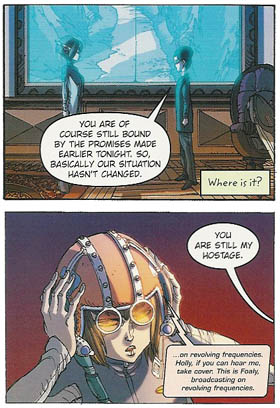
Artemis Fowl: The Graphic Novel uses that comics technique to replicate the prose novel's shifting points of view. Contrast the caption in the first of the four stacked panels above, its font and coloring, with the caption in panel three. The first is the fairy Holly's thought as she searches for her helmet. The second is Artemis's reflection as he sees Holly about to punch him in the face. The comics form offers both characters' thoughts in the same scene.

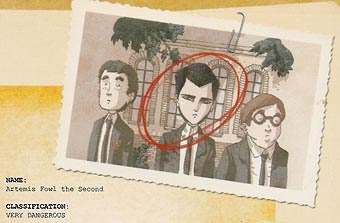
Another comic-book technique that pops up in Artemis Fowl: The Graphic Novel is the character profile; the top illustration is a bit of Artemis's. Each full-page profile offers a combination of words and image to introduce a magical creature or locale. Novels can't lay out such information without breaking the narrative flow, but such profiles are a comic-book tradition. DC publishes a whole series offering such dossiers on its heroes and villains: Secret Files. Another inspiration is probably card games like Magic: The Gathering. (It's no surprise that similar pages appear in The Spiderwick Chronicles; coauthor and artist Tony DiTerlizzi worked on Magic cards.)

There are other big points of overlap between Colfer's Artemis Fowl and comic-book adventures:

The second of those qualities is a flaw in any kind of novel, but the last one is a plus for the graphic form. The action allows visual storytelling in the hyped-up style that comic-book creators have developed to a high effect over the years. It's another way that, I found, Artemis Fowl: The Graphic Novel works as an over-the-top adventure comic.

Bottom line: A novel that reads a lot like a comic book makes a good comic book.