Showing posts with label AUTHOR Ruth Plumly Thompson. Show all posts

03 February 2026

Two More Tales of Oz

The 2025 edition of Oziana, the International Wizard of Oz Club’s creative magazine, is now available for purchase through Lulu.

This issue contains two stories by me.

“The Piglets and the Tin Soldier” is another short slice-of-life tale inspired by L. Frank Baum’s Little Wizard Stories of Oz, taking a couple of his established characters and bouncing them off each other.

The Nine Tiny Piglets first appeared from the Wizard’s pockets in Dorothy and the Wizard of Oz and made small cameos in the Emerald City after that, never getting individual names. 

Captain Fyter, the Tin Soldier, marched onto the scene in The Tin Woodman of Oz. At one point in that book the heroes meet the piglets’ parents. Afterward the soldier says, “I hope I’m not too particular about my associates, but I draw the line at pigs.” So there was a natural tension to work with.

David Valentin created digital artwork of the Tin Soldier and his basket of piglets for this story of a journey through the Munchkin Country.

“The Missing Key” is a mystery featuring Snip, the button boy who was a protagonist of Ruth Plumly Thompson’s The Lost King of Oz. She introduced Snip sneaking into Mombi’s kitchen and then spying on her, establishing him as a curious kid. Several years ago, I used that trait to bring Snip into a story called “Invisible Fence.” More recently I realized that would make him a good investigator for a mystery.

In this story, Snip sets out to retrieve the wind-up key that’s vanished from Tik-Tok’s back. David Lee Ingersoll supplied the illustrations, including one of Snip pinned to the ground by string-wielding field mice, inspired by scenes in The Wonderful Wizard of Oz and Gulliver’s Travels.

10 November 2015

The Emerald City in the Gutter

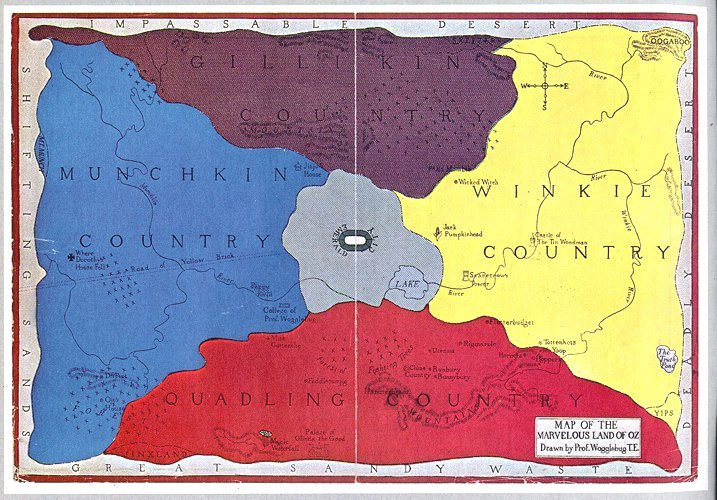
Here’s another view of the map of Oz as issued by Reilly & Lee. Can you spot two big differences between it and the map shown last week, from David Maxine’s Hungry Tiger Talk blog?

One difference is that this is a later reprinting of the map that first appeared in Tik-Tok of Oz (1914). As David discussed, the compass rose originally put east on the left and west on the right, contrary to the usual approach. At some point in subsequent decades, the publisher changed the labels so “E” was on the right as usual.

Of course, that change also meant the map showed the Winkie Country to be east of the Emerald City instead of west, as all of L. Frank Baum’s books described it. But his successors Ruth Plumly Thompson and John R. Neill started to state that the Winkies lived to the east, conforming to the reprinted map and its conventional compass.

Another difference is that the version of the map above is a broadside while the image David showed was scanned from an early copy of Tik-Tok of Oz, where it served as the endpapers. And that highlights a feature I find really interesting from the perspective of book design.

This map had to look good both as endpapers, when a thin strip of its middle would be concealed in the book’s binding, and as a poster or broadside lying flat. The artist accomplished that by making sure that almost no sites and no lettering fell within that central strip. Some large labels bridge the strip, such as the word “GILLIKIN” in the top quadrant—but there’s a little extra space between the second I and the K that could disappear into the binding.

The Emerald City was a challenge because Baum was clear that it’s in the middle of Oz—and thus in the middle of this map. How to keep it from vanishing into the gutter? The artist’s solution was to depict the city as a horizontal oval, with the word “Emerald” on the left and “City” on the right. (David Hulan once pointed out that the oval approximates an “emerald cut” in jewelry.) Then when the central strip of the map is hidden (look back on David’s map), the city appears as a circle and its full name remains legible.

On the accompanying map of Oz and surrounding countries, shown below, the Emerald City is safely off-center. And it appears as a circle, as it would appear in the endpapers form of the Oz map. This time the artist tried to keep other labels and locations out of the central strip. In the image from Wikipedia below, you can see where that got tough.

15 July 2014

Baum’s Collaborators, Real and Fictional

The Wild Things gang are sharing material they couldn’t include in their new book on their blog, including this article about the partnership between L. Frank Baum and W. W. Denslow on The Wonderful Wizard of Oz.

Here’s a bit about what happened after that book had become such a success but the men’s friendship soured:
Once Denslow received the royalties from the musical, he set off and decided to live the American dream à la Gilligan’s Island. Which is to say, he up and bought himself a tropical island. An honest-to-goodness tropical isle. It was just off the coast of Bermuda, a good four acres (though he would claim to anyone who was listening that it was ten) and it didn’t stop there. With what appears to be a tongue stuck firmly in his cheek (though it’s a little hard to tell) Denslow went on to crown himself King Denslow I of Denslow Island. He turned his native boatman into the “admiral of his fleet” and then went on to make his Japanese cook the prime minister. Said he, “If the government in Washington had got wind of it in the early stages, I have no doubt that they would have sent a fleet to Denslow Island to blow it out of the water.”

Suffice to say, this situation didn’t last. Full-blown island kingships rarely do. Denslow was an alcoholic and after selling a full-color cover to Life magazine he celebrated by going on a two day bender, getting pneumonia, and dying at the age of 58. Baum’s reaction upon hearing of Denslow’s death has been lost to the annals of history. What we do know, however, is that, when he was told, it was with the false information that Denslow had committed suicide.
That extracted extract goes on to discuss a stylometric analysis of The Royal Book of Oz, which I analyzed briefly back here. That 1921 book was credited to Baum but said inside to have been completed by Ruth Plumly Thompson, who had her name on the cover of the next eighteen annual Oz novels.

The computer-aided analysis of Royal Book’s writing style found that Thompson actually wrote the whole book. But that’s not really a discovery. All the way back in 1954 Jack Snow credited that book to Thompson in Who’s Who in Oz. When Reilly & Lee reissued all of Baum’s Oz novels in the 1960s, they let Royal Book go out of print—because they knew it wasn’t Baum’s.

I don’t doubt that the stylometric study of Royal Book showed it fit Thompson’s writing profile far more than Baum’s. But that wasn’t new information about the book. It was new information about the validity of that stylometric method.

06 August 2013

Why Thompson Oz Books Smell a Little Like Vanilla

Back in 2009 I wrote fondly about the smell of Ruth Plumly Thompson’s Oz books, as originally published by Reilly & Lee in the 1920s and ’30s. Lots of American books of that era shared the same perfume, though perhaps not as strongly, given that publisher’s low budgets.

This summer the Smithsonian blog noted an article from the International League of Antiquarian Booksellers on the chemistry of that smell:
Scientists say that “old book smell” is more than just mustiness; it contains hints of grass and vanilla. That’s because all the compounds used to make the book release distinctive odors as they break down. For example, lignin, which is present in all wood-based paper, is closely related to vanillin. As it breaks down, the lignin grants old books that faint vanilla scent.

It’s even possible to approximate the age of a book based on its smell. Chemists have identified 15 substances often present in books (known as VOC’s) that degrade (and therefore emit a gas) at a predictable rate.
The abstract of the underlying scientific paper, published in 2009, goes into more detail:
The main volatile degradation products of paper, constituting the particular “smell of old books”, were determined using headspace analysis after a 24 h predegradation procedure. Using supervised and unsupervised methods of multivariate data analysis, we were able to quantitatively correlate volatile degradation products with properties important for the preservation of historic paper: rosin, lignin and carbonyl group content, degree of polymerization of cellulose, and paper acidity.
Those scientists, some working with the Centre for Sustainable Heritage in Britain, appear to have been most interested in the preservation and dating of books. But I can also imagine interest in their findings from people who wish to create books as luxury items. What could be more luxurious than a book that smells wonderfully old but is actually in great shape?

30 May 2012

Reconciling with the Wizard of Oz

Yesterday I described a review of a latter-day Oz book by Hugh Pendexter III. Among Oz fans he’s best known for his short book Oz and the Three Witches, published in 1977. It was inspired by two contradictory passages that L. Frank Baum left us about the Wizard of Oz, the evil witch Mombi, and the baby princess Ozma.

First, near the end of The Marvelous Land of Oz (1904), Baum narrated Glinda the Good’s interrogation of Mombi this way:
“I will ask my first question: Why did the Wizard pay you three visits?”

“Because I would not come to him,” answered Mombi.

“That is no answer,” said Glinda, sternly. “Tell me the truth.” . . .

Mombi now saw how useless it was to try to deceive the Sorceress; so she said, meanwhile scowling at her defeat:

“The Wizard brought to me the girl Ozma, who was then no more than a baby, and begged me to conceal the child.”

“That is what I thought,” declared Glinda, calmly. ”What did he give you for thus serving him?”

“He taught me all the magical tricks he knew. Some were good tricks, and some were only frauds; but I have remained faithful to my promise [to hide] the Princess Ozma—the child brought to me by the Wizard who stole her father’s throne.“
Baum wrote that book because of the popularity of the 1902 stage extravaganza adapted from The Wonderful Wizard of Oz. That show used the Wizard as an antagonist, a charlatan and mountebank who had stolen the rightful king’s throne, and the book reflected that characterization.

But in Dorothy and the Wizard in Oz (1908), Baum brought the Wizard back as a capable and reliable protector for Dorothy. What happened when they reached the Emerald City and the Wizard met up with its new ruler, Princess Ozma? She asks him about his first arrival in Oz.
“At that time,” continued the Wizard, busily eating his soup while talking, “there were four separate countries in this Land, each one of the four being ruled by a Witch. But the people thought my power was greater than that of the Witches; and perhaps the Witches thought so too, for they never dared oppose me. I ordered the Emerald City to be built just where the four countries cornered together, and when it was completed I announced myself the Ruler of the Land of Oz. . . .”

“That is quite a history,” said Ozma; “but there is a little more history about the Land of Oz that you do not seem to understand—”
Aha—the J’accuse moment when Ozma confronts the Wizard with his misdeeds: “Do you remember the child you handed over to an evil crone? I, sir, was that little baby you sold into slavery!”

But no. She continues:
“Many years before you came here this Land was united under one Ruler, as it is now, and the Ruler’s name was always ‘Oz,’ which means in our language ‘Great and Good’; or, if the Ruler happened to be a woman, her name was always ‘Ozma.’ But once upon a time four Witches leagued together to depose the king and rule the four parts of the kingdom themselves; so when the Ruler, my grandfather, was hunting one day, one Wicked Witch named Mombi stole him and carried him away, keeping him a close prisoner. Then the Witches divided up the kingdom, and ruled the four parts of it until you came here. That was why the people were so glad to see you, and why they thought from your initials that you were their rightful ruler.”

“But, at that time,” said the Wizard, thoughtfully, “there were two Good Witches and two Wicked Witches ruling in the land.”

“Yes,” replied Ozma, “because a good Witch had conquered Mombi in the North and Glinda the Good had conquered the evil Witch in the South. But Mombi was still my grandfather’s jailor, and afterward my father’s jailor. When I was born she transformed me into a boy, hoping that no one would ever recognize me and know that I was the rightful Princess of the Land of Oz. But I escaped from her and am now the Ruler of my people.”

“I am very glad of that,” said the Wizard, “and hope you will consider me one of your most faithful and devoted subjects.”
And nothing more is said of kidnapping and baby-selling and other disagreeable subjects.

Ruth Plumly Thompson explored the history of Ozma’s father and Mombi in The Lost King of Oz (1925), but many gaps and inconsistencies remained. (Indeed, we haven’t even touched Baum’s later statement that Ozma was really a fairy left by a fairy queen in the far distant past.)

Pendexter’s Oz and the Three Witches picks up after the second conversation above as Glinda comes to the Emerald City to quiz the Wizard about the whole Ozma matter. The result is a lively little tale of the Wizard trying to fend off the Wicked Witches of East and West through his humbug illusions while navigating the tricky politics of pre-Dorothean Oz. He doesn’t realize who Mombi is, and he’s very, very sorry. All in all, it’s about as good a reconciliation of Baum’s contradictory statements as possible.

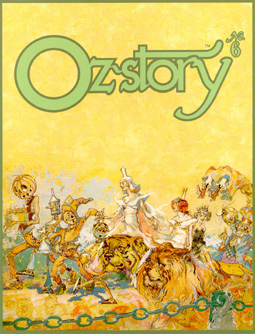
First published in 1977, Oz and the Three Witches was reprinted in its entirety with Patricia Ambrose’s quite competent illustrations in Oz-Story, #6.

17 April 2012

Mapping Oz

David Maxine at Hungry Tiger Press is mapping the history of Oz cartography each Monday. The latest installment examines the map included in The Lost Princess of Oz, which showed the settings of that adventure.

This was the first map to follow the comprehensive “official” pair published two years earlier in Tik-Tok of Oz. David writes:
This careful explanation of existing geographic points proves to me that Baum was looking at a copy of the 1914 map as he wrote. Indeed the 1914 map may have been a crucial plotting tool for Lost Princess. As we've discussed previously, Baum added several countries and locales to the 1914 map that he had not yet written about, such as the Skeezers, Mount Munch, and the Yips. It's possible that Baum had some notion of the plot of Lost Princess back in 1914, allowing him to place the Yip Country near the Truth Pond where the Frogman will bathe, but I think the evidence shows it is far more likely that Baum plotted the book by looking at the map - choosing to begin in one of his unexplored countries (the Yips) and seeing the only nearby landmark was the Truth Pond and he needed to come up with some excuse to make use of it.
Before Reilly & Britton published Tik-Tok of Oz, Baum’s books mentioned a map of Oz only one time. And in that mention, in one of the short stories in The Little Wizard Stories of Oz, Ozma draws an impromptu map for Jack Pumpkinhead to follow [yeah, that’ll work]. However, the story’s narrator never mentions an “official” map of the country or its neighboring fairylands.

After the Tik-Tok map appeared, every Oz book for decades included some mention of a map of Oz. Sometimes authors located their new countries on that map. Sometimes characters had or discussed maps. The authors simply couldn’t disregard that official layout for the country.

I agree with David that Baum looked at the Tik-Tok maps while writing his stories and drew inspiration from them. We also know that Ruth Plumly Thompson kept a copy of a map of Oz on which she drew the new places she created. John R. Neill included double-page maps in his books and took names of the 1914 documents.

In sum, the books and manuscripts Baum wrote up to 1914 shaped the official map of Oz, but the map shaped the stories he and his successors wrote after that.

07 February 2012

A Lesson from Sir Hokus

My thoughts on the value of a ongoing characters having an unresolvable foundational conflict have their roots, I realize, in thinking about a character far less known than Superman.

It was Sir Hokus of Pokes, the first recurring character that Ruth Plumly Thompson added to Oz. He’s an old knight that Dorothy and the Cowardly Lion find in The Royal Book of Oz (1921). He moves to the Emerald City and plays a supporting role in several more adventures, rather as L. Frank Baum used the Shaggy Man. He’s not rounded, and I doubt he’s many people’s favorite, but he becomes a comfortable part of the fabric of Thompson’s Oz.

As such, Sir Hokus reflects Thompson’s sensibility, based on older European fairy tales. In contrast, Baum’s usually tried to find magic in contemporary American culture for Oz.
I think Sir Hokus’s unresolvable foundational conflict is that he’s a man out of time. He speaks in a medieval lingo, constantly expressing a wish to rescue fair maidens and slay dragons. His anachronism is underscored by his age. Like Lewis Carroll’s White Knight, he’s an old man, still active but gray. In both respects, he’s removed from his prime period, no longer able to undertake all the quests he yearns for.

In The Yellow Knight of Oz (1930), Thompson made Sir Hokus one of her protagonists. He goes off on a solo quest at last. Along the way, complications ensue. By the end of that book, Sir Hokus is no longer a man out of time; he’s ensconced in a medieval-style culture. Furthermore, he’s young again.

As a result, the character is no longer the least bit interesting. Sir Hokus’s foundational conflict has been resolved. Even though Dorothy looks in the younger man’s eyes and says he’s the same friend she knew, it’s no surprise that he makes only token appearances in the rest of Thompson’s series.

John R. Neill liked drawing Sir Hokus so much, evidently, that he brought the old knight back in his three Oz books, once more chasing dragons without being able to slay them. Neill offered no explanation of how, but neither consistency nor logic was part of his storytelling.

13 October 2011

Art from Oz

The Australian picture-book artist Ben Wood is aiming to post an Oz illustration every day of this month. Above is his take on Ojo the Lucky, the Munchkin boy at the heart of L. Frank Baum’s The Patchwork Girl of Oz, as well as the Glass Cat. I also particularly like his Cowardly Lion and Wogglebug.

My reading of Ojo is that he’s a bit bipolar. For most of Patchwork Girl, he’s prone to crying jags and complaining about bad luck. In Ojo of Oz (1933), Ruth Plumly Thompson even refers to him at times as “depressed.”

Yet in books where he’s not the star, just one of the crowd, as in Glinda of Oz, Ojo tends to be as chirpy as he appears above. The first mood is a lot easier to make interesting, especially since he also has a habit of overstepping rules that people have specifically warned him about.

In other Oz-art news, Bill Campbell at The Oz Enthusiast has opened a Zazzle store.

02 August 2011

Henry Darger as L. Frank Baum’s Literary Heir?

Earlier this year Steve Ahlquist, principal creator of the early-1990s Oz Squad comics, wrote at Forces of Geek about “outsider artist” Henry Darger as L. Frank Baum’s true literary heir.

Baum’s Oz books certainly inspired Darger (1892-1973). The photo at right (courtesy of Some Girls Wander) shows that at his death Darger owned four Baum Oz books and one by Ruth Plumly Thompson, plus some more that might be missing their spines.

Darger might even have been part of Baum’s original audience, having grown up in Chicago around the turn of the last century. However, he also had a poor childhood, ending in orphans’ homes, so he might not have been able to enjoy much reading.

Ahlquist writes:
When Baum died, the mantel of “Royal Historian of Oz” was passed to Ruth Plumly Thompson, a capable if uninspired writer too often given to formula and romance. Though she wrote under the L. Frank Baum byline [note: for only one book, The Royal Book of Oz], the stories she contributed to the series never lived up to the original 14 novels Baum produced. The magic, it seems, had gone out of Oz.

But not out of Darger. While Baum's publisher, Reilly and Lee, sought to promulgate the fiction that Ruth Plumly Thompson was somehow the Royal Historian, in truth that job would fall to Henry Darger. His dark visions charted the exploits of a new and more dangerous space in the meme world of children’s literature. No longer were we in the safe realms of children’s fantasy, we were in the realms of the unreal, where fantasy and horror abutted one another uneasily.

Darger wrote of Child slavery, child murder, and explored his own confusion about, violence, sex, identity, good and evil.
I think that this essay, in the quest for a provocative formulation, gives too much credit to Darger’s crazy fantasies. While Baum’s plotting could be haphazard, he at least had plots. Darger’s sprawling epic has little coherence and two endings. Baum’s strength was in creating characters and showing how they interact. Darger seems to have treated all his characters as nearly interchangeable little bodies, without personalities. He’s recognized primarily as a visual artist, even if he saw himself as illustrating a story. Most important, Baum knew he was writing for an audience of children.

As for sex, there’s much more of an undercurrent of that in Thompson’s Oz books than in Baum’s.

Also at Forces of Geek in March, Ahlquist shared material on his planned prequel to Oz Squad, and how he saw his version of Ozian history building on Baum’s series:
Dorothy and Ozma named their son Ozzy, and one day perhaps he will become King Ozzy I.

22 February 2010

Not a Bit of It

Doing far more than is called for, Mari Ness recently reviewed The Cowardly Lion of Oz, by Ruth Plumly Thompson, at the Tor website. Published in 1923, this is the earliest Oz book still under copyright protection. It’s also one of the few strong arguments I know for keeping books that old out of the public domain.

Ness zeroes in on one of the annoying aspects of this book, the character of Notta Bit More, the neurotic circus clown:

The clown follows, he explains, four rules whenever he is in danger. One, try to disguise himself. Two, be polite—very polite. Three, joke. And Four, when all else fails, run away. And not at all to his credit, he follows these same four rules over and over throughout the book, leading to the same scene, over and over:

Clown sees, or thinks he sees, danger.

Clown puts on disguise.

People react with fear/anger/weapons/claws/large buckets of water.

Clown attempts to be polite to justifiably irritated/angry/frightened/distrustful people who are now in no mood for politeness.

Clown tells unfunny jokes.

People tie up or sit on clown. Readers wait in unfulfilled hope for someone to kill the clown.
In addition, Notta Bit More overshadows the book’s young American protagonist, erasing one of the strengths of the Oz books, even others with poor plots: empowered children.

One recurring theme of Ness’s reviews of the Oz series is “Ozma fail,” or poor decisions by the young ruler of the Emerald City. Of course, the biggest challenge of telling stories about Oz is that after the first eight books or so Ozma and her mentor Glinda are so powerful and have so much information available to them that it’s hard to build up a real threat. Some things we have to accept for the sake of the story.

But Notta Bit More isn’t one of them.

24 March 2009

Smells Like...Thompson

A certain smell immediately takes my mind back to reading Ruth Plumly Thompson’s Oz novels when I was eleven, discovering what crazy concoction of magic, romance, and chase scenes she'd come up with this time.

I think about that smell whenever I hear people claim that readers are so fond of the aesthetics and sensory experience of reading printed books that digital versions will never replace bound hard copies.

But what I smelled wasn't Oz, or children's literature. I was smelling the rotting of paper made with lots of wood fiber, and the glue that Reilly & Lee used on its cheap bindings of the 1930s. People younger than me who took in Thompson's stories through the Del Rey paperbacks of the 1980s no doubt have a different sensory memory of that experience, one that didn't depend on the books eating themselves away from within.

Yet the stories were the same, with all their ups and downs, strengths and flaws. Our reading memories differ because of many personal circumstances, and the physical format of the book is a minor factor at best. When Thompson did her job, we were immersed in the story, paying little attention to the real world. Digital formats convey that just as well as printed ones.

Similarly, people have been taking in the story of the Trojan War for millennia--in oral form, on scrolls, on handwritten codexes, in multiple printed volumes, and so on. In the middle of the 20th century, many readers consumed The Iliad or Troilis and Cressida from cheaply printed, pulpy books. Now readers are coming to the story in graphic form. The saga has lasted because of its inherent drama and tradition, not because of a particular packaging. The Odyssey is still with us; scrolls are not.

I think of this as I listen to my Humanities Major-classmate Jacob Weisberg speaking on NPR's Talk of the Nation about the aesthetics of digital books. His Microsoft colleagues used to tell him that if the smell of paper and glue was an inherent part of the reading experience, e-book readers could supply that smell. But we're quickly learning that rotting pulp is not necessary for an enjoyable read; it's just a side effect that some of our brains have been conditioned to remember fondly.

03 November 2008

Stylometry for Fun and Profit

At the recent Oz Club convention in Fayetteville, New York, there was a discussion of whether stylometry (I remembered the word with the help of my PDA) could identify certain anonymous newspaper articles as the writing of L. Frank Baum.

Stylometry is the systematic analysis of writing style, based on the notion that we all have unique and unconscious quirks, preferences, and patterns in our prose. Though people have been using various stylometric techniques for centuries, the field has really taken off with computers.

Don Foster is probably the best-known stylometrist now, as he was glad to explain in his book Author Unknown (2000). But other practitioners have their own methods, based on other stylistic details and differences.

Stylometry has even been applied to Baum's writing already. In 2003, José Binongo used software to analyze The Royal Book of Oz, which was published under Baum's name but for the last fifty years been identified as Ruth Plumly Thompson's work. To no one's surprise, the book's prose turned out to have much more in common with Thompson's other novels than with Baum's. (I suspect this paper was really meant to validate that stylometric method rather than to solve the "mystery.")

On Sunday the Times of London reported on a Republican attempt to use stylometry to affect tomorrow's US election:

Dr Peter Millican, a philosophy don at Hertford College, Oxford, has devised a computer software program that can detect when works are by the same author by comparing favourite words and phrases.

He was contacted last weekend and offered $10,000 (£6,200) to assess alleged similarities between [Barack] Obama’s bestseller, Dreams from My Father, and Fugitive Days, a memoir by William Ayers. . . .

The offer to Millican to prove that Ayers wrote Obama’s book was made by Robert Fox, a California businessman and brother-in-law of Chris Cannon, a Republican congressman from Utah. He hoped to corroborate a theory advanced by Jack Cashill, an American writer.

Fox and Cannon each suggested to The Sunday Times that the other had taken the initiative.

Cannon said that he merely recommended computer testing of the books. He doubted whether Obama wrote his autobiography, adding: “If Ayers was the author, that would be interesting.”

Fox said he had hoped that Cannon would raise the $10,000 to run a computer test. “It was Congressman Cannon who initially pointed me in that direction and, from our conversation, I thought he might be able to find someone [to raise the $10,000].”

He believed that if “proof” of Ayers’s involvement was provided by an Oxford academic it would be political dynamite.

Fox contacted Millican, who said: “He was entirely upfront about this. He offered me $10,000 and sent me electronic versions of the text from both books.”

Millican took a preliminary look and found the charges “very implausible”. A deal was agreed for more detailed research but when Millican said the results had to be made public, even if no link to Ayers was proved, interest waned.

Millican said: “I thought it was extremely unlikely that we would get a positive result. It is the sort of thing where people make claims after seeing a few crude similarities and go overboard on them.” He said Fox gave him the impression that Cannon had got “cold feet about it being seen to be funded by the Republicans”.
Which, of course, it would have been.

Millican also described the experience on his website, and explained how Cashill used his Signature software crudely to produce a false positive result. Anyone can download the program for educational purposes, and no doubt use it for better purposes.

Cashill is a right-wing writer known until last year for his TWA 800 and Clinton conspiracy theories. As for Rep. Cannon, he lost his Republican primary this summer and will leave Congress shortly.

Why would those two men and Fox believe that Sen. Obama couldn't have written his own autobiography? He has been, after all, a law review editor, a law school professor, and a politician known for his speeches even before he could afford speechwriters. What about Obama could make those men doubt that he could write? I wonder.

06 July 2007

When Pigs Fly in The Baum Bugle

Yesterday I posted links to some images that supplement my article about John Dough and the Cherub (1906) in the latest issue of The Baum Bugle. Today I'm displaying another image from that magazine that got pixelated in the printing.

The small image to the right, which comes from Oz-Central.com, is a color plate from Ruth Plumly Thompson's The Wishing Horse of Oz (1935). It shows Pigasus, the winged pig, and Princess Dorothy trapped in the coils of a stretchable palace.

Who's the man poking his head out of his skylight? And how might he help Dorothy restore proper order to Oz? For answers you'll have to read the book. Fortunately, it's in print and available from the International Wizard of Oz Club, as well as other sources.

Also in this issue of the Bugle are Ruth Berman's discussion of some difficulties in mapping Oz, Atticus Gannaway's discussion of flying pigs in literature and life, the annual Oz trivia quiz, and many fine reviews and reports about recent Oz publications and news. The Baum Bugle goes free to all members of the Oz Club.

17 February 2007

An Elegant Art Collection

Mamluke has kindly scanned some of John R. Neill’s art for Kabumpo in Oz, by Ruth Plumly Thompson (1922), and posted it for the world on Flickr. The collection includes several pictures of Kabumpo the elegant elephant himself, undergoing various indignities. (On adventures his robes always end up tattered, and he usually meets a giant who makes him feel small.)

There are also a handful of color plates, not printed in most copies of that book. (The Books of Wonder reprint has them; the Del Rey paperback still available from the Int’l Wizard of Oz Club does not.) Probably the best is this image of Ruggedo, the former Nome King, grown into a giant with Ozma’s palace stuck on his head.