Showing posts with label ARTIST W. W. Denslow. Show all posts

10 September 2019

Mid-Century Modern in the Emerald City

After the original publisher of The Wonderful Wizard of Oz went bankrupt, Bobbs-Merrill became the book’s one and only US publisher.

At first Bobbs-Merrill included W. W. Denslow’s illustrations, though not in the original ground-breaking multi-color design that integrated text and art. The company kept the book in print until the World War 2 paper shortages. As the war wound down, it looked for a way to reintroduce the title.

In 1944, Bobbs-Merrill commissioned entirely new art by Evelyn Copelman (1919-2003, also known as Evelyn Campbell and Evelyn Copelman Baker). She created black-and-white art on scratchboard and painted several color plates.

The title page of that new edition stated that Copelman’s art was “adapted from the famous pictures by W. W. Denslow.” Obviously those pictures weren’t the only source. Copelman’s Dorothy, Scarecrow, and Wizard are clearly designed like the characters in the 1939 MGM movie, and her Tin Woodman and Cowardly Lion look like hybrids.

Bobbs-Merrill had asked Copelman to create an edition that matched the movie, but it didn’t have rights to the MGM designs. It did own the rights to Denslow’s art, however. The title page claim apparently provided legal cover.

In 1949 MGM re-released its movie into cinemas. Not coincidentally, Bobbs-Merrill gave the book a new push. Copelman reworked her line art and added more plates.

With the book still under copyright, Bobbs-Merrill was the exclusive producer of new copies of The Wizard of Oz. Thus, for over a decade in the middle of the century, Evelyn Copelman’s artwork introduced young readers to Oz.

Then the copyright lapsed in 1956. Reilly and Lee, the publisher of the rest of the Oz series, created an edition with black-and-white reproductions of Denslow’s art in a trim that matched its other titles. Other publishers commissioned their own illustrations. As the years passed, Copelman’s art disappeared from bookstore shelves.

Archive.org, working with the San Francisco and other public library systems, has made a digital copy of a Copelman edition available for borrowing. This is a 1994 Illustrated Junior Library edition, with cover artwork by Michael Zimmer but Copelman’s line art and five plates inside. It’s worth a virtual thumb-through, especially if that’s the edition you remember.

28 October 2014

Monkeying Around with Influences

This is Harry Bliss’s daily newspaper cartoon from 16 Oct 2014.

I like the way he’s combined the costuming from the MGM movie with the composition of one of W. W. Denslow’s color plates.

15 July 2014

Baum’s Collaborators, Real and Fictional

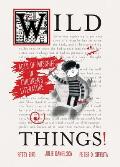
The Wild Things gang are sharing material they couldn’t include in their new book on their blog, including this article about the partnership between L. Frank Baum and W. W. Denslow on The Wonderful Wizard of Oz.

Here’s a bit about what happened after that book had become such a success but the men’s friendship soured:
Once Denslow received the royalties from the musical, he set off and decided to live the American dream à la Gilligan’s Island. Which is to say, he up and bought himself a tropical island. An honest-to-goodness tropical isle. It was just off the coast of Bermuda, a good four acres (though he would claim to anyone who was listening that it was ten) and it didn’t stop there. With what appears to be a tongue stuck firmly in his cheek (though it’s a little hard to tell) Denslow went on to crown himself King Denslow I of Denslow Island. He turned his native boatman into the “admiral of his fleet” and then went on to make his Japanese cook the prime minister. Said he, “If the government in Washington had got wind of it in the early stages, I have no doubt that they would have sent a fleet to Denslow Island to blow it out of the water.”

Suffice to say, this situation didn’t last. Full-blown island kingships rarely do. Denslow was an alcoholic and after selling a full-color cover to Life magazine he celebrated by going on a two day bender, getting pneumonia, and dying at the age of 58. Baum’s reaction upon hearing of Denslow’s death has been lost to the annals of history. What we do know, however, is that, when he was told, it was with the false information that Denslow had committed suicide.
That extracted extract goes on to discuss a stylometric analysis of The Royal Book of Oz, which I analyzed briefly back here. That 1921 book was credited to Baum but said inside to have been completed by Ruth Plumly Thompson, who had her name on the cover of the next eighteen annual Oz novels.

The computer-aided analysis of Royal Book’s writing style found that Thompson actually wrote the whole book. But that’s not really a discovery. All the way back in 1954 Jack Snow credited that book to Thompson in Who’s Who in Oz. When Reilly & Lee reissued all of Baum’s Oz novels in the 1960s, they let Royal Book go out of print—because they knew it wasn’t Baum’s.

I don’t doubt that the stylometric study of Royal Book showed it fit Thompson’s writing profile far more than Baum’s. But that wasn’t new information about the book. It was new information about the validity of that stylometric method.

08 April 2014

Mickey Rooney in Oz

Mickey Rooney had the rare distinction of playing two roles in prominent dramatic adaptations of the Oz books.

In 1974 Rooney provided the voice of the Scarecrow in Journey Back to Oz, an animated feature based loosely on L. Frank Baum’s first sequel, The Marvelous Land of Oz, with Dorothy thrown in. Dorothy’s voice was recorded by a young Liza Minnelli, daughter of one of Rooney’s frequent costars at MGM.

In 1998-99 Rooney played the Wizard in an arena-stage adaptation of the MGM Wizard of Oz, with the most prominent venue being Madison Square Garden in New York. His costars included Eartha Kitt as the Wicked Witch and Jessica Grove as Dorothy. Visually the older Rooney was a good match for W. W. Denslow’s drawings, but of course audiences wanted to see a Wizard who looked like Frank Kramer.

In the article announcing that production’s arrival in New York, Playbill magazine reported this anecdote:
MSG spokesperson Geoff Cohen relayed an amusing Rooney incident that occurred while the tour was in Chicago: “When Mickey takes off in the balloon at the end of the show, he’s in the basket, which is constructed with cables attached to the rim. Two guys on the floor hold the ropes to keep him from taking off. So Mickey’s supposed to lean forward and wave goodbye to everyone, and he says ‘I really don't know how this thing works’ and ‘You’re spoiling my exit!’ But this time, one of the floor guys held on to the ropes too long, so the basket flipped over, and Mickey was hanging upside down, holding onto the railing, twelve feet above the ground. It was a dangerous situation, but what did he do? Not only was he as cool as you could ask for a person to be, he looked up at the audience and said, ‘I guess I’m not leaving quite yet... You see I really don’t know how this thing works!’”
At the time Rooney was seventy-seven years old.

28 November 2013

Let Us Be Thankful That This Isn’t Rerun Every Year

In 1980 the Muller Rosen animation company released a half-hour holiday special for television titled Thanksgiving in the Land of Oz. That show was then recut to remove the Thanksgiving references and released on video as Dorothy in the Land of Oz; as of this holiday, it can be watched in two parts on YouTube. In 1982 Romeo Muller adapted his screenplay into a short illustrated book titled Dorothy and the Green Gobbler of Oz.

Like most Oz videos in the television age, this cartoon was written to invoke MGM’s Wizard of Oz. Dorothy meets the Wizard in Kansas again, the Cowardly Lion is bipedal, there are songs, and so on. But the filmmakers also obviously knew the Oz books and used them as inspiration for characters, settings, and plots points, albeit without being faithful to those books.

Thus, for example, just as in L. Frank Baum’s original novel and the MGM movie, Dorothy and Toto accidentally travel to Oz and meet three male companions who help her on a quest to vanquish a villain. One of those companions is an animated refugee from a farm, another made of metal, and the third a big carnivore with gentle habits. But in this movie those characters are Jack Pumpkinhead, Tic Toc [sic], and the Hungry Tiger, whom Baum introduced in different ways in his second and third Oz books.

Jack lives in a pumpkin house, as John R. Neill drew it in The Road to Oz. Other Oz houses resembles those he and W. W. Denslow designed, and a sequence of children opening Christmas presents owes a lot to Denslow’s art, rendered with less character. However, a trip over a rainbow at the end is clearly inspired by the MGM movie’s most famous song.

The end of the cartoon shows Ozma as rightful ruler of the Emerald City, but there’s no explanation of how she came to the throne. This Ozma seems much older than Dorothy and more like the Glinda of the movie.

Another element that the filmmakers borrowed from Baum’s books appears at the start: Uncle Henry and Aunt Em are about to lose their farm to the bank. The couple plans to go into an “old folks’ home” while Dorothy will have to live somewhere far away with a cousin—perhaps Zeb Hugson from Dorothy and the Wizard in Oz. This is a better fate than what Baum wrote about in The Emerald City of Oz, which suggested Dorothy would have to go to work while her aged relatives might end up begging. Still, it was probably a shock to many viewers.

The big-name star of the production is Sid Caesar, who plays the Wizard and narrates the story in that role. Caesar also plays a mince pie that’s brought to life, takes the name U.N. Krust, and delivers every line in a different foreign accent. The pie and its speech patterns play no role in the plot; they seem to have been included just to put Caesar’s shtick to use. We haven’t seen so much ethnic humor in an Oz adaptation since the 1903 Broadway show.

Another notable casting detail: Joan Gerber supplied the voices for both Ozma and Tic Toc.

The cartoon includes a couple of forgettable songs. Dorothy uses one to convert the villain back into a benevolent toymaker, and at the same time deliver a paean to Christmas shopping. In that respect, this modestly produced special was a perfect start to commercial television’s holiday season.

24 October 2012

Denslow in Cherokee

While researching a story, I came across this webpage from Western Carolina University’s Cherokee language program.

It uses the art from W. W. Denslow’s picture book Three Little Kittens, originally published in 1904. Those pictures come with a new Cherokee translation to create a tool for teaching that language to kids today. There are audio and PowerPoint versions, plus videos of classroom discussions and sample handouts.

There’s a similar interpretation of Denslow’s Five Little Pigs.

01 October 2012

Baum and The Inland Printer

In the 1890s L. Frank Baum and his family moved to Chicago. He supported them as a freelance journalist and traveling salesman before parlaying his (brief and unsuccessful) experience as a shopkeeper in Aberdeen, South Dakota, into a job editing The Show Window.

In 1900 a Chicago-based trade magazine called The Inland Printer described Baum’s magazine in a squib that might have been supplied by the editor himself:
The Show Window, edited by L. Frank Baum, Chicago, is growing in interest from month to month. It is the official organ of the National Association of Window Trimmers of America, and contains an amount of information in this line to be had through no other source. Its half-tone illustrations of window display are worth more than the price of the publication. No storekeeper can afford to be without such a magazine. Its suggestions for Easter window decorations in the special Easter number are a treat to even the uninitiated.
By then Baum also had a second career as a children’s author. The Inland Printer noted that as well a few issues later:
The author of “Father Goose,” Mr. L. Frank Baum, has followed up his success with a remarkable juvenile entitled “A New Wonderland,” which is shortly to be issued by R. H. Russell, of New York. The reader is introduced to a marvelous and hitherto undiscovered country, peopled with the quaintest and merriest characters ever conceived to delight childish hearts. Frank Ver Beck has made many colored pictures for the new book, which bids fair to attain a popularity seldom accorded a juvenile publication.
That book is better known now under its reissue title, The Magical Monarch of Mo.

The Inland Printer didn’t take note of Baum’s other fantasy for children published in 1900, The Wonderful Wizard of Oz. However, that year’s volume did feature illustrations from W. W. Denslow, including the spooky “What’s the Use?” and three bookplates for the Wilkins family (two reproduced here via Google Books, and thus at less than optimum crispness).

So we know Baum was almost certainly reading The Inland Printer, and probably contributing to it. Which gives more significance to another item from the 1900 volume, a response to a reader’s proofreading inquiry on whether “climb up” was incorrect.

The Inland Printer’s editors said the word “up” was unnecessary and noted other common phrases that were equally redundant. The column added:
No dictionary except one even mentions the phrase “climb down,” and that one, the Funk & Wagnalls Standard, says that it is a United States colloquialism.
Thus, when Baum had Dorothy Gale pass on a lesson from her teacher not to say “climb down,” he was echoing advice he’d probably read a few years before.

TOMORROW: But did that usage bother Baum?

12 June 2012

The Sawhorse and the Guardian of the Gates

I found this thin little Oz story in a twelve-year-old file on my hard drive.

The Sawhorse clattered to a halt beside the city gate. “Unlock the doors!” he called.

The Guardian of the Gates around the walled metropolis regretfully replied, “Believe me, all this afternoon I’ve tried. The iron bar that holds the doors is stalled, and nobody can leave the Emerald—”

“Who let this happen?”

“I,” the Guardian sighed. “I took a wishing pill to be a bard, completing verses for my tunes. But fate has barred me from the post I was assigned.”

The Sawhorse pawed the ground and pondered hard. “What tune?” he asked.

The Guardian sang. The gates swung free. “But how?”

“You sang your opening line.”
This Guardian is presumably the one in The Patchwork Girl of Oz, who plays the title character a tune on his mouth organ. I’ve theorized elsewhere that he’s not actually the same Guardian of the Gates in The Wonderful Wizard of Oz, The Marvelous Land of Oz, and other books (as shown above, depicted by W. W. Denslow), but rather a temporary substitute. The usual Guardian seems much more dedicated to his job than the one who composes music.

TOMORROW: The secret of this story.

27 December 2011

Oz on the iPad

One of my gifts this holiday/birthday season was an iPad, and one of my first apps purchased for that iPad was Oz, created by Boluga.

The text is an abridgment of L. Frank Baum’s Wonderful Wizard of Oz, and the aesthetic is derived from W. W. Denslow’s illustrations. Not as they originally appeared, though, since the “pages” have also been digitally aged and dusted with grime for a “classic” look. In addition, key phrases are enlarged and laid diagonally on many screens, especially those with no art. As I noted before, Denslow’s thick-line cartooning adapts well to this format.

Kirkus found that shortening the text removed a lot of Baum’s charm. Knowing the story already, I didn’t pay much attention to that, but I agree that a lot of Baum’s strength as a storyteller—his ability to create a verisimilitudinous fairyland through respect for individual characters and quotidian detail—appears in passages unnecessary for the plot and therefore likely to be the first to go.

Some of the screens have interactive elements, but I found them inconsistent. From one page to the next, the art can:
  • do nothing but look pretty. It’s possible to spot these by the lack of a circular icon in the upper right corner. 
  • come with animation, music, or other sounds, but (aside from rerunning the screen by hitting that icon) there’s nothing for readers to do. This is how the Wicked Witches die, for example.
  • let readers play with visual elements, though to no clear purpose. I don’t know why one is supposed to knock down the Soldier with the Green Whiskers’s gun. One can fill the poppy field with poppies drifting snowglobe-style from the sky, which is kind of pretty, but it doesn’t seem to grow from the story. 
  • allow readers to be part of the story by, say, taking the Scarecrow off his pole or putting the heart in the Tin Woodman. These screens are, of course, the most fun. But Kirkus complains that such games and puzzles require too much fine-motor control for the app’s intended audience. I must admit I still haven’t got the Guardian of the Gates’s key into the lock—I’d actually decided it didn’t belong there.
Not being able to distinguish one type of interaction from another was also a little frustrating. For example, after Mr. Joker, the clown in the China Country, shatters into dozens of pieces, I kept trying to reassemble him. But I think he’s a lost cause.

Perhaps a version 2.0 will fix those frustrations. But honestly, for 99¢, Oz was a fine way to learn some of the tricks of my iPad while revisiting some familiar faces and places. I was more than satisfied.

Incidentally, I noticed only one sign of the MGM movie’s influence on this version: when the Tin Woodman’s heart goes into his chest, it starts to tick. All the other details are from the book.

22 November 2011

The Tin Woodman’s Head on My Mind

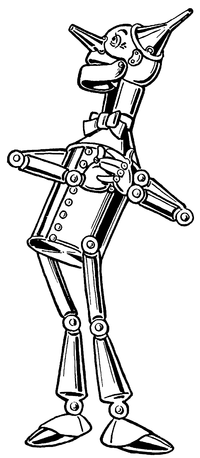
In The Wonderful Wizard of Oz, W. W. Denslow gave the Tin Woodman a skull-shaped head.

Of course, the long nose and ears riveted on that dome, as well as the lively eyes, make it possible to overlook the resemblance most of the time. But the rounded cranium and hinged jaw are quite reminiscent of fleshless human anatomy.

John R. Neill followed Denslow’s model in his illustrations for Ozma of Oz and Dorothy and the Wizard in Oz. As in the series’s first book, the tin man’s head bulges out at the back.

However, in The Marvelous Land of Oz, published before those two titles, and in all the Oz books that followed them, Neill used a different character design, with a cylindrical head. The neck varied at first, but eventually settled on the vague sort of attachment Denslow has used.

In most of those books, when the Tin Woodman takes off his funnel cap, we see that the top of his head is a rounded dome. Neill used the same design for Captain Fyter, the tin emperor’s doppelgänger in The Tin Woodman of Oz (1918).

Toward the end of his career, starting with Ozoplaning with the Wizard of Oz (1939), Neill made yet another variation: he drew the tin man’s head as flat on top, like a tin can. I suspect Neill was out of practice drawing his Tin Woodman; Ruth Plumly Thompson made little use of Baum’s more mature male characters.

I review this history to acknowledge that even within the Oz books there’s a significant variation in the Tin Woodman’s character design. On top of that, we have the costumes created for David Montgomery and Jack Haley, which have to allow a man to fit inside. Thus, people can imagine many things when they think of Nick Chopper.

Lots of comics artists like to depict the Tin Woodman as a robot. That’s doesn’t really fit his origin, in which he’s a living man whose body is gradually replaced with tin parts, and it leaves less room in the saga for Tik-Tok, an actual robot. But some artists just love drawing robots.

One example of that trend is David Hutchison in his Oz: The Manga series, as shown at right. His Tin Woodman’s head is a smokestack, and the robotic characterization extends to gear-shaped speech balloons.

Skottie Young avoided that temptation in helping to adapt the series for Marvel Comics. Indeed, his character design plays up the characters’ old-fashioned, rural beginning. (The man harvested wood, after all.) The tin mustache is reminiscent of L. Frank Baum himself.

And I have a hard time warming to the result. I think the problem for me is that as colored in a pale, tinny way, the mustache looks white. The character’s smooth round head and old-fashioned style reinforce that impression. As a result, this Tin Woodman always looks to me like an old man.

Based on Neill and Denslow’s art, and Baum’s writing, I think of Nick Chopper as a man in his twenties, preserved agelessly by being made into tin (and by living in Oz). Though the Tin Woodman has excellent and kind instincts, and matures somewhat over the series, he’s not old enough to have become wise. He makes mistakes and still regards his appearance with more than a little vanity.

I have trouble imagining the Tin Woodman as a Richard Farnsworth type, much as I admire that actor and some of the characters he’s played. Of course, it’s better than a robot.

15 November 2011

Cartoon Art Museum Has Gone to Oz

Last week the Cartoon Art Museum in San Francisco opened an exhibit on Oz comics. It draws heavily on the collection of Peter Maresca, publisher of Sunday Press (which would be a small press except that its books are so big).

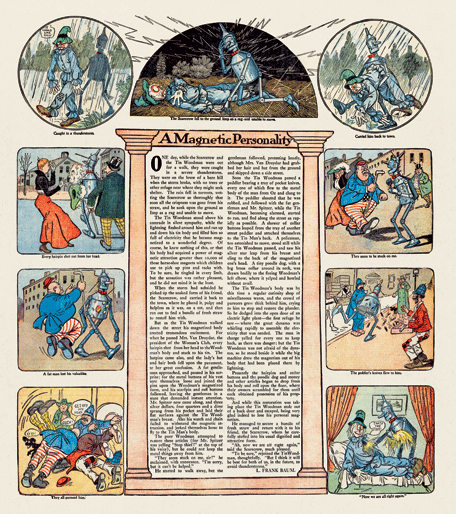
Early comics artists in the exhibit include Walt McDougall (working with L. Frank Baum), W. W. Denslow (competing with him), and John R. Neill (before becoming Baum’s main illustrator). More recent ones include Eric Shanower, Skottie Young, Anna-Maria Cool, and Ramona Fradon.
Among the pages on display is one Eric Shanower drew for Oz-Story magazine a while back, showing moments in the Oz series illustrated in the styles of different famous cartoonists.

I visited the Cartoon Art Museum on my last trip to San Francisco beyond the airport, and admired how much good stuff it displayed in a small space. Definitely worth a visit. [Hey, there’s Jerry Robinson!]

23 August 2011

Knitting Needles in Oz

The September/October 2011 issue of Piecework magazine (current link here, but it won’t last) has the theme of “needlework in literature.” Among the knitting and crochet patterns tied ever so gently to books is Joanna Johnson’s “Jinjur’s Jumper,” accompanied by an article on that character from L. Frank Baum’s The Marvelous Land of Oz.

I’m sorry to say that Johnson’s dress pattern isn’t designed like the outfit that General Jinjur and her soldiers wore in John R. Neill’s illustrations, one of which accompanies the article and another of which appears below. Nonetheless, it’s rooted in Victorian style, pretty, and impressively seamless.

The magazine’s little model for that dress wears a knitting needle in her hair, as Jinjur’s soldiers did. They used those sharp sticks to attack men who tried to stop their conquest of Oz. But knitting needles proved no match for the spears and swords of Glinda’s army.

While Baum never shows Jinjur or her soldiers actually knitting, he depicts a number of other female characters doing so:
  • Mme. Grogrande in John Dough and the Cherub.
  • Grandmother Gnit (of course) of the Fuddlecumjigs in The Emerald City of Oz.
  • Trot’s mother in Sea Fairies and Sky Island.
  • Reera the Red, a reclusive and powerful magic-worker, in Glinda of Oz.
There’s something magical about knitting and crochet—taking a cord that seems one-dimensional and producing something two- or three-dimensional out of it.

Johnson’s article provides a brief introduction to Baum, his Oz books, and his support for women’s suffrage. It unfortunately repeats a myth that he and artist W. W. Denslow struggled to find a publisher for The Wonderful Wizard of Oz: “nearly every publisher in Chicago refused the book initially because of its fantastic subject matter and extensive color plates, which were very expensive to print.” Really?

In fact, as Michael Patrick Hearn traces in The Annotated Wizard of Oz, Baum completed his first draft on 9 Oct 1899; he preserved his pencil with the date. By that time, Baum and Denslow’s Father Goose was a big hit, and the Geo. M. Hill Company had an option on their next book.

That small publisher asked the team to pay for the color plates and cover dies—not uncommon terms at the time. Baum and Denslow agreed, and they signed a publishing contract on 16 November. Less than six weeks passed between complete draft and contract, and I know of no evidence that the creators even spoke to other publishers.

03 June 2011

W. W. Denslow Goes Digital

This spring the developers ustwo and AtomicAntelope released an iPad/iPhone app of nursery rhymes by W. W. Denslow, as reviewed here by Kirkus. Apparently it hit #1 in Britain’s iTunes store.

Denslow’s illustrations lend themselves to this format because, besides being free to anyone, they have thick outlines and bright colors, allowing for easy animation—“plenty of swiping and swinging action,” the review says.

The Nursery Rhymes with StoryTime app doesn’t replicate Denslow’s edition of Mother Goose, but it pays due respect to how his book designs integrated text and art. It’s Nice that… had the ustwo developers talk about the look they wanted:
We wanted Nursery Rhymes with StoryTime to look as if it had been hand-built. To do that we literally hand-built it first out of natural media using card, paper, pencils and our hearts. Nursery Rhymes merges the illustrations of Denslow, created over a century ago, with the very latest in physics simulations. We love the fact the app appears to have been built out of a torn-up and rearranged copy of Denslow’s original book Mother Goose. That was what this project was all about – blending the old school with the new school! 
I’m also struck by how Kirkus’s review comes with screenshots and video. Review outlets have to keep up with the digital world as well, of course.

31 May 2011

A Peek at Oz in Peekskill?

The Wall Street Journal reports on a proposal to erect these statues in Peekskill, New York.

Why Peekskill? For a couple of years as a child, L. Frank Baum attended the Peekskill Military Academy. And there is a small stretch of yellow brick road in the city, reportedly old enough for him to have seen. Are those facts enough to make Peekskill a significant site in the literary history of Oz?

Who cares? Those statues are delightful! They’re by Richard Masloski, based on the character designs of W. W. Denslow. They can come large as life for only about a quarter-million dollars.

Surely there’s a library out there that wants the whole set.

(Hat tip to the Daily Ozmapolitan.)

12 May 2011

Designs on Illustrating The Wonderful Wizard of Oz

A British website called Blank Pages is inviting artists to collaborate in illustrating L. Frank Baum’s The Wonderful Wizard of Oz, each piece of art inspired by one page of the novel.

Obviously, the organizers chose that book because it’s in the public domain around the world, and conjures up a lot of striking visual images. However, many of those images come from the 1939 Technicolor movie rather than the text of the book. Thus, Baum’s Dorothy wears silver shoes, but one artist has contributed a couple of images of ruby slippers. (At least I think both come from the same artist; it’s definitely the same slippers.)

A more striking visual problem with the project is that the text itself is obviously a Project Gutenberg transcription laid out in an ugly, hard-to-read design. Much more attention is going to the art and user interface than to the words that started it all.

That’s a sad irony because W. W. Denslow’s design for The Wonderful Wizard of Oz in 1900 was a masterpiece of the book art. In addition to four-color plates, Denslow created two-color illustrations throughout the book, with the second color spreading behind the black text. The tints in those drawings reflected Dorothy’s progress through the color-coded land of Oz. In the spread above, for example, the green signals that she has come close to the Emerald City.

The Blank Pages format can’t replicate that overlapping effect, but it could do much better on the design side.

03 May 2011

“They looked down and saw a strange sight.”

The New York Public Library has sent me (and several thousand others) an email about its “Celebrating 100 Years” exhibit, due to open on 19 May. Among other treasures to be shown in the system’s century-old main building are “The Wizard of Oz pen and ink illustrations by W.W. Denslow.”

I couldn’t find out which pieces of artwork will be displayed, but I hope they include this image of Dorothy and Toto peering at the China Country, viewable through the Library of Congress’s website.

In the large version (click on the thumbnail) one can see how Denslow originally penciled Toto and the Cowardly Lion peering at the china people from the lower right corner. (There are other penciled figures on the left, but they’re hard to make out.)

Denslow eventually chose to draw Dorothy and Toto alone at a larger scale with a thicker line and hatching, to emphasize how she’s much bigger than the china people. And I like how he sat Toto on the internal frame of the picture itself.

28 January 2010

A Heavy Contract for Baum and Denslow

David Loiterstein of Readex kindly called my attention to this item from the Helena Independent, dated 25 June 1900. It appears to be based on a press release from the Geo. M. Hill Company, a small Chicago publisher:

A Heavy Contract

Chicago, June 24.—What is said to be the most important contract of the kind ever made west of the Mississippi river was executed here last night. By its terms a local publishing company secures for five years the exclusive publication of the joint productions of L. Frank Baum and W. W. Denslow, respectively author and illustrator of “Father Goose, His Book” and “The Wonderful Wizard of Oz.” Messrs. Baum and Denslow are to produce at least one book a year and it is said that they are guaranteed royalties of $10,000 each annually.
The same item ran in other Midwest papers around the same time, reflecting regional pride.

I thumbed through Michael Patrick Hearn’s Annotated Wizard of Oz and Katharine M. Rogers’s L. Frank Baum: Creator of Oz, and didn’t see a mention of this contract. This sort of newspaper report was easily overlooked before Readex’s searchable database. And it sheds some doubt on a story both those books retell, based on many accounts from the Baum family going back to 1908.

According to that tale, Baum, after prodding from his wife Maud, went to Geo. M. Hill toward the end of 1900 and asked for an early payment of royalties in order to buy Christmas presents. He brought home the check without looking at it, and the couple was amazed to find that it was for thousands of dollars. Over $13,000, according to some versions, more like $3,000 if it was the same amount Denslow received about that time.

But this newspaper item indicates that Baum, Denslow, and Hill were already talking about $10,000 in annual royalties before the middle of that year. Even if that’s just a projection with some puffery for publicity’s sake, that suggests the Baums’ surprise was misplaced.

The item is also remarkable since The Wonderful Wizard of Oz had been printed only about a month before, as The Annotated Wizard of Oz describes. The Bookseller magazine reported in June that Hill had ordered a second printing of 5,000 copies as the company prepared for the Chicago Book Fair in July. (Again, publishers’ announced print runs are often inflated for publicity.)

Thus, Hill made the multi-book offer to Baum and Denslow when they had produced one huge hit (Father Goose) and appeared to be on the verge of enjoying another—indeed a smart time for a publisher to sew up a successful author team.

Baum and Denslow produced only one more major project together, Dot and Tot in Merryland, published by Hill in 1901. They soon had a falling-out, and the company went bankrupt in 1902. So this “heavy contract” didn’t last. And evidently it didn’t survive in the Baum family lore.

25 December 2009

Denslow’s Santa Claus in Green and Brown

At right is the cover of The Night Before Christmas as illustrated by W. W. Denslow in 1902. This Santa is wearing a red hat, but no red suit. As in the interior illustrations, Denlow’s Santa dresses primarily in green and brown.

It took a while for Santa’s red suit to become an immutable part of his image. Thomas Nast’s drawings of Santa for Harper’s Weekly from 1863 on popularized the character. In these engravings Santa always wore a fur suit, usually with a wide belt, short fur boots, and a fur hat trimmed with holly.

In 1886 the publishing firm McLaughlin Bros., who pioneered the use of color printing in children’s books, hired Nast to adapt his Santa art for a new book, Santa Claus and His Works. In The Santa Claus Book, E. Willis Jones writes:

This posed a problem for the artist, because he had always thought of the Santas he drew in black ink as wearing a tannish fur suit, which certainly would not contribute to colorful illustrations. The simple solution was to make Santa’s suit in a bright red, and to add a little contrast he trimmed it with white ermine fur.
Nast’s first red-suited Santa was still a way from our modern image. The character is short, and wears fur, not woven cloth; his garment’s cut is like a set of pajamas with feet, and the ermine trim is slight, running around his waist in place of a belt.

In 1890 the McLaughlins published Nast’s Christmas Drawings for the Human Race, which put Santa in buckled shoes and a wide belt. But his ermine piping went down the front of his fur coat only. And the firm issued some copies of The Night Before Christmas showing Santa’s suit as green.

Maxfield Parrish’s 1896 portrait of Santa shows two rows of big buttons on his chest. Mary Cowles Clark’s illustrations for L. Frank Baum’s Life and Adventures of Santa Claus (1902) dress Claus alternately in green and red.

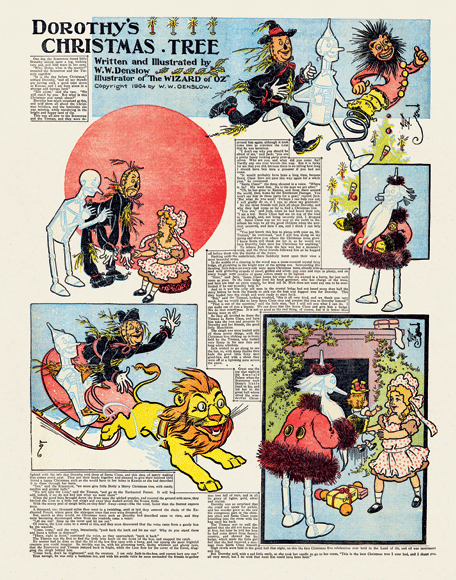
Thus, when Denslow drew this Santa, the character hadn’t become completely standardized. In December 1904 his Scarecrow and the Tinman comics page showed the Tinman dressing up as Santa in a red coat—with bristly brown trim.

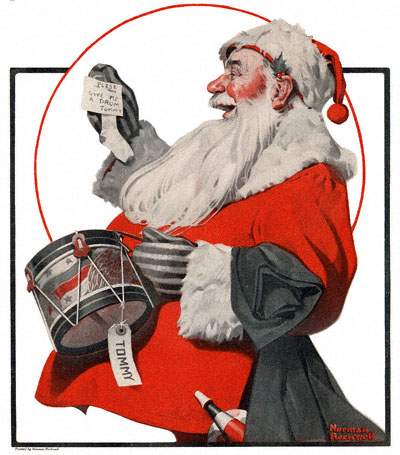
After World War 1, the standard image of Santa settled down, with magazine cover artists showing him in a red coat with lots of white fur trim—a choice largely determined by how those magazines were printed in black and red on white paper. The Saturday Evening Post and Country Gentlemen commissioned holiday images from Norman Rockwell (in 1920 and 1921, for example) and N. C. Wyeth (“Old Kris” in 1925) under those technical restrictions. And thus we stopped seeing Santa in green.

17 November 2009

Art to Capture the Imagination

Michael Patrick Hearn and the New York Times have both brought the news that Bloomsbury Auctions is preparing a 9 December sale on the theme of “Capture the Imagination: Original Illustration & Fine Illustrated Books.”

Among the lots are original John R. Neill artwork of Cap’n Bill smoking his pipe underwater in Sea Fairies and young Ervic meeting Reera the Red in Glinda of Oz, and page proofs from Neill’s three Oz novels, including an unused illustration of the Wizard.

Other Ozzy items include a 1969 letter from Margaret Hamilton to Ray Bolger and illustrations for The Wonderful Wizard of Oz by Michael Hague, by Barry Moser, by Charles Santore, and by Thea Kliros, whose edition appeared this year. The picture above is one of Moser’s sketches of the Wizard as a giant head.

Much of this auction consists of Tom Feelings’s artwork, including the stunning images for his Middle Passage, with an estimated price of over a quarter million dollars for the lot. I had the honor of meeting Feelings once, driving him to an SCBWI conference and showing him how a history book I was reading referred to his work. At the hotel we found a photocopier so he could add that to his files.

Among the other items that caught my eye in the online catalog:

Some items come from James Marshall’s estate, some from International Wizard of Oz Club founder Fred M. Meyer’s collection, and some from the artists themselves.

25 April 2009

Einstein Was Never in Dorothy’s Unique Position

In 1921, J. Malcolm Bird, an editor at Scientific American, compiled a book titled Einstein's Theories of Relativity and Gravitation: A Selection of Material from the Essays Submitted in the Competition for the Eugene Higgins Prize of $5,000.

The chapter “The General Theory: Fragments of Particular Merit on this Phase of the Subject” starts with this passage by Norman E. Gilbert, professor of physics at Dartmouth College:

When Dorothy was carried by the cyclone from her home in Kansas to the land of Oz, together with her uncle's house and her little dog Toto, she neglected to lower the trap door over the hole in the floor which formerly led to the cyclone cellar and Toto stepped through. Dorothy rushed to the opening expecting to see him dashed onto the rocks below but found him floating just below the floor. She drew him back into the room and closed the trap.

The author of the chronicle of Dorothy's adventures explains that the same force which held up the house held up Toto, but this explanation is not necessary. Dorothy was now floating through space and house and dog were subject to the same forces of gravitation which gave them identical motions. Dorothy must have pushed the dog down onto the floor and in doing so must herself have floated to the ceiling whence she might have pushed herself back to the floor. In fact gravitation was apparently suspended and Dorothy was in a position to have tried certain experiments which Einstein has never tried because he was never in Dorothy's unique position.
A poster of W. W. Denslow’s illustration of this moment in The Wonderful Wizard of Oz is available as a poster from AllPosters.com.