Showing posts with label AUTHOR Bill Finger. Show all posts

15 November 2015

“A depth that other superhero comics didn’t have”

A few months back, as McFarland sent out the first copies of Dick Grayson, Boy Wonder, editor Kristen L. Geaman asked all of us contributors to describe what our essays were about.

Here’s how I summed up my essay “Success in Stasis: Dick Grayson’s Thirty Years as a Boy Wonder” for the project’s Tumblr page:

The first chapter of the book looks at the first thirty years of stories about Dick Grayson, from his debut in 1940 until he leaves Wayne Manor in 1969. That was a period of stasis for the character, with no growth and no rifts with Batman that weren’t solved by the end of a story. Yet it was also the period that established Robin the Boy Wonder as a household name.

This chapter argues that the partnership of Batman and Robin was crucial to how those characters survived in the late 1940s when almost all other costumed superheroes stopped being published. The emotional bond between Dick Grayson and Bruce Wayne, explored most often in stories written by Bill Finger, gave their adventures a depth that other superhero comics didn’t have.

Robin thus became DC Comics’s preeminent symbol of youth, and the 1960s produced a roiling youth culture that forced the company to make changes in Dick Grayson’s life. After thirty years in his early to mid-teens, he had to grow up.
That highlights the hypothesis I arrived at while preparing that essay: that the emotional bond between Bruce Wayne/Batman and Dick Grayson/Robin was the crucial ingredient that made their series survive when most superheroes faded away. And Bill Finger, co-creator of the characters, was the storyteller who did the most to establish and explore that bond.

10 September 2014

Where Do You Get Your Ideas?

From Marc Tyler Nobleman’s interview with comics scripter Arnold Drake:

when Bill [Finger] was looking for an idea for Batman, one of the tricks that he used was to open up the Yellow Pages in the phone book and just kind of ripple through it. Where his fingers stopped he’d say, “Piano tuner…I wonder if there’s a story in a piano tuner?”
And then, of course, Finger would imagine the piano to be giant-sized.

29 May 2014

From Spring Heel Jack to Batman

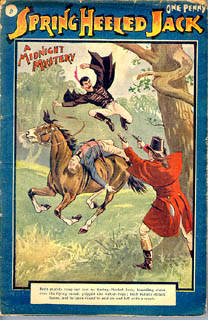
Among the ephemera on display in the “Comics Unmasked: Art and Anarchy in the UK” exhibit at the British Library is a penny-dreadful tale of Spring-Heeled Jack, which the curators suggest was an inspiration for Batman, pointing particularly to his horns.

I thought that was a stretch. Not that Bob Kane and Bill Finger were above borrowing plots, images, and details from other adventure stories of their time, acknowledged and unacknowledged. But how would two guys growing up in post-WW1 America have seen the Spring-Heeled Jack magazine serials from Victorian Britain? And wasn’t Spring-Heeled Jack a monster and/or troublemaker instead of a crimefighter?

At io9, commenter Michael Munro laid out a lineage of pulp fiction leading from London to California to Gotham:
Spring Heeled Jack…transitioned from London urban myth (1830s) to melodrama anti-hero (1870s) to prototype superhero (1880s-early 1900s). As written by "penny dreadful" author Alfred Burrage, SHJ was a wealthy aristocrat who assumed the disguise of a devilish, bat-winged avenger of the night, maintained a secret underground lair and used his athletic and technological skills to battle evil-doers - sounds familiar?
Expounding at more length, Munro wrote:
The several "penny dreadful" iterations of Spring Heeled Jack, many written by Alfred Burrage under the pseudonym "Charlton Lea", portrayed him as a nobleman who had been cheated out of his inheritance and who took up a devilish disguise to punish those responsible. Along the way, Spring Heeled Jack also rescued damsels in distress and generally stood up for the innocent and downtrodden. He wore a distinctive mask and costume and was capable of performing incredible leaps thanks to a special pair of boots, credited in one source to a secret mechanism invented by Indian street magicians.

Anticipating Zorro, Jack was fond of marking both enemies and territory by carving his initial with the point of his rapier. He also maintained a secret underground lair (in a converted crypt) and terrified his adversaries with his ringing laugh and catch-phrase, "The day is yours - leave the night to me!"
As Munro notes, the Batman team acknowledged Zorro, created by Johnston McCully in 1919, as an inspiration. Thus, Spring-Heeled Jack wasn’t a direct influence on Batman, and the horns/ears were a shared trope rather than deliberate borrowing.

23 February 2014

Neal Adams on Robinson’s Robin

In the third part of Kevin Smith’s podcast interview with artist Neal Adams, Smith asks whom Adams sees as the creator of Batman. Earlier in the conversation Adams mentioned both Bob Kane and Bill Finger, and he didn’t evince a lot of respect for either man. Rather, he says, he sees Batman as a collective creation, not any one person’s character.

But Adams goes on to say:
I think of Robin as Jerry Robinson’s, for sure. That bouncy…Robin that I put in Batman: Odyssey. Like, I have Man-Bat right at the beginning of the story. . . . Man-Bat comes into the cave and just grabs Robin and starts flipping him up into the rafters. And so they fight up in the rafters, but while they’re fighting Robin is talking to Batman, and Batman is talking to Robin.

And for Robin, that’s great. First of all, he’s hearing from his mentor,…and yet he’s flying around in the top of the cave…with Man-Bat, and they’re spinning on stuff and doing all this shit. That’s Jerry Robinson’s Robin to me. He doesn’t stand there and have a conversation, boy, if he can be up in the rafters and spinning around. That’s Robin. And I love that Robin.
That said, Adams dressed the Dick Grayson in Batman: Odyssey in the costume he’d designed for Tim Drake back in 1989 or so, rather than in Robinson’s costume. There are limits, after all. Or maybe royalties.

Adams and Robinson were both crusaders during the 1970s fight for creators’ rights. In the middle third of Smith’s interview Adams described how they teamed up to win recognition and pensions for Superman creators Jerry Siegel and Joe Shuster, as shown above. (Robinson is on the right, pre-toupée. Adams is the young man.) So I suspect Adams saw Robinson as standing out from the collective a bit.

19 January 2014

The New Team

Fans eagerly looking forward to the new Superman/Batman team-up movie were disappointed this week with news that their cinematic meeting would be postponed because Ben Affleck, cast as Bruce Wayne, broke his leg. That report turned out be false, though the delay is real, hopefully because the studio thinks this movie could be better than the two heroes’ last ones with a good script.

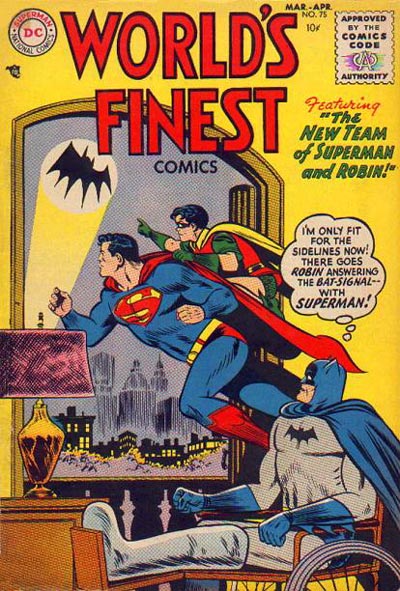
Still, the whole situation put us in mind of the lead story in World’s Finest, #75 (March 1955), written by Bill Finger and drawn by Curt Swan: “The New Team of Superman and Robin!”

Like other memorable stories that appeared at regular intervals in the 1940s and ’50s, the premise of this adventure was a threat to the Dynamic Duo’s partnership. Batman is laid up with a broken leg, so Superman comes to Gotham City and teams up with Robin to track down the fearsome Purple Mask Gang.

The tale’s emotional focus is lonely Batman moping around his cave, sadly poking at clues, and worrying that the Boy Wonder won’t want to return to their old methods now that he’s had a taste of flying. Of course, like nearly all the stories of that period, it ends with a return to the status quo ante. And, as with Ben Affleck, Batman’s leg turns out to be just fine.

“The New Team of Superman and Robin!” was reprinted in Superman in the Fifties, as well as other collections.

19 May 2013

“His uncle, Dick Grayson”

This panel from Batman, #159, drawn by Sheldon Moldoff for Bob Kane, suggests how Alfred saw the relationship between Bruce Wayne and Dick Grayson—and thus how scripter Bill Finger (credited with this story in the Grand Comics Database) saw it shortly before the arrival of the “New Look.”

This is one of the “imaginary stories” featuring a putative son of Bruce Wayne and Kathy (Batwoman) Kane, as pictured by Alfred. The story refers to Dick Grayson as Bruce’s “ward.” But it also matter-of-factly refers to him twice as “uncle” of redheaded Bruce Wayne, Jr.

Thus, Dick wasn’t an older brother to Bruce’s son, as a later generation of scripters would portray his relationship to Jason Todd, Tim Drake, and Damian Wayne. Instead, he was a younger brother to Bruce himself.

10 April 2013

A Mystery with Not-So-Secret Identities

A while back, I had the idea for a mystery story set in the world of mid-1900s American comics publishing. I’m still working on that, but in the meantime I sampled Max Allan Collins’s A Killing in Comics, the first in a series of mystery novels set, well, in the world of mid-1900s American comics publishing.

I should have expected Collins to have worked out this idea already. He’s written many comics himself, including the Dick Tracy newspaper strip for many years, the Ms. Tree private-eye stories, and The Road to Perdition. Collins was the Batman scripter who gave the second Jason Todd his past as a runaway with criminal parents.

Collins is also a prolific writer of prose mysteries, including his award-winning Nathan Heller books, another series built around major modern disasters, and numerous novelizations. So basically he’s already worked out every idea for a mystery story.

A Killing in Comics is clearly inspired by Gerard Jones’s Men of Tomorrow, which has become the authoritative history of the start of the American comic-book industry. It’s a roman à clef about the first generation of DC Comics, or more particularly about the men who worked on its most famous creations, Superman and Batman. But in this book those trademarks are cleverly disguised as Wonder Guy and Batwing.

Thus, instead of Jerry Siegel and Joe Shuster, the book gives us Harry Spiegel and Moe Shulman—but they’re almost exactly as Jones characterized the Superman creators. On the Batman side, Bob Kane becomes Rod Krane, Bill Finger becomes Will Hander, and Jerry Robinson becomes…nothing, because unlike the other creators there’s no clear moral conflict in his career. Editor Mort Weisinger is on the scene at Sy Mortimer but as of 1948 hasn’t reached his full potential as a villain.

The detective, Jack Starr, is the troubleshooting vice president of a newspaper syndication service. Though he refers to his father as “the major,” reminiscent of Maj. Malcolm Wheeler-Nicholson, this business is actually successful. It’s also run by a version of Gypsy Rose Lee, a retired stripper of an intellectual kind. That’s the most fictional part of the book.

As with Oz the Great and Powerful, the story is a little less interesting than watching it play out just on the edge of its source material without stepping over the line onto that territory. In this case, the mystery depends on all those comics pros being capable of killing the equivalent of the president of DC Comics. So of course “any resemblance to actual persons…is entirely coincidental,” as the copyright page says.

Further volumes in Collins’s Jack Starr series appear to be inspired by the Li’l Abner Broadway show of 1956 and its roots in newspaper comics, and by Dr. Fredric Wertham’s anti-comics crusade.

19 August 2012

A Full Look at Detective Comics, #38

Comixology’s Nightwing 101 sale (ending this evening) offered me a 99¢ look at the whole of Detective Comics, #38, the magazine which introduced Robin as the Sensational Character Find of 1940.

As I’ve written previously, this was Whitney Ellsworth’s first issue as chief editor, and he replaced the story originally slated for this issue with Robin’s debut. Within a short time, Ellsworth instituted new rules about guns and killing in Batman tales.

But the Batman cover feature was only the first of several stories in that issue of Detective. At twelve pages it was the longest, but the whole magazine contained 58 pages of comics and a couple of prose items (not included in the Comixology download).

The other graphic features were episodes of “Spy” and “Slam Bradley,” both written by Jerry Siegel; “Red Logan,” an American reporter in London; “The Crimson Avenger,” a Green Hornet knock-off; “Cliff Crosby,” a “Terry and the Pirates” knock-off; “Speed Saunders, Ace Investigator”; and “Steve Malone, District Attorney.” The Crimson Avenger had preceded Batman as a masked hero, but the rest of the magazine’s heroes were square-jawed young white men in suits. (Well, Cliff Crosby wears flying gear and spends an unusual amount of time shirtless at the North Pole.)
Aside from Dick Grayson and the newsboys he encounters, the magazine shows only two recognizable children: a girl and “crippled boy” whom Slam Bradley and his grotesque sidekick rescue from a fire. Within a year, boy sidekicks and heroes would proliferate as the success of Captain Marvel and Robin sent the industry chasing after its main readership. Cliff Crosby was soon dubbed “Young America’s Hero” rather than “Famous Explorer.”

Another striking aspect of the magazine is that the Batman and Robin story is much better than the rest. Granted, scripter Bill Finger had more pages to work with, but a lot of the other tales make little sense, relying on coincidences, leaps of logic, and ludicrous action sequences.

In contrast, Batman and Robin’s drive to shut down Boss Zucco’s protection racket proceeds rationally, building to a night-time battle on the skeleton of an unfinished building. For that fight Jerry Robinson designed pages of dark panels alternating with light, full moon in the background.

Bob Kane and Robinson’s draftsmanship wasn’t as good as that of some other artists in this early comic, but their composition was much better. Only Jack Lehti’s work on the Crimson Avenger finds as much depth and variety in the panels. (Kane and his crew were working with a varied three-tier page structure. Fred Guardineer used a more uniform three tiers in “Speed Saunders,” and all the other stories are told in four tiers, like Kane’s original, six-page Batman tale.)
The coloring on most pages is awful. There was a limited palette, and the colorists deployed it poorly. One page of “Speed Saunders” shows three different women in red tops and green skirts, making it easy to confuse them; on another, two planes keep switching colors. In “Cliff Crosby,” the polar bears are brown. And this is supposed to be an English village landscape at night from “Red Logan.”
With that baseline, Robin’s costume of red, green, and yellow doesn’t seem so unusual.

22 July 2012

Dick Grayson’s First Kiss

Batman, #107 (Apr 1957) contained a story from Bill Finger and Sheldon Moldoff titled “Robin Falls in Love.” According to the Batman volume of the Encyclopedia of Comic Book Heroes, this was the first time Robin the Boy Wonder developed a crush on a girl.

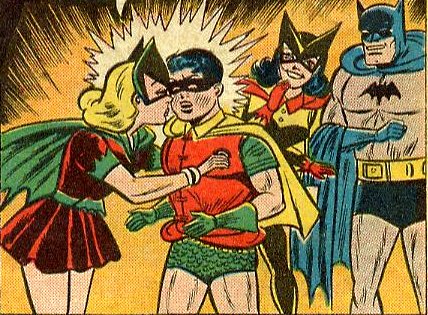
Robin rescues Vera Lovely, a fourteen-year-old figure skater. She kisses him; I haven’t seen the panel in question, but I assume it was an unreciprocated kiss on the cheek. [ADDENDUM: The Robin Appreciation Group on Facebook have kindly posted that panel, confirming my hunch.] Nonetheless, for a while he’s gaga, with little red hearts orbiting around his head.

But at the end of the story, Robin and Vera agree to be just good friends, and the situation returns to the status quo ante.

In seven stories of the early 1960s, Betty Kane comes to Gotham and takes up the mantle of Bat-Girl, mostly because she has a crush on the dreamy Boy Wonder. For a long time he doesn’t return her feelings.
In “Prisoners of Three Worlds” (Batman, #153, Feb 1963), Finger and Moldoff showed Bat-Girl finally getting her wish. The teen crime-fighters share a full-on, lip-to-lip kiss. At the end of the story the young masked couple even goes off together, presumably to do some more necking.

But that’s the pre-“New Look” Dick Grayson. It’s not the Dick Grayson of the 1986-2011 DC Universe. His first kiss appears in the story “Grimm” in Batman: Legends of the Dark Knight, #149-53. (Since that magazine told stories outside the concurrent Batman continuity, it’s possible that this was yet another version of Dick Grayson, but I’m assuming not.)

In this story, Dick is eleven years old. It’s about a month after he started to patrol Gotham City as Robin the Boy Wonder, about two months after he became Bruce Wayne’s ward. (So much for years of careful training.) Batman and Robin are still struggling to trust themselves as a team and a family.

One night Robin chases down a young teen thief called Wily Wendi. She nearly kisses him, as shown in the panel at top, and slips away. After that, Dick can’t get Wendi out of his mind.
He sits in his oddly cluttered room “thinking about The Girl” and puzzling over “such a strange feeling rippling through me.”

In the adventure that follows, Robin leaves Wayne Manor to go into the underground world of Mother Grimm, where Wendi and other orphaned children live. There are various completely unbelievable twists, spectacularly illustrated by Trevor Von Eeden and José Luis Garcia-López. Von Eeden’s website discusses the background of the story and displays some of the line art.

Mother Grimm’s haven catches on fire. Batman and Robin manage to rescue all the children, with Robin carrying Wendi from a burning hospital. And at last they really kiss.
How do we know that’s this Dick Grayson’s first kiss? Because he tells us (even if he doesn’t admit as much to Wendi).
The story ends with Mother Grimm and her twin sister, both murderous loons, disappearing down a raging river, and Batman having to find new homes for all of the orphans. The whole experience cements Dick’s relationship to Bruce, and his confidence as Robin.

And what about Wendi? Dick, narrating the story in his third Nightwing costume and thus in his mid-twenties, tells us she’s “getting a master’s in journalism.” The art shows us that he keeps tabs on her through the bat-computer. The caption says she’s “just as…memorable” for him as before.

But are they still in touch in any way? Might he run into her in Gotham City, as either Dick Grayson or Nightwing? J. M. DeMatteis’s script leaves a loose thread just perfect for fanfiction, but I couldn’t Google up a single story about Wily Wendi.

How long will it take now before such a story appears?

20 May 2012

Book Trailers and Boy Wonders

Having blogged about books and publishing for six years now (you can look it up), I’ve been witness to the rise and establishment of the book trailer. And I still don’t see much value in them.

In the amount of time it takes to download and watch a book trailer, I can take in a lot more information about that book through, you know, reading. And that experience is probably a much better preview of actually reading the book than watching a short shoestring-budget movie about it.

I know of no market research that says online trailers help to sell books, or even particular types of books to particular types of readers. Then again, it‘s the publishing industry, and there’s practically no market research at all.

I cynically suspect that the main value of book trailers is that they keep authors busy between copyedit approval and pub date. Without having trailers to make, we’d be on the phone every hour to the Marketing Department asking if they’ve thought about sending an advance copy to Orhan Pamuk. No wonder Marketing Departments recommend that authors make trailers!

Tim Kreider, author of We Learn Nothing, expressed similar thoughts in this New York Times oped today:
The first time I’d ever heard that there were video previews for books was when I was told I had to make one. A few months before my own book was to be released, my publisher advised me that official book trailers were now routinely posted on YouTube as a promotional device. I was skeptical, but remembering how instrumental video was in advancing the career of Men Without Hats, I acquiesced. . . .

The sudden, insane hula hoop-like popularity of social media and mass dinosaurian die-off of print has publishers panicked and willing to try anything, and so writers, typically reclusive types who are used to being able to do their jobs without putting on pants, now find themselves shoved on camera and hawking their books like mattresses on Presidents’ Day. . . .

The sympathetic audience for complaints about the terrible problems associated with having your book published turns out to be small. So I will just say that this is not a part of the process that most kids who sat at typewriters dreaming of growing up to be Authors ever fantasized about. Most writers are closet exhibitionists, shameless only on paper, and having to perform and promote themselves is a kind of mild custom-designed torture, like forcing the theoretical mathematics faculty to come up with something for skit night.
All that on a Sunday is my way of a running up to the trailer that Marc Tyler Nobleman and friends made for his upcoming picture-book bio Bill the Boy Wonder. Illustrated by Ty Templeton, the book tells more fully than ever before the life of Bill Finger, co-creator of Batman and Robin. What do we learn from the trailer? Well, it does look like it was fun to make.

15 January 2012

“The Guardianship of Dick Grayson!”

“You must have read how Batman first took charge of a young boy named Dick Grayson...whose parents, The Flying Graysons of circus fame, had died in a tragic fall from their trapeze!

“Since that day, the mutual affection between this man and boy has been as strong as that between father and son!”

That’s the start of “Bruce Wayne Loses the Guardianship of Dick Grayson!”, a classic but badly-titled story in Batman, #20 (cover date Dec 1943-Jan 1944). It came out of Bob Kane’s apartment studio, with his pencils, Jerry Robinson’s inking, and George Roussos’s lettering bringing out a script by Bill Finger.

And as far as I can tell, this was the first Batman story based on exploring the legal relationship between Bruce Wayne and his ward Dick Grayson, established in an afterthought back in 1940. In fact, back then the comics rarely mentioned Dick’s circus upbringing, the murder of Bruce’s parents, or what brought them together. Crime-fighting was just what they did.

But then Dick’s paternal uncle George shows up. (The whirling head effect in the first panel is a technique Kane brought from humor comics, his real love.)
It’s striking that Bruce says, “Not after all these years!” Dick has burst onto the scene less than four years before in real time, and in comic-book time Dick Grayson had barely aged. (There was one birthday story.) The same balloon also establishes that Bruce sees Dick “like a son!”

Uncle George goes to court, requiring anguished testimony. Per Reason for Robin, #4, Dick shows more emotion on the stand, but even Bruce is “strained” as he pulls out the word “love.”
But the judge decides that a “nightclubbing, shiftless, café society playboy” is no good guardian for a teenager and awards custody to Uncle George. The Dynamic Duo enjoy a panel of reminiscing…
That upper panel might be the first time the phrase “good soldier” appears in a Batman comic. It’s been echoing since Frank Miller’s The Dark Knight Returns. Back in 1943 it was an allusion to actual soldiers, of course.

I’m also struck by how Roussos chose to draw Bruce’s “Goodbye, kid, goodbye” in such small letters; that’s a very rare technique in 1940s superhero comics, and it again reflects Bruce’s feelings.
Bruce starts to mope around Wayne Manor (which in this era looks much bigger from inside than from outside). While complaining about unfairness as fervently as any thirteen-year-old, Bruce now calls Dick “the person I love the most!”

Being alone again even affects Bruce‘s work as Batman.
But after the fight Dick has to go back to his newfound relations. A few pages on, it becomes clear that Uncle George is simply trying to extort money from Bruce Wayne, offering him his own teen-aged boy for a mere million dollars. At the suggestion of Alfred the butler, Bruce steps in as Batman. But without his partner, the criminals lure the Caped Crusader “into a man-trap!”

How bad do things look? Batman’s only back-up now is Alfred, and not the ex-special-forces Alfred of today. This was the original fat, comic-relief Alfred. But he knows where to get help: he knocks on Dick’s new bedroom window, and the two of them race off to rescue Batman.

The outcome of that fight hinges on one of the Penguin’s trick umbrellas—a detail established back in that panel of reminiscing. It wasn’t necessary to have read a lot of earlier Batman comics to follow this story. Nevertheless, Finger clearly created it for readers who were already fans of the Dynamic Duo and wanted to learn more about their relationship.

Finally, we have another scene in court, where the judge reverses himself.
Interestingly, this story doesn’t end with Dick’s uncle revealed as a complete fraud; it suggests that he really is a brother of the late trapeze artist John Grayson. I don’t think Uncle George ever resurfaces in the Batman mythos, though.

This story was successful enough that Finger wrote a variation on it in “The Trial of Bruce Wayne!”, published in Batman, #57 (Feb-Mar 1950), with art by Dick Sprang. In this tale, a criminal whom Bruce somehow helped sent to prison seeks revenge by hitting the millionaire where it will hurt the most: he orchestrates a legal hearing to take away custody of Dick.

The crooks in this story attack Bruce instead of Batman, and there are no lost relatives for Dick. Once again, Bruce’s public persona as a shiftless playboy works against him. And in the end he calls the same character witness as before, only this time Finger has Batman speak to the court on panel. (Meanwhile, it appears that Bruce can’t be bothered to show up for his own hearing.)

The “Trial” story never rises to the emotional pitch of “Bruce Wayne Loses the Guardianship of Dick Grayson!”, but it’s a solid example of a story type that usually showed up about once a season: something threatening the partnership of Batman and Robin. I don’t think, however, there were any more stories about Bruce and Dick’s legal relationship, not even when Aunt Harriet appeared, until the 1980s.

COMING UP: The Jason Todd soap opera.

11 December 2011

Robinson’s Visual Inspiration for Robin

In further honor of the late Jerry Robinson, this weekly Robin quotes from his 2004-05 interview by Gary Groth for The Comics Journal on the character design for Robin:
We had a long list of about 30 names, and we kept adding others. The names are very important for the characters. Bill  [Finger] was very specific about that, as well as Bob [Kane]. Most of the names, as I recall, were of mythological origin — Mercury and others. None of them sounded right to me, or to anybody, because we never agreed on any one.

My reservation was that I thought that it should be a name that evoked an image of a real kid. He didn’t have superpowers, nor did Batman. That was what distinguished it from Superman and the other superheroes. I thought the boy should be the same. And thinking of a more human name, I came up with Robin because the adventures of Robin Hood were boyhood favorites of mine.

I had been given a Robin Hood book illustrated by N. C. Wyeth — I think it was a 10th or 12th birthday present. It was a big, very handsome book for the time, very elaborate because it had full-color illustrations, maybe a dozen throughout the book. It was the full text with full-plate tip-ins. I remembered those because I had pored over them so many times as a kid.

I had a vision of Robin Hood just as Wyeth drew him in his costume, and that’s what I quickly sketched out when I suggested [the name] Robin, which they seemed to like, and then showed them the costume. And if you look at it, it’s Wyeth’s costume, from my memory, because I didn’t have the book to look at. But it is pretty accurate: the fake mail pants, the red vest, upon which I added the little “R” to correspond with Batman’s bat on his chest.

When I started to letter the strip, every legend I did started off with a little round drop-out white letter. So I thought of that for the vest.
Now in fact I don’t see many elements of the Robin costume in Wyeth’s paintings, particularly the one most often cited as inspiration: “Robin Meets Maid Marian,” shown at right above. Certainly the “fake mail pants” don’t show up many places before Detective Comics, #38.

But I think the title-page illustration at top, showing young Robin Hood learning to shoot, must have been in Robinson’s head. For one thing, it shows the hero as a boy wonder. And although the garments are quite different from what Robin would wear, the silhouette is rather similar: short boots with flared ankles, smooth legs from ankle to upper thigh, jerkin extending below the belt, puffed upper sleeves looking like short sleeves. And, of course, emblems on the chest.

25 September 2011

“I could be Robin, but I didn't think I could be Batman”

As DC Comics wound down its first Batman series with issue #713, it turned to writing stalwart Fabian Nicieza to script a final story. I think Nicieza has a particularly good understanding of the place of Robin in the Batman mythos (i.e., he agrees with me on lots of points), so this was a good choice.

Comic Book Resources interviewed Nicieza about that story, and his fondness for Dick Grayson:
When I first came to this country [from Argentina], we watched the Batman TV series on ABC and I immediately got into the character. I don't know if it was the costume or the fact I felt I could be Robin, but I didn't think I could be Batman—same reason I thought I could be Chekhov but not Kirk! I don't know, it's dorky, but I always thought any kid in shorts and green pixie boots (have we mentioned he wore pixie boots?) who could hold his own up against Batman, much less all the villains in Gotham, was cool by me.
The tale Nicieza wrote is framed around Damian Wayne telling three younger boys a Grayson-centered history of Batman, at the same time sharing the valuable lessons he’s learned from being Robin.

The story reminded me a bit of “The Batman Nobody Knows” from 1973, also about boys telling each other stories of the legendary Batman. That tale is supposed show that children are too innocent to be scared of Batman like that cowardly, superstitious lot of criminals. (It actually shows the boys as jaded enough to quickly believe that millionaire bachelor Bruce Wayne likes to jump out at children on camping trips in a skin-tight costume and mask. But I digress.)

In Batman, #713, those three little boys are named Bob, Jerry, and Bill—obvious allusions to Bob Kane, Jerry Robinson, and Bill Finger, the team that created Dick Grayson back in 1940.

Little Bill later talks about a story he’s going to write. Readers’ response to these kids seems to depend on their tolerance for schmaltz. But a “last” issue of a magazine published since 1940 might deserve a bit of schmaltz.

Do I read too much into the fact that the Bob Kane analogue is a step behind everyone else?

18 September 2011

Your Best Source for Giant Cash Registers

A couple years back, the Comic Treadmill set out to catalogue all the giant props in Batman comics. The most familiar is the giant penny in the bat-cave, of course, but the most interesting are the oversized working models of everyday machines: record players, film projectors, toasters, and more.

The earliest examples of this trope came from the world of gambling: a slot machine, pinball game, and roulette wheel. But eventually the types of machines became more mundane.

The earliest giant cash register appears in Batman, #62, from 1951, on the premises of a cash register company. Why the company has produced such a large machine is never stated, but it’s a working replica, not a trick. The script for that story, “The Secret Life of the Catwoman!” came from Bill Finger.

A working typewriter for giants appeared in Batman, #115, published in 1958. That story was also by Finger. In fact, he was known for introducing oversized props into his Batman tales, as well as helpfully supplying the illustrators with visual references.

Attempts to make Batman stories more serious in the early and then the late 1960s removed the giant office appliances, at least from the present. There was a nostalgic revival in late 1977: one story showed the Caped Crusader fighting on a giant IBM Selectric with a rotating ball while another introduced a giant photocopier. Since then, Batman has rarely had to deal with such machines in his regular adventures.

But the giant typewriters and cash registers hang on in flashback stories, and as a symbol of “the way things used to be in Gotham City.” Dick Grayson occasionally remarks about the crazy platforms he used to fight on.

All that is grounding for the question behind this weekly Robin: What inspired Bill Finger to write stories around those giant working props? What made him think readers would believe that a cash register company would have a giant working replica of its product sitting around?

Of course, people built non-working replicas for various attention-getting campaigns. Here’s a photo of a giant cash register from 1923, at the University of Southern California—but that was just a set for a fundraiser, with “coeds” operating the numbers.

In Batman Unmasked, Will Brooker suggested that a giant cash-register-shaped float in a war bonds parade might have inspired Gotham’s architecture, citing a photograph in George Roeder’s The Censored War.

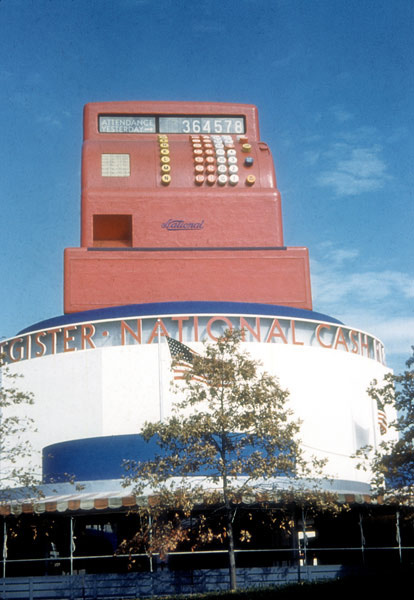
But we can go earlier than that, and right into Finger’s backyard—to the 1939 New York World’s Fair! (More about that exposition’s influence back here.)

As shown in postcards of all sorts, the National Cash Register company constructed a building with a giant cash register on the roof. Its display changed to tally the number if visitors at the fair, and it twirled to give everyone a good view.

NCR had pulled the same stunt at the 1933 World’s Fair in Chicago and the 1936-37 Expo in Dallas. Alas, the NCR machine’s buttons didn't work, and its drawer didn't shoot out to knock over bad guys or reveal giant currency. Still, it was enough to establish the idea.

Furthermore, the ’39 World’s Fair also included a 14-ton typewriter by Underwood that reportedly worked. The company had built a similar machine for the Panama-Pacific Exposition of 1915, later moving that device to Atlantic City. (See more at Agility Nut’s Big Stuff.) But Finger surely saw the ’39 version.

This impressive color image of the NCR building comes from from Bill Cotter, who also posited the Batman connection.

17 April 2011

Researching Robin

Marc Tyler Nobleman, author of Boys of Steel: The Creators of Superman and an upcoming book on writer Bill Finger, has generously shared some of his notes on the question of who created the original Robin, the Boy Wonder.

Jerry Robinson, who was working as an artist for Bob Kane, has often credited Finger for the idea of giving Batman a sidekick while providing strong evidence that he himself came up with the character’s name and look. For example, here’s an extract from Gary Groth’s interview with Robinson in The Comics Journal, #271, as supplied by Marc:

GROTH: I assume you’ve read Gerry Jones’ new history of comics, Men of Tomorrow. There’s a little contradiction I wanted you to clarify between what you’ve said previously about who created Robin and how Jones related it. Jones wrote, “When Bill Finger felt Batman could use a sidekick to talk to, he and Robinson created Robin, the Boy Wonder.” Now, you contradict that in an interview that you did with Comics Interview when the interviewer asks you, “What about Robin? You were responsible for his creation” and you reply, “No, no. I was not. I can’t take credit for that. As I reconstructed it and Bill confirmed my recollection, Bob and Bill had the idea of having a kid and discussed that idea before I arrived.”

ROBINSON: Right. That’s basically true. Gerry I think was very accurate in his interviews. He interviewed me extensively for the book. I think he did a very fine job. In any event, yeah, more accurately, adding a kid was under discussion. I’m sure it was Bill’s idea for adding a boy. That I would attribute to Bill without question. When I came in they were already discussing possible names. So I joined the discussion of the creation. There was nothing on paper yet, nothing but the idea of adding a sidekick. And I know that was Bill’s idea to add a sidekick, from the discussion that ensued. The impetus came from Bill’s wanting to extend the parameters of the story potential and of the drama. He saw that adding a sidekick would enhance the drama. Also, it enlarged the readership identification. The younger kids could then identify with Robin, which they couldn’t with Batman, and the older ones with Batman. It extended the appeal on a lot of levels.
Robinson said similar things in Alter Ego, #39, and elsewhere. However, this interview also makes clear that Robinson was not present when Finger presented the “idea for adding a boy”; rather, he inferred that Finger deserved the credit.

It’s notable, however, that Bill Finger himself didn’t lay claim to Robin even as he took credit for originating other parts of the Batman mythos. In 1965 he told The New Yorker that the “group” created Robin to be Batman’s Watson.

Bob Kane, of course, claimed the credit for himself.

I think this investigation may be so complicated because Robin was created in stages. The character is the combination of three ideas:
It’s clear that the last stage was mostly Robinson’s creation, with a bit of help from Finger. It also appears likely that Finger was already pushing to add a companion for Batman, which would make his scripting easier.

But who had the idea to make that companion a teenager? My theory remains that someone in the DC office pressed Kane to increase the “kid appeal” of the stories he was supplying. As I wrote back here, at the start of 1940 Fawcett reportedly had a poll showing that boys comprised the biggest set of comic-book readers, and the company created Captain Marvel as a response.

Robin’s arrived at the same time as new Detective Comics chief editor Whitney Ellsworth. He bumped the story announced for Detective, #38, in favor of introducing the Sensational Character Find of 1940. Shortly after that, Ellsworth demanded that Batman stop using guns and other lethal means because those weren’t appropriate for children’s entertainment. So Ellsworth definitely pushed the “kid appeal” message, and liked Robin’s potential.

So here’s a scenario to consider. In early 1940 Ellsworth told Kane that he’d be taking over Detective and that the Batman stories needed to offer even more for boys. Kane brought that message back to his apartment/office as his own idea—at the time, he was the only link between the publisher and his team.

Finger saw how this suggestion offered a solution to a problem he’d been wrestling with: the lack of a “Watson.” Finger and Kane had thus agreed to add a kid sidekick when Robinson came into the conversation. Robinson finished developing the character with Finger’s help.

Each man could thus claim to have come up with basic ideas for Robin—or, in Kane’s case, perhaps to have adopted that idea as his own. It’s consistent with what we know of their personalities for Kane to maximize his claims, Finger to be scrupulously minimal, and Robinson to take the side of the underdog. But the character was a joint creation, driven by a combination of commercial pressure, storytelling needs, and artistic choices.

19 September 2010

What Could Become of the Child?

In the cover story of Batman, #122, Dick Grayson dreams about Bruce Wayne marrying Kathy Kane, also known as Batwoman, and what comes of that relationship.

Nothing good, of course. Kathy tries to horn in on the crime-fighting again, and manages to give away Batman and Robin’s secret identities. (Message: Girls screw up everything!)

That story must have generated a positive response, in the DC Comics office or from readers, because writer Bill Finger went back to build on the same premise. He created an intermittent series of six tales in which Alfred typed out imaginary stories of a future in which Bruce and Kathy had married and raised a red-haired son named Bruce, Jr. Dick took up the mantle of Batman II while Bruce, Jr., insisted on being Robin II.

What might happen? Nothing good, of course. Robin II does a good job of falling down and being taken hostage, but Batman II retains that habit as well.

So it’s up to the first Batman (sometimes accompanied by Batwoman) to rescue his successor and son, and to preserve the family’s secret identities. (Message: No one will ever measure up to the real Batman!)

The one exception to that pattern appeared in Batman, #154, published in 1963. In “Danger Strikes Four,” Dick reads the manuscript of a Batman II and Robin II story that’s giving Alfred plotting problems.

A mission calls Batman and Robin away. Dick uses an idea from Alfred’s tale to sneak past some guards, allowing him to jump onto a flying buzz bomb and send it off course before leaping back to the batplane.

But that’s not all! Back in stately Wayne Manor, Dick adapts his trick with the missile into an ending for Alfred’s story. Robin II actually gets to save the imaginary day with an authorial assist from the real Robin. (Message: Writing fanfiction is fun for everyone!)

All those “Second Batman and Robin Team” stories have now been collected in DC’s Greatest Imaginary Stories, vol. 2: Batman and Robin. I’d like to know who wrote “Danger Strikes Four,” but the volume says its scripter is unknown. (The artist on the whole Batman II series was Sheldon Moldoff.)

Batman II and Robin II made a few more appearances in the comics, perhaps most notably in John Byrne’s Batman/Captain America crossover. And they’re one of the inspirations of Grant Morrison’s current series about Dick Grayson taking over as Batman with Bruce Wayne’s son as his Robin. But with that one exception, the originals left me cold. If Robin represents the potential for growing up, it’s disappointing when his future is unsuccessful.

DC’s Greatest Imaginary Stories, vol. 2 collects three more Batman and Robin tales which never happened, and which most fans wouldn’t want to happen:

  • Bruce Wayne blames Superman for his parents’ death, and plots revenge with Lex Luthor.
  • Lois Lane marries Bruce Wayne, has a child with him, and manages not to reveal Batman and Robin’s secret identities.
  • In a future that includes both hospitals in orbit for weightless surgery and electric typewriters, Dick is married with twins, Bruce thinks of retiring to the quiet life of a governor, and the whole story feels emotionally dead.
One recurring motif in this collection is, of all things, water-skiing. One story shows us the “Joker’s Son” on skis (his face is white, but the rest of his skin is not). Another shows Bruce skiing—with Lois on his shoulders.

As a fan of weird-ass Batman stories, I’m glad to have this collection in my library, but it never achieves the weirdness of The Black Casebook or extremes of The Strange Deaths of Batman. Instead, most of these tales reinforce the dominant attitudes of their eras, reassuring young male readers about the way the world should be.

10 January 2010

Boy Commandos and a Killer in the Big Top

This cover to Detective Comics, #65, shows Batman and Robin welcoming a new team to the magazine: the Boy Commandos, created by Joe Simon and Jack Kirby. Judging by art styles, it looks like Jerry Robinson drew the Dynamic Duo, and Simon and Kirby drew the commandos.

The Boy Commandos were a logical outgrowth of a trend that started in early 1940, apparently following market research that said many readers of superhero magazines were boys. Suddenly publishers introduced Captain Marvel, Robin, and a host of other wonder boys and kid sidekicks. Simon and Kirby joined that parade, creating Marvel Boy for Daring Mystery, #6 (Sept 1940), and Bucky as a sidekick for Captain America (March 1941).

What might be even more marketable than one boy? A whole gang of boys! Gangs of kids had roared through comics since the days of Hogan’s Alley, but Simon and Kirby used them for adventures rather than humor. First came the Sentinels of Liberty/Young Allies, featuring Bucky, Toro, and a set of stereotypes. Then the Newsboy Legion, featuring a set of stereotypes. And in 1942, with World War 2 raging, the Boy Commandos—international stereotypes on a mission!

Soon that team was popular enough to join Batman and Robin in Detective Comics—they actually arrived in issue #64, possibly a last-minute addition since the cover didn’t even feature a small picture of them, just a banner. The Boy Commandos remained in the magazine past the end of the war to 1949, but they never knocked the Dynamic Duo off the cover.

That wasn’t Simon and Kirby’s only brush with Robin the Boy Wonder, however. After the war they contracted with Harvey Comics for a new superhero comic called Stuntman, with the first issue dated April 1946.That hero’s origin story starts with a crook trying to shake down a traveling circus. The circus manager refuses the crook’s demands, and the star aerialists, the Flying Apollos, shrug off the threat. But at that evening’s performance, the Apollos’ trapeze breaks. The newest member of the trio, Fred Drake, sees the other two performers fall to their deaths.

Later that night, Fred stumbles across evidence that the trapeze didn’t break by accident. He narrowly escapes being killed for what he knows, then bumps into a rich, handsome man who leads a secret life investigating crime. That man makes Fred his partner, encouraging him to fight crime while wearing a mask, cape, and brightly colored costume.

Sounds rather familiar, no? There are significant differences:

  • Fred Drake is a young man, not a boy, and not related to the other members of the Flying Apollos.
  • The rich man is movie star Don Daring, who dabbles in detective work as a hobby. He has no secret identity, nor much detective skill; he becomes the stories’ comic relief.
  • Daring hires Fred as his stunt double at the studio—thus creating Stuntman!
Despite those differences, it’s clear that Simon and Kirby were recycling Bill Finger’s origin story for Robin from six years before.

The Stuntman comic entered a market glutted with other magazines after the end of wartime paper rationing. It lasted only two issues, so we never saw the promised arrival of Stuntboy.

Stuntman’s origin story and dozens of other comics in many genres have been restored and reprinted in the oversized anthology The Best of Simon and Kirby.

13 December 2009

“That’s Potent Stuff, Kid! Like as Not to Give You Bad Dreams…”

Some Batman histories, such as the From the ’30s to the ’70s volume I read as a lad, say that Dick Grayson’s departure for college allowed the Caped Crusader to return to his detective roots. Indeed, the first story that followed, “One Bullet Too Many,” was a forensic procedural. But a lot of that era’s stories featured vampires, ghosts, and Man-Bat. They belonged to the gothic or horror mode rather than the detective genre.

Of course, those stories were a return to Batman’s roots. His earliest adventures in Detective Comics, before Robin arrived, also involved vampires, mutated monsters, mad monks, and other elements of gothic horror. Which isn’t that big a shift when you start with a millionaire dressed as a giant bat.

Those fantastic elements didn’t go away when Robin arrived, as Batman’s pistol did. In fact, the arrival of a young character opened the door for a new sort of story, even more fantastic—indeed, unreal.

Detective, #44, half a year after Robin’s debut, offered “The Land Behind the Light.” It showed the Dynamic Duo passing through a scientist’s strange light into “the 4th Dimsension,” a world wracked by war between giants and dwarfs! That fantastic mode played to Bob Kane’s strengths as an illustrator; he was better at comically exaggerated figures than realistic ones.

For more detail of this adventure, see Vintage Spandex. But I’m spoiling the ending: Yes, it was the Batman saga’s first use of the “It was all a dream” escape hatch when a writer—in this case Bill Finger—couldn’t finish or explain his tale. Eventually comics publishers realized that their readers would sit for “imaginary” stories, parallel universes, “What If?” alternatives, possible futures, “Elseworlds,” and other justifications for stories that don’t take place in their heroes’ “real” lives. Even in the real lives of Batman and Robin, stories broadened to feature time travel by hypnosis (don’t ask) and trips into outer space.

I don’t think Kane and Finger could have used the “all a dream” exit without Robin. Batman is supposed to be a physical and mental paragon; in those early years, he was also an emotional paragon. He wouldn’t get lost in a book of fables and be unable, even for a minute, to tell dream from reality. But because Robin is still a child, he can get lost in a nightmare. His arrival on the scene in 1940 widened the team’s storytelling possibilities to include fantasy sequences.

In contrast, a later story told us that Batman hasn’t had nightmares since his childhood. (It also showed us that he sleeps in his full costume and cowl, so we can debate how well adjusted he really is.)