Showing posts with label snack foods. Show all posts

11 May 2026

“The following routine hardly constitutes a ‘vacation’”

In March 1924, for the first time in more than six years, eleven-year-old Ernie Morrison didn’t have a movie to make.

He had no call time the Hal Roach Studio. He wouldn’t spend hours with the other kids he’d worked and played with for the past two years. (Ernie had his own tutor, so at least he wasn’t also cut off from Fern Carter’s studio classroom.)

The end of Ernie’s $250 per working week salary would no doubt affect the Morrison family finances, but not immediately. His father, Joseph, who had run a market before entering show business, evidently invested some of those earnings in what the 17 September New York Evening Journal called “a string of ice cream parlors and frocery [sic] stores in Los Angeles.” In addition, the 18 December Savannah Tribune indicated he owned the Four Brown Candy Factory. The African-American press treated Joseph Morrison as a admirable entrepreneur.

It’s notable that the Morrison family and the Hal Roach Studio didn’t cut ties. Joseph continued to play black men in the movies, performing opposite Gene “Pineapple” Jackson and Allen “Farina” Hoskins in “Circus Fever.” Ernie’s little sister Dorothy Morrison appeared as Farina’s girlfriend in “The Love Bug,” with Joseph along as her father. In 1925 she would make “Isn’t Life Terrible?” with Charley Chase.

In late June, Ernie himself returned to Our Gang unit for a week (at his previous salary) to finish shooting “Fast Company,” a short begun over a year before. (Harold Lloyd’s young brother-in-law, Jack Davis, returned from military school for the same shoot.) That movie proved to be the coda to Ernie’s long Rolin/Hal Roach Studio career, but decades later he still had good things to say about Roach.

An item in the 24 May Colton Daily Courier revealed how Ernie was spending most of his days:
Sunshine Sammy, world famous little comedian and formerly featured player in Hal E. Roach’s “Our Gang” comedies, has a complaint to enter. . . . his father, Joseph Morrison, well known candy manufacturer, promised Sammy a good long vacation. Sammy, in his aforesaid complaint, says the following routine hardly constitutes a ‘vacation’—“Three to four hours a day study under his special teacher, Miss Zenovia [sic] Frierson. One hour violin lesson each day from James B. Warren. Miscellaneous and incidental other hours spent in perfecting himself in fencing, boxing, wrestling and in his ‘spare’ moments he composed a wonderful waltz, “Sunshine Sammy is a Good Old Scout.”
The same newspaper had reported on that waltz back on 3 May, saying “hundred of congratulatory messages” had come for Ernie. That article added:
The fact that he has become a composer of the first rank is only incidental with Sammy’s plans and he will soon spring a surprise on his friends, that will prove momentous in amusement circles.
COMING UP: Big plans.

16 February 2025

Wisest Thing I’ve Read Today

From Katherine Rundell’s essay “Why Children’s Books?” in the London Review of Books:

It’s easier to trust a writer who writes great food: they are a person who has paid attention to the world. Children have very little control over what or when they eat, and evolution has given them a sweet tooth far stronger than an adult’s to ensure they consume enough calories during growth spurts – of course their longings are colossal. Fictional food provokes real hunger: it makes the story into a bodily thing. Food is a way to open the door to the space in which the capacity for imaginative and intellectual freedom is built: you lure them in with real appetites.

Perhaps the best book ever written about postwar rationing is Charlie and the Chocolate Factory. Published in 1964, ten years after rationing ended in Britain, it has an entire nation’s hunger for fresh tastes and wild luxury encoded in its pages.

And there is The Lion, the Witch and the Wardrobe, written in 1950, when sugar and fruit and treats were still scarce (in 1942, according to a survey, many children did not believe that bananas were real): Edmund’s Turkish Delight stands in for every lost and longed-for glory. What child forgets the seismically disappointing discovery that the English version tastes like jellied flowers dusted in soap powder?

22 December 2015

Slice of Life

At the Hungry Tiger Talk blog, David Maxine has written about the one-of-a-kind Oz-related item that was part of our first meeting, when we were teenagers. This is my side of the story.

Back in 1979, at the age of thirteen, I attended my first International Wizard of Oz Club convention. This was the Munchkin Convention, meaning it drew Oz fans from the eastern part of the United States. In the books, you see, the Munchkins live in the eastern part of Oz. (In most of the books. It’s a long story, which David summarized here.)

That year the Munchkin Convention was in Cherry Hill, New Jersey, a reasonably short car ride from my grandparents’ home in suburban Philadelphia. I’d already done some air travel by myself, so I felt confident flying down to visit Grandpa and Grandma.

I wasn’t so confident about meeting the Munchkin conventioneers. I was a shy kid, and I’d never been at that sort of gathering before, much less on my own. It turned out to be a milestone event because it was the first time adult strangers treated me as a peer. For that, I’ll always be grateful to the Oz Club.

There were other teenagers there as well, or at least one: Judy Bieber. But she intimidated me. I was thirteen, and she was (and remains) a couple of years older, which felt like an incredibly significant gap. She was also smart, pretty, and seemingly very much at home in Munchkinland. She created the quiz about the Oz books for that year. She and her father Herm were selling older Oz editions. She appeared to have everything.

To the surprise of the room, and the astonishment of myself, I won Judy’s quiz. The Oz books were the first field of knowledge I really tried to master, and my brain is good at retaining trivial information. And, though I didn’t know it at the time, previous winners were probably sitting out that event. The prize that Judy supplied was an abridged “Junior” edition of Rinkitink in Oz with some John R. Neill color plates. I’m sure that was the first time I’d ever seen one of those abridgments. It may have been the first time I ever knew about them.

By the end of that day, while I was waiting for my grandmother to pick me up, I was already worrying about my responsibilities for the following year. The winner of each year’s quiz had to write the next year’s quiz and supply the prize. I remember another attendee congratulating me on winning and asking if I was already thinking about new questions, and me replying that I was already thinking about the prize.

Making the quiz was fun. I decided to base it on Neill’s pictures and books, and I had fun laying it out. But for a prize? I didn’t have much money to spend, I didn’t know the range of possibilities, and I wasn’t linked into collectors’ networks. I also wasn’t good at asking for help (I’m still not). I wanted to solve this problem on my own—since I was acting as an adult, and all that.

So I decided to use my time in woodworking class to make a prize. A pair of O and Z bookends didn’t work out, but I grabbed a piece of mahogany and figured out a design for a cheese board that incorporated Neill’s OZ symbol in its handle. I didn’t do a great job with the carving, but it was a one-of-a-kind Oz-related trophy. And its real value was symbolic, right?

As David guessed, during the 1980 Munchkin Convention I decided to augment that cheese board with an edition of The Wizard of Oz autographed by Margaret Hamilton, who was there. So now I can also say that I had a brief conversation with her. Very brief.

The person who won my quiz was David Maxine, who had come from out west all the way to Cherry Hill. He was also a teenager. But, like Judy, he was (and is) a couple of years older than me. The difference is minuscule now—we’re all part of what I called the “white cover generation” of Oz fans. But back then David was also daunting.

Looking back, I realize that my thinking at thirteen was skewed by the universal adolescent assumption that every other teen is having more fun than you. To me David seemed like an old hand at Oz conventions and collecting and life. I should have perceived that this was his first time at the Munchkins, and he had no idea I was at just my second gathering. We had more in common than I realized.

If I’d known the winner of my quiz was going to be another teen, I probably wouldn’t have made a kitchen implement. If I’d had the boldness to befriend Judy the year before, I could probably have asked her and Herm to snatch up one of those abridged editions for the 1980 prize. But I couldn’t see any of those possibilities at the time.

I also couldn’t see that David and I would reconnect in something called “online” almost twenty years later. During some Ozzy conversation he mentioned that he still had the cheese board, which was both astonishing and gratifying. (As he’s pointed out, it’s compact and almost impossible to break.) And now that we’re both adults and have had online exchanges about such things as Swiss chard, a kitchen implement turns out to have been more appropriate than we knew. It’s come to symbolize a real-world friendship rooted in Oz.

22 October 2014

Supporting the Finer Arts

Not being or ever having been a coffee fan, I much enjoyed novelist Ethan Hauser’s New York Times essay, “I Am Not a Coffee Drinker” last Sunday.

A taste:

Is espresso the miniature one, or is that cappuccino? I don’t know what Nespresso is. Did Nestlé buy espresso? Hello, Federal Trade Commission? Isn’t this against the law?

I know what a barista is. They pull levers and shout and have better taste in music than I do. Some of them have mustaches and, so I have heard, draw pictures in the foam atop the coffee. Good for them — I am an ardent supporter of the arts.

I know what free Wi-Fi is. That means you can check your email and tweet a picture of your muffin and do Facebook things. . . . I don’t know what “Fair Trade” is. I grew up with an older brother.
Yorkshire Gold for me, thank you.

16 September 2014

Breakfast in Oz

Perhaps L. Frank Baum’s biggest strength (and occasional weakness) as a writer was in how he exhibited all of his characters’ different outlooks and habits—usually without judgment.

For example, here’s a moment from The Lost Princess of Oz, as Scraps the Patchwork Girl, who doesn’t have to sleep, explains what she’s found in the night, and other characters eat their morning meals:
“The Sawhorse and I made a journey in the dark, while you were all asleep, and we found over there a bigger city than Thi. . . . It isn’t far to the city. We can reach it in two hours after you’ve had your breakfasts.”

Trot went back and, finding the other girls now awake, told them what Scraps had said. So they hurriedly ate some fruit—there were plenty of plums and fijoas in this part of the orchard—and then they mounted the animals and set out upon the journey to the strange city. Hank the Mule had breakfasted on grass and the Lion had stolen away and found a breakfast to his liking; he never told what it was, but Dorothy hoped the little rabbits and the field mice had kept out of his way. She warned Toto not to chase birds and gave the dog some apple, with which he was quite content. The Woozy was as fond of fruit as of any other food, except honey, and the Sawhorse never ate at all.
It all sounds very pleasant, except for those little rabbits and field mice Dorothy is worried about. But nobody says nothing.

15 September 2014

Another Childhood Illusion Shattered

Tonight I attended Leonard Marcus’s talk about Robert McCloskey on the centenary of the author-illustrator’s birth. (It turns out he was born in Hamilton, Ohio, now home of this sculpture. But I digress.)

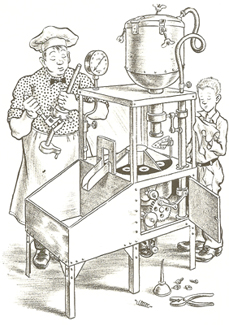
Marcus showed a photo of the doughnut-making machine from Homer Price and remarked how there are only two places to see such a machine now.

“Well, it’s good that someone preserved that model of doughnut-maker,” I thought. “I’m surprised there are so few left—maybe it really didn’t work well, so most of the machines were pulled apart.”

But that wasn’t what Marcus was saying. If I understood him correctly, only two examples of that machine were ever made. One was for the Walden Wood film studio when it adapted Homer Price as a short film in 1963. McCloskey was a friend of the studio owner and spent a lot of time there in later life; as a lifelong tinkerer, he might well have helped to build that machine.

The other was a replica built and displayed in the Municipal Building back in Hamilton, amid McCloskey’s architectural decorations. It’s not clear whether that one was made to work or just to look like the picture in the book.

All along I’d thought that was a standard type of doughnut-maker from the 1940s. After all, I’d seen it in action in that movie, operated by a boy who looks just like Homer Price (and couldn’t act for beans).

But it sounds like McCloskey made it up, based on real, less compact doughnut-making machinery. I feel like Freddy and Louis discovering that the Super Duper can’t lift his car out of the ditch.

15 August 2014

Keith Ablow Lets His OIP Derangement Syndrome Hang Out

This week’s example of OIP Derangement Syndrome comes from Keith Ablow, a FOX television psychiatrist and writer of thrillers featuring a hairless psychiatrist who’s irresistible to women.

Ablow can be relied on to say ridiculous negative things about President Barack Obama, which is of course why he’s under contract to FOX.

He was presumably on the woman-hosted talk show Outnumbered because of his keen insight into feminine psychology, as shown by his claim in 2012 that Newt Gingrich’s pattern of marital infidelity and divorce proves he’s attractive to women.

The Outnumbered regulars brought up Michelle Obama’s campaign for better childhood nutrition, a cause that would ordinarily be so non-controversial that resentment of it is itself a strong sign of OIP Derangement Syndrome. Ablow’s contribution to the conversation was, in the words of Wonkette:
How well could she be eating? She needs to drop a few. [All the women gasp as if they didn’t already know Keith Ablow is terrible] We’re taking nutritional advice from who?
The next day he repeated his argument.

Which he had launched with his paunch hanging over his belt, as shown above.

08 September 2013

The Amorality of Teen Titans Go

I had something else in mind for this weekly Robin, but today I saw reports of DC Comics’s plan to publish a Teen Titans Go comic book (the second of that name, the first being a spin-off its earlier Teen Titans cartoon). Comics Alliance says this will be a digital comic, taking advantage of ComiXology’s “guided-view” feature to create more page turns, before being printed in a standard magazine format. And I doubt I’ll be buying it.

Bleeding Cool’s article “Could Teen Titans GO! Be The Most Amoral Comic That DC Publishes?” echoes why I gave up on the show:
It’s actually quite vicious and surreal, often ending with all the Titans dead or permanently maimed. . . .

The most subversive episode is one where Robin decides he’s sick of being the only one without superpowers on the team because he has to work harder than everyone else. They tell him that superpowers are a curse. A CURSE! He will be forever a stranger, an outsider.

He insists he wants powers, so Raven gives him the gamut of powers, warning him he’ll live to regret it. NOPE. He goes off and solves all crime, ends world hunger and everything’s great. Except that means superheroes are out of a job. The team disbands. Robin has to find a crappy, boring 9 to 5 job. He toils at this job for the next 50 years until he falls over and ends up in the hospital on his death bed. . . .

The sheer amorality of the characters throughout the series is brilliant.
I recognize the talent and imagination involved in these stories. For instance, when Robin gets superpowers, he also gains a Superman-style spit curl. The show doesn’t call attention to that detail, Superman himself never appears in this universe—it’s just a little touch for fans.

The problem is that in any episode featuring Robin, he comes across as egotistical, bossy, short-sighted, lazy, and otherwise less than heroic. And so do all of the other male Titans, and sometimes the females. We hardly ever see them do anything nice for each other, or for anyone else.

What’s worse, in that episode Robin does end crime and save the world, as the summary says. And the show depicts that as a bad thing. Robin becomes a middle-aged adult (always a bad sign) and dies in a hospital bed. Because, you know, kids love that stuff.

At his Batwatch site Jeremy Sims mixes up “amoral” and “immoral,” but recognizes the same problem:
I really enjoy Teen Titans Go! but I'm not sure that I would want my kids to watch it. The characters almost always act immorally and almost never suffer the consequences, and they are supposed to be heroes.
As I groused back in June, “There is, as far as I can tell, almost no heroism in Teen Titans Go.” And the overarching theme of superhero stories, I think, is the nature of heroism in different circumstances. Teen Titans Go is no more concerned with heroism than the average Heckle and Jeckle cartoon.

As is to be expected, the cover of the first issue of the new comic book shows the Titans, particularly Beast Boy, eating.

25 July 2013

Editing Dahl

From Stephen Roxburgh’s recollections of editing Roald Dahl’s The Witches thirty years ago, just published in Publishers Weekly:
On May 16, I sent Roald our American copyeditor’s queries, three closely typed pages of minutiae, most of it involving using American English rather than British English. Roald wrote, “I don’t approve of some of your Americanisms. This is an English book with an English flavour and so it should remain.” Here are a few examples:

“elevator vs. lift: I agree elevator for ‘lift’ because most American children simply won’t know what ‘lift’ means.

“candy vs. sweets: I do not agree ‘candy’ for ‘sweet.’ Your children will know what sweets are and anyway it’s important for the witch to say “Sveet-shop.” So no candy or candy-shops, please.

“tuna fish vs. fish-paste: I won’t have ‘tuna fish’ for “fish-paste.’ Please keep this Anglicism. It’s a curiosity even over here.”
I’m pleased that even though Dahl began with a broad statement about “Americanisms,” he made his actual choices based on how well the text would communicate to young American readers.

Also notable in this article is that Dahl originally thought The Witches needed a more conventional ending, as forecast in its original beginning: “I myself escaped twice from the clutches of witches before I was eight years old, and for that I have to thank my grandmother.”

23 June 2013

Little Gotham and the Rough Edges

I read through Batman: Little Gotham, #10-12, this month. It remains one of the last vestiges of the DC Universe that existed before the current “New 52” continuity. Or rather, it’s a particular reflection of that universe.

In Little Gotham, not only are there no dead Robins, but most of Batman’s protégé(e)s are on good terms with him and each other. Jason Todd and Cassandra Cain are hanging around Wayne Manor. Nightwing and Oracle are still dating. Damian brings his (sometimes) little friend Colin home with him for play dates instead of keeping him secret.

In other words, this is the universe that many fanfiction writers seem to prefer imagining, where all interpersonal friction among the heroes has been sanded down to nothing more than amusing grumpiness. (Oh, that Jason!)

Little Gotham’s Damian continues to act out of character, as defined by his interpretations in the main comics. He was raised within the al-Ghul clan of assassins and world-conquerors, and in #10 he doesn’t recognize the name Napoleon. (He calls it his favorite ice cream. Overly obsessed Robin fans know that Neapolitan ice cream was Jason’s favorite. Not that I know that fact. No.) Like the Robin of the Teen Titans Go cartoon, this Damian seems greatly concerned with food.

In another panel Damian comments on American men’s fashion from the 1980s and ’90s, when he wasn’t even supposed to be alive. While the Little Gotham Damian has the same lack of patience and politesse as the character in the main comics, his history and outlook are unrecognizable.

That change seems to be part of the same process as the change in the rest of the Batman family: this Damian has become more cute, at the cost of the rough edges and details that made him distinct and more interesting in stories.

A couple of these issues left me with questions about their editing. The villain of #10 is Bane, and about halfway through he develops an accent (“d” for “th”). Batman fans of Latino descent disagree on the use of Spanish words and phrases in this story.

Another editing issue was word-balloon placement in #10-11. (Usually editors handle that job and letterers carry out their instructions.) On several pages I struggled to find the right flow from one balloon to the next unclear. The credited editor, Kristy Quinn, has years of experience with Wildstorm and DC. But maybe those issues were a learning experience for an assistant.

26 January 2013

Fast Food and the Caped Crusader

I recently read a study in Pediatric Obesity titled “What would Batman eat?: priming children to make healthier fast food choices.” Unfortunately, it left me with a lot of questions.

The study was small, involving only 22 children. (Interestingly, just six of those were non-Hispanic whites.) During weekly lunches at Burger King the researchers asked the kids, “Do you want apple fries or French fries with your lunch?”—“apple fries” being the chain’s term for apple slices.

At the outset only 9% of the kids chose the fruit. But when shown “12 photos of (6 admirable and 6 less admirable) real and fictional models” and asked what those folks would choose, the kids’ choice of apples went up to 45%. Not even half, but still a significant jump.

Alas, the study doesn’t list all the people in those photos. Two of the admirable figures were Batman and Spider-Man (spelled without the hyphen in the abstract). One of the “less admirable” figures was the Penguin—a villain whom Dick Grayson chuckled at in 1941 (see below) and who has only gotten more roly-poly and villainous since.

The other nine figures remain unknown. Did they include the Hulk, an embodiment of id with no regard for body issues—yet usually on the “admirable” side? What about Bouncing Boy of the Legion of Super Heroes, chubby and heroic? What about Stephen Hawking? What about a villain in excellent physical condition, like Deathstroke?
(One of the early Bruce Wayne’s brief attempts to be mature and parental. Within a few panels he was referring to the Penguin as “that fatty.” But then the man turned out to be a criminal, so it was okay to look down on him.)

22 August 2012

Baked-in Resentment from Sendak

I was struck by this quotation from Jonathan Cott’s interview with Maurice Sendak in Pipers at the Gates of Dawn (1983), about the inspiration for In the Night Kitchen:

When I was a child, there was an advertisement which I remember very clearly. It was for the Sunshine bakers, and it read: “We Bake While You Sleep!” It seemed to me the most sadistic thing in the world because all I wanted to do was stay up and watch . . . It seemed so absurdly cruel and arbitrary of them to do it while I slept. And also for them to think I would think that was terrific stuff on their part, and would eat their product on top of that. It bothered me a good deal, and I remember I used to save the coupons showing the three fat little Sunshine bakers going off to this magic place at night, wherever it was, to have their fun, while I had to go to bed. This book was a sort of vendetta book to get back at them and to say that I am now old enough to stay up at night and know what’s happening in the Night Kitchen!
A similar Chicago Tribune article says Sendak saw that slogan when his sister left him in the Uneeda Biscuit exhibit at the 1939 World’s Fair.

Sunshine Biscuits and Uneeda (from Nabisco) were rival products, and it looks like the real story might be a blend of those memories. As shown above, Sunshine Biscuits ran ads as early as 1936 depicting miniature bakers at work on its products. At the 1939 World’s Fair the company evoked those scenes with little people dressed as bakers, as shown in the postcard at right. Sendak, who turned eleven that year, might well have seen the little bakers at work.

However, I haven’t found any Sunshine Biscuits ads proclaiming something like “We Bake While You Sleep!” The company could have used that line, of course. Bakers have long been known for getting up early to produce fresh bread for the day. Merita Breads, a brand centered in the South, used “Baked while you sleep” as one of its slogans. The Carmel Bakery, in business in Monterey County since 1906, proclaims, “We bake while you sleep.”

What’s most striking to me about Sendak’s story of inspiration is its emotional dimension. Many children might be intrigued by the thought of bakers (especially little bakers) working all night for them. But Sendak declared that arrangement was “sadistic,” “absurdly cruel and arbitrary” to himself, and used it to fuel “a sort of vendetta book.” But he talked like that a lot in middle age.

TOMORROW: The legends of Mickey’s diaper and penis.

29 March 2012

Don’t Mind Me—Just Go Ahead with Your Salad

After Art Spiegelman’s talk, a bunch of us from the Boston Comics Roundtable went out for dinner and chat about comics, electronic publishing, and electronic cigarettes.

After I’d ordered dinner, I realized that the other three folks at my end of the table were vegans. “Do you have a soy press?” “I’ve actually found some good sausages.” “There are some great restaurants in Cambridge.” (Of course.)

And then my dinner came. I’d ordered the Breakfast Burger: a hamburger with a fried egg, bacon, and cheese. We joked that the only way I could have ordered a less vegan dish would have been to ask for a smear of foie gras and a live oyster.

The Breakfast Burger was pretty good, really. I don’t think I’ll be hungry enough for another for at least a year. There was an odd moment when I realized that the warm liquid dripping on my fingers wasn’t burger juice but egg yolk. Hey, it was all animal protein.

31 October 2011

How Picture Books (and Life) Used to Be

Courtesy of the Albert Whitman blog, a page from Time to Eat: A Picture Book of Foods, by Mame Dentler and Frank Fenner, Jr., published in 1945:

28 June 2011

Beyond the Butter Cow

Norma “Duffy” Lyon, the Iowa State Fair’s butter cow sculptor from 1960 to 2005, has just passed away. Lyon had some art training in college, but her strongest qualification might have been being an Iowa dairy farmer who knew cows.

A predecessor had established a tradition of sculpting something new alongside each year’s cow. Among Lyon’s choices were Grant Wood’s American Gothic, a Last Supper, the Peanuts gang, and Tiger Woods with a tiger.

There’s a book about Lyon, and a website created by her younger brother.

08 June 2011

Divided by a Common Language in Narnia


This is a detail from Amy Goldwasser and Peter Arkle’s Sketchbook page at the back of the last New York Times Book Review, headlined “Literature sue l’Herbe.” They asked different New Yorkers what they were reading in Central Park. The Lawsons were reading C. S. Lewis.

I had the same question that Matthew asks when I read about the Turkish delight in The Lion, the Witch, and the Wardrobe. And I’d never seen a wardrobe; here in America we don’t forget to build closets into houses. It’s amazing the book found any sort of American audience at all.

28 March 2011

Divided by a Common Language under Enchanted Glass

One consequence of the late craze for British fantasies is that US publishers are much less worried about letting young American readers see original British language. Indeed, readers of the sort who know what Hogwarts house they would belong to might even demand those exotic details.

Here’s an example from Diana Wynne Jones’s Enchanted Glass, as a character flips through a telephone book:

“I’ve been through all the Browns twice now,” he told Aidan, “and there’s no Brown of Melstone Manor in here! The wretched crook must be ex-directory. He would be!”
Context makes it easy to figure out that what this British character calls “ex-directory” an American would call “unlisted.”

Another character in the book regularly makes “cauliflower cheese,” and to confirm that dish exists here’s a recipe. It even has a Wikipedia entry. In contrast, the “big, sloppy bowl of potato cheese” that same character sets out in chapter 8 has no equivalent webpages, indicating that she’s just thrown stuff together, and the result doesn’t even necessarily pass muster as rural English cuisine. I wouldn’t have gotten that nuance if I hadn’t tried looking up both phrases.

08 February 2011

That’s a Lot of Creamed Corn

Today’s edible Oz image comes from a charity event where “teams of Kansas City architects, engineers and contractors showed off their ‘can do’ spirit by creating structures using cans of food.” The photo above appeared on the Kansas City Community News site; Oz fans Ruth Berman and Alan Wise dug up the story and the link.

This is the Society of Design Administration’s tenth annual CANstruction, which “challenges teams to design and build large sculptures made only of canned food and other non-perishable food items.” The canned food used then goes to the Harvesters Community Food Network.

04 February 2011

Edible Oz

Oz and Ends reader Judy Cataldo kindly sent me this photo of a gingerbread and candy landscape displayed at the Strawbery Banke Museum in December.

Titled “Trail of Oz,” it was created by Zachary, Alexia, Nicholas, and Mimi.

Fans of the Oz books will be pleased to see how more than one Yellow Brick Road converges at the Emerald City. Of course, this sticky terrain is more like what we’d expect to find in Mo.

24 September 2010

“Took down a square green bottle…”

I don’t know much about wine, but I nonetheless feel skepticism about wine from Kansas. On the other hand, the Oz Winery in Wamego deserves a toast for its graphics alone. Just look at that visual riff on MGM’s Emerald City.

The wines themselves all hearken back to the 1939 movie, though the Limited Editions and some others have W. W. Denslow art on the labels. I’m not sure how the firm manages to formulate so many flavors from the Kansas growing season, but choices include Ding Dong the Wine is Red, Drunken Munchkin, Poppy Fields, and Surrender.

A little Googling dedicated research unearthed this local TV story about the firm, which also reports, “Before prohibition, Kansas was the third largest grape producing state in the nation. Right now, there are less than 20 wineries in the state, with 300 to 400 acres of vineyards.”