Showing posts with label revision is your friend. Show all posts

27 September 2020

More on Christie and Wodehouse
After posting about the possible influence of P. G. Wodehouse on Agatha Christie, I got a hold of Christie’s autobiography to see if it had any information to refute or confirm that hypothesis.

(I also looked at Laura Thompson’s biography, Agatha Christie: A Mysterious Life, but nothing in it contradicted Christie’s own statements.)

As a young writer, Christie tried to place her literary short stories: “I sent them to magazines, but expected them to come back, and come back the usually did.” However, her autobiography didn’t name those magazines, so I can’t say whether any were publishing Wodehouse in the mid-1910s.

Christie definitely had Dr. Watson in mind when she created Capt. Hastings for her first detective story, The Mysterious Affair at Styles, and she definitely didn’t think much of the character:
At that date I was well steeped in the Sherlock Holmes tradition. So I considered detectives. Not like Sherlock Holmes, of course: I must invent one of my own, and he would also have a friend as a kind of butt or stooge—that would not be too difficult.
That certainly doesn’t sound like she put a lot of thought into Hastings when she planned that story. “He was a stereotyped creation,” she wrote, though she “quite enjoyed” him.

As for her writing process, Christie’s autobiography confirmed that she “finished the last half of the book, or as near as not, during my fortnight’s holiday. Of course that was not the end. I then had to rewrite a great part of it—mostly the over-complicated middle.” Again, it’s not clear when she developed Hastings and his rapport with Poirot, which is where I see the resemblance to Wodehouse’s Bertie and Jeeves.

Christie started sending her rewritten manuscript to publishers during the World War. It stayed at The Bodley Head through the Armistice and for “nearly two years” before the publisher asked for revisions. Christie described those changes merely as the “last chapter” and “a few more alterations,” suggesting that by that point the main characterizations were intact.

Thus, it appears that Christie most likely developed Poirot and Hastings’s interactions during her 1917 revisions, after stories exploring the Jeeves and Bertie relationship had started to appear in British magazines. But the autobiography offers no additional evidence of possible influence from Wodehouse.

Christie did refer to her first husband’s wartime “soldier servant and batman” as “a kind of Jeeves—a perfection.” But of course she could have read Wodehouse’s stories anytime in the decades between her debut and when she wrote her memoirs.

04 July 2013

The Invention of Rewriting Revision?

Declaration of Independence.  ... Digital ID: psnypl_mss_1228. New York Public LibraryI’m looking at successive drafts of the Declaration of Independence while considering Craig Fehrman’s Boston Globe essay on revision in writing.

Fehrman says that Hannah Sullivan’s The Work of Revision posits that “revision as we now understand it—where authors, before they publish anything, will spend weeks tearing it down and putting it back together again—is a creation of the 20th century.”

More specifically, she argues that approach to rewriting is a product of the typewriter, cheaper typesetting, and word-processing programs. In days when paper and printing were rarer resources, authors didn’t see so many versions of their work and therefore took fewer opportunities to rewrite.

Yet the article omits some counterexamples. It cites John Milton’s “Lycidas” as an example of a writer making “local tweaks instead of significantly recasting.” It doesn’t mention that Milton issued Paradise Lost in two forms, the first divided into ten books and the second into twelve, as he revised his work. Alexander Pope published three versions of The Rape of the Lock within a decade.

Fehrman says Sullivan cites the Romantics as a school that “made resisting revision a virtue. The best literature, they believed, flowed from spontaneous and organic creative acts.” Yet no great English poem was more fussed over and rewritten (not always to good effect) than William Wordsworth’s verse autobiography, posthumously published as The Prelude.

The Work of Revision doesn’t appear to go deep into English literary history, or to find the same trends in the literature of other languages where the same typesetting technologies applied. The catalog copy names only Modernist authors, contrasted with a nameless swarm of “Romantics,” and the earliest name in the table of contents is Henry James.

It might be more accurate to say that the Modernists, in contrast to their immediate literary predecessors, talked a lot more about revision, and about what hard work it was. And that would be significant in how they, and we, think about art. But are writers really driven more to revise now, or do we just see and hear about it more often?

04 November 2012

Remaking Batgirl in Li’l Gotham

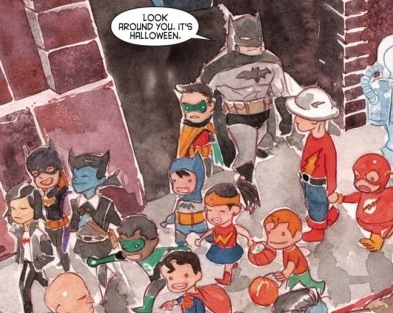
This week DC published a digital comic called Batman: Li’l Gotham, by Dustin Nguyen and co-writer Derek Fridolfs. It’s a Halloween tale about Batman introducing Damian Wayne as Robin to the custom of trick-or-treating.

This Dynamic Duo is never out of costume, so the pages don’t clarify whether Batman is Bruce Wayne in DC Comics’s current continuity or Dick Grayson during the last year of the last one. I felt the story really belonged in that earlier universe. Damian seems like a very new arrival to America. This Batman’s appreciation of holidays seems more like Dick. Of course, the Li’l Gotham universe doesn’t have to exactly match the standard continuity. (Would any other version of Damian be so excited about candy?)

I suspect that Nguyen created this story in early 2011 or before. He’d been experimenting with this watercolor chibi style for a few years, and DC published a couple of stories written with Fridolfs in 2009. Some of the art promoting the series still shows Nightwing in blue, Cassandra Cain, and other sights not included in DC’s new continuity.

As more evidence of the story’s age, look at the three figures in the left of the detail above. Batman fans would quickly recognize trick-or-treaters dressed as Cass Cain after she stopped being Batgirl, a Batgirl, and Klarion the Witch Boy in blue. Which Batgirl? The big smile and purple stripe down her leg suggest Stephanie Brown, and indeed Nguyen painted Stephanie meeting Klarion in Batgirl, #18, published for Halloween 2010. Contrarily, the red hair suggests Barbara Gordon, once and present Batgirl, who had appeared in Nguyen’s original Li’l Gotham poster. But it’s easy to change a spot of yellow into a spot of orange with Photoshop.

In fact, the Bleeding Cool comics gossip website showed just how easy. The image above comes from DC’s preview of the story, issued early on 31 October. Later that day Bleeding Cool labeled that Batgirl as Stephanie.

The image at left comes from the version I downloaded late on the afternoon of 31 October from ComiXology. Note how its Batgirl has dark hair and a purple stripe.

On 1 November Bleeding Cool shared another image, on the right, showing a further change: even the purple stripe is gone. Someone at DC had digitally recolored Nguyen’s watercolors to remove all visual allusions to Stephanie Brown.

Some observers interpreted these late changes as an attempt to catch up on an editorial mandate to wipe out all traces of that character. I suspect the motivation was to make that Batgirl look more like Barbara Gordon and thus match the current continuity.

But was that at all necessary? Once superhero fans might have been bothered by discrepancies, but today’s fandom seems to accept different versions of the same mythos. Just this week, for instance, DC Collectors highlighted paper dolls from Funko that include a definitely un-round Robin with a look not seen in DC’s main comics since Ronald Reagan’s first term and wiped out of existence in the current continuity. McDonald’s is offering Young Justice toys based on a TV cartoon set in a world all to itself. DC’s parent company is preparing to release a movie based on Lego Batman. It just made a bundle on Christopher Nolan’s “realistic” take on the mythos. Why put so much effort into making the Li’l Gotham world reflect the late-2011 continuity instead of the early-2011 one?

27 October 2012

Quandaries of Proofs and Historical Proof

Roger Sutton of The Horn Book just wrote about Unspoken, by Henry Cole, a picture book clearly designed around the myth of quilt patterns as guides on the Underground Railroad. The magazine was all set to publish a mixed review of the book, praising its art and storytelling but criticizing the perpetuation of a myth. But, just in time, the publisher changed the book’s afterword to remove all references to the myth.

Since the body of the book is wordless, there was no main text to change. The quilt remains a significant visual element, however. Sutton thinks the story remains “terrific and intriguing,” but he can’t help noticing that quilt hanging there.

By coincidence, this week I sent The Horn Book my review of an upcoming picture book about an event during the Revolutionary War, also generally praising its storytelling but pointing out a significant historical error. That error didn’t originate with the author-illustrator; it’s an all-too-common exaggeration of the event. The mistaken line could be removed without greatly affecting the larger story—but with the book already in proofs, it’s probably too late.

Sutton’s posting notes that Deborah Hopkinson and James Ransome’s picture book Sweet Clara and the Freedom Quilt linked quilt patterns and escaping from slavery in 1993. That was a story about a girl improvising a patchwork quilt to serve escapees as a map. The “quilt code” myth goes further, positing a widely known, prearranged, and yet secret code based on patchwork patterns, some not documented until after the U.S. Civil War.

Leigh Fellner, one of the quilt scholars working to disabuse of this myth, found the earliest manifestation of the quilt code myth to be a “brief statement in a 1987 feminist video” with no supporting citation. Sweet Clara… followed, probably independently and probably doing more to promote the linkage of quilts and escape routes.

After that picture book, a woman in Charleston, South Carolina, named Ozella McDaniel Williams told a similar story to Jacqueline Tobin while selling her quilts. After three years of fruitless searching for confirmation, Tobin went back to Williams and interviewed her at greater length. Based on that one source, Tobin wrote Hidden in Plain View with Raymond Dobard, Jr. One Oprah appearance later, and a new American myth was born.

01 July 2011

Peeking in on Kirby and Lee

HiLoBrow just published Rob Steibel’s analysis of an original page from Fantastic Four, #63, that preserves handwritten notes and revisions by Jack Kirby and Stan Lee.

I was especially interested by Steibel’s comments on changes made after Kirby had drawn the page, Lee had scripted the dialogue, Sam Rosen had lettered the balloons and captions, and Joe Sinnott had inked the art. The page came back to Lee as editor-in-chief, and he ordered further changes in house.

About one panel Steibel writes:
look closely at the word balloon in the top left corner — you can see all the dialogue has been covered in white-out, and replaced with the text written in the small circle right above the change. Those notes are in Stan Lee’s handwriting. This is obviously a change made at the very end of the process.
Lee must have rethought that bit of dialogue, though it’s not clear why.

There’s a more subtle change in another panel: Lee asked for more space between two word balloons coming from the same character. As Steibel suggests, “Lee may have felt there was too much blank space above the character Blastaar, and this revision made the image more balanced.” I think Lee also wanted more space to symbolize a gap in time between the speeches in the two balloons; that gap offers Blastaar the opening to do his blasting.

Lee also had an in-house artist fix how Blastaar shot explosions from his fingertips. Steibel notes:
Lee writes in the margins in the second circle, “More speed lines,” which you can clearly see were added to the image because they are fairly shaky, once again, much different than Sinnott’s impeccable line-work.
This documentary record bears out Lee’s recent testimony about how he worked with Kirby, which in turn is consistent with his past statements. He cultivated the image of a blowhard, but he was an honest blowhard.

25 May 2011

Making Lemonade Mouth a Little Sweeter

I heard an interesting publishing story at last week’s SCBWI New England conference. Mark Peter Hughes originally published Lemonade Mouth as a young adult novel in 2007. This story of a teen-aged band got good reviews, and Mark and his family toured the country to promote it.

Earlier this year the Disney Channel unveiled its adaptation of the book to big audiences. Even a moderately successful television show reaches more people than solidly successful book by multiple orders of magnitude, and the Lemonade Mouth movie was more than moderately successful. It may not be a High School Musical phenomenon yet, but it attracted a lot of Disney’s core viewers.

The only problem is that those core viewers aren’t “young adults”—they’re tweens, and possibly tween wannabes aspirants. What would those readers find when they looked for Lemonade Mouth in bookstores? What would their parents find?

Mark and his publisher decided to tweak the text for the book’s likely new readers as they reissued the paperback. The adaptations seem small—nothing to the plot, little to the language. The result is, I suppose, a “Disney version,” but it also speaks more directly to most tweens’ interests. It may also reflect a future of authors tailoring books to different readerships, something that digital formats will make even more economic.

Still, I can’t help but wonder if sixth-graders will whisper to each other to check out the library’s old hardcover copy of Lemonade Mouth.

27 March 2011

Revisting the First Boy Wonder’s Boyhood

This cosplay in its purest form comes from the website of WSOC in Charlottesville. Evidently it’s Charlie, one of the station’s deejays, around age six.

And speaking of childhood, this week DC and Grant Morrison addressed a detail of the Batman and Robin saga that nagged me ever since I read Batman: From the ’30s to the ’70s when I was a little older than Charlie here.

The original Batwoman was Kathy Kane, a socialite/circus performer. (In the world Bob Kane created, almost all heroes had to be rich. And it didn’t hurt if they had names similar to the one he adopted.) Batman figured out Batwoman’s identity by noticing she used circus slang. Robin, despite having grown up in a circus, was left with the “Holy jargon, Batman! I never realized!” routine.

For a while I rationalized that by telling myself that Dick Grayson was just so used to those terms that he didn’t realize they were unusual. But then I read other comics fans expressing bother at the same detail, and I could acknowledge it a sign of disrespect for the Boy Wonder.

Thanks to the billions of dollars humans have invested in the internet, I can even pin that down on science-fiction novelist Edmond Hamilton (1904-1977). The Grand Comics Database credits him with scripting Batwoman’s debut in Detective, #233, published in 1956.

But Hamilton may not have known Dick Grayson’s background. He started writing regularly for DC in the late 1940s, years after Robin was introduced. Today’s superhero comics constantly refer back to major characters’ backgrounds and origins, but the comic books didn’t retell Robin’s backstory between his arrival as the sensational character find of 1940 and Batman, #129, twenty years later. (There was a 1943 pilot for radio, never broadcast, that made his doomed parents trapeze artists and FBI agents.)

As a result, most of Hamilton’s young readers had probably never read about Dick’s upbringing in a circus. But when I saw Robin’s origin in the same volume as Batwoman’s, the discrepancy popped out. As I’ve noted before, Grant Morrison read the same collection as a wee lad in Glasgow, and perhaps he had the same thought.

In the latest issue of Batman, Inc., Morrison reinterprets the first Batwoman’s role in Batman’s past, as he forecast doing two years ago in a story collected in Batman, RIP. But this time Dick gets to spot the circus slang. He doesn’t tell Bruce what he knows because he’s conflicted about his adoptive big brother falling in love. And because he’s a grumpy thirteen-year-old. Now that I can believe.

30 December 2009

Rocketeer Relaunched with “Rendering”

The publication of The Rocketeer: The Complete Collection, by Dave Stevens, has provided a new example for the debate over recoloring old comics with new digital techniques (as I discussed back here).

After Chris Sims praised the new coloring by Laura Martin on his Invincible Super-Blog, some commenters politely disagreed. For instance, Adam Russo wrote:

The older, limited-palette, ‘pop art’ kind of look appeals to me and I think it meshes better with the art. Whereas the newer colors are well picked and the scene in particularly is well laid out (the way all the dark blues surround the warm colored centerpiece is a nice and effective way of drawing the eye in), it doesn’t seem the same for some reason.

Like I said, I think it’s a style thing. The older colors are easily recognizable as an old pulp style story. The newer ones, though wonderful to look at, give it a different feel all together. Way more modern in both good and bad ways.
Greg Burgas then wrote of the new pages, while showing some examples:
Martin adds depth to the scenes, a very nice 1930s pulp sheen to the book (which, from what I’ve seen of the original, is lacking) and really gives the book a sense of place - New York is very different from Los Angeles, for instance.

From what I’ve seen of the original (this is the first time I’ve ever read the comic), it had much more of a bright, cartoony feel to it, and although that works for comics, Stevens obviously had a more pulp vibe going on, and Martin helps create this. The characters look real, too - in the original, they looked more like comic book characters and Cliff’s outfit looked a bit more like spandex, while Martin makes the people - even Betty - more real, and Cliff is obviously wearing actual clothing.
Back when IDW announced this reissue, the publisher made much of the fact that before his death Stevens had chosen Laura Martin to do the new coloring job using today’s technology. She described her approach for Comic Book Resources:
“The art style and the story’s tone are two major leads in the search for a coloring solution. Every colorist should consider these two concepts first when choosing a rendering technique and a palette,” Martin said of her approach to “The Rocketeer.”

“My first consideration will be Dave’s own painted pieces. One can only assume that he likes his own coloring the best, so I’m starting there. Is his work brushy or blocky? How does he handle different surface textures? Does he limit his palette, or open it up? What's his favorite tool — airbrush, brush, marker, etc.?

“Once I get a feel for that, I’ll look at the pulp and strip art from the 1940’s, to see what influenced Dave while he drew these pages. Of course, the fact that ’The Rocketeer’ was previously colored is a major advantage. I can visualize the page in color, and I can use it as a starting point for my own interpretation.”

She said there were challenges particular to this project, as well. “The first challenge is to interpret Dave’s intent through the filter of the the colorists’ final work, while overlaying my own aesthetic. The second is to introduce digital techniques that weren’t available in the 1980s, without it looking too ‘digital.’”
I think one key to this discussion is Burgas’s remark that “this is the first time I’ve ever read the comic.” He’s therefore free of the question of whether rereading this comic feels just like the first time. Of course, rereading rarely feels just like the first time—all the more so because for many people comics are escapist reading during youth, and therefore beyond full recovery.

Me, I never read The Rocketeer, either. But I liked the movie.

28 December 2008

Not “Not Goofing Off!”

Last December I posted this image, taken from an online preview of the first issue of the comic-book miniseries Teen Titans Year One. The script is by Amy Wolfram, the art by Karl Kerschl.
That issue and the five that followed have now been collected in a paperback. But not every detail made it into that edition.

Robin's agitated speech balloon in the picture disappeared between the preview and the paperback. Twenty years ago, the likely explanation would have been that a balloon pasted onto the artwork at the last minute had fallen off on the way to the printer. But with the technology of that time, there was also no easy way to make one of Robin's words to appear in red.

These days, comics are assembled on computers. That makes lettering and coloring much more flexible. It also turns editing, moving, or removing an element inserted by the letterer a simple matter of finding the right level in the Photoshop file. So this was a deliberate change.

What could have been the reason? Kerschl's art makes clear that Robin is startled by Batman's comment, so a red-letter speech isn't necessary to show his emotional state. Still, he does have his mouth open. I suspect the explanation lies in how Robin doesn't talk back to Batman like this in the rest of the miniseries (more's the pity). Wolfram and her editors may have decided that even though there was enough space on the page for this balloon, it no longer fit the story.

28 November 2008

The Synoptic Gospel

Earlier this year I helped a friend polish the synopsis of his first novel for a literary agent. That got me thinking about synopses, a singular literary genre with a very small audience but a great deal of potential value locked up inside. Of course, the full manuscript still has to deliver, but a good synopsis really is worth all the effort it requires.

I think a strong synopsis can do three important things for an author:

  • crystallize what your book's really about, which is more than a little useful when revising.
  • show an agent or editor how your novel has a plot to excite and eventually satisfy readers through the requisite mix of surprises, emotional tugs, and logical connections.
  • show those publishing pros that you understand how your plot works, leading them to think that you might just be able to do that again.
Editorial Anonymous has tackled the synoptic topic by inviting people to try synopsizing a well-known, published book for practice, and then submitting the result for feedback. EA's guidelines reminded prospective entrants:
Don't forget to include:
  • What makes it all appealing. If you've summarized everything except the reason readers will be drawn through the plot, you've failed.
  • The ending. I don't care if it's a surprise. Tell me how it fricking ends.
The world breathlessly awaits the results.

Meanwhile, for more examples to learn from, there's Miss Snark's Crapometer-synopsis thread. Evil Editor's Face-Lifts are more focused on query letters, but also offer useful advice on expressing the essence of a story. Cynthea Liu takes a more formulaic approach to synopses, seemingly based on the five-paragraph essay, but that's okay; as a genre, synopses are all about content, not form.

24 September 2008

Hey, Kids! What Day Is It?

It's National Punctuation Day! And in observance I'm bringing back Oz and Ends's PUNCTUATION WEEK, at least for a few days.

To start with, here's a reminder of how the little matter of punctuation still matters to important and right-thinking people. Author Gail Gauthier brought this recent posting from Kirkus Reviews to my attention. Editor Vicky Smith warns authors and publishers that poor copyediting might cost one of their books big.

Consider the case of one of the best young-adult books of the year. It caught both the reviewer and me up with its compelling plot, world-building and character development, but the galley was so riddled with errors that, in the end, I could not read past them. I contacted the publisher in the hopes that these had been corrected in the finished book and discovered that, alas, many--too many--had not. They were errors of the most basic sort, the kind that we all learned about (and then many of us forgot) in eighth-grade grammar. . . .

After consultation, the reviewer and I agreed that although we both felt the story deserved a starred review, it should not receive one; we felt we had to look at the book as a whole, and the whole included too many grammatical faults to ignore. The publisher has assured me that the errors will be corrected in the second printing.
The publisher could have tried to bull through the criticism as the McCain-Palin campaign has been doing, claiming that what look like mistakes were correct all along. But the fact that the publisher plans to correct those items shows that they weren't part of the narrative voice, or reflections of an alternative style sheet. They were errors.

As for which book that was, Monica Edinger reported that most children's-lit people were guessing The Hunger Games, published by Scholastic.

15 January 2008

Not Withholding Information

I mustn't withhold a link to Janni Lee Simner's "Revision lessons." Among her hard-learned reminders:

You know those writers who withhold information from the reader for no good reason? And how you thought you weren't one of them? You were wrong.