Showing posts with label BOOK Wonderful Wizard of Oz. Show all posts

21 January 2025

Two More Oziana Short Stories

Last week’s posting about a mystery story in Oziana 2024 made me realize I’d never noted Oziana 2023, which contains two of my stories.

As I reported last week, I’ve been seeking inspiration for new stories from pairing two recurring characters in the Oz books, as L. Frank Baum did in his Little Wizard Stories of Oz.

“The Soldier with the Green Whiskers and the Guardian of the Gates” is a natural pairing: two officers of the Wizard’s Emerald City government who kept their posts under the Scarecrow and then Princess Ozma, working together as friends.

The Oziana 2023 stories, in contrast, pair characters who have little in common and start out at odds with each other.

“Button-Bright and the Professor” shows the small boy from Philadelphia and the highly educated Wogglebug quarreling over directions before they’re forced to deal with a giant riddle-loving pangolin. This story was illustrated by Marcus Mébes.

“Glinda and the Glass Cat” follows the transparent feline to the China Country, the Hammerheads, and the Fighting Trees while the powerful sorceress seeks to make her curb her willful instincts. Anna-Maria Cool supplied fun art for this tale, and for the magazine’s cover.

Like other recent issues of Oziana magazine, the 2023 collection is sold through Lulu.

17 January 2025

A Mystery Tale from the Early Emerald City

Oziana is the International Wizard of Oz Club’s creative magazine for fiction and art inspired by the Oz books. It’s been published annually for about half a century now.

The latest issue, printed at the end of last year, includes my short story “The Soldier with the Green Whiskers and the Guardian of the Gates,” delightfully illustrated by Rob Lauer.

This story is set shortly after the end of The Wonderful Wizard of Oz. The Wizard has flown away, leaving the Emerald City under the rule of the now-brainy Scarecrow. And then the Scarecrow departed to escort his friend Dorothy to the castle of Glinda the Good. So the soldier and the guardian are the highest-ranking officials in town when Winged Monkeys start tearing a hole in the city wall.

I wrote the first version of this story when I was in junior high or high school, but was never fully satisfied with it. A few years ago I realized that it fit into a couple of trends in my newer Oz writing:
  • It was a mystery, and could be a better one.
  • It paired two recurring characters, a form L. Frank Baum used in his Little Wizard Stories of Oz and which I’ve been using to springboard other tales.
I wrote the story again from scratch, hopefully better. At the time I didn’t have a copy of the first version. Since then I came across an old photocopy, but I haven’t dared to read it, lest it be so much worse or even a tiny bit better.

If you care to read “The Soldier with the Green Whiskers and the Guardian of the Gates,” plus six more stories about the early history of Oz, all illustrated, and a closing poem, please order Oziana 2024 from Lulu.

30 July 2024

“The Dorothy Paintings” and More in South Yarmouth

The Cultural Center of Cape Cod is hosting a summer celebration of The Wonderful Wizard of Oz.

The executive director of the institution, Molly Demeulenaere, says: “The Wonderful Wizard of Oz is more than just a story; it's a timeless exploration of what it means to find and appreciate the complex emotions around the concept of home. Dorothy’s journey, alongside her wonderfully loyal and caring friends, mirrors the universal quest for belonging and self-discovery, making it a story that truly resonates across generations.”

Its description of the event says:
At the beating heart of this enchanting exhibition is Christina Schlesinger’s “The Dorothy Paintings.” This compelling collection of thirteen mural-sized canvases reimagines Dorothy’s adventures with a freshness of perspective that aptly portrays her as the symbol of youthful resilience and independence. Schlesinger’s work demands attention while simultaneously depicting a delicateness and vulnerability rarely seen successfully in combination.
Some of Schlesinger’s paintings can be seen here. The Cape Cod Times offers additional photographs of the space, showing how there are hands-on activities for families, inside and out.

This exhibit will be at the center’s Flagship Bass River Campus, 307 Old Main Street in South Yarmouth. The gallery is open Tuesday through Friday from 10 to 5, and Saturday from 10 to 3. The show will run through 7 September.

15 August 2023

“Dorothy the Conqueror” Now Online

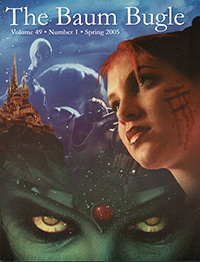
Back in 2005, the International Wizard of Oz Club’s journal, The Baum Bugle, published my article “Dorothy the Conqueror.”

It discussed the character of Dorothy Gale as L. Frank Baum developed her, from a little girl who called herself “small and meek” into a bold adventurer. That boldness had always been part of her character, but after her first trip to Oz she knew it. By the end of Baum’s series, she was happy to set out for unknown parts of Oz because “all excitement is fun.”

The article also points out ways that the MGM movie’s treatment of Dorothy doesn’t reflect that character, especially in her baffling speeches at the end.

The Oz Club has now made the text of “Dorothy the Conqueror” available for anyone to read through this webpage. It even comes with citations in both Chicago and MLA style.

04 July 2023

The Characters of Oz and the Character of Oz the Wizard

Later this year McFarland will publish The Characters of Oz: Essays on Their Adaptation and Transformation, edited by Dina Schiff Massachi of the University of North Carolina at Charlotte.

The publisher says, “This collection of essays follows Baum’s archetypal characters as they’ve changed over time in order to examine what those changes mean in relation to Oz, American culture and basic human truths.”

Among those essays is my own “A Good Man But a Bad Wizard?: The Shifting Moral Character of the Wizard of Oz.”

One of the few lines that appeared in both L. Frank Baum’s original novel and the 1939 MGM movie was the Wizard’s insistence that he was “a good man, but a bad wizard.” Within that first novel the Wizard was a humbug whom people believed in, a tyrant who benefited his people, but ultimately someone Dorothy couldn’t rely on.

Just a few years later, however, the American public knew the Wizard of Oz unambiguously as a bad man in the Wizard of Oz stage extravaganza. And a few years after that, Baum brought the Wizard back as a stalwart friend for Dorothy and eventually a real magic-worker. This essay analyzes those changes in his persona across media and moral boundaries.

Other articles in this collection include Katharine Kittredge on Dorothy, Dee Michel and James Satter on the Cowardly Lion, Walter Squire on Glinda, Paige Gray on Jack Pumpkinhead, and Angelica Carpenter on the Nome King, among many other experts. Dina Massachi wrangled the contributors and provided her own exploration of the Winged Monkeys.

04 April 2022

The Opening of the Emerald City

My last posting explored the location of the original gateway into the Emerald City, the one Dorothy and her friends use in L. Frank Baum’s The Wonderful Wizard of Oz.

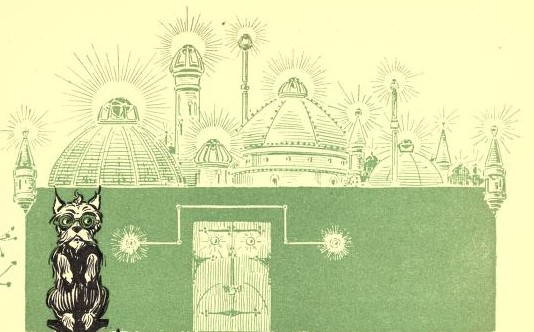
The travelers come to an emerald-studded gate at the end of the Yellow Brick Road. That outer gate leads to a room inside the thick wall with an inner gate on the other side. The little man inside is therefore called the “Guardian of the Gates” even though there is only one opening the in wall. (With his typical inconsistency, Baum also called this character the “Guardian of the Gate,” sometimes within the same chapter.) Thus, the many early references to the city “gates” don’t mean there’s more than one gateway through the wall.

When characters arrive at the city in The Marvelous Land of Oz, Baum describes their experiences in much the same way as in the first book. The Guardian of the Gates greets them and hands them off to the Soldier with the Green Whiskers. Characters speak of “the gate” of the city.

At the same time, it’s clear that there have been changes in the Emerald City. While before the gate was studded with emeralds, the jewels inside the city only appeared to be emeralds because people wore green spectacles. In Land the city contains some real jewels. General Jinjur and her soldiers don’t fear blindness without the spectacles.

More pertinent to this inquiry, in Wizard the Guardian tells Dorothy and her friends there’s no road to the west because no one ever travels that way for fear of the Wicked Witch. In Land the Sawhorse follows “the road to the West.” It’s not clear whether this path begins at the same gate where the Yellow Brick Road ends.

Finally, toward the end of Land Baum tells us that “Jinjur had closed and barred every gateway” into the city. While other passages in that book refer to “the gate” as if there’s still only one, the phrase “every gateway” definitely implies that by the time of Jinjur’s brief rule the city had more entrances.

Once again, this fits with what we know about overall politics in Oz. When the Scarecrow becomes ruler of the Emerald City at the end of Wizard, the Wicked Witches of the East and West have been eliminated. He’s on good terms with Glinda to the south. His friend the Tin Woodman will now govern the west. It would be safe to welcome visitors to his city.

I therefore surmise that between Wizard and Land the Scarecrow began the process of building more gates into the Emerald City walls. Perhaps not as large as the original gate, or perhaps (given the peacetime conditions) larger. Likewise, the Scarecrow and Tin Woodman probably promoted the new road from the city to the west.

Commerce and travel between the parts of Oz was probably still slow in this period. The Scarecrow met Gillikins so rarely that by the time of Land he hadn’t learned they speak his language. Yet General Jinjur could assemble an Army of Revolt of young women from all four outer realms of Oz. (Indeed, Jinjur’s uprising might have been the first pan-Oz movement, at least for several decades.)

Another sign of Oz opening up to travelers appears when we consider the “road to the South” to Glinda’s castle. At the time of Wizard, that route ran into the Fighting Trees, the walled China Country, a dark and boggy forest, and the Hammerheads, who refused to let anyone hike over their hill. None of those obstacles ever appear in the Oz books again, and characters make many easy land journeys from the Emerald City to Glinda’s home. 

What could produce that change? The most likely answer is Glinda the Good Sorceress. With the Wizard in power, she might well have appreciated having several difficult obstacles between his power base and her castle. But once the Emerald City was under a friendly straw-man regime, Glinda probably preferred easier travel.

In The Emerald City of Oz we learn that Glinda has established several protected little communities in Quadlingland and even manipulates the weather over one of them, Miss Cuttenclip’s village. At the end of that book she unilaterally cuts all of Oz off from our Great Outside World. Tik-Tok of Oz shows us Glinda’s moving a mountain pass to divert a hostile army outside of Oz—and so casually she doesn’t bother to remember that she’s done so.

Given that record, it’s easy to imagine Glinda magically shifting the road from the Emerald City to her castle to be straighter or safer, or shifting the Fighting Trees, Hammerheads, and other relentlessly hostile obstacles away from it.

The process of connecting the Emerald City to the rest of Oz no doubt accelerated after Princess Ozma took the throne at the end of Land. Unlike the Scarecrow, she claimed dominion over all of Oz. Her realm is largely peaceful and her rule increasingly secure. It’s no surprise, therefore, that years later The Patchwork Girl of Oz assures us there are four gateways into the city, one for each quadrant of Oz.

02 April 2022

Seeking the Original Gateway into the Emerald City

For fictive purposes, I’ve been trying to figure out the location of the original gate to the Emerald City and when more gates were added.

L. Frank Baum’s The Wonderful Wizard of Oz makes clear the city has only one gateway, which Dorothy and her companions use to enter and exit. That makes sense historically. Oz the Wizard built the Emerald City as a citadel against the witches, especially the Wicked Witches, so he wanted to minimize the entry points. He claimed no authority over the lands of the Munchkins, Winkies, Quadlings, and Gillikins and therefore didn’t need to welcome them.

Several adventures later, The Patchwork Girl of Oz states that by then there are four gates in the city walls, one pointing in each cardinal direction. Presumably one of the four gates of the later city was the Wizard’s original. That means the original gate faces north, south, east, or west—but which one?

We know that it doesn’t face to the west or south because when Dorothy and her friends leave the gate to head in those directions, Baum wrote that they “turned toward the West” and “turned their faces toward the Land of the South.” Turning would be unnecessary if they were already facing either of those directions as the gate opened.

Baum described the travelers’ first glimpse of the gate this way:
As they walked on, the green glow became brighter and brighter, and it seemed that at last they were nearing the end of their travels. Yet it was afternoon before they came to the great wall that surrounded the City. It was high and thick and of a bright green color.

In front of them, and at the end of the road of yellow brick, was a big gate, all studded with emeralds that glittered so in the sun that even the painted eyes of the Scarecrow were dazzled by their brilliancy.
Likewise, in The Marvelous Land of Oz travelers from the Gillikin Country to the north follow another Yellow Brick Road to what appears to be the same gate. And in The Patchwork Girl of Oz we learn there’s another Yellow Brick Road in Munchkinland.

We must presume that when there was only one gateway into the city, all those roads merged at some place in the green country surrounding the city. That leads to the possibility that one or more of the Yellow Brick Roads didn’t head straight to the city from east or north but first led to the merge point—perhaps why Dorothy’s approach seeemed to take so long.

In contrast, the Sawhorse and Jack Pumpkinhead’s arrival at the gate from the north in Land seems more direct. To me that gives a slight edge to the original gateway being at the Emerald City’s north.

Again, that seems to fit with what we know of the history of Oz’s reign. Wicked Witches ruled to the east and west, so the Wizard wouldn’t have built an entrance in either of those directions. The most powerful magician in Oz, Glinda, controlled the south; though she was not a hostile power, she was still a threat to the humbug ruler.

In contrast, the Good Witch of the North dominating the Gillikin Country was a lesser danger to the Wizard. And as for the wicked witch in that territory, Mombi, he actually had personal dealings with her. A gateway to the north would have made the most sense to the great Oz.

COMING UP: Adding more gateways.

07 April 2020

Reading the Monkey

In this time of pandemic throughout the Great Outside World, Prof. Dina Massachi and the International Wizard of Oz Club have organized a video reading of L. Frank Baum’s The Wonderful Wizard of Oz.

All the videos are on the Oz Club’s YouTube channel, as well as various Facebook, Instagram, and Twitter feeds. Yesterday there was even a report on the project in Philadelphia keyed to local reader Ryan Bunch.

Other readers have included Baum’s granddaughter Gita Morena, novelist Gregory Maguire, biographer Michael Patrick Hearn, historian of feminism Sally Roesch Wagner, and many friends I’ve made through the Oz conventions.

Dina asked me to tackle Chapter 14, “The Winged Monkeys.” In this chapter Dorothy learns the secret of the Golden Cap she took from the Wicked Witch of the West—that it can summon the Winged Monkeys to fulfill her wish. She then hears the story of how those Winged Monkeys became enslaved to the cap.

A large part of the chapter consists of the King of the Winged Monkeys’ story from his grandfather’s day. There are other long flashbacks in the book, such as when the Tin Woodman and the Wizard explain how they ended up in the fixes where Dorothy found them. This flashback is unusual in going so far back to tell a story about characters we never see elsewhere in the book—or elsewhere in Baum’s other books, either.

All the characters in the chapter are matter-of-fact about the Monkeys being compelled to obey the owner of the Golden Cap. The present King of the Winged Monkeys expresses no resentment about the sorceress who enslaved them, or his grandfather who angered her, or the Wicked Witch for ordering them around. Dorothy never considers freeing the monkeys from slavery as she’s inadvertently freed the Munchkins and the Winkies.

Glinda the Good does free the Winged Monkeys at the end of the book, but then in the sequel, The Marvelous Land of Oz, Baum describes them still as enslaved to the cap, so evidently that moment in his story hadn’t meant much to him. I doubt an author today could write so casually about slavery.

Reading Chapter 14 therefore presented a challenge. How to voice the King of the Winged Monkeys in a way that made him more than a docile servant by preserving the sense of mischief he acknowledges. Plus, that story of people we’d never meet again had to be interesting. In my telling, the king’s voice came out like a Bowery Boy.

Here’s the result for Chapter 14. Or you can start from the beginning in the great Kansas prairies.

10 September 2019

Mid-Century Modern in the Emerald City

After the original publisher of The Wonderful Wizard of Oz went bankrupt, Bobbs-Merrill became the book’s one and only US publisher.

At first Bobbs-Merrill included W. W. Denslow’s illustrations, though not in the original ground-breaking multi-color design that integrated text and art. The company kept the book in print until the World War 2 paper shortages. As the war wound down, it looked for a way to reintroduce the title.

In 1944, Bobbs-Merrill commissioned entirely new art by Evelyn Copelman (1919-2003, also known as Evelyn Campbell and Evelyn Copelman Baker). She created black-and-white art on scratchboard and painted several color plates.

The title page of that new edition stated that Copelman’s art was “adapted from the famous pictures by W. W. Denslow.” Obviously those pictures weren’t the only source. Copelman’s Dorothy, Scarecrow, and Wizard are clearly designed like the characters in the 1939 MGM movie, and her Tin Woodman and Cowardly Lion look like hybrids.

Bobbs-Merrill had asked Copelman to create an edition that matched the movie, but it didn’t have rights to the MGM designs. It did own the rights to Denslow’s art, however. The title page claim apparently provided legal cover.

In 1949 MGM re-released its movie into cinemas. Not coincidentally, Bobbs-Merrill gave the book a new push. Copelman reworked her line art and added more plates.

With the book still under copyright, Bobbs-Merrill was the exclusive producer of new copies of The Wizard of Oz. Thus, for over a decade in the middle of the century, Evelyn Copelman’s artwork introduced young readers to Oz.

Then the copyright lapsed in 1956. Reilly and Lee, the publisher of the rest of the Oz series, created an edition with black-and-white reproductions of Denslow’s art in a trim that matched its other titles. Other publishers commissioned their own illustrations. As the years passed, Copelman’s art disappeared from bookstore shelves.

Archive.org, working with the San Francisco and other public library systems, has made a digital copy of a Copelman edition available for borrowing. This is a 1994 Illustrated Junior Library edition, with cover artwork by Michael Zimmer but Copelman’s line art and five plates inside. It’s worth a virtual thumb-through, especially if that’s the edition you remember.

09 December 2015

The Feelings We Once Had

Of all the famous dramatic adaptations of L. Frank Baum’s The Wonderful Wizard of Oz, The Wiz in its original form is the most faithful. But of course the 1939 MGM movie is now more famous than either version.

As I observed yesterday, that movie clearly dominated Harvey Fierstein’s thinking about how to adapt the book of The Wiz for Broadway and TV today.

I spotted some other debts/homages to the MGM film that don’t come from the original Wiz:
  • Dorothy wears shiny red sneakers at the start, though public-domain silver shoes later.
  • Aunt Em’s farm employs three farmhands played by the men who (lots of makeup later) play the Scarecrow, Tinman, and Lion.
  • Dorothy is magically faced with the image of a maternal figure (Aunt Em/her late mother) calling for her.
  • We get a view of the distant green spires of the Emerald City across a red-poppy landscape.
  • The Wiz has a “Pay no attention to the man behind the curtain!” moment.
  • Glinda comes to the Emerald City for the penultimate scene instead of Dorothy and her friends going to Quadlingland.
Other elements of Baum’s original story that made it into The Wiz were dropped from this live-broadcast version, such as the Kalidahs as tiger-bear hybrids, the Lion falling asleep among the Poppies instead of outwitting them, and the need to wear green glasses in the Emerald City.

I saw the original Broadway production decades ago, and some elements of its stagecraft have stuck with me. Most memorable was the tornado depicted by a dancer with fabric billowing from her head, an image that inspired the play’s trademark art. The TV production simulated the tornado instead with projected images and wire-flying—much less magical.

The TV version of the Yellow Brick Road consisted of illuminated parts of the stage, like Michael Jackson’s “Billie Jean” video. The stage original was four men in yellow costumes with poles—another image that stuck with me strongly since I first saw it, probably because it was such a bold staging choice for my young mind.

Curiously, Baum’s Winged Monkeys, which became Flying Monkeys in the 1939 movie and Funky Monkeys in The Wiz, were referred to only as “Winged Warriors” here.

08 December 2015

Fierstein Adding “a Little More Sense” to Oz

Last week NBC broadcast a restaging of The Wiz that’s also slated for Broadway next year. It has a new book by Harvey Fierstein, who boasted about his improvements in an interview with BroadwayWorld:
I've loved Wizard of Oz my whole life but have had questions. I was always a questioning kind of kid. I got to answer all the questions that I had. Where did Dorothy's parents go? There's this girl living with her aunt and uncle... well I killed off the uncle; he doesn't do anything anyway. Do we care about him just sitting on the porch rocking away? You have a girl living with her aunt, and it's never mentioned what happened to her parents. Dorothy's such a victim. She didn't create that storm; she gets taken away. She doesn't kill the witch; the house falls on her. She doesn't kill the other witch; she throws water to save her friend. She's just a victim. I said, "Why should she be just a victim? It's her dream! It's her fantasy!"

So I gave her a story, and we open with her running away from home trying to get home to Omaha where she was actually born. Her parents are dead. She hates her school; she hates Kansas. "I hate this place; I hate being out in the cornfield. I want to go home." Her answer is this is your home but your too old for me to tell you what to do. I could keep you here and force you, but at some point in your life you have to figure out where you really belong. She's sent off on this very different journey of going home to Omaha. She ends up in this place that's not Omaha and becomes much more of an active participant in it. In the end, when the Wiz turns out to be from Omaha when they get in the balloon. Instead of missing the balloon, I have her walk away from the balloon an say you're going to your home, I'm headed somewhere else. She finally figures out home is not where your feet are; it's where your heart is.
Clearly Fierstein’s playing off the 1939 MGM adaptation rather than L. Frank Baum’s novel. In the original, Dorothy doesn’t throw water on the Wicked Witch of the West to save the Scarecrow; she does so because she’s ticked off (a situation Fierstein rediscovered). Uncle Henry does more than sit on a rocker.

Fierstein’s characterization of Dorothy makes sense only if she’s a teenager, like nineteen-year-old Shanice Williams. Judy Garland was a teen, of course, but she played a younger girl. The Dorothy of the books is younger still.

In Baum’s books, the Wicked Witch of the East enchants the Tin Woodman because she (or another old woman) doesn’t want to lose the services of his beloved. Fierstein instead put those three characters into a love triangle:
I gave each of those characters a backstory that makes a little more sense. The Tin Man got turned into the Tin Man by the Wicked Witch because she had a thing for him. She caught him with this girl, and she blasted his ass and stole his heart. She said, "If I can't have your heart, no one can."
That “makes a little more sense” for an older audience, perhaps. But children haven’t had trouble understanding Baum’s original motivation for the witch.

Evidently the choice to cast Queen Latifah as the Wiz prompted Fierstein’s thinking about that character:
Queen Latifah's backstory [as the Wiz] is that she was a magician's assistant at a carnival so they gave balloon rides and all of that but you ever meet the person that is not bad enough they're unhappy, they have to make everyone unhappy and that was this guy. She jumps in the balloon to piss him off and this balloon landed me in Oz. Everyone came running so I put on the magic hat and did the magic act. They put me in here and I've been hiding ever since so nobody finds out that I'm not anything. I was the assistant. She is a woman escaping the world of men, which I thought would give a different color to Dorothy as well. It all has to come out of a little girl's imagination. If you don't believe it came out of her imagination it doesn't work.
Because then Oz would just be real, and who wants that?

29 September 2015

The Electric “Elements of Oz”

Elements of Oz is a new stage/video show that seems to combine an homage to the MGM movie with Ozma’s Magic Picture. (Which, as we all know, can show you any place or person you ask to see.)

Here’s a taste of the review in today’s New York Times:
At “Elements of Oz,” having its premiere as part of the Peak Performances season at Montclair State University here, viewers are encouraged to use smartphones or tablets during the performance. . . . You download a special app that instructs you to put your phone in airplane mode until the show starts. The app then provides access to various elements that enhance the production, primarily nifty filters that, when you point the phone at the stage, add new layers of imagery to the action. When Dorothy’s house in Kansas flies skyward, for example, you can hold up your phone and see a real corker of a tornado and slashing rain that isn’t apparent to the naked eye.

Directed by Marianne Weems, “Elements of Oz” was jointly created by James Gibbs and Moe Angelos. Ms. Angelos is also one of the three performers, alongside Sean Donovan and Hannah Heller. A loose, loopy and enjoyable seminar on the making of the movie and its influence on pop culture, the production combines live video and performance — several famous scenes from the movie are more or less filmed anew before us — with anecdotes about its production and other random arcana about the film and the book it was based on by L. Frank Baum. . . .

The live re-creations of scenes from the movie are technically marvelous; the digital video (by Austin Switser) is dazzlingly pristine, and it’s fun, at least for a while, to watch the wry comic impersonations of the performances in the movie. . . . But ultimately these sequences don’t provide enough comic stimulation to justify their length. It begins to feel a bit too much like a draggy day on the back lot, and you might find yourself tempted to escape the app and fire up the real movie on your phone…
The performers, who each play multiple roles, all get praise, as does Bert Lahr.

18 November 2014

The Wizard of Oz teapot tempest”

In 1957 Ralph Ulveling, director of the Detroit Public Library, received nationwide criticism for remarks he was reported as having made about the Oz books.

I’ve been looking into that story, and this is part of one of the documents from it: Ulveling’s counterattack in the October 1957 American Library Association Bulletin.

Ulveling insisted that his library system hadn’t gotten rid of The Wizard of Oz—it simply wasn’t in the children’s rooms. To be fair to him, that decision had been made “More than thirty years ago,” or shortly after L. Frank Baum’s death. On the other hand, his endorsement of that policy acknowledged rather than refuted the anti-Oz-book sentiments attributed to him.

Ulveling went on to accuse the Michigan State University Press, of all people, of ginning up the controversy to sell books.

And you know, he might have been right.

28 October 2014

Monkeying Around with Influences

This is Harry Bliss’s daily newspaper cartoon from 16 Oct 2014.

I like the way he’s combined the costuming from the MGM movie with the composition of one of W. W. Denslow’s color plates.

30 September 2014

A Myth about Oz’s “Women in Strong Leadership Roles”

A new myth about banning The Wonderful Wizard of Oz has cropped up and spread on the web.

Back in March 2013, R. Wolf Baldassarro posted a blog essay about objections to the book. Baldassarro isn’t a librarian, educator, or scholar. He’s a “seasoned paranormal investigator” who happens to feel strongly about book banning.

I found several faults with that essay, including falling for a 2004 Deadbrain hoax about Jerry Falwell and misquoting sources.

Baldassarro’s essay also said about the book:
Nevertheless, it has come under attack several times. Ministers and educators challenged it for its “ungodly” influence and for depicting women in strong leadership roles. They opposed not only children reading it, but adults as well, lest it undermine longstanding gender roles.

In 1928, the city of Chicago banned it from all public libraries.
Note that the words “depicting women in strong leadership roles” were Baldassarro’s own. While ascribing that thought to “Ministers and educators,” he didn’t cite any source, person, place, or date for that complaint.

Despite (or because of) how it overstated the evidence, Baldassarro’s essay got quoted on Buzzfeed and other sites.

Then this February Kristina Rosenthal at the University of Tulsa’s McFarlane Library posted her own essay on the book’s troubles with librarians and censors, which said:
In 1928 all public libraries banned the book arguing that the story was ungodly for “depicting women in strong leadership roles”. This argument remained the common defense against the novels from ministers and educators through the 1950s and 60s.
Baldassarro’s statement about a supposed policy in Chicago thus became a statement about “all public libraries,” and his phrase “depicting women in strong leadership roles” appeared as if it were a direct quotation from those 1928 book banners. That’s shoddy scholarship.

Furthermore, that statement doesn’t stand up to the briefest historical scrutiny. In 1928, Reilly & Lee was publishing one book every year in the Oz series, and would continue to do so for over a decade. How would that have remained economic if “all public libraries banned the book”? Hollywood adapted The Wonderful Wizard of Oz as a feature film in 1925, a cartoon in 1933, and a major feature in 1939. If the book had so many opponents, why was it so broadly popular?

Was there really widespread opposition to “women in strong leadership roles,” even in a fairy tale, in 1928 America? Women had just finished serving as governors of Wyoming and Texas. In 1929 nine women took seats in Congress, including one elected from Illinois.

Finally, people who actually read The Wonderful Wizard of Oz know that its “women in strong leadership roles” consist of Glinda and possibly the Good Witch of the North; two others, the Wicked Witches, are actually eliminated. Meanwhile, the story shows the Scarecrow, Tin Woodman, and Lion all becoming males in strong leadership roles.

I don’t think there’s any evidence of widespread, powerful objections to The Wonderful Wizard of Oz or its sequels based on their depiction of Glinda, Ozma, or Dorothy as strong females. There’s certainly no evidence that was cited in 1928 as a reason for “all public libraries” or any to ban the book. That’s a myth based on our wish to see ourselves as greatly superior to the people of past decades.

09 September 2014

Graphic Design in Oz

This week brought news of a couple of new editions of The Wizard of Oz that concentrate on visual detail.

As the Deseret News reported, Gibbs Smith’s BabyLit line is publishing a board-book abridgment of L. Frank Baum’s story that uses its emphasis on color:
“The Wonderful Wizard of Oz: A Colors Primer” reflects the colorful, busy world of Oz. Each page is based on one of the story’s key features or characters of that color surrounded by many other objects. For example, the yellow brick road fittingly represents the color yellow while the Tin Man represents the color silver.
There are no ruby slippers in this edition, of course. The text is by Jennifer Adams and the art by Alison Oliver.

Rockport Publishers is issuing an edition of the full novel in its Classics Reimagined series, with new art by Olimpia Zagnoli. (Note her initials.) All Zagnoli’s illustrations are in black, white, green, and gold, combined in minimalist graphics. The Huffington Post featured a number of those graphics. They’re striking but not warm, leaving me to wonder what the target audience for this edition is.

28 August 2014

Indomitable

Last weekend the New York Times Book Review ran an interview with Malala Yousafzai, the Afghan teenager attacked by Taliban gunsels because she continued to attend school. Her answers included this surprise:
Were there particular books that helped you get through the recovery process after the attack on you by the Taliban?

“The Wonderful Wizard of Oz” was the first book I read in the hospital. I had been having headaches and couldn’t read or focus properly for a while. It is a lovely book, and it was given to me by [Prime Minister] Gordon Brown — he sent me 25 books, and this was my favorite.
I like to think that the simplicity of that book’s storytelling, and its indomitable heroine, were what Yousafzai needed at that time.

26 August 2014

A New Look at the Emerald City

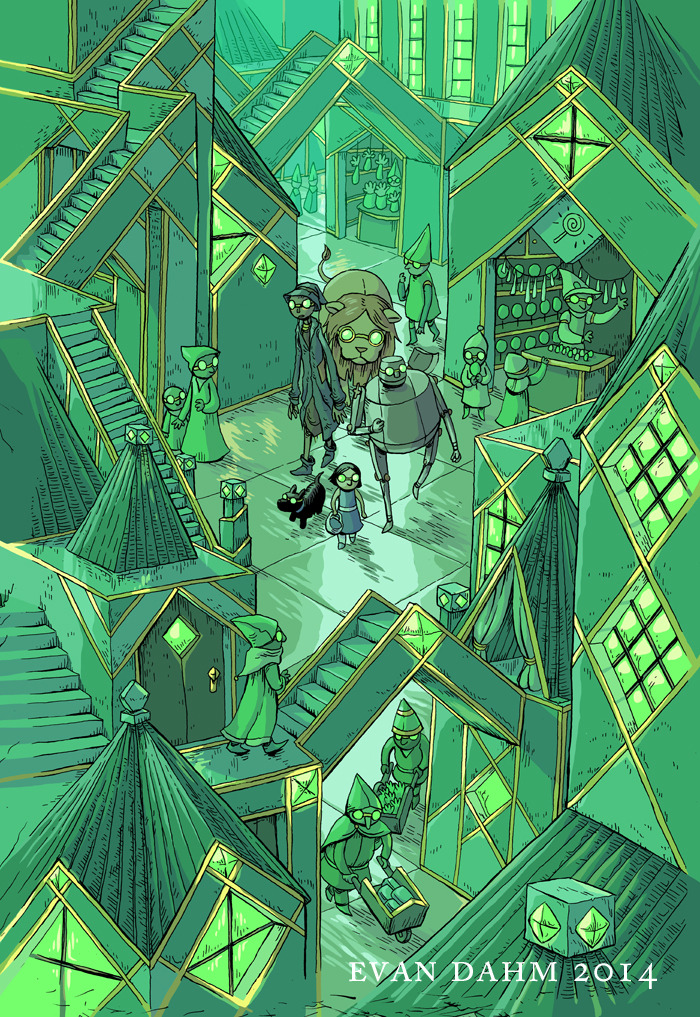
Evan Dahm is more than halfway through illustrating L. Frank Baum’s Wonderful Wizard of Oz.

This Tumblr post shows Dahm’s process for this illustration. Follow his progress at Baum by Dahm.

15 July 2014

Baum’s Collaborators, Real and Fictional

The Wild Things gang are sharing material they couldn’t include in their new book on their blog, including this article about the partnership between L. Frank Baum and W. W. Denslow on The Wonderful Wizard of Oz.

Here’s a bit about what happened after that book had become such a success but the men’s friendship soured:
Once Denslow received the royalties from the musical, he set off and decided to live the American dream à la Gilligan’s Island. Which is to say, he up and bought himself a tropical island. An honest-to-goodness tropical isle. It was just off the coast of Bermuda, a good four acres (though he would claim to anyone who was listening that it was ten) and it didn’t stop there. With what appears to be a tongue stuck firmly in his cheek (though it’s a little hard to tell) Denslow went on to crown himself King Denslow I of Denslow Island. He turned his native boatman into the “admiral of his fleet” and then went on to make his Japanese cook the prime minister. Said he, “If the government in Washington had got wind of it in the early stages, I have no doubt that they would have sent a fleet to Denslow Island to blow it out of the water.”

Suffice to say, this situation didn’t last. Full-blown island kingships rarely do. Denslow was an alcoholic and after selling a full-color cover to Life magazine he celebrated by going on a two day bender, getting pneumonia, and dying at the age of 58. Baum’s reaction upon hearing of Denslow’s death has been lost to the annals of history. What we do know, however, is that, when he was told, it was with the false information that Denslow had committed suicide.
That extracted extract goes on to discuss a stylometric analysis of The Royal Book of Oz, which I analyzed briefly back here. That 1921 book was credited to Baum but said inside to have been completed by Ruth Plumly Thompson, who had her name on the cover of the next eighteen annual Oz novels.

The computer-aided analysis of Royal Book’s writing style found that Thompson actually wrote the whole book. But that’s not really a discovery. All the way back in 1954 Jack Snow credited that book to Thompson in Who’s Who in Oz. When Reilly & Lee reissued all of Baum’s Oz novels in the 1960s, they let Royal Book go out of print—because they knew it wasn’t Baum’s.

I don’t doubt that the stylometric study of Royal Book showed it fit Thompson’s writing profile far more than Baum’s. But that wasn’t new information about the book. It was new information about the validity of that stylometric method.

21 May 2014

Tik-Tok and a Kalidah Walk into a Bar

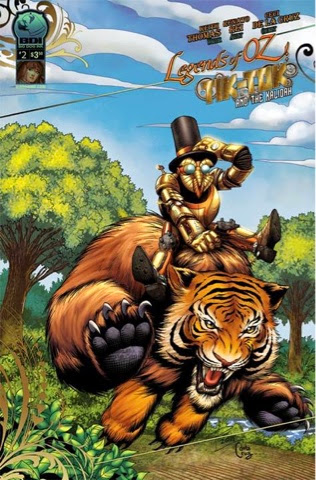
The comics universe of The Legend of Oz: The Wicked Witch and Legends of Oz: The Scarecrow will expand a little this summer as publisher Big Dog Ink releases a comics miniseries subtitled Tik-Tok and the Kalidah this summer.

As created by Tom Hutchinson, this comics continuity “mashes up the Land of Oz with a classic Western,” in the words of Rob Anderson. Anderson pitched the idea of Tik-Tok, the mechanical man, as a bounty hunter in that universe.

Tik-Tok’s partner is a kalidah, a creature L. Frank Baum invented in The Wonderful Wizard of Oz. Kalidahs are crosses between bears and tigers. They’re smart, they’re nasty, they’re carnivorous. They can swim like ducks. Their king knows a bit of magic. In sum, they’re extremely dangerous. And it’s hard to imagine a kalidah partnering up with anyone except another kalidah.

The miniseries is scripted by Anderson and Keith Thomas, with art by Renato Rei and Ceci de la Cruz. It looks like they’ve redesigned Tik-Tok significantly. It’s harder to tweak a kalidah.