Showing posts with label the public domain belongs to all of us. Show all posts

10 September 2019

Mid-Century Modern in the Emerald City

After the original publisher of The Wonderful Wizard of Oz went bankrupt, Bobbs-Merrill became the book’s one and only US publisher.

At first Bobbs-Merrill included W. W. Denslow’s illustrations, though not in the original ground-breaking multi-color design that integrated text and art. The company kept the book in print until the World War 2 paper shortages. As the war wound down, it looked for a way to reintroduce the title.

In 1944, Bobbs-Merrill commissioned entirely new art by Evelyn Copelman (1919-2003, also known as Evelyn Campbell and Evelyn Copelman Baker). She created black-and-white art on scratchboard and painted several color plates.

The title page of that new edition stated that Copelman’s art was “adapted from the famous pictures by W. W. Denslow.” Obviously those pictures weren’t the only source. Copelman’s Dorothy, Scarecrow, and Wizard are clearly designed like the characters in the 1939 MGM movie, and her Tin Woodman and Cowardly Lion look like hybrids.

Bobbs-Merrill had asked Copelman to create an edition that matched the movie, but it didn’t have rights to the MGM designs. It did own the rights to Denslow’s art, however. The title page claim apparently provided legal cover.

In 1949 MGM re-released its movie into cinemas. Not coincidentally, Bobbs-Merrill gave the book a new push. Copelman reworked her line art and added more plates.

With the book still under copyright, Bobbs-Merrill was the exclusive producer of new copies of The Wizard of Oz. Thus, for over a decade in the middle of the century, Evelyn Copelman’s artwork introduced young readers to Oz.

Then the copyright lapsed in 1956. Reilly and Lee, the publisher of the rest of the Oz series, created an edition with black-and-white reproductions of Denslow’s art in a trim that matched its other titles. Other publishers commissioned their own illustrations. As the years passed, Copelman’s art disappeared from bookstore shelves.

Archive.org, working with the San Francisco and other public library systems, has made a digital copy of a Copelman edition available for borrowing. This is a 1994 Illustrated Junior Library edition, with cover artwork by Michael Zimmer but Copelman’s line art and five plates inside. It’s worth a virtual thumb-through, especially if that’s the edition you remember.

30 July 2019

Sea Fairies and Sea Sirens

Sea Sirens is a new middle-grade graphic novel by Amy Chu and Janet K. Lee. It’s subtitled A Trot & Cap’n Bill Adventure, and the back cover says it was “inspired by L. Frank Baum’s classic adventure The Sea Fairies, the ‘underwater Wizard of Oz.’” The story’s last page promises more Trot & Cap’n Bill Adventures.

However, this is not a story about Trot and Cap’n Bill from The Sea Fairies and Sky Island, whom Baum settled in the Emerald City in The Scarecrow of Oz. It’s a remix of elements from The Sea Fairies including the names of major characters, the setting in and off the coast of southern California, and the general idea of being able to breathe underwater to visit mermaids.

Baum’s Sea Fairies is one of his weaker fantasies, though it introduces some of his most winning characters and one of his scariest villains. As in Jules Verne’s Twenty Thousand Leagues Under the Sea, a lot of pages are taken up by underwater tourism with little plot (but, in Baum’s case, plenty of puns). Though Trot is a winning personality already distinct from Dorothy Gale, she functions mostly as an observer; she becomes more of a plot driver in Sky Island.

Lee, who created the striking Return of the Dapper Men, had the idea to pull from The Sea Fairies to create a modern adventure. Like Trot, the Trot* in Sea Sirens lives along the southern California coast with her mother and a disabled older man—not a one-legged sailor but her grandfather, who suffers from intermittent dementia. The new Cap’n Bill* is one-eyed cat.

Trot* is a Vietnamese-American surfer. About twenty years ago I wrote an Oz novel featuring a Vietnamese-American surfer as the child who travels to the Emerald City. I’m therefore particularly intrigued by Trot*. Both stories hinge on the powerful allure of surfing, particularly as a respite from domestic tensions.

In The Sea Fairies, Trot and Cap’n Bill are boating off the coast when the mermaids of the title appear and invite them to visit. They want to disabuse Cap’n Bill of his superstitious ideas about mermaids luring sailors to their deaths. Once underwater, Trot and Cap’n Bill meet many creatures, culminating in a gigantic, ancient sea serpent named King Anko, who presides over the Pacific. Then they get captured by the villainous Zog.

Sea Sirens strives for more conflict from the start. (Perforce this paragraph and the following contain SPOILERS.) Trot* is at odds with her mother over whether it’s safe to leave her wandering grandfather to go surfing. Trot* and Cap’n Bill* almost drown before a mermaid princess with her own mother issues rescues them and empowers them to breathe underwater. The mermaid queen Aquareine* is imperious instead of just friendly. The mermaids are close to war with a nation of underwater serpents, and Trot*’s grandfather wanders into their possession.

However, in the end that conflict washes away in a few pages. The King Anko* in Sea Sirens is a former cabin boy with more than a little resemblance to Maurice Sendak’s Max, Mikey, Jack, and Guy, who in turn harken back to Winsor McCay’s Nemo. Anko* is delighted to find other humans underwater at last. Trot* asks him and Aquareine* to pull back their armies, and they do. Problem solved.

Even Trot*’s fear of her mother worrying that she and her grandfather have drowned evaporates quickly. It turns out the entire underwater adventure takes only an hour in surface time. (In The Sea Fairies, Baum had the mermaids cast a spell on Trot’s mother so that she slept peacefully through her daughter’s absence.) There’s a final fear that Cap’n Bill* has drowned, but he hasn’t.

In sum, Sea Sirens ends up being even slighter than The Sea Fairies. The pictures are lovely, and the graphic storytelling successful on a page-by-page, moment-by-moment basis. The character-based jokes land, especially when Trot* learns there’s more to Cap’n Bill* than she thought. Jimmy Gownley, creator of the Amelia Rules! series, provides fine lettering. Now that the characters are established, we can hope the next graphic Trot & Cap’n Bill Adventure is more of an adventure.

14 November 2015

Planetary Copyright

Here’s an interesting wrinkle about international copyright protections:
The classic novella “The Little Prince” fell into the public domain this year in much of the world but remains under copyright in France because of an exception that grants a 30-year extension to authors who died during military service in World War I and II.
There’s a logic to that provision, I suppose. If a society bases copyright terms on an author’s life, but an author dies before his or her time while fighting for the society, then the society extends the copyright term to about what it would otherwise have been. Still, I wonder what specific cases gave rise to this exception.

That passage comes from a New York Times story on a dispute over the copyright of Anne Frank’s diary as originally published. That copyright is the main asset of a foundation, which wishes to extend its term by calling Anne’s father a coauthor of the text. Other institutions, hoping to make the diary more widely accessible and/or mindful of Holocaust deniers’ claims that Otto Frank invented the story to begin with, are resisting that move.

By the logic of the French law, the term of Anne Frank’s copyright could be extended based on what her natural lifespan would have been—meaning even longer protection than basing the term on her father’s lifespan. Of course, few countries follow France’s example.

Meanwhile, the foundation already authorized the editing and publication of a more complete version of Anne Frank’s diary, which has its own copyright term based on the life of the scholarly editor.

09 September 2014

Graphic Design in Oz

This week brought news of a couple of new editions of The Wizard of Oz that concentrate on visual detail.

As the Deseret News reported, Gibbs Smith’s BabyLit line is publishing a board-book abridgment of L. Frank Baum’s story that uses its emphasis on color:
“The Wonderful Wizard of Oz: A Colors Primer” reflects the colorful, busy world of Oz. Each page is based on one of the story’s key features or characters of that color surrounded by many other objects. For example, the yellow brick road fittingly represents the color yellow while the Tin Man represents the color silver.
There are no ruby slippers in this edition, of course. The text is by Jennifer Adams and the art by Alison Oliver.

Rockport Publishers is issuing an edition of the full novel in its Classics Reimagined series, with new art by Olimpia Zagnoli. (Note her initials.) All Zagnoli’s illustrations are in black, white, green, and gold, combined in minimalist graphics. The Huffington Post featured a number of those graphics. They’re striking but not warm, leaving me to wonder what the target audience for this edition is.

21 May 2014

Tik-Tok and a Kalidah Walk into a Bar

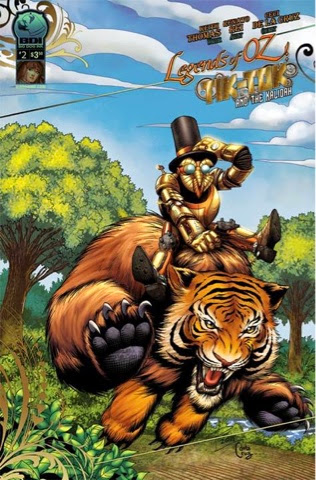
The comics universe of The Legend of Oz: The Wicked Witch and Legends of Oz: The Scarecrow will expand a little this summer as publisher Big Dog Ink releases a comics miniseries subtitled Tik-Tok and the Kalidah this summer.

As created by Tom Hutchinson, this comics continuity “mashes up the Land of Oz with a classic Western,” in the words of Rob Anderson. Anderson pitched the idea of Tik-Tok, the mechanical man, as a bounty hunter in that universe.

Tik-Tok’s partner is a kalidah, a creature L. Frank Baum invented in The Wonderful Wizard of Oz. Kalidahs are crosses between bears and tigers. They’re smart, they’re nasty, they’re carnivorous. They can swim like ducks. Their king knows a bit of magic. In sum, they’re extremely dangerous. And it’s hard to imagine a kalidah partnering up with anyone except another kalidah.

The miniseries is scripted by Anderson and Keith Thomas, with art by Renato Rei and Ceci de la Cruz. It looks like they’ve redesigned Tik-Tok significantly. It’s harder to tweak a kalidah.

14 November 2013

The Wonderful Wizard of You

A tweet alerted me to this service, which offers to create an edition of L. Frank Baum’s Wonderful Wizard of Oz customized for yourself or a person of your choice.

This consists of stuffing your specified names (and, curiously, eye color) into the novel’s public-domain text. I tried it out, and this is part of the resulting preview:
They walked along listening to the singing of the brightly colored birds and looking at the lovely flowers which now became so thick that the ground was carpeted with them. There were big yellow and white and blue and purple blossoms, besides great clusters of scarlet poppies, which were so brilliant in color they almost dazzled John's brown eyes.

"Aren't they beautiful?" the girl asked, as she breathed in the spicy scent of the bright flowers.

"I suppose so," answered Buckingham Scarecrow. "When I have brains, I shall probably like them better."

"If I only had a heart, I should love them," added Pablo the Tin Woodman.

"I always did like flowers," said Harold the Cowardly Lion. "They seem so helpless and frail. But there are none in the forest so bright as these."

They now came upon more and more of the big scarlet poppies, and fewer and fewer of the other flowers; and soon they found themselves in the midst of a great meadow of poppies. Now it is well known that when there are many of these flowers together their odor is so powerful that anyone who breathes it falls asleep, and if the sleeper is not carried away from the scent of the flowers, he sleeps on and on forever. But John did not know this, nor could she get away from the bright red flowers that were everywhere about; so presently her eyes grew heavy and she felt she must sit down to rest and to sleep.
I think we might agree that there’s still one bug in the system.

The same site offers to treat various other classic (i.e., public-domain) texts in the same way. That means, I presume, you can stand in for Hercule Poirot in Agatha Christie’s first mystery novel, insert your name in Jane Austen’s roundelays, or head off to Treasure Island with Long John Silver—or rather Long Jason Silver if you prefer.

COMING UP: But wait! There’s more!

22 October 2013

Remember When Oz Was on TV Only Once a Year?

Deadline has passed on the news of another television series based in some small way on the Oz mythos:
Lifetime has put in development Red Brick Road, from the Wolper Organization, Vertigo Entertainment and Warner Horizon. Written by Tim Schlattman (Dexter) based on an concept by artist Rob Prior and executive produced by Roy Lee and Adrian Askarieh, Red Brick Road is described as an edgy, Game Of Thrones take on the world of Wizard Of Oz.

In the classic 1939 feature, when Dorothy set off for the Emerald City, she followed the Yellow Brick Road. But among the yellow bricks at Dorothy’s feet, there was also a swirl of red bricks. They’ve been there the whole time in plain sight. Unnoticed. Unexplored. Which raises the question — just where do they go? Red Brick Road will answer that by following Dorothy down that fateful path, taking her to the oldest, darkest and most dangerous parts of Oz to find what became of her friends who all have gone missing.
Actually, the red bricks were just the negative space around the yellow bricks, but they’ve been intriguing fans of the movie since the video era began.

As Deadline notes, TV networks have bought four other Oz-themed projects recently, including:
  • “NBC’s drama Emerald City, a dark reimagining of the classic tale of Oz in the vein of Game Of Thrones”—there’s that comparison again.
  • “CBS’ Dorothy, a medical soap” noted back here.
  • “the CW’s Dorothy Must Die, a revisionist take on L. Frank Baum’s classic based on the upcoming young adult novel by Danielle Paige.”
  • “Syfy’s miniseries Warriors Of Oz from director Timur Bekmambetov, a fantasy-action reimagining of the classic story.”
Note how all claim both to be rooted in the beloved public-domain property and to offer a completely new, usually darker take on it. Odds are that most of these shows will never be broadcast as series, but some may end up competing against one another.

13 August 2013

No Place Like the Hospital

This month Entertainment Weekly’s website reported on a new Oz-themed TV show, sort of:
CBS is taking a big swing with a new project with a higher-than-high concept: Wizard of Oz medical drama.

The broadcaster has inked a deal to develop a series titled Dorothy, described by the network as “a medical soap based in New York City, inspired by the characters and themes immortalized in The Wizard of Oz.”
There’s no more information on the drama than that, as far as I can tell, yet the news has already kicked up a lot of talk on television websites.

Which is the point. Without the link to a beloved property like The Wonderful Wizard of Oz, this would be just another medical drama set in the big city. The executive producers pulled a similar trick with Elementary, spun off the public-domain Sherlock Holmes mythos and promoted as such.

I don’t doubt that the show’s creators might take inspiration from the basic Oz story: a young female character named Dorothy looking for a home, three male companions who feel inadequate, and so on. But if The Wonderful Wizard of Oz weren’t both famous and free, the network would never mention that vague inspiration. No, Dorothy would then be an entirely original show, any resemblance between it and preceding stories entirely coincidental.

21 March 2013

The Real Sources of Oz the Great and Powerful

Yesterday I noted how Oz the Great and Powerful credits “the Works of L. Frank Baum” as its source but doesn’t actually draw much from that source—and what it does draw is almost entirely filtered through MGM’s Wizard of Oz from 1939.

That beloved movie is of course the main source for the new one. Oz the Great and Powerful is quite obviously an attempt to create a prequel. Yet the new movie’s makers didn’t have the rights to do so, so they played an odd game of tiptoeing to the edge of fair use and stopping just an inch away from infringement.

Thus, MGM’s Wicked Witch of the West is green with a black gown, hat, and broomstick. (W. W. Denslow’s Wicked Witch is tan with an eyepatch, jacket and patterned skirt, and umbrella.) Sam Raimi and his team couldn’t exactly copy the previous movie, so they made the witch a different shade of green.

The New York Times reported on how Disney’s lawyers advised the moviemakers to alter one Munchkin’s whiskers to be less like those in the 1939 movie. But they’re still the same singing, dancing, particolored little people of that movie, not the dignified farmers all in blue of Baum’s book.

Similarly, the end of the yellow brick road goes in circles, but not in a spiral. There are brightly colored horses grazing outside the Emerald City, but they’re several colors at once instead of in succession. Glinda’s bubbles work a little differently. The green Wicked Witch says “my pretty one” instead of “my pretty.” Oz produces the illusion of a giant heading speaking from a cloud of smoke, but it’s a different giant head. And there are no ruby slippers or silver shoes.

At times, finding a way to evoke the MGM movie without directly copying some detail still under copyright produced new creativity. The winged baboons are even more frightening than MGM’s flying monkeys. The Emerald City’s towers are reminiscent of those from the older movie, but more angled. The landscape of Oz has a verticality that was hard to portray on 1939 sound stages, much easier with CGI.

At other time, the strain of aping the MGM movie is too great. There’s a scene at the end of the Wizard conferring gifts on his companions, but his remarks aren’t nearly as interesting as the dialogue Yip Harburg wrote for Frank Morgan in the equivalent scene, and most of those characters never asked him for stuff, so the scene has no greater meaning than triggering audience nostalgia.

Plotwise, the result doesn’t hang together. Like the 1939 film, the new movie’s screenplay provides for people whom Oz knows in Kansas to reappear as other characters in Oz. Yet there’s no hint that Oz is dreaming, as Judy Garland’s character was. Nor does Oz recognize the resemblance between his Kansas girlfriend and his Oz girlfriend.

And that girlfriend points to the second big influence: Wicked. (The hit stage show, not Gregory Maguire’s novel.) Again, the moviemakers didn’t have the rights to make Wicked, and they had a very different conception of the Wizard. But the screenplay is designed to set off the same nostalgic neurons that produce applause during the stage play, whenever the story foretells some detail from the movie: a cowardly lion, a scarecrow, and so on. And of course the Wicked Witch of the West starts out as sympathetic.

One of the biggest changes in Wicked’s journey from book to stage was the inclusion of a happy ending for Elphaba, with a boyfriend. Oz the Great and Powerful likewise ends with Oz and Glinda paired off. There’s no hint of that in the MGM movie, even less than none in Baum’s books, but apparently Hollywood demands a romantic ending. (To be fair, Baum inserted such pairings in most of his stage and screen adaptations of his books, and imported them back into books he based on his scripts.)

A third, smaller influence is Disney’s theme park and merchandising divisions. When the Wizard arrives in Oz, his balloon lands in a raging river, and we’re then treated to a water slide in 3-D. The climax involves fireworks bursting over the turreted city. I was pleased that Mari Ness also noted the similarity between that action and Disney’s nightly fireworks display. And the corporation already has a ton of collectibles on sale.

Indeed, the main takeaway from Oz the Great and Powerful isn’t a great screenplay or powerful acting (hard to do without a great screenplay), but spectacle and nostalgia. On that level it succeeds—quite well enough to make hundreds of millions of dollars. But I doubt it will have the real emotional impact as any of its predecessors and influences.

20 March 2013

What Oz the Great and Powerful Draws from Baum’s Works

The credits for Oz the Great and Powerful say the movie is “Based on the Works of L. Frank Baum.” Those works are in the public domain, meaning the moviemakers could use as many details from Baum’s Oz books as they wanted for free.

In fact, the moviemakers used very few details from those books, aside from The Wonderful Wizard of Oz itself, filtered through other versions (more on that tomorrow). Fans of the series have been tallying the items they recognize from the later books, and the list is short:
  • The Wizard’s full name is as stated in Dorothy and the Wizard in Oz (1908). That book also adds a few details to what the Wizard told Dorothy earlier about his arrival in Oz and finding himself caught between the witches.
  • When a map of Oz appears, it includes the name “Wogglebug.” Baum introduced that character in The Marvelous Land of Oz (1904), and the maps credited to his highly educated self appeared in Tik-Tok of Oz (1915).
  • A group of mechanically inclined inventors is called the Tinkers, and Ozma of Oz (1907) includes a Mr. Tinker as co-inventor of the Tik-Tok the clockwork man.
  • As discussed yesterday, The Road to Oz (1909) introduced the notion of traveling inside a bubble. That main inspiration for that detail of the new movie nonetheless appears to be its reappearance in the 1939 movie.
  • Oz has to escape from aggressive plants in a forest, reminiscent of man-eating flowers in The Patchwork Girl of Oz (1913). However, since both the book and movie forms of The Wizard of Oz include aggressive plants, Patchwork Girl might not be the source.
  • The land of Oz’s recent history echoes the situation Glinda explains in The Marvelous Land of Oz: the last rightful king was deposed and destroyed, leaving a daughter out of power. In the books, that daughter is Ozma. In Oz the Great and Powerful, that daughter is Glinda herself.
That last tidbit demonstrates the new movie’s real relationship to Baum’s books. While crediting them as its basis, the new movie’s story is incompatible with them.

In The Wonderful Wizard of Oz, for example, the Wizard explains that he oversaw the building of the Emerald City and had his subjects wear green glasses, ostensibly to shield their eyes but really to make the city glow like emeralds. In the new movie Oz arrives at the Emerald City, its green towers already scraping the sky. That leaves less for him to do.

And there’s no way for this land of Oz to become the fairyland of The Marvelous Land of Oz and beyond because there’s no way to fit Ozma into that political history. The new movie’s Glinda is not only the Good Witch of the South as in the books and the obvious analogue of the Good Witch of the North in the 1939 movie, but also the rightful heir to the throne of the Emerald City.

There’s nothing wrong with offshoots of the original mythos. Indeed, Baum was so unconcerned with consistency that he created offshoots in his own books and plays. But this latest version of Oz isn’t on a trajectory to end up at the happy paradise under Princess Ozma where Baum ultimately left us.

19 March 2013

Inspiration Bubbling Up

Even with the relatively awkward special effects of 1939, Glinda’s pink bubble in The Wizard of Oz is an American icon. So much so that the Wicked stage show reproduced that entrance.
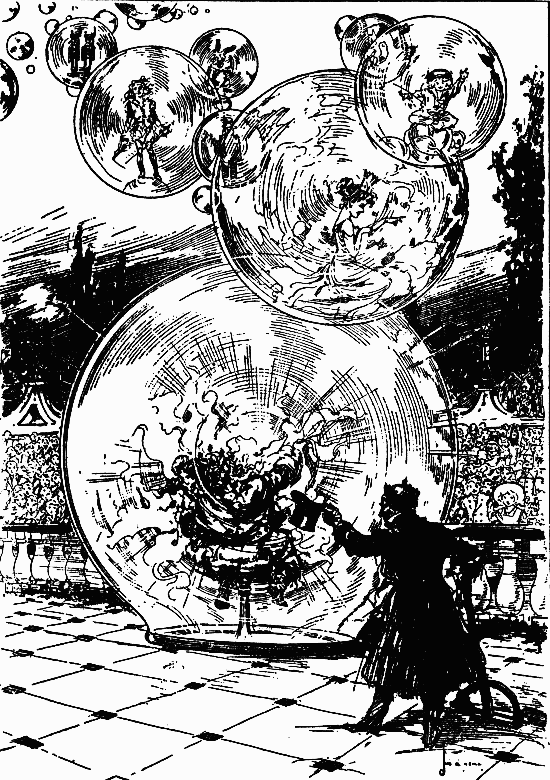
The new Oz the Great and Powerful movie is not supposed to infringe on the 1939 film’s copyright, however. Fortunately for its makers, L. Frank Baum and John R. Neill portrayed travel in giant bubbles at the end of The Road to Oz. (Curiously, it’s one of the few adventures Dorothy turns down.)
With that book in the public domain, Sam Raimi and company could show people in bubbles, and even make them Glinda’s thing, as long as they weren’t perfectly round and pink. In fact, with CGI animation they could show the Wizard’s weight bending his bubble out of its spherical shape. But there’s really no doubt those bubbles are supposed to evoke the 1939 movie, not Baum’s lesser-known 1909 sequel.
For the next couple of days I’ll discuss the sources of Oz the Great and Powerful—the official sources and the real ones.

18 February 2013

The Artful Dodger’s Back. And This Time It’s Personal

Toward the end of Oliver Twist, the police arrest Jack Dawkins, alias the Artful Dodger, for stealing a silver snuffbox from a gentleman’s pocket. One of his colleagues, Charley Bates, comments: “To think of Jack Dawkins—lummy Jack—the Dodger—the Artful Dodger—going abroad for a common twopenny-halfpenny sneeze-box!”

“Going abroad” refers to a sentence of transportation to one of Britain’s penal colonies, most likely Australia. Charles Dickens never actually shows the Dodger’s sentencing, but his youth makes him an unlikely candidate for hanging (yet). Instead, we can imagine Jack Dawkins starting a new life in the antipodes, perhaps even becoming the gentleman he’s always styled himself to be.

But the Guardian reports a movie studio is imagining a different future for the Dodger:
Titled Dodge and Twist, studio Sony's revisionist take follows…a more comedic approach and is based on an original screenplay by Cole Haddon, writer of the forthcoming US TV series Dracula. The film will portray the two characters as rivals on opposite sides of the law in Victorian London during an episode in which someone tries to steal the crown jewels. The script is based on an original idea by producer Ahmet Zappa, son of rock legend Frank, which is said to be influenced by the success of Guy Ritchie's Sherlock Holmes films.
This isn’t the first time imaginative dramatists have invented new fates for the Dodger. In the 1968 Oliver!, of course, he and Fagin escape arrest and enjoy the movie’s final number.

More to the point, in 1980 British television came up with The Further Adventures of Oliver Twist, in which the title character goes off to a posh boarding school and there finds Jack Dawkins, of all people. The two boys end up back on the dark streets of London. That story also appeared as a paperback novel and a comic.

Australian television gave us Escape of the Artful Dodger in 2001. That story transported the Dodger to Australia, but also sent Oliver there in more respectable fashion. Once again, Oliver ends up on the wrong side of the law, and the Dodger helps him out.

Those latter-day sequels, like Dodge and Twist, recognize that Oliver without the Victorian underworld to threaten him is a bourgeois nonentity. At the same time, the Dodger’s class-conscious thievery isn’t that endearing unless he’s got a little mate to reluctantly look after. It’s a natural buddy movie.

In fact, British writer Tony Lee worked on a story called Dodge & Twist for years, first as a graphic novel with Paul Peart-Smith (PDF download of preview from 2007) and then as a self-published prose novel (two-chapter preview from 2011). It shows Oliver, having lost his money, meeting Jack, back from Australia—and we’re right back in Dickens’s world.

Zappa’s story is set twenty years after Dickens’s novel; Lee’s is set twelve years after. Zappa’s story uses the crown jewels as the maguffin; Lee’s uses the Koh-i-noor diamond. The Hollywood Reporter said Lee’s take was “more serious.” Lee said he discussed his idea with Zappa a few years back. Isn’t the public domain delightful?

19 November 2012

The Takedown

At Publishers Weekly’s PWxyz blog, Peter Brantley highlighted some new Republican thinking about copyright law that was quickly squelched by old Republican thinking:

On Friday, 16 November, the conservative Republican Study Committee (RSC) released an amazingly liberal document proposing deep and substantive reforms in U.S. copyright law. Within 24 hours, on Saturday, 17 November, the report had been pulled from the House website and an email apology for its “inadequate” vetting had been flung out on the net. . . .

The report details four areas of potential reform: 1). Statutory Damages. “Copyright awards were meant to make the copyright holder whole – they were not supposed to be punitive. Reforming this process is an important element of federal tort reform, which unlike other forms of tort reform is clearly within the federal prerogative.”

2). Expansion of Fair Use. “Right now, it’s somewhat arbitrary as to what is legally fair use based upon judicially created categories.”

3). Punish false copyright claims. “Because there is minimal or nearly non-existent punishment for bogus copyright claims today, false takedown requests are common and have a chilling effect upon legitimate speech.”

And, 4). Limit copyright terms and create disincentives for renewal. The report elucidates one possible path, with an initial 12 year copyright award period and renewable elective terms that are fee-based, with a maximum cliff of 46 years protection. This last proposal is actually currently infeasible in an international context, which is based on life of the author plus 50 years (life+50) for most non-corporate works.
I suspect the report was more “libertarian” than “liberal,” though there’s significant overlap between those terms. It proposed to dial back government-backed legal advantages for copyright owners. (For some radical libertarians, governments shouldn’t be granting patents and copyrights at all.)

The American right is energized by four strains of conservatism: libertarian, social/theocratic, pro-business, and general pro-establishment crankiness. (To put faces on those impulses, consider Ron Paul, Rick Santorum, Mitt Romney, and Newt Gingrich, respectively, at the end of the 2012 Republican primaries.) Sometimes those strains are at odds with each other. This report reflected libertarian thinking. After business lobbies contacted party leaders, the stronger pro-business wing pulled it back.

As for the proposals, I think we’d all benefit from clearer definitions of fair use. I’m not sure point 1 is valid—sometimes damages are supposed to be punitive—but agree with point 3 that false claims should also produce punishments. Point 4 would reduce copyright terms to below what American creators have enjoyed for a century and, as Brantley points out, would go against international agreements. Copyright terms have become irrationally long, but the US can’t decide that point alone.

31 October 2012

Nostalgia Was Originally a Disease

This summer I stumbled across bits of my childhood entertainment on YouTube.

Back when Bill Bixby was getting unlikably angry on CBS, he also hosted a kids’ version of Masterpiece Theater on public television called Once Upon a Classic.

Most of its drama specials and serials from Britain were based on classic (i.e., public-domain, no need to pay for rights) literature. When the supply ran low, however, the show broadcast some original shows, which I vaguely remembered.

There was also a Saturday-morning (or early afternoon) anthology show on one of the American commercial networks that broadcast an English slapstick comedy series called something like “The Jiffy Kids.”

That turned out to be “The Chiffy Kids,” and “Chiffy” referred to the Children’s Film Foundation (later Children’s Film and Television Foundation) in Britain. Financed by a tax on cinema tickets, the foundation cranked out a steady stream of domestic drama and comedy for school-age audiences.

TV Cream explains the CFF films’ place in British culture:
A joint enterprise between Rank Film Distributors and the most out-of-touch government you ever did see,…the Children’s Film Foundation turned out mini-masterpieces of pre-pubescent crime-solving about five times annually for over 35 years. . . .

crooks were foiled, bullies were trounced, pompous council officials were brought to rights and wacky inventions exploded on a regular basis on some waste-ground just outside London in much the same manner for over three decades, with a few, mainly cosmetic, alterations – the widening of the trousers, the democratisation of the protagonist’s accents – along the way.

The CFF films remain one of those odd cubbyholes of popular culture that are fondly recalled almost by default – not because of any inherent greatness in the films themselves, or any general joy to be had in watching them at the time, but more because they were so heavily plugged by local fleapits, the Beeb and well-meaning headmasters at end of term film shows, that they formed a part of the patina of everyday life, in the manner of the Toffo ads or Nationwide. In short, they were always on, we can’t not remember them.
And through 1970s American television’s need for material that might seem vaguely educational, or at least not completely commercial, some of those movies got broadcast here, too.

Then came the 1980s. In Britain, Margaret Thatcher‘s Tory government ended the tax that provided the funding for the C.F.F. In the US, Ronald Reagan and George W. Bush’s Republican governments pulled back on standards for children’s television.

The foundation tried to revive itself in 2006 with a new website listing all its productions. But that soon became a cobwebsite.

Before disappearing, the foundation created a YouTube channel with the handle CFandTF to show the first five or so minutes of many of its movies. The channel is no longer active, but the individual shows can be found by their titles. Certain clips last just long enough to trigger memories in my brain: The ominous truck in “The Battle of Billy’s Pond”! The odd politics of “Robin Hood Junior”! And of course “The Chiffy Kids” as interior decorators! (In terms of a compelling plot, that’s rather like, “In this one, the Stooges are firemen.”)

Now if only I could find any mention of the Westinghouse Television special from about 1978 that involved Huck Finn being picked up in a helicopter to participate in interviews with modern troubled youth? He talked with pregnant teens and played basketball.

28 June 2012

Bill Willingham on Oz in the Fables Universe

Sequential Tart interviewed writer Bill Willingham, who’s been slowly unrolling some Oz-themed storylines in his Fables comic book:

ST: I have a couple of questions about some of the current storylines. What led to the idea of Bufkin leading a revolution in Oz? Frank L. Baum had some strong political opinions; did that play into at all?

BW: To a certain extent. My reading of the Oz books was woefully antiquated in that I did it early on in life and hadn't revisited them as often as I should. And this is what I found out about Oz readers: Oz readers are fanatical readers. They want things correct. The few dips I've made into the Oz world had readers and some of the people who work in the Fables camp, like Eric Shanower, who has done the odd Fables book, and who, of course, is a massive Oz fan [Shanower writes Oz-themed comics for IDW and Marvel Comics], and Todd Klein, our letterer from day one: massive Oz fan — which apparently is a redundancy. There's no such thing as just a middle-of-the-road Oz fan. They called me out on the tiniest little thing. It is not the Lunchpail Tree; it is the Lunchbox Tree.

I realized that if I wanted to play in Oz at all, which I wanted Bufkin to eventually do again someday, I'd have to either have all my ducks in a row and massively re-immerse myself in the Oz stuff — or create a situation wherein I'm the only expert, [and can say], "Todd, Eric, what you don't understand is that when the Adversary conquered Oz, he made all these changes and all these changes are inscribed only in my mind, so nyah nyah, here's the way it is now, and you're just going to have to live with it."

I decided to go that route, so Bufkin finding that the whole place was conquered and overrun by the gnome king, who, when the big empire fell, continued on with his little local empire. Well, it was obvious that Bufkin, having defeated the djinn and slain Baba Yaga would think, "Overthrow a dinky little side-empire like this? Easy." It almost wrote itself, and it solved the problem of these guys who could so easily point out where I got things wrong.
I suspect Sequential Tart asked about Baum’s “strong political opinions” because he was progressive for his time while Willingham identifies himself as a conservative. But Willingham didn’t address that potential conflict.

I’ve written before about how the Ozma and Dorothy of Willingham’s Fables universe bear little resemblance to Baum’s characters. In contrast, Jack Pumpkinhead, the Sawhorse, and the Glass Cat act quite familiar. As for Bufkin, he’s a true original.

(Hat tip to Blair Frodelius’s Daily Ozmapolitan.)

22 May 2012

Darkside Is Coming, Now Nothing Is Real

The Morton Report recently featured Bill Baker’s online conversation with artist Tommy Castillo about a book called The Art of The Darkside of Oz. The second capitalized T in that title is the tip-off that this book is a teaser for Castillo’s comics series called The Darkside of Oz.

Most of the drawings shown with the interview have appeared on Castillo’s earlier collections and website, so I’m not completely sure how they represent the ultimate product. Baker writes of Castillo’s plans:
…if the images and ideas he’s slowly begun to reveal are any indication, we’re about to see Dorothy, the Scarecrow, the cowardly Lion and the Tin Man in a whole new twilight.
And Castillo says, among other things:
How do you tell an epic tale of woe and love, desire and greed, wars and betrayals? How do you tell of revenge and have all of it wrapped up in the idea of redemption? And how can you do this all with the highest amount of respect for the creator of Oz, Frank Baum?
To be frank, I’m not impressed with the respect for Baum displayed so far. It’s details like:
  • Misspelling Glinda’s name as “Glenda.”
  • Using the MGM movie (still protected by copyright and trademark) as the basis of plot comments instead of Baum’s books (in the public domain).
  • Promising not to render Dorothy as “some scantily clad teen with giant boobs,” but dressing her in a very short skirt.
Furthermore, the notion that “everything we knew about our beloved Oz was a lie” isn’t that new, especially in comics form. After The Oz Squad, Dark Oz, Woe Is Oz, and so on, it’s no surprise to see Dorothy and her companions panelized in grim and gritty ways. It looks like Castillo will show us another Tin Woodman as a robot with a giant axe, another Scarecrow with a sinister slant to his eyes, another Lion as an anthropomorphic warrior, and so on.

Of course, Castillo could still create a compelling, eye-opening story out of those elements. Gregory Maguire certainly did with Wicked. But it would require knowing Baum’s work deeply, and intervening reinventions as well. Deciding to take a myth in the exact opposite direction may seem revolutionary, but it doesn’t really take as much imagination as digging deeper, or going off at an angle.

23 October 2011

Fight at the Guggenheim Museum

Here’s a page from New Teen Titans: Games with visuals I found particularly striking. In this scene, George Pérez shows Joey (Jericho) Wilson fighting villains called Knight and Squire in New York’s Guggenheim Museum. At the top, the Knight knocks Joe over the rail of a balcony.

As Joe falls down the page, the Guggenheim’s tiers define the tiers of the panels, providing strong horizontal lines yet uniting the fall into a single image. The effect reminds me of Maurice Sendak’s In the Night Kitchen, which in turn drew heavily from Winsor McCay’s Little Nemo in Slumberland. Near the bottom, Joe grabs onto the rail of a lower balcony, and thus in a way grabs onto the top border of that panel to hold himself up.

Meanwhile, on the left, Pérez offers framed vignettes of the museum staff reacting to the fight, and at the bottom (within a differently styled frame to signal the difference) the Squire taunting them. The shapes and scale of those panels are reflected in the picture frames that Joe falls past on the right.

In the years when no one expected Games to come out, some of Pérez’s artwork circulated among fans. Titans Tower has posted a scan of the line art of this page, showing the bare design.

The finished page includes the contributions of Hi-Fi, the firm that provided digital coloring for Games. That process added not just colors but Joe’s shadows on the wall, and the images of famous nineteenth-century art in the frames, under glowing lamps.

Of course, that’s not the type of art that gets displayed in the Guggenheim. Modernist works, particularly Pop and Op Art, might even have worked better in this scene, playing off the medievalism of the villains and Jericho’s costume. But those works have more copyright protection. And the choice of Impressionism enhances the surreal contrast between this fight and the dignified placidity of its museum setting.

12 August 2011

It’s Birds! It’s Planes! It’s…Supermen!

Supermen!: The First Wave of Comic Book Heroes, 1936-1941 promises to fill gaps in “the origins and early development of superheroes and the comic book form.” Editor Greg Sadwoski has assembled an eye-catching collection of stories, magazine covers, and house ads showing unfamiliar faces from the first years of American adventures comics.

There are many familiar names, however. Sadowski appears to have sought out stories by creators who eventually found success with other characters: Jerry Siegel and Joe Shuster, Jack Cole, Will Eisner, Bill Everett, Joe Simon, and Jack Kirby, among others. The collection includes two stories by the execrable Fletcher Hanks, who’s on his way to being the least deserving artist to have his entire oeuvre reprinted. My favorite item is the cover of Fantastic Comics, #3, by Eisner and Lou Fine.

Along the way there are a few landmarks in the development of the American superhero. We see the first caped flying hero (Zator, 1936), the first masked comic-book hero (the Clock, 1936), the first adolescent hero in cape and shorts (Dirk the Demon, 1938—two years before Robin).

But Supermen! is most interesting for what didn’t lead anywhere. All these comics are in the public domain, which of course makes them cheaper to republish. The book is thus a collection of failures—characters and storylines that didn’t attract enough readers to survive. There’s nothing from the firms that became DC and Marvel, and only a couple of items from M.L.J. before it found Archie. In the evolution of the American comic book, these are dead ends.

Seeing what didn’t work or become the norm can be as illuminating as seeing what did. For example, the field was already on its way to male domination when Al Bryant used the pen name “Allison Brant” for a horror story about “Fero, Planet Detective” in May 1940.

We can see publishers figuring out what sells. Silver Streak Comics’s first covers in late 1939 featured a villain—a sort of superhuman Fu Manchu named the Claw. By issue #3 the magazine showed off a hero named Silver Streak instead, and by issue #7 another new hero called Daredevil was fighting the Claw.

Several stories in this volume, especially the earliest, are space-opera science fiction, inspired by Buck Rogers (1928) and Flash Gordon (1934). Their heroes aren’t costumed crime-fighters, but square-jawed men with ordinary abilities in futuristic settings.

The earliest are chapters within continuing stories: the adventures of Dr. Mystic (1936), Dan Hastings (1937), and Cosmic Carson (1940) break off at cliffhangers rather than conclude with triumphs. Clearly, early comic-book publishers and creators were taking their cues from newspaper comics, with their ongoing adventures. But families had newspaper subscriptions, and municipal distribution networks were solid. In contrast, fledgling comic-book publishers probably couldn’t deliver the next installments so reliably, so readers gravitated toward magazines that told complete stories.

Now the industry’s gone back to stretching storylines out over several issues, a form of storytelling possible only because their readership has fallen and their distribution though comic-book shops is narrow but reliable.

18 July 2011

Don’t Let the Sidekick Drive the Steamroller

Silver Age Comics just featured this cover by Alex Schomburg from Exciting Comics, #35, published in October 1944. Even for wartime, it seems extreme.

The Black Terror was a mild-mannered pharmacist who developed superpowers after breathing a pharmaceutical concoction mixed with formic acid. His young sidekick started as his gofer, and then inhaled the same chemicals with the same result. That teen crime-fighter’s name was…Tim.

“Black Tim”? “Terrible Tim”? “Tim to Make Criminals Think They’ve Figured Out His Real Name But It’s Actually Something Else”? No, just Tim. The Black Terror and…Tim.

The Black Terror appeared in over a hundred magazines published by the Nedor company, whose properties fell into the public domain. So reuses are as legal as parodies, and the Black Terror has popped up repeatedly in the last few decades (almost always without Tim, or a steamroller).

03 June 2011

W. W. Denslow Goes Digital

This spring the developers ustwo and AtomicAntelope released an iPad/iPhone app of nursery rhymes by W. W. Denslow, as reviewed here by Kirkus. Apparently it hit #1 in Britain’s iTunes store.

Denslow’s illustrations lend themselves to this format because, besides being free to anyone, they have thick outlines and bright colors, allowing for easy animation—“plenty of swiping and swinging action,” the review says.

The Nursery Rhymes with StoryTime app doesn’t replicate Denslow’s edition of Mother Goose, but it pays due respect to how his book designs integrated text and art. It’s Nice that… had the ustwo developers talk about the look they wanted:
We wanted Nursery Rhymes with StoryTime to look as if it had been hand-built. To do that we literally hand-built it first out of natural media using card, paper, pencils and our hearts. Nursery Rhymes merges the illustrations of Denslow, created over a century ago, with the very latest in physics simulations. We love the fact the app appears to have been built out of a torn-up and rearranged copy of Denslow’s original book Mother Goose. That was what this project was all about – blending the old school with the new school! 
I’m also struck by how Kirkus’s review comes with screenshots and video. Review outlets have to keep up with the digital world as well, of course.