Showing posts with label BOOK Tik-Tok of Oz. Show all posts

17 November 2015

When Maps Came to Oz

The Oz stories that L. Frank Baum wrote up through 1914 shaped the maps that he and his publishing team included in that year’s novel, Tik-Tok of Oz. That stands to reason.

Less obviously, those maps shaped the Oz stories that Baum told afterward. None of the Oz novels up through Tik-Tok mentioned maps at all. (In the Little Wizard Stories collection, “Jack Pumpkinhead and the Sawhorse” describes Ozma drawing an impromptu map for Jack to follow to save two lost children.)

In contrast, every Oz novel that followed Tik-Tok included some mention of a map, often an “in-universe” map known to the people of Oz themselves.

The Scarecrow of Oz:
“I’ve been to the Land of Oz before,” said Button-Bright, “but I’ve never been here.”

“Did you ever hear of Jinxland before?” asked Trot.

“No,” said Button-Bright.

“It is on the Map of Oz, though,” asserted the woman, “and it’s a fine country, I assure you. If only," she added, and then paused to look around her with a frightened expression. “If only—” here she stopped again, as if not daring to go on with her speech.
Rinkitink in Oz begins this way:
If you have a map of the Land of Oz handy, you will find that the great Nonestic Ocean washes the shores of the Kingdom of Rinkitink, between which and the Land of Oz lies a strip of the country of the Nome King and a Sandy Desert.
The Lost Princess of Oz doesn’t include the word “map,” but there are extended passages about Oz geography, and Baum sketched a map to appear in the book, as David Maxine discussed at Hungry Tiger Talk.

The Tin Woodman of Oz:
“I have a map of Oz in my pocket,” persisted the boy, “and it shows that the Winkie Country, where we now are, is at the west of Oz, and the Munchkin Country at the east, while directly between them lies the Emerald City.”
The Magic of Oz:
In the central western part of the Gillikin Country is a great tangle of trees called Gugu Forest. It is the biggest forest in all Oz and stretches miles and miles in every direction—north, south, east and west. Adjoining it on the east side is a range of rugged mountains covered with underbrush and small twisted trees. You can find this place by looking at the Map of the Land of Oz.
Glinda of Oz:
“This is funny!” she exclaimed. “Did you know, Ozma, that there were people in your Land of Oz called Skeezers?”

“Yes,” replied Ozma, coming to her side, “I know that on Professor Wogglebug’s Map of the Land of Oz there is a place marked ‘Skeezer,’ but what the Skeezers are like I do not know. No one I know has ever seen them or heard of them. The Skeezer Country is ’way at the upper edge of the Gillikin Country, with the sandy, impassable desert on one side and the mountains of Oogaboo on another side. That is a part of the Land of Oz of which I know very little.”
The Tik-Tok maps are, after all, credited to Prof. Wogglebug.

10 November 2015

The Emerald City in the Gutter

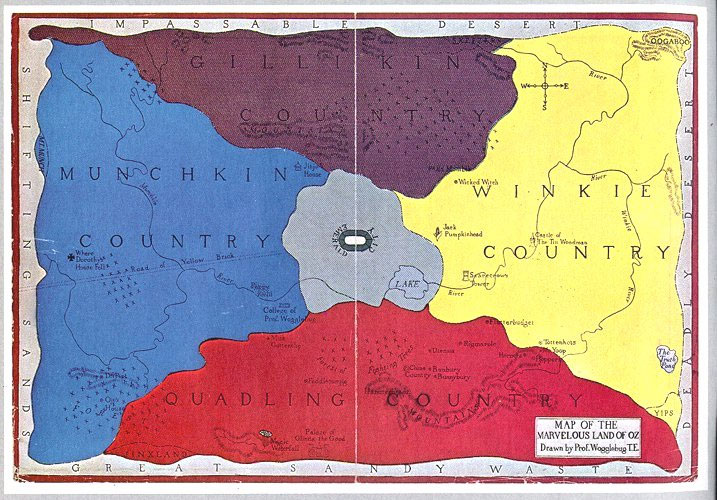
Here’s another view of the map of Oz as issued by Reilly & Lee. Can you spot two big differences between it and the map shown last week, from David Maxine’s Hungry Tiger Talk blog?

One difference is that this is a later reprinting of the map that first appeared in Tik-Tok of Oz (1914). As David discussed, the compass rose originally put east on the left and west on the right, contrary to the usual approach. At some point in subsequent decades, the publisher changed the labels so “E” was on the right as usual.

Of course, that change also meant the map showed the Winkie Country to be east of the Emerald City instead of west, as all of L. Frank Baum’s books described it. But his successors Ruth Plumly Thompson and John R. Neill started to state that the Winkies lived to the east, conforming to the reprinted map and its conventional compass.

Another difference is that the version of the map above is a broadside while the image David showed was scanned from an early copy of Tik-Tok of Oz, where it served as the endpapers. And that highlights a feature I find really interesting from the perspective of book design.

This map had to look good both as endpapers, when a thin strip of its middle would be concealed in the book’s binding, and as a poster or broadside lying flat. The artist accomplished that by making sure that almost no sites and no lettering fell within that central strip. Some large labels bridge the strip, such as the word “GILLIKIN” in the top quadrant—but there’s a little extra space between the second I and the K that could disappear into the binding.

The Emerald City was a challenge because Baum was clear that it’s in the middle of Oz—and thus in the middle of this map. How to keep it from vanishing into the gutter? The artist’s solution was to depict the city as a horizontal oval, with the word “Emerald” on the left and “City” on the right. (David Hulan once pointed out that the oval approximates an “emerald cut” in jewelry.) Then when the central strip of the map is hidden (look back on David’s map), the city appears as a circle and its full name remains legible.

On the accompanying map of Oz and surrounding countries, shown below, the Emerald City is safely off-center. And it appears as a circle, as it would appear in the endpapers form of the Oz map. This time the artist tried to keep other labels and locations out of the central strip. In the image from Wikipedia below, you can see where that got tough.

03 November 2015

zO fo paM suoiretsyM ehT

At the Hungry Tiger Talk blog, David Maxine has been presenting his research into the many maps of Oz. In his latest, he shares information about the map that appeared in Tik-Tok of Oz (1914), as shown above.

David quotes material showing that L. Frank Baum:
  • sketched a map of Oz for a young reader while working on the musical that became Tik-Tok of Oz, according to his composer, Louis F. Gottschalk.
  • sketched a supplemental map depicting the adventure in The Lost Princess of Oz (1917) based on the first.
He thus reaches the convincing conclusion that Baum himself sketched the preliminary version of the Tik-Tok map.

The main mystery of that map is why its compass is reversed, with east shown on the left and west on the right. Baum’s texts are consistent about east and west—the Winkie Country is always to the west of the Emerald City, for example, and traveling west in the Winkie Country takes one to the edge of Oz. Likewise, the Lost Princess map is consistent with the earlier Tik-Tok map, with west on the right. But if one were to hover in the air over Oz in a balloon facing north, would it look like that map?

For David, the consistency suggests that Baum actually pictured Oz that way, with east to the left and west to the right. I'm not so sure that’s the only explanation.

Even in its early years, the Reilly & Britton publishing firm seems to have been a bit slapdash in how it assembled the Oz books. A couple of years ago I wrote an article about the art program for The Patchwork Girl of Oz, which included reusing many of John R. Neill’s illustrations, including at least one that Baum had rejected.

I therefore think there’s a possibility the Tik-Tok map ended up with a reverse compass because no one noticed that mistake till all the hand-lettering was done. Then, with the book ready to go to the printers, everyone (including Baum) just decided to live with the oddity. As for the Lost Princess map, Baum clearly based that off the earlier one, and it would have been much easier for him to maintain its orientation than to redraw the borders in reverse.

Unfortunately, correspondence between Baum and his publisher during the time when the map was created appears to be lost. We therefore don’t know what Baum asked for or settled for. But it’s clear that he accepted the map as published, with its unorthodox orientation.

19 March 2014

Kick-star-ter for Tik-Tok

This week I pledged in a Kickstarter campaign for a production of The Tik-Tok Man of Oz, first shown in 1913-14, at this summer’s Winkie Convention in San Diego.

I’m attending that convention (in fact, I’m helping with the daytime programming), so I’m already going to reap the benefit of this production. But I admired producer Eric Shanower’s theatricality in a bare-bones ballet adaptation of The Road to Oz a few years back, so I thought this show would be worth a real ticket price.

As a celebrated artist, Eric had the ability to offer a very rare incentive for a large pledge: a “20"x24" original painting by Eric Shanower of 30 major Oz characters.” Having just one person sign up for that reward would have brought the campaign two-thirds of the way to its goal. I assumed that was the sort of pie-in-the-sky level that Kickstarter campaigns offer people in order to make the next level down seem less expensive.

Instead, two people have signed up for that grand reward, putting the campaign over the top and producing an unusual pattern in the pledges. Recent Kickstarter campaigns for a documentary film titled “Who Stole the Ruby Slippers?” (still ongoing) and a “Shadow of Oz” tarot deck (which just made its goal) seem to have a more common distribution, with most people pledging in the low and middle tiers and nobody offering four-figure sums.

The demand indicated by this pledge pattern for Tik-Tok Man would make me seriously think about doing nothing but original paintings of 30 major Oz characters.

26 January 2012

The Real Glinda

From the penultimate chapter of L. Frank Baum’s The Emerald City of Oz, as Ozma, Dorothy, and her family go south to visit their friend:
With hearts light and free from care they traveled merrily along through the lovely and fascinating Land of Oz, and in good season reached the stately castle in which resided the Sorceress.

Glinda knew that they were coming.

"I have been reading about you in my Magic Book," she said, as she greeted them in her gracious way.

"What is your Magic Book like?" inquired Aunt Em, curiously.

"It is a record of everything that happens," replied the Sorceress. "As soon as an event takes place, anywhere in the world, it is immediately found printed in my Magic Book. So when I read its pages I am well informed." . . .

"Then," said Ozma, "I suppose you know what is in my mind, and that I am seeking a way to prevent any one in the future from discovering the Land of Oz."

"Yes; I know that. And while you were on your journey I have thought of a way to accomplish your desire. For it seems to me unwise to allow too many outside people to come here. Dorothy, with her uncle and aunt, has now returned to Oz to live always, and there is no reason why we should leave any way open for others to travel uninvited to our fairyland. Let us make it impossible for any one ever to communicate with us in any way, after this. Then we may live peacefully and contentedly."

"Your advice is wise," returned Ozma. "I thank you, Glinda, for your promise to assist me."

"But how can you do it?" asked Dorothy. "How can you keep every one from ever finding Oz?"

"By making our country invisible to all eyes but our own," replied the Sorceress, smiling. "I have a magic charm powerful enough to accomplish that wonderful feat, and now that we have been warned of our danger by the Nome King's invasion, I believe we must not hesitate to separate ourselves forever from all the rest of the world."

"I agree with you," said the Ruler of Oz.

"Won't it make any difference to us?" asked Dorothy, doubtfully.

"No, my dear," Glinda answered, assuringly. "We shall still be able to see each other and everything in the Land of Oz. It won't affect us at all; but those who fly through the air over our country will look down and see nothing at all. Those who come to the edge of the desert, or try to cross it, will catch no glimpse of Oz, or know in what direction it lies. No one will try to tunnel to us again because we cannot be seen and therefore cannot be found. In other words, the Land of Oz will entirely disappear from the knowledge of the rest of the world."

"That's all right," said Dorothy, cheerfully. "You may make Oz invis'ble as soon as you please, for all I care."

"It is already invisible," Glinda stated. "I knew Ozma's wishes, and performed the Magic Spell before you arrived."
She doesn’t say, “I did it thirty-five minutes ago,” like Ozymandias in Watchmen, but she’s still mighty high-handed.

And from the third chapter of Tik-Tok of Oz, after Queen Ann Soforth has set out to conquer all of Oz from her little corner:
Princess Ozma was all unaware that the Army of Oogaboo, led by their ambitious Queen, was determined to conquer her Kingdom. The beautiful girl Ruler of Oz was busy with the welfare of her subjects and had no time to think of Ann Soforth and her disloyal plans. But there was one who constantly guarded the peace and happiness of the Land of Oz and this was the Official Sorceress of the Kingdom, Glinda the Good.

In her magnificent castle, which stands far north of the Emerald City where Ozma holds her court, Glinda owns a wonderful magic Record Book, in which is printed every event that takes place anywhere, just as soon as it happens.

The smallest things and the biggest things are all recorded in this book. If a child stamps its foot in anger, Glinda reads about it; if a city burns down, Glinda finds the fact noted in her book.

The Sorceress always reads her Record Book every day, and so it was she knew that Ann Soforth, Queen of Oogaboo, had foolishly assembled an army of sixteen officers and one private soldier, with which she intended to invade and conquer the Land of Oz.

There was no danger but that Ozma, supported by the magic arts of Glinda the Good and the powerful Wizard of Oz—both her firm friends—could easily defeat a far more imposing army than Ann's; but it would be a shame to have the peace of Oz interrupted by any sort of quarreling or fighting. So Glinda did not even mention the matter to Ozma, or to anyone else. She merely went into a great chamber of her castle, known as the Magic Room, where she performed a magical ceremony which caused the mountain pass that led from Oogaboo to make several turns and twists. The result was that when Ann and her army came to the end of the pass they were not in the Land of Oz at all, but in an adjoining territory that was quite distinct from Ozma's domain and separated from Oz by an invisible barrier.
In Baum’s books, Ozma has a tendency to want to talk nicely to people threatening Oz so as to convince them of the error of their ways. Glinda doesn’t play by those rules. You threaten Oz—she will take you down. And she may not even bother to tell anyone about it.

03 January 2012

Musical of Last Month: The Wizard of Oz

In December the New York Public Library celebrated the Wizard of Oz stage extravaganza that reached Broadway in 1903 as its “Musical of the Month.”

A huge and influential hit when it appeared, the show prompted L. Frank Baum to write sequels to his novel. It provided Dorothy with the surname Gale, the Tin Woodman with his original name Nick Chopper, and Oz with a former king named Pastoria. For fans of the MGM movie, the snowstorm that saves Dorothy and the Cowardly Lion from the poppies was borrowed directly from this show. But hardly anyone remembers the show itself.

As organized by Doug Reside, Digital Curator at the NYPL’s Library for the Performing Arts, the website offers four essays on the show:
These essays are illustrated with some of the images from the NYPL’s huge archive, including the photo of Fred Stone and David Montgomery as the Scarecrow and Tin Woodman above.

04 April 2011

Hammer Time

This week Heritage Auction Galleries is offering sketches, finished line art, paintings, and signed books from the estate of illustrator Garth Williams. Up for sale are Williams’s pictures for Charlotte’s Web, Stuart Little, and a couple of other books, one of which involved lots of bunnies.

Next week Sotheby’s will offer artwork from the collection of Kendra and Allan Daniel. The artists represented include W. W. Denslow, Frank Ver Beck, Fanny Y. Cory, E. H. Shepard, Arthur Rackham, Kate Greenaway, Beatrix Potter, Jessie Willcox Smith, William Pène du Bois, Dr. Seuss, Jean and Laurent de Brunhoff, Ludwig Bemelmans, Johnny Gruelle, Lois Lenski, Eleanor Parke Custis, Tasha Tudor, Maurice Sendak, and many others. Plus some more bunnies.

Among those items is a John R. Neill illustration of Betsy Bobbin and Hank the Mule from Tik-Tok of Oz. It’s described as an ink drawing, but the gents at Hungry Tiger Press have said that Neill usually colored photostats rather than originals. But I’d accept it as a gift either way.

16 November 2010

Round-Trip Journey to the Center of the Earth

Nathan DeHoff today posed several questions of how physics works in the land of Oz and surrounding countries, with the general conclusion that it’s questionable.

One particular matter is the tunnel through the center of the Earth depicted in Tik-Tok of Oz, redundantly called the Hollow Tube. The Nome King tricks all the book’s heroes into falling into one end of the tunnel, and they exit the other end like this:

Tik-Tok popped out into broad daylight and, after making a graceful circle in the air, fell with a splash into a great marble fountain. . . .

Queen Ann sailed up from the Tube, took a ride through the air as high as the treetops, and alighted squarely on top of the Peculiar Person’s head…
Later in the book, Quox the adolescent dragon takes all those heroes on his back and crawls into that end of the tunnel. When Quox comes out,
he shot into the open air a hundred feet or more and sailed so far away from the slanting hole that when he landed it was on the peak of a mountain and just over the entrance to the many underground caverns of the Nome King.
Does that accord with the laws of physics? Martin Gardner addressed that very question in The Annotated Alice, in his discussion of Alice’s fall into the Earth. And the basic answer is: gravity doesn’t work like that.

In a frictionless environment, people would travel exactly as far from the center of the Earth as they traveled down into it. Tik-Tok and his companions fall into the tunnel while hiking through some mountains, so conceivably they’re at a higher altitude, farther from the center of the Earth, than the garden at the other end. That would make it possible for them to pop up to some height on the other side and, with some wind and movement of the Earth, not fall right back down into the Tube.

But there are two problems with that scientific explanation:
  • The return journey wouldn’t work at all. Starting from the garden, Quox wouldn’t fall far enough to reach the other end of the tunnel as he rose, much less fly out the other side.
  • The tunnel is not a frictionless environment. In fact, Quox slows himself down by scraping his claws against the Tube’s inner walls.
In an environment with friction, Gardner wrote, air resistance would slow the travelers enough that they wouldn’t rise as far as they had fallen. They would therefore fall back down into the tunnel, pass the center of the Earth again, and rise not quite as far as where they had started from. Those unfortunate folks would continue to oscillate for many trips of decreasing length until coming to a stop at the gravitational center of the Earth.

So what explanation is there for how the Hollow Tube works? I can only assume that it’s magic. It does, after all, run from one fairyland to another, and the Nome King can even shift the opening around.

When creator Hiergargo the Magician first used the tunnel, according to Polychrome the rainbow fairy, “he tumbled through the Tube so fast that he shot out at the other end and hit a star in the sky, which at once exploded.” That hints that Hiergargo juiced the Tube with magic to make the journey faster, and some residual or revised magic might remain.

L. Frank Baum admired science, deliberately mixed it into his fairy tales, and even wrote a bit of science fiction. Occasionally he got some things remarkably right, but he never worked in the field, and never really treated science as more than a jumping-off point.

10 August 2010

The Oz Allusion

Saturday’s Oz-book allusion appeared in the heading for the post, which quoted this passage from L. Frank Baum’s Tik-Tok of Oz, describing the heroes’ overmatched assault on the Nome Kingdom, spearheaded by a clockwork robot:

It was now Queen Ann’s turn to attack, so the Generals yelled “Forward march!” and the Colonels and Majors and Captains repeated the command and the valiant Army of Oogaboo, which seemed to be composed mainly of Tik-Tok, marched forward in single column toward the nomes, while Betsy and Polychrome cheered and Hank gave a loud “Hee-haw!” and Shaggy shouted “Hooray!” and Queen Ann screamed: “At ’em, Tik-Tok—at ’em!”

The nomes did not await the Clockwork Man’s attack but in a twinkling disappeared into the underground caverns. They made a great mistake in being so hasty, for Tik-Tok had not taken a dozen steps before he stubbed his copper toe on a rock and fell flat to the ground, where he cried: “Pick me up! Pick me up! Pick me up!” until Shaggy and Files ran forward and raised him to his feet again.
The lesson of this part of Tik-Tok of Oz is that when you’re planning an attack on a magical kingdom with an immense number of warriors, and your own forces include a large dragon who’s been equipped by an incredibly powerful enchanter, you should let the dragon go first.