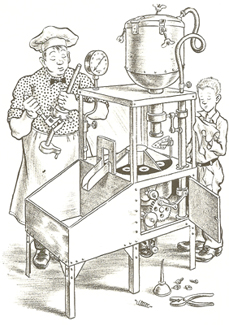
Eric Gugler began a short essay in the November 1943 Horn Book like this:
When I thumb through this decidedly provocative bunch of illustrations made by Bob McCloskey for his new book, Homer Price (Viking), hundreds of tangent thoughts pop up.
Evidently not among them was “I should read this book.” Because it quickly becomes apparent that Gugler hadn’t read
Homer Price.
“What a universal and delightful brat, this Homer Price,” Gugler proclaimed two sentences later, leading into a rhapsodic ode to mischievous boys:
They rings bells at front doors; when maids answer they snitch ice cream and cakes from the kitchen door and run away with bubbling glee; and they know they are never going to amount to much in the future unless they sell newspapers.
At no point in
Homer Price or its 1951 sequel,
Centerburg Tales, does Homer play any pranks like that. Instead, most of the time we see him
working: in his mother’s hotel, in his uncle’s lunch room, at the greenhouse, at the library, in the town pageant.
For fun, Homer builds a crystal radio and goes to a movie, but he passes up fishing because of a job. Neither he nor his young friends makes trouble. Instead, it’s the adults of Centerburg who avoid work, put things over on each other, and tell outlandish tales. Level-headed, hard-working Homer helps to keep the town together.
Gugler was obviously less interested in reading McCloskey’s stories than in sharing “reminiscences of other boys I knew very well indeed.” Maybe he was busy, on deadline, and anxious to say nice things about “Bob’s” new book. He provided a lively disquisition on the “lovable bad boy” type established by
Twain,
Aldrich,
Tarkington,
Shute, and
Peck. But Gugler didn’t know young Homer Price at all.
What was Gugler’s connection to children’s literature? How did he come to
The Horn Book? He was an architect who helped design the West Wing of the White House. Among Gugler’s other work was the office of his good friend May Massee at Viking Press—editor of
Homer Price. So this little essay looks like those excited but empty five-star Amazon reviews you can’t help suspecting were written by the author’s friends and relations.
The same issue of
The Horn Book contained a better appraisal of
Homer Price by
James Daugherty,
Newbery winner in 1940. He focused on its gentle satire of “the daily life of the Mid-Western small town” and McCloskey’s “solemn and devastating humor.” Daugherty noted how “Homer and his friends cope with, and master, such surprising emergencies as radio robbers,
Superman, musical mousetraps, ferocious doughnut machines, housing problems, and mass production.” He didn’t neglect the delight and craft of McCloskey’s pictures, but it’s clear that Daugherty had
read the text as well.