Showing posts with label children's magazines. Show all posts

16 March 2024

“Historic Children’s Voices” Coming from American Antiquarian Society

The American Antiquarian Society in Worcester will launch a website on “Historic Children’s Voices, 1799-1899.”

Its introductory page explains: “The holdings to be digitized are not children’s literature, i.e., works created BY adults FOR children, but rather are direct testimony as well as imaginative works created BY children. As such, they constitute an archive of historical evidence not previously accessible.”

The materials to be digitized include diaries, letters, stories, poems, and the AAS’s “large amateur newspaper collection—most printed on home parlor presses.” There will be 15,000 pages of content in all.

Those presses were very popular in the late 1800s. When L. Frank Baum issued the Rose Lawn Home Journal and later self-published works on stamp collecting and chicken farming, he was among thousands of young people working their own small presses.

Accompanying the website, the AAS will host an in-person and online symposium on 2–3 May featuring panel discussions on “Authentic Children’s Voices,” “Archival Silences,” “Visual Culture of Children’s Production,” and “Hearing the Child’s Voice.”

On 5–9 August, the AAS will host an institute for K-12 teachers on the subject, with hands-on workshops using the collection and a field trip to Lowell National Historical Park.

17 November 2023

The Return of “The Fuzzy Ghost”

This week I received my contributor’s copy of The Big Book of Things That Go Bump in the Night: A Collection of Utah Horror.

This anthology of “27 stories, poems, and flash fiction pieces, all geared toward kids” is published by Timber Ghost Press and available here.

My story, “The Fuzzy Ghost,” is much older than its target audience. It’s a tale about a family coming to terms with the death of a relative, and I wrote the first version in the 1990s after the death of my own older brother, Al.

At one point I had interest in the story from a kids’ magazine company, but the editor of the magazine I’d submitted to thought it would work better for the next-younger audience. I wrote another version, half the length to fit the second magazine’s specs. But for a story that depends on mood, that took away too much, and the revision didn’t sell.

Back then, kids’ magazines were practically the only market for such short fiction, and they had very strict limits on word counts. Technology has made internet magazines, micro-press anthologies, and even story vending machines viable, and that in turn has opened up the specs for stories.

Last year, as I continued to process the death of my mother, I spotted Timber Ghost Press’s call for submissions. I dug the latest draft of “The Fuzzy Ghost” out of my hard drive, updated it with specific period details, and sent it in. And now it’s come back to me inside a paperback book.

13 December 2017

Happy Holidays from Highlights

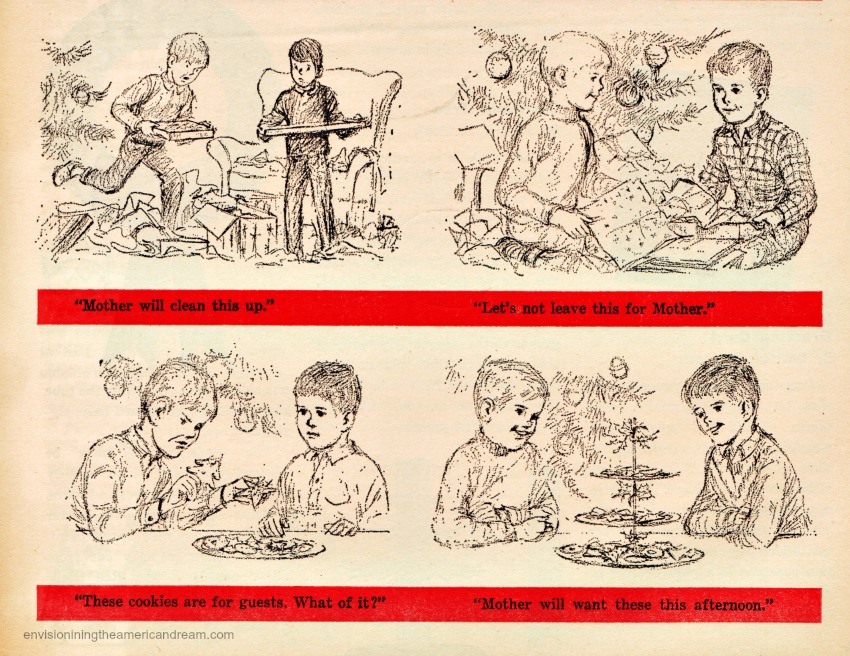
This week H-Net’s American Studies discussion site published Patrick Cox’s article “What's Wrong with Christmas in Highlights for Children?” While certainly not saying this was a Bad Thing, Cox noted a significant change in how the magazine has presented Christmas to young readers:
Santa Claus, arguably the most prominent figure in wondrous childhood, has been almost entirely absent from the pages of Highlights over the past 30 years. Santa used to appear multiple times in every December issue in stories and images, as did elves and flying reindeer, since the magazine was founded in 1946. Other Christmas-y pages in December Highlights issues of Chistmases past included short non-fiction pieces on, for example, the history of Christmas trees or Christmas celebrations in other countries, and short fiction about children at Christmas who typically learn valuable lessons about giving and kindness. Recurring characters The Timbertoes and The Bear Family celebrated christmas. Overt Christianity was also prominent in the early years of the magazine all year round and the December issues always included bible stories, sheet music of religious carols, and images of the nativity and angels.

Jesus and Santa both appear less and less frequently in Highlights beginning in the 1950’s. By the 1990’s, Highlights is beginning to look a lot less like Christmas. Santa and Jesus are both almost completely absent, as are the decorations, the bright colors, the piles of gift wrapped presents. They’re replaced by pleas to keep Christmas simple, emphasizing time with family and friends, giving to charities, and making presents by hand. Several pages are given to instructions on making homemade presents and homemade decorations. . . .

The children in Highlights are very often white, as I suspect most of their readers are, and main characters in stories and comics in the magazine are most often male, never queer, and pretty much always comfortably middle class. But at Christmas, their anti-consumerist pragmatism is surprisingly non-conformist.
But what should we expect from a magazine so un-American that it includes no advertising?

(Above: Goofus and Gallant do Christmas, courtesy of Envisioning the American Dream.)

14 March 2009

Fantasy in Very Small Doses

The Institute of Children's Literature has posted an interesting article by Jan Fields on "Magical Magazine Fiction." As to writing for the youngest subscribers:

For preschoolers, magazine fantasy is pretty much limited to talking animal stories (where the animals talk only to other animals). Editors prefer not to see talking inanimate objects (this includes talking teddy bears, talking toasters or talking oak trees) - again, because small children are still learning the difference between what is alive and conscious and what is not.
So, paradoxically, very young children are too quick to believe in magic for them to get much of a charge out of fantasy. Or perhaps the adults in their lives (parents, teachers, magazine editors) recognize that one of their big tasks at this developmental stage is to figure out what's real, and talking toasters would seem to confuse them.

As for older readers, they have a better sense of what defines fantasy. But there's an even bigger major challenge.

Rule #1 in writing fiction for children's magazines is that it has to be short. Shorter than you imagined the story. Shorter than you think you can make it. Even shorter than that.

Rule #1 in writing fantasy is that you have to define the boundaries of the fantastic elements--the rules of magic, the types of creatures, etc.--before they become crucial in the plot. Otherwise, they'll just seem convenient. And rather than lay out those rules explicitly, it's usually better to show them in action in some early episode.

So the first Rule #1 can come into direct conflict with the second, since defining or showing the magic requires a lot more words than are necessary for a story set in the universe readers recognize as their own. As Fields says:
Because all magazine fiction has such tight word counts, stories for intermediates (readers who read) often rely on certain preset reader expectations. A sea adventure may have a sea monster. A castle may be besieged by a dragon. You can play with existing forms such as creating an athletic princess or a bookish knight, but you won't usually see the introduction of totally new creatures or complex societies that need lots of explanation for the reader to understand. . . .

This is why you see so much castle-medieval-fantasy in intermediate short stories, the conventions are part of the culture so we don't need a lot of explanation to grasp the story.
And did I mention the story has to be short as well?

18 June 2006

highlighting Highlights

I didn't mind when the New Teen Titans went vaguely manga for their TV show. After all, I'd read that comic book during the George Perez years of the 1980s, and no animation studio in Asia could replicate his artwork 20 frames a second.

Nor did I mind the new, vaguely manga look for the Teenage Mutant Ninja Turtles a few years ago, or this week's news that their TV look will change a little bit more. After all, they always had a Japanese inflection.

But I was a little taken aback by this year's model of
Goofus and Gallant from Highlights for Children, that waiting-room staple. They've looked about the same since my early childhood. The magazine revamped the pair when it switched to a full-color interior, but their basic style remained: realistic pencil sketching, timeless clothing, whitest boys in America. Samples are preserved at Fark.com.

So I checked out the Highlights website. I was pleased to see that, despite the new stylist, Goofus still doesn't comb his hair. That gave me courage to try out the choose-your-own-very-mild-adventure pages for G&G. It felt like being one of those cartoon characters with a little devil on one shoulder and a little angel on the other. I can therefore report that Gallant comes off as even more of a prig. All is well.

This week the Boston Globe ran a story about Highlights on the occasion of its sixtieth anniversary and (so the magazine says) billionth copy. The August issue will explain the concept of a billion this way: "If Goofus stacked a billion children on his shoulders, they would reach the moon, wrap around the moon 11 times, stretch back to the earth, wrap around the earth five times, and there would be enough kids left over for 34,944 Little League teams." But where could we possibly find a billion kids stupid enough to trust Goofus to hold them up?

I understand that Highlights is narrowing its target audience, no longer aiming for the upper-elementary grades at all. This revamp of G&G as cuter may be part of that strategy.