Showing posts with label AUTHOR Ellen Raskin. Show all posts

06 March 2025

Raskin Returns, the Sequel

As Publishers Weekly points out, there’s poetic irony in two previously unknown literary projects surfacing from the literary estate of Ellen Raskin, author of The Mysterious Disappearance of Leon (I Mean Noel) and The Westing Game.

The industry organ reports:
International Literary Properties—a global company that invests in and manages literary estates—has acquired Raskin’s estate and, along with it, two previously unpublished manuscripts by the late author, including a sequel to her Newbery Award–winning mystery, The Westing Game. . . .

John Silbersack of the Bent Agency took on the role of Raskin’s literary agent nearly two decades ago, when Ellen’s daughter Susan Moore and son-in-law John first approached him to represent the estate. . . . Silbersack shared that at the time of Raskin’s death in 1984, “she had been working on—and had very nearly completed—a marvelous new story, very much in the vein of The Westing Game, titled A Murder for Macaroni and Cheese.

“Ellen’s practice was to rewrite and re-edit each prior chapter on the completion of a new chapter, so the earliest sections of the book were pored over time and again, while the very final chapters were more sketched out.” In an example of life imitating art, he said, “Ellen’s daughter, Susan, devoted herself to ‘solving’ the mystery and tying up all the loose ends, and the manuscript awaits a final polish and a worthy collaborator to bring it to a finale, which is at the top of our to-do list.”

Of the second book, a Westing Game sequel, he said, “Crafting a follow-up to one of the most beloved titles of all time is no small task. In conjunction with ILP, we’re currently in the process of bringing in another iconic middle grade author to work with us on this eagerly anticipated literary event. Watch this space!”
So in fact Ellen Raskin left two unfinished manuscripts, both needing considerable work by others to complete. A “global company” in now investing in those projects, seeking “a worthy collaborator” and “another iconic middle grade author” to make her notes publishable.

If Raskin told us anything, however, it’s to look beyond the surface. Back in 2012, Betsy Bird dug up a report from Publishers Weekly in 2007:
Stephanie Owens Lurie and Mark McVeigh at Dutton have acquired five books by Newbery Award–winner and The Westing Game author Ellen Raskin in a major six-figure deal negotiated by Alex Glass and John Silbersack at Trident on behalf of the Raskin estate. The books include two new puzzle mystery novels: The Westing Quest, a sequel to The Westing Game, and A Murder for Macaroni and Cheese, a never-before-seen manuscript nearly completed at the author’s death in 1984.
Bird then noted, “Years go by and not a peep is made about these books again.” Dutton reissued other Raskin titles in 2011. In the same year, the company announced A Murder for Macaroni and Cheese, issuing a brief blurb and an ISBN (9780525422914). But then that was pulled back.

The internet working as it does, lots of book websites (GoodReads, StoryGraph, Google Books, BooksWagon, etc.) sucked up the data attached to that ISBN and produced pages for A Murder for Macaroni and Cheese. So it already has the online profile of an out-of-print book when it’s never seen print at all.

15 April 2013

The Mystery

You might remember this photograph from 2007. That is Godson’s Brother, engrossed in a mystery.

For their shared birthday I usually send Godson and his Brother books, sometimes comics and sometimes prose. My choice for Godson last month was Tui and Kari Sutherland’s The Menagerie. For Godson’s Brother, who reads everything that his eyes fall on, I sprang for two paperbacks: Ellen Raskin’s The Mysterious Disappearance of Leon, I Mean Noel and The Westing Game.

Their mother is a stickler for thank-you notes, which arrived this weekend. Godson’s says in part:
I am very much looking forward to reading them. Captain Awesome away!
(Captain Awesome, the other side of the notecard makes clear, has telekinesis.)

Godson’s Brother wrote:
I really enjoyed reading them!
Well, I thought, that’s what I should expect. Two books couldn’t keep him occupied for long. Probably onto four more by now. Hardly made a dent.

But it looks like Godson’s Brother’s use of the past tense might have been a little poetic license. Today their mother emailed me that Godson’s Brother
ran into our bedroom at 6:10 this morning and exclaimed, “EUREKA! I GOT IT! I FIGURED OUT”…waving The Westing Game around. He sat on the floor, started to read again and said “Ohhhhhhh…”, got up, and wandered out.

27 December 2008

Unreliable

Lisa Von Drasek began her NYTBR review of Knucklehead, a new memoir about boys behaving badly, this way:

I have been a fan of Jon Scieszka (rhymes with Fresca) since “The True Story of the Three Little Pigs” by A. Wolf was published 20 years ago. Can you name another book that introduces the unreliable narrator to second graders?
Well, yes.

01 June 2008

Repeated Robins

One of the visual techniques of comics that I find most interesting is a sequence of similar panels. I'll explain what I mean with help from--who else?--Robin the Boy Wonder.

It's relatively rare to find such repetitive images in modern picture books because that form has come to emphasize visual variety and richness, usually just one full-spread image at a time. The technique depends on the readers' eyes quickly comparing two juxtaposed images, which is harder with a page turn in between. There are exceptions to that rule, of course; Ellen Raskin was a master at producing meaning from repetitive illustration, spread to spread.

One version of this technique is to show several instants in one scene from the same angle, with the same framing and the same background. That directs our eyeballs to what changes from one image to the next, usually the characters in action. This sequence of panels featuring the current Robin, Tim Drake, comes from Robin Plus Fang, script by Chuck Dixon, art by Anthony Williams and Andy Lanning.

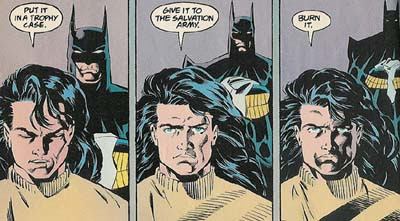
The changes in similar panels don't have to be so physical, though. Here's a sequence from the first Nightwing miniseries, collected in Ties That Bind, by Dennis O'Neil and Greg Land. Dick Grayson has decided to get out of the vigilante business. (I suspect that his hair was taking up a lot more of his time than he'd expected.) He's telling Batman what to do with his costume.
With each panel, Dick's face grows darker, and the Batman more distant. The similar but changing images convey the protagonist's mood.

Repetitive images can also focus our attention on one changing detail which might otherwise be lost, such as the grin that appears on "Batman's" face in the second panel below. That's all the clue that Nightwing needs, trained detective that he is.
That sequence is from JLA/The Titans: The Technis Imperative, by Devin Grayson and Phil Jimenez.

Repetitive images are also a tool for pacing. Seeing two similar panels, especially with no word balloons, tells us that time passes even when we don't see change. In the next sequence, Batman asks the third Robin, Jason Todd, to explain what happened to the rape suspect who was just with him on that balcony.
Batman's figure stays the same, so we sense he's waiting and waiting for an answer. These panels are from Batman, #424, script by Jim Starlin, art by Mark "Doc" Bright and Steve Mitchell.

Given how repetitive panels affect pacing, they can also be used for comic effect. After all, what's the key to comedy?


Timing. In the next sequence, the adult mentor of the teen-aged superhero group Young Justice orders Tim Drake as Robin and his speedy friend Impulse not to search for their missing comrade Secret.
This page comes from an uncollected issue of Young Justice, script by Peter David and drawing by Todd Nauck.

The brief, silent passage of time created by wordless panels in each of the last three examples is the equivalent of what screenwriters have come to call a beat. Such a silence can be hard to convey in prose, and The New Yorker has caught some lazy novelists instructing readers that characters "waited a beat" before they speak.

The visual dimension of comics makes it easy to convey that silent moment. Here's yet another example, from the current teen-superhero magazine to feature Robin, the third volume of The Teen Titans.
This deathless conversation was published in the volume Teen Titans/Outsiders: The Insiders. Scripted by Geoff Johns, penciled by Matthew Clark, inked by Art Thibert.

That last example also hints at something I don't like about how comics artists are applying this technique today. Many artists now work on computers ("penciled" and "inked" are just digital metaphors). That makes it awfully tempting to copy and paste an image from one panel to the next, especially when working under a tight deadline. The three-panel sequence of Nightwing and his hair far above is obviously hand-drawn, and the artists made many changes, large and subtle, from one panel to the next. But the two images of Robin above are identical down to the cross-hatched shadows and coloration.

A growing number of copy-and-paste jobs strike me as having been done without enough regard for the dramatic needs of the scene. This last example comes from Outsiders: Looking for Trouble, script by Judd Winick, art by Todd Raney and Scott Hanna. In these panels, it makes sense to draw the redhead the same because he's making a deadpan joke. His expression shouldn't change. But doing the same for Nightwing just looks like laziness. And using the same image for two panels with different characters talking apparently means that neither can be shown with his mouth open.
The only place I enjoy watching cardboard cutouts talk to each other like that is Wondermark.

09 November 2007

Same Image, Slightly Different

Having broken the news that there are more pictures on a typical comics page than a typical picture-book page, I'm going out on a limb today to suggest that there are fewer pictures in a traditional picture book than a comics-style book of the same length. Yes, the insights just keep coming.

My real point is that I think the smaller number of images in typical picture books has pushed artists away from a method of using sequential pictures that comics artists use a lot: a series of similar images with small changes from one to the next.

Picture books have a minimum number of images, a fact that writers have to consider when they conceive of their stories. As Peggy Tibbetts wrote, "if you can't come up with at least a dozen concrete visual images for the illustrator to choose from, you might want to re-think your picture book idea." Jan Fields went further in distinguishing a picture-book story from one more appropriate for a magazine: "In a picture book, it is...important that every illustration be different (not all in the same room, not all of two people talking)."

Traditional picture books also have a maximum number of images. They tend to be 32 pages, and if nearly every spread offers a single picture, that means there are only about 17 holes to fill. Where the Wild Things Are has an extra half-signature: 48 pages (including endpapers). But, even counting the cover, Maurice Sendak created only 20 images for that book. The picture-storybook Pink and Say is also 48 pages; Patricia Polacco created only 26 pictures.

Faced with so few opportunities for art, most picture-book artists strive for visual variety. They make each image a full-spread masterpiece, showing a complete scene. When a manuscript calls for them to portray the same scene over time, most choose different angles or move characters around to create dissimilar images. After all, why spend 2 of 17 spreads (more than 10% of a 32-page book) repeating yourself?

In contrast, the comics storytelling style often requires artists to depict the same scene several times on a page: the same two people talking in a room, for example. Artists can show that scene from a variety of angles, with lots of character action. Or they can create a series of similar panels, focusing readers' attention on the passage of time or the small variation between one panel and the next. I've come to think of that technique as another hallmark of comics art that's uncharacteristic of recent picture books.

The page from Sendak's In the Night Kitchen that I showed back here offers a view of that technique, clearly inspired by comics. A single page contains two images of Max falling through the same room. By comparing one to the next, we can see how he's moving down past the chandelier and the clock. We can also see Max lose all his clothes, which is bound to keep a young reader's attention.

I suspect that technique works best if the two similar illustrations aren't separated by a page turn. When the two images are side by side, we can see their similarity even as we concentrate on the details; we don't have to hold one in memory. However, some picture-book artists have used this technique well from spread to spread. Ellen Raskin was a master at it: Spectacles, And It Rained, Nothing Ever Happens on My Block. (I wonder if it was more popular when artists were responsible for supplying their own separations, and so were copying their drawings already.)

As an example of how this type of sequential art works so well in comics, I've taken two facing pages from Art Spiegelman's Maus. (I've fuzzed the unnecessary words so as not to show more than fair use.) On these pages the narrator's father describes his family gatherings before World War II.

This page contains eight images. Two show the narrator's father speaking from his exercise bicycle; in a picture book, that would be redundant. The other six images show the father's family, and they're even more repetitive. They're all from the same angle. They all show nearly the same instant in time. Yet they're still visually interesting because of their differences.

By comparing one similar image to the next, we understand that Spiegalman is bringing us into the scene through the window (like the opening of Citizen Kane!), and introducing us to each part of the family in turn. On this page, he's used panels to organize a single scene mostly by space.

On the facing page, Spiegelman continues to show us the same family from the same angle, but this time he emphasizes time by keeping the same part of the table in every picture, the same characters in the same seats. We're forced to focus on what changes from one panel to the next.
That puts more weight on the grown-up characters' words. We also see time pass by following a couple of little wordless stories involving the younger relatives. The teenager Lolek has his book taken away, and pouts. Baby Richieu turns over his plate, gets scolded, wails, and gets a hug. In a picture book with one image per spread, those four moments would need nearly a quarter of the book. Here it's just a lovely detail on a single page.

14 November 2006

Better Than The Westing Game

When it comes to Ellen Raskin mystery novels involving word games, multimillion-dollar inheritances derived from household products, inappropriate engagements, assumed identities, sudden deaths, an epilogue stretching years into the future, and children and adults detecting together, I'm fondest of The Mysterious Disappearance of Leon (I Mean Noel). Yes, I like it better than The Westing Game.

I'm not claiming that The Mysterious Disappearance of Leon (I Mean Noel) is clearly better than Raskin's Newbery-winner. The Westing Game is more sophisticated. Its cast is bigger, rounder, and more diverse, with tougher issues to deal with alongside the mystery. There are more layers to its narrative and its mystery (in large part because it's a puzzle deliberately crated to deceive rather than a set of mysterious circumstances). The Westing Games can also boast a swell online archive of Raskin's notes and manuscript, which the University of Wisconsin set up a few years ago.

Nevertheless, I have strong nostalgic feelings about The Mysterious Disappearance of Leon (I Mean Noel). As I commented on The Magic of Books months back, I think the many devoted fans of The Westing Game could do a lot worse than to check out her first novel. What precisely makes me prefer the earlier book?

1) THE TIMING. My paperback copy of The Mysterious Disappearance of Leon (I Mean Noel) was printed in 1973, the year I became a "middle reader." The Westing Game was published in 1978, the year I became a teenager. So the first book became available just when I was ready for it, and the latter as I was growing out of kids' mysteries. I liked it, but it didn't grab me and hold on.

Furthermore, The Mysterious Disappearance of Leon (I Mean Noel) is very much of its time--of my childhood's time. It takes place in a New York City when a bunch of shaggy-haired, jeans-wearing hippies are ready to protest at the drop of a hat. Not that I've ever lived in New York or ran with such a crowd, but I liked the idea that they'd be available if ever I needed someone sprung from a pesthole of a jail.

2) THE GRAPHICS. Until this book, Raskin had been creating delightful picture books in her unique graphic style: Spectacles, And It Rained, Nothing Ever Happens on My Block. As part of her transition to novelist, she created drawings to start each chapter of The Mysterious Disappearance of Leon (I Mean Noel).

Furthermore, those drawings incorporate typographical elements, which have long fascinated me. The characters' bodies are made up of words and phrases important in the following chapter. The central character's flowered dress and upholstery are rendered in asterisks.

3) THE FOOTNOTES. Reading the book last week, I realized that they're a forebear of Lemony Snicket's authorial interjections.

4) THE FARCE. The plot of The Mysterious Disappearance of Leon (I Mean Noel) is undoubtedly silly, the central character undoubtedly flat (in E. M. Forster's sense) and immature. In real life, she'd never get to adopt twins; she'd be referred to therapy instead. But now that we're all adults, do the characters in The Westing Game behave any more realistically, especially Mr. Westing himself? At least The Mysterious Disappearance of Leon (I Mean Noel) doesn't take itself so seriously.