Showing posts with label ARTIST Bob Kane. Show all posts

14 November 2015

Planetary Copyright

Here’s an interesting wrinkle about international copyright protections:
The classic novella “The Little Prince” fell into the public domain this year in much of the world but remains under copyright in France because of an exception that grants a 30-year extension to authors who died during military service in World War I and II.
There’s a logic to that provision, I suppose. If a society bases copyright terms on an author’s life, but an author dies before his or her time while fighting for the society, then the society extends the copyright term to about what it would otherwise have been. Still, I wonder what specific cases gave rise to this exception.

That passage comes from a New York Times story on a dispute over the copyright of Anne Frank’s diary as originally published. That copyright is the main asset of a foundation, which wishes to extend its term by calling Anne’s father a coauthor of the text. Other institutions, hoping to make the diary more widely accessible and/or mindful of Holocaust deniers’ claims that Otto Frank invented the story to begin with, are resisting that move.

By the logic of the French law, the term of Anne Frank’s copyright could be extended based on what her natural lifespan would have been—meaning even longer protection than basing the term on her father’s lifespan. Of course, few countries follow France’s example.

Meanwhile, the foundation already authorized the editing and publication of a more complete version of Anne Frank’s diary, which has its own copyright term based on the life of the scholarly editor.

29 May 2014

From Spring Heel Jack to Batman

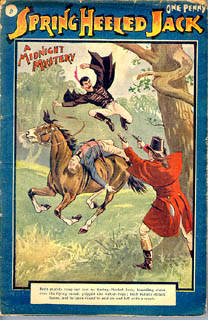
Among the ephemera on display in the “Comics Unmasked: Art and Anarchy in the UK” exhibit at the British Library is a penny-dreadful tale of Spring-Heeled Jack, which the curators suggest was an inspiration for Batman, pointing particularly to his horns.

I thought that was a stretch. Not that Bob Kane and Bill Finger were above borrowing plots, images, and details from other adventure stories of their time, acknowledged and unacknowledged. But how would two guys growing up in post-WW1 America have seen the Spring-Heeled Jack magazine serials from Victorian Britain? And wasn’t Spring-Heeled Jack a monster and/or troublemaker instead of a crimefighter?

At io9, commenter Michael Munro laid out a lineage of pulp fiction leading from London to California to Gotham:
Spring Heeled Jack…transitioned from London urban myth (1830s) to melodrama anti-hero (1870s) to prototype superhero (1880s-early 1900s). As written by "penny dreadful" author Alfred Burrage, SHJ was a wealthy aristocrat who assumed the disguise of a devilish, bat-winged avenger of the night, maintained a secret underground lair and used his athletic and technological skills to battle evil-doers - sounds familiar?
Expounding at more length, Munro wrote:
The several "penny dreadful" iterations of Spring Heeled Jack, many written by Alfred Burrage under the pseudonym "Charlton Lea", portrayed him as a nobleman who had been cheated out of his inheritance and who took up a devilish disguise to punish those responsible. Along the way, Spring Heeled Jack also rescued damsels in distress and generally stood up for the innocent and downtrodden. He wore a distinctive mask and costume and was capable of performing incredible leaps thanks to a special pair of boots, credited in one source to a secret mechanism invented by Indian street magicians.

Anticipating Zorro, Jack was fond of marking both enemies and territory by carving his initial with the point of his rapier. He also maintained a secret underground lair (in a converted crypt) and terrified his adversaries with his ringing laugh and catch-phrase, "The day is yours - leave the night to me!"
As Munro notes, the Batman team acknowledged Zorro, created by Johnston McCully in 1919, as an inspiration. Thus, Spring-Heeled Jack wasn’t a direct influence on Batman, and the horns/ears were a shared trope rather than deliberate borrowing.

23 February 2014

Neal Adams on Robinson’s Robin

In the third part of Kevin Smith’s podcast interview with artist Neal Adams, Smith asks whom Adams sees as the creator of Batman. Earlier in the conversation Adams mentioned both Bob Kane and Bill Finger, and he didn’t evince a lot of respect for either man. Rather, he says, he sees Batman as a collective creation, not any one person’s character.

But Adams goes on to say:
I think of Robin as Jerry Robinson’s, for sure. That bouncy…Robin that I put in Batman: Odyssey. Like, I have Man-Bat right at the beginning of the story. . . . Man-Bat comes into the cave and just grabs Robin and starts flipping him up into the rafters. And so they fight up in the rafters, but while they’re fighting Robin is talking to Batman, and Batman is talking to Robin.

And for Robin, that’s great. First of all, he’s hearing from his mentor,…and yet he’s flying around in the top of the cave…with Man-Bat, and they’re spinning on stuff and doing all this shit. That’s Jerry Robinson’s Robin to me. He doesn’t stand there and have a conversation, boy, if he can be up in the rafters and spinning around. That’s Robin. And I love that Robin.
That said, Adams dressed the Dick Grayson in Batman: Odyssey in the costume he’d designed for Tim Drake back in 1989 or so, rather than in Robinson’s costume. There are limits, after all. Or maybe royalties.

Adams and Robinson were both crusaders during the 1970s fight for creators’ rights. In the middle third of Smith’s interview Adams described how they teamed up to win recognition and pensions for Superman creators Jerry Siegel and Joe Shuster, as shown above. (Robinson is on the right, pre-toupée. Adams is the young man.) So I suspect Adams saw Robinson as standing out from the collective a bit.

10 April 2013

A Mystery with Not-So-Secret Identities

A while back, I had the idea for a mystery story set in the world of mid-1900s American comics publishing. I’m still working on that, but in the meantime I sampled Max Allan Collins’s A Killing in Comics, the first in a series of mystery novels set, well, in the world of mid-1900s American comics publishing.

I should have expected Collins to have worked out this idea already. He’s written many comics himself, including the Dick Tracy newspaper strip for many years, the Ms. Tree private-eye stories, and The Road to Perdition. Collins was the Batman scripter who gave the second Jason Todd his past as a runaway with criminal parents.

Collins is also a prolific writer of prose mysteries, including his award-winning Nathan Heller books, another series built around major modern disasters, and numerous novelizations. So basically he’s already worked out every idea for a mystery story.

A Killing in Comics is clearly inspired by Gerard Jones’s Men of Tomorrow, which has become the authoritative history of the start of the American comic-book industry. It’s a roman à clef about the first generation of DC Comics, or more particularly about the men who worked on its most famous creations, Superman and Batman. But in this book those trademarks are cleverly disguised as Wonder Guy and Batwing.

Thus, instead of Jerry Siegel and Joe Shuster, the book gives us Harry Spiegel and Moe Shulman—but they’re almost exactly as Jones characterized the Superman creators. On the Batman side, Bob Kane becomes Rod Krane, Bill Finger becomes Will Hander, and Jerry Robinson becomes…nothing, because unlike the other creators there’s no clear moral conflict in his career. Editor Mort Weisinger is on the scene at Sy Mortimer but as of 1948 hasn’t reached his full potential as a villain.

The detective, Jack Starr, is the troubleshooting vice president of a newspaper syndication service. Though he refers to his father as “the major,” reminiscent of Maj. Malcolm Wheeler-Nicholson, this business is actually successful. It’s also run by a version of Gypsy Rose Lee, a retired stripper of an intellectual kind. That’s the most fictional part of the book.

As with Oz the Great and Powerful, the story is a little less interesting than watching it play out just on the edge of its source material without stepping over the line onto that territory. In this case, the mystery depends on all those comics pros being capable of killing the equivalent of the president of DC Comics. So of course “any resemblance to actual persons…is entirely coincidental,” as the copyright page says.

Further volumes in Collins’s Jack Starr series appear to be inspired by the Li’l Abner Broadway show of 1956 and its roots in newspaper comics, and by Dr. Fredric Wertham’s anti-comics crusade.

02 January 2013

Who Wrote “The Isle That Time Forgot”?

While researching the last weekly Robin posting, I stumbled across a curious dispute over the question of who wrote “The Isle That Time Forgot,” the story in Batman, #10 (April-May 1942), that showed Dick Grayson turning either eight or thirteen or fourteen, depending on which panel you read and how.

Of course the story was credited to Bob Kane, the artist who had brought Batman to DC Comics and tried to take full credit for the character for years. But by that point DC had hired Kane’s original studio team of Bill Finger, Jerry Robinson, and George Roussos, and employed other freelancers as well. The company didn’t keep records from that period, so it’s hard to link particular stories with their creators.

Both Robinson and Roussos reportedly identified “The Isle That Time Forgot” as their work. For other stories and other details, fans have tried to fill in the gaps, but identifying artists by their visual styles is easier than fingering writers.

In DC’s recent reprints and the Grand Comics Database, “The Isle That Time Forgot” is credited to Joseph Greene. That identification appears to rest on the judgment of Martin O’Hearn, apparently based on “comparing textual styles.” That would make this story Greene’s very first published comics script.

However, in 2002 writer Alvin Schwartz has queried whether some of the Batman stories from that period credited to Greene should really be credited to himself. He definitely wrote for DC at the time, couldn’t recall hearing of Joseph Greene, and spotted some details he didn’t think any other writer (except his own erstwhile writing partner Charley Greene) could have come up with.

Complicating matters, other sources say that Greene later wrote under Grosset’s in-house pen name of “Alvin Schwartz.” As a man actually named Alvin Schwartz, Alvin Schwartz was surprised by that. He was more aware than anybody how mid-century American publishing wanted him to use a name more like, well, “Bob Kane” (born Robert Kahn).

But Schwartz also notes that comics historians defending his place in the early comics industry have credited him with stories he never wrote. It’s all very tangled, and if all we have to go on is subjective judgments of “textual styles,” we must learn to live with uncertainty.

19 August 2012

A Full Look at Detective Comics, #38

Comixology’s Nightwing 101 sale (ending this evening) offered me a 99¢ look at the whole of Detective Comics, #38, the magazine which introduced Robin as the Sensational Character Find of 1940.

As I’ve written previously, this was Whitney Ellsworth’s first issue as chief editor, and he replaced the story originally slated for this issue with Robin’s debut. Within a short time, Ellsworth instituted new rules about guns and killing in Batman tales.

But the Batman cover feature was only the first of several stories in that issue of Detective. At twelve pages it was the longest, but the whole magazine contained 58 pages of comics and a couple of prose items (not included in the Comixology download).

The other graphic features were episodes of “Spy” and “Slam Bradley,” both written by Jerry Siegel; “Red Logan,” an American reporter in London; “The Crimson Avenger,” a Green Hornet knock-off; “Cliff Crosby,” a “Terry and the Pirates” knock-off; “Speed Saunders, Ace Investigator”; and “Steve Malone, District Attorney.” The Crimson Avenger had preceded Batman as a masked hero, but the rest of the magazine’s heroes were square-jawed young white men in suits. (Well, Cliff Crosby wears flying gear and spends an unusual amount of time shirtless at the North Pole.)
Aside from Dick Grayson and the newsboys he encounters, the magazine shows only two recognizable children: a girl and “crippled boy” whom Slam Bradley and his grotesque sidekick rescue from a fire. Within a year, boy sidekicks and heroes would proliferate as the success of Captain Marvel and Robin sent the industry chasing after its main readership. Cliff Crosby was soon dubbed “Young America’s Hero” rather than “Famous Explorer.”

Another striking aspect of the magazine is that the Batman and Robin story is much better than the rest. Granted, scripter Bill Finger had more pages to work with, but a lot of the other tales make little sense, relying on coincidences, leaps of logic, and ludicrous action sequences.

In contrast, Batman and Robin’s drive to shut down Boss Zucco’s protection racket proceeds rationally, building to a night-time battle on the skeleton of an unfinished building. For that fight Jerry Robinson designed pages of dark panels alternating with light, full moon in the background.

Bob Kane and Robinson’s draftsmanship wasn’t as good as that of some other artists in this early comic, but their composition was much better. Only Jack Lehti’s work on the Crimson Avenger finds as much depth and variety in the panels. (Kane and his crew were working with a varied three-tier page structure. Fred Guardineer used a more uniform three tiers in “Speed Saunders,” and all the other stories are told in four tiers, like Kane’s original, six-page Batman tale.)
The coloring on most pages is awful. There was a limited palette, and the colorists deployed it poorly. One page of “Speed Saunders” shows three different women in red tops and green skirts, making it easy to confuse them; on another, two planes keep switching colors. In “Cliff Crosby,” the polar bears are brown. And this is supposed to be an English village landscape at night from “Red Logan.”
With that baseline, Robin’s costume of red, green, and yellow doesn’t seem so unusual.

15 January 2012

“The Guardianship of Dick Grayson!”

“You must have read how Batman first took charge of a young boy named Dick Grayson...whose parents, The Flying Graysons of circus fame, had died in a tragic fall from their trapeze!

“Since that day, the mutual affection between this man and boy has been as strong as that between father and son!”

That’s the start of “Bruce Wayne Loses the Guardianship of Dick Grayson!”, a classic but badly-titled story in Batman, #20 (cover date Dec 1943-Jan 1944). It came out of Bob Kane’s apartment studio, with his pencils, Jerry Robinson’s inking, and George Roussos’s lettering bringing out a script by Bill Finger.

And as far as I can tell, this was the first Batman story based on exploring the legal relationship between Bruce Wayne and his ward Dick Grayson, established in an afterthought back in 1940. In fact, back then the comics rarely mentioned Dick’s circus upbringing, the murder of Bruce’s parents, or what brought them together. Crime-fighting was just what they did.

But then Dick’s paternal uncle George shows up. (The whirling head effect in the first panel is a technique Kane brought from humor comics, his real love.)
It’s striking that Bruce says, “Not after all these years!” Dick has burst onto the scene less than four years before in real time, and in comic-book time Dick Grayson had barely aged. (There was one birthday story.) The same balloon also establishes that Bruce sees Dick “like a son!”

Uncle George goes to court, requiring anguished testimony. Per Reason for Robin, #4, Dick shows more emotion on the stand, but even Bruce is “strained” as he pulls out the word “love.”
But the judge decides that a “nightclubbing, shiftless, café society playboy” is no good guardian for a teenager and awards custody to Uncle George. The Dynamic Duo enjoy a panel of reminiscing…
That upper panel might be the first time the phrase “good soldier” appears in a Batman comic. It’s been echoing since Frank Miller’s The Dark Knight Returns. Back in 1943 it was an allusion to actual soldiers, of course.

I’m also struck by how Roussos chose to draw Bruce’s “Goodbye, kid, goodbye” in such small letters; that’s a very rare technique in 1940s superhero comics, and it again reflects Bruce’s feelings.
Bruce starts to mope around Wayne Manor (which in this era looks much bigger from inside than from outside). While complaining about unfairness as fervently as any thirteen-year-old, Bruce now calls Dick “the person I love the most!”

Being alone again even affects Bruce‘s work as Batman.
But after the fight Dick has to go back to his newfound relations. A few pages on, it becomes clear that Uncle George is simply trying to extort money from Bruce Wayne, offering him his own teen-aged boy for a mere million dollars. At the suggestion of Alfred the butler, Bruce steps in as Batman. But without his partner, the criminals lure the Caped Crusader “into a man-trap!”

How bad do things look? Batman’s only back-up now is Alfred, and not the ex-special-forces Alfred of today. This was the original fat, comic-relief Alfred. But he knows where to get help: he knocks on Dick’s new bedroom window, and the two of them race off to rescue Batman.

The outcome of that fight hinges on one of the Penguin’s trick umbrellas—a detail established back in that panel of reminiscing. It wasn’t necessary to have read a lot of earlier Batman comics to follow this story. Nevertheless, Finger clearly created it for readers who were already fans of the Dynamic Duo and wanted to learn more about their relationship.

Finally, we have another scene in court, where the judge reverses himself.
Interestingly, this story doesn’t end with Dick’s uncle revealed as a complete fraud; it suggests that he really is a brother of the late trapeze artist John Grayson. I don’t think Uncle George ever resurfaces in the Batman mythos, though.

This story was successful enough that Finger wrote a variation on it in “The Trial of Bruce Wayne!”, published in Batman, #57 (Feb-Mar 1950), with art by Dick Sprang. In this tale, a criminal whom Bruce somehow helped sent to prison seeks revenge by hitting the millionaire where it will hurt the most: he orchestrates a legal hearing to take away custody of Dick.

The crooks in this story attack Bruce instead of Batman, and there are no lost relatives for Dick. Once again, Bruce’s public persona as a shiftless playboy works against him. And in the end he calls the same character witness as before, only this time Finger has Batman speak to the court on panel. (Meanwhile, it appears that Bruce can’t be bothered to show up for his own hearing.)

The “Trial” story never rises to the emotional pitch of “Bruce Wayne Loses the Guardianship of Dick Grayson!”, but it’s a solid example of a story type that usually showed up about once a season: something threatening the partnership of Batman and Robin. I don’t think, however, there were any more stories about Bruce and Dick’s legal relationship, not even when Aunt Harriet appeared, until the 1980s.

COMING UP: The Jason Todd soap opera.

25 December 2011

Weekly Robin Holiday Greetings

This weekly Robin shares a few highlights from the holiday story in Batman, #15, dated February-March 1943 but on sale the previous December. That was even before Alfred Beagle arrived at stately Wayne Manor.

The tale, scripted by Don Cameron and drawn by Bob Kane and Jerry Robinson, begins with Bruce Wayne and Dick Grayson out holiday shopping. (As usual in winter scenes of this era, Dick wears earmuffs.) They see a poor newsboy and give him presents, but the image of his poverty lingers in their minds that night.
Bruce and Dick decide to bring gifts to the three loneliest men in Gotham. But of course they can’t do that simply as a wealthy philanthropist and his ward. No, they’ve got to show off the bat-tech!

One of the men they’ve targeted is a doorman at an “ultra-exclusive” nightclub.
Batman brings the doorman inside and asks the revelers for a show of appreciation for the doorman. The 1% obligingly rattle their jewelry. But because this is Gotham City, any upper-class entertainment is due to be disrupted by crooks. Sure enough, thugs arrive, walk through the now-unguarded door, and hold everyone at gunpoint.

Fortunately, the Boy Wonder has a brainstorm about one of the presents the Dynamic Duo has brought for the doorman.
Also fortunately, these are the two dumbest crooks in the world. (Full story here.)

11 December 2011

Robinson’s Visual Inspiration for Robin

In further honor of the late Jerry Robinson, this weekly Robin quotes from his 2004-05 interview by Gary Groth for The Comics Journal on the character design for Robin:
We had a long list of about 30 names, and we kept adding others. The names are very important for the characters. Bill  [Finger] was very specific about that, as well as Bob [Kane]. Most of the names, as I recall, were of mythological origin — Mercury and others. None of them sounded right to me, or to anybody, because we never agreed on any one.

My reservation was that I thought that it should be a name that evoked an image of a real kid. He didn’t have superpowers, nor did Batman. That was what distinguished it from Superman and the other superheroes. I thought the boy should be the same. And thinking of a more human name, I came up with Robin because the adventures of Robin Hood were boyhood favorites of mine.

I had been given a Robin Hood book illustrated by N. C. Wyeth — I think it was a 10th or 12th birthday present. It was a big, very handsome book for the time, very elaborate because it had full-color illustrations, maybe a dozen throughout the book. It was the full text with full-plate tip-ins. I remembered those because I had pored over them so many times as a kid.

I had a vision of Robin Hood just as Wyeth drew him in his costume, and that’s what I quickly sketched out when I suggested [the name] Robin, which they seemed to like, and then showed them the costume. And if you look at it, it’s Wyeth’s costume, from my memory, because I didn’t have the book to look at. But it is pretty accurate: the fake mail pants, the red vest, upon which I added the little “R” to correspond with Batman’s bat on his chest.

When I started to letter the strip, every legend I did started off with a little round drop-out white letter. So I thought of that for the vest.
Now in fact I don’t see many elements of the Robin costume in Wyeth’s paintings, particularly the one most often cited as inspiration: “Robin Meets Maid Marian,” shown at right above. Certainly the “fake mail pants” don’t show up many places before Detective Comics, #38.

But I think the title-page illustration at top, showing young Robin Hood learning to shoot, must have been in Robinson’s head. For one thing, it shows the hero as a boy wonder. And although the garments are quite different from what Robin would wear, the silhouette is rather similar: short boots with flared ankles, smooth legs from ankle to upper thigh, jerkin extending below the belt, puffed upper sleeves looking like short sleeves. And, of course, emblems on the chest.

08 December 2011

Weekly Robin Extra: Farewell to Jerry Robinson

Comics artist and advocate Jerry Robinson died this week at the age of eighty-nine. He was a teenager when Bob Kane hired him as an assistant in the summer of 1939. From inking and lettering he moved on to being the uncredited principal artist on some Batman comics before being hired away by the publisher.

At a signing in Boston earlier this year, I asked Robinson about the appearances of his and inker George Roussos’s names in early Batman pages—slipped onto shop signs and the like. Was that their way of “signing” the art alongside Kane? With a sly smile, Robinson said, “I probably signed Bob’s name more than he did!”

The photo above comes from Geoff Boucher’s 2009 profile of Robinson from the Los Angeles Times. Is it a sign of our values that lately Robinson has been celebrated more for co-creating the Joker than for co-creating Robin?

25 September 2011

“I could be Robin, but I didn't think I could be Batman”

As DC Comics wound down its first Batman series with issue #713, it turned to writing stalwart Fabian Nicieza to script a final story. I think Nicieza has a particularly good understanding of the place of Robin in the Batman mythos (i.e., he agrees with me on lots of points), so this was a good choice.

Comic Book Resources interviewed Nicieza about that story, and his fondness for Dick Grayson:
When I first came to this country [from Argentina], we watched the Batman TV series on ABC and I immediately got into the character. I don't know if it was the costume or the fact I felt I could be Robin, but I didn't think I could be Batman—same reason I thought I could be Chekhov but not Kirk! I don't know, it's dorky, but I always thought any kid in shorts and green pixie boots (have we mentioned he wore pixie boots?) who could hold his own up against Batman, much less all the villains in Gotham, was cool by me.
The tale Nicieza wrote is framed around Damian Wayne telling three younger boys a Grayson-centered history of Batman, at the same time sharing the valuable lessons he’s learned from being Robin.

The story reminded me a bit of “The Batman Nobody Knows” from 1973, also about boys telling each other stories of the legendary Batman. That tale is supposed show that children are too innocent to be scared of Batman like that cowardly, superstitious lot of criminals. (It actually shows the boys as jaded enough to quickly believe that millionaire bachelor Bruce Wayne likes to jump out at children on camping trips in a skin-tight costume and mask. But I digress.)

In Batman, #713, those three little boys are named Bob, Jerry, and Bill—obvious allusions to Bob Kane, Jerry Robinson, and Bill Finger, the team that created Dick Grayson back in 1940.

Little Bill later talks about a story he’s going to write. Readers’ response to these kids seems to depend on their tolerance for schmaltz. But a “last” issue of a magazine published since 1940 might deserve a bit of schmaltz.

Do I read too much into the fact that the Bob Kane analogue is a step behind everyone else?

17 April 2011

Researching Robin

Marc Tyler Nobleman, author of Boys of Steel: The Creators of Superman and an upcoming book on writer Bill Finger, has generously shared some of his notes on the question of who created the original Robin, the Boy Wonder.

Jerry Robinson, who was working as an artist for Bob Kane, has often credited Finger for the idea of giving Batman a sidekick while providing strong evidence that he himself came up with the character’s name and look. For example, here’s an extract from Gary Groth’s interview with Robinson in The Comics Journal, #271, as supplied by Marc:

GROTH: I assume you’ve read Gerry Jones’ new history of comics, Men of Tomorrow. There’s a little contradiction I wanted you to clarify between what you’ve said previously about who created Robin and how Jones related it. Jones wrote, “When Bill Finger felt Batman could use a sidekick to talk to, he and Robinson created Robin, the Boy Wonder.” Now, you contradict that in an interview that you did with Comics Interview when the interviewer asks you, “What about Robin? You were responsible for his creation” and you reply, “No, no. I was not. I can’t take credit for that. As I reconstructed it and Bill confirmed my recollection, Bob and Bill had the idea of having a kid and discussed that idea before I arrived.”

ROBINSON: Right. That’s basically true. Gerry I think was very accurate in his interviews. He interviewed me extensively for the book. I think he did a very fine job. In any event, yeah, more accurately, adding a kid was under discussion. I’m sure it was Bill’s idea for adding a boy. That I would attribute to Bill without question. When I came in they were already discussing possible names. So I joined the discussion of the creation. There was nothing on paper yet, nothing but the idea of adding a sidekick. And I know that was Bill’s idea to add a sidekick, from the discussion that ensued. The impetus came from Bill’s wanting to extend the parameters of the story potential and of the drama. He saw that adding a sidekick would enhance the drama. Also, it enlarged the readership identification. The younger kids could then identify with Robin, which they couldn’t with Batman, and the older ones with Batman. It extended the appeal on a lot of levels.
Robinson said similar things in Alter Ego, #39, and elsewhere. However, this interview also makes clear that Robinson was not present when Finger presented the “idea for adding a boy”; rather, he inferred that Finger deserved the credit.

It’s notable, however, that Bill Finger himself didn’t lay claim to Robin even as he took credit for originating other parts of the Batman mythos. In 1965 he told The New Yorker that the “group” created Robin to be Batman’s Watson.

Bob Kane, of course, claimed the credit for himself.

I think this investigation may be so complicated because Robin was created in stages. The character is the combination of three ideas:
It’s clear that the last stage was mostly Robinson’s creation, with a bit of help from Finger. It also appears likely that Finger was already pushing to add a companion for Batman, which would make his scripting easier.

But who had the idea to make that companion a teenager? My theory remains that someone in the DC office pressed Kane to increase the “kid appeal” of the stories he was supplying. As I wrote back here, at the start of 1940 Fawcett reportedly had a poll showing that boys comprised the biggest set of comic-book readers, and the company created Captain Marvel as a response.

Robin’s arrived at the same time as new Detective Comics chief editor Whitney Ellsworth. He bumped the story announced for Detective, #38, in favor of introducing the Sensational Character Find of 1940. Shortly after that, Ellsworth demanded that Batman stop using guns and other lethal means because those weren’t appropriate for children’s entertainment. So Ellsworth definitely pushed the “kid appeal” message, and liked Robin’s potential.

So here’s a scenario to consider. In early 1940 Ellsworth told Kane that he’d be taking over Detective and that the Batman stories needed to offer even more for boys. Kane brought that message back to his apartment/office as his own idea—at the time, he was the only link between the publisher and his team.

Finger saw how this suggestion offered a solution to a problem he’d been wrestling with: the lack of a “Watson.” Finger and Kane had thus agreed to add a kid sidekick when Robinson came into the conversation. Robinson finished developing the character with Finger’s help.

Each man could thus claim to have come up with basic ideas for Robin—or, in Kane’s case, perhaps to have adopted that idea as his own. It’s consistent with what we know of their personalities for Kane to maximize his claims, Finger to be scrupulously minimal, and Robinson to take the side of the underdog. But the character was a joint creation, driven by a combination of commercial pressure, storytelling needs, and artistic choices.

10 April 2011

Look Upward Robin!

From the daily Batman and Robin strip of the 1940s, back when a superhero comic being gritty meant it contained actual grit.

But to show that some things don’t change over more than sixty years, note the pride beneath Batman’s disapproving scowl* in panel three. * phrase borrowed from Nightwing, #138, published in 2007.

03 April 2011

The Original Daily Batman

Yes, Dick, we discern the irony in your current situation.

This panel is from the first Batman and Robin daily comic strip, which ran in North American newspapers from 1943 to 1946. Each week brought two independent storylines, one in black and white Monday through Saturday and another in color jumping from one Sunday to the next. Although some tales from the strip were reconfigured for the magazines, most of these comics never reappeared until DC and Kitchen Sink Press started to assemble the complete run in four volumes in 1990.

The daily Batman and Robin strips are notable for being Bob Kane’s last sustained work on the most famous characters he co-created (and for a long time took full credit for). Even with diligent practice and Charles Paris’s inking, Kane was only fair at drawing realistic scenes (much less the super-realistic rendering of superheroes). Note, for instance, the background of this landscape. Kane managed to have the shadows extending from the house, the barn and shack, and the farm equipment in three different directions.

It’s no mystery why Kane chose to concentrate on the comic strip instead of the comic books. Newspapers were more established and prestigious than cheap magazines. In addition, if more papers picked up a strip, a creator could receive more money without having to do more work—and Kane was all about taking money for as little work as possible. In contrast, DC paid a flat rate for comic-book pages regardless of how many copies they sold.

For similar reasons, Gerard Jones wrote in Men of Tomorrow, Jerry Siegel and Joe Shuster concentrated on the Superman comic strip launched in 1939 and let other artists produce the magazines. That strip ran continuously until 1966, nearly twenty years after Siegel and Shuster quit. (Then a new Batman strip fueled by the TV show took over the slot.)

The Robin of the daily strip functions exactly like the character in the comic books. He’s someone for Batman the detective to talk to and to withhold information from; he gets held hostage or trips at inopportune times. And he expresses emotion more openly than Batman—which could strain Kane’s drawing skills.

Indeed, some of Kane’s portrayals of Robin go beyond awkward to downright creepy. This wasn’t such a problem in drawing Bruce Wayne/Batman, whose handsome stolidity produced a limited set of facial expressions. Kane could kept using his favorite stock poses—face straight on, for example.

When storylines required, say, slinky women, DC gave the assignment to other artists. But for ordinary crime cases, Kane’s artwork served just fine, with a Dick Tracy vibe. And one humorous storyline, built around the wartime housing shortage, even ended with the Dynamic Duo doing a “plop take” out of the last panel as if they were “bigfoot” comics characters.

Indeed, Kane seems to have been a comedic cartoonist at heart. He started out drawing funny comics like Hiram Hick, Ginger Snapp, and Peter Pupp, his first character to have a young sidekick. After giving up Batman (but not credit), Kane developed a couple of TV cartoons, Courageous Cat and Cool McCool. Those projects were a better fit for his natural style and talents.

13 December 2009

“That’s Potent Stuff, Kid! Like as Not to Give You Bad Dreams…”

Some Batman histories, such as the From the ’30s to the ’70s volume I read as a lad, say that Dick Grayson’s departure for college allowed the Caped Crusader to return to his detective roots. Indeed, the first story that followed, “One Bullet Too Many,” was a forensic procedural. But a lot of that era’s stories featured vampires, ghosts, and Man-Bat. They belonged to the gothic or horror mode rather than the detective genre.

Of course, those stories were a return to Batman’s roots. His earliest adventures in Detective Comics, before Robin arrived, also involved vampires, mutated monsters, mad monks, and other elements of gothic horror. Which isn’t that big a shift when you start with a millionaire dressed as a giant bat.

Those fantastic elements didn’t go away when Robin arrived, as Batman’s pistol did. In fact, the arrival of a young character opened the door for a new sort of story, even more fantastic—indeed, unreal.

Detective, #44, half a year after Robin’s debut, offered “The Land Behind the Light.” It showed the Dynamic Duo passing through a scientist’s strange light into “the 4th Dimsension,” a world wracked by war between giants and dwarfs! That fantastic mode played to Bob Kane’s strengths as an illustrator; he was better at comically exaggerated figures than realistic ones.

For more detail of this adventure, see Vintage Spandex. But I’m spoiling the ending: Yes, it was the Batman saga’s first use of the “It was all a dream” escape hatch when a writer—in this case Bill Finger—couldn’t finish or explain his tale. Eventually comics publishers realized that their readers would sit for “imaginary” stories, parallel universes, “What If?” alternatives, possible futures, “Elseworlds,” and other justifications for stories that don’t take place in their heroes’ “real” lives. Even in the real lives of Batman and Robin, stories broadened to feature time travel by hypnosis (don’t ask) and trips into outer space.

I don’t think Kane and Finger could have used the “all a dream” exit without Robin. Batman is supposed to be a physical and mental paragon; in those early years, he was also an emotional paragon. He wouldn’t get lost in a book of fables and be unable, even for a minute, to tell dream from reality. But because Robin is still a child, he can get lost in a nightmare. His arrival on the scene in 1940 widened the team’s storytelling possibilities to include fantasy sequences.

In contrast, a later story told us that Batman hasn’t had nightmares since his childhood. (It also showed us that he sleeps in his full costume and cowl, so we can debate how well adjusted he really is.)

06 December 2009

Robin Never Kills

As a follow-up to my “Reason for Robin, #9,” the weekly Robin will spend a couple of weeks exploring how Dick Grayson’s youth changed the nature of Batman stories after he made his entrance in 1940.

In the first year of Batman adventures, the Dark Knight sometimes carried a gun. He wore a pistol in a holster in some panels of Detective, #33 (though not in other panels on the same page). Detective, #35, opens with an image of him holding a smoking gun, and in #36 he fires into the air to summon the police.

Batman shot at his foes only twice, and both times they were no longer human: vampires in Detective, #32, and “man-monsters” in Batman, #1, as shown here. Of course, in those early stories he left a lot of villains dead in other ways.

Robin arrived in Detective, #38. Putting a kid at Batman’s side meant the adventures had to become more gentle, right? Well, not right away. These panels are from Robin’s first fight. I doubt that gunman has a happy landing. The end of this tale turns on another death: a mob boss knocks another henchman off that same unfinished building. The Dynamic Duo is more interested in capturing photographic evidence of that murder than in stopping it.

According to the Grand Comics Database, Whitney Ellsworth took over as editor of Detective Comics with that issue #38. And he brought new ideas for how Batman should behave. Writer Bill Finger later recalled in an interview:

I had Batman use a gun to shoot a villain, and I was called on the carpet by Whit Ellsworth. He said, “Never let us have Batman carry a gun again.” He was right.
I don’t believe Finger started working directly for Ellsworth at DC (then National) Comics until late 1940, so that conversation was probably prompted by a script he’d turned in, not by a published comic.

Bob Kane’s autobiography, Batman and Me, says that Ellsworth’s objection arose from that “man-monsters” tale in Batman, #1. I suspect that book’s coauthor, Tom Andrae, was trying to make Kane’s self-aggrandizing anecdotes match up to the historic record. The “man-monsters” story was originally supposed to run in Detective, #38, but got bumped, so it had probably originated under the previous editor, Vincent Sullivan. Ellsworth applied his new rule going forward.

Kane’s book also claimed that the same Batman story “resulted in DC preparing its own comics code which every artist and writer had to follow.” But that code wasn’t instituted until the summer of 1941, over a year after Robin had arrived and Batman had stopped carrying a gun.

Of course, guns and killing didn’t disappear from the Batman comics, even after the more stringent Comics Code of 1954. Only the magazines’ heroes refrained from using guns or any other sort of deadly force. Villains still tried to kill, and that’s how we knew they were villains. (World War 2 allowed for some exceptions, like the cover of Batman, #15, from 1943.)

Those rules stayed in effect even after superhero comics became grim, gritty, and aimed at a smaller audience of adults. In Batman Unmasked: Analysing a Cultural Icon (2000), Will Brooker quotes from the “Bat-Bible” in use under editor Dennis O’Neil:
Wayne/Batman is not insane...and he never kills. Let’s repeat that for the folks in the balcony: Batman never kills.
The editorial edict against Batman killing actually turned out to be a blessing for the writers. It offers an easy explanation of why the Joker and other unrepentant villains stay around for future stories. It provides an additional source of pressure on Batman and the young men he’s trained: not only do they have to subdue the bad guys, but they have to do it without compromising their values by using lethal force.

Writers now present Bruce Wayne’s insistence on never using guns as rooted in seeing his parents murdered with one, drawing psychological depth from an editorial edict.

In superhero comics’ never-ending debates about the nature of heroism, the bat-family’s values are a topic of explicit discussion. Tim Drake protests and even cries when he thinks Bruce Wayne has broken his no-killing vow. Dick Grayson spends months feeling guilty about not doing enough to stop his girlfriend from killing his arch-enemy. The second Jason Todd, the second Huntress, and even Wonder Woman argue with Batman about the ethics of killing criminals.

In the past two years, writer Grant Morrison has tested Batman’s no-killing rule in two ways:
  • In Final Crisis the most powerful bad guy in the DC Universe pushes Bruce Wayne to the limit, and he responds by using some sort of cosmic gun. Morrison told Wizard magazine, “the root of the Batman mythos is the gun and the bullet that created Batman. So, Batman himself is finally standing there to complete that big mythical circle and to have the image of Batman up against the actual personification of evil, and now he's got the gun and he's got the bullet.”
  • In Batman and Robin Dick Grayson, having taken on the Batman role, is trying to instill his mentor’s values in the new Robin, who was reared by the League of Assassins. Can a boy who’s already killed be Robin?
All those conflicts and stories arise because in 1940 Whitney Ellsworth thought it was inappropriate to show guns and killing in a comic book featuring a kid. After all, that would just look wrong.

02 August 2009

Featuring “the Sensational Character Find”

Among DC Comics's many paperback collections are The Batman Chronicles, collecting every Batman story from the Detective and Batman magazines in the order they were published starting in 1939. The first two volumes of that series offer our best evidence of how the publisher treated Robin's debut.

According to Bob Kane's self-aggrandizing autobiography, Batman and Me, DC's head originally resisted adding the Boy Wonder to the comics:

Oddly enough, when I brought the idea to my boss, Jack Liebowitz, he didn't want Robin in the book. He said that Batman was doing well enough by himself and felt we shouldn't tamper with it. Jack also thought that mothers would object to a kid fighting gangsters. He had a point. I said, "Why don't we try it for one issue. If you don't like it, we can take it out."
But the printed evidence suggests that the company was behind the character from the start.

Our first clue to how that introduction took place appears in the final panel of the Batman story in Detective, #37:
Next Month

Huge, terrifying MAN-MONSTERS stalk the streets of a once peaceful metropolis, bringing to them havoc and destruction!! Yet one man alone had the power and courage to oppose them

That man...the mighty BATMAN!

America's greatest adventure mystery action strip.
This typically understated text emphasizes Batman as "one man alone."

Yet Detective, #38, dated April 1940, didn't offer that story. Instead, "Professor Hugo Strange and the Monsters" was held until the first issue of Batman, published sometime that spring. It would be the last Batman story for years to show the Caped Crusader operating completely without Robin.

Instead, Detective, #38, trumpeted "the Sensational Character Find of 1940....Robin the Boy Wonder"! The cover of that issue was based on a photostat of the first page of the Batman story inside, rather than new art. I suspect that shows the issue was produced on an unusually fast schedule. It thus appears that the company actually sped up Robin's introduction.

At the end of the tale of how Dick Grayson became Robin and avenged his parents' murder, the final panel promised more of Batman and Robin "in every issue." Batman had stopped being "one man alone"; he was now the senior partner on a team.

Contrary to Kane's story, DC didn't offer Robin as a tentative experiment, waiting to see how the audience responded. The company was behind the young hero all along.