Showing posts with label AUTHOR Susan Cooper. Show all posts

27 December 2019

The Oxford and Cambridge Schools of British Fantasy

From Slate’s interview with Maria Sachiko Cecire, professor at Bard and author of Re-Enchanted: The Rise of Children’s Fantasy Literature in the Twentieth Century:
J.R.R. Tolkien and C.S. Lewis, of course, as many people know, were friends and colleagues, but they were actually working to reform the English curriculum at Oxford, in addition to writing their own fantasy.

They were the architects of this curriculum, which went into effect in 1931. And they really had an enormous role to play in the kinds of questions that were set in examinations, the texts that were required for undergrads to read; then this had this kind of huge knock-on effect in terms of what people were studying for the next nearly 40 years at Oxford. There’s still some vestiges of that curriculum in the Oxford education today. Then the younger authors I was looking at were Susan Cooper, Kevin Crossley-Holland, Diana Wynne Jones, and Philip Pullman. They all studied this curriculum and got their degrees between 1956 and 1968.

This curriculum at Oxford was really heavy on medieval literature, just at the moment when most other universities were going in the direction of modernism and the kinds of writing that we now associate with literary fiction in the 20th and 21st centuries. At Oxford they were doubling down on medieval literature and also looking at it not just as examples for linguistic analysis—which was how it had been primarily studied in the 19th century under philology—but really looking at it as literature. Really seriously asking students to meditate on both the English medieval past and also this idea of magic and enchantment. . . .

And for comparison’s sake, I also went to the archive at a few other universities, including Cambridge, which went in a really different direction from Oxford in the ’20s and ’30s—much more intentionally towards modernism, towards more contemporary texts, and cutting out medieval requirements for their undergraduate English degree.

And interestingly, Cambridge didn’t really have the same legacy of children’s fantasy writers. T.H. White was at Cambridge at a really interesting time, when there was still a medieval requirement, but right as they were ending it. If you compare his The Once and Future King to, say, The Lord of the Rings, they’re so different in the way they talk about the Middle Ages, with a different level of reverence. There’s anachronism in White’s writing, and pretty profound critiques of the warlike nature of the Middle Ages and of a lot of the nostalgia for that period. Whereas Tolkien and his students tend to be a lot more reverent of that material.
See previous discussions of Tolkien as a teacher of future fantasy writers in 2010 and 2011.

18 March 2013

Better Nate to Come?

Tim Federle’s Better Nate Than Never is a novel for tween readers that fills a particular niche: a story of a stagestruck boy that deals almost openly with being gay. In other words, Nate’s sexuality is obvious to readers, and as a thirteen-year-old narrator he’s only a hair’s breadth away from acknowledging it.

(Which is more than the New York Times Book Review could do; actor Bob Balaban’s recommendation of the book dares not speak of that aspect.)

Some years back I wrote about the gay reading of Susan Cooper’s 1999 novel King of Shadows, also the story of a teen-aged actor far from home. But that book downplays homosexuality when it comes to the young hero and William Shakespeare.

Better Nate Than Never is more a novel of our time. And I suspect that it will become dated rather quickly. It’s perched at a moment when Nokia cell phones are present but unfashionable and iPhones still something special. Brand names like that are ubiquitous in teenagers’ lives, but writers are advised to avoid them because they can change quickly and date a book. In another five years Nate’s book-length quest for a Nokia charger could be as quaint as a character using a payphone.

More problematic for me was the novel’s plotting. The story involves Nate running away to New York to audition for the lead in a musical production of E.T. Not once but twice, and possibly three times at the end, the storyline turns on the show’s producers calling that Nokia cell phone to say that they’ve completely changed their minds since the last time we heard from them. Perhaps this is how the theater business works, but each additional shift in this novel seems more like a convenience for the sake of a sudden plot twist.

As for other plot elements, page 28 tells us that Nate’s father had an affair the previous winter, and that never comes up again. A religious backstory pops up on page 178, two-thirds of the way through the book, with no follow-up. Nate’s mother has a drinking problem that’s crucial to resolving the plot yet not introduced until page 228.

Author Tim Federle knows the milieu of his book well: like Nate, he grew up in greater Pittsburgh and lit out for Broadway. But his training is in acting, not fiction, and this was his first novel. Better Nate Than Never will undoubtedly speak to some readers more than anything else on the children’s shelf right now, and that rarity gives it value. But I suspect that, just as the next big thing in smartphones is on its way, there will soon be better constructed middle-grade novels taking the same stage. Perhaps even the upcoming sequel to this book from Tim Federle.

18 July 2012

The Influence of Middle-Grade Fiction on Wes Anderson

Movie director Wes Anderson, born in 1969, grew up reading the children’s books that librarians praised in the 1970s. Not that there’s anything wrong with that.

That influence was clear the moment that the narrator of The Royal Tenenbaums tells us that two of the siblings had lived surreptitiously in the Metropolitan Museum of Art, just as in E. L. Konigsburg’s From the Mixed-Up Files of Mrs. Basil E. Frankweiler, Newbery winner for 1968. That scene took less than a minute, as I recall; any longer, and it would have moved from homage to outright theft.

Anderson of course adapted Roald Dahl’s The Fantastic Mr. Fox, published in 1970.

According to Hollywood.com, Anderson had some more fantastic middle-grade models in mind for his latest movie, Moonrise Kingdom:
…Anderson returned to many of books and movies he loved as a kid. Anderson recalls Madeleine L’Engle’s A Wrinkle in Time [Newbery Medal, 1963], Mark Twain’s Huckleberry Finn (which the director suggests shaped the characterization of his young hero Sam Shakusky) and Susan Cooper’s ’60s [actually 1965 and 1973-77] fantasy series, The Dark Is Rising [Newbery Honor in 1974, Newbery Medal in 1977].

Anderson calls the first book in the saga, Under Sea Under Stone, “a tease,” in that at the core of the epic tale was a touching family story. But that didn’t stop him from immersing himself in the more fantastic elements as a kid.
Anderson was right in detecting something different about that first volume: Cooper didn’t envision the more fantastic sequels when she wrote it. In the US it even came from a different publisher. The epic qualities arrive in the second volume:
“There’s a poem that includes all these different symbols and talisman, and there’s this whole sort of mythology associated with it,” Anderson fondly remembers. “But it does not have the complexity of Tolkien. It’s young adult novel feeling, from the ’50s, ’60s, so there’s a sort of simplicity at the same time that there’s a very fleshed-out fantasy world. I remember carrying and wearing objects that I was imbuing with the powers of these talismans that were in the series.”
I don’t think the term “young adult” applies to any of those books, however. (Even Huckleberry Finn is either middle-grade or adult.) They’re all middle-grade novels, most about finding capability instead of finding identity. But of course “young adult” is a hot term today.

TOMORROW: The greatest influences on Moonrise Kingdom.

04 July 2012

Cooper, Coleridge, and More in James Treadwell’s Advent


In its starred review for James Treadwell’s Advent, Publishers Weekly concluded, “Readers of Susan Cooper and Alan Garner will rejoice to find the first of a new trilogy worthy of sharing their shelf.” I know that’s especially gratifying for James since Cooper’s The Dark Is Rising was a touchstone for both of us growing up.

Our Q&A continues with an unseasonal discussion of the weather.

We’ve talked about winter scenes in English fantasy fiction before: Narnia under the White Queen, the blizzard that shuts down Buckinghamshire in The Dark Is Rising. Are you drawing on that tradition?

It would probably be more accurate to say that it’s drawing on me, if that doesn’t sound too affected … The instances you mention are certainly two of the most powerful fixed points in the imaginative geography I grew up with. (A third would be the snowbound planet called Winter in Ursula K Le Guin’s The Left Hand of Darkness.) I didn’t deliberately set out to echo them, but then that’s not how influence works, is it?

If my landscape made anyone think of The White Witch or Will Stanton and the Dark Rider, I’d be very happy indeed.

Advent starts with an epigraph from Coleridge:


If a man could pass through Paradise in a dream, and have a flower presented to him as a pledge that his soul had really been there, and if he found that flower in his hand when he awoke—Aye! and what then?
How did you pick that quotation, and what does Coleridge mean to you?

When I was at university, studying literature, I had a small notebook in which I scribbled down some phrases or lines that particularly struck me. I only know this because I found it a few years ago; I’d completely forgotten about it. I must only have kept it up for a few months at most. It strikes me now as a rather sophomoric thing to have done. Nevertheless, that quotation was in there, and the moment I saw it I knew it belonged to Advent.

In my former life I spent a fairly long time thinking quite intensively about Coleridge, though I don’t think that’s relevant to my book. The significance of the epigraph in relation to Advent is the unanswered — unanswerable — question into which the little visionary story collapses. Coleridge’s work has a genius for that. He’s the patron saint of tellingly failed endings.

TOMORROW: Questions of influence, and polite tussling about our different approaches to storytelling.

[The photograph above shows one of James’s sons in London back in the surprising winter of 2009.]

09 April 2012

Defining a Sequel, for Marketing Purposes

Godson’s Father James Treadwell’s fantasy novel Advent has been published in Britain, and is getting some fine reviews.

He’s still working out the marketing process, though:
I was invited last week to appear on the BBC News 24 channel “Meet the Author” slot. Sadly, I didn’t get to meet any authors, but I did have a pleasant chat with BBC’s effortlessly genial and knowledgeable Nick Higham.
James was just on an Olympus (Eastercon) panel on the topic “Sequel-itis,” but says on his home page that he’s finishing the “second novel,” not the sequel:
I don’t think [“sequel”] quite describes the relation between Advent and the story that’s falling into its final shape now. Sequels are really the same thing again, aren’t they? — the timescale and events may be subsequent to the first book/film/whatever, but basically they exist to repeat what’s already been achieved. The case of Advent won’t work like that. Presumably you can’t have advents twice, anyway. There has to be an arrival after a coming.
But aren’t sequelae simply things that follow? Advent is an open-ended story, and its last pages set up a story in quite a different place. The result may be as different as The Dark Is Rising from Over Sea, Under Stone, or Witch Week from Charmed Life. But for marketing and saga-construction purposes, those are surely sequels.

29 December 2011

Piling on The Seeker

Salon asked some children’s writers about movie adaptations, and a couple had interesting things to say about an uninteresting film, The Seeker: The Dark Is Rising. I read that piece just a couple of hours after watching the movie for the first time (I had a bunch of envelopes to stuff, all right?). M. T. Anderson is right on the mark about it:
The original novel, published in the ’70s, established a lot of the common tropes of kids’ fantasy novels – for example, the odd penchant of Forces of Light in general for engaging underage teens to save the world. (Really? Is that a wise choice? Are those the only resumes they receive?)

The qualities of the original that make it a classic of the genre also make it a tough thing to adapt into a movie. It’s richly atmospheric and moody, even dreamy, evoking a Celtic Christmas that is ancient and half-pagan – but the confrontations between Light and Dark are subtle. The action is almost ritualistic.

For the movie, they threw the whole Celtic thing out the window and focused on action. By sapping the story of everything that made it particular (its mood and its focus on a seductive blend of British mythologies) they left behind only the elements that have been imitated so many times in the 30 years since the book’s publication that they’ve become cliché. So the filmmakers managed to create something that fans of the book hated – because it gutted the original material – while at the same time boring the hell out of everyone who didn’t know the book, because all that was left was insipidly generic.
Charitably, Anderson says, “Some of the bustling family scenes, scripted by the talented John Hodge (‘Trainspotting’) have verve.” Family was also a major theme in Susan Cooper’s novel as well, starting from the first line, but used in a completely different way. Though one Stanton brother is exasperated by the number of siblings (which the movie doesn’t try to replicate fully), for Will his family is safe and sturdy. In contrast, the movie family is full of nasty teasing, sexual rivalry, and hidden shame.

I was struck by how desperate the moviemakers were to establish that The Seeker was set in the present, not the (gasp!) 1970s. Our first sight of Will is him putting in earbuds. Shortly afterward comes a shot of a line of teens all flicking open their cell phones. (Remember when phones flicked open?) Will’s brothers have a huge screen for their videogames, an older brother Skypes in from Hawaii for Christmas, and Will researches the ancient battle of light and dark through Google.

That technology theme fades away, however, and cell phones and computers aren’t allowed to affect the plot any more than in the Harry Potter stories. The conflict plays out in a series of very familiar special-effects shots. Giant snakes! Water bursting through archways! Glass breaking! Smoke billowing!

Diane Duane concurred on how much was lost:
…probably the adaptation I’ve seen that stands out as most completely screwed-up would be “The Seeker: The Dark Is Rising.” The basic concept was eviscerated and left staggering around like a zombie-ized shell of itself, and all the good character business was either dumbed down, ripped out or rendered meaningless. It infuriated me, because that book was the anchor of one of the great mid-’70s YA fantasy series, a nuanced piece of work.
I know mood is hard to translate from page to screen. But The Dark Is Rising offers one of the finest lines in children’s literature—“Tonight will be bad, and tomorrow will be beyond all imagining”—and The Seeker managed to screw up even that.

I have no compunction about spoiling what’s supposed to be one of the movie’s big reveals: that Will’s twin brother was kidnapped in infancy, and—despite his growing up in a family with two guilt-stricken parents and five older brothers who love to torment him—no one ever told him. This allows for a sight of the lead actor in an awful wig alongside his regular self in trick shots at the end of the film. Hell, I’ll even give away the ending! The brother returns to the family after fourteen years of captivity in a snow globe as if nothing has happened.

09 December 2011

Tolkien the Teacher

Back in early 2010, I quoted reminiscences about J. R. R. Tolkien at Oxford from Diana Wynne Jones and Susan Cooper, as collected by Leonard Marcus. Cooper said, “He was a wonderful lecturer,” but Jones said his lectures were “absolutely appalling.”

It looks like many more people shared Jones’s response. Adam Gopnik’s recent article in the New Yorker about high fantasy for young readers begins:

At Oxford in the nineteen-forties, Professor John Ronald Reuel Tolkien was generally considered the most boring lecturer around, teaching the most boring subject known to man, Anglo-Saxon philology and literature, in the most boring way imaginable.

“Incoherent and often inaudible” was Kingsley Amis’s verdict on his teacher. Tolkien, he reported, would write long lists of words on the blackboard, obscuring them with his body as he droned on, then would absent-mindedly erase them without turning around.

“I can just about stand learning the filthy lingo it’s written in,” Philip Larkin, another Tolkien student, complained about the old man’s lectures on “Beowulf.” “What gets me down is being expected to admire the bloody stuff.”
Since Jones and Cooper were at Oxford at about the same time, and since Cooper can appreciate theatricality when she sees it, most likely she was remembering the more popular lectures of C. S. Lewis.

According to Philip Pullman, Tolkien left his stamp on the Oxford curriculum even after he had retired from teaching: “every undergraduate had to read and study—and suffer—Anglo-Saxon.”

29 March 2010

Conflicting Recollections of Prof. Tolkien

In his book The Wand and the Word: Conversations with Writers of Fantasy, literary scholar Leonard S. Marcus asked a number of established fantasy writers about their influences, particularly J. R. R. Tolkien.

Diana Wynne Jones (born in 1934) and Susan Cooper (born in 1935) attended Oxford University at about the same time, and they gave Marcus completely different memories of Tolkien.

Cooper said:

I never met him, but I went to his lectures on Anglo-Saxon literature, along with hundreds of other students. He was a wonderful lecturer. Like C. S. Lewis, whose lectures I also attended, he was a tweedy, pipe-smoking, middle-aged man. We were all waiting for the third volume of The Lord of the Rings to come out.
But Jones told Marcus:
I went to his public lectures. They were absolutely appalling. In those days a lecturer could be paid for his entire course even if he lost his audience, provided he turned up for the first lecture. I think that Tolkien made quite a cynical effort to get rid of us so he could go home and finish writing The Lord of the Rings.

He gave his lectures in a very, very small room and didn’t address us, his audience, at all. In fact he looked the other way, with his face almost squashed up against the blackboard. He spoke in a mutter. His mind was on finishing The Lord of the Rings, and he was really musing to himself about the nature of narrative.

But I found this so fascinating that I came back week after week, as did one other person. I’ve always wondered what became of him, because he was obviously equally fascinated. And because we stuck there, Tolkien couldn’t go away and write Lord of the Rings!

He would say the most marvelous things about the way you take a very basic plot and twitch it here and twitch it there—and it becomes a completely different plot.
Perhaps these writers are remembering different series of lectures, and Tolkien was more engaged in the topic of Anglo-Saxon than in his “public lectures.” Perhaps Cooper’s memory of Tolkien is mixed with her memory of Lewis, whom Jones recalls as a polished, popular speaker in a large, packed auditorium.

12 December 2009

Story Museum Tells Half of the Story?

Fuse #8 offered a link to the Story Museum, devoted to Oxford, England’s rich tradition of children’s literature. The website calls the city “A world centre of language and learning, home to some of the best-loved children’s writers and illustrators in the world – from Lewis Carroll, JRR Tolkien and CS Lewis to Philip Pullman.” A July 2009 handout from the museum also mentions Kenneth Grahame, who attended school at Oxford but wasn’t allowed by his guardian to go to the university.

Right now the Story Museum is its website, handouts, and school visits program, “taking lively storytelling performances, hands on exhibitions and creative activities to schools and family venues and offering training and resources for teachers and parents.”

On my first visit to England, I stayed with friends in Christ Church College at Oxford. And by that I mean I stayed in the college, with a view of Alice Liddell’s garden from the window above my bed. I was thrilled. So I appreciate the city’s heritage of children’s literature.

But right now the Story Museum gives short shrift to part of that heritage: the female side. Though the organization has many female supporters, its literature emphasizes the male, donnish aspect of British children’s literature and gives little attention to women’s historic contributions.

The museum website doesn’t mention Beatrix Potter, Kate Greenaway, Edith Nesbit, Enid Blyton, or Lucy M. Boston, as far as Google can tell. None has a strong Oxford connection, but of course as women they didn’t have the same university opportunities as their male contemporaries. (Similarly, I suspect that female dons at the women’s colleges in the mid-1900s would have suffered worse harm to their scholarly stature if they’d written children’s books than Tolkien and Lewis did.)

But what about female authors who did attend Oxford? Susan Cooper went to Somerville College and received an MA from the university; she was the first woman to edit the university’s newspaper. Diana Wynne Jones graduated from St. Anne’s College at Oxford. Their names don’t appear on the Story Museum website, either.

(I’m not bringing up women like Philippa Pearce of Cambridge or J. K. Rowling of Exeter. I understand how choosing to go to another university might be unforgivable.)

24 January 2008

You Never Know What You Might Find

It all started when a friend and colleague alerted me to the Toronto Public Library's Osborne Collection of Early Children's Books, which now contains some of our correspondence, of all things. Then I noticed that that collection is also the repository of papers from author Susan Cooper, and a finding aid for Cooper's papers is available for downloading as a PDF file.

So I downloaded and saw some intriguing items. Series 1, Box 3, contains "The Gift of Gramarye [1973?] / Original typed manuscript with extensive corrections (354 p.)." That manuscript eventually became The Dark Is Rising.

I wondered how widely known Cooper's working title was, so I Googled that phrase. That search led me to this guide to writing Dark Is Rising fanfiction. It hadn't occurred to me that people would be writing such stories; I guess Cooper's cycle always struck me as complete in itself, and not (like the Oz books, for example) encouraging further exploration.

But if inspiration ever strikes, now I know this site contains such valuable information as this, from a profile of Will Stanton:

When "undercover", he can look faintly stupid. He smiles amiably, mutters vaguely, and avoids fights. Jane thinks that he is sometimes like an adult in the way he behaves.

Mary says that he's pompous sometimes.

Jane notices how he manages to deflect arguments - e.g. when Simon is trying to pick a fight. She thinks that he's like a grown-up sometimes.
I found a more pithy characterization of Will at a website linked from that one, DarkIsRising.net:
Ordinary. So ordinary and unassuming you may feel the need to kick him. Enthusiastic, knowledgeable, pleasant, voted most likely to blend in. Occasionally has a habit of seeming a fair bit older than he is. And more commanding. And take charge. And knowing everything. Please try to ignore his other habits of controlling magic, time-skipping, living forever and being what's basically the main avatar of the Light.
And that website in turn holds this archive of Dark Is Rising "slash" fanfiction (i.e., focused on gay, usually male love affairs and relationships among the established characters). Again, I'd never imagined there was such.

As I wrote in connection to King of Shadows, and as Cooper herself said in her talk at the Cambridge Forum last fall, she prefers to write about preadolescents because they don't have the hormone problems of teenagers. Nonetheless, the fanfiction archive shows some fans must like writing about romantic and/or sexual pairings among her characters, with the overwhelmingly popular option being Will/Bran.

I have no objection to the hobby of "slash" fanfiction. I do have a strong objection to stories composed without enough commas or plot, which prevents me from enjoying a lot of fanfiction, and I haven't looked at any of these examples. Just knowing that they're there is enough to think about.

This trail of digital bread crumbs does lead to one dead end. In June, the moderator of the slash fanfiction website added a new category just for people who were inspired by the movie adaptation, The Seeker. That area remains empty.

06 December 2007

Half in the Shadows

Yesterday I started writing about my look back at Susan Cooper's King of Shadows after hearing her speak of the book's genesis in a story about gay love between Shakespeare and a young actor. When Cooper decided she was writing the boy Nat's story for young readers, what happened to the sexual themes?

The whole novel takes place among two theatrical troupes: a group of American boys recruited to perform Shakespeare's plays in the recreated Globe Theatre, and Shakespeare's own players in Elizabethan London. Not one person in either time is identified as gay. Arby, the flamboyant impresario who heads the boys' troupe, lives with a woman named Julia. The Elizabethan Nathan Field is said to have been known, like other theatrical professionals, for his "success with women."

I spotted only two moments in which characters mentioned heterodox notions of sexuality or gender. When a young member of the boys' troupe says his mother thinks the theater is dangerous, a sardonic teen answers, "She thought her beautiful little boy'd get attacked by nasty molesters?" Later, when Nat is in Elizabethan England, he gets angry at a street-toughened older teen calling him "little lass."

However, unlike other boy actors in both the modern and Elizabethan scenes, Nat is never assigned a female role. Nat says he has no interest in playing "lovey-dovey roles," and Shakespeare agrees that he's "not a romantic beauty." What's more, there is not a word in the modern scenes about the implications of boys dressing as women: no teasing, no arguments, no comments at all. Instead, one of the loudest themes in the book, introduced on page 2 and repeated often afterwards, is the idea of a theatrical troupe as a "family."

Cooper passes up other opportunities to address ideas of homosexuality. Shakespeare gives Nat a copy of his sonnet beginning "Let me not to the marriage of true minds / Admit impediments." This is usually identified as one of the batch dedicated to a "fair [male] youth." However, Cooper's Shakespeare says he wrote it "for a woman."

Shakespeare tells Nat to read that sonnet as about "thee and thy father," which illuminates how Cooper eventually restructured her characters' relationship in what turned out to be "a children's story." She had originally planned to write about Shakespeare's homosexual love for a young player, but in the finished book Shakespeare is Nat's surrogate father and Nat is the playwright's replacement son.

This becomes clear in the scene beginning on page 73, when Nat dissolves in tears before the playwright and reveals his father's suicide for the first time. Shakespeare in turn talks about losing his son Hamnet, who was about Nat's age. It turns out that Nat's father was a writer, too. Shakespeare later speaks of visiting his wife and surviving children at Stratford. In this context, when the playwright moves the young player into his rooms for more rehearsal, that comes across as Nat regaining something of his life with his father (his mother had died years earlier) rather than as a potentially romantic relationship.

Well, at least from one side. Even though Shakespeare shows only paternal fondness for Nat, the boy develops some sort of crush on the playwright. "I'll never leave you. I want to act with you forever," Nat thinks, and later asks to be Shakespeare's apprentice. Nat misses the man terribly when he returns to the 20th century. And although he never identifies his feelings as romantic love, he comes to sees his portrayal of Puck alongside Shakespeare's Oberon as a "spirit in love with his master."

Thus, while the William Shakespeare in King of Shadows doesn't appear to be gay or bisexual, it's certainly possibly to read Nat as at the start of realizing his homosexuality. Of course, that mix of filial and romantic love can be disquieting, especially in a young boy--hence the explicit emphasis on finding a family.

Earlier I quoted an interview Cooper gave to a British newspaper in 2000, in which she mentioned the genesis of King of Shadows in the love between Shakespeare and a young player. Perhaps she said the same to American journalists, but as the book was coming out in 1999 she emphasized a different inspiration in an interview with Publishers Weekly:
About 10 years ago, I had a flicker of an idea that I would like to write about a boy who is acting at the new Globe and finds himself going back in time to act at Shakespeare's Globe. But I thought, "Oh, God, all that research!" I had just finished The Boggart, and the [main character] hadn't quite left my head, so instead of doing my Elizabethan boy, I wrote a sequel. But the Elizabethan boy didn't leave my head either. So then I did bite the bullet.
Though some readers have latterly wondered about Cooper's Shakespeare being gay, the book's earliest reviewers picked up its clear theme of Nat finding a replacement family rather than its misty whiffs of romance. Publishers Weekly said "Shakespeare [is] cast as a wise, intuitive father figure," and Library Journal spoke of the playwright and Nat's "father/son relationship."

Seeing Cooper shift her story from a love story to a tale of rebuilding a family makes sense when we consider her oeuvre. In her books, families are sources of stability and strength, not tension and anger. She writes little about romantic love and sexual attraction; as she described in her Cambridge Forum presentation, that's one reason she likes writing about pre-adolescent kids. (The recent movie The Seeker was particularly un-Cooperish because the screenwriter gave Will Stanton a teenage crush and a treacherous sibling. We can find such things in Diana Wynne Jones's novels, but not in The Dark Is Rising.)
05 December 2007

Out of the Shadows?

Back in October, I asked what major characters in children's fantasies were identified as gay before J. K. Rowling's post-publication comments on Albus Dumbledore. With some commenters' help I came up with a very short list of characters, none of them humans explicitly identified as gay.

I didn't include William Shakespeare in Susan Cooper's King of Shadows on that list even though the real poet wrote love sonnets to a young man. That was because, as far as I could recall, there was no sign of homosexual interest from the character who appears in the novel.

At last month's Cambridge Forum, however, Cooper described her book as having its seed in imagining Shakespeare's attraction to a young male actor. Mentioning Dumbledore, an audience member had asked her why so many recent fantasy stories for children appear to advocate tolerance. (Not unlike most other modern American children's literature: "tolerance is good" is an almost inevitable theme.) Cooper reply included these remarks:
It is hard to do something on purpose without being didactic, and I had intended King of Shadows to be a book about a gay relationship between--a homosexual relationship since the word “gay” meant something quite different in the 17th century--between this boy and Shakespeare, and it wasn’t spelled out in the book. And one of the nicest things anybody has ever said to me about a book is when a friend of mine said, “I wish I’d had that book when I was a gay boy at ten.” So it was there--something--it was as if it was still there in the book for someone who wanted to take it out.
(MP3 download of this talk here.)

That genesis for King of Shadows isn't just a post-Dumbledore revelation. In a 2000 interview with the Guardian, Cooper said:
Initially, my idea was to write a story about Shakespeare's repressed homosexual relationship with one of his boy actors--but then the boy, Nat, got stronger, and by the second chapter I knew that it was a children's story.
Some King of Shadows readers have evidently seen hints of a homosexual relationship in the book. In October, Horn Book editor Roger Sutton wrote cheekily, "I still maintain that, in Susan Cooper's time fantasy King of Shadows, young hero Nat and the Bard of Avon totally had it going on". And a reviewer on Epinions wrote in 2005:
There were several times when I half expected Shakespeare to make a play for Nat - all of the signs seemed to be leaning in that direction - but it never happened. I don't know if that ambiguity was intentional or not, but I'd have greatly preferred that either something had happened or that there'd have been no signals that things might go in that direction. I found constantly wondering if something was going to happen distracting.
So I took another look at King of Shadows. And I still don't see Shakespeare showing any sexual interest in other males. Indeed, I think the book passes up opportunities to address issues of sexuality and gender, and heavily emphasizes other aspects of the relationship between Shakespeare and Nat. Which isn't surprising, considering the abiding themes in Cooper's other fantasies for children.

TOMORROW: What might it mean for King of Shadows to have become "a children's story"?

18 November 2007

Susan Cooper in Cambridge

On Thursday I had the pleasure of hearing Susan Cooper speak on “Unriddling the World” at the Cambridge Forum. As I did during the Horn Book Awards ceremony, I noted down some particularly aphoristic remarks from Cooper's speech or the question session that followed.

"Nearly every time I sit down to write a piece of fiction, it turns into a fantasy by the end of page 3."

"Though myth, like its great-grandchild fantasy, may not be real, it is true."

"You have to be irrational, indirect, in order to help young readers solve this determinedly puzzling universe."

"I don't write for ten-year-olds. An audience of ten-year-olds fills me with terror. But I write from the heart of my ten-year-old self."

In regard to her experience growing up during the Battle of Britain: "Under normal circumstances, a child doesn't experience enough bad things to get a sense of evil."

"Fantasists can't deal with extremes, just as extremists can't deal with fantasy."

Growing up on an English landscape, as opposed to (I believe) America, "gives you a sense that everything that ever happened is still happening."

"Life is not a happy little story, but it has a lot of wonderful things in it."

That event was recorded for the Cambridge Forum program on public radio, and an audio download will soon be available through the WGBH Forum Network, at which time we can check how good my note-taking was.

In her talk, Cooper listed five great mysteries of human existence that fantasy can help young readers explore: life, death, time, good, evil. That got me thinking about what mysteries aren't on Cooper's list.

Love, not in the sense of "Love your neighbor" goodness, but in the sense of "Why can't I stop thinking about that girl across the room? Why do I want to spend the rest of my life with this man?" Cooper chooses not to write about adolescents, who are often rapt (and wrapped) in that mystery. She noted how her Dark Is Rising hero Will Stanton is eleven years old while the recent cinematic offshoot is in his teens and, naturally, in the throes of a crush.

Family. This human bond is a big part of Cooper's work, but not as a mystery she probes. For Will and for the Drew children in the Dark Is Rising series, family is a given, a guarantee, a haven and a happy responsibility. In King of Shadows, Nat has lost his family, and seeks a new one in the theater. But not all families are alike, or happy. Families and family ties are not benign forces in the work of Diana Wynne Jones, to take one example. And the screenwriter of The Seeker was clearly interested in difficult sibling relationships, grafting that mystery onto Cooper's story.

09 August 2007

Cooper in Cambridge

I'm pleased to pass on the news that author Susan Cooper will be speaking twice in Cambridge, Massachusetts, this fall. The timing of these appearances is no doubt tied to the upcoming release of The Dark Is Rising movie, but the scope of the discussions looks far more promising.

“Unriddling the World”: Fantasy and Literature
Wednesday, November 14, 2007
7:00 P.M.

Roundtable discussion about fantasy and literature in books for children and adults with:
  • Susan Cooper, author of The Dark is Rising, The Boggart, King of Shadows and Victory
  • Gregory Maguire, author of The Hamlet Chronicles, Wicked, Son of a Witch, and What-the-Dickens: The Story of a Rogue Tooth Fairy
  • Roger Sutton, Editor-in-Chief, The Horn Book Magazine, as moderator
Massachusetts Institute of Technology, Room 10-250, 77 Massachusetts Avenue
[ADDENDUM: In September Roger Sutton posted an alert that the venue for this event has changed to MIT’s wacky Stata Center, and that one should write to the Cambridge Public Library for one's free tickets.]

That's one. And the next day:
“Unriddling the World”: Fantasy and Children
Thursday, November 15, 2007
7:30 P.M.

Talk presented to the Cambridge Forum by Susan Cooper

What are the sources of the fantastic? George Emlen and Tony Barrand from The Revels explore the rich tradition of riddle and magic songs and lead the audience in singing to set the tone for Susan Cooper's exploration of fantasy in children's lives and literature. How do children understand fantasy? What does it add to their lives? Why do adults often find fantasy in children's literature objectionable, even threatening?

First Parish in Cambridge, 3 Church Street (Harvard Square)
Both events are free and open to the public. The sponsors are the Cambridge Forum, Cambridge Public Library, Horn Book, and Massachusetts Institute of Technology. Cooper's talk may eventually be available on the WGBH Forum Network.

30 July 2007

Gregory Smith: "Getting to Be Kind of Bad"

Here's material from an MTV Movie Blog interview with Gregory Smith, who plays older brother Max Stanton in his next movie. (Thanks to Bookshelves of Doom for the warning.)

MTV: Tell me, then, how does Max - how does he fit into this epic battle of Light versus Dark?

Smith: Max comes home from college and he is acting a little strange and you’re not really sure what is going on with him but you know that something is a little wrong. It turns out he has been kicked out of college. He is ashamed and doesn’t want to tell his parents and is trying to hide it. The Darkness senses that insecurity and weakness and they sort of use that to their advantage.

MTV: So he becomes a tool of the Darkness, against Will in his quest to find the Signs?

Smith: Yes, I am trying to get the Signs before he does. I am trying to stop him from his quest and get the Signs for the Darkness. I have a foray into the Dark Side. But my character is redeemed before the end.

MTV: That’s kind of cool for an actor[,] isn’t it?

Smith: It’s totally awesome. Like, there is one sequence where Max chases his little brother through time. So on top of getting to be kind of bad there were all these special effects, all these fights that we choreographed.

MTV: Tell me about that big fight.

Smith: It was basically a choreographed karate fight scene, but the director [David Cunningham] set it on top of a vegetable cart. He had the entire cart surrounded by peasants and gave them bread, or rotten pieces of fruit, or carrots, or hay, or whatever.
And now a pause while we remember critic Robert Ebert's definition of a "Fruit Cart Scene", especially in connection to chases.

Rather than continue the pretense that this movie has much to do with Susan Cooper's novel called The Dark Is Rising, today I feature a photo of Smith as Harriet's friend Sport in Harriet the Spy (1996). Another beloved children's book, modernized for the movies a generation after publication. But not one that strayed aggressively far from the plot, themes, or spirit of the original.

17 July 2007

The Church Scene in The Dark Is Rising Movie

Back when I first read about Fox Walden's plans to make of a movie of Susan Cooper's novel The Dark Is Rising this year, I queried how director David L. Cunningham's evangelical Christian background would affect the book's picture of older, deeper power in pagan form.

Having raised that question (and seen that blog entry become a locus for people to express concerns about this adaptation), I feel obligated to follow up on it. Articles on the making of the movie which I quoted here reveal that (a) the church scene has changed drastically, and (b) this probably had nothing to do with Cunningham or his faith.

First, the change. In the book, the Dark howls outside the church, Will and the Old Ones form a circle to drive away the Dark, and Will spots the Sign of Stone glowing in the plaster of the church. This leads to a discussion with the vicar of what religious traditions are oldest and most powerful, as I quoted. Though that scene is full of menace, it's not full of action--certainly not Hollywood-style action.

The equivalent scene in the movie will deliver such action. Will still finds the Sign of Stone in the village church, but he and Merriman have to go down into the church crypt to retrieve it. And there they find snakes. Lots and lots of snakes. The imitation of Raiders of the Lost Ark couldn't be clearer, even to the image of a snake slithering out of someone's mouth.

Now for Cunningham's role. He came into the project after John Hodge had written the screenplay to the producers' and studio's satisfaction. As director he had some influence over the final script revisions, but very little time to make changes: the movie was on a tight schedule, and major scenes had to be planned right away. That means the big changes from book to movie came from Hodge, working with the producing team.

Might the changes reflect the producers' bias instead of the director's? After all, Cunningham was hired for The Dark Is Rising by producer Marc E. Platt; they had filled the same roles on The Path to 9/11, which was widely criticized for presenting a distorted, politically conservative view of recent history.

That, too, seems unlikely. Critics of the 9/11 miniseries searched the background of Platt and other producers for political bias. And they found some--but in a surprising direction. Platt's political contributions from 1982 to 2002, dug up by Newsmeat, all went to Democrats, mostly centrists. The other producers seem to have had similar records. Most of the miniseries's historical distortions came from screenwriter Cyrus Nowrasteh.

Hodge is clear about his reason for changing the church scene:

In the novel, there's an atmosphere of threat. He sees light shining out through the wall, and he finds the sign. That's fine, but that doesn't provide quite enough action for this type of film. And so we basically increase the scale of the battle quite a bit.
And nothing says "increase the scale of the battle" more than lots and lots of snakes.

A cerebral, symbolic scene on the page will be turned into a visceral, active scene on the screen. That's what movies do, of course. In the transition, Cooper's interpretation of her supernatural system through Will's conversation with the vicar is almost certainly going away. It wasn't cinematic, not at the level of an effects-driven action movie. It might have produced resentment among some Christian moviegoers; it would probably have produced boredom among many more in the audience, who just want more snakes. In any event, Cunningham is not responsible for the new shape of that scene.

02 July 2007

The Hype Is Rising

As Fox Walden prepares to release The Dark Is Rising later this year, it's starting to ramp up the on-set interviews, sneak peeks, and other publicity material. Already we have the new cover design with "Soon to be a major motion picture" at the bottom.

There are, of course, deviations from the book. Will is older by two years, and an American living in Britain. The Walker has a love interest. The Arthurian basis of the magic is gone. There are more action sequences, including one with lots and lots of snakes.

The filmmakers' changes seem to go well beyond what seems necessary for a commercial film, into inserting new themes into the book. Here's a passage from screenwriter John Hodge's interview at JoBlo.com:

He [Will] has to find these 6 signs which are hidden, restore the power of the light and than defeat the dark. He has to do this, and this is what I thought was interesting about the story, he has to do this at the same time as being a 13-year old boy and dealing with the issues that a 13-year old boy has to deal with. So, for example, he's the second youngest in a large family. He has older brothers who are picking on him and kind of trampling on him and ignoring him because he's at the lower end of the family. Also his parents don't seem to take much notice of him. . . .

For example, the opening of the film, Will arrives home with his twin older brothers who've been kind of persecuting him on the bus and then as he arrives home there's another brother who has been away at college and has arrived back. He's the kind of bohemian of the family and there's that tension there. Than we discover that the returning bohemian has taken Will's room and he says, well, I've got your room. There's just nothing Will can do about this. He goes to try and share with his other brothers and it's like 'King Lear' or something. Every door he goes to, he gets turn[ed] away from. He's offered less and less every time. So I put in stuff like that just to give it a personal note.
Much the same interview appears at Movieweb.

It's true that the notion of Will's family being "too big!" is in the very first line of the book. But that's not Will's feeling; that's a complaint from his next-older-brother James. The Stanton family is very supportive of Will, particularly on the matter of where he sleeps that first stormy night. The tension comes from Will not being able to tell his supportive family about his new mission.

And that's not the only sibling-based change Hodge made. In the words of Merriman portrayer Ian McShane's interview at Movieweb, "Of course [Will]'s got the twin who has been imprisoned by the Dark for all these years." (Remember that from the book? No? Perhaps I'm thinking of The Man in the Iron Mask.) So this movie isn't really about "the issues that a 13-year old boy has to deal with"; it's about sibling issues that Hodge wanted to write about.

JoBlo's interview with director David Cunningham says that most of those major changes had been settled by screenwriter and producers before he started work. It's disquieting that he seems already to be making excuses for the quality of the film:
We had three months to prep a movie that really needed six to eight months. I have three or four months to shoot a movie that really needed seven or eight months. I've got a few months to edit a movie that really needs five or six months. So that's my challenge as a filmmaker.
One of Cunningham's strategies was to shoot some scenes with several cameras simultaneously, to get the most footage out of a single effect or run-through. Again, McShane spoke candidly about what that meant for him as an actor:
I think he [Cunningham] has the toughest job. On this, he's always thinking about something else. So he tends to gloss over the acting. He has to trust the acting. To do what they do with that dialogue stuff? He's constantly walking around with, at the very least, three cameras at all times. Which can get very annoying. It sometimes gets in the way, I think. These are very big sets. It's very rare that we are in an intimate situation. It's hard when you find yourself in a one-on-one, and you don't know where he has the camera. I think he knew that the more natural it was, the better it was. Easier. More fluid.
As for novelist Susan Cooper's feelings about the adaptation, Cunningham suggests a lukewarm endorsement:
I don't want to speak on her behalf, but I think it’s mixed feelings. She's thrilled that it's being introduced to a new audience, but of course she would love it to be truer to the book and in many ways we would, but at the same time we needed to translate it. She’s also done screenplays so she understands the difference between books and screenplays and in her words there is violence done to the book to get to that point. So she's been supporting us and it's got to be a tough position to be an author and say, "Okay, let's make the movie version." Yikes I wouldn’t want to have to do that.
And McShane is once again more candid:
I don't think they've been very faithful to the book. I don't know how many of you've read the book. I know they sold a few copies, but I couldn't read it very well. It's really dense. It's from the 70s, you know?
Thanks to the Wild Hunt and authorblog for the links.

In other hype news, in the last hour two comments came into my original posting on The Dark Is Rising movie, both offering the same link to an MTV.com “reality” show about interns on the set. Both "ken" and "clayton" compared the behind-the-scenes footage to The Real World. Neither spelled correctly. Both declared the movie would be a big hit, though a connection between being used as the game board for a reality show and becoming a successful movie escapes me.

05 June 2007

Now We Know Why He Was So Bitter

An anonymous commenter calls our attention to this dispatch from the set of The Dark Is Rising, which states that among the upcoming movie's changes from Susan Cooper's book is "the addition of a love interest for The Walker."

18 March 2007

So What's "Temporal Perspective"?

Lee of the Mortal Ghost blog novel sent this comment to one of last week’s posting:

Will you please explain what you mean by 'temporal perspective'?
Which left me confused because I hadn’t used that term recently. But by using the search function, I found that Lee must have followed links back to a posting about narrative voices last year. That mentioned a presentation I gave at last year’s SCBWI New England conference about the parameters of narrative voice in fiction.

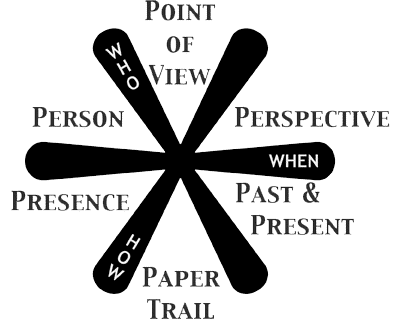
One of those parameters, I posit, is Perspective. (I gave all six parameters labels that begin with P, just because.) In my thinking, Perspective refers to the amount of time that’s passed between the events in a story and the storytelling itself. Does the narrator indicate that he or she knows how the story ends? Is the narrator looking back on the events from years later? Does the narrator’s Perspective shift with events, as in an epistolary novel?

In my talk I used the openings of three novels to show different common Perspectives--

Immediate
“Too many!” James shouted, and slammed the door behind him.

“What?” said Will.

“Too many kids in this family, that’s what. Just too many.” James stood fuming on the landing like a small angry locomotive, then stumped across to the window-seat and stared out at the garden.
--Susan Cooper, The Dark Is Rising (1973)
That appears to be the default Perspective today: get us right into the action, with no hint that the narrator has any knowledge of what’s to come. (Curiously, this opening suggests that James is the character with a problem; Cooper does a deft shift in the next paragraph to put us in Will’s head instead. But that’s a matter of what I call Point of View.)

Recent
I don’t know just why I’m telling you all this. Maybe you’ll think I’m being silly. But I’m not, really, because this is important. You see, it was different! It wasn’t just because it was Jack and I either--it was something more than that.
--Maureen Daly, Seventeenth Summer (1942)
This narrator does know what will happen in her story. But she’s still close enough to those events to believe that they’re really important, and deep. This story about adolescence thus comes from an adolescent Perspective. Other novels about that time in life are written from a more distant, adult Perspective. I think that’s one of the significant differences between true YA fiction and coming-of-age novels for adult readers.

Retrospective
My brother Tom and eldest brother Sweyn arrived home for summer vacation on Sunday, June 5, 1898. I remember the date very well because, just two weeks later, the entire town of Park City was destroyed by the worst fire in the history of Utah.
--John D. Fitzgerald, The Great Brain Reforms (1973)
This narrator not only knows what’s upcoming two weeks after the opening moment, but is also distant enough from those events to say, “I remember the date” and “the history of Utah.” This Perspective adds to the sense that the novel might be the true recollection of an aged Utahan. And it hints at entertaining chaos to come.

Telling a story in diary form forces an author to adopt a certain Perspective: each diary entry describes what the character writing believes and feels at that moment, not while the events take place, nor the next day with more knowledge. Often this can interfere with a sense of immediacy and produce less suspense for readers. In Beka Cooper: Terrier, Tamora Pierce wrestles with this problem on page 364 by having her heroine write:
I must write about today, because so much has happened. I think the only way I can write it is to write of my watch, and do so as I lived it, without knowing how it will end.
As I wrote earlier, eschewing the diary format for an immediate Perspective would have let Pierce launch straight into the episode without this apology for doing so.

Lee added in an email:
Have you done any reading in neuroscience or cosmology regarding time? Terribly complex for someone like myself, but fascinating nevertheless. I'm currently working my way through Benjamin Libet's Mind Time: The Temporal Factor in Consciousness.
No, I haven’t explored that far, and I’m not sure my concept of Perspective is up to that level of sophistication. It’s simply a parameter writers might choose when considering various ways to tell a story. The same events can look quite different from the distance of a few minutes, a day, a year, or many years. One story might work best with one Perspective while another story wouldn’t work that way at all. And breaking out of the Perspectives we’re used to (as in, say, the movies Groundhog Day and Memento) can be very powerful.

27 October 2006

Questions about the Dark Is Rising Movie

The good news is that Walden Media and 20th Century Fox have made a deal to adapt Susan Cooper’s The Dark Is Rising into a movie, scheduled for release in a year.

The disquieting news is that the director is David L. Cunningham, director of the recent TV miniseries The Path to 9/11, widely criticized for being historically inaccurate, politically slanted, and rather unexciting.

This PDF download quotes Cunningham saying in 1991, at the age of twenty, that he felt a “call to be a missionary to Hollywood. It was a plan to create an independent film company whereby he could both influence the Hollywood film industry and produce major motion pictures which would carry a Biblical, values-based message.” In 2004, Cunningham and fellow alumni of the University of the Nations (an unaccredited institution founded by his father) started a non-profit organization called The Film Institute. It describes itself as

dedicated to a Godly transformation and revolution TO and THROUGH the Film and Television industry. TO it, by serving, living humbly with integrity in what is often a world driven by selfish ambition, power and money – transforming lives from within, and THROUGH it, by creating relevant and evocative content which promotes Godly principles of Truth married with Love.
All well and good, but Cunningham’s highest-profile project showed little concern for “Truth,” at least the historically accurate kind. There were so many distortions in The Path to 9/11 that ABC recut the footage after sending out review copies, added disclaimers, and has now wiped mentions of the movie from abc.com and the pathto911.abc.com subdomain.

Most of the miniseries’s distortions seem to stem from Cyrus Nowrasteh’s screenplay, but at least one was the director’s choice. In one scene the actor playing National Security Advisor Sandy Berger hung up his phone in the middle of a (fictional) CIA operation. The actor improvised that business. Rather than stick to documented “Truth,” Cunningham included that scene in his final cut, which was sent to TV critics and right-wing commentators. After nationwide protests and threats of legal action, ABC edited out the scene.

The first drama from Cunningham’s production company, Pray for Rain Pictures, was the WW2 prison camp drama To End All Wars. Its source in the memoir of a Christian clergyman was no doubt part of its appeal to Cunningham. DVDreport.com reviewer Joel Pearce wrote:
Unfortunately, the lack of subtlety with which these [allegorical] scenes are handled threatens to destroy everything good about To End All Wars. The first few times there are scenes of personal sacrifice, we understand where they are heading. By the fifth time, we are starting to get tired of being hit with it over and over. By the seventh or eighth time, I found myself stunned by the overtness of it all. It also strains believability, which is so important for historical films.
Why does this matter when it comes to The Dark Is Rising? A fantasy novel has no historical record to adhere to, after all. But it’s still quite possible for a director to distort source material by imposing his own world-view on it. I wonder how Cunningham will handle this scene from the book, immediately after the Old Ones have driven off an attack of the Dark:
The rector stood up, his smooth, plump face creased in an effort to make sense of the incomprehensible. “Certainly it has gone,” he said, looking slowly round the church. “Whatever--influence it was. The Lord be praised.” He too looked at the Signs on Will’s belt, and he glanced up again, smiling suddenly, an almost childish smile of relief and delight. “That did the work, didn’t it? The cross. Not of the church, but a Christian cross nonetheless.”

“Very old, them crosses are, rector,” said Old George unexpectedly, firm and clear. “Made a long time before Christianity. Long before Christ.”

The rector beamed at him. “But not before God,” he said simply.

The Old Ones looked at him. There was no answer that would not have offended him, so no one tried to give one. Except, after a moment, Will.

“There’s not really any before and after, is there?” he said. “Everything that matters is outside Time. And comes from there and can go there.”

Mr Beaumont turned to him in surprise. “You mean infinity, of course, my boy.”

“Not altogether,” said the Old One that was Will. “I mean the part of all of us, and of all the things we think and believe, that has nothing to do with yesterday or tomorrow because it belongs at a different kind of level. Yesterday is still there, on that level. Tomorrow is there too. You can visit either of them. And all Gods are there, and all the things they have ever stood for. And,” he added sadly, “the opposite, too.”

“Will,” said the rector, staring at him, “I am not sure whether you should be exorcized or ordained. You and I must have some long talks, very soon.”
Cooper depicts the rector, a well-meaning voice of Christianity, as completely out of his depth in her novel’s war between Light and Dark. He strains “to make sense of the incomprehensible,” and shows “an almost childish smile of relief and delight” when he spots something that lets him explain events through his pre-existing beliefs. Some Christians have been troubled by this aspect of Cooper's novel, and its general use of motifs from pre-Christian Britain.

How will Cunningham, with his professed mission to spread "a Biblical, values-based message" and his track record for straining both accuracy and believability in dramatic films, handle this novel’s challenges to his own beliefs?

[ADDENDA: Further news on this movie: